A Monthly Double-Blind Peer Reviewed (Refereed/Juried) Open Access International e-Journal - Included in the International Serial Directories Indexed & Listed at:
Ulrich's Periodicals Directory ©, ProQuest, U.S.A., EBSCO Publishing, U.S.A., Cabell’s Directories of Publishing Opportunities, U.S.A., Open J-Gage, India [link of the same is duly available at Inflibnet of University Grants Commission (U.G.C.)],
VOLUME NO.3(2013),ISSUE NO.07(JULY) ISSN2231-5756
INTERNATIONAL JOURNAL OF RESEARCH IN COMMERCE, IT & MANAGEMENT
CONTENTS
CONTENTS
CONTENTS
CONTENTS
Sr.No.
TITLE & NAME OF THE AUTHOR (S)
Page No.
1. STANDARDIZING GOVERNMENT HOSPITAL LIBRARIES: WHERE ARE WE NOW?
DR. MA. LINDIE D. MASALINTO, DR. ESTRELLA ALMEDA SAN JUAN & DR. LAZARO E. AVELINO
1 2. CHALLENGES IN APPLICATION OF SIX SIGMA TECHNIQUES IN HR DOMAIN
NAGARAJ SHENOY & DR. KALYANI RANGARAJAN
6 3. COMPETITIVENESS IN NIGERIAN TELECOMMUNICATION INDUSTRY: MARKETING STRATEGY
FALANO, TOLULOPE & POPOOLA F. CORNELIUS
9 4. MANPOWER PLANNING IN HIGHER EDUCATION: A CASE STUDY IN DAKSHINA KANNADA DISTRICT IN KARNATAKA
DR. WAJEEDA BANO
15 5. IP TRACEBACK OF DOS ATTACKS
S.THILAGAVATHI. & DR. A. SARADHA
21 6. BEHAVIOURAL CONSEQUENCES OF FACEBOOK USAGE AMONGST GENERATION Y OF MUMBAI CITY
DR. ANKUSH SHARMA & KRATIKA SHRIVASTAVA
24 7. COMPARATIVE STUDY OF CRM (PUBLIC SECTOR BANKS Vs. PRIVATE SECTOR BANKS) IN DELHI REGION
R. C. BHATNAGAR, RAJESH VERMA & ADITI GOEL
33 8. FIRM, FINANCIAL SYSTEMS AND FINANCIAL DEREGULATIONS: A SURVEY OF LITERATURE
NEMIRAJA JADIYAPPA & DR. V. NAGI REDDY
39 9. PREFERENCES AND SIGNIFICANCE OF DEMOGRAPHICS ON THE FACTORS INFLUENCING INVESTMENT DECISIONS: A STUDY OF INVESTORS
IN THANE CITY, MAHARASHTRA, INDIA DINESH GABHANE & DR. S. B. KISHOR
44
10. DETERMINANTS OF LEVERAGE: AN EMPIRICAL STUDY ON INDIAN TEXTILE SECTOR D. VIJAYALAKSHMI & DR. PADMAJA MANOHARAN
49 11. CUSTOMER SATISFACTION & AWARENESS REGARDING INSURANCE POLICIES
DR. MEGHA SHARMA
53 12. RISK-ADJUSTED PERFORMANCE EVALUATION OF INFRASTRUCTURE FUNDS IN INDIA
G. ARUNA
59 13. EMPOWERMENT OF RURAL WOMEN THROUGH ENTREPRENEURSHIP IN SMALL BUSINESS: A EMPIRICAL STUDY IN KHAMMAM DISTRICT
OF A.P
DR. S. RADHAKRISHNA & DR. T. GOPI
63
14. THE ETERNAL FIGHT: SMALL TRADITIONAL STORES Vs. SUPERMARKETS DR. FAYAZ AHMAD NIKA & ARIF HASAN
68 15. A STUDY ON CUSTOMER SATISFACTION TOWARDS MARKETING STRATEGY OF BANKING LOANS ADOPTED BY SCHEDULED COMMERCIAL
BANKS WITH SPECIAL REFERENCE TO COIMBATORE DISTRICT G. SANGEETHA & DR. R. UMARANI
72
16. KNOWLEDGE CAPTURE SYSTEMS IN SOFTWARE MAINTENANCE PROJECTS SARFARAZ NAWAZ
79 17. SELF-MANAGING COMPUTING
K. M. PARTHIBAN, M. UDHAYAMOORTHI, A. SANTHOSH KUMAR & KONSAM CHANU BARSANI
82 18. A STUDY ON PERFORMANCE OF DISTRICT CONSUMER DISPUTES REDRESSAL FORUMS IN INDIA
GURLEEN KAUR
87 19. TEA INDUSTRY IN INDIA: STATE WISE ANALYSIS
DR. R. SIVANESAN
89 20. THE ROLE OF INFORMATION AND COMMUNICATION TECHNOLOGY (ICT) IN ENHANCING THE QUALITY EDUCATION OF ETHIOPIAN
UNIVERSITIES: A REVIEW OF LITERATURE DR. BIRHANU MOGES
94
21. PROBLEMS & PROSPECTS OF WOMEN ENTREPRENEURS IN INDIA JAINENDRA KUMAR VERMA
102 22. CAPITAL STRUCTURE AND PROFITABILITY: A STUDY ON SELECTED CEMENT COMPANIES
DR. BRAJABALLAV PAL & SILPI GUHA
105 23. MUTUAL FUND INDUSTRY IN INDIA: RECENT TRENDS AND PROGRESS
BHARGAV PANDYA
114 24. CHALLENGE OF ATTRITION: A CASE STUDY OF BPO INDUSTRY IN CHANDIGARH REGION
MANJIT KOUR
120 25. GOOD GOVERNANCE IN INDIA: NEED FOR INNOVATIVE APPROACHES
PARDEEP KUMAR CHAUHAN
122 26. RESPONSE OF PEASANT FARMERS TO SUPPLY INCENTIVES: AN INTER-REGIONAL ANALYSIS OF COTTON CROP IN SINDH, PAKISTAN
DR. MOHAMMAD PERVEZ WASIM
126 27. EFFECTS OF INTEREST RATE DEREGULATION ON DEPOSIT MOBILIZATION IN THE NIGERIAN BANKING INDUSTRY
SAMUEL, KEHINDE OLUWATOYIN & OKE, MARGARET ADEBIPE
137 28. AN E-3 VALUE MODEL FOR ASSESSING e-COMMERCE PARTNERSHIP PROFITABILITY TO SMEs IN GHANA
AMANKWA, ERIC & KEVOR MARK-OLIVER
147 29. A STUDY ON PERFORMANCE OF CONSUMER DISPUTES REDRESSAL AGENCIES IN STATE OF HIMACHAL PRADESH
GURLEEN KAUR
154 30. A STUDY OF SELECTED ENTREPRENEURIAL DIMENSIONS IN INDIA: AN EXPLORATORY STUDY
JAINENDRA KUMAR VERMA
156
INTERNATIONAL JOURNAL OF RESEARCH IN COMMERCE, IT & MANAGEMENT
CHIEF PATRON
CHIEF PATRON
CHIEF PATRON
CHIEF PATRON
PROF. K. K. AGGARWAL
Chairman, Malaviya National Institute of Technology, Jaipur
(An institute of National Importance & fully funded by Ministry of Human Resource Development, Government of India)
Chancellor, K. R. Mangalam University, Gurgaon
Chancellor, Lingaya’s University, Faridabad
Founder Vice-Chancellor (1998-2008), Guru Gobind Singh Indraprastha University, Delhi
Ex. Pro Vice-Chancellor, Guru Jambheshwar University, Hisar
FOUNDER
FOUNDER
FOUNDER
FOUNDER PATRON
PATRON
PATRON
PATRON
LATE SH. RAM BHAJAN AGGARWAL
Former State Minister for Home & Tourism, Government of Haryana
Former Vice-President, Dadri Education Society, Charkhi Dadri
Former President, Chinar Syntex Ltd. (Textile Mills), Bhiwani
CO
CO
CO
CO----ORDINATOR
ORDINATOR
ORDINATOR
ORDINATOR
AMITA
Faculty, Government M. S., Mohali
ADVISORS
ADVISORS
ADVISORS
ADVISORS
DR. PRIYA RANJAN TRIVEDI
Chancellor, The Global Open University, Nagaland
PROF. M. S. SENAM RAJU
Director A. C. D., School of Management Studies, I.G.N.O.U., New Delhi
PROF. M. N. SHARMA
Chairman, M.B.A., Haryana College of Technology & Management, Kaithal
PROF. S. L. MAHANDRU
Principal (Retd.), Maharaja Agrasen College, Jagadhri
EDITOR
EDITOR
EDITOR
EDITOR
PROF. R. K. SHARMA
Professor, Bharti Vidyapeeth University Institute of Management & Research, New Delhi
CO
CO
CO
CO----EDITOR
EDITOR
EDITOR
EDITOR
DR. BHAVET
Faculty, Shree Ram Institute of Business & Management, Urjani
EDITORIAL ADVISORY BOARD
EDITORIAL ADVISORY BOARD
EDITORIAL ADVISORY BOARD
EDITORIAL ADVISORY BOARD
DR. RAJESH MODI
Faculty, Yanbu Industrial College, Kingdom of Saudi Arabia
PROF. SANJIV MITTAL
University School of Management Studies, Guru Gobind Singh I. P. University, Delhi
PROF. ANIL K. SAINI
VOLUME NO.3(2013),ISSUE NO.07(JULY) ISSN2231-5756
INTERNATIONAL JOURNAL OF RESEARCH IN COMMERCE, IT & MANAGEMENT
DR. SAMBHAVNA
Faculty, I.I.T.M., Delhi
DR. MOHENDER KUMAR GUPTA
Associate Professor, P. J. L. N. Government College, Faridabad
DR. SHIVAKUMAR DEENE
Asst. Professor, Dept. of Commerce, School of Business Studies, Central University of Karnataka, Gulbarga
ASSOCIATE EDITORS
ASSOCIATE EDITORS
ASSOCIATE EDITORS
ASSOCIATE EDITORS
PROF. NAWAB ALI KHAN
Department of Commerce, Aligarh Muslim University, Aligarh, U.P.
PROF. ABHAY BANSAL
Head, Department of Information Technology, Amity School of Engineering & Technology, Amity
University, Noida
PROF. A. SURYANARAYANA
Department of Business Management, Osmania University, Hyderabad
DR. SAMBHAV GARG
Faculty, Shree Ram Institute of Business & Management, Urjani
PROF. V. SELVAM
SSL, VIT University, Vellore
DR. PARDEEP AHLAWAT
Associate Professor, Institute of Management Studies & Research, Maharshi Dayanand University, Rohtak
DR. S. TABASSUM SULTANA
Associate Professor, Department of Business Management, Matrusri Institute of P.G. Studies, Hyderabad
SURJEET SINGH
Asst. Professor, Department of Computer Science, G. M. N. (P.G.) College, Ambala Cantt.
TECHNICAL ADVISOR
TECHNICAL ADVISOR
TECHNICAL ADVISOR
TECHNICAL ADVISOR
AMITA
Faculty, Government M. S., Mohali
FINANCIAL ADVISORS
FINANCIAL ADVISORS
FINANCIAL ADVISORS
FINANCIAL ADVISORS
DICKIN GOYAL
Advocate & Tax Adviser, Panchkula
NEENA
Investment Consultant, Chambaghat, Solan, Himachal Pradesh
LEGAL ADVISORS
LEGAL ADVISORS
LEGAL ADVISORS
LEGAL ADVISORS
JITENDER S. CHAHAL
Advocate, Punjab & Haryana High Court, Chandigarh U.T.
CHANDER BHUSHAN SHARMA
Advocate & Consultant, District Courts, Yamunanagar at Jagadhri
SUPERINTENDENT
SUPERINTENDENT
SUPERINTENDENT
SUPERINTENDENT
INTERNATIONAL JOURNAL OF RESEARCH IN COMMERCE, IT & MANAGEMENT
CALL
CALL
CALL
CALL FOR MANUSCRIPTS
FOR MANUSCRIPTS
FOR MANUSCRIPTS
FOR MANUSCRIPTS
We invite unpublished novel, original, empirical and high quality research work pertaining to recent developments & practices in the areas of Computer Science & Applications; Commerce; Business; Finance; Marketing; Human Resource Management; General Management; Banking; Economics; Tourism Administration & Management; Education; Law; Library & Information Science; Defence & Strategic Studies; Electronic Science; Corporate Governance; Industrial Relations; and emerging paradigms in allied subjects like Accounting; Accounting Information Systems; Accounting Theory & Practice; Auditing; Behavioral Accounting; Behavioral Economics; Corporate Finance; Cost Accounting; Econometrics; Economic Development; Economic History; Financial Institutions & Markets; Financial Services; Fiscal Policy; Government & Non Profit Accounting; Industrial Organization; International Economics & Trade; International Finance; Macro Economics; Micro Economics; Rural Economics; Co-operation; Demography: Development Planning; Development Studies; Applied Economics; Development Economics; Business Economics; Monetary Policy; Public Policy Economics; Real Estate; Regional Economics; Political Science; Continuing Education; Labour Welfare; Philosophy; Psychology; Sociology; Tax Accounting; Advertising & Promotion Management; Management Information Systems (MIS); Business Law; Public Responsibility & Ethics; Communication; Direct Marketing; E-Commerce; Global Business; Health Care Administration; Labour Relations & Human Resource Management; Marketing Research; Marketing Theory & Applications; Non-Profit Organizations; Office Administration/Management; Operations Research/Statistics; Organizational Behavior & Theory; Organizational Development; Production/Operations; International Relations; Human Rights & Duties; Public Administration; Population Studies; Purchasing/Materials Management; Retailing; Sales/Selling; Services; Small Business Entrepreneurship; Strategic Management Policy; Technology/Innovation; Tourism & Hospitality; Transportation Distribution; Algorithms; Artificial Intelligence; Compilers & Translation; Computer Aided Design (CAD); Computer Aided Manufacturing; Computer Graphics; Computer Organization & Architecture; Database Structures & Systems; Discrete Structures; Internet; Management Information Systems; Modeling & Simulation; Neural Systems/Neural Networks; Numerical Analysis/Scientific Computing; Object Oriented Programming; Operating Systems; Programming Languages; Robotics; Symbolic & Formal Logic; Web Design and emerging paradigms in allied subjects.
Anybody can submit the soft copy of unpublished novel; original; empirical and high quality research work/manuscriptanytime in M.S. Word format
after preparing the same as per our GUIDELINES FOR SUBMISSION; at our email address i.e. [email protected] or online by clicking the link online submission as given on our website (FOR ONLINE SUBMISSION, CLICK HERE).
GUIDELINES FOR SUBMISSION OF MANUSCRIPT
GUIDELINES FOR SUBMISSION OF MANUSCRIPT
GUIDELINES FOR SUBMISSION OF MANUSCRIPT
GUIDELINES FOR SUBMISSION OF MANUSCRIPT
1. COVERING LETTER FOR SUBMISSION:
DATED: _____________
THE EDITOR
IJRCM
Subject: SUBMISSION OF MANUSCRIPT IN THE AREA OF.
(e.g. Finance/Marketing/HRM/General Management/Economics/Psychology/Law/Computer/IT/Engineering/Mathematics/other, please specify)
DEAR SIR/MADAM
Please find my submission of manuscript entitled ‘___________________________________________’ for possible publication in your journals.
I hereby affirm that the contents of this manuscript are original. Furthermore, it has neither been published elsewhere in any language fully or partly, nor is it under review for publication elsewhere.
I affirm that all the author (s) have seen and agreed to the submitted version of the manuscript and their inclusion of name (s) as co-author (s).
Also, if my/our manuscript is accepted, I/We agree to comply with the formalities as given on the website of the journal & you are free to publish our contribution in any of your journals.
NAME OF CORRESPONDING AUTHOR: Designation:
Affiliation with full address, contact numbers & Pin Code: Residential address with Pin Code:
Mobile Number (s): Landline Number (s): E-mail Address: Alternate E-mail Address:
NOTES:
a) The whole manuscript is required to be in ONE MS WORD FILE only (pdf. version is liable to be rejected without any consideration), which will start from the covering letter, inside the manuscript.
b) The sender is required to mentionthe following in the SUBJECT COLUMN of the mail:
New Manuscript for Review in the area of (Finance/Marketing/HRM/General Management/Economics/Psychology/Law/Computer/IT/ Engineering/Mathematics/other, please specify)
c) There is no need to give any text in the body of mail, except the cases where the author wishes to give any specific message w.r.t. to the manuscript. d) The total size of the file containing the manuscript is required to be below 500 KB.
e) Abstract alone will not be considered for review, and the author is required to submit the complete manuscript in the first instance.
f) The journal gives acknowledgement w.r.t. the receipt of every email and in case of non-receipt of acknowledgment from the journal, w.r.t. the submission of manuscript, within two days of submission, the corresponding author is required to demand for the same by sending separate mail to the journal.
2. MANUSCRIPT TITLE: The title of the paper should be in a 12 point Calibri Font. It should be bold typed, centered and fully capitalised.
3. AUTHOR NAME (S) & AFFILIATIONS: The author (s) full name, designation, affiliation (s), address, mobile/landline numbers, and email/alternate email address should be in italic & 11-point Calibri Font. It must be centered underneath the title.
VOLUME NO.3(2013),ISSUE NO.07(JULY) ISSN2231-5756
INTERNATIONAL JOURNAL OF RESEARCH IN COMMERCE, IT & MANAGEMENT
5. KEYWORDS: Abstract must be followed by a list of keywords, subject to the maximum of five. These should be arranged in alphabetic order separated bycommas and full stops at the end.
6. MANUSCRIPT: Manuscript must be in BRITISH ENGLISH prepared on a standard A4 size PORTRAIT SETTING PAPER. It must be prepared on a single space and single column with 1” margin set for top, bottom, left and right. It should be typed in 8 point Calibri Font with page numbers at the bottom and centre of every page. It should be free from grammatical, spelling and punctuation errors and must be thoroughly edited.
7. HEADINGS: All the headings should be in a 10 point Calibri Font. These must be bold-faced, aligned left and fully capitalised. Leave a blank line before each heading.
8. SUB-HEADINGS: All the sub-headings should be in a 8 point Calibri Font. These must be bold-faced, aligned left and fully capitalised.
9. MAIN TEXT: The main text should follow the following sequence:
INTRODUCTION
REVIEW OF LITERATURE
NEED/IMPORTANCE OF THE STUDY
STATEMENT OF THE PROBLEM
OBJECTIVES
HYPOTHESES
RESEARCH METHODOLOGY
RESULTS & DISCUSSION
FINDINGS
RECOMMENDATIONS/SUGGESTIONS
CONCLUSIONS
SCOPE FOR FURTHER RESEARCH
ACKNOWLEDGMENTS
REFERENCES
APPENDIX/ANNEXURE
It should be in a 8 point Calibri Font, single spaced and justified. The manuscript should preferably not exceed 5000 WORDS.
10. FIGURES &TABLES: These should be simple, crystal clear, centered, separately numbered & self explained, and titles must be above the table/figure. Sources of data should be mentioned below the table/figure. It should be ensured that the tables/figures are referred to from the main text.
11. EQUATIONS:These should be consecutively numbered in parentheses, horizontally centered with equation number placed at the right.
12. REFERENCES: The list of all references should be alphabetically arranged. The author (s) should mention only the actually utilised references in the preparation of manuscript and they are supposed to follow Harvard Style of Referencing. The author (s) are supposed to follow the references as per the following:
•
All works cited in the text (including sources for tables and figures) should be listed alphabetically.•
Use (ed.) for one editor, and (ed.s) for multiple editors.•
When listing two or more works by one author, use --- (20xx), such as after Kohl (1997), use --- (2001), etc, in chronologically ascending order.•
Indicate (opening and closing) page numbers for articles in journals and for chapters in books.•
The title of books and journals should be in italics. Double quotation marks are used for titles of journal articles, book chapters, dissertations, reports, working papers, unpublished material, etc.•
For titles in a language other than English, provide an English translation in parentheses.•
The location of endnotes within the text should be indicated by superscript numbers.PLEASE USE THE FOLLOWING FOR STYLE AND PUNCTUATION IN REFERENCES: BOOKS
•
Bowersox, Donald J., Closs, David J., (1996), "Logistical Management." Tata McGraw, Hill, New Delhi.•
Hunker, H.L. and A.J. Wright (1963), "Factors of Industrial Location in Ohio" Ohio State University, Nigeria.CONTRIBUTIONS TO BOOKS
•
Sharma T., Kwatra, G. (2008) Effectiveness of Social Advertising: A Study of Selected Campaigns, Corporate Social Responsibility, Edited by David Crowther & Nicholas Capaldi, Ashgate Research Companion to Corporate Social Responsibility, Chapter 15, pp 287-303.JOURNAL AND OTHER ARTICLES
•
Schemenner, R.W., Huber, J.C. and Cook, R.L. (1987), "Geographic Differences and the Location of New Manufacturing Facilities," Journal of Urban Economics, Vol. 21, No. 1, pp. 83-104.CONFERENCE PAPERS
•
Garg, Sambhav (2011): "Business Ethics" Paper presented at the Annual International Conference for the All India Management Association, New Delhi, India, 19–22 June.UNPUBLISHED DISSERTATIONS AND THESES
•
Kumar S. (2011): "Customer Value: A Comparative Study of Rural and Urban Customers," Thesis, Kurukshetra University, Kurukshetra.ONLINE RESOURCES
•
Always indicate the date that the source was accessed, as online resources are frequently updated or removed.WEBSITES
INTERNATIONAL JOURNAL OF RESEARCH IN COMMERCE, IT & MANAGEMENT
DETERMINANTS OF LEVERAGE: AN EMPIRICAL STUDY ON INDIAN TEXTILE SECTOR
D. VIJAYALAKSHMI
ASST. PROFESSOR
DEPARTMENT OF B. COM. (AM)
PSGR KRISHNAMMAL COLLEGE FOR WOMEN
COIMBATORE
DR. PADMAJA MANOHARAN
HEAD (RETD.)
DEPARTMENT OF COMMERCE
PSGR KRISHNAMMAL COLLEGE FOR WOMEN
PEELAMEDU
ABSTRACT
Every firm needs funds to run and manage the business. The success of any firm depends on the effective utilization of funds procured. The principal sources of finance of a firm are owners’ equity and the borrowed money. The decision on the composition of funds, otherwise, known as ‘capital structure’ is an essential decision, which influences the risk and return of the investors. Leverage plays an essential role in framing the capital structure. Textile is a capital intensive sector, where greater prominence has been given in constructing the capital structure. In this backdrop, the study makes an attempt to identify and analyse the determinants of leverage of Indian Textile sector. A panel data approach has been applied to analyse the data. The study reveals that the variables, namely, profitability and size are the key determinants of leverage of Indian Textile sector.
KEYWORDS
Capital structure, leverage, profitability, size.
INTRODUCTION
he performance and survival of a firm depend on the choice of the source of funds and its effective utilization. The decision on the composition of funds, otherwise, known as ‘capital structure’ is an essential decision, which influences the risk and return of the investors. The decision taken by the firms with respect to capital structure has a great impact on their success. Leverage is an indicator of relationship between owners’ funds and borrowed fund. A proper mix of debt and equity would determine the path to increase the shareholder value. Firms have to analyse the factors determining the leverage before framing its capital structure. In this background, the study makes an attempt to identify and analyse the determinants of leverage of Indian textile sector for the period 1995-96 to 2009-10.
TEXTILE
Textile sector is one of the major sectors of the economy. It occupies a unique place in our country. It is closely linked with agricultural and rural economy. The industry consists of cotton textiles, synthetic textiles, textile processing, readymade garment and other textiles such as wool & wollen textiles, jute goods, handloom goods etc.; it has contributed 14 per cent to industrial production. 4 per cent to National GDP and10.63 per cent of country’s export earnings. It has provided direct employment to over 35 million people. The sector has earned foreign exchange of US$ 10.32 billion in the year 2011. India has the potential to increase its textile and apparel share in the world trade from 4.5 per cent to 8 per cent. The sector has grown at 3-4 per cent during the last six decades.
REVIEW OF LITERATURE
Mehdi Janbaz (2010) has conducted a study on “Capital Structure decisions in the Iranian corporate sector”. He has examined the determinants of capital structure and their influence on capital structure. A sample of 70 companies for the year 2006-2007 has been taken from Tehran Stock Exchange. He has employed statistical techniques such as descriptive statistics, Pearson correlation and multiple regression analysis to analyse the data. He has taken leverage as a dependent variable and the independent variables, such as, profitability, asset tangibility, growth, firm size, tax provision, liquidity and agency conflict. The correlation result has shown that the tangibility, growth, firm size, tax and agency conflict have a positive correlation with leverage. The variables, viz., profitability and liquidity are negatively correlated with the leverage ratio. The regression result has revealed that all factors have a positive impact on leverage except the variables, namely, profitability and liquidity. The study has concluded that the Pecking order theory has more predictions on decision making in the Iranian corporate capital structure.
Sumikhare and Saima Rizyi (2011) have conducted a study on “Factors affecting the capital structure of BSE-100 Indian firms: A panel data analysis”. The objectives of the study are to examine the variables that impact debt-equity choice of a company and they have also identified which of the two theories, namely, trade off or pecking order is suitable for the Indian firms. The data have been collected for 69 firms from BSE 100 index. The study has covered a period of 10 years from 2000-2009. They have taken leverage as a dependent variable and the independent variables, such as, tangibility, size, depreciation to total assets, depreciation over operating profit, profit margin on sales, return on assets and growth opportunities. They have applied panel data model to analyse the data. A random effect model has been fitted to panel data analysis. The result has shown that the variables, namely, profitability, return on asset and profit margin on sales are found to be significant. The result has supported the pecking order theory.
FRAMEWORK OF THE STUDY
The dependent variables taken to represent the leverage are Long term debt ratio, Short term debt ratio and Total debt to asset ratio.
Dependent Variables Formulae
Long term debt ratio (LTD) Long term debt / Total assets
Short term debt ratio (STD) Short term debt / Total assets Total debt to total asset ratio (TDTA) Total debt / Total assets
VOLUME NO.3(2013),ISSUE NO.07(JULY) ISSN2231-5756
INTERNATIONAL JOURNAL OF RESEARCH IN COMMERCE, IT & MANAGEMENT
DETERMINANTS OF LEVERAGE
Leverage depends on many factors, both internal and external. The following variables have been considered to study the determination of the leverage.
Independent Variables
Profitability PBIT net of P&E / Total assets
Size Natural logarthim of total assets
Tangibility Net fixed assets / Total assets
Non debt tax shield (NDTS) Depreciation + Amortization / Total assets
Growth Growth rate in total assets
Business Risk (BR) Standard deviation of PBIT net of P&E
Liquidty Current assets / Current liabilities and provision
Free cash flow to total assets (FCFTA) PAT net of P&E + depreciation /Total assets
Cost of borrowing (COB) Interest paid / Total Borrowing
Tax rate (TR) PAT net of P&E
1-
PBT net of P&E
THEORIES OF CAPITAL STRUCTURE
The capital structure is one of the most important debatable issues in the field of finance. The Modigliani and Miller (1958) have made the first attempt to explain the relationship between capital structure and the firm value. The capital structure has been revisited by many theories, such as, pecking order theory, static trade off theory, agency theory and signaling theory.
SIGNALING THEORY
The Signaling Theory has been originally developed by Leland and Pyle (1976) and Rose (1977). According to Leland and Pyle the value of a company is positively correlated with the managerial ownership and each change noticed on the level of the managerial ownership results in a modification in the financial policy followed by a new value of the company. He has argued that the higher is the managerial ownership in the capital of the company, the larger is the debt capacity. Such strong ownership is highly recognized by the bond holders and signals confidence in the future investments.
According to Rose (1977), the managers have been informed about the company’s profitability than external investors. They know the true distribution of the company returns, but investors do not. He has argued that higher financial leverage can be used by the managers to signal an optimistic future of the company since the debt is a contractual obligation to repay both principal and interest. He has stressed that the usage of more debt in the capital structure is a good signal of the managers’ optimism about their companies.
STATIC-TRADE OFF THEORY
According to Static trade off model, the tax benefit – bankruptcy cost trade off models have predicted that companies seek to maintain an optimal capital structure by balancing the benefits and the costs of debt (DeAngelo and Masulis, 1980). The benefits include the tax shield whereas the costs include expected financial distress costs. This theory has predicted that companies maintain an optimum capital structure where the marginal benefit of debt equals the marginal cost. The implication of the trade-off model is that companies have target leverage and they adjust their leverage towards the target over time.
OBJECTIVE OF THE STUDY
To identify and to analyse the determinants of leverage of Indian Textile sector
HYPOTHESIS
The following null hypothesis has been framed for the purpose of the study: Leverage is an independent function
RESEARCH METHODOLOGY
SAMPLE AND SAMPLING DESIGNA sample of 50 firms, which have been listed at both BSE and NSE stock exchange by applying purposive sampling technique have been taken for the study. The data has been collected from PROWESS 3.1 version maintained by Centre for Monitoring Indian Economy Pvt Ltd. The study has covered a period of 15 financial years from post-liberalisation era, namely, 1995 -1996 to 2009- 2010.
TOOLS FOR ANALYSIS
Panel data set has both cross section dimension and time series dimension. In particular, the same cross-sectional units (e.g. individuals, companies, firms, cities, states) are observed over time. It is different from the Pooled OLS ie., pooling independent cross sections across time. Two main models, viz., Fixed Effect Model (FE) and Random Effect model (RE) are available for panel data. All the three models (pooled OLS, FE and RE) have been applied in the study and further, two tests have been carried out to decide the appropriateness of these three models. Initially, the Lagrange multiplier (LM) test has been applied to find the existence of panel effect in the values. The classical model (Pooled OLS) and the RE model are compared and when there is no panel effect, the pooled OLS will be chosen for further analysis. Otherwise, the RE model will be chosen for the next step of application. As a second step, the RE model is compared with FE model using Hausman Specification test and the appropriate model is chosen for further analysis based on the significance of the chi-square value.
RESULTS AND DISCUSSIONS
LONG TERM DEBT RATIOThe following null hypothesis has been framed to find whether the selected variables have a significant influence on long term debt ratio:
INTERNATIONAL JOURNAL OF RESEARCH IN COMMERCE, IT & MANAGEMENT
TABLE 1 - LTD -POOLED OLS AND PANEL DATA REGRESSION-TEXTILE Pooled OLS Fixed Effect Random Effect
B T Sig. B t-value Sig. B z-value Sig. (Constant) -0.0375900 -1.100 NS -.1597836 -3.23 ** -.1108109 -2.46 *
Profitability 1.5800000 7.757 ** 1.191906 6.24 ** 1.225477 6.51 **
Size 0.0103200 1.926 NS .0570876 7.00 ** .0397294 5.58 **
Tangibility 0.4830000 15.608 ** .2868573 7.49 ** .3692103 10.36 **
NDTS 1.6010000 5.162 ** .3405722 1.09 NS .5351249 1.75 NS
Growth 0.0000989 4.625 ** .0000451 2.30 * .000053 2.71 **
Business Risk -0.0006117 -2.732 ** -.0002956 -1.71 NS -.0003218 -1.81 NS
Liquidity -0.0008997 -1.170 NS -.0000767 -0.10 NS -.0004035 -0.51 NS
FCFTA -1.9090000 -8.400 ** -1.388303 -6.61 ** -1.461604 -7.02 **
COB -0.0440600 -6.172 ** -.0269886 -4.46 ** -.0312894 -5.11 **
TR -0.0001287 -.053 NS .0000814 0.05 NS .0000391 0.02 NS
R2 .550 0.3572 0.3433 F-statistic 68.243 ** 28.54 **
Wald (χ2χ2χ2χ2) 362.33 **
Hausman (χ2χ2χ2χ2) 51.42 **
LM (χ2χ2χ2χ2) 581.73 **
Source: Computed * significant at 5 per cent level ** significant at 1 per cent level
It is observed from the table 1 that the sign of the regression coefficients have been the same in all the three models for all the independent variables, except the variable, tax rate. The R2 values have shown a high correlation in the pooled OLS model and a moderate correlation has existed in the FE model and the RE model. The F-value and Wald chi-square have shown a significant value at one per cent level indicating the existence of significant correlation between the selected independent variables and the long term debt ratio.
The LM test has revealed that the chi-square value (581.73) is significant at one per cent level implying that the RE model has been considered instead of the pooled OLS model.
The Hausman test has revealed that the value of chi-square (51.42) is significant at one per cent level indicating that the FE model has been more effective than the RE model. In all the three models applied, the FEmodel has been taken for further analysis.
The FEmodel has revealed that the variables, namely, profitability, size, tangibility and growth have a significant positive influence on LTD ratio and the variables, namely, free cash flow to total assets and cost of borrowing have a significant negative influence on LTD ratio. Hence, the null hypothesis has been rejected for these variables.
The rest of the variables, namely, NDTS, BR, liquidity and TR have not had a significant influence on LTD ratio. Hence, the null hypothesis has been accepted for these variables.
To conclude, Profitability, size, tangibility, growth, FCFTA and COB have influenced the leverage (LTD ratio) of the Textile sector during the study period.
SHORT TERM DEBT RATIO
The following null hypothesis has been framed to find whether the selected variables have a significant influence on short term debt ratio:
H0 : “The variables, namely, profitability, size, tangibility, NDTS, growth, BR, liquidity, FCFTA, COB and TR do not have a significant influence on short term
debt ratio”
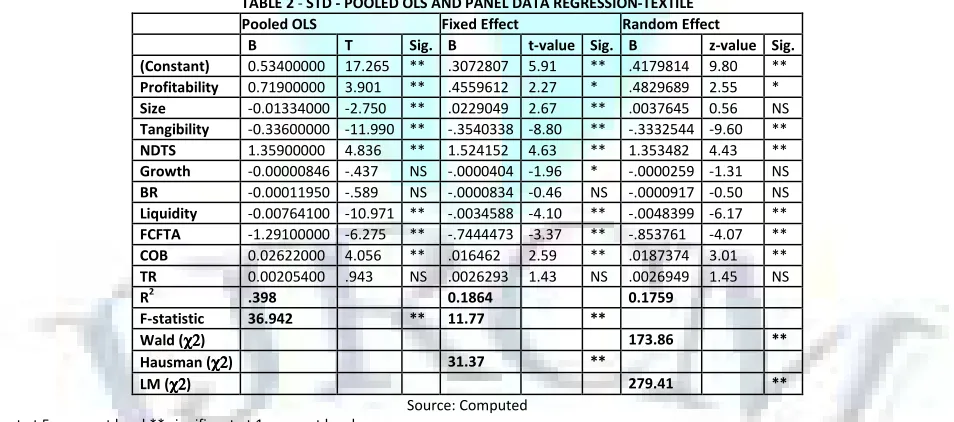
TABLE 2 - STD - POOLED OLS AND PANEL DATA REGRESSION-TEXTILE Pooled OLS Fixed Effect Random Effect
B T Sig. B t-value Sig. B z-value Sig. (Constant) 0.53400000 17.265 ** .3072807 5.91 ** .4179814 9.80 **
Profitability 0.71900000 3.901 ** .4559612 2.27 * .4829689 2.55 *
Size -0.01334000 -2.750 ** .0229049 2.67 ** .0037645 0.56 NS
Tangibility -0.33600000 -11.990 ** -.3540338 -8.80 ** -.3332544 -9.60 **
NDTS 1.35900000 4.836 ** 1.524152 4.63 ** 1.353482 4.43 **
Growth -0.00000846 -.437 NS -.0000404 -1.96 * -.0000259 -1.31 NS
BR -0.00011950 -.589 NS -.0000834 -0.46 NS -.0000917 -0.50 NS
Liquidity -0.00764100 -10.971 ** -.0034588 -4.10 ** -.0048399 -6.17 **
FCFTA -1.29100000 -6.275 ** -.7444473 -3.37 ** -.853761 -4.07 **
COB 0.02622000 4.056 ** .016462 2.59 ** .0187374 3.01 **
TR 0.00205400 .943 NS .0026293 1.43 NS .0026949 1.45 NS
R2 .398 0.1864 0.1759 F-statistic 36.942 ** 11.77 **
Wald (χ2χ2χ2χ2) 173.86 **
Hausman (χ2χ2χ2χ2) 31.37 **
LM (χ2χ2χ2χ2) 279.41 **
Source: Computed * significant at 5 per cent level ** significant at 1 per cent level
It is discernible from the table 2 that the regression co-efficient signs have been similar for all the independent variables, in all the three models, except for the variable - size in the pooled OLS model. The R2 values have revealed a low correlation between the selected independent variables and the STD ratio in the FE
model and the RE model. A moderate correlation has been found in the pooled OLS model. The F value and Wald-chi square have shown significant values in all the three models.
The LM test has exhibited that the chi-square value (279.41) is significant at one per cent level revealing the existence of panel effect; thereby, the RE model is found effective.
The result of Hausman specification test shows that the chi-square value (31.37) is significant at one per cent level revealing that the FE model is effective, in comparison to the RE model. In all the three models applied, the FEmodel has been taken for further analysis of the determinants of leverage.
VOLUME NO.3(2013),ISSUE NO.07(JULY) ISSN2231-5756
INTERNATIONAL JOURNAL OF RESEARCH IN COMMERCE, IT & MANAGEMENT
The rest of the variables, namely, BR and TR have not had a significant influence on STD ratio. Hence, the null hypothesis has been accepted in respect of these variables.In general, it is inferred that in the Textile sector, the factors, namely, profitability, size, NDTS, COB, tangibility, growth, liquidity and FCFTA have influenced the leverage (short term debt ratio) during the study period.
TOTAL DEBT TO TOTAL ASSET RATIO
The following null hypothesis has been framed to find whether the selected variables have a significant influence on total debt to total asset ratio:
H0 : “The independent variables, namely, profitability, size, tangibility, NDTS, growth, BR, liquidity, FCFTA, COB and TR do not have a significant influence on
TDTA ratio”
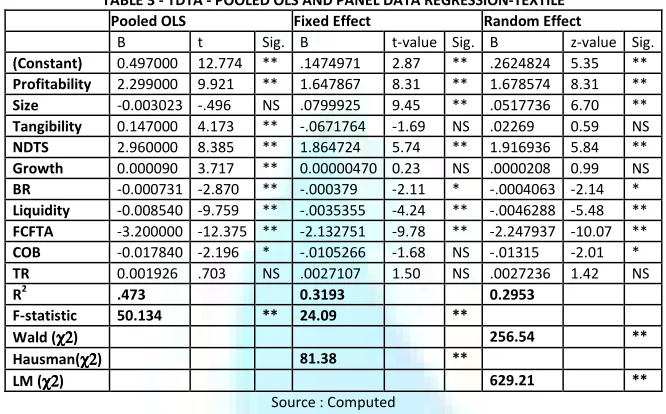
TABLE 3 - TDTA - POOLED OLS AND PANEL DATA REGRESSION-TEXTILE Pooled OLS Fixed Effect Random Effect
B t Sig. B t-value Sig. B z-value Sig.
(Constant) 0.497000 12.774 ** .1474971 2.87 ** .2624824 5.35 **
Profitability 2.299000 9.921 ** 1.647867 8.31 ** 1.678574 8.31 **
Size -0.003023 -.496 NS .0799925 9.45 ** .0517736 6.70 **
Tangibility 0.147000 4.173 ** -.0671764 -1.69 NS .02269 0.59 NS
NDTS 2.960000 8.385 ** 1.864724 5.74 ** 1.916936 5.84 **
Growth 0.000090 3.717 ** 0.00000470 0.23 NS .0000208 0.99 NS
BR -0.000731 -2.870 ** -.000379 -2.11 * -.0004063 -2.14 *
Liquidity -0.008540 -9.759 ** -.0035355 -4.24 ** -.0046288 -5.48 **
FCFTA -3.200000 -12.375 ** -2.132751 -9.78 ** -2.247937 -10.07 **
COB -0.017840 -2.196 * -.0105266 -1.68 NS -.01315 -2.01 *
TR 0.001926 .703 NS .0027107 1.50 NS .0027236 1.42 NS
R2 .473 0.3193 0.2953 F-statistic 50.134 ** 24.09 **
Wald (χ2χ2χ2χ2) 256.54 **
Hausman(χ2χ2χ2χ2) 81.38 **
LM (χ2χ2χ2χ2) 629.21 **
Source : Computed * significant at 5 per cent level ** significant at 1 per cent level.
It is observed from the table 3 that the signs of the regression coefficients have been the same for all the variables both in the FE and RE models, except for the variable, tangibility. The R2 values have revealed a moderate correlation between the selected independent variables and the TDTA ratio. The F value and chi-square values have shown a significant correlation between the selected independent variables and the TDTA ratio.
The result of LM test has revealed that the chi-square value (629.21) is significant at one per cent level implying that the RE model is considered better than the pooled OLS model.
Nevertheless, the result of Hausman specification test has revealed that the chi-square value (81.38) is significant at one per cent level implying that the FE model is more effective than the RE model. Among all the three models applied, the FEmodel serves as an appropriate model for further analysis.
The FEmodel has displayed that the variables, namely, profitability, size and NDTS have a significant positive influence on TDTA ratio.
The variables, namely, BR, liquidity and FCFTA have a significant negative influence on TDTA ratio. Hence, the null hypothesis has been rejected for these variables. The rest of the variables, namely, tangibility, growth, COB and TR have no significant influence on TDTA ratio. Hence, the null hypothesis has been accepted for these variables.
In general, it is inferred that in the textile sector, the factors, namely, profitability, size, NDTS, BR, liquidity and FCFTA have influenced the leverage during the study period.
CONCLUSION
To conclude, profitability and size are identified as the major determinants of leverage of Indian textile sector with a positive influence. They have supported the trade off theory and signaling theory, according to which, higher profitable firms have higher debt capacity and larger firms are expected to employ greater amount of debt in their capital structure.
REFERENCES
1. Debasish Sur, Kaushik Chakraborty and Parveen Begam (2009), “Financial leverage and owners return”, SNS Journal of Finance, Volume 1, Issue 1, pp 9-19.
2. Malabika Deo and Jackline.S (2009), “The determinants of debt ownership structure – some empirical evidence”,Indian Journal of Finance, Vol.3, No.1, pp 22-27.
3. Mehdi Janbaz, (2010) “Capital structure decisions in the Iranian corporate sector”, International Research Journal of Finance and Economics, Issue 58. 4. Santanu Kumar Ghosh and Paritosh Chandra Sinha (2009), “Is there optimality in firms’ capital stucutre? An empirical study”, Finance India, Vol 23, No.3,
pp 867-888.
5. Santi Gopal Maji and Santanu Kumar Gosh (2007), “Determinants of capital structure of Indian companies”, The ICFAI Journal of Applied Finance, Vol.13, No.5, pp 5-15.
6. Sumikhare and Saima Rizyi, (2011) “Factors affecting the capital structure of BSE-100 Indian firms: A panel data analysis”, Indian Journal of Finance, Vol.5, No.6, pp 20-24.
INTERNATIONAL JOURNAL OF RESEARCH IN COMMERCE, IT & MANAGEMENT
REQUEST FOR FEEDBACK
Dear Readers
At the very outset, International Journal of Research in Commerce, IT and Management (IJRCM)
acknowledges & appreciates your efforts in showing interest in our present issue under your kind perusal.
I would like to request you to supply your critical comments and suggestions about the material published
in this issue as well as on the journal as a whole, on our E-mail i.e.
for further
improvements in the interest of research.
If you have any queries please feel free to contact us on our E-mail
.
I am sure that your feedback and deliberations would make future issues better – a result of our joint
effort.
Looking forward an appropriate consideration.
With sincere regards
Thanking you profoundly
Academically yours
Sd/-
VOLUME NO.3(2013),ISSUE NO.07(JULY) ISSN2231-5756