ABSTRACT
Background and objectives: Synthesis and characterization of several metal complexes (metal ions: Co2+, Ti4+ and Ce3+) of macroacyclic Schiff base ligand have been
reported. The Schiff base ligand is prepared from the condensation reaction of 1, 4-di-(4-fluoro-2-aminophenoxy) butane with salicylaldehyde in ethanol. In addition, antibacterial activity of metal ions, Schiff base ligand and their complexes have been investigated. Recent studies show that many Schiff base complexes have antibacterial activity against Gram-positive and Gram-negative bacteria. Therefore, we aimed to synthesize new Schiff base complexes and evaluate their antibacterial activity against a number of Gram-positive and Gram-negative bacteria.
Methods: Schiff base ligand and their complexes were characterized by mass spectrometry, FTIR, 1H-NMR and 13C-NMR spectroscopy. The invitro antibacterial activity of
the Schiff base ligand, metal ions and their complexes were evaluated against some Gram-positive and Gram-negative bacteria by disk diffusion method and determining minimum inhibitory concentration.
Results: In this study, the Schiff base complexes had good antibacterial activity, but the Schiff base ligand and metal ions did not show any antibacterial effect. In some cases, the antibacterial effect of the complexes was higher than that of the standard antibiotics tetracycline and gentamycin. The titanium complex showed the highest antibacterial activity in both methods. This complex created the largest growth inhibition zone (diameter: 100mm) against Staphylococcus aureus, and had the lowest minimum inhibitory concentration against Bacillus subtilis (6.75 mg/mL).
Conclusion: The compounds synthesized in our study have strong antibacterial activity.
Keywords: Schiff base complex, Schiff base ligand, antibacterial activity, Staphylococcus aureus, Bacillus subtilis.
Taiebeh Tamoradi (MSc)
Department of Chemistry, Faculty of Science, Ilam University, Ilam, Iran E-mail: [email protected]
Hamid Goudarziafshar (PhD)
Department of Chemistry, Faculty of Science, Ilam University, Ilam, Iran
Somayeh Rashki (MSc)
Department of Microbiology, Faculty of Science, Ilam University, Ilam, Iran
Fatemeh Katouzian (MSc)
Department of Microbiology, Islamic Azad University, Pharmaceutical Sciences Branch, Tehran, Iran
Firoozeh Chalabian (PhD(
Department of biology, Faculty of Science, Islamic Azad University, North Tehran Branch, Tehran, Iran
Corresponding author: Taiebeh Tamoradi
Tel: 09168944955
E-mail: [email protected]
Address: Department of Chemistry, Faculty of Science, Ilam University, Ilam, Iran
Synthesis of New Schiff Base Ligand and Its Complexes in The Presence of Some Transition Metal Ion and Evaluation of Their Antibacterial Properties Medical Laboratory Journal,Mar-Apr , 2017; Vol 11: No 2
This paper should be cited as: Tamoradi T, Goudarziafshar H, Rashki S, Katouzian F, Chalabian F[Synthesis of New Schiff Base Ligand and Its Complexes in The Presence of Some Transition Metal Ion and Evaluation of Their Antibacterial Properties] . mljgoums. 2017; 11(2): 5-10
Received : 13 May 2015
Revised: 28 Jun 2015
Accepted: 06 Jul 2016
(VERTEX 70, Bruker Co.). 13CNMR and
1
HNMR spectra were assessed by NMR device (model AV400, Bruker Co.) with the field strength of 9.4 T. Mass spectra were assessed by HP Agilent 5973 mass spectrometer.
Preparation of the Schiff base ligand
For the preparation of the ligand, 2 mmol of salicylaldehyde (0.24 g) were dissolved in warm ethanol. Then, 1 mmol (0.390 g) of amine salt 1, 4-D-(4-fluoro-2-aminophenoxy) butane was dissolved in 20 mL of water. After adding 50 mL of ethanol to the mixture, the solution containing amine salt was added to the aldehyde solution dropwise. The pH of the solution was measured and NaOH was added to the reaction mixture to achieve pH of 7. The mixture was refluxed for 48 hours until a mixture of brown sediment and ethanol was achieved. The sediment (Schiff base ligand) was removed for use in future experiments (Figure 1). The best characteristic of the formation of the Schiff base ligand is the presence of an absorption band associated with imine bond that appears in the 1618 cm-1 region. In addition, the study of the mass spectrum of this compound shows a peak in the m/z 517 region, which confirms the preparation of the Schiff base ligand. The 1H NMR spectra of DMSO-d6 was obtained.
There are eight protons in the aliphatic region, which appear in two sets of multiple peaks. A set of these peaks appear in the chemical shift 1.92 ppm, which is related to Ha protons. The integral below these peaks confirms the relatively correct number of protons in this compound. The other set is evident in the chemical shift 4.09 ppm, which is related to Hb
hydrogens. The Hb protons appear in chemical
shifts more than Ha protons because of their
lower electron coverage. The integral of these peaks corresponds to the relatively correct number of hydrogens. There are 14 aromatic hydrocarbons in chemical shift 6.90-7.59 ppm. The area under these peaks corresponds to the relatively correct number of aromatic hydrocarbons. Imine hydrogens are observed in chemical shift 8.99 ppm. A peak related to the O-H phenolic group was noted in chemical shift 13.69 ppm.
Preparation of large Schiff base complexes using ligand and some transition metals by the template method
1 mL salicylaldehyde (0.224 g) was dissolved in 170 mL of ethanol.
INTRODUCTION
Schiff bases R2C=NR are imines that are
resulted from the condensation reaction of aldehydes or ketones with primary amines and their derivatives, which are considered as important ligands in the development of coordination chemistry. These compounds are characterized by the presence of azomethine (C=N) in their structure (1). Schiff bases ligands and their complexes are important in coordination chemistry because of their electron properties, application in industry and biochemistry, solubility in conventional solvents, availability, and wide structural range (2-6).
In recent years, researchers have been interested in studying Schiff bases and heteroatom donors such as nitrogen and oxygen due to the stability and biological activity of their complexes. Examination of these complexes shows that some drugs may become more active than free ligands when they are prepared in the form of metal complexes (7-10). Schiff base ligands are interesting because of their antibacterial, antiviral, antifungal and anti-tumor properties (11-16). In addition, some of these bases have anti-cancer properties specially when used in the form of metal complexes (17). Schiff base ligands can easily form stable complexes with most transition-metal ions. Recent studies have shown that some of the complexes of cobalt(III) Schiff base have anti-tumor properties, indicating the need for evaluation of the interactions of cobalt(III) with proteins and nucleic acids. Cobalt(III) Schiff base with two amines in the axial position has been used as an antibacterial and antiviral agent (18). In this study, a Schiff base ligand and its Co(II), Ce(III) and Ti(IV) complexes were prepared and their antibacterial activity was investigated against a number of positive and Gram-negative bacteria.
MATERIAL AND METHODS
In this study, a Schiff base ligand and its Co(II), Ce(III) and Ti(IV) complexes were prepared. The antibacterial properties of these compounds were investigated. The ligand and its complexes were identified by Fourier transform infrared spectroscopy (FTIR), nuclear magnetic resonance (13CNMR and
1
HNMR) and mass spectrometry (MS). FTIR spectra of the ligand and the complexes synthesized were measured by FTIR device
culture of each bacterium in nutrient agar, standard discs with diameter of 6 mm were dipped in the prepared solutions. This procedure was performed for all synthesized compounds. Afterward placing the discs on the culture medium, the plates were incubated at 37 °C for 24 hours. Then, the diameter of inhibition zones was measured. These experiments were repeated three times. The mean diameter of the inhibition zones created by each compound was calculated. Methanol-treated discs were used as controls. In addition, commercial standard antibiotics (gentamicin and tetracycline) were used as positive controls. In order to evaluate the minimum inhibitory concentration (MIC) of various concentrations of the Schiff base ligand, the metal ions and complexes containing the ligand were used in the microdilution method (19-21). In this method, solutions containing different concentrations of the samples were prepared. Then, 13 serial dilutions were prepared from the solutions by adding one ml of the antimicrobial solution to tube 1, and then transferring one ml of the solution from tube 1 to tube 2. The steps were continued until tube 13. At the end of this process, tubes 1 and 13 had the highest and lowest concentration, respectively.
Data analysis
The obtained data was analyzed using SPSS (version 20). One-way ANOVA was used to determine differences between groups. Duncan's new multiple range test was used to determine statistically significant differences. P-values less than 0.05 were considered as statistically significant.
After heating the solution, 1 mL of metal salt (Ti4+, Ce+3, Co+2) was added and left for two hours for the reaction between the metal and aldehyde. Then, 2 mmol (0.390 g) of amine salt was dissolved in 20 mL of water and 50 mL of ethanol. The solution containing amine salt was added dropwise to the metal-aldehyde solution. After measuring the pH of the solution, NaOH was added to the reaction mixture to reach pH of 7. The reaction was placed under reflux conditions. The reaction was completed after about 40 hours. The sediment remaining in the bottom of the container was separated using a separatory funnel. The sediment was purified by methanol and acetonitrile. The sediment obtained is the Schiff base complex prepared. The general structure of these complexes is shown in Figure 2. The absorption bands in the FTIR spectrum are observed in the 1620, 1619 and 1619 cm-1 regions that are related to formation of imine bonds in the Schiff base complexes of Ce3+, Ti4+ and Co2+, respectively. Peaks in the 655, 561 and 572 regions are related to Schiff base complexes Ce3+, Ti4+ and Co2+, which indicate the formation of the Schiff base complexes.
The antibacterial activity of the metal ion, free ligand and their complexes were tested against a number of bacteria including Staphylococcus
epidermidis, Klebsiella pneumonia,
Staphylococcus aureus, Enterococcus faecalis, Bacillus subtilis, Pseudomonas aeruginosa and Escherichia coli by disc diffusion method and determining minimum inhibitory concentration (MIC). First, 5 μl of each compound synthesized was dissolved in methanol. After
Figure 1- Synthesis of the Schiff’s base ligand (L(
Figure 2- Structure of Schiff base metal complexes (Co2+, Ce3+, Ti4+)
7/Tamoradi and colleagues
Medical Laboratory Journal, Mar- Apr , 2017; Vol 11: No 2
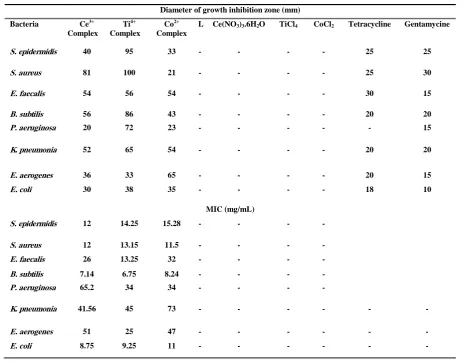
zone: 33 mm),respectively. In the case of Gram-positive bacteria, the highest and lowest inhibitory effects of the Co(II) complex were against E. faecalis and S. aureus, respectively. In the case of Gram-negative bacteria, the highest and lowest inhibitory effects of the Co(II) complex were observed against E. aerogenes
and P. aeruginosa, respectively. Considering the
MIC values, the highest and lowest effects of Ce(III) complex were against S. epidermis (7.14 mg/mL) and P. aeruginosa (65.2 mg/mL), respectively. The highest and lowest effects of the Ti(IV) complex were against B. subtilis
(MIC=6.75 mg/mL) and K. pneumonia (MIC=45 mg/mL), respectively. In addition, the Co(II) complex had the highest effect on B. subtilis
(MIC=8.24 mg/mL) and the lowest effect on K.
pneumoniae (MIC=73 mg/mL).
Overall, the Ti(IV) complex had more antibacterial activity compared to the other two complexes (Table 1).
RESULTS
In this study, the antimicrobial properties of metal ions, Schiff base ligand, and Ce(III), Co(II) and Ti(IV) complexes were investigated. The Schiff base ligand and metal ions had no antibacterial activity, while the complexes had strong antibacterial effects. In the disc diffusion method, the highest antibacterial effect was related to the Ce(III) complex against the Gram-positive S. aureus (diameter of inhibition zone: 81 mm), while the least antibacterial effect was against E. faecalis (diameter of inhibition zone: 40 mm). In the case of Gram-positive bacteria, the Ti(IV) complex had the highest inhibitory effect on S. aureus (diameter of inhibition zone: 100 mm) and the least inhibitory effect on E. faecalis (diameter of inhibition zone: 56 mm). In the case of Gram-negative bacteria, the highest and lowest inhibitory effects of Ti(IV) complex were against P.
aeruginosa (diameter of inhibition zone: 72
mm) and E. aerogenes ( diameter of inhibition
Diameter of growth inhibition zone (mm)
Bacteria Ce3+
Complex
Ti4+ Complex
Co2+ Complex
L Ce(NO3)3.6H2O TiCl4 CoCl2 Tetracycline Gentamycine
S. epidermidis 40 95 33 - - - - 25 25
S. aureus 81 100 21 - - - - 25 30
E. faecalis 54 56 54 - - - - 30 15
B. subtilis 56 86 43 - - - - 20 20
P. aeruginosa 20 72 23 - - - - - 15
K. pneumonia 52 65 54 - - - - 20 20
E. aerogenes 36 33 65 - - - - 20 15
E. coli 30 38 35 - - - - 18 10
MIC (mg/mL)
S. epidermidis 12 14.25 15.28 - - - -
S. aureus 12 13.15 11.5 - - - -
E. faecalis 26 13.25 32 - - - -
B. subtilis 7.14 6.75 8.24 - - - -
P. aeruginosa 65.2 34 34 - - - -
K. pneumonia 41.56 45 73 - - - - - -
E. aerogenes 51 25 47 - - - - - -
E. coli 8.75 9.25 11 - - - - - -
Table 1 - Antibacterial activity of Schiff base ligand, metal ions and Ce3+, Ti4+ and Co2+ complexes compared with the positive controls
in the body. In 2015, Mobinikhaledi et al. synthesized complexes containing Schiff base ligand and evaluated the antibacterial activity of these complexes against bacteria including S.
aureus, B. subtilis and E. coli. Comparison of
results of the mentioned study with our findings indicates that the complexes synthesized in our study have significantly higher antibacterial activity compared to those synthesized by Mobinikhaledi et al. (25). Patil et al. and Abdallah et al. also synthesized complexes containing Schiff base ligand. Comparison of the two mentioned study with the present study showed that the complexes we have synthesized have significantly higher antibacterial activity against bacteria including E. coli and S. aureus
(26, 27).
CONCLUSION
Nowadays, the antibiotic resistance in a large population of bacteria is a major problem in the field of treatment, which raises the need for more suitable compounds (28). Therefore, Schiff base complexes with strong antibacterial properties could be used to eliminate some of these antibiotic resistant bacteria.
ACKNOWLEDGMENTS
Hereby, the authors would like to thank the colleagues and authorities at Ilam University and Islamic Azad University, North Tehran Branch who helped us in this project.
CONFLICT OF INTEREST
The authors declare no conflicts of interest regarding this manuscript.
phenoxo bridges and single molecule magnetism.
Polyhedron. 2009; 28(7): 1253-1260.
5. da Silva CM, da Silva DL, Modolo LV, Alves RB, deResende MA, Martins CVB, et al. Schiff bases: A short
review of their antimicrobial activities. Journal of
Advanced Research. 2011; 2(1): 1-8.
6. Singh K, Barwa MS, Tyagi P. Synthesis, characterization and biological studies of Co(II), Ni(II), Cu(II) and Zn(II) complexes with bidentate Schiff bases
derived by heterocyclic ketone. Polyhedron. 2006; 41(1):
147-153.
7. Keypour H, Shayesteh M, Rezaeivala M, Chalabian F, Elerman Y, Buyukgungor O. Synthesis, spectral
characterization, structural investigation and
antimicrobial studies of mononuclear Cu (II), Ni (II) Co (II), Zn (II), and Cd (II) complexes of a new potentially
hexadentate N2O4 Schiff base ligand. Journal of Molecular
Structure. 2013; 1032(2): 62-69.
DISCUSSION
We have determined the antibacterial properties of the chemical compounds studied. According to the results, all complexes prepared had high antibacterial activity when compared with the standard antibiotics, indicating the suitability of these compounds as alternatives for other chemical antibiotics. The results also showed that these complexes have better antimicrobial properties compared with the ligands. On the other hand, the difference in the effect of a complex against different bacteria is due to the difference in the biochemical and genetic characteristic of each bacterium (22). However, the difference in the behavior of the synthetized complexes against a bacterium is due to the difference in the metal ion linked to the ligand because the Schiff base ligand in is identical in all complexes. Generally, antibacterial agents are more effective against Gram-positive bacteria, which is due to the difference in the composition of the cell wall of Gram-positive and Gram-negative bacteria (23). The cell wall of Gram-negative bacteria is mainly composed of lipopolysaccharides, which prevents accumulation of compounds in the cell membrane. For this reason, Gram-positive bacteria are more sensitive compared to Gram-negative bacteria (24). Since nitrogen and oxygen functional groups are not linked to the central metal in the Schiff base ligand, the ligand may cause toxicity after entering the body and interfere with metabolic reactions. In the case of Schiff base complexes, these functional groups are linked to the central metal that significantly reduces the amount of toxicity. Therefore, it may be appropriate to take appropriate doses of the Schiff base complexes prepared to kill bacteria
REFERENCES
1. Gupta KC, Sutar AK. Catalytic activities of Schiff base
transition metal complexes. Coordination Chemistry
Reviews. 2008; 252(12): 1420-1450.
2. Wadher SJ, Puranik MP, Karande NA, Yeole PG.
Synthesis and biological evaluation of Schiff base of dapsone and their derivative as antimicrobial agents.
International Journal of PharmTechResearch. 2009; 1(1): 22-33.
3. Sinha D, Tiwari AK, Singh S, Shukla G, Mishra P, Chandra H, Mishra AK. Synthesis, characterization and biological activity of Schiff base analogues of
indole-3-carboxaldehyde. European journal of medicinal chemistry.
2008; 43 (1): 160-5.
4. Bhargavi G, Rajasekharan MV, Costes JP, Tuchagues
JP. Synthesis, crystal structure and magnetic properties of
dimeric Mn(III) Schiff base complexes including
pseudohalide ligands: Ferromagnetic interactions through
9/Tamoradi and colleagues
Medical Laboratory Journal, Mar- Apr , 2017; Vol 11: No 2
18. Nayak S, Gamez PP, Kozlevcˇar B, Pevec AA, Roubeau O, Dehnen S, et al. Coordination compounds from the planar tridentate Schiff-base ligand 2-methoxy-6-((quinolin-8-ylimino)methyl)phenol (mqmpH) with several
transition metal ions: Use of [FeIII(mqmp)(CH3OH)Cl2] in
the catalytic oxidation of alkanes and alkenes. Polyhedron.
2010; 29(11): 2291-2296.
19. Siddiqi KS, Khan S, Nami SAA, El-ajaily MM.
Polynuclear transition metal complexes with thiocarbo
-hydrazide and dithiocarbamates. Spectrochimica Acta.
2007; 67(3): 995-1002.
20. Desai RM, Shah RM, Shah VH. Preparation and Antimicrobial Screening of Cu (II), Ni (II), Zn (II), Cd (II)
Complexes. EJournal of chemistry. 2006; 3(12): 137-141.
21. Brooks GF, Carroll KC, Butel JS, Morse SA, Mietzner TA. Jawetz, Melnick & Adelberg's medical microbiology; 26th ed. New York: McGraw Hill. 2013; 209-222.
22. Gheibi N, Saboury A A, Mansuri TH. The inhibition effect of some n-alkyl dithiocarbamates on mushroom
tyrosinase. Journal of Enzyme Inhibition and Medicinal
Chemistry. 2005; 20(4): 393-399.
23. Kosanic M, Rankovic B. Screening of antimicrobial
activity of some lichen species in vitro. Kragujevac Journal of Science. 2010; 32(2): 65-72.
24. Sanez MT, Garcia MD, Rowe JG. Antibicrobial activity and phytochemical studies of some lichens from south of
spain. Fitoterapia 2006; 77(3) 156-159.
25. Mobinikhaledi A, Jabbarpour M. Preparation, characterization, and biological activity of some new Schiff bases derived from aminophenoxyalkyloxybenzenamines and salicylaldehyde in the presence of p-TSA, and their
Zn(II) and Cu(II) complexes. Research on Chemical
Intermediates. 2015; 41(2): 511-523.
26. Patil M, Hunoor R, Gudasi K. Transition metal complexes of a new hexadentate macroacyclic N 2O 4-donor Schiff base: Inhibitory activity against bacteria and
fungi. European Journal of Medicinal Chemistry. 2010;
45(7): 2981-2986.
27. Abdallah SM, Zayed MA, Mohamed GG. Synthesis and spectroscopic characterization of new tetradentate Schiff base and its coordination compounds of NOON donor atoms and their antibacterial and antifungal activity.
Journal of Chemistry. 2010; 3(2): 103-113.
28. Stewart PS, Costerton JW. Antibiotic resistance of
bacteria in biofilms.Lancet. 2001; 358(9276):135-8.
8. Keypour H, Shayesteh M, Rezaeivala M, Chalabian F, Valencia L. Synthesis and characterization of a series of transition metal complexes with a new symmetrical polyoxaaza macroacyclic Schiff base ligand: X-ray crystal structure of cobalt (II) and nickel (II) complexes and their
antibacterial properties. SpectrochimicaActa Part A:
Molecular and Biomolecular Spectroscopy. 2013; 101 (1) 59-66.
9. Khanmohammadi H, Amani S, Abnosi MH, Khavasi
HR. New asymmetric heptaaza Schiff base macrocyclic
complex of Mn(II): Crystal structure, biological and DFT studies, SpectrochimicaActa Part A: Molecular and
Biomolecular Spectroscopy. 2010; 77(2)342-347.
10. Faridbod F, Ganjali MR Dinarvand, R, Norouzi P, Riahi S. Schiff's bases and crown ethers as supramolecular sensing materials in the construction of potentiometric membrane sensors. Sensors. 2008; 8 (3): 1645-1703. doi: 10.3390/s8031645.
11. Rosu T, Pahontu E, Maxim C, Georgescu R, Stanica N, Almajan GL, et al. Synthesis, characterization and antibacterial activity of some new complexes of Cu(II), Ni(II), VO(II), Mn(II) with Schiff base derived from 4-amino-2,3-dimethyl-1-phenyl-3-pyrazolin-5-one.
Polyhedron. 2010; 29(2): 757-766.
12. Cimernman Z, Galic N, Bosner B. The Schiff bases of salicylaldehyde and aminopyridines as highly sensitive
analytical reagents. Analyticachimicaacta. 1997; 343(1):
145-153.
13. Yousifa EA, Majeeda AS, Salih NA. Synthesis,
characterization and preliminary in vitro
antibacterialscreening activity of metal complex
derivatives
of2-[(5-styryl-[1,3,4]thiadiazol-2-ylimino)-methyl]-phenol. Taibah University for Science. 2014; 8(1):
26-30.
14. Bhat MA,Al-Omar MA, Siddiqui N. Antimicrobial activity of Schiff bases of coumarin-incorporated
1,3,4-oxadiazole derivatives: an in vitro evaluation. Medicinal
Chemistry Research. 2013; 22(9): 4455-4458.
15. Shukla S, Srivastava RS, Shrivastava SK, Sodhi A, Kumar P. Synthesis, characterization, in vitro anticancer activity, and docking of Schiff bases of
4-amino-1,2-naphthoquinone. Medicinal Chemistry Research. 2013;
22(4): 1604-1617.
16. Nair MS, Arish D, Joseyphus RS. Synthesis, characterization, antifungal, antibacterial and DNA cleavage studies of some heterocyclic Schiff base metal
complexes. Saudi Chemical Society. 2012; 16(1): 83-88.
17. Basak S, Sen S, Banerjee S, Mitra S, Rosair G, Rodriguez MTG. Three new pseudohalide bridged dinuclear Zn(II) Schiff base complexes: Synthesis, crystal
structures and fluorescence studies. Polyhedron. 2007;
26(17): 5104-5112.