Lepton Universality and Lepton Flavour Violation tests
at the
B
-factories
Alberto Lusiani1,2,a, on behalf of theBABARCollaboration
1Scuola Normale Superiore, Pisa, Italy 2INFN sezione di Pisa, Pisa, Italy
Abstract.We review the experimental status of the lepton universality tests and lepton flavour violation searches after the completion of the data-taking and most of the data analysis of theB-factoriesBABARand Belle. The universality of the Standard Model charged weak couplings has been confirmed and moderately improved in precision by theB-factories results. Lepton Flavour violation in theτlepton decays has been searched in several decay modes and no evidence has been found. We set 90% confidence level upper limits on the Lepton Flavour violating branching ratios in the10−7−10−8range, greatly extending the previous limits set mainly by CLEO in the10−6range.
1 Introduction
In the Standard Model (SM) the lepton couplings are the same for each lepton generation. The universality of the charged weak coupling for charged leptons can be tested by combining the measurements of decay widths with lep-tons in the initial and/or final state, which can be obtained by measuring the relevant branching fractions, the lepton masses and the leptons lifetimes.
In the SM with zero neutrino masses, the lepton flavour is exactly (accidentally) conserved. When we take into ac-count the experimentally measured neutrino mass squared differences and neutrino mixing, lepton-flavour-violating (LFV) branching fractions, such as for instanceτ → μγ,
μ → eγ,τ → 3μ, are predicted to be non-zero but sup-pressed by a factor of order (mν/mW)4 to values several
orders of magnitude smaller than the current experimental reach.
Models beyond the SM like Supersymmetry, Grand Unification or Extra Dimensions typically include addi-tional lepton-flavour-violating processes, which can pro-duce observable LFVτlepton decay rates, even when the model parameters are constrained with the available ex-perimental data [1–9].
Since about year 2000, theB-factoriesBABARand Belle have collected unprecedented samples of cleane+e− colli-sions at and around theΥ(4S) peak, which have improved the experimental test of the SM lepton universality. The B-factories have ceased data-taking in 2008 (BABAR) and 2010 (Belle) and have now completed and published most of the data-analyses, increasing the experimental knowl-edge on lepton universality and lepton flavour violation.
Before the B-factoriesBABARand Belle, experimental measurements have permitted testing the lepton
universal-ae-mail: [email protected]
ity to a precision around 0.2%. The most important contri-butions have been theτlifetime measurements by the LEP experiments, the τ leptonic branching fraction measure-ments by the LEP experimeasure-ments and in particular ALEPH, and the BESτmass measurement. We report in the fol-lowing the present status after theB-factories results.
BABARand Belle have provided effective conditions to search for LFV τ lepton decay branching fractions with clean and unambiguous experimental signatures [10], like a final state with invariant mass matching theτmass and with total energy matching half the event energy in the center-of-mass frame. We report in the following signifi-cant advancements that have been obtained with respect to the pre-existing limits set mainly by CLEO around 10−6.
2 Lepton Universality Tests
In the Standard Model, the partial width of a heavier lepton
λ decaying to a lighter leptonρare, neglecting neutrino masses and including radiative corrections [11],
Γ[λ→νλρνρ(γ)]=GλGρm 5 λ 192π3 f
⎛ ⎜⎜⎜⎜⎜ ⎝m 2 ρ m2 λ ⎞ ⎟⎟⎟⎟⎟ ⎠rWλ rλγ,
where
Gρ=
g2 ρ
4√2M2 W
f(x)=1−8x+8x3−x4−12x2lnx
rλ
W=1+
3 5 m2 λ M2 W rλ γ =1+
α(mλ) 2π
25
4 −π
2 .
Computing the proper ratios of the above partial widths us-ing the HFAG 2014τworld averages [12], the Review of Particle Physics (PDG) 2014 [13] and CODATA 2010 [14]
results we obtain the following charged weak current cou-pling ratios:
g τ
gμ =
Bτe
Bμe
τμm5μfμerμWrγμ
ττm5τfτerWτrτγ =
1.0011±0.0015
g τ
ge =
Bτμ Bμe
τμm5μfμerμWrμγ
ττm5τfτμrτWrτγ =
1.0029±0.0015
g μ
ge =
Bτμ Bτe
fτe
fτμ =1.0018±0.0014
The data are consistent with lepton universality, and the precision of the tests improved from 0.20−0.23% before the B-Factories to 0.14−0.15%, thanks primarily to the Belle tau lifetime measurement [15]. TheBABAR measure-ment of the ratio between the muon and electron branching fraction [16] and the BABAR and Belleτ mass measure-ments [17, 18] provide negligible contributions. The pre-cision of the tests is now mainly limited by the uncertain-ties on theτlifetime (0.09%) and on theτleptonic branch-ing fractions (0.11−0.12%). The overall consistency of the data with the SM is summarized in figure 1, which reports the experimental measurements of the τ lifetime and of the “universality improved”τ−→ e−ν¯eντbranching frac-tion [19], together with the constraint on them from the SM, which relies on the measurements of the τlifetime and the muon mass and lifetime.
Partial widths ofτdecays to hadrons compared to the same hadron decay to muons measure the tau-muon uni-versality of charged weak couplings as follows:
g τ
gμ 2
= B(τ→hντ)
B(h→μν¯μ)
2mhm2μτh
(1+δh)m3τττ ⎛ ⎜⎜⎜⎜⎜ ⎝1−m
2 μ/m2h 1−m2
h/m2τ ⎞ ⎟⎟⎟⎟⎟ ⎠
2 ,
where h=πor K and the radiative corrections areδπ = (0.16±0.14)% andδK=(0.90±0.22)% [20], we measure:
g τ
gμ π=
0.9963±0.0027, g
τ
gμ K=0.9858±0.0071.
The BABAR measurement of the ratio between the kaon and electron branching fractions [16] improved these tests. Similar tests could be performed with decays to electrons, however they are less precise because the hadron two body decays to electrons are helicity-suppressed. Averaging the threegτ/gμratios we obtain
g τ
gμ τ+π+K=1.0001±0.0014,
accounting for statistical correlations.
Additional electron-muon universality tests can be ob-tained comparing pion and kaon leptonic branching frac-tions. TheB-factories did not improve these tests.
3 Searches for Lepton Flavour Violation
The B-factories have searched for an extensive range of LFV τ decay modes: no evidence has been found and
90% confidence level (CL) upper limits have been set. The most recent published result are the searches forτ→ 3 charged leptons [21, 22],τ→K0Sandτ→K0SK0S[23],
τ → V0 [24], τ → hh [25]. Recently, the LHCb collaboration has published the result of the search for
τ→μμμ[26].
The most recent published result by the B-factories Belle andBABARand by LHCb are the searches forτ → 3 leptons by Belle [21],
B(τ→e−e+e−) <2.7·10−8,
B(τ→μ−e+e−) <1.8·10−8,
B(τ→e−μ+μ−) <2.7·10−8,
B(τ→μ−μ+μ−) <2.1·10−8,
B(τ→e−μ+e) <1.5·10−8,
B(τ→μ−e+μ−) <1.7·10−8,
byBABAR[22]
B(τ→e−e+e−) <2.9·10−8,
B(τ→μ−e+e−) <2.2·10−8,
B(τ→e−μ+μ−) <3.2·10−8,
B(τ→μ−μ+μ−) <3.3·10−8,
B(τ→e−μ+e) <1.8·10−8,
B(τ→μ−e+μ−) <2.6·10−8,
and by LHCb [26]
B(τ→μ−μ+μ−) <4.6·10−8,
the searches forτ→K0
S andτ→KS0K0S by Belle [23]
B(τ→e−K0
S) <2.6·10−8,
B(τ→μ−K0
S) <2.3·10−8,
B(τ→e−K0
SKS0) <7.1·10−8,
B(τ→μ−K0
SKS0) <8.1·10−8,
the searches forτ→V0by Belle [24]
B(τ→e−ρ0) <1.8·10−8,
B(τ→μ−ρ0) <1.2·10−8,
B(τ→e−K∗(892)0) <3.2·10−8,
B(τ→μ−K∗(892)0) <7.2·10−8,
B(τ→e−K¯∗(892)0) <3.4·10−8,
B(τ→μ−K¯∗(892)0) <7.0·10−8,
B(τ→e−φ) <3.1·10−8,
B(τ→μ−φ) <8.4·10−8,
B(τ→e−ω) <4.8·10−8,
B(τ→μ−ω) <4.7·10−8,
and the searches forτ→hhby Belle [25] B(τ→e−π+π−) <2.3·10−8,
B(τ→μ−π+π−) <2.1·10−8,
B(τ→e−π+K−) <3.7·10−8,
B(τ→μ−π+K−) <8.6·10−8,
B(τ→e−K+π−) <3.1·10−8,
B(τ→μ−K+π−) <4.5·10−8,
B(τ→e−K+K−) <4.4·10−8,
B(τ→μ−K+K−) <7.1·10−8,
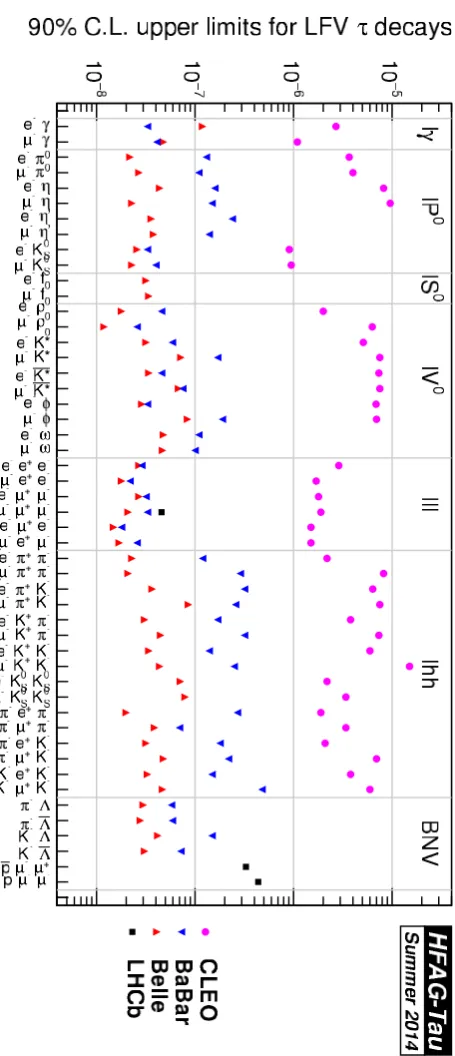
The Heavy Flavour Averaging Group has collected all the upper limits on the LFV τ branching fractions [12] and we report here just the summary plot in figure 2. In addition, we report in figure 3 the upper limits combina-tions computed in the HFAG 2014 report. The significant progress made with theB-factories results is evident.
4 Conclusions and prospects
The B-factories helped improving the precision of the lepton universality tests, which continue to confirm the ,01018 (2016)
EPJ Web of Conferences DOI: 10.1051/epjconf/201611801018
118 201
Figure 1. Experimental measurements of theτlifetime and of the “universality improved”τ→ebranching fraction compared with the Standard Model prediction (yellow band). The width of the band is dominated by the uncertainty on theτlifetime.
SM predictions with a precision that increased from 0.20−0.23% to 0.14−0.15%. The relevant experimen-tal measurements are systematically limited, and there are only modest prospects of further improvements at the planned future high luminosityB-factory Belle-II. A high luminosity LEP-likee+e− collider at the Z0 peak would most probably provide better conditions for precision mea-surements of theτbranching fractions.
The B-factories have experimentally probed the LFV
τbranching fractions from the CLEO limits around 10−6
up to 10−7−10−8without finding any evidence of a signal. Future high luminosityB-factories like Belle II offer good prospects to advance the experimental reach close to 10−7 for decay modes such asτ→μγand close to 10−8for the cleanest decay modes such asτ→3 charged leptons.
References
[1] J.R. Ellis, M.E. Gomez, G.K. Leontaris, S. Lola, D.V. Nanopoulos, Eur. Phys. J. C14, 319 (2000),
hep-ph/9911459
[2] J.R. Ellis, J. Hisano, M. Raidal, Y. Shimizu, Phys. Rev.D66, 115013 (2002),hep-ph/0206110 [3] A. Masiero, S.K. Vempati, O. Vives, Nucl. Phys.
B649, 189 (2003),hep-ph/0209303
[4] T. Fukuyama, T. Kikuchi, N. Okada, Phys. Rev.D68, 033012 (2003),hep-ph/0304190
[5] G. Cvetic, C. Dib, C.S. Kim, J.D. Kim, Phys. Rev.
D66, 034008 (2002),hep-ph/0202212
[6] C.x. Yue, Y.m. Zhang, L.j. Liu, Phys. Lett.B547, 252 (2002),hep-ph/0209291
[7] A. Dedes, J.R. Ellis, M. Raidal, Phys. Lett.B549, 159 (2002),hep-ph/0209207
[8] A. Brignole, A. Rossi, Phys. Lett.B566, 217 (2003),
hep-ph/0304081
[9] E. Arganda, M.J. Herrero, Phys. Rev.D73, 055003 (2006),hep-ph/0510405
[10] A. Lusiani, PoSHQL2010, 054 (2010),1012.3733 [11] W.J. Marciano, A. Sirlin, Phys. Rev. Lett.61, 1815
(1988)
[12] Y. Amhis et al. (Heavy Flavor Averaging Group (HFAG)) (2014),1412.7515
[13] K.A. Olive et al. (Particle Data Group), Chin. Phys.
C38, 090001 (2014)
[14] P.J. Mohr, B.N. Taylor, D.B. Newell, Rev. Mod. Phys.84, 1527 (2012),1203.5425
[15] K. Belous et al. (Belle), Phys. Rev. Lett.112, 031801 (2014),1310.8503
[16] B. Aubert et al. (BaBar), Phys. Rev. Lett. 105, 051602 (2010),0912.0242
[17] B. Aubert et al. (BaBar), Phys. Rev. D80, 092005 (2009),0909.3562
[18] K. Abe et al. (Belle), Phys. Rev. Lett. 99, 011801 (2007),hep-ex/0608046
[19] M. Davier, A. Hocker, Z. Zhang, Rev. Mod. Phys.78, 1043 (2006),hep-ph/0507078
[20] R. Decker, M. Finkemeier, Phys. Lett. B334, 199 (1994)
[21] K. Hayasaka et al. (Belle), Phys. Lett. B687, 139 (2010),1001.3221
[22] J.P. Lees et al. (BaBar), Phys. Rev. D81, 111101 (2010),1002.4550
[23] Y. Miyazaki et al. (Belle), Phys. Lett.B692, 4 (2010),
1003.1183
[24] Y. Miyazaki (Belle), Phys. Lett.B699, 251 (2011),
Figure 2.τlepton-flavour-violating branching fraction upper limits summary plot from the HFAG 2014 report.
[25] Y. Miyazaki et al. (Belle), Phys. Lett. B719, 346 (2013),1206.5595
[26] R. Aaij et al. (LHCb), JHEP 02, 121 (2015),
1409.8548
,01018 (2016)
EPJ Web of Conferences DOI: 10.1051/epjconf/201611801018
118 201