R E S E A R C H A R T I C L E
Open Access
A spatial analysis of the expanding
roles of nurses in general practice
Christopher Pearce
1*, Sally Hall
2, Christine Phillips
2, Kathryn Dwan
3, Rachael Yates
4and Bonnie Sibbald
5Abstract
Background:Changes to the workforce and organisation of general practice are occurring rapidly in response to the Australian health care reform agenda, and the changing nature of the medical profession. In particular, the last five years has seen the rapid introduction and expansion of a nursing workforce in Australian general practices. This potentially creates pressures on current infrastructure in general practice.
Method:This study used a mixed methods,‘rapid appraisal’approach involving observation, photographs, and interviews.
Results:Nurses utilise space differently to GPs, and this is part of the diversity they bring to the general practice environment. At the same time their roles are partly shaped by the ways space is constructed in general practices. Conclusion:The fluidity of nursing roles in general practice suggests that nurses require a versatile space in which to maximize their role and contribution to the general practice team.
Keywords:General practice, Private practice nursing, Physicians office, Spatial analysis, Skill mix
Background
The last decade has seen a significant increase in the number of practice nurses in Australia, doubling be-tween the years 2003 and 2007 to 7,824. At the same time the number of practices employing nurses also doubled, with 60% of general practices now employing at least one nurse [1,2]. Australian general practices are usually small businesses, geographically separate and with considerable structural diversity [3]. Practice own-ers are usually GP’s, and nurses tend to be salaried employees. As a result practices need to fund nurse em-ployment, along with other organisational costs, out of business cash flow.
The growth in general practice nursing has been facilitated by a number of Medicare rebates for nurse activity, incentives for rural practices and those in areas of workforce depletion to hire nurses [4], support from Divisions of General Practice [5,6], and the federal gov-ernments’Nursing in General Practice Program. The ra-tionale for providing these incentives was that nurses would solve health workforce shortages [7,8] and
improve the quality of healthcare [9]. This move in Aus-tralia is part of a world-wide understanding that nurses benefit general practice, and that governments need to en-courage them [10].
At the same time the general practice landscape is changing in response to professional evolution and health care reform. The doctor workforce is becoming increasingly feminised [11] and teamwork is widely pro-mulgated as the way of the future [12,13]. Changes to average practice size and staffing configurations over the last decade have meant that pressure on general practice infrastructure has been intense [14], particularly in rural and outer urban areas where the bulk of nursing incen-tive payments have been directed [15].
One study identified concerns regarding the demands nurse are making on space requirements in general prac-tices [16], where nurses are having to compete with doc-tors (often the owners of the practice), students, allied health and other staff. The aim of this study was to examine the effects of incorporating a large, new work-force cohort with a differently oriented professional cul-ture to that of both general practitioners and past practice nurses into the spatial infrastructure of general practice.
* Correspondence:[email protected]
1
Director of Research, Inner Eastern Melbourne Medicare Local and Adjunct Associate Professor, Monash University, Melbourne, Australia
Full list of author information is available at the end of the article
Method
This study undertook rapid appraisal of 25 general prac-tices, spread throughout the two states of Victoria and New South Wales. 9 of the practices were from large metropolitan areas, 4 from regional cities, 11 rural towns and 1 remote practice. Rapid appraisal studies use a range of methods that share two features: they are field-based, and they are designed to be collected in a concen-trated period of time. This makes them ideal for use in small, busy organizations [17]. The study was conducted between September 2005 and March 2006. Our study was approved by the human research ethics committees of the Australian National University and the Royal Australian College of General Practitioners.
Practices were identified by local divisions of general practice [6] in a purposive manner to identify practices expanding the nurse role. Informed consent from partici-pants was obtained. During a day-long visit to each prac-tice by a researcher, the following data were collected: interviews with nurses (n = 36), doctors (n = 24), and managers (n = 22); photographs of the general practice; two hours of structured observation of practice nurse ac-tivity (51 hours of observation of 34 nurses); practice floorplans and a situational analysis. Interviews were semi-structured, and addressed (for nurses) work history, types of work done in general practice, contribution to safety and quality, and their experiences within the work-place, and (for doctors and practice managers) the experi-ences of the general practice with nurses, roles of nurses and contribution to safety and quality. All interviews were audiotaped and transcribed. The rapid appraisal tool was piloted in two practices with each researcher and an independent observer; concordance rates for the observa-tional component were 94% and 96%.
Further details of the sample, data collection and ana-lytical methods have been presented elsewhere [18]. The sampling frame for this project was designed to in-clude variation between practices in location, regional demographics, rural or urban orientation, size, business structure, GP & nurse workforce size, and types of nursing role.
Inter-case and intra-case analyses for each practice were performed by a multidisciplinary team (sociologist, nurses, GPs, policy analyst). All data, including photo-graphs and floorplans, were coded into a database using NVivo qualitative data analysis software, version 7 (QSR International, Melbourne, Vic), enabling triangulated data interpretation. Whilst the research team could not be blinded to participants, anonymity has been protected by not reporting any identifying information as to prac-tice whereabouts. All pracprac-tices have consented to the publication of photos.
The research team probed for emergent themes, using the constant comparison method [19], and
cross-checked with practice data. Primary themes included structural elements (health care policy, environment, gender, nursing culture); practice-level elements (inter-professional relationships, time-use patterns, space); and individual factors.
We then undertook a specific analysis of the influence of space, using the photos as referents, and correlating this with data from other elements of the study. The analysis of general practice spatial arrangements in this study is based on an interpretation of fixed images or fixed situations. According to Ball & Smith [20], fixed images (in this case, photographs and floorplans) can be interpreted according to their content (the elements of the photo), the referent (what the photograph is of ), or the context (how the referent is used). By examining still shots of referents, we took the ontological position that the content exists not purely of itself, but that it carries with it its social context and can be interpreted. The images are therefore “lived visual data” [21], representa-tions of three dimensional spaces that humans inhabit– in this case as a working environment.
Results
The floor plans were classified first into different zones that could be used to analyse and interpret photos of dif-ferent practice spaces:
Public–unrestricted areas (free access to all). Examples were the patient entry areas, including waiting rooms, and public access toilets.
Public–restricted areas (access restricted to control by staff ). Examples included corridors behind consulting rooms.
Staff-only areas. Examples included reception and administration areas, tearooms and storage areas.
Clinical/Patient interaction areas. Examples included consulting and treatment rooms.
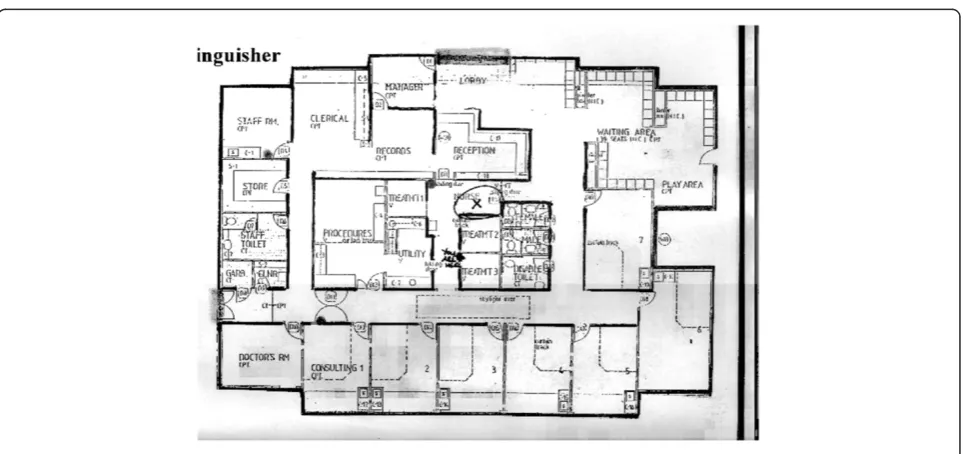
It was quickly clear that practices in the study sample fell into two categories: practices that had modified an older existing building (often a house) to accommodate a medical clinic; and practices that had built (or extended) into a purpose designed clinic Figure 1.
the smallest consulting room, and no specified treatment room. The ability for the nurse to carry out significant functions within the practice is limited by the practice design.
The practice in Figure 2 however, is purpose built. This is manifest in the clear identification of the four zones. Design consideration has been given to the work-ing needs of the staff, and the nurse is given a central position. This structure was not unusual for these type of surgeries: waiting area to the front, consulting rooms around the edge, and a central island that contains
administrative and nurse/clinical areas. In this case the nurse has her own administrative area, as well as having access to, and responsibility for, several spaces.
How nurses use space: looking at the built environment
Within the surgery, nurses have a wide-ranging physical workspace, often wider than the doctors or reception staff. These areas reflect their combination of clinical and non-clinical roles. All but one practice had a treat-ment room as a centre of nurse clinical activity, whilst several also had dedicated consulting or clinical rooms. Many had an arrangement for time-sharing of consulting rooms when not in use by a doctor. While they clearly focused on treatment and consulting rooms, nurses also identified cupboards and stockrooms as key work areas, demonstrating a prioritisation of workplaces which were not“premium space”in the general practice.
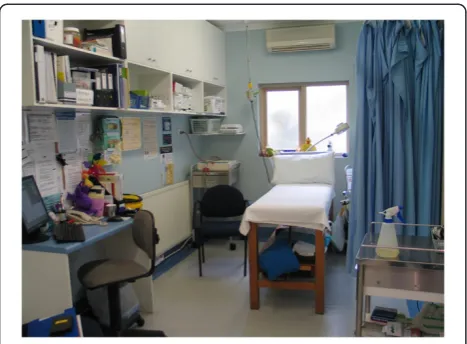
The photograph in Figure 3 presents the most com-mon workspace for nurses–the treatment room. It is in a four consulting room practice, and occupies a central or ‘hub’ position. Treatment rooms are often in a pos-ition that makes them a hub of activity within the prac-tice, either amongst the consulting rooms or between the rooms and the reception area. The curtain seen in the right of the picture was the only form of visual privacy, and consequently conferred no aural privacy. This nurse works in a public (but controlled) environment. Observa-tions revealed that other staff had little compunction in intruding in this space, quite distinct from their attitude to the consultation room. Examining the elements of the photos reveals much that is ‘intrinsically active’ - or designed to be used. These are occupational objects in the typology proposed by Riggins [21]. The predominance of Figure 1Floorplan, modified building..
clinical equipment and the organisation of the room indi-cate that this is a place where things are “done” to patients. There is very little personalisation of this work-space with esteem or social objects - objects conveying status or personality. The central object of this, and all treatment room photos, is the trolley or bed–reinforcing the centrality of the bed to nurse activity in this environ-ment. The focus of this clinical workspace is on the patient – and the procedure to be undertaken - the nurse is secondary. This is in contrast to many medical consult-ing rooms that display personal artifacts important to the individual practitioner.
By contrast, the nurse desk in Figure 4 is not in a pri-marily clinical area, but in a shared administration area, adjacent to storage rooms. Here, there is much more‘ in-trinsically passive’ material, with social objects found in the form of the jellybean jar and the pot plant. A com-mon feature of all these workspaces is the presence of posters/handouts stuck on the wall. You can see here several sheets of information on the wall, information
that the nurse feels she needs rapid access to. This is mirrored in the first photo, with the space above the desk covered with information. In the first photo, note also on the other side of the gloves is more generic in-formation that is more available to the patient and may be less frequently referred to.
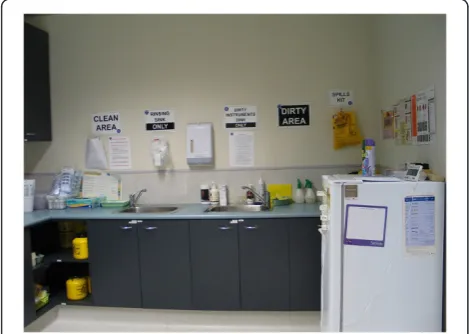
A third category of nurse workspace identified in this study is storage or utility areas. These may be integrated into existing spaces or occupy separate areas/cupboards, but are typically like the one shown in Figure 5–containing almost exclusively active, occu-pational objects. Their frequent presence in the photos is a reflection of their prominence in nurses’work prac-tices, both in ensuring stock is kept up to date, and in managing patients in a clinical environment. Nurses fre-quently reference this aspect of their work and see it as an underpinning component of their contribution to the practice team.
The overall impression is that nurses enact their work in three spatial domains: clinical interactions and activity primarily within patient-centred spaces; administrative work in an‘office’setting, and equipment, stock manage-ment and support activities conducted within the ‘ back-stage’ areas of a practice. Correlating this information with the observational and interview data reinforces the fluidity of the nurse space, with nurses cycling through multiple tasks in a given time frame, and deploying a series of operating roles as they adapt to the practice environment.
The six primary operating roles of general practice nurses identified in this study have been described else-where [18], but include: patient care; organisation; prob-lem solving; quality control; education and connectivity. Nurses move consistently through practice space as they cycle between these operating roles. The physical charac-teristics of the practice space influence these roles through the positioning of nurse spaces, their accessibility, and the Figure 3Treatment room..
independence or shared nature of space utilization. In par-ticular, these elements affect the interconnectedness of nurse work with that of others, and the strength and utility of their connectivity role. This role is an import-ant capacity factor in many practices and an enabler of extended relationships with patients and the broader community.
Nurses are frequent sharers of space – either with other nurses or with colleagues from other disciplines including GPs. In this situation they commonly appro-priate elements of the space to be used in a certain way and act as monitors of the behaviour of other space users. This is illustrated by the signage in Figure 6 that acts as both a communication and quality control mechanism.
“A free consulting room is like a present”: talking about space
A prominent theme in the interview and observation data was the lack of space available in general practice to perform the tasks required of the practice team.
Nurse:“[We] don’t need more staff. More than anything we need more space. And -”
Interviewer:“So another treatment room ?”
Nurse:“No, we need - well, a bigger treatment room would have been good but we also need more consulting rooms. I think we could have done with at least one or two more consulting rooms”
[PN, practice 3]
This space shortage applied to many activities of the practice as a whole, as well as to nurses specifically.
“Room, space is. . .that would be the most difficult thing here, lack of space it just makes everything difficult. I don’t know if you noticed this morning I
went and asked if there was any free consulting rooms, you know if there is a free consulting room it is sort of like a present”[PN, practice 2]
The influence that this had on nurse practice was gen-erally acknowledged, and several of the interviewees noted that, in the scheme of practice allocations, doctors (as greater income generating units) would always have priority over nurses. This was particularly evident in practices based on a modified house design, such as in Figure 1. Nurses in those practices often described them as‘rabbit warrens”or“cramped and cosy”. Those in sur-geries that had been renovated or purpose built had a more positive view of the space allocation. In the follow-ing account, a nurse in a rural area describes the section of the clinic where she works, which has been purpose-built with central cubicles and a nursing desk.
Nurse:“[W]e have a designated nurses area where we have a main desk with our computer system where we do all of our own filling and obviously all the
encounters and things for every patient is on the computer.. . .”
Interviewer:“So that’s almost like a front desk, isn’t it?” Nurse:“It is, yes. So patients come to us to report, which they don’t really need to but they all like to report to certain doctors. . .And then from there we have the sterilising area which has also got where we keep all of our medications from the drug reps and things like that, and stock in that area, which goes out to the theatre, which joins onto the theatre which also has a lot of our stock in there.”[PN, practice 13]
Nurses were often involved in the designs of renova-tions and new surgeries, and this was clearly associated with higher satisfaction with the space allocation. In the following account, a nurse in a large multi-doctor and multi-nurse practice describes a process where the nurses limited their accessibility to patients while maxi-mizing the contiguousness of working patterns with other nurses.
down with the plan and redrew our nursing area. And what we’ve got basically is what we drew up.”
[PN, practice 6]
We have already noted the diverse spaces in which general practice nurses work, characterised by a much more mobile, accessible, open work orientation, espe-cially when compared to the closed, consulting room settings favoured by doctors. Such an open environment was a feature of both the older style surgeries, and the purpose built ones. Nurses are clearly comfortable with, and in fact favour, such an open environment. They saw it not just as a task related feature, but as an expression of their accessibility and the candid or relaxed relation-ship that perceive they have with patients.
“[W]e don’t put up barriers for people. We don’t make it difficult for them. We don’t make them feel like ooh, I’m overstepping the mark here, I shouldn’t be here or - yeah, make it very warm. It’s like walking into a home, this place, yeah, and I think that makes a big difference.”[PN, Practice 3]
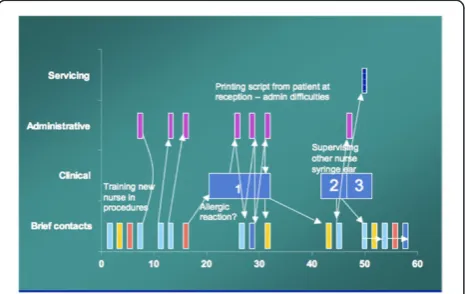
The example in Figure 7 shows how rapid cycling of tasks is enabled by working in an open environment. The space requirement of this nurse took her from treat-ment room through shared and administrative spaces, but importantly her availability in a shared space allows the connectivity element to occur. Doctors are locked away in consulting room, requiring a knock and permis-sion before entering, Nurses, by virtue of the combination of their role and accessibility in the practice space, are available for more unstructured staff and patient contact.
Discussion
Nurses require a larger floor space than doctors, because of the fluid and variable nature of nursing work, At the same time, they are more mobile and spend less time in
a single location. Nurses work across all space zones in a practice, and often cycle through these repetitively in such a way that they seem to have an ‘access all areas’ pass. This reflects the rapid cycling of tasks that they have been observed to undertake, and the interconnect-edness of their interactions with other members of the practice team27. Nurses also perceive their workspace in a broad way, including storage, utility and medical sup-ply areas.
Practices tend to locate nurses in a treatment room or other central, procedural or transitional space. In many cases this is the result of space pressures in a practice where the availability of space is limited by design, geog-raphy or cost. Most urban, and many rural, general prac-tice nurses work within modified houses, and often have limited access to consulting spaces. The transitional or shared nature of the spaces they routinely occupy means that privacy may be compromised. This is further com-pounded in cases where space is structured to facilitate easy access and mobility such as curtains and open areas, and where the space is freely entered and utilized by others, such as doctors. This limits their capacity to expand their patient carer role through individual con-sultations in a way that is typical of general practice, but enables and fosters their connectivity role.
Nurses demonstrate high levels of adaptability to the spaces they are allocated, and are able to adapt and modify their workspaces to fit the needs of their workflow. Most nurse workspaces in this sample, however constrained, had been organized to achieve high levels of functionality and often served as verbal and non-verbal communica-tion hubs. This may reflect the collective orientacommunica-tion of nurses [22], stemming from their professional culture as a numerate, interchangeable workforce – especially in hospital settings [23].
However there are spatial configurations which foster greater communication and teamwork. Iedema et al [24]. have suggested that meaningful teamwork is conducted in transitional or liminal spaces such as the corridor, where “the interstices among clinical knowledge, pro-cesses, problems and purposes are dynamically nego-tiated and worked out”. In this study we found that designs that isolated or removed nurses from a central location tended to reduce the incidental involvement of nurses in practice life, and limited their connectivity.
less efficient use of space, despite their need for wide ranging and flexible work spaces.
As practice teams and general practice nursing roles evolve, surgery design (and modifications to existing sur-geries) will need to take into account the many factors that we have considered here. The workspaces that nurses inhabit have arisen not just out of a historical role, but developed in response to their multiple roles within the practice. The previously highlighted connect-ivity and trouble shooting roles require accessibility, and accessibility come from nurses inhabiting those public, but controlled environments. What nurses require is space flexibility in accordance with their role flexibility– private space when the work demands, public space at other times.
Limitations
This study does not purport to be a detailed and repre-sentative analysis of all Australian general practice. By identifying practices at the developing edge we hoped to identify information to inform change across the rest of the sector. The strength of the method is in the multiple data sources, yet perforce each source has its own limita-tions, be it the perceptions of participants or the practice dynamics on the day, which may be influenced by the time of year, etc.
The study was conducted some years ago, which raises the question of its current validity – however the study was done with practices who were effectively ‘early adopters’in a process that continues to evolve through the Australian health care system. Similarly, as this is a study of change in general practice, we do not feel the results will date.
Conclusion
Nurses in general practice have fluid and dynamic roles that are enacted across three main spatial domains: the consultation space, the administrative space and the ‘backstage’ practice environment. The fluidity of these roles and the mobility of nurses’transition through sur-gery space are an important part of their contribution to general practice organisational life, and a result of the impact of their professional culture on the GP environ-ment. Infrastructure constraints (either lack of space or the money to enhance it) are significant issues for gen-eral practices in the current reform environment where the nature and structure of practice teams is under pres-sure to change–and mainly grow. The fact that nurses are versatile personnel who require versatile workspace may be a key consideration for policy makers who want to facilitate the development of teamwork in general practice.
Competing interests
The authors have no competing interests.
Authors’contributions
All authors were involved in design and analysis of the study. CMP wrote the first draft of the paper and all authors contributed to its development. All authors read and approved the final manuscript.
Acknowledgements
This research was funded by a grant from the Australian Government Department of Health and Ageing through the Australian Primary Health Care Research Institute (APHCRI). We are grateful to the staff of all participating general practices, the Divisions of General Practice who supported the research, and to Monika Thompson, Hannah Walker, Daniel Sybaczynskyj and Miriam Glennie for their research assistance. The opinions expressed in this article are not the opinions of APHCRI or the Department of Health and Ageing.
Author details
1
Director of Research, Inner Eastern Melbourne Medicare Local and Adjunct Associate Professor, Monash University, Melbourne, Australia.2Academic Unit of General Practice and Community Health, Australian National University Medical School, Canberra, ACT, Australia.3Australian Primary Health Care Research Institute, Australian National University, Acton, ACT 2601, Australia. 4Australian General Practice Network, Manuka, ACT, Australia.5National
Centre for Primary Care Research Development Centre, Manchester University, Manchester, UK.
Received: 26 August 2011 Accepted: 9 July 2012 Published: 7 August 2012
References
1. Australian Divisions of General Practice:National Practice Nurse Workforce Survey 2003. Canberra: ADGP; 2004. http://generalpracticenursing.com.au/ document-library2.
2. Australian General Practice Network:General Practice Nursing Workforce Survey 2007. Canberra: AGPN; 2008. http://generalpracticenursing.com.au/ document-library2.
3. Australian Institute of Health And Welfare:General Practice Activity in Australia 2006–7. Canberra: AIHW; 2008. http://www.aihw.gov.au/ publications/index.cfm/title/10574.
4. Pearce C, Phillips C, Hall S, Sibbald B, Porritt J, Yates R, Dwan K, Kljakovic M:
Following the funding trail: financing, nurses and teamwork in Australian general practice.BMC Health Serv Res2011,11:38.
5. Hall S:Divisions of general practice and practice nurse development in Australia.Contemp Nurse A J Aust Nurs Prof2007,26(1):37–47.
6. Pearce C, Shearer M, Gardner K, Kelly J, Xu TB:GP Networks as enablers of quality of care: implementing a practice engagement framework in a General Practice Network.Aust J Prim Health2012,18(2):101–104. 7. Halcomb EJ, Patterson E, Davidson PM:Evolution of practice nursing in
Australia.J Adv Nurs2006,55(3):376–388. discussion 388–390. 8. Laurant M, Reeves D, Hermens R, Braspenning J, Grol R, Sibbald B:
Substitution of doctors by nurses in primary care.Cochrane Database of Systematic Reviews2004, doi:10.1002/14651858.CD001271.pub2. Issue 4. Art. No.: CD001271.
9. Pearce C, Phillips C, Hall S, Sibbald B, Porritt J, Yates R, Dwan K, Kljakovic M:
Contributions from the lifeworld: quality, caring and the general practice nurse.Qual Prim Care2009,17(1):5–13.
10. Hoare KJ, Mills J, Francis K:The role of Government policy in supporting nurse-led care in general practice in the United Kingdom, New Zealand and Australia: an adapted realist review.J Adv Nurs2012,68(5):963–980. 11. Teljeur C, O'Dowd T:The feminisation of general practice–crisis or
business as usual?Lancet2009,374(9696):1147.
12. Ferlie EB, Shortell SM:Improving the quality of health care in the United Kingdom and the United States: a framework for change.Milbank Q
2001,79(2):281–315.
13. Shortell SM, Marsteller JA, Lin M, Pearson ML, Wu SY, Mendel P, Cretin S, Rosen M:The role of perceived team effectiveness in improving chronic illness care.Med Care2004,42(11):1040–1048.
from the australian general practice network.Aust J Prim Health2007,
13(2):10–17.
15. Moretti C, Kalucy E, Hordacre AL, Howard S:South Australian Divisions of General Practice supporting diabetes care: insights from reporting data.
Aust J Prim Health2010,16(1):60–65.
16. Senior E:How general practice nurses view their expanding role.Aust J Adv Nursing2008,26(1):8–15.
17. Gregg MB:Field epidemiology. 2nd edition. Oxford; New York: Oxford University Press; 2002.
18. Phillips CB, Pearce C, Hall S, Kljakovic M, Sibbald B, Dwan K, Porritt J, Yates R:
Enhancing care, improving quality: the six roles of the general practice nurse.Med J Aust2009,191(2):92–97.
19. Lincoln YS, Guba EG:Naturalistic inquiry. Beverly Hills, Calif: Sage Publications; 1985.
20. Ball MS, Smith GH:Analyzing visual data. Newbury Park, CA: Sage Publications; 1992.
21. Riggins SH:The socialness of things: essays on the socio-semiotics of objects. Berlin; New York: Mouton de Gruyter; 1994.
22. Horsburgh M, Perkins R, Coyle B, Degeling P:The professional subcultures of students entering medicine, nursing and pharmacy programmes.
J Interprof Care2006,20(4):425–431.
23. Hudson B:Interprofessionality in health and social care: the Achilles' heel of partnership?J Interprof Care2002,16(1):7–17.
24. Iedema R, Long D, Carroll K, Stenglin M, Braithwaite J:Corridor Work: How Liminal Space becomes a Resource for Handling Complexities of Multi-disciplinary Health Care. InAPROS Colloquium (11th: 2005: Melbourne, Vic.). APROS 11: Asia-Pacific Researchers in Organization Studies: 11th International Colloquium, Melbourne, Australia, 4-7 December 2005. Melbourne: Asia-Pacific Researchers in Organisation Studies; 2006:238–247.
doi:10.1186/1472-6955-11-13
Cite this article as:Pearceet al.:A spatial analysis of the expanding
roles of nurses in general practice.BMC Nursing201211:13.
Submit your next manuscript to BioMed Central and take full advantage of:
• Convenient online submission
• Thorough peer review
• No space constraints or color figure charges
• Immediate publication on acceptance
• Inclusion in PubMed, CAS, Scopus and Google Scholar
• Research which is freely available for redistribution