DEC-JAN, 2017, VOL. 4/19 www.srjis.com Page 4268 MENTAL HEALTH AND PEER RELATION AMONG HIGHER SECONDARY
SCHOOL STUDENTS
P. Jayachandran
The aim of the research study is to analyze the mental health and Peer relationof Higher secondary school students. Survey method is employed for collecting the data from 300 samples from six different higher secondary schools by adopting stratified random sampling technique. The major objectives of the study include, to analyze the level of mental health among Higher secondary school students, to assess the level of Peer relationamong Higher secondary school students, to find out the mental health among Higher secondary school students based on, gender, type of school, to find out the Peer relationamong Higher secondary school students based on, type of management, type of school, Location of the school. The study reveals the following findings, the level of mental health among Higher secondary school studentsis high, the level of Peer relationamong Higher secondary school students is moderate in nature, and thereis significant difference of mental health among Higher secondary school students based on gender, type of school. There is significant difference of Peer relationamong Higher secondary school students based on type of management, type of school, Location of school.
Introduction:
Higher secondary students are an integral part of an educational system. Higher secondary
students are intimately connected with the society, and are conditioned by the ethos and
culture of the society. The constitutional goals, the directive principles of the state policy, the
socio economic problems, the growth of knowledge, the emerging expectations and the
changes operating in education etc., influences the higher secondary students to large extent
in building up of their efficacy. The emotional aspect of the higher secondary students also
plays a predominant role in satisfying the needs of the young learners. Hence the higher
secondary students trainees should be mould with the Peer relationto understand the student
emotions and problems, understanding the learning ability and also the inculcation of positive
attitudes among the students.
Need and Significance of the study:
Mental health is an important dimension in the educational part of the children. The students
with the able mental health will ignite the future citizens with the moral values which is Scholarly Research Journal's is licensed Based on a work at www.srjis.com
DEC-JAN, 2017, VOL. 4/19 www.srjis.com Page 4269
highly essential to build a healthy citizen. The Peer relationhelps toincrease the level of
confidence of studentswhich leads to unfold innovating powers and entrepreneurship. In
order to discharge such a high responsibility, it is very necessary that students must be
conscious of their efficacy. The emotional behaviour of the higher secondary
studentsindicates an attempt to have a commitment over their profession and keep on
improving their efficacy. The personality of higher secondary students must reflect
characteristics of good citizenship, so that they may transmit the same to the younger
generation. The higher secondary students should also have an able Peer relationthat would
influence professional competence and sense of responsibility in fulfilling the academic
desires of the learners.
Operational definition:
Peer relation
Peer relationinfluences the potential for learning the practical emotional
competencies, and developing the emotional literacy necessary for quality of life, life
satisfaction, and overall happiness.
Mental health
The ability of the higher secondary students in attaining the mental well beingand in
taming the students with the innovative and cognitive based approach.
Objectives of the study:
1. To analyze the level of mental health among Higher secondary school students
2. To assess the level of Peer relationamong Higher secondary school students
3. To find out the mental health among Higher secondary school students based on,
gender and type of school
4. To find out the Peer relationamong Higher secondary school students based on, type
of management, type of school, location of the school
Hypotheses of the study:
1. The level of mental health among Higher secondary school students ismoderate in
nature.
2. The level of Peer relationamong Higher secondary school students is moderate in
nature.
3. There is no significant difference of mental health among Higher secondary school
students based on,gender and type of school
4. There is no significant difference of Peer relationamong Higher secondary school
DEC-JAN, 2017, VOL. 4/19 www.srjis.com Page 4270 Tools used for the study:
1. Mental health Scale:
A questionnaire was developed by the Investigator under the guidance and
supervision of the Research Supervisor.Mental health scale contains 23 items related to the
three dimensions.
2. Peer relation Scale
Peer relation scale was developed and standardised by Cyberia Shrink (1994), has
been used in the present study. Peer relation scale contains 35 items related to six dimensions
- self-awareness, self-manageable, internality, motivation, empathy and social skills.
Pilot study:
A random sample of 60 higher secondary students was selected for the study
for establishing reliability and validity.
Reliability and Validity:
Mental health Scale
The reliability wasfound out to be 0.66and the validity of mental health scale was 0.81.
Peer relationscale:
The reliability was found out to be 0.69. The validity of the tool was 0.89.
Design of the study:
In the present study, the investigator employed the survey method for
collecting and analysing the data. 300 sampleswere taken from Government, Government
aided and Self-financing schools of Chennai, Kanchipuram and Thiruvallur district which
follows the stratified random sampling technique.
Statistical analysis
Hypothesis: 1
The level of mental health among Higher secondary school students ismoderate in nature.
Table: 1Mental health of Higher secondary school students
Variable Level Frequency Percent Valid Percent
Cumulative Percent Higher
secondary students Efficacy
High 118 39.5 39.5 39.5
Moderate 85 28.1 28.2 67.7
Low 97 32.3 32.3 100.0
Total 300 100.0 100.0
From the above table it is observed that 40% of Higher secondary school
studentshave high mental health, 32%and28%of Higher secondary school studentshas low
DEC-JAN, 2017, VOL. 4/19 www.srjis.com Page 4271 Graph showing Mental health of Higher secondary school students
Hypothesis: 2
[image:4.595.136.457.85.216.2]The level ofPeer relationamong Higher secondary school students is moderate in nature.
Table: 2Peer relationof Higher secondary school students
Variable Level Frequency Percent Valid Percent
Cumulative Percent
Peer relation
High 89 29.7 29.7 29.7
Moderate 135 45.0 45.0 74.7
Low 76 25.3 25.3 100.0
Total 300 100.0 100.0
From the above table it is observed that 45% of Higher secondary school studentshas
moderatePeer relation. 25.3% and 29.7% of Higher secondary school studentshave low and
high level of administrative behaviour. Hence the null hypothesis is accepted.
Hypothesis: 3
There is no significant difference of mental health among Higher secondary school students
based onGender
Table 3 Comparison of mental health –gender
Variable Gender N Mean SD ‘t’ value L.S Mental
health
Male 123 76.38 12.033
3.470 0.01
Female 177 81.95 14.694
From the above table, the calculated‘t’ value (3.470)which is greater that the table value,there is a significant difference in the mental health based on gender.Hence the null hypothesis is rejected.
Hypothesis: 4
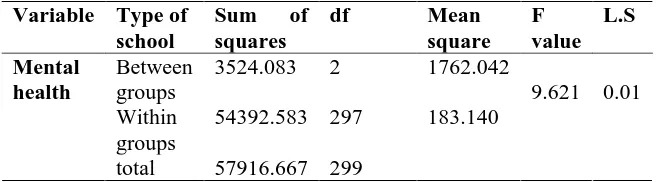
There is no significant difference of mental health among Higher secondary school studentsbased ontype ofschool.
Table 4 Comparison of mental health –type of school
Variable Type of school
Sum of squares
df Mean
square F value
L.S
Mental health
Between groups
3524.083 2 1762.042
9.621 0.01 Within
groups
54392.583 297 183.140
total 57916.667 299
0 50 100 150
High Moderate Low
Frequency
[image:4.595.134.464.656.747.2]DEC-JAN, 2017, VOL. 4/19 www.srjis.com Page 4272
From the above table, the calculated F-ratio(9.621)which is grater than the table
value at 0.01 level, there is a significantdifference in their mental health based on type of
school.
Table 4(a)
Mental health
‘t’-value L.S Type of
school N Mean SD
Men’s 50 76.10 11.079
3.43 0.01
Women’s 100 84.45 15.307
Men’s 50 76.10 11.079
0.76 NS
Co-ed 150 77.67 13.001 Women’s 100 84.45 15.307
3.76 0.01
Co-Ed 150 77.67 13.001
Analysis of mean difference between type of school was tested, which reveals that, in
the overall mental health, the students studying in women’s B.Ed., school have comparatively
high mental health than compared to the Higher secondary school students who are studying
in men’s and co – education school.
Graph showing Mental health –type of school
Hypothesis 5
There is no significant difference of Peer relationamong Higher secondary school
[image:5.595.132.449.360.491.2]studentsbased on type of management.
Table 5 Comparison of Peer relation-type of management
Variable Type of management
Sum of
squares df
Mean
square F - value L.S
Peer relation
Between
groups 14989.727 2 7494.863
24.380 0.01
Within
groups 91303.510 297 307.419
Total 106293.237 299
From the above table, the calculated F-ratio (24.380) which is greater than the table
value at 0.01 level, there is a significant difference in the administrative behaviour based on
type of management.
0 50 100
Mean
[image:5.595.106.491.576.658.2]DEC-JAN, 2017, VOL. 4/19 www.srjis.com Page 4273 Table 5(a)
Peer relation
‘t’-values L.S Type of
management N Mean SD
Government 100 115.95 17.890
6.418 0.01
Aided 100 130.32 13.463
Government 100 115.95 17.890
5.712 0.01
Self-financing 100 131.50 20.517
Aided 100 130.32 13.463
0.481 Ns
Self-financing 100 131.50 20.517
Analysis of mean difference between the type of management was tested, which
reveals that, in the overall Peer relation, the self – financing schoolB.Ed., students (131.50)
have comparatively high Peer relation than theHigher secondary school students who are
studying in government and aided schools.
Hypothesis 6
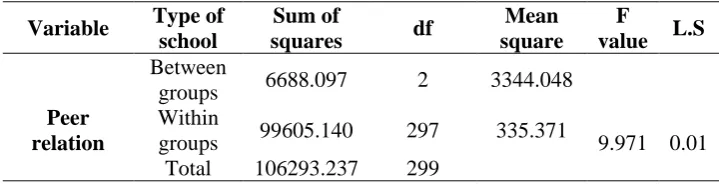
There is no significant difference of Peer relationamong Higher secondary school
[image:6.595.97.500.82.246.2] [image:6.595.117.477.411.503.2]studentsbasedon type of school.
Table 6Comparison of administrative behaviour – Type of school
Variable Type of school
Sum of
squares df
Mean square
F
value L.S
Peer relation
Between
groups 6688.097 2 3344.048
9.971 0.01 Within
groups 99605.140 297 335.371
Total 106293.237 299
From the above table, the calculated F -ratio(9.971) which is greater than the table
value, there is a significant difference in the Peer relationbased on type of school.
Table 6(a)
Analysis of mean difference between type of school was tested, which reveals that,in
the overallPeer relation, the higher secondary students trainees who are studying in Co –
Peer relation ‘t’-value L.S
Type of school
N Mean S.D
Men’s 50 115.50 15.194 3.61 0.01
Women’s 100 127.00 19.759
Men’s 50 115.50 15.194 4.60 0.01
Co-ed 150 128.68 18.253
Women’s 100 127.00 19.759 0.69 N.S
DEC-JAN, 2017, VOL. 4/19 www.srjis.com Page 4274
education school (128.50) significantly differ in their Peer relationthan the Higher secondary
school studentswho are studying in the Men’s and Women’s school.
Hypothesis 7
There is no significant difference of Peer relationamong Higher secondary school students
based on the location of the school.
Table 7 Comparison of administrative behaviour –location of school
Variable
Location of the school
N Mean SD ‘t’
value L.S
Peer relation
Rural 100 131.50 20.517 3.69
0.01
Urban 200 123.14 17.357
From the above table, the calculated ‘t’ value (3.69) which is greater than the table
value, there is a significant difference in the Peer relationbased on the location of the school.
Hence the null hypothesis is rejected.
Major Findings of the study:
1. The level of mental health among Higher secondary school students are high.
2. Female Higher secondary school studentshave higher Mental health than compared to
their counter parts.
3. Women’s schoolHigher secondary school students found to have comparatively
highmental health than compared to the higher secondary students trainees studying in
Men’s and Co – education B.Ed., schools.
4. The level of Peer relationamong Higher secondary school students is moderate in
nature.
5. Self – financing schoolhigher secondary students trainees found to have high Peer
relationthan compared to government and government aided Higher secondary school
students.
6. Co- education schoolHigher secondary school students found to have high Peer
relationthan compared to Men’s and Women’s schoolhigher secondary students
trainees.
7. Rural schoolHigher secondary school studentsfound to have high Peer relationthan
compared to urban schoolHigher secondary school students.
Suggestions for further study:
DEC-JAN, 2017, VOL. 4/19 www.srjis.com Page 4275
This study was undertaken at the level of Higher secondary school students only.
Other professional, university candidate and D.TEd.Studentscan also be tested in a
similar way.
Educational Implication:
The higher secondary students are considered to be the pillars of the educational
institutions. These higher secondary students should have an able efficiency in their contents,
class room control and also with the usage of varied educational strategies. Apart from these
skills, the higher secondary students must also have an emotional control and stability in their
profession. They must also understand the emotions of the students. This kind of efficiency as
well as emotional stability will bring positive impact about the higher secondary students
towards the students. Therefore this type of skills has to be inculcated during the course of
higher secondary students training. Apart from emphasising on the academics other
competency towards the professional development of the higher secondary students can be
enumerated for the betterment of teaching and learning process.
Conclusion:
The purpose of the present study was to investigate the mental health and Peer
relationamong Higher secondary school students. The mental health and Peer relationof the
Higher secondary school students can be enhanced by adopting the skills and implementing
the strategies required for the inculcation ofemotional qualities apart from the academics
during the period of training.
Bibliography:
Annamalai A.R. 2000. Attitude of higher secondary students towards teaching, experiment in education, Vol.XXVIII 94, 69-71
Bandaru A., C.R.Force, et al 1999. The dimensions of student perception of Teaching Effectiveness, Educational and Psychological Measurement, Vol.59 p 580-597
Galluzzo 2005. Study on Mental health and Higher secondary students behaviour, article in journal of
Education research, Vol IV, 40-52