R E S E A R C H
Open Access
Transfer Entropy Estimation and Directional
Coupling Change Detection in Biomedical
Time Series
Joon Lee
1*, Shamim Nemati
2,3, Ikaro Silva
1, Bradley A Edwards
3, James P Butler
3and Atul Malhotra
3* Correspondence: joonlee@mit. edu
1Harvard-MIT Division of Health Sciences and Technology, Cambridge, MA, USA Full list of author information is available at the end of the article
Abstract
Background:The detection of change in magnitude of directional coupling between two non-linear time series is a common subject of interest in the
biomedical domain, including studies involving the respiratory chemoreflex system. Although transfer entropy is a useful tool in this avenue, no study to date has investigated how different transfer entropy estimation methods perform in typical biomedical applications featuring small sample size and presence of outliers. Methods:With respect to detection of increased coupling strength, we compared three transfer entropy estimation techniques using both simulated time series and respiratory recordings from lambs. The following estimation methods were analyzed: fixed-binning with ranking, kernel density estimation (KDE), and the Darbellay-Vajda (D-V) adaptive partitioning algorithm extended to three dimensions. In the simulated experiment, sample size was varied from 50 to 200, while coupling strength was increased. In order to introduce outliers, the heavy-tailed Laplace distribution was utilized. In the lamb experiment, the objective was to detect increased respiratory-related chemosensitivity toO2andCO2 induced by a drug, domperidone. Specifically,
the separate influence of end-tidalPO2andPCO2 on minute ventilation(VE˙ )before
and after administration of domperidone was analyzed.
Results:In the simulation, KDE detected increased coupling strength at the lowest SNR among the three methods. In the lamb experiment, D-V partitioning resulted in the statistically strongest increase in transfer entropy post-domperidone for
PO2→ ˙VE. In addition, D-V partitioning was the only method that could detect an increase in transfer entropy forPCO2→ ˙VE, in agreement with experimental
findings.
Conclusions:Transfer entropy is capable of detecting directional coupling changes in non-linear biomedical time series analysis featuring a small number of
observations and presence of outliers. The results of this study suggest that fixed-binning, even with ranking, is too primitive, and although there is no clear winner between KDE and D-V partitioning, the reader should note that KDE requires more computational time and extensive parameter selection than D-V partitioning. We hope this study provides a guideline for selection of an appropriate transfer entropy estimation method.
Introduction
In multi-variable time series analysis, a common subject of interest is the coupling among the variables. One promising measure of the coupling strength between two time series is transfer entropy [1,2], which quantifies the amount of information trans-fer from one variable to the other. Importantly, transtrans-fer entropy is non-parametric and can capture non-linear coupling effects. This property can be useful in analyzing com-plex systems where interactions among sub-systems are expected to be non-linear and where minimal a priori knowledge is available. Furthermore, transfer entropy is an asymmetric measure that conveys directional information. Unlike mutual information, which can only quantify the amount of shared information between two variables, transfer entropy can elucidate directional relationships between variables. In fact, it has been shown that transfer entropy is a non-linear extension of Granger causality [3].
Given all these advantages, transfer entropy has been gaining popularity as a power-ful analytic tool for characterizing complex physiologic networks. For instance, this new method has been suggested [4] and successfully applied to electroencephalograms and magnetoencephalograms to help elucidate complex neural phenomena such as consciousness under anesthesia [5], sensory functional integration [6], auditory neural assembly [7], attention related processing [8], and sensor-motor connectivity [9]. In the area of cardiovascular physiology, Katura and colleagues [10] have utilized the techni-que of transfer entropy to elucidate (or reject) causal relationships that explain sources of variability in the regulation of cerebral hemodynamics. In addition, a number of stu-dies have employed variations of transfer entropy, such as cross-conditional entropy and conditional mutual information, to investigate relationships between cardiovascular variables as indicator of baroreflex function [11-14]. Conditional mutual information has been shown to be equivalent to transfer entropy [15].
In practice, one major challenge with transfer entropy estimation using biomedical signals is the estimation of Probability Density Functions (PDFs) from finite data with outliers. This estimation challenge is well discussed in [2,16]. Small sample size can stem not only from experimental and/or technical constraints but also from the need for stationarity; a non-stationary time series may have to be broken into quasi-station-ary segments before analysis. This sample size issue can be a major hindrance for bio-medical studies where data collection is often costly. Also, outliers frequently originate from either noise sources or underlying physiology.
Specifically, we studied three non-parametric techniques in this endeavor: fixed-bins, Kernel Density Estimation (KDE), and adaptive partitioning. The fixed-bin approach, in which a given time series is quantized by dividing the dynamic range into equally-spaced bins, is the simplest method that boasts the least computational complexity at the cost of inefficient bin allocation [16]. KDE has been shown to perform well in mutual information estimation using short time series [17] and hence was included in our study. For adaptive partitioning, we introduce a novel method that applies the Dar-bellay-Vajda (D-V) partitioning algorithm [18] to transfer entropy estimation. The D-V partitioning algorithm is equivalent to the adaptive partitioning introduced by Fraser and Swinney [2,19] and has been shown to be effective in mutual information estima-tion [20].
The comparison among the three transfer entropy estimation techniques was accom-plished via both simulated and real-life signals. In both experiments, we analyzed the sensitivity of the techniques to increased non-linear coupling strength, under small sample size and presence of outliers. The purpose of the simulated experiment was to perform a rigorous comparison in a controlled setting. In order to address any cou-pling characteristics that were not represented by the simulated data, we also applied the transfer entropy estimation methods to measurements of spontaneous breathing respiratory flow, end-tidal carbon dioxide pressure (PCO2) and end tidal oxygen pres-sure (PO2), collected from lambs [21]. The objective of the lamb experiment was to detect changes in chemosensitivity, which is of major clinical interest. The method of transfer entropy provides a natural framework for quantification of directional influ-ence that breath-by-breath changes in blood gases have on ventilation (via peripheral chemoreceptors located in the aortic arch and carotid bodies), while taking into account the delayed nature of the response (due to lung-to-chemoreceptors transport time, typically on the order of 2-4 breaths) and possible non-linearities [22]. Ventila-tory control instabilities are important in a variety of pathological conditions, including Cheyne-Stokes breathing in congestive heart failure [23,24] and obstructive sleep apnea [25-27]. Although the specific mechanisms underlying each condition may vary, increases in the ventilatory sensitivity to hypoxia/hypercapnia (controller gain) have been shown to play a critical role in the pathogenesis of unstable breathing. An ele-vated hypoxic ventilatory response at high altitude is associated with the presence of unstable breathing [28]. Moreover, heightened dynamic hypercapnic responses deline-ate heart failure patients with periodic breathing (in the form of Cheyne-Stokes respiration) from those patients that exhibit stable breathing [29-31]. Additionally, in heart failure patients, elevated hypoxic and/or hypercapnic sensitivity [32] and the con-sequent presence of Cheyne-Stokes respiration itself [33] are important predictors of mortality.
Methods
Transfer Entropy Construction
Given two concurrently sampled time series X= {x1,x2, . . .,xN} andY= {y1,y2, . . ., yN}, the transfer entropy fromX to Y, termedTX®Y, can be derived from conditional
entropies as follows:
TX→Y=H(yi|yi(−l)t)−H(yi|y
(l)
i−t, x
(k)
=
yi,yi(−l)t,x
(k)
i−τ
pyi,y(i−l)t,x(i−k)τlog
p
yi|y(l)
i−t,x
(k)
i−τ
pyi|yi(−l)t
, (2)
where iindicates a given point in time,τandtare the time lags in XandY, respec-tively, and kand l are the block lengths of past values inX andY, respectively (see Appendix I for a complete derivation). The past values on which the conditional
prob-abilities in (2) are conditioned are x(i−k)τ ={xi−τ−k+1, xi−τ−k+2, . . ., xi−τ} and
yi(−l)t ={yi−t−l+1, yi−t−l+2, . . ., yi−t}. In words, (1) implies that transfer entropy measures
the reduction in uncertainty in yi givenx(i−k)τandyi(−l)t in comparison with given only yi(−l)t. Note that TX®Y cannot be negative becauseH(yi|y(i−l)t)≥H(yi|y(i−l)t,x(i−k)τ)in (1); conditioning on another variable,x(i−k)τ, cannot increase the uncertainty inyi. (Note that
if base 2 logarithm is used, the unit of transfer entropy is bits, which has the interpre-tation of the amount of reduction in the average length of the optimal code needed to encode the target variable.)
Equation (2) is the most general definition of transfer entropy and provides maxi-mum flexibility. However, the usual parameter choices in practice are k= 1 andl= 1 for computational reasons when sample size is small. In addition, here we set t= 1 under the assumption that the maximum auto-transfer of information occurs from the data point immediately before the target value in Y. For example, Francis et al. only considered lags of one breath in ventilation andCO2 for the same reason [30]. These choices of k =l=t = 1 are especially appropriate in biomedical experiments where time series length is usually short and the absolute values of auto-correlation functions tend to decrease monotonically as time lag increases. Also, the original definition in [1] implicitly assumed t = 1 by using a Markov chain; our choice can be seen as a first-order Markov process. Hence, we restrict the focus of this paper to these usual parameter choices by simplifying (2) to
TX→Y(τ) =
yi,yi−1,xi−τ
p(yi, yi−1, xi−τ) logp(yi|yi−1,xi−τ)
p(yi|yi−1) (3)
=
yi,yi−1,xi−τ
p(yi, yi−1, xi−τ) log
p(yi,yi−1,xi−τ)p(yi−1)
p(yi−1,xi−τ)p(yi,yi−1)
. (4)
Note that (3) and (4) explicitly show transfer entropy as a function ofτ.
In practice, the foremost challenge in transfer entropy computation is estimating the joint probabilities in (4). The ensuing section describes the three different PDF estima-tion methodologies to be investigated in this study.
Probability Density Function Estimation Methodologies
Fixed Bins
tests. The ranks are integers ranging from 1 (smallest value) to N(largest value). Let the transformed time series of X andYbe U= {u1, u2, . . .,uN} andV= {v1,v2, . . .,
vN}, respectively (UandVcontain integers that represent ranks).
Then, (4) can be rewritten in terms ofUandVas follows:
TU→V(τ) =
vi,vi−1,ui−τ
p(vi, vi−1, ui−τ) log
p(vi,vi−1,ui−τ)p(vi−1)
p(vi−1,ui−τ)p(vi,vi−1)
. (5)
Using the same number of bins,Q, in each dimension for simplicity, the fixed-bin technique estimates (5) as follows:
TU→V(τ)≈ Q
a=1,b=1,c=1
ma,b,c P log
ma,b,cmb
mb,cma,b
, (6)
where a, b, and cindex bins along vi,vi-1, andui-τ, respectively, and Pis the total number of triplets ofvi, vi-1, andui-τ. Furthermore,ma,b,c,ma,b, and mb,crepresent the number of data points in the intersection of the one-dimensional bins denoted by the subscript, whereas mbis the number of data points in the bth bin along the vi-1 dimension.
Kernel Density Estimation
In KDE, the PDF is estimated by summing individual distributions centered at each data point. The shape of the individual distributions is dictated by a chosen kernel, the magnitude of which decreases as the distance from the center of the distribution increases. Since distance is a crucial measure in KDE, ordinal sampling is not employed. In the three-dimensional space of yi, yi-1, andxi-τ, the joint probability at an
arbitrary point,(yi˜,yi˜−1,xi˜−τ), can be estimated by normalizing the following:
p(˜yi, ˜yi−1, ˜xi−τ)≈1P P
j=1
1
hyihyi−1hxi−τ
K ˜
yi−yi,j
hyi
K
˜
yi−1−yi−1,j
hyi−1
K ˜
xi−τ−xi−τ,j
hxi−τ
, (7)
where jindexes thePdata points andh(·)is the bandwidth for the dimension speci-fied in the subscript. We utilized a scaled version of the rule of thumb specispeci-fied in [34] to select the bandwidth:
h(·)= 1.06ασˆP−1/5, (8)
where ais a multiplier for scaling and σˆ is the sample standard deviation in the given dimension. In terms of K, several possible kernels exist but we employed the widely used Gaussian kernel in this study, which is defined as follows:
K(u) = √1 2πe
−0.5u2
(9)
The rest of the probabilities in (4) can be computed by marginalizing p(yi˜, yi˜−1, xi˜−τ).
Adaptive Partitioning using the Darbellay-Vajda Algorithm
We introduce an extension of the D-V algorithm to three-dimensional space for trans-fer entropy estimation. After ordinal sampling, the D-V algorithm recursively partitions the three-dimensional space defined by vi, vi-1, and ui-τ into cubes of varying sizes.
computed to test the null hypothesis that data points are evenly distributed across the 8 cubes:
sχ2 =
8
i=1
(Mi−μM)2, (10)
whereM1,M2, . . .,M8are the numbers of data points contained in the 8 cubes and
μMis the total number of data points divided by 8 (number of cubes). Ifsχ2 > χ2
95%(7)
(at a 5% significance level and 7 degrees of freedom), then the null hypothesis is rejected and each of the 8 cubes is further partitioned into 8 smaller cubes in the same manner, and the recursion continues. If the null hypothesis is not rejected, the parti-tions in the current iteration are discarded and the current 8 cubes under scrutiny as a whole are taken as one partition. Cubes that contain no data point do not contribute to the transfer entropy estimation.
Appendix II shows a two-dimensional analogy of a partitioned space. It was gener-ated based on 1,000 data points randomly sampled from a bivariate Gaussian distribu-tion with covariance sxy= 0.9 and unit variance, σx2= 1andσy2= 1. Note that many squares with smaller sizes are allocated to densely populated parts of the space, whereas fewer partitions are created in sparse areas.
The result of the partitioning process is a finite number of cubes, L, each of which contains nonzero data points. By approximating each probability in (5) by counting, TU®V(τ) can now be estimated using theLpartitions as follows:
TU→V(τ)≈ L
k=1
nk P log
nknvi−1 k nvi−1,ui−τ
k n
vi,vi−1 k
, (11)
where Pis the total number of data triplets (vi, vi-1, andui-τ), nk is the number of
data points in the kth partition, andnvi−1 k ,n
vi,vi−1 k , andn
ui−τ,vi−1
k are the numbers of data points in the entire data that are greater than or equal to lower bounds and less than upper bounds of the kth partition with respect to the dimensions in the superscript. For example, if thekth partition’s lower and upper limits invi-1are 5 and 10, thennvki−1 is the total number of data points such that 5 ≤vi-1 < 10, regardless of theirviandui-τ
coordinates.
Our transfer entropy estimation method with D-V partitioning has been implemen-ted in MATLAB, and we made the code and an example data set (from the simulaimplemen-ted experiment described in the next section) publicly available at PhysioNet [35] (http:// physionet.org).
Experiments
Simulation
The source time series,X= {x1,x2, . . .,xN+2} and the corresponding sink time series,Y = {y1,y2, . . .,yN+2}, were generated as follows:
where the signal (sx,iandsy,i) and noise components (νx,iand νy,i) are sx,i∼N(10, 1)
sy,i= (a·sx,i−2)2
νx,i∼L(0,bx) νy,i∼L(0,by),
(12)
where ~ denotes sampling from a distribution,ais a coupling constant, and N and Lrepresent the Gaussian (mean, variance) and Laplace (mean, scale) distributions, respectively. The Laplace distribution is an example of a heavy-tailed statistic and thus can better model the type of noise often encountered in physiological signals compared with Gaussian noise (e.g., occasional sighs and apneas in a ventilation time series or muscle artifacts in electrocardiography (ECG) recordings [36]). Equation (12) imposed a nonlinear relationship between Xand Y(via the squaring) at a time lag of two. Sam-ple size, N, was varied from 50 to 200 at a step of 50, representing the focus of this experiment on small sample size. Note that the lengths ofX andYwere N+ 2 due to the lag of 2;xN+1,xN+2,y1, andy2were discarded during transfer entropy estimation.
The coupling strength between X andYwas varied by increasing the signal-to-noise ratio (SNR) in both time series from 10 to 20 dB in steps of 1 dB. This increase in SNR was induced by increasing the coupling constant a. In order to maintain the same SNR in both X andY, the noise power inX was gradually reduced by decreasingbx while holding the signal power constant, whereas the signal power in Ywas gradually increased by increasingaaccordingly while holding the noise power (i.e.,by) constant.
As the first step, we analyzed transfer entropy vs. time lag (τ, from 0 to 5 in steps of 1) with SNR = 20 dB and N= 200 using all three estimation methods. This analysis served not only as a comparison among the methods but also as a parameter selection step for the fixed-bin (Qwas varied from 4 to 10 in steps of 2) and KDE (awas varied from 0.5 to 1.5 in steps of 0.25) methods.
With the selected values for the parametersQanda, XandYwere randomly gener-ated 100 times at each SNR level and the corresponding transfer entropies were com-puted using all three methods. Subsequently, one-sided Wilcoxon rank sum tests were conducted to judge whether there was a significant increase in transfer entropy at each step of increase in SNR with p< 0.05 considered to be statistically significant.
An Application to Respiratory Physiology
Using the three transfer entropy estimation methods, we quantified the impact of the administration of domperidone, a dopamineD2-receptor antagonist that increases car-otid body sensitivity to O2 and CO2 [21]. We performed our analysis on recordings from 14 newborn lambs obtained at Monash University, Australia [21]. All surgical and experimental procedures conformed to the guidelines of the National Health and Medical Research Council of Australia and had the approval of the Standing Commit-tee in Ethics in Animal Experimentation of Monash University.
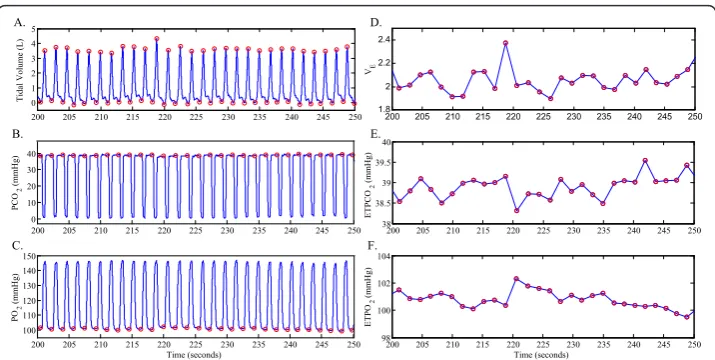
Measurements of spontaneous breathing respiratory flow, end-tidalPCO2and end-tidalPO2were obtained for a period of approximately 10 minutes before and following the intravenous administration of domperidone. Minute ventilation(VE˙ )was calculated for each breath asVT/Ttot, whereVTis tidal volume andTtotis breath duration (see
data ofVE˙ , end-tidalPCO2and end-tidalPO2were further band-pass filtered to remove any oscillations slower than (i.e., more breaths/cycle than) 20 breaths/cycle or faster than (i.e., fewer breaths/cycle than) 5 breaths/cycle (using a 7th-order Butterworth digi-tal filter with band-pass frequency of 0.05-0.2 cycles/breath). The frequencies included in the resulting band-passed time series are consistent with the range of oscillations often observed during periodic breathing [21,25]. All extracted time series included at least ~ 200 data points. In a few cases where longer observations were available, the time series were divided into non-overlapping windows of size ~ 200 data points and the win-dow with the largest variance was selected for further analysis. Our rationale behind this choice of data segment selection was to characterize the system at its most variable (or unstable) state during spontaneous breathing (see [37] for more information).
The three transfer entropy estimation methods were applied to the VE˙ , PO2, and PCO2time series from each lamb. Specifically, the following two directional informa-tion flows were investigated before and after the administrainforma-tion of domperidone: PO2→ ˙VEandPCO2→ ˙VE. Unlike the simulation experiment, the time lagτat which
a significant coupling exists was unknown a priori. Hence, τwas varied between one and five breaths and the results for the time lag at which the value of transfer entropy was the largest and statistically significant were reported. Significant information flows were determined by Monte Carlo surrogates, i.e., temporally shuffled time series. In this experiment, transfer entropies were computed for 100 surrogates of the source time series (PO2or PCO2), and the transfer entropy from the original source time ser-ies was deemed to be significant if it was greater than the 95th percentile of the surro-gate results (as described in [38]). If no τ value resulted in a significant information flow, that particular time series pair was removed from further analysis. There was dif-ficulty in selecting optimalQandavalues for the fixed-bin and KDE methods, respec-tively, due to the lack of a priori knowledge regarding coupling time lag. Therefore, arbitrary, but reasonable, choices ofQ= 5 anda = 1 were made. Finally, increases in
200 205 210 215 220 225 230 235 240 245 250 0 1 2 3 4 5 Tidal Vol um e (L)
200 205 210 215 220 225 230 235 240 245 250 0 10 20 30 40 PCO 2 (m m Hg)
200 205 210 215 220 225 230 235 240 245 250 100 110 120 130 140 150 Time (seconds) P O2 (m m Hg)
200 205 210 215 220 225 230 235 240 245 250
1.8 2 2.2 2.4
VE
200 205 210 215 220 225 230 235 240 245 250 38 38.5 39 39.5 40 ETPCO 2 (m m Hg)
200 205 210 215 220 225 230 235 240 245 250 98 100 102 104 Time (seconds) ETPO 2 (m m Hg) A. B. D. E. C. F.
coupling strength caused by domperidone were tested using the Wilcoxon signed rank sum test.
Results
Simulated Experiment
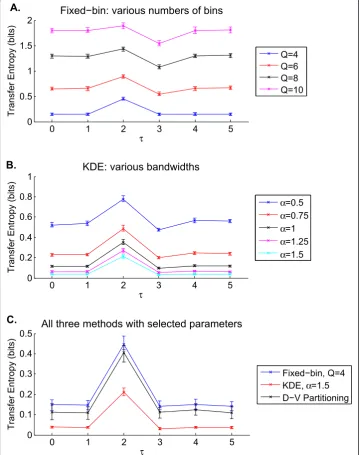
Figure 2 shows how the three transfer entropy estimation methods performed whenτ was varied from 0 to 5 with N= 200 and SNR = 20 dB in the simulated experiment.
0 1 2 3 4 5
0 0.5 1 1.5
2 Fixed−bin: various numbers of bins
τ
Transfer Entropy (bits)
Q=4 Q=6 Q=8 Q=10
0 1 2 3 4 5
0 0.2 0.4 0.6 0.8
1 KDE: various bandwidths
τ
Transfer Entropy (bits)
α=0.5 α=0.75 α=1 α=1.25 α=1.5
0 1 2 3 4 5
0 0.1 0.2 0.3 0.4
0.5 All three methods with selected parameters
τ
Transfer Entropy (bits)
Fixed−bin, Q=4 KDE,α=1.5 D−V Partitioning
C. B. A.
Panels A and B illustrate transfer entropy estimation for different values ofQandafor the fixed-bin and KDE methods, respectively. Since one expects to see near zero transfer entropies atτvalues other than 2,Q= 4 anda= 1.5 were selected for the rest of the experiment. Panel C of Figure 2 compares the three methods using the selected para-meter values. All three methods allowed one to visually distinguish τ= 2 from other time lags. KDE was better at estimating low transfer entropies atτ≠2 at the cost of a reduced transfer entropy atτ= 2. Fixed-binning and D-V partitioning performed com-parably, although D-V partitioning yielded lower transfer entropies atτ≠2.
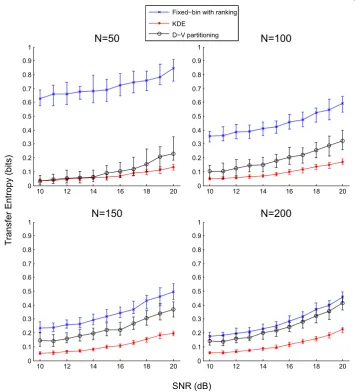
The main results of the simulated experiment are shown in Figure 3 which illustrates the estimated transfer entropies from the 100 trials as a function of SNR. Following from Figure 2, Q= 4 and a= 1.5 for the fixed-bin and KDE methods, respectively. Overall, the fixed-bin method estimated higher transfer entropies at all lags than the
10 12 14 16 18 20
0 0.1 0.2 0.3 0.4 0.5 0.6 0.7 0.8 0.9
1 N=50
10 12 14 16 18 20
0 0.1 0.2 0.3 0.4 0.5 0.6 0.7 0.8 0.9
1 N=100
10 12 14 16 18 20
0 0.1 0.2 0.3 0.4 0.5 0.6 0.7 0.8 0.9
1 N=150
SNR (dB)
Trans
fer Entropy
(bits
)
10 12 14 16 18 20
0 0.1 0.2 0.3 0.4 0.5 0.6 0.7 0.8 0.9
1 N=200
Fixed−bin with ranking KDE
D−V partitioning
other two methods, which was improved as Nincreased. KDE showed the smallest dynamic range in transfer entropy as SNR increased but was also associated with the smallest estimation variance at any given SNR. In fact, estimation variance with KDE was similar across different sample sizes, whereas the other two methods resulted in improved estimation variance asNincreased.
Table 1 tabulates the one-sided rank sum test results of Figure 3 for detection of sta-tistically significant increases in coupling strength. The two compared SNR levels are shown and statistically significant increases in transfer entropy were found to be sus-tained at and beyond the indicated SNR levels. In Table 1 all methods show the trend of detecting increased coupling at a lower SNR as Nincreases. Overall, KDE outper-formed the other two methods in sensitivity to increasing coupling strength; for N≥ 100, KDE was able to distinguish 11 dB (a= 1.059) and 12 dB (a= 1.122). Although D-V partitioning was able to detect increases in transfer entropy at a lower SNR than the fixed-bin method when N= 50, the fixed-bin method slightly outperformed D-V partitioning at otherNvalues.
Respiratory Physiology Experiment
Figure 4 illustrates how the estimated transfer entropy values changed for PCO2→ ˙VE
and PO2→ ˙VE(first and second row, respectively), before ("Control”) and after
("Dom-peridone”) the administration of domperidone. The first, second, and third columns correspond to the fixed-bin, KDE, and D-V partitioning methods, respectively. Each closed circle represents one lamb, and the pre- and post-domperidone transfer entro-pies from the same lamb are connected with a straight line. Hence, we expect to see as many lines with a positive slope as possible. The number of subjects (N) varied among the different estimation methods as well as between pre- and post- domperidone since some cases did not pass the surrogate significance test. The group statistics are shown by the box plots.
Figure 4 shows that all three techniques were able to detect a statistically significant increase in transfer entropy for PO2→ ˙VE(interpreted as increased chemosensitivity)
post-domperidone. However, the D-V partitioning technique indicated the statistically strongest increase in transfer entropy following domperidone administration (p< 0.01). Moreover, only D-V partitioning detected a significant increase in the PCO2→ ˙VE
chemosensitivity post-domperidone (p< 0.05).
There are three other notable findings in Figure 4. First, fixed-binning led to higher transfer entropy values for both control and domperidone cases than the other two techniques. Second, unlike the simulation results, KDE did not show smaller estimation variance than the other two methods. Third, domperidone administration increased the range in transfer entropy in most panels in Figure 4.
Table 1 Simulated experiment: minimum SNR associated with sustained detection of statistically significant increases in transfer entropy
N Fixed-bin KDE D-V partitioning
50 18®19 dB 15®16 dB 17®18 dB
100 15®16 dB 11®12 dB 17®18 dB
150 13®14 dB 11®12 dB 16®17 dB
200 11®12 dB 11®12 dB 13®14 dB
Discussion
In this paper, D-V partitioning was extended to three dimensions and, along with ranking, was used in the framework of transfer entropy estimation. Also, a comparison among three transfer entropy estimation techniques (namely traditional fixed-binning with ranking, state-of-the-art KDE, and adaptive partitioning) was conducted via a simulated experiment and an application to respiratory physiology. The focus of both studies was to investigate the methods’ability to detect increases in directional cou-pling strength under small sample size and outliers which are commonly encountered in biomedical studies. Although KDE detected increases in coupling strength at the lowest SNR level across different sample sizes in the simulation, D-V partitioning out-performed the other two methods in detecting increased chemosensitivity caused by domperidone in the lamb experiment. The respiratory chemoreflex system was a suita-ble example of non-linearity and non-stationarity. Several authors have reported evi-dence for non-linearity in the respiratory chemoreflex system [22,39]. Non-stationarity may also arise as a result of fluctuations in other variables/parameters such as cardiac output, respiratory rate, sleep-state, arousal-related changes in respiratory mechanics and the chemical control system, behavioral factors, or interventions. The application to respiratory physiology in this article demonstrated that the adaptive-partitioning-based transfer entropy estimation technique was more sensitive to increases in
0 0.2 0.4 0.6 0.8 1 TPCO 2 oV E
Ranking + Fixed-binning
0 0.2 0.4 0.6 0.8 1 Control Domperidone TPO 2 oV E 0 0.2 0.4 0.6 0.8 1 Control Domperidone 0 0.2 0.4 0.6 0.8 1 KDE 0 0.2 0.4 0.6 0.8 1 Control Domperidone 0 0.2 0.4 0.6 0.8 1 Partitioning A. B. C. D. E. F. N=9 N=10 N=14 N=13 N=11 N=12 N=14 N=14 N=10 N=11 N=13 N=14 † † †† † (bits) (bits)
coupling strength for both the PCO2 and PO2 chemosensitivity than the other two methods. These results, which are based on non-invasive measurements of sponta-neous breathing ventilatory variables, are in agreement with the experimental findings of Edwards and colleagues [21] based on the traditional hypercapnic and hypoxic responses (i.e., ratio of change in ventilation in response to an incremental increase in PCO2 or decrease in PO2 in the inspired air). Therefore, transfer entropy has the potential to be a useful surrogate marker of chemosensitivity, and may provide physiol-ogists and physicians with a non-invasive tool to track patient response to pharmacolo-gical interventions (e.g., Acetazolamide).
Strictly speaking, transfer entropy measures the coupling strength of a causal link between two time series at a specific time lag and thus makes it difficult to attribute any observed change in transfer entropy to changes in chemosensitivity. For example, Porta et al. have also shown that cross-conditional entropy can be high with a rela-tively low level of baroreflex sensitivity [11]. Thus, any interchangeability in the cur-rent study between transfer entropy and chemosensitivity requires further investigation, since it is possible to increase transfer entropy by, for example, improv-ing the SNR in the data acquisition system under the same level of chemosensitivity or changing the operating point of the feedback system in the direction of an improved SNR. The simulation corroborated the lamb experiment by enabling a con-trolled comparative analysis. For example, unlike the lamb experiment, the simulated experiment allowed us to control the amount of noise and forced the signals to be sta-tionary throughout. Furthermore, the square function and Laplace noise simulated a non-linear coupling relationship and real-life noise, respectively, that are easy to inter-pret and control.
Both fixed-binning and D-V partitioning incorporated ordinal sampling, or ranking, which should have at least partially dealt with outliers and multi-modal PDFs. The only difference between the two methods is in how the three-dimensional space is par-titioned, and here the efficient bin allocation of the D-V partitioning algorithm becomes a substantial advantage. Under non-uniform distributions that exhibit multi-ple peaks or varying concentrations of data points, fixed-binning is destined to func-tion inefficiently by allocating fixed-size bins from the minimum to maximum observed values. On the other hand, the D-V partitioning adaptively adjusts bin size according to how evenly data are distributed in a given sub-region of the data space. The expected effectiveness of adaptive partitioning increases with greater deviation from a uniform distribution, and this advantage could partially explain the improved performance of the D-V partitioning method in the lamb experiment in comparison with the simulation.
The block lengths kand l as well as the time lag twere fixed at 1 in the current study similar to previous studies quoting computational reasons, despite the known limitation that transfer entropy is expected to be underestimated [1,38]. In cases where data size is sufficiently large and computational tractability is not a concern, one can attempt to optimize k,l, andt. For instance, Faes et al. discussed a greedy approach for conditional entropy that selects an optimal conditional pattern consisting of past data from two or more related signals [12]. Porta et al. studied the effects of condi-tional pattern length on cross-condicondi-tional entropy [40]. With respect to computacondi-tional time, the three different methods are ranked in the following ascending order: fixed-bin, D-V partitioning, and KDE. Although KDE performed very well in the simulated experiment, the necessity to compute the distance between a given point and every point in the data set along each dimension makes it computationally intensive. How-ever, it is worthwhile noting that computational time is not a major limiting factor in most research studies that only require retrospective analysis.
In a number of biomedical studies, small sample size and presence of outliers are often closely associated with physiological dynamics. A common focus of many research studies is to investigate how physiological systems behave under different con-ditions or respond to external interventions, naturally formulating a non-stationary problem. One way to analyze a non-stationary time series is to segment them into quasi-stationary intervals. This limits the number of data points in each segment and leads to the small sample size problem. This can be a major challenge to many para-meter estimation algorithms in presence of noise, because they often require suffi-ciently long observations. In addition, physiological systems tend to exhibit non-linear behaviors which may cause the state of the system to abruptly change from its steady-state baseline, producing outliers. These outliers, originating from underlying physiolo-gical phenomena rather than noise, convey meaningful value and hence should not be removed for mere computational convenience. We remind the reader that our simu-lated experiment explicitly investigated the issues of small sample size and of outliers.
Conclusions
In this article, we have shown that transfer entropy can detect changes in directional coupling between two biomedical time series. We have extended D-V partitioning to transfer entropy estimation and compared the performance of three transfer entropy estimation methods in detection of increased coupling strength: fixed-binning with rank-ing, KDE, and D-V partitioning with ranking. Based on the results of this study, fixed-binning, even with ranking, failed to clearly outperform the other two methods, while the comparison between KDE and D-V partitioning was inconclusive. However, D-V partitioning may be the most attractive option after taking into account computational time and the difficulty associated with parameter selection. We hope that this study pro-vides a helpful guideline in selecting an appropriate transfer entropy estimation method.
Appendix I
Given two concurrently sampled time series X= {x1,x2, . . .,xN} andY= {y1,y2, . . ., yN}, the conditional entropyH(xi|yi) is defined as:
H(xi|yi) =
xi,yi
p(xi, yi) log p(yi)
Note that H(xi| yi)≥ 0. Then, the transfer entropy fromXtoY, termedTX®Y, can
be derived from conditional entropies as follows:
TX→Y=H(yi|y(i−l)t)−H(yi|y(i−l)t, x
(k)
i−τ)
=
yi,y(i−l)t
p(yi, yi(−l)t) log
p(y(i−l)t)
p(yi,y(i−l)t)
−
yi,y(i−l)t,x
(k)
i−τ
p(yi, y(i−l)t,x
(k)
i−τ) log
p(x(i−τk),yi(−l)t)
p(yi,y(i−l)t,x
(k)
i−τ)
. (13)
But since p(yi, yi(−l)t) =x(k)
i−τp(yi, y (l)
i−t, x
(k)
i−τ), the two arguments in the separate sum-mations can be combined. Thus,
TX→Y=
yi,y
(l)
i−t,x
(k)
i−τ
p(yi, y(i−l)t, x(i−k)τ) logp(y (l)
i−t)p(yi,y
(l)
i−t,x
(k)
i−τ)
p(yi,y(i−l)t)p(yi(−l)t,x(i−k)τ)
=
yi,y(i−l)t,x
(k)
i−τ
pyi, y
(l)
i−t, x
(k)
i−τ
log
pyi|y(i−l)t,x(i−k)τ
p
yi|y(i−l)t
.
Appendix II
Figure 5 shows a two-dimensional visualization of D-V partitioning. The space con-tains 1,000 data points sampled from a bivariate Gaussian distribution with sxy= 0.9, σ2
y = 1, and σy2= 1. This figure shows the transformed data space after ordinal
0 100 200 300 400 500 600 700 800 900 1000
0 100 200 300 400 500 600 700 800 900 1000
U
V
sampling. The proposed transfer entopy estimation with the D-V partitioning algo-rithm extends this kind of partitioning to three dimensions.
Acknowledgements
This research work was funded by the National Institutes of Health (NIH) (through grant numbers EB001659, R01-HL73146, HL085188-01A2, HL090897-01A2, K24 HL093218-01A1, cooperative agreement U01-EB-008577, and training grant T32-HL07901) and American Heart Association (AHA) (grant 0840159N). Dr. Lee holds a Postdoctoral Fellowship funded by the Natural Sciences and Engineering Research Council of Canada (NSERC). Dr. Edwards is the recipient of the Thoracic Society of Australia and New Zealand/Allen and Hanburys Respiratory Research Fellowship. The content of this document is solely the responsibility of the authors and does not necessarily represent the official views of the NIH, AHA, or NSERC. The authors would also like to thank Professor George Verghese for his helpful comments.
Author details 1
Harvard-MIT Division of Health Sciences and Technology, Cambridge, MA, USA.2Massachusetts Institute of Technology, Cambridge, MA, USA.3Harvard Medical School, Division of Sleep Medicine, Brigham and Women’s Hospital, Boston, MA, USA.
Authors’contributions
JL and SN conceived of the study, developed and implemented the D-V partitioning transfer entropy estimation algorithm, conducted the experiments, and wrote the entire manuscript. IS conceived of the study, contributed to the algorithm development, and wrote parts of the manuscript. BE supplied the lamb data and rigorously revised the manuscript. JB and AM thoroughly revised the manuscript.
Competing interests
The authors declare that they have no competing interests.
Received: 30 November 2011 Accepted: 13 April 2012 Published: 13 April 2012
References
1. Schreiber T:Measuring information transfer.Physical Review Letters2000,85(2):461-464.
2. Hlavackova-Schindler K, Palus M, Vejmelka M, Bhattacharya J:Causality detection based on information-theoretic approaches in time series analysis.Physics Reports2007,441:1-46.
3. Barnett L, Barrett AB, Seth AK:Granger causality and transfer entropy are equivalent for Gaussian variables.Physical Review Letters2009,103(23):238701.
4. Rubinov M, Sporns O:Complex network measures of brain connectivity: uses and interpretations.NeuroImage2010, 52(3):1059-1069, [http://www.ncbi.nlm.nih.gov/pubmed/19819337].
5. Alkire MT, Hudetz AG, Tononi G:Consciousness and anesthesia.Science2008,322:876-880, [http://dx.doi.org/10.1126/ science.1149213].
6. Vakorin VA, Kovacevic N, McIntosh AR:Exploring transient transfer entropy based on a group-wise ICA decomposition of EEG data.NeuroImage2010,49(2):1593-1600, [http://www.ncbi.nlm.nih.gov/pubmed/19698792]. 7. Gourevitch B, Eggermont JJ:Evaluating information transfer between auditory cortical neurons.Journal of
Neurophysiology2007,97(3):2533-2543, [http://www.ncbi.nlm.nih.gov/pubmed/17202243].
8. Hinrichs H, Noesselt T, Heinze HJ:Directed information flow: a model free measure to analyze causal interactions in event related EEG-MEG-experiments.Human Brain Mapping2008,29(2):193-206, [http://www.ncbi.nlm.nih.gov/ pubmed/17390316].
9. Vicente R, Wibral M, Lindner M, Pipa G:Transfer entropy–a model-free measure of effective connectivity for the neurosciences.Journal of Computational Neuroscience2011,30:45-67, [http://www.ncbi.nlm.nih.gov/pubmed/20706781]. 10. Katura T, Tanaka N, Obata A, Sato H, Maki A:Quantitative evaluation of interrelations between spontaneous
low-frequency oscillations in cerebral hemodynamics and systemic cardiovascular dynamics.NeuroImage2006, 31(4):1592-1600, [http://www.ncbi.nlm.nih.gov/pubmed/16549367].
11. Porta A, Catai AM, Takahashi ACM, Magagnin V, Bassani T, Tobaldini E, van de Borne P, Montano N:Causal relationships between heart period and systolic arterial pressure during graded head-up tilt.American Journal of Physiology - Regulatory, Integrative and Comparative Physiology2011,300:R378-R386.
12. Faes L, Nollo G, Porta A:Information-based detection of nonlinear Granger causality in multivariate processes via a nonuniform embedding technique.Physical Review E2011,83:051112.
13. Vejmelka M, Palus M:Inferring the directionality of coupling with conditional mutual information.Physical Review E 2008,77:026214.
14. Palus M, Stefanovska A:Direction of coupling from phases of interacting oscillators: an information-theoretic approach.Physical Review E2003,67:055201.
15. Palus M, Vejmelka M:Directionality of coupling from bivariate time series: how to avoid false causalities and missed connections.Physical Review E2007,75:056211.
16. Kaiser A, Schreiber T:Information transfer in continuous processes.Physica D2002,166:43-62.
17. Khan S, Bandyopadhyay S, Ganguly AR, Saigal S, Erickson DJ, Protopopescu V, Ostrouchov G:Relative performance of mutual information estimation methods for quantifying the dependence among short and noisy data.Physical Review E2007,76:026209.
18. Darbellay AG, Vajda I:Estimation of the information by an adaptive partitioning of the observation space.IEEE Transactions on Information Theory1999,45(4):1315-1321.
20. Hudson JE:Signal processing using mutual information.IEEE Signal Processing Magazine2006,23(6):50-53. 21. Edwards B, Sands S, Skuza E, Stockx E, Brodecky V, Wilkinson M, Berger P:Increased peripheral chemosensitivity via
dopaminergic manipulation promotes respiratory instability in lambs.Respiratory physiology & neurobiology2008, 164(3):419-428.
22. Bruce EN:Temporal variations in the pattern of breathing.J Appl Physiol1996,80(4):1079-1087.
23. Xie A, Skatrud JB, Puleo DS, Rahko PS, Dempsey JA:Apnea-hypopnea threshold for CO2 in patients with congestive heart failure.Am J Respir Crit Care Med2002,165(9):1245-1250.
24. Bradley TD, Floras JS:Sleep apnea and heart failure: Part I: obstructive sleep apnea.Circulation2003, 107(12):1671-1678, [http://dx.doi.org/10.1161/01.CIR.0000061757.12581.15].
25. Khoo MC, Kronauer RE, Strohl KP, Slutsky AS:Factors inducing periodic breathing in humans: a general model.J Appl Physiol1982,53(3):644-659.
26. Younes M, Ostrowski M, Atkar R, Laprairie J, Siemens A, Hanly P:Mechanisms of breathing instability in patients with obstructive sleep apnea.J Appl Physiol2007,103(6):1929-1941, [http://dx.doi.org/10.1152/japplphysiol.00561.2007]. 27. Wellman A, Malhotra A, Jordan AS, Stevenson KE, Gautam S, White DP:Effect of oxygen in obstructive sleep apnea:
role of loop gain.Respir Physiol Neurobiol2008,162(2):144-151, [http://dx.doi.org/10.1016/j.resp.2008.05.019]. 28. Lahiri S, Maret K, Sherpa MG:Dependence of high altitude sleep apnea on ventilatory sensitivity to hypoxia.Respir
Physiol1983,52(3):281-301.
29. Solin P, Roebuck T, Johns DP, Walters EH, Naughton MT:Peripheral and central ventilatory responses in central sleep apnea with and without congestive heart failure.Am J Respir Crit Care Med2000,162(6):2194-2200.
30. Francis DP, Willson K, Davies LC, Coats AJ, Piepoli M:Quantitative general theory for periodic breathing in chronic heart failure and its clinical implications.Circulation2000,102(18):2214-2221.
31. Topor ZL, Johannson L, Kasprzyk J, Remmers JE:Dynamic ventilatory response to CO(2) in congestive heart failure patients with and without central sleep apnea.J Appl Physiol2001,91:408-416.
32. Ponikowski P, Chua TP, Anker SD, Francis DP, Doehner W, Banasiak W, Poole-Wilson PA, Piepoli MF, Coats AJ:Peripheral chemoreceptor hypersensitivity: an ominous sign in patients with chronic heart failure.Circulation2001,
104(5):544-549.
33. Lanfranchi PA, Braghiroli A, Bosimini E, Mazzuero G, Colombo R, Donner CF, Giannuzzi P:Prognostic value of nocturnal Cheyne-Stokes respiration in chronic heart failure.Circulation1999,99(11):1435-1440.
34. Silverman BW:, Circulation, Volume 26 of Monographs on Statistics and Applied Probability. Chapman and Hall. 35. Goldberger AL, Amaral LA, Glass L, Hausdorff JM, Ivanov PC, Mark RG, Mietus JE, Moody GB, Peng CK, Stanley HE:
PhysioBank, PhysioToolkit, and PhysioNet: components of a new research resource for complex physiologic signals.Circulation2000,101(23):E215-E220.
36. Martinez J, Olmos S:A robust T wave alternans detector based on the GLRT for Laplacian noise distribution. Computers in Cardiology2002,2002:677-680.
37. Nemati S, Edwards BA, Sands SA, Berger PJ, Wellman A, Verghese GC, Malhotra A, Butler JP:Model-based characterization of ventilatory stability using spontaneous breathing.Journal of Applied Physiology2011,111:55-67, [http://jap.physiology.org/content/111/1/55.abstract].
38. Ruddell BL, Kumar P:Ecohydrologic process networks: 1. identification.Water Resources Research2009,45:W03419. 39. Fiamma MN, Straus C, Thibault S, Wysocki M, Baconnier P, Similowski T:Effects of hypercapnia and hypocapnia on ventilatory variability and the chaotic dynamics of ventilatory flow in humans.Am J Physiol Regul Integr Comp Physiol2007,292(5):R1985-R1993.
40. Porta A, Baselli G, Lombardi F, Montano N, Malliani A, Cerutti S:Conditional entropy approach for the evaluation of the coupling strength.Biological Cybernetics1999,81:119-129.
doi:10.1186/1475-925X-11-19
Cite this article as:Leeet al.:Transfer Entropy Estimation and Directional Coupling Change Detection in Biomedical Time Series.BioMedical Engineering OnLine201211:19.
Submit your next manuscript to BioMed Central and take full advantage of:
• Convenient online submission
• Thorough peer review
• No space constraints or color figure charges
• Immediate publication on acceptance
• Inclusion in PubMed, CAS, Scopus and Google Scholar
• Research which is freely available for redistribution

![Figure 4 Lamb experiment: comparison of the three transfer entropy estimation techniques0.35] to 0.40 bits [0.21 0.54] ([0.40 0.73] (post-domperidone](https://thumb-us.123doks.com/thumbv2/123dok_us/9141252.1907927/12.595.117.478.89.284/figure-experiment-comparison-transfer-entropy-estimation-techniques-domperidone.webp)