R E V I E W A R T I C L E
Open Access
The beneficial effects of different types of
exercise interventions on motor and
cognitive functions in older age: a
systematic review
Oron Levin
1, Yael Netz
2and Gal Ziv
2*Abstract
The decline in cognitive and motor functions with age affects the performance of the aging healthy population in many daily life activities. Physical activity appears to mitigate this decline or even improve motor and cognitive abilities in older adults. The current systematic review will focus mainly on behavioral studies that look into the dual effects of different types of physical training (e.g., balance training, aerobic training, strength training, group sports, etc.) on cognitive and motor tasks in older adults with no known cognitive or motor disabilities or disease. Our search retrieved a total of 1095 likely relevant articles, of which 41 were considered for full-text reading and 19 were included in the review after the full-text reading. Overall, observations from the 19 included studies conclude that improvements on both motor and cognitive functions were found, mainly in interventions that adopt physical-cognitive training or combined exercise training. While this finding advocates the use of multimodal exercise training paradigms or interventions to improve cognitive-motor abilities in older adults, the sizeable inconsistency among training protocols and endpoint measures complicates the generalization of this finding.
Keywords:Exercise, Motor functions, Cognitive functions, Cognitive-motor training, Brain
Background
Changes in brain structure and function with age can give rise to a wide range of cognitive and motor declines
in healthy older adults [1–13]; see reviews [12, 14–17].
Research over the past two decades has provided com-pelling evidence that these declines can be delayed or even reversed, and that skills can be revived by engaging in different sports activities and maintaining an active
lifestyle; see reviews [18–22]. Given the relatively fast
rise in the proportion of older adults in Europe and worldwide, finding new approaches or interventions to improve motor and cognitive functioning and promote healthy lifestyle is of importance. The present systematic review aims at providing a summary of research that has been conducted over the last decade and examined spe-cifically the effect of different types of physical exercise training on both cognitive and motor functions.
In healthy older adults, regular physical exercise training has been reported to improve mood [23], relieve anxiety and depression [24], and enhance global cognitive
func-tions such as memory [24–26], attention [24, 27],
inhib-ition [27–33], and processing speed [22, 34]; see reviews
[21, 22, 35]. Besides the beneficial impact of physical train-ing on cognition, it has also been shown to improve
mo-bility [29, 36–39], balance [37, 40], and fine upper limb
control [41–44]; see reviews [39, 45, 46]. While there has
been a growing number of studies evaluating the effects of physical exercise training on cognition in the past decade, the beneficial effects of training on motor functions per se have received less attention. In addition, the effects of physical exercise training on cognitive functions and motor functions have generally been explored separately. This segregation is somewhat surprising, given that motor and cognitive functions share similar brain network sys-tems, and thus are expected to be influenced by parallel neurodegenerative processes in aging.
* Correspondence:[email protected]
2The Academic College at Wingate, Netanya, Israel
Full list of author information is available at the end of the article
For example, age-related changes in the structural and functional integrity of prefrontal and basal ganglia sub-structures have been reported to be associated with a range of cognitive deficits, such as a decline in memory [47], information processing speed [6, 9, 11], and inhib-ition [4]; see [48, 49] of the involvement of the prefrontal-basal ganglia network in motor and cognitive functioning. Structural changes in the same substruc-tures can also predict a wide range of motor declines, such as poor performance of complex coordination tasks [3, 8], longer action selection times [50], mobility deteri-oration [5], and balance loss [2]. Nonetheless, a growing body of evidence suggests that general physical training increases gray matter and white matter volume in
pre-frontal brain networks ([32, 51–55]; see reviews [20, 22]),
which are compromised by aging processes to a greater extent than other regions of the brain [10, 56]. However, note that prefrontal contributions to performance declines cannot be isolated from greater distributed gray and white matter loss in the whole brain [1, 57]. Taken together, these observations suggest that physical training could be an effective means to prevent brain atrophy and maintain (or even improve) cognitive and motor abilities in aging.
As physical activity appears to ameliorate cognitive de-cline in both healthy aging and age-related pathological
conditions ([23, 24, 26, 27, 29–31, 37, 58, 59]; for review
see [60]), questions emerge as to what extent improve-ments in cognitive functions predict gains in motor functions, and to what extent different types of exercise training differentially affect cognitive and motor func-tions. For example, it has been shown that exercise training reduced the need of prefrontal resources of ex-ecutive function and attention involved in challenging treadmill walking. This, in turn, was speculated to allow older adults to allocate more attentional resources to processes related to balance control [27]. An alternative working hypothesis, nonetheless, would assume bilateral positive impacts of physical exercise training on both cognitive and motor functioning. Along these lines, the first aim of the current systematic review was to exam-ine the specific beneficial effects of physical exercise in-terventions on cognitive and motor functioning in healthy older adult population. The second aim was to examine the interplay between cognitive and motor gains in relation to the physical exercise training used. In line with the aforementioned aims, our search
strat-egy predominantly included search combinations of (i)
common exercise interventions or training protocols such as cardiovascular (aerobic), strength and/or balance
[18–46], [58, 59] and (ii) motor and cognitive tasks
which are commonly used for evaluation of brain-behavior relationships in aging studies such as inhibition,
reaction time, and balance control [1–17, 47–50]. We
primarily focused on executive functions such as
processing, attention, inhibition which have been shown crucial for successful performance of both gross and fine motor functioning such as locomotion, balance control,
reaction time, and coordination; for review see [15–17].
Literature search, selection process, data extraction, and quality assessment
A systematic electronic search of the literature was car-ried out online through PubMed database that was pub-lished between January 2007 and December 2016. The search strategy was conducted by using a keyword search of the following terms:(physical activity OR train-ing OR aerobic OR resistance OR strength OR dance OR yoga OR tai chi OR martial art OR qigong OR en-durance OR balance OR cycling OR swimming OR run-ning OR jogging OR walking OR cross country) AND ((cognitive OR cognition OR cognitive function* OR ex-ecutive function* OR attention OR inhibition) AND (motor OR motor skill* OR motor task* OR motor learning OR reaction time (RT))) OR motor-cognitive. The search was conducted with the following additional filters: publication dates (10 years), age (65+ years), and
pathology (NOT Parkinson’s NOT stroke NOT Alzheimer
NOT cancer NOT lesions* NOT patients NOT injury). A list of references, which included relevant reviews or ori-ginal studies with no restrictions on study design and age-range, was also scanned for additional bibliography. Only studies published in English were considered.
The following inclusion criteria were implemented: (i)
a longitudinal study design with at least two intervention groups (short-term or acute effect studies were not
con-sidered), (ii) physical intervention or combined physical
and cognitive intervention (dual-task), and (iii)
com-bined motor and cognitive outcomes as an endpoint.
Studies were excluded if they: (i) were study design
reports, (ii) did not include at least one cognitive
func-tion test and at least one motor funcfunc-tion test at baseline
or post-intervention phases of the study, (iii) were
non-interventional or (iv) did not include at least one
com-parison group (i.e. single group pre- and post-test de-sign) or cross-sectional study design. There were also restrictions with respect to the mean age (> 65 years old) and health condition of the included population (no reported neurodegenerative diseases, chronic illnesses and/or overt cognitive impairments).
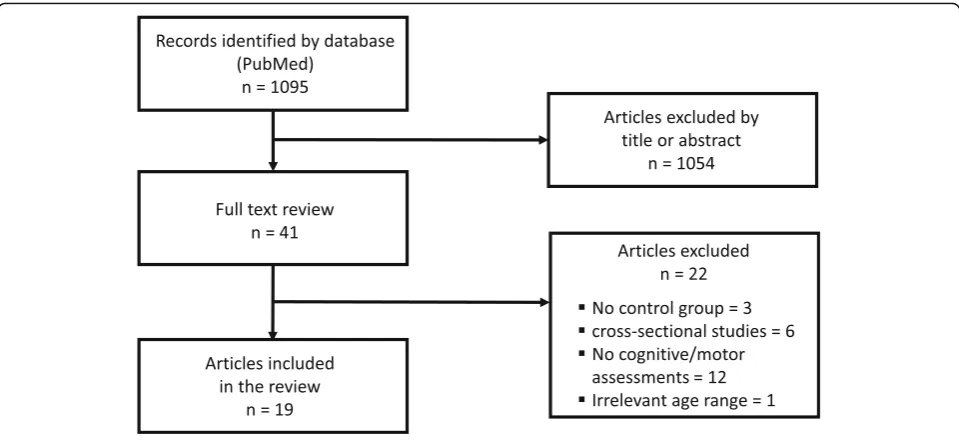
A flow diagram of the study selection process is illus-trated in Fig. 1. The search retrieved a total of 1095 likely relevant articles. All retrieved articles were screened by two reviewers (OL and GZ). Doubtful deci-sions for inclusion/exclusion were resolved by the senior co-author (YN). After screening by title and/or abstract,
1054 articles were excluded due to (i)topic irrelevance,
(ii) being meta-analysis/review papers, (iii) irrelevant
patients groups, (v) being a report of a study protocol
with no actual collection of data, and (vi) absence of
cognitive or motor assessments at baseline and/or end-point. The remaining 41 articles were evaluated as po-tentially relevant papers and the full papers were obtained. After screening the full papers, 22 articles were excluded for the following reasons: irrelevant age-range
[61], single group pre- and post-test design [62–64], a
cross-sectional study design or no exercise intervention
[65–70], or absence of cognitive or motor assessments at
baseline or endpoint [69, 71–81]. The remaining articles
(n= 19) met all inclusion criteria and were included in
the review [82–100]. Results from the aforementioned
19 articles were summarized with respect to: (i)
demo-graphic characteristics of participants (total sample size,
number of group participants and gender ratio), (ii)
characteristics of the intervention (exercise protocol,
duration/frequency, and exercise intensity), and (iii) the
outcome effects of the intervention on specific cognitive and motor functions. The aforementioned results are presented in Table 1. Lastly, article quality assessment was conducted using the Jadad scale [101] (see Table 2).
Results
Sample characteristics
The number of participants, mean age, and gender dis-tribution for each intervention group in the 19 included studies are summarized in Table 1. Five studies had
small sample sizes (N< 15) in one or more groups [83]: 2
groups,N≤7 per group; [85]: 2 groups,N≤13 per group;
[86]: 2 groups,N≤11 per group; [87]: control group,N=
13; [96]: physical-cognitive training group, N= 12). In
most of the included studies sample sizes per group were
larger than 15, and in three studies sample sizes per group were equal to or larger than 50 [92, 97, 99]. In all studies the number of females was larger than that of males, how-ever information about gender distribution within each intervention group was not always available. In one study [98], all of the included participants were female. Subject ages ranged from 55 to 97 years old and mean group ages ranged from 65.5 ± 6.3 [89] to 81.9 ± 6.3 years old [97].
Interventions
Studies included in this review reported multiple outcome measures, and an extensive range and diverse types of inter-vention protocols. The most frequent interinter-vention protocol (11 of the 19 included studies) was combined exercise training (e.g. aerobic training followed by resistance
train-ing) [82–84, 88, 90, 91, 97–100]. The second most frequent
intervention protocol (9 of 19 included studies) was com-bined physical-cognitive training. Here physical exercise training was either conducted simultaneously with a cogni-tive task in a dual-task manner [84, 91, 93, 94, 96, 100], or was followed by separate cognitive interventions [83, 92, 97]. The remaining intervention protocols consisted of single-exercise training paradigms, involving aerobic train-ing [89, 95], resistance traintrain-ing [85, 89], balance traintrain-ing [86, 89] or dance [87, 88]. Nine studies included a passive
control group [85, 86, 89–91, 93, 94, 96, 98]. Alternatively,
participants in control groups underwent health education classes [87, 92, 99] or were subjected to lesser physical (or cognitive) training, for example training of gross motor ac-tivities [82] or training of a single cognitive task [96].
Table 1 A Summary of studies ( n = 19) examining the effect of physical exercise intervention on cogn itive and motor functions in older adults Study (Auth ors/Ye ar/Ref.) Intervent ion Tra ining prot ocol Demographic prope rties Endpo int outcom es Group Nu mber of part icipants/ Fema le Age Me an (SD ) years Berry man et al., 2014 [ 82 ] 3 groups: Combine d aerob ic and strength lower body (LBS-A) , Combine d aerob ic and strength upper body (UB S-A) Gross mot or activit ies (GM A). All gro ups rece ived training 3 times/ week for 8 we eks. LBS -A an d UBS-A: 60 mi n of st rength exercis es followe d by 20 -min cycling at 60 – 65 % of max aerob ic power. GM A: 60 min exerc ises of fl exibility , walki ng & bal l mani pulat ion.
LBS-A UBS-A GMA
Table 1 A Summary of studies ( n = 19) examining the effect of physical exercise intervention on cogn itive and motor functions in older adults (Con tinued) Study (Auth ors/Ye ar/Ref.) Intervent ion Tra ining prot ocol Demographic prope rties Endpo int outcom es Group Nu mber of part icipants/ Fema le Age Me an (SD ) years rep etition per set; tw ice a we ek, for 6 we eks. PCG : No interve ntion. mov ement time (61%) for RE group. No pre /post diff erenc es for PC group. Cogni tive: Likely be neficial effec t (85% ) in sp atial awa reness (Neurot racker thresho ld speed) , indicating possible gains on attentio n and pr ocessing sp eed for RE group. No pre /post differ ences for PC group. Granacher et al. , 2010 [ 86 ] 2 groups: Balance training (BT) Passive Contro l (PC). BT G: 60 mi n session of po stural stabi lization tasks (i ncluding warm up and cool down on a bicycle erg omete r); 3 se ssions per we ek for 6 we eks. PCG : No interve ntion. BT PC 11 /7 9/ 7
72 (5.0) 75 (6.0)
Motor: Significant gains on gait stability but not gait velo city for BT group in FES-I. No pre/post differ ences for PC gro up. Si gnificant Group x Ti me interact ion. Cogni tive: Significant gains o n dual task cost of the second ary mot or task but not for cogn itive interfe rence tas k (subtraction mistakes made during the task) for BT group. No pre/p ost differ ences for PC group. Signif icant Grou p x Time interac tion. Hackne y et al., 2015 [ 87 ] 2 groups: 90 mi n Tango class es (TG) 90 mi n Healt h education classes (HEG ). Bot h groups underwent 20 cl asses over 12 we eks. TG : 20-m in st anding warm -up followed by 70 min dan ce exerc ise. H EG: 90-m in se minar class es at local univ ersit y. TG HEG 62 /48 12 /5 82 .3 (8.8 ) 84 .1 (7.9 ) Motor: Significant gains on mobility (Four Sq uare Step, bac kward gai t, and gait spee ds) but not balance (Berg Balan ce Scal e) for TG. Significant gains o n back ward gai t spee d but not for outcom e measu res for HEG. All gai ns main tained 3 mon ths after the interven tion. Cogni tive: Neither group showe d any gai ns on processing speed , working memor y ,o r attentio n . Cogni tive ass essment s inc luded: Montre al Co gnitive Assessm ent, the Rever se & Corsi Blocks, the Broo ks Spatial Task, and the Tra il-Making Test (TMT) Part B. Ham acher et al. , 2015 [ 88 ] 2 groups: 90 mi n Dancing sessio n (DG) 90 mi n Healt h-related exercise session (HR G). Bot h group rece ive training tw ice a week for 6 month s. Tra ining inc luded 15 min of warm -up an d 15 min of DG HRG 19 /11 16 /10 67 .2
(3.4) 68.5 (3.1)
Table 1 A Summary of studies ( n = 19) examining the effect of physical exercise intervention on cogn itive and motor functions in older adults (Con tinued) Study (Auth ors/Ye ar/Ref.) Intervent ion Tra ining prot ocol Demographic prope rties Endpo int outcom es Group Nu mber of part icipants/ Fema le Age Me an (SD ) years cool -down, stretch ing, and rel axation. D G: le arning chore ograp hies of five differ ent danc e genres . H RG: 60 min se ssion of com bined enduranc e, st rength-e nduran ce, and fl exibility train ing. decrease o f gait variability for HRG. Main effect for GROUP and the GROUP × TIME interact ion were not signific ant for neith er outcom e measu res. Cogni tive: Significant gains o n performance of a serial three subtractions test whil e wal king (shorte r su ccessive-subtract ion ti mes and higher corre ct ans wer cou nts on) and dual-task cost for DG. No pre / post differ ences for HRG . No signific ant gains o n du al task cost for bot h groups. Iuliano et al., 2015 [ 89 ] 4 groups: Resistan ce (RG ), Cardiovascular (C VG) Postural (PG) Passive control (CG). Exe rcises we re pe rformed ov er the course of 12 weeks. RG : 30 min sessi on of high inte nsity streng th train ing for 6 muscle groups. CVG : 30 min sessio n of high inte nsity CVG training on erg omete r mach ines PG : 20 min sessi on of fl exibility , core-stabil ity and res piratory exerc ises. CG : No interven tion
RG CVG PG CG
20 /11 20 /12 20 /13 20 /12 65 .8
(6.3) 68.4 (6.4) (66.7
)
(5.8) 66.5 (6.3)
Table 1 A Summary of studies ( n = 19) examining the effect of physical exercise intervention on cogn itive and motor functions in older adults (Con tinued) Study (Auth ors/Ye ar/Ref.) Intervent ion Tra ining prot ocol Demographic prope rties Endpo int outcom es Group Nu mber of part icipants/ Fema le Age Me an (SD ) years CG : No interven tion. for mobili ty . N o significan t gains o n all elem ents of strength and mobili ty were observe d for neith er group. Cogni tive: Cogni tive ass essment includ ed the Five-Co g test for evaluation of attenti on, me mory, visuosp atial fun ction, language, an d reason ing. Significant Group differ ences on the reas oning ability element , with sign ificant gai ns observe d onl y for INT gro up. Bot h groups showe d sign ificant gai ns on attentio n and me mory item s and the Wec hsler Digit Sym bol Substituti on. Leon et al. , 2015 [ 91 ] 3 groups: Physical exerc ise (PE), Combine d phy sical and cognit ive (P E-C) and Passive control (CG) PE an d PE-C receive d 60 min trai ning se ssions twice a we ek for 12 weeks. PE : Comb ined physical trai ning (w armup, streng th, aerob ic, and rel axation) . PE -C: physical training (as PE gro up) com bined with psyc homot or tasks, dua l tas ks, and memor y task s. CG : No interven tion
PE PE-C CG
46 /38 56 /51 35 /17 72 .6 (5.0 ) 70 .5 (5.5 ) 71 .1 (6.2 ) Motor: assessment was bas ed on RT and MT me asures of the sim ple element of the VTS. PC-E and PE and PE-C: sign ificant gai ns on both MT and RT. Pre/p ost gains w e re signific antly highe r for PC-E than PE and CG (all effec ts: p < .0 1). Note: CG showe d sign ificant gai n ( p <. 0 1 ) o n MT in choi ce but not simpl e elem ent of VST. Cogni tive: asses sment was bas ed on the choi ce RT elem ent of the VTS (=high cog nitive invo lvement ) as an indicator for gai ns on proces sing speed , attentio n, and dual-task cos t . PC-E: sign ificant gai ns on RT in bot h simple and choi ce elem ents of VTS. PE: sign ificant gai ns on RT only in the simpl e element of VTS. Pre/po st gains w e re significan tly highe r for PC-E than PE and CG. GC: no signific ant gains. Maki et al., 20 12 [ 92 ] 2 groups: Commu nity-b ased wal king-program (CBW) Health ed ucation class es (HEG) CBW : 90-m in inte rvention once a we ek for 12 weeks. 30 -min exerc ise pe riod and 60 -min group work . Part icipants in CBW group pla nned and exec uted wal king event s (exc ursion) wit h other group memb ers. CBW HEG 75 /52 2 75 /54 2 71 .9 a
(4.1) 72.0
Table 1 A Summary of studies ( n = 19) examining the effect of physical exercise intervention on cogn itive and motor functions in older adults (Con tinued) Study (Auth ors/Ye ar/Ref.) Intervent ion Tra ining prot ocol Demographic prope rties Endpo int outcom es Group Nu mber of part icipants/ Fema le Age Me an (SD ) years H EG: rece ived ed ucation al le ctures on food, nutrition , an d oral care. Cogni tive: Both CBW and HEG showe d sign ificant gai ns on element s of the Dual task test, Delayed recal l test, D igit-Symbol Substitutio n te st, and Yamaguchi Kanji-Symbol Substitution Te st (all, p ≤ .008). O nly CBW group improve d on Categ orical word flue ncy ( p = .003). Marme leira et al., 2009 [ 93 ] 2 groups: Exercise group (EG) Passive control group (CG) EG : 60 min exerc ise of physical (aero bic) and cog nitive (p sychom otor, dual-task ing, pro blem solv ing. 3 days a we ek for 12 weeks. CG : No interven tion EG CG 16 /3 16 /4 68 .4 (6.7 ) 68 .2 (6.5 ) Motor: Significant gains on RT, MT , and response time in simul ated driving scenarios unde r sing le and dual task cond itions for EG. No gains on all elem ents for CG. Be tween groups differ ences were found for MT and res ponse time in single task and RT an d respo nse time in dual task. Cogni tive: Significant gains o n spee d of vis ual processing, but not in divided atte ntion, selective atte ntion, or Stroop (neith er incon gruent , nor interfe rence sc ores) for EG. No signific ant gains for CG . Betw een groups differ ences were found only for spee d of visual proc essing. Schoene et al. , 2013 [ 94 ] 2 groups: Home-based step-training intervent ion of Dan ce-Dance Revoluti on video game (DDR) Passive control (CG) D DR: Training for a rec ommend ed time of 15 – 20 mi n, 2 – 3 times per week for 8 weeks. CG : No interven tion DDR CG 15 NA 17 NA 77 .5
(4.5) 78.4 (4.5)
Motor: assessments were bas ed on element s of the PPA test battery for fall ris k, CS RT, TUG, 5S TS, and ATS. DDR: sign ificant gai ns on CSRT and balance cont rol . No signific ant gai ns were observe d for mo bility and stren gth . CG: no sig nificant gains. Cogni tive: asses sments were bas ed on elem ents of TMT; parts A and B and dual tas k pe rformanc e (verb al fluen cy dur ing TUG) . IG: gai n on dual-t ask abi lity. No signif icant gai ns on all elem ents of TMT. CG: no signific ant gains. Smil ey-Oyen et al., 2008 [ 95 ] 2 groups: Cardiovascular trai ning (CARD IO) Strengt h, Flexi bility & Bal ance training (FLE X-TONE). Bot h groups trained 3 times pe r week for 10 mont hs. CAR DIO: 25 – 30 min of aerob ic training at 45 – 60% of HRR. CARDIO FLEX-TONE 28 /21 29 /20 69 .9
(4.6) 70.5
Table 1 A Summary of studies ( n = 19) examining the effect of physical exercise intervention on cogn itive and motor functions in older adults (Con tinued) Study (Auth ors/Ye ar/Ref.) Intervent ion Tra ining prot ocol Demographic prope rties Endpo int outcom es Group Nu mber of part icipants/ Fema le Age Me an (SD ) years FLE X-TONE: 25 – 30 mi n of yog a, Tai Chi, Flex bands, free ha nd we ights, and stabi lity bal ls. Motor: No sign ificant gai ns on simple/ choice rea ction times for both groups. Cogni tive: Significant gain for CARDIO group an d mar ginal gain for the FLEX-TONE group on RT of the Word – Color confli ct el ement of the Stroop test. Si gnificant gai n for CARDIO on error scores of the Word – Color confli ct el ement of the Stroop ( p < .05). Neith er group showe d sign ificant gai ns on the othe r elem ents of the neuro cogn itive assessment tests. Theil l et al., 2013 [ 96 ] 3 groups: Aerobic-Cognit ive (A-CG), Single Cogni tive (S-CG) , Passive Contro l (CG). A-CG an d S-C G particip ated in 1.5-2 h training sessio ns tw ice a week for 10 we eks. A-CG : Cogni tive te st bat tery fol lowed by a mot or-cog nitive dua l tas k while wal king +40 mi n aerobic trai ning (60 – 80% HHR). S-C G: Cogni tive test battery , fol lowed by motor-c ognitive dua l tas k while sitt ing.
A-CG S-CG CG
18 /F NA 12 /F NA 21 /F NA 72 .4 (4.2 ) 73 .3 (6.1 ) 70 .9 (4.8 ) Motor: gait pe rformanc e was asses sed unde r sing le-and dual-task cond itions wh ile pe rforming a working memor y task . Both trai ning groups (A-CG and S-CG) showe d signific ant gains o n gai t step -to-step variability dur ing dua l task but not during single task . C G : no gains. Cogni tive: test battery cons iste d of six compu ter-ba sed te sts to assess for: selective atte ntion, pai red-asso ciates learn ing, execut ive control, reason ing (St andard Prog ressive Matri ces test) , memor y spa n, an d information processing speed (We chsler DSST ). Bot h training groups (A-CG and S-CG) showe d signific ant gains o n e lements of the execut ive control task and the Paired Asso ciates task (b oth invo lve st rong element s of working me mory ) but not in othe r el ements of test batte ry. CG: no gains. van het Reve & de Bruin, 20 14 [ 97 ] 2 groups: Stability-Balance training (SB), Stability-Balance-Cogni tive training (SB-C). SB : 30 min progr essiv e res istance training and 10 mi n balance train ing, tw ice a week for 12 we eks. SB -C: Receiv ed in add ition to SB trai ning a cogn itive trai ning, with the Cogni Plus [R EF] training pro gram 3 ti mes a we ek for 10 mi n. SB SB-C 98 /F NA 84 /F NA 81 .9 a
(6.3) 81.1
12 months [99]. In most studies the intervention lasted 8 to 12 weeks and consisted of 24 training sessions (or classes) in total. Exercise protocols also varied greatly between studies. For example, the intensity of the aer-obic exercise varied from light (e.g. [94]) to moderate-high (e.g. [89]). Durations of the training sessions (for all types of interventions) were inconsistent as well, ranging
from 15 to 20 min [89] for balance training to 60–70 min
[87, 88] for dance. Similar to the differences in exercise in-tensity and duration, the type and combinations of exer-cises varied greatly between studies. For example, three studies that included a combined-exercise training con-sisted of aerobic-strength training [82, 88, 91], and three studies consisted of strength-balance training [83, 97, 100], whereas in five studies all three exercise paradigms were used in a single training session [85, 88, 90, 98, 99]. Finally, six studies that combined physical-cognitive inter-vention protocols consisted of physical exercise training with a dual task [84, 91, 93, 94, 96, 100], whereas the inter-ventions in the remaining studies were made up of separate blocks of physical exercise and cognitive training [83, 97] or involved social interactions [92]. Exercises in the physical-cognitive intervention consisted of aerobic
training [92–94, 96, 100] or combined aerobic/strength/
balance training [83, 84, 91, 97].
Main outcome measures
Due to the large heterogeneity in exercise protocols and testing methods, it was difficult to arrive at a synthesis of the search findings. Therefore, we performed a descriptive analysis where performance gains (or negative effects) were sorted and summed according to four motor outcome measures and five cognitive outcome measures. The four motor outcome measures were: functional lower limb
mo-bility and gait characteristics [82–84, 86–90, 92–94, 96–
100], static and/or dynamic balance [86, 87, 89, 94, 97–99],
muscle strength [82, 85, 89, 90, 92, 99], and psychomotor
(RT) tasks [83, 85, 91, 93–95, 97, 98]. The five cognitive
outcome measures were: processing speed [85–99],
work-ing memory [82, 84, 88, 90, 92, 95, 96, 98, 99], inhibition
[82, 84, 89, 93–96, 98, 99], attention [85, 87–99], and
dual-task cost [82–84, 86, 88, 92–94, 96, 97, 100]. Other
out-come measures were aerobic fitness [82, 95], depression scores [87, 90, 92], quality-of-life and life-satisfaction scores [87, 90, 92], and markers of brain plasticity (brain-derived
neurotrophic factor–BDNF) [85, 98]. Battery of tests used
for the assessments of the aforementioned motor/cognitive outcome measures in each of the included studies are spe-cified in Table 1.
The outcome effects of each intervention on specific cognitive and motor functions are presented in Table 1.
Table 2Study quality assessment score (Jadad scale [101] with modificationa)
Study Randomization
(max = 2)
Blindinga
(max = 2)
Account of all participants (max = 1)
Total (max = 5)
Berryman et al., 2014 [82] 1 0 1 2
de Bruin et al., 2013 [83] 2 1 1 4
Falbo et al., 2016 [84] 1 0 1 2
Fragala et al., 2014 [85] 1 0 0 1
Granacher et al., 2010 [86] 1 0 1 2
Hackney et al., 2015 [87] 0 1 1 2
Hamacher et al., 2015 [88] 2 1 1 4
Iuliano et al., 2015 [89] 2 0 0 2
Kamegaya et al., 2014 [90] 1 0 1 2
Leon et al., 2015 [91] 1 0 1 2
Maki et al., 2012 [92] 1 0 1 2
Marmeleira et al., 2009 [93] 1 0 1 2
Schoene et al., 2013 [94] 2 1 1 4
Smiley-Oyen et al., 2008 [95] 0 1 1 2
Theill et al., 2013 [96] 0 0 1 1
van het Reve & de Bruin, 2014 [97] 1 0 1 2
Vaughan et al. 2014 [98] 2 1 1 4
Williamson et al., 2009 [99] 2 1 1 4
Yamada et al., 2011 [100] 2 1 1 4
a
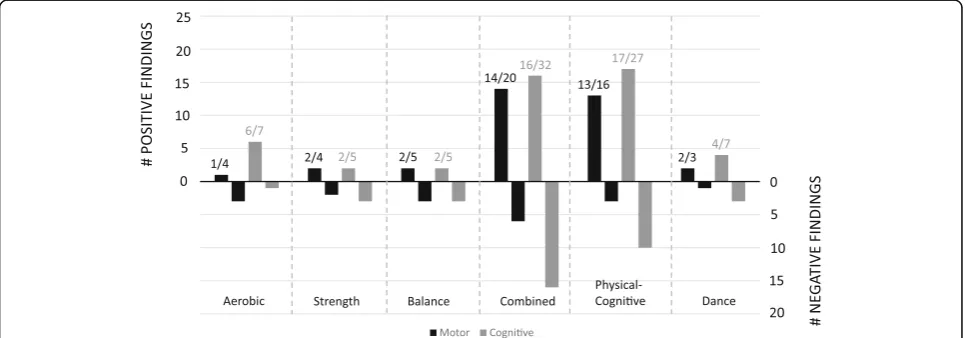
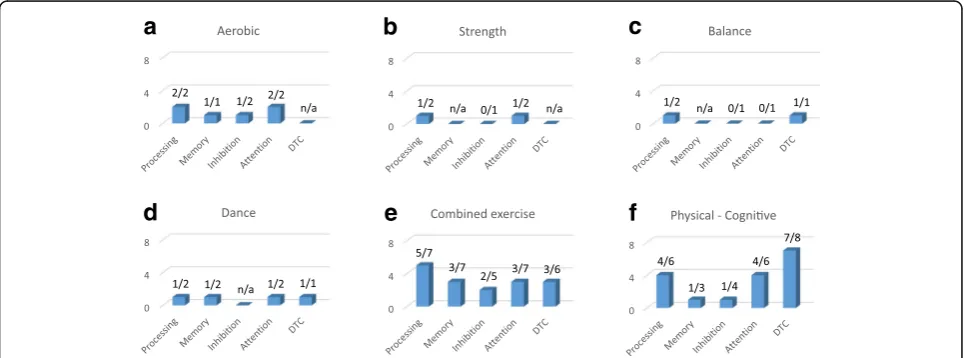
Data are summarized in Fig. 2 for the overall motor/cog-nitive gains in each intervention category, and in Figs. 3 and 4 for the specific motor (Fig.3) and cognitive (Fig. 4) gains in each intervention category. As can be seen in Fig. 2, the highest number of reported performance gains and negative findings were reported for the com-bined exercise training and cognitive-motor training. However, the abovementioned interventions were also the most frequent (Table 1). In line with the first main objective of the current systematic review, the specific effects of the different intervention categories on motor and cognitive gains are described in detail next.
Motor performance gains as a function of intervention
Motor performance gains (from a number of studies) are illustrated in Fig. 3 for each of the six interventions. The majority of test batteries (or protocols) examined gains in functional tasks (i.e. mobility and strength) [82, 84,
86–90, 92, 94, 97–100], gross motor skills (i.e. balance)
[84, 86–89, 94, 96–99], or RT [83, 91, 93–95, 97, 98].
None of the included studies examined fine motor skills or motor learning. Four studies used aerobic [89, 95], strength [85, 89],or balance [86, 89] training as a single intervention. In one study [89], the three interventions and a passive control group were included in a single study design (see Table 1; [89]). Significant gains induced by aerobic training were found only for a mobility pre/ post-test (gait speed, One Mile Walk Test), significant gains induced by resistance training were found for the strength pre/post-tests (One Repetition Maximum test in all trained muscles), and significant positive gains in-duced by balance training have been shown only for a balance pre/post-test (Stork Balance Stand Test). No gains on all elements of the test battery were observed
in the passive control group. For the remaining studies, aerobic training [95], resistance training [85], or balance training [86] were applied as single interventions. Likely beneficial gains in performance of the visuomotor RT task (i.e. shorter responses times at likelihood of 80.2%) were reported in [85] and significant gains in gait stabil-ity were reported in [86]. Taken together, observations from the four studies suggest that using aerobic [89, 95], strength [85, 89], or balance [86, 89] training as a single intervention may have only limited effects on motor per-formance gains. However, findings cannot be generalized due to limitations caused by the small number of studies
or the diversity in testing protocols–specifically, no
in-clusion of psychomotor tests [86, 89] and no inin-clusion of mobility, balance, and strength tests [85, 95].
Two studies focused on dance as a single exercise [87, 88]. Observations from these studies are summarized in Fig. 3D. Irrespective of differences in the intervention and testing protocols, both studies showed a significant increase in gait speed. One of these studies also reported a significant in-crease in backward gait speed as well as faster performance time on the Four-Square Step Test [87].
Eleven studies used combined-exercise training proto-cols: (i) aerobic and strength [82, 88, 91], (ii) aerobic and flexibility [90], (iii) strength and balance [83, 95, 97], or (iv) aerobic, strength, and balance exercises combined
[84, 88, 98–100]. Observations from these studies are
summarized in Fig. 3E. In all studies but two [91, 95], mo-bility tests were applied pre- and post-intervention, and in seven of nine studies significant gains were observed in one or more mobility performance tests: Time Up & Go
(TUG) [82, 98], Walking Speed [82, 97–100], Stride
Length Variability [88], and Chair Stand [82, 97, 99]. Im-provements in mobility characteristics were observed for
all training protocols in which strength exercises were
in-cluded [82, 88, 97–100], albeit pre-to-post gains in
strength were reported only by one study [82] in which two intervention groups and one control group were tested. Three studies reported significant pre-to-post
im-provements in balance [97–99] and three of four studies
reported significant pre-to-post improvements in the per-formance of one or more psychomotor tests [83, 91, 97]. However, all three studies that reported pre-to-post im-provements in balance also included balance training in their intervention. Finally, pre-to-post gains on RT were found in five studies [83, 91, 95, 97, 98]. In two of the studies the training protocol consisted of combined strength and balance exercises [83, 97]. The three remaining studies consisted of aerobic-strength training [91] or aerobic-strength-balance training [98].
Nine intervention studies used one or more paradigms of combined physical-cognitive training. Observations from these studies are summarized in Fig. 3F. In six of the nine studies [84, 91, 93, 94, 96, 100], physical and cognitive training were conducted in a dual-task man-ner. In the remaining studies [83, 92, 97], participants received the cognitive intervention [83, 97] or social intervention [92] at the end of the physical training. Intervention protocols consisted of: (i) aerobic exercise combined with: a battery of cognitive-psychomotor train-ing [93], memory traintrain-ing [96], a video game [94]; (ii) strength-balance exercise [83, 97] combined with comput-erized cognitive training for attention; and (iii) aerobic-strength-balance exercise combined with dual-task inter-ference and/or a battery of psychomotor and memory tasks [84, 91, 100]. Most of the pre-to-post performance gains
a
d
e
f
b
c
Fig. 4Outcome effects of each of the six types of interventions on cognitive performance gains (from the number of studies). Please note that one study can measure more than one outcome.aaerobic,bstrength,cbalance,ddance,ecombined exercise,fphysical-cognitive. n/a = information was not available
a
b
c
d
e
f
were reported for mobility outcome measures, specifically TUG [92], walking speed [97, 100], stride length/gait speed variability [84, 96], and chair stand [97]. Significant pre-to-post gains were also observed for balance [94, 97]. How-ever, observed gains in the above-mentioned studies were not specific to the intervention, nor to the type of physical exercises or the cognitive training protocols involved. Fi-nally, pre-to-post gains in RT were examined in five stud-ies, in which attention training and/or dual task training exercises were applied [83, 91, 93, 94, 97]. In all five studies a significant improvement in simple RT and/or movement time was observed post-intervention, but significant group differences were evident only when a passive control group was included [91, 93]. Thus, the existence of an evident link between these two types of cognitive training and re-spective pre-to-post gains in Stepping Reaction Time (SRT) cannot be generalized. To conclude, intervention protocols using single-exercise training tended to re-sult in focal performance gains [86, 89], whereas
mul-tiple exercise training [82, 83, 97–99] or
physical-cognitive training [83, 94, 97] typically resulted in gains of multiple motor outcome measures.
Cognitive performance gains as function of intervention
Cognitive performance gains (from the number of studies) are illustrated in Fig. 4 for each of the six in-terventions. Again, pre-to-post performance gains on cognitive outcome measures were more visible in groups that underwent combined physical exercise
train-ing [82–84, 88, 90, 91, 97–100] or combined
physical-cognitive training [82, 84, 91–94, 96, 97, 100] than in
groups that underwent aerobic training [89, 95], strength training [85, 89] or balance training [86, 89] as a single ex-ercise. Pre-to-post improvements on processing and atten-tion were found in both studies in which aerobic training was applied as a single intervention [89, 95], whereas sig-nificant improvements on memory [89] or inhibition [95] were evident only in one of the two studies. Finally, the beneficial effects of strength training [89, 95] or balance training [86, 95] on cognition were marginal, with evi-dence pointing to possible gains in processing speed [85], attention [89] or motor interference task [86], but not on inhibition [85, 89] or cognitive interference task [86] (see, Figs. 4A-C).
The effects of dance as a single intervention on cogni-tive functions in older adults were reported in two stud-ies [87, 88]. In one study [87], no pre-to-post gains in cognition were reported. In contrast, the other study [88], which used a cognitive-motor interference task (a serial three subtractions test while walking), found a signifi-cant decrease in the average time required to recite the successive subtractions and a marginal increase in the per-centage of correct answers, suggesting pre-to-post im-provements in processing speed, working memory,
attention, and dual-task cost (see, Fig. 4D). Of note, the du-rations of the single training sessions in both studies were largely similar (90 min including warm-up and cool-down). However, the duration of the intervention was twice as long in one study [88] (26 weeks) than in the other study [87] (12 weeks). This could partially explain the absence of significant post-intervention effects in the latter study.
Findings from the eleven studies in which combined-exercise training protocols were used (see, Fig. 4E) and the nine studies in which combined physical-cognitive training protocols were used (see, Fig. 4F) are discussed next. Due to the large variety among the applied cogni-tive test batteries, pre-to-post intervention effects are presented for each of the five outcome measures separ-ately, as a function of the different training protocols. Statistically significant pre-to-post-intervention differ-ences on one or more outcome measures of processing were reported for aerobic-flexibility training [90], for strength-balance training [97], and for aerobic-strength-balance [98]. Improvements were found on: (i) Digit Symbol Substitution Test (DSST) and Analogy test scores [90], (ii) TMT parts A and B time scores [97], and (iii) California Older Adult Stroop Test (COAST) and TMT (parts A and B) time scores [98]. Significant pre-to-post-intervention differences on one or more outcome measures of processing were also reported in four studies in which combined physical-cognitive
training protocols were used [91–93, 97]. In three of those
studies [92, 93, 97], significant pre-to-post improvements on one or more outcome measures of attention or dual-task cost were also found. Significant pre-to-post differ-ences were found: (i) in TMT parts A and B time scores following strength-balance training and computerized at-tention training [97]; (ii) on the Categorical Word Fluency element of the 5-Cog test, the digit symbol substitution test (DSST), and the Yamaguchi Kanji symbol substitution tests following aerobic training combined with social interaction [92]; (iii) in a visual processing (Useful Field of View Test (UFOV)) [93], and (iv) in the Simple/Choice RT elements of the Vienna Test System [91].
groups, but not for the LBS-A. For [90], a significant gain was reported on the Cued Recall Test of the Five-Cog task. However, a comparable improvement was also found in the control group. Pre-to-post-intervention im-provements in memory were observed in only one [92] of the three studies [84, 92, 96] where memory tests were conducted after the implementation of combined physical-cognitive training.
Statistically significant pre-to-post-intervention differ-ences on one or more outcome measures of inhibition were reported for aerobic-strength training [82] and aerobic-strength-balance training [98]. In one study [82], significant gains were found for the Turning Point Index (TPI, changes between ascending and descending phases) and the adjacency score (numbers presented in
pairs; i.e. 3–4) of the RNG test that were visible in both
the single-and dual-task test conditions. However, im-provements were not statistically different as a function of the group, and were not consistent across test condi-tions. With respect to the studies in which combined physical-cognitive training protocols were used, pre-to-post-intervention improvements in the performance of the inhibition component in the RNG test was reported only in one study following an intervention with dual-task walking [84].
Statistically significant pre-to-post-intervention differ-ences on one or more outcome measures of attention were reported for aerobic-flexibility training [90], strength-balance training [97], and aerobic-strength-strength-balance training [98]. Testing protocols were not identical across the three abovementioned studies. For [97], significant pre-to-post improvements were reported in the performance of the di-vided attention task of the Vienna Test System. For [90], a significant gain was reported on the Character Position Referencing task of the Five-Cog task, but a comparable improvement was also found for participants in the passive control group. Finally, [98] reported significant pre-to-post improvement on performance of the TMT parts A and B tests (see also improvement in processing), but not on the Letter-Number Sequencing task. No significant gains were reported by [95] for strength-balance training and for [88, 99] for aerobic-strength-balance training.
With respect to the studies in which combined physical-cognitive training protocols were used, signifi-cant pre-to-post-intervention improvements on one or more outcome measures of attention were reported in
four studies [91–93, 97]. With respect to one study [97],
significant pre-to-post improvements were also reported on all divided attention elements of the Vienna Test Sys-tem. Finally, another study [93] reported significant pre-to-post improvement in the divided attention element of the UFOV evaluation tool.
Significant pre-to-post-intervention differences on
Dual-Task Cost (DTC) were reported by [82] for
aerobic-strength training and [83] for aerobic-strength-balance training (however, statistical power in the latter study was poor due to the small sample size). In [82], improvements in DTC were associated with improvement in working mem-ory and inhibition, as reported above. Interestingly, for three of the six studies mentioned above [91, 97, 100], sig-nificant pre-to-post improvements on DTC were reported when the same physical intervention protocols were repeated whilst cognitive training was added. With re-spect to the studies in which combined physical-cognitive training protocols were used, pre-to-post-intervention improvements in DTC were reported in seven of the eight studies where this outcome
meas-ure was tested [83, 92–94, 96, 97, 100]. Gains were
not specific to the intervention program (either to the type of physical exercises or to the cognitive training protocols involved) or to the evaluation protocol.
Association between motor and cognitive gains
In line with the second major aim of the current review–
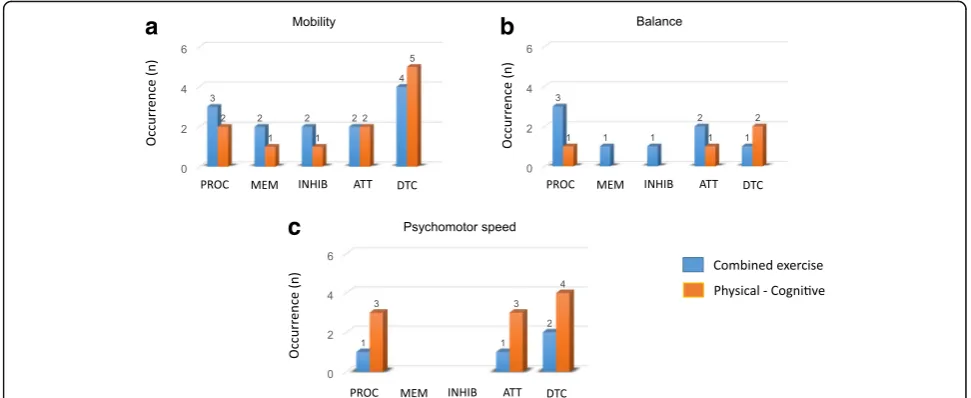
looking into the dual effect of various training protocols on motor and cognition, we provided a qualitative over-view of the extent by which pre-to-post gains in motor functions parallel improvements in the performance of cognitive functions. Specifically, a detailed inspection of the data in Table 1 indicates that parallel improvements in motor and cognitive performances were observed, mainly for interventions consisting of combined physical training or combined physical-cognitive training. The occurrences of parallel improvements in motor and cog-nitive outcome measures are illustrated in Fig. 5 for the two combined training interventions. It can be seen that
parallel improvements were mainly found for: (i)
mobil-ity and dual-task cost (DTC) [82, 83, 92, 96, 97, 99, 100],
(ii) mobility, balance, processing speed, and attention
[97, 98], or (iii) psychomotor speed, processing speed,
attention, and/or DCT [83, 91, 93, 94, 97]. To a lesser
extent, we also found associations between: (i) mobility
(TUG/gait speed/gait variability), balance and inhibition
for physical-cognitive training [84, 98], or (ii) between
gait speed, strength, and inhibition for combined exer-cise training [82].
For the remaining interventions (aerobic, strength, bal-ance, and/or dance), parallel improvements in physical/ motor outcome measures and cognitive outcome
mea-sures were found between: (i) mobility (gait speed) and
processing speed, attention, memory, and DTC in dance
[88];(ii)mobility, attention, and processing speed in
aer-obic training [89]; (iii) psychomotor speed, attention,
and processing speed for strength training [85]; and(iv)
included studies did not examine correlations between the pre-post difference values of cognitive and motor outcome measures.
Direct assessment of the associations between pre-to-post difference values of cognitive and motor outcome measures were available in only two of the nineteen reviewed studies [84, 99]. One study [84] reported that increased inhibition efficiency was associated with
de-creased gait variability (r=−.65, p= .006) in the group
that underwent physical-cognitive dual-task training. However, this effect was found only during dual-task walking with simple gait demands. The same authors re-ported a marginally significant association between the same outcome measures also for the group that under-went the physical training alone (aerobic-strength-bal-ance combined). Here, a significant correlation between increase inhibition efficiency and decreased gait
variabil-ity (r=−.47,p= .049) was reported for dual-task walking
with complex gait demands (i.e., walking while negotiat-ing hurdles). The second study [99] reported that pre-to-post gains in processing and attention (as measured with DSST) following aerobic-strength-balance training were positively correlated with improvements in the Short
Physical Performance Battery (SPPB) scores (r= .38, p
= .002), chair stand scores (r= .26,p= .012), and to some
extent balance scores (r= .21,p= 047). The same authors
also reported significant positive correlations between gains on short-term memory scores (Rey Auditory Verbal
Learning Test, (RAVLT)) and gait velocity (r= 0.25, p
= .019) or chair stand (r= .22,p= .039). Otherwise,
corre-lations between pre-to-post changes in the performance of RAVLT or the inhibition test (Stroop), and pre-to-post
changes in all other elements of the SPPB, did not reach
the level of significance (r≤.20,p> .05).
Discussion
In line with the objectives of the current systematic view, the search strategy we used aimed at locating re-search studies that examined the combined effects of physical training interventions on motor and cognitive functions in older adults. Our literature search and se-lection process resulted in 19 publications, of which 11 studies reported the effects of combined
(multi-compo-nent) exercise training [82–84, 88, 90, 91, 97–100], 9
re-ported the effects of combined physical cognitive
training [83, 84, 91–94, 96, 97, 100], and 8 reported the
effects of single exercise protocols with aerobic ing [89, 95], strength training [85, 89], balance train-ing [86, 89], or dance [87, 88]. The main findtrain-ings from the 19 included studies were:
1. Multi-component exercise training or combined physical-cognitive training were found to improve a larger number of physical, motor, and cognitive outcome measures than a single exercise intervention. Physical-cognitive training was found to be the best intervention strategy. 2. Multi-component exercise training was found to be
beneficial for improving gait and processing speed, whereas combined physical-cognitive training was found to be most beneficial for psychomotor speed, processing speed, attention, and dual task cost. 3. Pre-post gains in mobility and psychomotor speed
were strongly associated with pre-to-post gains in
a
b
c
processing and dual task cost. However, these associations were more prevalent when intervention consisted of combine physical-cognitive training. 4. Due to lack of sufficient consistency in the training
protocols and applied test batteries, we were unable to provide a reliable evaluation of the possible effects of single-exercise protocols on performance.
Specificity of the exercise interventions
The extent to which exercise interventions were associ-ated with specific gains in cognitive and motor functions were examined in line with the first major aim of the current systematic review. Overall, findings from the nineteen included studies indicated that combined exer-cise training and physical-cognitive training resulted in significant improvements in mobility (e.g. increased walking speed and reduced time of chair rise), attention, and processing capabilities. Also, improvements in psy-chomotor speed and dual-tasks cost were more pro-nounced after physical-cognitive training than after exercise training alone. The aforementioned observa-tions are in line with findings from previous systematic reviews or meta-analysis studies [45, 46], all together pro-viding evidence that multi-component exercise training or combined physical-cognitive training appeared to be the best intervention strategies for improving multiple phys-ical, motor, and cognitive functions. This augmented effect could be attributed to parallel improvements in processing and attention, which were more evident after combined physical-cognitive training than after combined exercise training. Moreover, observations from the nineteen in-cluded studies indicated that combined physical-cognitive training had a greater beneficial effect than other types of interventions on processing and attention, but not on
in-hibition and memory (e.g. [91–93, 97]); partly explaining
the observed improvements in the performances of dual-task when this type of intervention was used. However, the above-mentioned findings need to be interpreted with caution, due to the large diversity among the intervention protocols and testing methods.
Pre-to-post improvements in mobility, processing, at-tention, and/or dual-task cost were also evident in the control group, which underwent physical exercise train-ing or cognitive traintrain-ing as a strain-ingle intervention (e.g. [95, 96]). The fact that non-significant time × group in-teractions were observed, indicates that training effects on some of the outcome measures may not necessarily be spe-cific to the training protocol, but may have been caused by merely engaging in physical activity once or twice a week. For example, in five of the nine studies that used com-bined physical-cognitive training [83, 84, 91, 97, 100], pre-to-post gains in mobility outcome measures were statistically similar to the respective gains found in the control groups that underwent physical training alone.
Moreover, the performance gains observed in partici-pants who received the training were not always statis-tically different from the gains observed in participants in the control groups who attended health education classes [92, 99] or received cognitive training alone [96]. Nonetheless, significant group differences were observed in seven of the nine studies where a passive control group was included [85, 86, 89, 91, 93, 94, 96]. Taken together, one could suggest that adding cognitive elements to the physical intervention may have only a minor additional effect on the mobility characteristics at the post-tests. However, a closer inspection of the findings indicated that improvements in mobility were associated to a greater extent with pre-post gains in dual-task cost after combined physical-cognitive train-ing than after exercise traintrain-ing alone (e.g. [84]). From a brain-behavior perspective, parallel improvements in mobility characteristics and dual-task cost may suggest improvements in the functioning of the basal ganglia and prefrontal cortex [2, 5, 50, 102].
Significant gains in mobility or functional motor tests (e.g., chair rise) could be attributed, at least in part, to sig-nificant gains in cardiovascular performance (e.g., [59]; for studies included in the present review see [82, 95]) or in-crease of muscle strength [29, 31]. The findings from
stud-ies included in the current review [84, 98–100] suggest
that multimodal combined training would likely lead to greater benefits for general health, cardio-respiratory fit-ness, and general improvement of cognitive and motor functions than aerobic, strength, or balance training alone. Nonetheless, due to the diversity in interventions and test protocols among the nineteen included studies, we were unable to make a clear association between the types of training used and their specific effects on performance.
Cognitive-motor interactions
training [84, 91, 93, 94, 96, 100]; see for further evidence [27, 29, 31]. Taken together, the aforementioned findings suggest that the beneficial effects of physical-cognitive training (in general) and dual task training (in particular) appeared to be superior to other forms of training proto-cols. However, a closer inspection of the findings indi-cated that training effects on dual-task performance occurred in parallel to pre-to-post gains in attention, processing, and psychomotor speed (e.g. [97]). Moreover, parallel improvement in physical or cognitive functions under dual-tasks were also evident (albeit to a lesser ex-tent) in studies that used physical exercise training as the main intervention (e.g. [82]), and improvements in physical performance tasks were found when performed under single-task conditions (e.g. [86]). To conclude, the main body of evidence from the current systematic re-view suggests that combined exercise and cognitive training (in particular when the cognitive training con-sists of a dual task) could improve basic cognitive and motor functions, and give rise to better management of
brain resources [25, 59, 102–104]. This observation is
not surprising given the fact that training under a dual task requires sustained attention to visual or auditory stimuli, effective processing of sensory information, and
effective transfer of information among the brain’s
sen-sory centers. As such, we expect that this type of inter-vention would infiltrate high-order executive-control centers and sensorimotor centers, causing neuroplastic changes in widespread areas of the aging brain, as com-pared to other types of interventions which may induce more local effects. These findings must be interpreted with caution, however, given the low number of included studies and large variety in the intervention and test protocols.
The association between changes in inhibition and mo-bility or inhibition and balance could be attributed partly to the beneficial effects of cardiovascular training [95]; see for further evidence [103, 105]. However, evidence from other included studies that also applied cardiovascular training either exclusively or solely [89], or in combination with other physical/cognitive exercises [93, 96], failed to support this assumption. Notably, positive training effects on attention could indicate adaptation of a shared attention-inhibition substructure, for example the dorso-lateral prefrontal cortex or the prefrontal-basal ganglia network [6, 102, 103]. This could entail selective benefits for attention and inhibition or inhibition and gait per-formance under a dual task. However, associations be-tween changes in inhibition and attention [98] or inhibition and dual-task walking [84] were rather scarce, as compared to associations between basic cognitive func-tions and mobility or psychomotor speed (Fig. 5).
Negative findings were reported in the majority (69%) of the included studies where pre-to-post training effects
on inhibitory functions were examined [89, 93–96, 99];
see also [84] for combined exercise training but not combined physical-cognitive training. The absence of consistent findings on inhibition across the included studies could be attributed to the large diversity among training protocols, intervention durations, and assess-ment tools. However, the fact that most of the included studies did report significant training effects when pre-to-post differences were examined for attention (61%), processing (67%), and dual-task costs (75%), implies that some training protocols showed selective beneficial ef-fects for inhibition, where others did not. In line with these observations, we propose that inhibition (and pos-sibly also memory) may be responsive to specific types of training paradigms, whereas other basic cognitive (or motor) functions such as attention or mobility may be responsive to a broader range of interventions or multi-modal training protocols. Similar to the findings from two other systematic reviews [18, 20], findings from the current review suggest that multimodal interventions have a greater beneficial effect on older adults than do
single interventions – specifically, improving a broader
range of cognitive-motor functions and having a better potential protective effect on the structural and func-tional integrity of the aging brain. Further insights into the effects of specific training protocols on pre-to-post differences in brain-behavior relationships should be considered in future research by including brain imaging techniques.
Brain-behavior relationships
While evidence from other research studies or systematic reviews could provide some indications about
training-induced reorganization of the brain ([26, 32, 51–55]; see
addition, it was found that individuals who experienced greater fitness improvements from the exercise training (i.e., high responders to exercise) also had greater in-creases in the serum neurotrophic factors, such as BDNF and insulin-like growth factor-1 (IGF-1) [106].
In contrast to the aforementioned observations, one study [85] reported no significant change of serum BDNF in response to a resistance training intervention. Yet evidence also suggests that increases in serum neurotrophic factors appeared to be less responsive to resistance training as compared to other exercise inter-ventions; see [18] for a systematic review and meta-analysis. Furthermore, inconsistencies in findings could be attributed to differences in gender and intensity/dur-ation of the intervention [18, 51, 107] or individual dif-ference in baseline levels of BDNF [18, 108].
Notably, changes in levels BDNF (or other neuro-trophic factors) could provide a general indication for neuroplasticity, but cannot provide indications about the exact brain regions or networks that were affected by the intervention. For that reason, studies comparing two or more modes of interventions against a single mode (or controls) should also include pre/post measurements of brain structures. Including neuroimaging data in fu-ture studies will be important in order to examine changes in gray or white matter, or brain metabolic pro-files to examine the effect of an intervention on neuro-transmitter concentration or integrity of brain tissue) at specific brain regions. Some studies have already taken this step [26, 32, 51, 53]. However, most studies reported cross-sectional associations between self-reported phys-ical activity and gray matter or white matter volume (see, for review [20]). Therefore, in future studies,
assess-ments should be made of: (i) the extent to which the
brain structure and functions are influenced by different
types of interventions, and(ii) the extent to which brain
structural and functional changes occur along with pre-to-post intervention changes in motor and cognitive measurements assessed before and after exercise.
Limitations
The present systematic review has several limitations. First, the included studies applied very heterogeneous intervention protocols and test batteries, which limited our ability to gain conclusive insights into the specific
training effect of each type of intervention–in
particu-lar, the lack of consistency among the outcome measures tested in each study and the use of different test batter-ies for assessment of the same outcome measure. In addition, we found some mismatches between the phys-ical fitness components of training and the reported out-come measures, especially in studies where combined physical-cognitive training protocols were used. For ex-ample, nine of eleven studies included strength exercises
in the combined-exercise training protocol, but only three studies performed pre- and post-intervention tests of strength [82, 90, 99]. Taken together, this large diver-sity in methodology hindered our ability to compare re-sults from different studies and perform a quantitative meta-analysis.
Second, all included studies in the current review re-ported pre-to-post intervention gains on multiple out-come measures. But in none of the included studies were adjustments for multiple testing across dependent variables made; post-hoc comparisons for significant main effects from analyses of variance or covariance, or mixed model regressions within each dependent variable were adjusted (for the most part) by using the
Bonfer-roni correction [82, 84, 86, 89–92, 95]. However, this
does not address the issue of Type-1 error for testing across multiple dependent variables; see for example [82,
87, 89, 92–94, 99, 100]. Therefore, we encourage
scien-tists in this area to adapt a more conservative approach for evaluating their findings; for example, to discuss
multivariate results at the p< .001 level or greater (e.g.
[109]) or to apply a false discovery rate procedure [110]. Other limitations may pertain to the use of a single data-base source (PubMed) and/or the elimination of
studies which included patient groups. However,
PubMed is considered to be a reliable source, and offers free access to most research articles, meta-analysis pa-pers, and systematic reviews. Therefore, it is most likely that very few studies, if at all, may be found in other sci-entific sources. The inclusion of patient groups may, on the one hand, allow more specific insights into mecha-nisms or brain structures which may benefit from the intervention. On the other hand, variability among pa-tients regarding the type and severity of their patho-logical conditions is expected, complicating the synthesis of the search findings.
Conclusions
exact effects of cognitive-physical training on structural and functional changes in specific brain areas, as well as on interactions between functionally interconnected brain networks. Finally, we encourage scientists in this area to develop specific and consistent test batteries for assessing cognitive and motor effects of exercise. This will enable a clearer picture of the effects of exercise, and will make it possible to conduct reviews and draw general conclusions.
Abbreviations
10MWT:Ten Minutes Walk Test; 1MWT: One Mile Walk Test; 1RM: One
Repetition Maximum; 5STS: Five Times Sit-Tostand; 6MWT: Six Minutes Walk Test; AMT: Attentive Matrices Test; ATS: Alternate Step Test; COAST: California Older Adult Stroop Test; CSRT: Choice Stepping Reaction Time test; DNF: Brain-derived neurotrophic factor; DSST: Digit Symbol Substitution Test; DTC: Dual-Task Cost; FES-I: Fall Efficacy International Test; LBS-A: Lower Body Strength & Aerobics; MMSE: Mini Mental State Examination; MRG: Mean Repetition Gap; MT: Movement Time; PPA: Physiological Profile Assessment; RAVLT: Rey Auditory Verbal Learning Test; RNG: Random Number Generator Task; RPMT: Revan’s Progressive Matrices Test; RT: Reaction Time; SBST: Stork Balance Stand Test; SPPB: Short Physical Performance Battery; SRT: Stepping Reaction Time; TMT: Trail Making Test; TUG: Time Up & Go Test; UBS-A: Upper Body Strength & Aerobics; UFOV: Useful Field of View Test; VTS: Vienna Test System; WCST: Wisconsin Card Sort Test
Acknowledgements
The authors would like to thank Dinah Olswang for her help during the preparation of this manuscript.
Funding
No funding was used during the preparation of this review.
Availability of data and materials Not applicable.
Authors’contributions
OL: concept creation, bibliography systematic search, establishing the exclusion/ inclusion criteria, design of the review, categories formation, creating the Table and Figures, writing. YN: collaborating in concept creation, assistance in the design of the article, and in categories formation, assistance in decisions making on inclusion/exclusion of articles, proof-reading the manuscript. GZ: collaborating in bibliography systematic search, collaborating in screening articles for inclusion/ exclusion, assistance in writing and in designing the Table, Critically reading and proof-reading the manuscript.
Ethics approval and consent to participate Not applicable.
Consent for publication Not applicable.
Competing interests
None of the authors have any competing interests that are related to this review.
Publisher’s Note
Springer Nature remains neutral with regard to jurisdictional claims in published maps and institutional affiliations.
Author details
1Movement Control and Neuroplasticity Research Group, Biomedical
Sciences Group, Department of Movement Sciences, KU Leuven, Heverlee,
Belgium.2The Academic College at Wingate, Netanya, Israel.
Received: 22 September 2017 Accepted: 5 December 2017
References
1. Boisgontier MP, Cheval B, van Ruitenbeek P, Levin O, Renaud O, Chanal J, et al. Whole-brain grey matter density predicts balance stability irrespective of age and protects older adults from falling. Gait Posture. 2016;45:143–50. 2. Boisgontier MP, Cheval B, Chalavi S, van Ruitenbeek P, Leunissen I, Levin O,
et al. Individual differences in brainstem and basal ganglia structure predict postural control and balance loss in young and older adults. Neurobiol Aging. 2017;50:47–59.
3. Coxon JP, Goble DJ, Van Impe A, De Vos J, Wenderoth N, Swinnen SP. Reduced basal ganglia function when elderly switch between coordinated movement patterns. Cereb Cortex. 2010;20(10):2368–79.
4. Coxon JP, Van Impe A, Wenderoth N, Swinnen SP. Aging and inhibitory control of action: Cortico-subthalamic connection strength predicts stopping performance. J Neurosci. 2012;32(24):8401–12.
5. Demnitz N, Zsoldos E, Mahmood A, Mackay CE, Kivimäki M, Singh-Manoux A, et al. Associations between mobility, cognition, and brain structure in healthy older adults. Front Aging Neurosci. 2017;9
6. Eckert MA, Keren NI, Roberts DR, Calhoun VD, Harris KC. Age-related changes in processing speed: unique contributions of cerebellar and prefrontal cortex. Front Hum Neurosci. 2010;4
7. Fleischman DA, Yang J, Arfanakis K, Arvanitakis Z, Leurgans SE, Turner AD, et al. Physical activity, motor function, and white matter hyperintensity burden in healthy older adults. Neurology. 2015;84(13):1294–300. 8. Fujiyama H, Van Soom J, Rens G, Gooijers J, Leunissen I, Levin O, et al.
Age-related changes in frontal network structural and functional connectivity in relation to bimanual movement control. J Neurosci. 2016;36(6):1808–22. 9. Kennedy KM, Raz N. Aging white matter and cognition: differential effects
of regional variations in diffusion properties on memory, executive functions, and speed. Neuropsychologia. 2009;47(3):916–27.
10. Raz N, Gunning-Dixon FM, Head D, Dupuis JH, Acker JD. Neuroanatomical correlates of cognitive aging: evidence from structural magnetic resonance imaging. Neuropsychology. 1998;12(1):95–114.
11. Ruscheweyh R, Deppe M, Lohmann H, Wersching H, Korsukewitz C, Duning T, et al. Executive performance is related to regional gray matter volume in healthy older individuals. Hum Brain Mapp. 2013;34(12):3333–46. 12. Van Petten C. Relationship between hippocampal volume and memory
ability in healthy individuals across the lifespan: review and meta-analysis. Neuropsychologia. 2004;42(10):1394–413.
13. Van Petten C, Plante E, Davidson PSR, Kuo TY, Bajuscak L, Glisky EL. Memory and executive function in older adults: relationships with temporal and prefrontal gray matter volumes and white matter hyperintensities. Neuropsychologia. 2004;42(10):1313–35.
14. Eckert MA. Slowing down: age-related neurobiological predictors of processing speed. Front Neurosci. 2011;5
15. Glisky EL. Changes in cognitive function in human aging. In: Riddle DR, editor. Brain aging: models, methods, and mechanisms. Boca Raton, FL: CRC Press; 2007. p. 3–20.
16. Levin O, Fujiyama H, Boisgontier MP, Swinnen SP, Summers JJ. Aging and motor inhibition: a converging perspective provided by brain stimulation and imaging approaches. Neurosci Biobehav Revs. 2014;43:100–17. 17. Seidler RD, Bernard JA, Burutolu TB, Fling BW, Gordon MT, Gwin JT, et al.
Motor control and aging: links to age-related brain structural, functional, and biochemical effects. Neurosci Biobehav Rev. 2010;34(5):721–33. 18. Barha CK, Davis JC, Falck RS, Nagamatsu LS, Liu-Ambrose T. Sex differences
in exercise efficacy to improve cognition: a systematic review and meta-analysis of randomized controlled trials in older humans. Front Neuroendocrinol. 2017;46:71–85.
19. Buckner RL. Memory and executive function in aging and AD. Neuron. 2004; 44(1):195–208.
20. Erickson KI, Leckie RL, Weinstein AM. Physical activity, fitness, and gray matter volume. Neurobiol Aging. 2014;35(suppl 2):S20–8.
21. Kelly ME, Loughrey D, Lawlor BA, Robertson IH, Walsh C, Brennan S. The impact of exercise on the cognitive functioning of healthy older adults: a systematic review and meta-analysis. Ageing Res Rev. 2014;16:12–31. 22. Voelcker-Rehage C, Niemann C. Structural and functional brain changes
![Table 2 Study quality assessment score (Jadad scale [101] with modificationa)](https://thumb-us.123doks.com/thumbv2/123dok_us/9445249.1927525/12.595.56.542.99.387/table-study-quality-assessment-score-jadad-scale-modificationa.webp)