
S T U D Y P R O T O C O L
Open Access
Motor imagery training for children with
developmental coordination disorder
–
study protocol for a randomized controlled
trial
Imke L. J. Adams
1*, Bert Steenbergen
1,2, Jessica M. Lust
1and Bouwien C. M. Smits-Engelsman
3Abstract
Background:Previous studies have shown that the predictive control of movements is impaired in children with Developmental Coordination Disorder (DCD), most likely due to a deficit in the internal modeling of movements. Motor imagery paradigms have been used to test this internal modeling deficit. The aim of the present study is to examine whether a training focused on the mental imagery of motor skills, can help to improve the motor abilities of children with DCD.
Methods/Design:A pre-post design will be used to examine the motor performance, motor imagery and motor planning abilities before and after a training of 9 weeks. Two groups will be included in this study (1) one receiving motor imagery (MI) training focused on the forward modeling of purposive actions, (2) one receiving Cognitive Orientation to daily Occupational Performance (CO-OP) training focused on identifying effective cognitive strategies that will increase motor competence. MI training will be given with the use of instruction videos of the motor skill that will be trained. Both groups will participate in 9 individual sessions of 45 min (once a week) with a paediatric physical or occupational therapist, added with homework sessions. Inclusion criteria are: (1) aged 7–12 years, (2) meeting the DSM-V criteria for DCD (motor performance substantially low (score on the m-ABC≤16th percentile) and motor problems that interfere with daily life (DCDQ, and request for help at a paediatric physical or occupational therapist)). Exclusion criteria are IQ < 70 and other medical conditions causing the motor impairment.
Discussion:The results of this study will help to make treatment protocols for children with DCD more evidence-based. This study will increase our knowledge about the efficacy of both the MI training and CO-OP training, and both children with DCD and therapists will benefit from this knowledge.
Trial registration:www.trialregister.nl/NTR5471.
Keywords:Developmental coordination disorder, DCD, Internal modeling deficit, Motor imagery, Motor imagery training, Cognitive orientation to daily occupational performance, CO-OP
* Correspondence:[email protected]
1Behavioural Science Institute, Radboud University Nijmegen, PO Box
91046500 HE Nijmegen, The Netherlands
Full list of author information is available at the end of the article
Background
Children with Developmental Coordination Disorder (DCD) show motor performance that is substantially below expected levels, given the child’s chronologic age and previous opportunities for skill learning [1]. The prevalence estimate for DCD is 5–6 % [2], and a pre-requisite for a diagnosis DCD is that these problems with motor skills are significant enough to interfere with both social and academic functioning. The etiology of DCD has been examined in several studies which reveal a number of viable hypotheses including reduced process-ing speed, problems in executive functionprocess-ing, poor cross-model integration and poor perceptual-motor coupling (for review see [3]). In two recent systematic reviews [3, 4] this collective evidence was shown to reveal an underlying deficit in motor control and learning, linked to the pre-dictive control of movements. This deficit has also been described as the ‘internal modeling deficit’ (IMD) [5] and is thought to compromise the motor learning cap-abilities of children with DCD. Internal models provide stability to the motor system by predicting the outcome of movements before slow, sensori-motor feedback be-comes available [6], providing a means of rapid online correction [7, 8] and anticipatory control. We recently showed that children with DCD indeed experience problems with tasks that are thought to rely on an internal model of a movement - motor imagery, action planning and rapid online control of movements [4]. The impaired performance on these experimental tasks in children with DCD might be caused by an inaccurate or incomplete in-ternal model of movements. It is crucial that children with DCD learn to make a comparison between the predicted and actual sensory feedback, and thereby learn to fine-tune their internal model of several movements. A motor imagery (MI) training, which is focused on the comparison between the predicted consequences of a movement (by using imagery) and the actual conse-quences of a movement, might help children with DCD to improve the predictive control of movements.
Currently, three main professions provide treatment for children with DCD: occupational therapy, physical therapy and special education [9]. Occupational thera-pists analyze capacities and performance and develop intervention and therapy solutions for problems related to performance and participation in close co-operation with the child and parents. Physical therapists help children to develop and optimize their mobility and movement-related functions. Educational approaches are not dis-cussed in this study protocol because these approaches are mainly focused on improving school activities and less focused on improving motor skills. Occupational therapists and physical therapists both use strategic task-oriented approaches like Cognitive Orientation to daily Occupation Performance (CO-OP) [10] and also
specific task-oriented interventions like neuromotor task training (NTT) [11]. Both approaches, CO-OP and NTT, are often used in the treatment of children with DCD [12]. CO-OP focuses on performance of the activ-ities that a child needs or wants to master. CO-OP in-volves improvement of knowledge of the task, cognitive strategy use, learning and teaching principles, self-instruction, adaptation of environment and involves the Goal-Plan-Do-Check framework [10, 13]. Several stud-ies have shown that the CO-OP intervention is effective to improve motor performance in children with DCD [10, 14–16]. Recently, Thornton and colleagues [17] showed that CO-OP intervention can also be effective in a group environment. In NTT, skills are examined through task analysis [18]. A task is broken down into its component parts if necessary and this will enable to focus on the main problems in the task [11]. First, the tasks and activities related to participation, which are of greatest concern to the child, and his family, need to be identified and tasks or activities for the training need to be selected. By using motor teaching strategies, therapists guide children through the different phases of motor skill learning by gradually increasing task demands. Task and environmental constraints that impede successful task performance are identified and manipulated in interven-tion sessions to provide the opportunity to practice and improve the deficient motor skills [19]. NTT was shown to yield positive (task-specific) changes on measures of gross- and fine-motor skill [11, 20, 21].
motor imagery can lead to an improvement of perform-ance [23] and also in a rehabilitation context it has been proven that MI training can enhance motor recovery after stroke [24]. In the systematic review of Schuster et al. [25] it was indicated that MI training is evaluated in more than 100 studies with adults. However, only a restricted num-ber of studies have used MI training in children [25]. An important difference in MI training used in athletes and post-stroke patients compared to its use in children is that the former group of individuals are capable or have been capable before to perform a selected movement. In chil-dren, MI training is used to learn motor abilities that they do not yet master. The rationale for using MI training to promote the (re)learning of motor function arises from the functional correlates that MI shares with the execu-tion of physical movements. It is now recognized that the duration of mentally simulated actions usually cor-relates well with the duration of real movements, indi-cating that the simulation of movements evokes similar autonomic responses and that the imagination of an ac-tion or its physical execuac-tion engage largely similar neural networks [26–28]. MI training has already been described as an approach for children with DCD, but it is not recommended yet because there is a lack of solid empirical evidence [9]. In addition, in the study of Wil-son et al. [22], only 61 % of the sample scored below the 15th percentile. The present study will be the first study that examines the effectiveness of a MI training protocol in children who meet the DSM-V diagnostic criteria for DCD. The objectives of this study are:
1. To study the effectiveness of MI training compared to the in the EACD guideline recommended CO-OP training for improving the motor abilities of children with DCD;
2. To examine the relation between MI ability and improvement in the motor abilities via MI training in children with DCD;
3. To assess patient and therapist satisfaction when applying MI training
Methods/Design
Design
This study is a randomized controlled multicenter trial with two rehabilitation centers and 17 private practices for occupational and physical therapy across the Netherlands who are willing to co-operate. Therapists will participate in an instructive workshop about the MI or CO-OP train-ing. MI training will be compared to CO-OP training, a recommended therapy for children with DCD. MI ther-apists will participate in an instructional course of 3 h, before the start of the study. CO-OP therapists have followed a two-day CO-OP training as designed by Polatajko and Mandich [29]. For the present study they
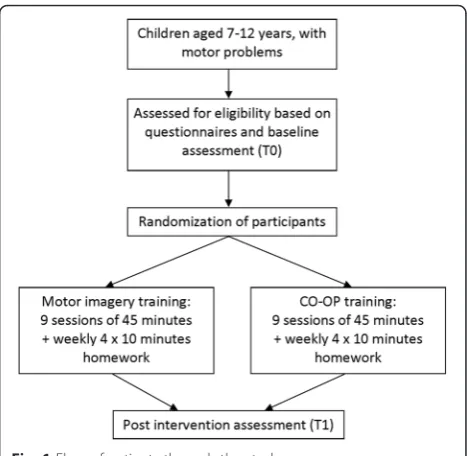
will also participate in a short training of 1.5 h to up-date their knowledge of the CO-OP training and assure a standardized protocol. Children that meet the inclu-sion criteria for this study, will be randomly allocated to either the MI or CO-OP training group, see Fig. 1. Children in the MI and CO-OP group will receive the same amount therapist contact and training time as well as homework exercises.
Patient population
All children between the ages of 7 and 12 years admit-ted at the rehabilitation centers and private practices for occupational and physical therapy for training of their motor abilities in the participating centers will be considered for inclusion. They will be offered participa-tion in the study if they fulfill all of the following cri-teria (according to the DSM-V cricri-teria for DCD [1]):
– Motor ability substantially below expected level given the chronological age of the child (criterion A). The Movement Assessment Battery for Children (m-ABC - 2ndedition) will be used to assess the motor abilities [30]. A total percentile score≤16th or a component score≤5this needed for inclusion.
– Motor impairment significantly interferes with daily life and/or academic achievement (criterion B). Only children that are referred to the centers for training of their motor abilities are included in this study. Referral for training of motor abilities is a strong indication that the motor impairment either causes problems in daily life, or with academic
achievement. In addition, as recommended, the DCD Questionnaire (DCDQ) will be used to assess
whether the motor impairment has an impact on the daily life or academic achievement of the child (Dutch translation DCD-Q [31]).
– Onset of symptoms is in the early developmental period (criterion C) as evidenced by their referral to a centre for training of their motor abilities between the ages of 7–12 years.
– No medical condition that could cause the motor impairment is known and IQ≥70 (criterion D). This will be checked by using a health questionnaire that will be filled in by the parents/caregivers of the participating children. If parents do not report learning difficulties and the child attends a regular primary school, an IQ≥70 is assumed. When attending special education, parents are asked to fill in the latest IQ score of their child.
In addition to the above mentioned criteria, atten-tional problems are assessed by using the attention def-icit hyperactivity disorder (ADHD) questionnaire [32]. Parents/caregivers of participating children will be asked to fill in this questionnaire to be able to check in the off-line analysis if attentional problems are a confounder.
Interventions
Both the MI and CO-OP intervention will be delivered for 9 weeks with 1 training session per week of 45 min. Additionally, participating children receive a homework booklet from their therapist and are required to prac-tice 4 times a week for 10 min at home. Homework will be recorded by use of a diary. The number of 9 sessions was chosen because earlier studies on MI training in children with DCD [22] and CO-OP training [10, 15, 17] showed a training effect in the intervention group using 5 – 10 sessions. The 1 session per week was chosen as this was the most feasible schedule in both the rehabilitation centers and private practices, and has also been used in earlier studies on MI training [22].
For the CO-OP training it is not specified whether ses-sions should be once a week or more or less frequent [29, 33], but a recent study showing the effectiveness of a CO-OP intervention has also used sessions once a week [17]. Two self-chosen skills that are important for the child to learn will be selected for training during the 9 week intervention period [9]. The Motor Coord-ination Questionnaire will be filled in by both the par-ents and the children (guided by the therapist) to examine which motor skills are difficult for the child to perform (part A), and which motor skills are important for the child to master (part B). Using these two parts of the questionnaire, the therapist will help the child to choose two skills that will be targeted during the inter-vention period.
Motor imagery training
In the review of Malouin, Jackson and Richards [34] three modes of MI delivery are discussed: (1) the motor imagery and physical practice are provided in separate sessions with MI training delivered either through audiotaped (or videotaped) scripts or guided by a ther-apist on a one to one basis, (2) motor imagery and physical practice are provided in the same session with series of physical repetitions alternating with the men-tal repetitions, (3) motor imagery alone. In a study of Courtine et al. [35], it was found that the timing (func-tional equivalence) of the motor task that is mentally rehearsed improved when motor imagery was alter-nated with physical repetitions within the same session. The process of forward internal modeling is depicted schematically in Fig. 2. Internal modeling comprises two aspects: an inverse modeling process that maps the necessary motor parameters (e.g. force, timing, trajec-tory) to achieve a desired goal state, and forward mod-eling that uses a predictive estimate of the sensory consequences of an action as means of error correction [6]. The output of the forward model provides a tem-plate against which real-time feedback can be compared
under tight temporal constraints, and motor output sig-nals can be corrected if needed [36]. When a mismatch occurs between predicted and actually sensory feedback an error signal is generated which provides an oppor-tunity to correct movements online, but also helps to make the forward model for the next movement more accurate [35]. This suggests that afferent information during actual execution of a movement is helpful for consistent reproduction of the next imagined move-ment. Therefore, in the current study a combination of motor imagery and physical practice is used within the same session.
In addition, the PETTLEP model was used to design the current MI training. The PETLEPP model was devel-oped by Holmes and Collins in 2001 [37]. The model is based on neuroscience research findings, particularly the discovery that the same neurophysiological processes underlie imagery and actual movement [38]. This ‘ func-tional equivalence’ provides a possible explanation for the improvements of performance after imagery train-ing [39]. The PETTLEP acronym relates to important components when implementing motor-based imagery interventions, namely: Physical, Environment, Task, Timing, Learning, Emotion and Perspective components. These seven components, as described by Holmes and Collins [37], are summarized here:
(I). Physical: imagery is more effective when it includes all of the senses that would be engaged, and kinesthetic sensations that would be experienced, during actual performance. (II). Environment: It is important to imagine the
performance in an environment that is as similar as possible to the actual performing environment, to be able to access the same motor representation. If a similar environment is not possible, photographs or videotapes can be used [40].
(III). Task: The imagined task needs to be closely matched to the actual task. The participant should be encouraged to verbally report physiological and behavioral involvement, to emphasize a kinesthetic orientation toward the imagery [41].
(IV). Timing: Equivalence in timing between the imagined and executed movement is important. To be able to access the same motor
representation during motor imagery as during the execution of a movement, the temporal characteristics should be the same [37]. (V). Learning: The imagery content needs to be
adapted to the skill learning stage that the performer is currently in and moves from cognitive to autonomous. First the performer
will have to think more about the technique, but in later stages of imagery the performer can focus more on the‘feel’of the movement [41]. (VI). Emotion: To achieve optimal functional
equivalence, the person should try to experience all of the emotions associated with the
performance. This is in accordance with Lang [42] and Cuthbert, Vrana and Bradley [43] who suggest that the performer’s emotional responses must be included in imagery. The affective response during motor imagery is best shown through the autonomic system [44]. When faced with a physiological challenge, heart rate and respiration rate change already during motor preparation and subsequently in execution that reflect alterations in the energetic state of the performer [45].
(VII).Perspective: From a functional equivalence perspective, imagery from a 1st person
perspective (a representation of the self in action) is preferable because it is more closely related to the performer’s view when actual performing the movement.
needed to perform the skill [46]. This also reflects to the learning component of the PETLEPP model, participants can first focus on the technique of the movement by watching the video from a 3rd person perspective, followed by the video from a 1st person perspective where they can focus more on the ‘feel’ of the move-ment as if they were doing it themselves.
The training protocol consists of several parts that will be run through every training session: (a) discuss homework of the past week and determine goal of current session (10 min), (b) watch videos of selected motor skill from 3rd person perspective and 1st person perspective, followed by mental rehearsal of this motor skill (10 min), (c) overt practice of the motor skill (10 min), (d) alternating mental rehearsal and overt practice of the motor skill, and compare and reflect on overt practice and mental rehearsal (10 min); (e) explain-ing homework for next week, advice for parents to motiv-ate their child, goal of upcoming week (5 min). Videos of the following motor skills are provided by the researchers to the therapists: (a) Running and playing tag, (b) Throw-ing and catchThrow-ing a ball, (c) HoppThrow-ing and playThrow-ing hop-scotch, (d) Jumping (amongst others rope skipping), (e) Bicycling, (f) Playing baseball, (g) Playing tennis, (h) Handwriting and (i) Eating with cutlery. On the videos the performance of the skill by a child aged 7–12 years is shown. If therapists want to train another motor skill with the child, they can record a short video themselves. Time practicing the two selected motor skills will be evenly distributed.
CO-OP training
Like the MI training, the CO-OP training will focus on the acquisition of two self-chosen skills that are im-portant for the child to learn. CO-OP is expected to improve the knowledge of the task through cognitive strategy use. CO-OP approach is based on cognitive behavior modification theories, in particular the verbal self-instruction strategy developed by Meichenbaum [47]. During a CO-OP intervention, a child learns this self-instruction strategy, which enables the child to identify why the performance was not successful, and to invent and execute plans to correct his/her performance (the goal-plan-do-check strategy) [13]. It is based on the belief that when a child guides himself through a problem-solving task by talking aloud, he/she learns to regulate be-haviour by learning how to identify a goal, develop a plan and evaluate the success of that plan [48]. The training protocol consists of several parts that will be run through every training session: (a) discuss homework last week and determine goal of current session (10 min), (b) practice the selected motor skill using the Goal-Plan-Do-Check framework (30 min), (c) explaining homework for next week, tips for parents to motivate their child, goal of
upcoming week (5 min). Time-on-task of both selected motor skills will be evenly distributed.
Outcome measures
All tests will be performed by one assessor who is blind to group allocation at baseline (< 2 weeks before the intervention start) and post treatment (within < 2 weeks after last treatment). The assessor will be trained in the testing procedures before the start of this study.
Primary outcome measure–m-ABC-2
The primary outcome measure is the score on the m-ABC-2 (Dutch translation [30]), reflecting the fine motor skills, gross motor skills and coordination abilities.
Secondary outcome measures
Motor coordination questionnaire
Parents will be asked to fill in a questionnaire about 16 motor skills before and after the intervention, the Motor Coordination Questionnaire. Prior to the start of the intervention, they are asked how well their child is at performing these motor skills (part A), and how import-ant it is for their child to perform well on these motor skills (part B). Children are also asked to fill out this questionnaire during the first training session. Parents and children can complement the questionnaire, with motor skills that are not present on the questionnaire, but important for their child to master. The answers help to choose the motor skills that will be trained dur-ing the intervention. After the intervention, parents and children will be asked to fill out this questionnaire again, however in addition to questions focusing on how well the child is able to perform the motor skills (part A), it is asked whether they think that the child has become better or worse in performing these motor skills (part C). All answers need to be filled out on a 5-point Likert scale. The score on the Motor Coordination Question-naire will serve as an evaluation of the perceived im-provement of motor skills of both participating children and their parents.
Video- analysis of the trained motor skills
handwriting test (SOS-2 [49, 50]) will be used to evalu-ate the training effect.
Motor imagery performance
In earlier studies several tasks have been used that are thought to rely on an internal model of a movement – motor imagery, action planning and rapid online control of movements. Motor imagery performance will be tested with two tasks in this study, the hand rotation task [51] and the radial visual guided pointing task [52]. These two tasks are used because they are based on dis-tinct concepts. In the hand rotation task an on-line, real-time representation of the body position is used, also called the ‘body schema’ [53, 54]. In contrast, in the radial visual guided pointing task an internal repre-sentation of the pointing movement is used to deter-mine how long it takes to perform the task mentally, and this representation is mainly built by repeating practice and is less based on the body schema.
Action planning performance
In addition, a task to measure anticipatory action plan-ning is assessed. Action planplan-ning can be defined as the ability to take the constraints of the action task and its goal into account when first taking hold of an object [55]. Tasks that examine action planning are also thought to rely on an internal model of a movement. We will use the sword task [56, 57], that has been previously used and val-idated in children. This task is specifically designed to measure action planning in children.
Rapid online control
The online control of movements requires that the motor system predicts the future location of the mov-ing limb usmov-ing a forward internal model [6, 58]. Durmov-ing target-directed reaching, the nervous system must im-plement rapid changes in trajectory in-flight, if the movement is perturbed in some way or in the event of a visually detected change in the environment. Experi-mentally, the operation of these internal feedback loops has been examined in children with DCD using double-step perturbation paradigms [7, 8]. In this study, we will also examine the detection and correction of online perturbations with the double step reaching paradigm.
Feasibility of MI training protocol
Therapists that have provided the MI or CO-OP will be asked to share their experiences and suggestions for im-provement of the training after the intervention period. In addition, we will ask the children to fill in the Enjoy-ment Scale after the intervention period. The EnjoyEnjoy-ment Scale is a 5 point scale with smiley faces (0 is no fun at all; 4 is super fun) that has been developed by Jelsma et al. [59]. Using the scale, we can examine whether children
enjoyed the therapy, and if this is related to the overall performance score.
Ethical approval
The MI training study has been approved by the Com-mittee on Research Involving Human Subjects of the region Arnhem-Nijmegen in the Netherlands (protocol number 2013/463) and will be conducted in conform-ance with the ‘Declaration of Helsinki’. Written in-formed consent for participation of the parents of the children will be obtained. The trial is registered at the Dutch trial register, www.trialregister.nl (NTR5471).
Sample size
The smallest detectable difference (SDD 95 %), regarded as clinically relevant of the m-ABC-2 as reported in the manual is two standard scores [30]. Using the SDD 95 % as the cut off, it will be established how many of the children improved their total standard score on the m-ABC-2 in the two groups. The number of participants is based on this SDD 95 %, with a statistical power of 80 % and an α= 5 % (two-tailed). Because the main question is whether the MI training group has a greater improve-ment of motor abilities than the CO-OP training group after the intervention, the sample size calculation is based on the difference between the MI and CO-OP training on the m-ABC-2 change score (before and after training). Power calculations yielded a required sample size of 58 participants, 29 participants in each group.
Statistical analysis
Statistical methods to assess differences between groups will be ANOVA and ANCOVA analyses and Mann Whitney U tests. Between group comparisons will be made for primary and secondary outcome measures. Ef-fect sizes (D) will be calculated to determine the prac-tical significance of these differences. D-values greater than 0.5 indicate a moderate and values greater than 0.8 will indicate a large practical significance [60]. Potential confounders, such as age, gender and score on the ADHD questionnaire, will be included in an ANCOVA.
Study organization
The study is organized and coordinated by the Radboud University in Nijmegen, the Netherlands. Collaborating institutions are 2 rehabilitation centers in the Netherlands and 17 private practices for occupational and physical therapy across the Netherlands.
Discussion
to conventional physical therapy. However, 39 % of the sample had a test score within the low normal range on the m-ABC. Therefore, conclusions about MI training for DCD should be interpreted with care. It is important to study whether MI training is also effective in a population with scores in the clinical range of the m-ABC-2 that meet the DSM-V diagnostic criteria for DCD.
Moreover, the multicenter character of the study will increase the generalizability of study results across dif-ferent rehabilitation centers and private practices for occupational and physical therapy. The present study will also provide an opportunity to evaluate the feasibil-ity of MI training both from the therapists’ and chil-dren’s point of view. As a result, the present study will also help to gather information needed to implement MI training on a larger scale. This study will increase our knowledge about the efficacy of both the MI train-ing and CO-OP traintrain-ing, and therefore will help to make treatment protocols for children with DCD more evidence-based, from which both children with DCD and therapists will benefit.
Abbreviations
ADHD:attention deficit hyperactivity disorder; ANCOVA: analysis of co-variance; ANOVA: analysis of variance; CO-OP: cognitive orientation to daily occupational performance; DCD: developmental coordination disorder; DCDQ: developmental coordination disorder questionnaire; DSM: diagnostic and statistical manual of mental disorders; EACD: European Academy for Childhood Disability; IMD: internal modeling deficit; m-ABC: movement assessment battery for children; MI: motor imagery; NTT: neuromotor task training; SDD: smallest detectable difference; SOS: systematische opsporing schrijfproblemen.
Competing interests
The authors declare that they have no competing interests.
Authors’contribution
ILJA drafted the manuscript. All authors participated in developing the design of the study, contributed to and critically appraised the manuscript. All authors have read and acknowledged the final manuscript.
Acknowledgements
The MI/CO-OP trial is funded by the Graduate School of the Behavioural Science Institute Nijmegen, Radboud University Nijmegen. We acknowledge the contribution of physical therapists Rinske van Stee, Thomas Doll, Max Keurentjes and Jesper Lange for arrangement of exercises and video collection. We are grateful for the support of the clinicians working at the participating centres.
Author details
1Behavioural Science Institute, Radboud University Nijmegen, PO Box
91046500 HE Nijmegen, The Netherlands.2School of Psychology, Australian Catholic University, Melbourne 3065VIC, Australia.3Department of Health and Rehabilitation Sciences Faculty of Health Sciences, University of Cape Town, Old Main Building Grote Schuur Hospital, Cape Town, South Africa.
Received: 29 May 2015 Accepted: 7 January 2016
References
1. American Psychiatric Association. Diagnostic and statistical manual of mental disorders. 5th ed. Washington: American Psychiatric Association; 2013. 2. Gaines R, Missiuna C, Egan M, McLean J. Interprofessional care in the
management of a chronic childhood condition: Developmental Coordination Disorder. J Interprof Care. 2008;22(5):552–5.
3. Wilson PH, Ruddock S, Smits-Engelsman B, Polatajko H, Blank R. Understanding performance deficits in developmental coordination disorder: a meta-analysis of recent research. Dev Med Child Neurol. 2013; 55(3):217–28. doi:10.1111/j.1469-8749.2012.04436.x.
4. Adams ILJ, Lust JM, Wilson PH, Steenbergen B. Compromised motor control in children with DCD: A deficit in the internal model?-A systematic review. Neurosci Biobehav Rev. 2014;47C:225–44. doi:10.1016/j.neubiorev.2014.08.011. 5. Wilson PH, Butson M. Deficits underlying DCD (Chapter 4). In: Geuze RH,
editor. Developmental Coordination Disorder: a review of current approaches. Marseille: Solal Editeurs; 2007. p. 115–9.
6. Wolpert DM. Computational approaches to motor control. Trends Cogn Sci. 1997;1(6):209–16. doi:10.1016/S1364-6613(97)01070-X.
7. Hyde C, Wilson PH. Online motor control in children with developmental coordination disorder: chronometric analysis of double-step reaching performance. Child Care Health Dev. 2011;37(1):111–22. doi:10.1111/j.1365-2214.2010.01131.x.
8. Hyde C, Wilson PH. Dissecting online control in Developmental Coordination Disorder: a kinematic analysis of double-step reaching. Brain Cogn. 2011;75(3):232–41. doi:10.1016/j.bandc.2010.12.004.
9. Blank R, Smits-Engelsman B, Polatajko H, Wilson PH. European Academy for Childhood Disability (EACD): Recommendations on the definition, diagnosis and intervention of developmental coordination disorder (long version). Dev Med Child Neurol. 2011;54:54–93. doi:10.1111/j.1469-8749.2011.04171.x. 10. Miller LT, Polatajko HJ, Missiuna C, Mandich AD, Macnab JJ. A pilot trial of a cognitive treatment for children with developmental coordination disorder. Hum Mov Sci. 2001;20(1–2):183–210.
11. Niemeijer AS, Smits-Engelsman BC, Schoemaker MM. Neuromotor task training for children with developmental coordination disorder: a controlled trial. Dev Med Child Neurol. 2007;49(6):406–11.
12. Smits-Engelsman BC, Blank R, van der Kaay AC, Mosterd-van der Meijs R, Vlugt-van den Brand E, Polatajko HJ, et al. Efficacy of interventions to improve motor performance in children with developmental coordination disorder: a combined systematic review and meta-analysis. Dev Med Child Neurol. 2013;55(3):229–37. doi:10.1111/dmcn.12008.
13. Barnhart RC, Davenport MJ, Epps SB, Nordquist VM. Developmental coordination disorder. Phys Ther. 2003;83(8):722–31.
14. Corcoran R, Tong L, Cameron D, Polatajko H.Task-specific intervention and CO-OP: Improving occupational performance for children. Paper presented at the Canadian Association of Occupational Therapists Conference, Vancouver, BC, May 28, 2005.
15. Polatajko HJ, Mandich AD, Miller LT, Macnab JJ. Cognitive orientation to daily occupational performance (CO-OP): part II–the evidence. Phys Occup Ther Pediatr. 2001;20(2–3):83–106.
16. Zwicker JG, Rehal H, Sodhi S, Karkling M, Paul A, Hilliard M, et al. Effectiveness of a summer camp intervention for children with
developmental coordination disorder. Phys Occup Ther Pediatr. 2015;35(2): 163–77. doi:10.3109/01942638.2014.957431.
17. Thornton A, Licari M, Reid S, Armstrong J, Fallows R, Elliott C. Cognitive orientation to (daily) occupational performance intervention leads to improvements in impairments, activity and participation in children with Developmental Coordination Disorder. Disabil Rehabil. 2015; 1–8. doi:10.3109/09638288.2015.1070298
18. Schoemaker MM, Smits-Engelsman BCM. Neuromotor task training: a new approach to treat children with DCD. In: Sugden DA, Chambers M, editors. Children with Developmental Coordination Disorder. London: Whurr; 2005. p 212–227.
19. Schoemaker MM, Smits-Engelsman BCM. Is treating motor problems in DCD just a matter of practice and mere practice? Curr Dev Disord Rep. 2015;2(2):150–6. 20. Jongmans MJ, Linthorst-Bakker E, Westenberg Y, Smits-Engelsman BCM. Use
of a task-oriented self-instruction method to support children in primary school with poor handwriting quality and speed. Hum Mov Sci. 2003;22: 549–66.
21. Schoemaker MM, Niemeijer AS, Reynders K, Smits-Engelsman BCM. Effectiveness of neuromotor task training for children with developmental coordination disorder: a pilot study. Neural Plast. 2003;10:155–63. doi:10.1155/NP.2003.155. 22. Wilson PH, Thomas PR, Maruff P. Motor imagery training ameliorates motor
clumsiness in children. J Child Neurol. 2002;17(7):491–8. 23. Janssen JJ, Sheikh AA. Enhancing athletic performance through
24. Sharma N, Pomeroy VM, Baron JC. Motor imagery: a backdoor to the motor system after stroke? Stroke. 2006;37(7):1941–52.
25. Schuster C, Hilfiker R, Amft O, Scheidhauer A, Andrews B, Butler J, et al. Best practice for motor imagery: a systematic literature review on motor imagery training elements in five different disciplines. BMC Med. 2011;9:75. doi:10.1186/1741-7015-9-75.
26. Decety J, Boisson D. Effect of brain and spinal cord injuries on motor imagery. Eur Arch Psychiatry Clin Neurosci. 1990;240(1):39–43. 27. Malouin F, Richards CL, Jackson PL, Dumas F, Doyon J. Brain activations
during motor imagery of locomotor-related tasks: a PET study. Hum Brain Mapp. 2003;19(1):47–62.
28. Hetu S, Gregoire M, Saimpont A, Coll MP, Eugene F, Michon PE, et al. The neural network of motor imagery: an ALE meta-analysis. Neurosci Biobehav Rev. 2013;37(5):930–49. doi:10.1016/j.neubiorev.2013.03.017. 29. Polatajko H, Mandich A. Enabling Occupation in Children: The Cognitive
Orientation to daily Occupational Performance (CO-OP) Approach. Ottawa: CAOT Publications ACE; 2004.
30. Smits-Engelsman BCM. Handleiding Movement ABC-2-NL. Amsterdam: Pearson; 2010.
31. Schoemaker MM, Reinders-Messelink AJ, De Kloet AJ. Coördinatievragenlijst voor Ouders (CVO) - Translation of DCD-Questionnaire By Wilson (2007). 2008. 32. Scholte EM, van der Ploeg JD. ADHD-vragenlijst (AVL). Nippo- Nederlands
Instituut voor Pedagogisch en Psychologisch Onderzoek, 2004.
33. Polatajko HJ, Mandich AD, Missiuna C, Miller LT, Macnab JJ, Malloy-Miller T, et al. Cognitive orientation to daily occupational performance (CO-OP): part III–the protocol in brief. Phys Occup Ther Pediatr. 2001;20(2–3):107–23.
34. Malouin F, Jackson PL, Richards CL. Towards the integration of mental practice in rehabilitation programs. A critical review. Front Hum Neurosci. 2013;7:576. doi:10.3389/fnhum.2013.00576.
35. Courtine G, Papaxanthis C, Gentili R, Pozzo T. Gait-dependent motor memory facilitation in covert movement execution. Brain Res Cogn Brain Res. 2004;22(1):67–75.
36. Shadmehr R, Smith MA, Krakauer JW. Error correction, sensory prediction, and adaptation in motor control. Annu Rev Neurosci. 2010;33:89–108. doi:10.1146/annurev-neuro-060909-153135.
37. Holmes PS, Collins DJ. The PETLEPP approach to motor imagery: a functional equivalence model for sport psychologists. J App Sport Psychol. 2001;13:60–83.
38. Decety J, Jeannerod M. Mentally simulated movements in virtual reality: Does Fitts's law hold in virtual reality? Behav Brain Res. 1996;72:127–34. 39. Jeannerod M. Mental imagery in the motor context. Neuropsychologia.
1995;33(11):1419–32.
40. Smith D, Holmes PS, Whitemore L, Collins D, Devonport T. The effect of theoretically-based imagery scripts on hockey penalty flick performance. J Sport Behav. 2001;24:408–19.
41. Smith D, Wright C, Allsopp A, Westhead H. It’s all in the mind: PETLEPP-based imagery and sports performance. J App Sport Psychol. 2007;19:80–92. doi:10.1080/10413200600944132.
42. Lang PJ. The cognitive psychophysiology of emotion: Fear and anxiety. In: Tuma AH, Maser JD, editors. Anxiety and the anxiety disorder. Hillsdale: Lawrence Erlbaum Associates; 1985.
43. Cuthbert BN, Vrana SR, Bradley MM. Imagery: Function and physiology. In: Jennings PR, Ackles PR, Coles MGH, editors. Advances in psychophysiology. 4th ed. London: Jessica Kingsley Publishers; 1991. p. 1–42.
44. Decety J. Do imagined and executed actions share the same neural substrate? Cogn Brain Res. 1996;3(2):87–93.
45. Smith NC, Collins DJ. The role of psychophysiology as a research and intervention tool in sport psychology. J Psychophysiol. 1992;6:78. 46. Hardy L, Callow N. Efficacy of external and internal visual imagery
perspectives for the enhancement of performance on tasks in which form is important. J Sport Exerc Psychol. 1999;21(2):95–112.
47. Meichenbaum D. Cognitive-Behavior Modification: An integrative approach. New York: Plenum Press Publishing Corporation; 1977.
48. Sangster CA, Beninger C, Polatajko HJ, Mandich A. Cognitive strategy generation in children with developmental coordination disorder. Can J Occup Ther. 2005;72(2):67–77.
49. Van Waelvelde H, de Mey B, Smits-Engelsman B. SOS: een instrument om schrijfmotorische problemen op te sporen. Signal. 2012;21(78):4–12. 50. Smits-Engelsman BCM, Stevens M, Vrenken I, Van Hagen A. Systematische
Opsporing Schrijfproblemen (SOS): een hulpmiddel voor leerkrachten bij het signaleren van motorische schrijfproblemen van leerlingen in het Basis
en Speciaal Onderwijs. [Systematic screening of handwriting problems (SOS): An instrument for teachers for screening of handwriting problem of children in primary school and special education] Kinderfysiotherapie. 2005; 16-20.
51. ter Horst AC, van Lier R, Steenbergen B. Mental rotation task of hands: differential influence number of rotational axes. Exp Brain Res. 2010;203(2): 347–54. doi:10.1007/s00221-010-2235-1.
52. Smits-Engelsman BC, Wilson PH. Age-related changes in motor imagery from early childhood to adulthood: probing the internal representation of speed-accuracy trade-offs. Hum Mov Sci. 2013;32(5):1151–62. doi:10.1016/j. humov.2012.06.006.
53. Coslett HB. Evidence for a disturbance of the body schema in neglect. Brain Cogn. 1998;37(3):527–44.
54. Wolpert DM, Ghahramani Z. Computational principles of movement neuroscience. Nat Neurosci. 2000;3(Suppl):1212–7.
55. Johnson-Frey SH, McCarty ME, Keen R. Reaching beyond spatial perception: Effects of intended future actions on visually guided prehension. Vis Cogn. 2004;11(2–3):371–99. doi:10.1080/13506280344000329.
56. Craje C, Aarts P, Nijhuis-van der Sanden M, Steenbergen B. Action planning in typically and atypically developing children (unilateral cerebral palsy). Res Dev Disabils. 2010;31(5):1039–46. doi:10.1016/j.ridd.2010.04.007.
57. Jongbloed-Pereboom M, Nijhuis-van der Sanden MWG, Saraber-Schiphorst N, Craje C, Steenbergen B. Anticipatory action planning increases from 3 to 10 years of age in typically developing children. J Exp Child Psychol. 2013; 114(2):295–305. doi:10.1016/j.jecp.2012.08.008.
58. Desmurget M, Grafton S. Feedback or feedforward control: end of a dichotomy. In: Johnson-Frey SH, editor. Taking action: Cognitive neuroscience perspectives on intentional acts. Cambridge: MIT Press; 2003. p. 289–338. 59. Jelsma D, Geuze RH, Mombarg R, Smits-Engelsman BC. The impact of Wii Fit
intervention on dynamic balance control in children with probable Developmental Coordination Disorder and balance problems. Hum Mov Sci. 2014;33:404–18. doi:10.1016/j.humov.2013.12.007.
60. Cohen J, editor. Statistical Power Analysis for the Behavioral Sciences. NY: Academic; 1969.
61. Bubic A, von Cramon DY, Schubotz RI. Prediction, cognition and the brain. Front Hum Neurosci. 2010;4:25. doi:10.3389/fnhum.2010.00025.
• We accept pre-submission inquiries
• Our selector tool helps you to find the most relevant journal • We provide round the clock customer support
• Convenient online submission • Thorough peer review
• Inclusion in PubMed and all major indexing services • Maximum visibility for your research
Submit your manuscript at www.biomedcentral.com/submit
![Fig. 2 Forward model of motor control (adapted from [61])](https://thumb-us.123doks.com/thumbv2/123dok_us/9377757.1924669/4.595.58.540.576.718/fig-forward-model-motor-control-adapted.webp)
