
CIRCUIT INTEGRATED DESIGN AND ANALYSIS
TECHNOLOGY FOR PERFORMANCE AND RELIABILITY
1GANG ZHAO, 2GUANGYAN ZHAO*, 3YUFENG SUN
1School of Reliability and System Engineering, Beihang University
No.37 Xueyuan Road, Haidian district, Beijing China, telp: 086-01082315729
*Corresponding author’s e-mail: [email protected]
ABSTRACT
Integrated design and analysis technology for performance and reliability is a highlight issue in the field of reliability. A technical framework for the integration of performance and reliability of electronic products was built up. The framework integrates multiple performance analysis tools and reliability analysis tools and realizes the integrated design and analysis of performance and reliability, centering on performance simulation and on the basis of data-share. In order to realize the integrated capability, the flow and data relationship of integration of performance and reliability of electronic products were investigated, and then the integration platform was established. Finally, a case was analyzed to validate the function of the platform. It could take the circuit fault simulation, FMEA, reliability prediction, derating design, testability prediction etc. during the process of circuit performance design.
Keywords: Integration, Reliability, Performance, Platform, Circuit
1. INTRODUCTION
With the rapid progress of scientific technology and the ever-increasing complexity of modern products, the traditional product design idea in the past is not applicable to designing modern complicated products any more. The successively emerging methods like concurred design, collaborative design, multidisciplinary design optimization and integrated design have become research hot topics [1-3]. One field of integrated design is performance and reliability integration design. It’s well known that, reliability design and performance design are two different technical systems and their separation severely restricts the improvement of product design. In recent years, performance and reliability integration technology is a method commonly used to improve the product design. The rapid progress of Electronic Design Automation (EDA) just forms an excellent basis for developing the integrated design of performance and reliability of electronic products. This technology is developed in two directions at present, one of which is set up a unified integrated design environment like ADEPT [4, 5]. This direction requires a complicated function modeling which is designed in need of building up a new model for the circuit; thus it is applicable to be operated by professional operators. The other direction of the
environment/platform is unavailable which plays an important role in supporting the electronic product performance and reliability integration design.
Focusing on the overall electronic product design process, this paper analyzes elaborately the performance and reliability integration design process, studies the integration data model, and sets up electronic product performance and reliability integration platform so as to provide an effective instrument for integrated design.
2. TECHNICAL SCHEME OF
INTEGRATED DESIGN AND ANALYSIS OF PERFORMANCE AND RELIABILITY OF ELECTRONIC PRODUCTS
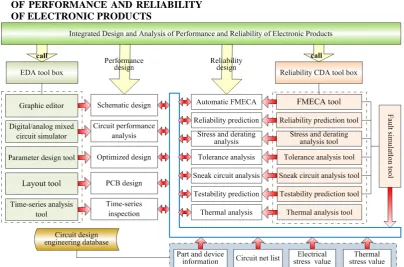
[image:2.612.97.502.245.512.2]Integration of performance and reliability of electronic products is to conduct reliability design and analysis on the basis of EDA design and full use of performance simulation model and data for well blending performance design with reliability design [8]. In respect of this, it’s necessary to build up a platform for the cooperation and exchange between EDA tools and reliability CAD tools, blend performance design data with reliability data via relevant interface, further, integrate performance design process with reliability design process. Herein a technical scheme is shown in Figure 1.
Figure 1. Technical Scheme Of Circuit Integrated Design And Analysis Of Performance And Reliability
Corresponding to circuit performance design process based on EDA tool, circuit reliability design and analysis and performance design collaborate with each other and are conducted synchronously, thereof, circuit performance design mainly uses EDA tools inclusive of schematic and HDL editor and digital/analog mixed circuit simulator etc., while reliability design mainly uses engineering reliability CAD tools inclusive of FMECA and reliability prediction etc. A common data interface is established between different tools and the platform to realize data sharing among different tools on the platform, and fault simulation tool is used for acquiring a lot of fault performance data needed by reliability analysis to lay a foundation for automatic FMECA, reliability prediction and testability prediction. Meanwhile, different tools are
used in different analysis phases through the platform’s simulation logic control to effectively raise the automation level of circuit reliability analysis.
3. KEY TECHNIQUE OF INTEGRATED
DESIGN AND ANALYSIS OF PERFORMANCE AND RELIABILITY OF ELECTRONIC PRODUCTS
3.1. Integration Process Design
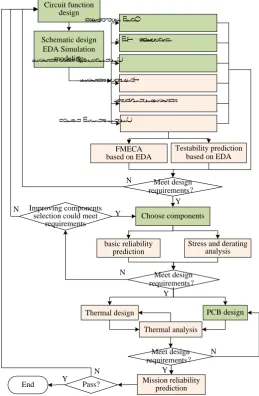
The common performance design of electronic product usually adopts serial design idea, in which the design is refined and data progresses step by step in normal order from the initial circuit schematic design to the following performance simulation and to the final PCB routing. Each step of reliability design needs to be developed synchronously with performance design, and data is in need of exchange or even reiteration in some procedures to trace conversely the data flow.
Therefore, we need to make a new product design process and realize the integrated design of performance and reliability in the research of integration design process by integrating serial design, concurred design and feedback design, reviewing in details the existing performance design items & reliability design items, and basing on the data flow direction and exchange relationship. After research, the flow of circuit integrated design and analysis of performance and reliability is set up as indicated in Figure 2.
Schematic design EDA Simulation
modeling
T
o
le
ra
n
ce
a
n
al
y
si
s
C
ir
cu
it
f
au
lt
s
im
u
la
ti
o
n
FMECA based on EDA
Testability prediction based on EDA
Stress and derating analysis Meet design
requirements?
Y N
Circuit function design
Choose components Y
basic reliability prediction
Meet design
requirements?
PCB design Thermal design
Thermal analysis
Meet design
requirements?
Y
N
End
S
n
ea
k it u rc cis si y al an
N Improving components
selection could meet requirements
Y N
Mission reliability prediction Pass?
Y N
C
ir
cu
it
p
er
fo
rm
an
ce
a
n
al
y
si
s
T
im
e sn oie- s erti ec sp in
O
p
ti
m
iz
ed
d
es
ig
[image:3.612.175.435.244.641.2]n
Figure 2. The Flow Of Circuit Integrated Design And Analysis Of Performance And Reliability
In this figure, the green part indicates performance design process, and the pink part indicates reliability design process. The two parts integrates and alternates so as to ensure the design outputs meet both performance requirements and
3.2. Integration Data Design
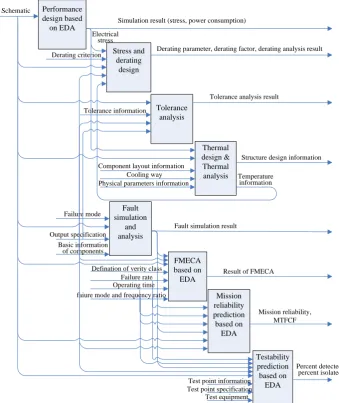
Data integration is the foundation of realizing performance and reliability integration design. In the integrated design process of performance and reliability indicated in figure 2, the latter design item in sequential progressed process are supported by relevant data generated in former item, and concurrently progressed design items need to exchange design information. So a close data coupling relationship exists in design items. Only with an integrated product design data flow
relationship set up, it is realistic to support the collaboration and data information exchange between each item in the integration design process. It’s also effective in supporting data exchange and integration in performance design and reliability design. By analyzing the electronic product performance and reliability integration design projects and the relationship between input/output data, data relationship of performance &reliability integration design is set up as shown in Figure 3.
Stress and derating
design
Tolerance analysis Performance
design based on EDA
Thermal design & Thermal analysis Schematic
Failure mode
Simulation result (stress, power consumption)
Derating parameter, derating factor, derating analysis result Derating criterion
Electrical stress
Temperature information Physical parameters information
Structure design information Tolerance information
Tolerance analysis result
Fault simulation
and analysis
Testability prediction based on
EDA FMECA
based on EDA
Mission reliability prediction based on
EDA Fault simulation result Output specification
Defination of verity class Failure rate Operating time faiure mode and frequency ratio
Result of FMECA Basic information
of components
Mission reliability, MTFCF
Test point information
Test equipment Test point specification
Percent detected percent isolated Cooling way
[image:4.612.135.475.233.637.2]Component layout information
Figure 3. The Data Exchange Relationship Of Integrated Design
Circuit schematic diagram becomes initial input of all items, data of electrical stress and thermal stress generated from simulation will become input data for derating design and thermal design, and temperature information obtained from thermal design & thermal analysis will further become input
4. CIRCUIT INTEGRATED PLATFORM
FOR PERFORMANCE AND
RELIABILITY AND ITS APPLICATION
Practicing the electronic product performance &reliability integration design requires an integration design environment in capable of providing process control environment, necessary data share environment and core fault simulation means.
4.1. Integration Platform
In the thought of integrated design for performance and reliability, this paper establishes
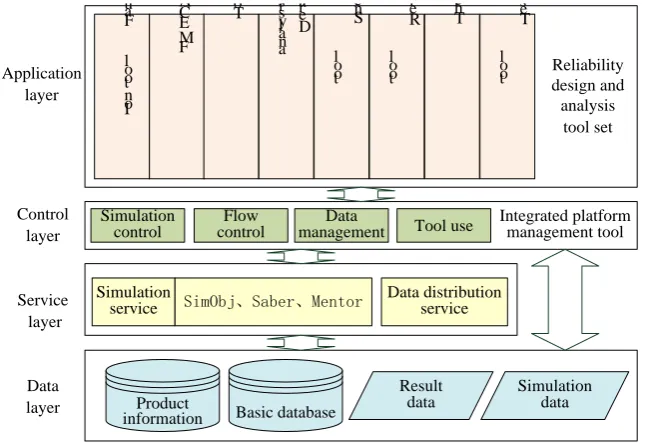
an integrated platform for performance and reliability of electronic products to meet the need of collaboration. The integrated platform conducts circuit performance simulation in the view of performance designers of electronic products, integrates various reliability design and analysis tools in combination with the overall process of product design, controls product design flow, and uses shared data for the integrated design and analysis of performance and reliability of electronic products. Its structure is shown in Figure 4.
Basic database Product information Result data Simulation data Data layer Application layer Control layer Service layer Simulation service Data distribution service F M E C A t o o l T o le ra n ce a n al y si s D er at in g a n d s tr es an al y si s to o l S n ea k c ir cu it a n al y to o l R el ia b il it y p re d ic t to o l T h er m al a n al y si s t T es ta b il it y p re d ic t to o l F au lt s im u la t Io n t o o l
SimObj、Saber、Mentor
[image:5.612.129.453.259.481.2]Reliability design and analysis tool set Tool use Data management Simulation control Flow control Integrated platform management tool
Figure 4. Platform System Structure
(1) Data layer mainly means the management of all data generated during the running of integrated platform, inclusive of product information, standard and criterion and other basic data, normal and faulty data generated by EDA simulation and analysis results, and is the basis of integration.
(2) Service layer is the inner core of the running of integrated platform and includes simulation service and data distribution service. Simulation service mainly means EDA tool simulation running service, e.g. SimObj, and all of EDA simulation, fault simulation, tolerance simulation and others need such service; data distribution service mainly means the distribution of simulation results.
(3) Control layer is system nerve center. It is realized by integrated platform management tool, and can activate various service and use different tools in accordance with simulation logic and design item to realize simulation control, flow control and
tool use, meanwhile, finish data management and data transfer between tools.
(4) Application layer is execution tool of integrated platform and achiever of platform function. It integrates total 8 reliability design and analysis tools, and realizes the interaction among tools via integrated platform management tool.
4.2. Case Study
Here is to take an example of main pass amplifier circuit of rudder loop in a UAV autopilot and have a reliability analysis to the circuit by use of integration platform.
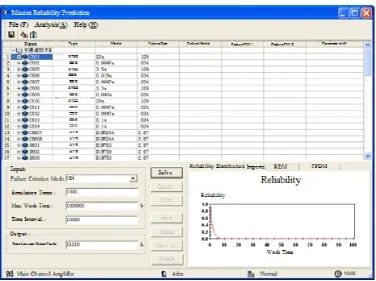
circuit by use of EDA simulator, share all performance simulation result data and fault result data at the same time, and perform analyses like
[image:6.612.116.497.127.388.2]reliability prediction, FMEA, testability prediction, etc. Some results are shown in Figure 5 - Figure 6.
Figure 5. Integration Platform For Performance And Reliability
[image:6.612.118.495.409.690.2]5. CONCLUSIONS
Integrated design and analysis technology for performance and reliability is a highlight issue in the field of reliability, and it provides an effective technical approach for improving overall performance and reliability of product. This paper, under the guidance of integration thought, studies integration process modeling and integration data modeling, establishes an integrated design and analysis platform for performance and reliability of electronic products. At present, this platform has been developed, and its functions have been verified through typical case analysis. The building and applying of electronic product performance and reliability integration platform is a breakthrough to the current status of separating product performance analysis and reliability analysis, an excellent tool to synchronize performance analysis and reliability analysis for electronic product performance designers and provide design improvement basis thanks to its automatic fault analysis, tolerance analysis and sneak circuit analysis synchronized in the circuit design process. Due to data sharing and process synchronization, the development cycle is effectively shortened, and working efficiency is improved; therefore, it has a significant role in project practice.
REFERENCES
[1] Alejandro D.D., John G.K., Joel E.S. etal. An
integrated methodology for the dynamic performance and reliability evaluation of
fault-tolerant systems. Reliability Engineering and
System Safety. 2008; 93(11):1628-1649.
[2] Halil K, Vedat T, and Ton V. An integrated
reliability-based design optimization of offshore
towers. Reliability Engineering and System
Safety. 2009; 9(10):1510-1516.
[3] Liu J.M., Hao J.P., Liu L.Z.. Theory of
incorporate design and its advance. Journal of
Machine Design. 2006; 23(3):4-7.
[4] Klenke R.H, Meyassed M., Aylor J.H., Johnson
B.W. etal. Integrated design environment for
performance and dependability analysis.
Proceedings of the 34th Conference on Design
Automation. Anaheim. 1997; 184-189.
[5] Klenke R.H., Aylor J.H., Johnson B.W. etal.
Improvements to ADEPT-a VHDL based integrated design environment for performance
and dependability analysis. Proceedings of
VHDL International Users’ Forum. Arlington. 1997; 190-199.
[6] Zhao G.Y., Sun Y.F., KANG R., WU Y.
Methodology of Fault Modeling, Injection and Judgment of Circuit Fault Simulation.
Microelectronics & Computer. 2007;
24(1):143-146.
[7] Zhao G.Y., Sun Y.F., Yang L.B. Design of the
Platform of Circuit Functional Reliability
Simulation. Journal of System Simulation. 2005;
17(12):2931-2934.
[8] Sun Y.F. Circuit integrated Design of
performance and reliability based on EDA.
![Assessment of Physiological Health Status in Relations to Different Anthropometric and Cardio respiratory Measures of Head Supported Load Carrying Male Porters of Sikkim, India [Article Retracted]](data:image/gif;base64,R0lGODlhAQABAIAAAP///wAAACH5BAEAAAAALAAAAAABAAEAAAICRAEAOw==)