P E R S P E C T I V E
Open Access
Recent developments in computer assisted
rehabilitation environments
Rob van der Meer
Abstract
Computer Assisted Rehabilitation Environment (CAREN) is a system that integrates a training platform (motion base), a virtual environment, a sensor system (motion capture) and D-flow software. It is useful for both diagnostic and therapeutic use. The human gait pattern can be impaired due to disease, trauma or natural decline. Gait analysis is a useful tool to identify impaired gait patterns. Traditional gait analysis is a very time consuming process and therefore only used in exceptional cases. With new systems a quick and extensive analysis is possible and provides useful tools for therapeutic purposes. The range of systems will be described in this paper, highlighting both their diagnostic use and the therapeutic possibilities. Because wounded warriors often have an impaired gait due to amputations or other extremity trauma, these systems are very useful for military rehabilitative efforts. Additionally, the virtual reality environment creates a very challenging situation for the patient, enhancing their rehabilitation experience. For that reason several Armed Forces have these systems already in use. The most recent experiences will be discussed; including new developments both in the extension of the range of systems and the improvement and adaptation of the software. A new and promising development, the use of CAREN in a special application for patients with post-traumatic stress disorder (PTSD), will also be reviewed.
Keywords:Computer assisted rehabilitation environment, Virtual reality, Trauma, Amputations, Rehabilitation, Post-traumatic stress disorder, Military medicine
Introduction
The use of Improvised Explosive Devices (IEDs) in re-cent conflict often results in complex orthopedic and neurological trauma, which may include limb loss, spinal cord injuries and traumatic brain injury. Survival rates have significantly increased with mortality among US troops at 8.5% in World War I, 3.3% in World War II, 2.6% in The Vietnam War. In recent operations, mortality has increased to 4.8%, most likely a result of a decreased number of Killed in Action (20.0% in WW II as compared to 13.8% in recent operations) [1]. Unfortunately, many warriors sustain limb amputations, as many as 3.5%-14.0% trauma admissions in recent operations [2]. The primary rehabilitation goal for these individuals is to provide them with an expedited recovery and progressive reintroduction into the civilian or active duty populations. In this rela-tively young population, new challenging rehabilitation methods are ideal. The Computer Assisted Rehabilitation Environment (CAREN) is such a system [3].
Virtual reality
Virtual reality in medicine, and more specifically in re-habilitation medicine, is a developing area. Lohse et al. [4] carried out a literature study comparing Virtual Real-ity therapies (VR) to conventional therapies (CT) and commercially available gaming systems (CG) in stroke patients. There was a wide range of CTs, like treadmill gait training, balance training, postural control, creative therapy, etc. The study showed that virtual reality moder-ately improved outcomes compared to conventional ther-apy in adults post-stroke. Current CG interventions have been too few and too small to assess potential benefits of CG. Future research in this area should aim to clearly de-fine conventional therapy, report on participation measures, consider motivational components of therapy, and investi-gate commercially available systems in larger randomized clinical trials (RCTs). McEwen et al. [5] showed that vir-tual reality exercises in stroke patients improved mobility-related outcomes. Another study addressed upper extremity dysfunction after stroke. The traditional rehabilitation approaches based on one-to-one physiotherapist-patient Correspondence:[email protected]
MeerHealth, Riënzistraat 41, 2555 JT‘s-Gravenhage, The Netherlands
interaction are evidence based. However, recent evidence is enlightening the possibility that innovative approaches, based on the augmentation of specific kinematic feed-backs, could enrich the rehabilitation environment, pos-sibly leading to a significant improvement of the motor function. This enrichment could potentially facilitate the physiological activation of the brain areas devoted to motor relearning. As a consequence, reinforced feed-back in virtual environment can promote the recovery of motor function in post-stroke patients, by means of regular, intensive, and supervised training [6]. The lit-erature available supports the conclusion that virtual reality therapies have an added value in motor learning and stability training [7-9].
CAREN
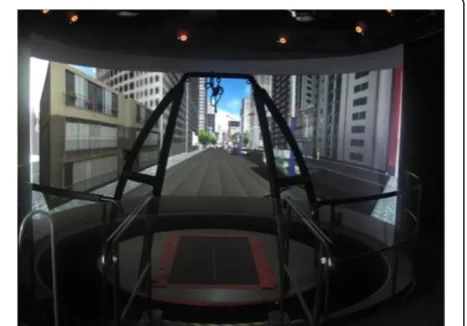
The CAREN system consists of a motion capture system and a base platform, driven by hydraulic and mechanical actuators (Figure 1). The base where the user stands is designed with force plates and a treadmill, with up to 6 degrees of freedom (Figure 2). This allows the operator to generate visual and physical perturbations that re-quire the user to make dynamic responses during their gait patterns. The CAREN system may also be equipped with varying degrees of virtual reality immersion ranging from a flat video, dual-channel audio, and theater in its “base”model to a 360° surround sound dome enclosure in its“high end”version (Figure 3). Real-time motion track-ing technology enables the CAREN system to track patient movements. The CAREN system is equipped with a safety harness for the patient. The whole system is controlled by the “D-flow software”, which can be specifically adapted and customized to the user specifications. Depending on the model, CAREN is spacious equipment that requires the adequate housing infrastructure.
CAREN operates based on biofeedback principles. In a recent publication, Giggins et al. [10] describe the different
types of biofeedback in rehabilitation. Biofeedback has been widely used in rehabilitation for several decades. It is the technique of providing biological information to pa-tients that would otherwise be unknown. Biofeedback can be divided into biomechanical and physiological biofeed-back. Examples of physiological feedback are neuromuscu-lar (Electromyography, EMG), cardiovascuneuromuscu-lar (heart rate, blood pressure) and respiratory. Biomechanical biofeed-back involves measurements of the movement, postural control and forces produced by the body. Inertial sensors, force plates, electrogoniometers, pressure biofeedback units and camera based systems are all measurement de-vices which can be used to provide biomechanical biofeed-back. Biomechanical biofeedback is more complex than physiological biofeedback, as one measurement device can be used to deliver different types of biomechanical feed-back. For example, a force plate can be used to deliver both feedback on force and postural control. Several of these biofeedback modalities are all integrated in the CAREN system.
Literature review
CAREN was developed in the 1990’s and with a limited use in the beginning. This is reflected by the literature that is rather limited and mainly focused on more technical as-pects of the tool and oriented on the clinical use for stroke patients only. Specific reports on its use in the military and with amputees are scarce. Here we review a selection of current literatures.
Van der Eerden et al. [11] were one of the first to de-scribe CAREN. They dede-scribed CAREN as made by cus-tomizing hardware and developing software, to enable detailed measurements of motion of a subject in re-sponse to perturbations from the computer driven mo-tion platform. After feeding the data into a human body model simulation, joint moments of force and muscle activation can be calculated. From the time patterns of these responses, inferences can be made concerning the motor programs the subjects launch. Any primary prob-lem in a motor program, resulting in functional failure or inadequacy, can be identified down to the joint and muscle group. Secondary adaptations of patients to a limitation in the periphery (such as lack of muscle force) can be sepa-rated from the primary ones. Especially the understanding of compensation strategies in patients may lead to a better therapeutic attitude. The authors conclude that CAREN offers not only a test environment, capable of almost un-limited exploratory behaviors for patients, but also an out-standing tool for motor control research.
mechanisms of proximal joints. They determined the CAREN platform’s axes of rotation in all three planes and found the CAREN platform’s consistency to be compar-able to validated methods for determining joint axes. They conclude that the CAREN platform is a valuable tool to generate perturbations by rotating the supporting surface around a kinematically reconstructed joint axes. The de-scribed method could serve as a benchmark for other CAREN systems. The accurate translation of the CAREN platform’s axes of rotation into arbitrary locations over-comes a major limitation of other moving platforms. The benefit of rotating the supporting platform around a joint’s axis rather than around an axis outside the body is that the joint is purely rotated without being translated thus remov-ing the confoundremov-ing effects of translation on balance. The ability to apply isolated rotational perturbations on targeted joints while standing, opens up the possibility to focus on the role of individual joints in balance mechanisms.
Maksoud et al. [13] also studied virtual reality technol-ogy and states that “it offers the opportunity to expose
patients to complex physical environments, without phys-ical danger and thus provides a wide range of opportun-ities for locomotor training, or the study of human postural and walking behavior”. A clinical study has shown that post-stroke patients are able to adapt and benefit from this system, wherein they walk into virtual environ-ments on a self-paced treadmill mounted on a platform with 6 degrees of freedom. This platform is programmed to mimic changes in the terrain encountered in the virtual environments. While engaging in these virtual environ-ments, excessive trunk movements and speed alterations have been observed, especially during the pitch perturba-tions accompanying uphill or downhill terrain changes. The aim of this study was to determine an optimal solu-tion to simulate walking in real life when engaging in vir-tual environments.
Hawkins et al. [14] studied the relationship between performance and difficulty by altering game velocity and surface perturbations in a virtual game environment. Per-formance deteriorates as game difficulty increases, when Figure 2Six degrees of freedom (DOF) platform.
changing game velocity and surface perturbations. Adjust-ment of both game velocity and the introduction of sur-face perturbations independently appear to be simple and effective methods of customizing task difficulty as a func-tion of patients’motor ability during rehabilitation.
Kizony et al. [15] studied dual-tasking, specifically in people with neurological deficits (Figure 4). The authors designed a study to test the feasibility of using a virtual functional environment for the examination of dual-tasking and to determine the effects of dual-dual-tasking on gait parameters in people with stroke and age-matched healthy controls. Participants walked on a self-paced treadmill while viewing a virtual grocery aisle projected onto a screen placed in front of them. They were asked to walk through the aisle (single task) or to walk and se-lect (“shop for”) items according to instructions deliv-ered before or during walking (dual-tasking) (Figure 4). Overall, the stroke group walked slower than the control group in both conditions, whereas both groups walked faster over ground than on the treadmill. The stroke group also showed larger variability in gait speed and shorter stride length than the control group. There was a general tendency to increase gait speed and stride length during task conditions. However, a significant effect of dual-tasking was found only in one dual-task condition for gait speed and stride duration variability. All participants were able to complete the task with minimal mistakes. They conclude that it is feasible to use a functional virtual envir-onment for investigation of dual-tasking. Different gait strategies, including an increase or decrease in gait speed can be used to cope with the increase in cognitive de-mands required for dual-tasking.
Isaacson et al. [3] described how CAREN may im-prove physical and cognitive rehabilitation for wounded
warfighters. They employed the CAREN system to assist service members who had sustained IED injuries during Operation Enduring Freedom, Operation Iraqi Freedom, and Operation New Dawn. They describe that the com-plex nature of warfighter injuries, present unique re-habilitation challenges that demand new tools for quick return to active duty or the civilian community. They describe the CAREN system as unique, in that it allows the wounded warriors to be immersed in a realistic clin-ical environment, while therapist and physicians collect kinematic and kinetic data in order to plan future re-habilitation regimens. In everyday life, warfighters with lower extremity trauma may experience uneven terrain, cracks in pavements, slippery conditions, etc. All poten-tial scenarios may increase fall risk or injury. However, when using the CAREN system, specific physical perturba-tions may simulate these environmental condiperturba-tions in a safer and controlled setting. New rehabilitation methods and gait/prosthetic limb training may be developed for these individuals to mitigate falling risks outside of the clinic. They conclude that the CAREN system is a dy-namic rehabilitation aid and may be a translational tool for collecting biomechanical and physiological data during prosthetic training. As such, rehabilitation regimens may be patient specific.
Experience
The Netherlands Armed Forces have a Military Rehabilita-tion Center, where all military rehabilitaRehabilita-tion patients are being treated. Almost 40% of the population is civilian pa-tients. In Table 1, you see the distribution of the patient categories. As expected, the great majority of stroke pa-tients (90%) were civilians, whereas 80% of the amputation patients were military.
In a study at the Dutch Central Military Rehabilita-tion Center, 50 subjects underwent training on the CAREN [16]. They were asked to give their opinion on eight questions, using a Visual Analog Score by pla-cing a mark on a continuous 10 cm long line. The general domains addressed were the following: Rela-tionship with the therapist, goal oriented therapy, the approach of the therapists, and the way the patient thinks about the general therapeutic contact. Specific-ally for CAREN the following was investigated: The at-tributed importance of training on the CAREN-system to the rehabilitation process, whether the rehabilitation process accelerated by the CAREN-system, whether the amount of the therapy is considered challenging and will the training transfer to the real world. All domains scored above 8, which is a satisfactory level. Interest-ingly, patients point out that they think that training on the CAREN system accelerates the rehabilitation process, has an important role in their recovery, and is challenging, and the transfer of training to the real world is noticeable.
Post-Traumatic Stress Disorder (PTSD)
In a recent paper by Vermetten et al. [17] a report is given on developments of the use of the CAREN system for mental health problems in the military. They de-scribe that although the symptoms of PTSD in the gen-eral and military population seem very similar, combat-related PTSD is typically thought to be more severe due to the repeated and prolonged exposure of traumatic events. Therapeutic adherence is a problem in military population that compromises treatment efficacy. There-fore, a new potential supplementary treatment was spe-cially designed for patients with combat related-PTSD. This intervention is called Military Motion Memory Desensitization and Reprocessing (3MDR). The ment incorporates key elements of successful treat-ments as Virtual Reality Exposure and Eye Movement Desensitization Reprocessing, and adds motion to the condition. The authors aimed at designing a treatment procedure that preserved dual-task processing principle, but also introduced new engagement by performing the desensitization during motion by walking on a tread-mill. Moreover, they aimed at exposure to real high-affect pictures of a deployment setting. These pictures are selected by the patients and must have a link to the trau-matizing event or environment. Subjects walk a repetitive cycle while viewing the high-affect pictures of deployment scenes. Dual-task processing was maintained by an oscil-lating ball. Aspects of presence are adhered to in order to maximize possible positive outcome. The authors describe the therapy in 2 patients and conclude that the results of the two cases suggest that the 3MDR treatment is a suc-cessful treatment that goes further into the patients affect, whereas traditional treatments may fail to lead to further
Table 1 Distribution of patient categories
Diseases Rate (%)
Cerebrovascular accidents 20
Anterior cruciate ligament injury 15
Amputation 15
Multi-trauma 10
Vertigo 10
Miscellaneous 30
results. The presence was highly appreciated. They plead for further research with more patients to be performed to obtain more reliable results.
Technical developments
The CAREN system is mainly designed for a Research and Development environment. It has certain infra-structural requirements, needs a significant investment and a higher level of technical development. Therefore, MOTEK Medical (Amsterdam, The Netherlands) devel-oped other similar systems for clinical use [18].
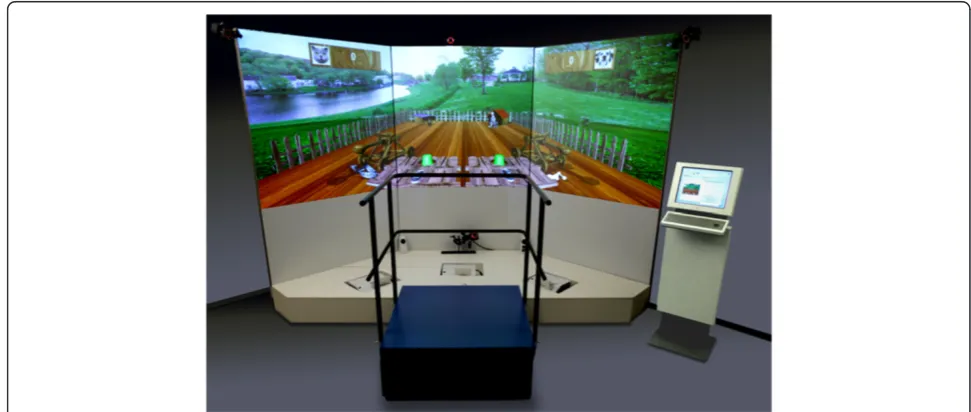
The GRAIL, Gait Real-Time Analysis Interactive Laboratory (Figures 5 and 6), is a tool for use in regular re-habilitation medicine as a gait lab. Instead of the 6DOF
platform, GRAIL uses a dual belt treadmill. GRAIL needs less space and provides quick output of results. It offers a total package solution for clinical gait analysis and gait training using the latest technologies. Besides the func-tionality of a traditional gait lab, GRAIL provides real-time gait analysis, gait off-line analysis tool (GOAT: a gait report directly after the session that facilitates video analysis and post-processing/filtering options for data analysis). Recording multiple steps makes it possible to calculate averages, standard deviations and variations of gait parameters over time, functional gait analysis for the identification of pathologic responses to perturba-tions, visual challenges, fast pitch, and sway and belt speed changes, enable identification and quantification Figure 6GRAIL, a treadmill, combined with a screen on which a scenario is projected and performance of the patient is required.
of compensatory strategies or dynamic stability and gait training. The design makes the wide spread use in re-habilitation feasible.
STABLE
Stability and Balance Learning Environment (Figure 7) is a system for the assessment and training of postural sta-bility and balance-related disorders in neurological peti-ents, orthopedic patipeti-ents, patients with musculo-skeletal complaints, and especially in the elderly with increased risk of falling. STABLE uses a force plate and motion capture, and a projection screen. One can obtain object-ive and quantitatobject-ive outcome measures for stability and balance alongside fun and motivating exercise games to train stability and balance with reduced risk of falling.
Conclusion
CAREN is a useful tool for rehabilitation in the military. Although the literature is limited and research is still in progress, the first results are promising in terms of both clinical results and patient acceptance. In The Netherlands Armed Forces as well as in other nations, it is a valuable tool in the rehabilitation programs for wounded warriors. New development in the use of CAREN for the treatment of-combat related PTSD is rather positive. Technical de-velopments will make the use of Virtual Environments in rehabilitation medicine more widespread and feasible.
Consent
Written informed consent was obtained from the patient for the publication of this report and any accompanying images.
Abbreviations
CAREN:Computer assisted rehabilitation environment; CG: Commercially available gaming systems; CT: Conventional therapies; DOF: Degrees of freedom; EMG: Electromyography; GRAIL: Gait real-time analysis interactive laboratory; IEDs: Improvised explosive devices; 3MDR: Military motion memory desensitization and reprocessing; PTSD: Post-traumatic stress disorder; STABLE: Stability and balance learning environment; VR: Virtual reality.
Competing interests
This article is written based on a lecture delivered during the 40thICMM World Congress on Military Medicine, 7-12 Dec. 2013, Jeddah, Saudi-Arabia. The author declares no competing interests.
Author details
Prof. Rob van der Meer, MD, was Brigadier General (retired), Surgeon General of The Netherlands (retired), Chairman COMEDS of NATO (retired), Chairman Pan-European Working Group ICMM(retired), and his active position is the CEO of MeerHealth and the Consultant with MOTEK Medical bv, Riënzistraat 41, 2555 JT‘s-Gravenhage, The Netherlands.
Received: 2 July 2014 Accepted: 6 October 2014 Published: 20 October 2014
References
1. Manring MM, Hawk A, Calhoun JH, Andersen RC:Treatment of war wounds: a historical review.Clin Orthop Relat Res2009,467:2168–2191. 2. Krueger CA, Wenke JC, Ficke JR:Ten years at war: comprehensive analysis
of amputation trends.J Trauma Acute Care Surg2012,73:S438–S444.
3. Isaacson BM, Swanson TM, Pasquina PF:The use of computer-assisted rehabilitation environment (CAREN) for enhancing wounded warrior rehabilitation regimens.J Spinal Cord Med2013,36:296–299.
4. Lohse KR, Hilderman CG, Cheung KL, Tatla S, Van der Loos HF:Virtual reality therapy for adults post-stroke: a systematic review and meta-analysis exploring virtual environments and commercial games in therapy. PLoS One2014,28:e933318.
5. McEwen D, Taillon-Hobson A, Bilodeau M, Sveistrup H, Finestone H:Virtual reality excercise improves mobility after stroke: in inpatient randomized controlled trial.Stroke2014,45:1853–1855.
6. Kiper P, Agostini M, Luque-Moreno C, Tonin P, Turolla A:Reinforced feedback in virtual environment for rehabilitation of upper extremity dysfunction after stroke: preliminary data from a randomized controlled trial.Biomed Res Int2014,2014:752128.
7. Sessoms PH, Wyatt M, Grabiner M, Collins JD, Kingsbury T, Thesing N, Kaufman K: Method for evoking a trip-like response using a treadmill-based perturbation during locomotion.J Biomech2014,47:277–280.
8. Yoon J, Park HS, Damiano DL:A novel walking speed estimation scheme and its application to treadmill control for gait rehabilitation.J Neuroeng Rehabil2012,9:62.
9. Fluett CG, Deutsch JE:Virtual reality for sensimotor rehabilitation post-stroke: the promose and current state of the field.Curr Phys Med Rehabil Rep2013,1:9–20.
10. Giggins OM, Persson UM, Caulfield B:Biofeedback in rehabilitation. J Neuroeng Rehabil2013,10:60.
11. van der Eerden WJ, Otten E, May G, Even-Zohar O:CAREN-computer assisted rehabilitation environment.Stud Health Technol Inform1999, 62:373–378.
12. Barton GJ, Vanrenterghem J, Lees A, Lake M:A method for manipulating a movable platform’s axes of rotation: a novel use of the CAREN system. Gait Posture2006,24:510–514.
13. Makssoud HE, Richards CL, Comeau F:Dynamic control of a moving platform using the CAREN system to optimize walking in virtual reality environments.Conf Proc IEEE Eng Med Biol Soc2009,2009:2384–2387. 14. Hawkins PJR, Hawken MD, Barton GJ:Proc. 7th ICDVRAT with ArtAbilitation,
Maia, Portugal, 2008.UK: © 2008 ICDVRAT/University of Reading; ISBN 07 049 15 00 6.
15. Kizony R, Levin MF, Hughey L, Perez C, Fung J:Cognitive load and dual-task performance during locomotion poststroke: a feasibility study using a functional virtual environment.Physical Therapy2010,90:252–260. 16. Mert A, Frunt TM, van der Lint R, Uijttewaal KJM, van der Wurff P:The
CAREN system is useful in the rehabilitation process: User survey of 50 patients (poster presentation).In The Netherlands Ministry of Defence, Commando DienstenCentra, Military Rehabilitation Center; 2009. 17. Vermetten E, Meijer L, van der Wurff P, Mert A:The effect of military
motion-assisted memory desensitization and reprocessing treatment on the symptoms of combat-related post traumatic stress disorder: first preliminary results.Stud Health Technol Inform2013,191:125–127. 18. Reference list of all available equipment, properties and applications.
www.motekmedical.com.
doi:10.1186/2054-9369-1-22
Cite this article as:van der Meer:Recent developments in computer assisted rehabilitation environments.Military Medical Research20141:22.
Submit your next manuscript to BioMed Central and take full advantage of:
• Convenient online submission
• Thorough peer review
• No space constraints or color figure charges
• Immediate publication on acceptance
• Inclusion in PubMed, CAS, Scopus and Google Scholar
• Research which is freely available for redistribution