R E S E A R C H
Open Access
Whole-genome sequence assembly of
Pediococcus
pentosaceus
LI05 (CGMCC 7049) from the human
gastrointestinal tract and comparative analysis
with representative sequences from three
food-borne strains
Long-Xian Lv
1,3, Yu-Dong Li
2, Xin-Jun Hu
1,3, Hai-Yan Shi
1,3and Lan-Juan Li
1,3*Abstract
Background:Strains ofPediococcus pentosaceusfrom food and the human gastrointestinal tract have been widely
identified, and some have been reported to reduce inflammation, encephalopathy, obesity and fatty liver in animals. In this study, we sequenced the whole genome ofP. pentosaceusLI05 (CGMCC 7049), which was isolated from the fecal samples of healthy volunteers, and determined its ability to reduce acute liver injury. No other genomic information for gut-borneP. pentosaceusis currently available in the public domain.
Results:We obtained the draft genome ofP. pentosaceusLI05, which was 1,751,578 bp in size and possessed a
mean G + C content of 37.3%. This genome encoded an abundance of proteins that were protective against acids, bile salts, heat, oxidative stresses, enterocin A, arsenate and universal stresses. Important adhesion proteins were also encoded by the genome. Additionally,P. pentosaceusLI05 genes encoded proteins associated with the biosynthesis of not only three antimicrobials, including prebacteriocin, lysin and colicin V, but also vitamins and functional amino acids, such as riboflavin, folate, biotin, thiamine and gamma-aminobutyrate. A comparison ofP. pentosaceusLI05 with all known genomes of food-borneP. pentosaceusstrains (ATCC 25745, SL4 and IE-3) revealed that it possessed four novel exopolysaccharide biosynthesis proteins, additional putative environmental stress tolerance proteins and phage-related proteins.
Conclusions:This work demonstrated the probiotic properties ofP. pentosaceusLI05 from the gut and the three
other food-borneP. pentosaceus strainsthrough genomic analyses. We have revealed the major genomic differences between these strains, providing a framework for understanding the probiotic effects of strain LI05, which exhibits unique physiological and metabolic properties.
Background
The genusPediococcusbelongs to the family Lactobacilla-ceaein the orderLactobacillales. Currently, it is comprised of eleven valid published species, including Pediococcus acidilactici, P. stilesii,P. pentosaceus,P. siamensis,P. celli-cola, P. argentinicus, P. parvulus, P. ethanolidurans,
P. claussenii, P. inopinatus and P. damnosus [1]. The
majority of the members of the genus Pediococcus are used in the food and drink industry as starter and pro-biotic cultures as well as food spoilers [2].P. pentosaceus has been intensively investigated and widely employed for food preservation due to its ability to produce anti-microbial agents [3]. Additionally, several strains of
P. pentosaceus have been shown to reduce inflammation,
encephalopathy [4], obesity and fatty liver [5] in animals. Although food is the main source of P. pentosaceus for humans, the strains of P. pentosaceus adapted to the gastrointestinal tract are dissimilar from those found * Correspondence:[email protected]
1
State Key Laboratory for Diagnosis and Treatment of Infectious Disease, The First Affiliated Hospital, Zhejiang University, Hangzhou 310003, PR China 3
Collaborative Innovation Center for Diagnosis and Treatment of Infectious Diseases, Hangzhou, China
Full list of author information is available at the end of the article
in food because the former may originate from sub-populations present in food at low numbers that exhibit special adaptive properties [6].
Previously, we have isolated a potential probiotic,
P. pentosaceus LI05 (CGMCC 7049), from the fecal
samples of healthy volunteers. This strain is tolerant to bile and acid and possesses strong antimicrobial activities against tested enteropathogens. More import-antly, the administration of P. pentosaceus LI05 during acute D-galactosamine-induced liver injury in rats was shown to reduce elevated alanine aminotransferase and aspartate aminotransferase levels, prevent the increase of total bilirubin, reduce the histological abnormalities of both the liver and terminal ileum, decrease bacterial translocation, increase the serum levels of IL-10 and re-sult in a cecal microbiome that differ from that of the liver injury control [7].
In this study, we present a summary, classification and the unique characteristics of human gut-borne P.
pento-saceus LI05 in addition to a high-quality draft genome
sequence and annotations. The probiotic properties of
P. pentosaceus LI05 were analyzed using these genomic
sequences combined with data from our previous study.
Because the genome sequences of P. pentosaceus SL4
from kimchi [8], P. pentosaceusIE-3 from a dairy
efflu-ent sample [9], and P. pentosaceus ATCC25745 from
plant [10] are now available, this research will provide an essential resource for elucidating the differences be-tween strains isolated from food and the human gastro-intestinal tract.
Methods
Determination of cultural, morphological and physiological properties
Growth was investigated under different temperature, pH and NaCl conditions. Cell morphologies, motilities and sporulation activities were examined using transmis-sion electron (H-600, Hitachi Ltd., Tokyo, Japan) mi-croscopy. Phenotypic identification was achieved with API CH50 strips and the API CHL medium system ac-cording to the manufacturer’s instructions (BioMérieux SA, Marcy-l’Etoile, France). Other physiological and bio-chemical tests were conducted as described previously [11]. Phylogenetic analysis was conducted using the neighbor-joining method based on the 16S rRNA and housekeeping gene sequences [12].
Cultural conditions and DNA isolation
After revival using standard methods, theP. pentosaceus LI05 strain (CGMCC 7049) was anaerobically cultured in DeMan-Rogosa-Sharpe (MRS; OXOID, Thermo Fisher Biochemicals Ltd., Beijing, China) broth at 37°C for 24 h. Cells were obtained by centrifugation at 8,000 g for 10 min at 4°C. DNA was extracted using the QIAamp
DNA Micro Kit according to manufacturer’s guidelines (Qiagen, Westburgb.v., Leusden, The Netherlands).
Genome sequencing and assembly
The genome ofP. pentosaceusLI05 was sequenced with the next-generation sequencing platform Illumina HiSeq 2000, and the total number of reads based on a 500-bp library database were 2 × 11,079,017 (bp). The quality of the sequencing read data was estimated by calculating the quality and GC content of each read. The draft gen-ome sequence was assembled using SOAPdenovo2 [13], and iterative optimization was used to obtain the opti-mal k-mer value through the use of 31–85 k-mers. The 500-bp libraries were used to build scaffolds, and the SOAPdenovo gap closer software was also used (http:// soap.genomics.org.cn/soapdenovo.html). To close the remaining gaps, reference-guided assemblies were carried out with the CLC Genomics Workbench v. 6.05 (CLC bio, Aarbus, Denmark). The combination of de novoassembly and reference-guided assembly was performed manually using the microbial genome-finishing module in the CLC genomics workbench (CLC bio, Aarbus, Denmark). The complete genome sequence ofP. pentosaceusATCC 25745 was used as the reference genome.
Genome annotation
P. pentosaceusLI05 genes were identified using Glimmer
[14] together with comparative gene prediction by the direct mapping of the ORFs of theP. pentosaceusATCC reference strain from the NCBI Genome Database. After a round of manual curation, the unannotated predicted coding sequences (CDS) were translated into amino acid sequences for a query using the NCBI non-redundant database as well as the UniProt, Pfam, COG, and Inter-Pro databases to identify the closest existing homology annotations. Transfer RNA (tRNA) genes were detected using tRNAScanSE [15]. Ribosomal RNAs (rRNAs) were identified using a BLASTn [16] search against the ribo-somal RNA databases. Signal peptides were predicted using SignalP 4.0 [17], whereas transmembrane helices in proteins were predicted using TMHMM [18]. The Inte-grated Microbial Genomes (IMG) platform (http://img.jgi. doe.gov/) was used to support additional gene prediction analyses and manual functional annotations [19].
Comparative genomics
A comparative genomic analysis using BRIG [20] was conducted comparing P. pentosaceus LI05 from the hu-man gastrointestinal tract with three food-borne strains with available genomic sequences, including P.
pentosa-ceus ATCC 25745, SL4 and IE-3. The P. pentosaceus
genes that only existed in P. pentosaceus LI05 or that possessed sequence similarities of less than 50% with the three food-borne strains were further analyzed by BLASTp.
Results and discussion
Classification and unique features
P. pentosaceus LI05 is a Gram-negative, non-motile,
acid-tolerant, non-sporulating, spherical, facultative an-aerobe from the human gastrointestinal tract (Additional file 1: Figure S1). It tolerates 6% NaCl in MRS broth. Growth occurs at 15–45°C and at pH 4–8 but optimally at 37°C. The colonies on the MRS agar were white, smooth, shiny, and circular with complete edges. Some carbohydrates, such as L-arabinose, D-ribose, D-xylose, D-galactose, D-glucose, D-fructose, D-mannose, N-acetylglucosamine, amygdalin, arbutin, salicin, D-cellobiose, D-maltose, D-trehalose, gentiobiose, and D-fucose, can be used as the sole carbon sources, whereas glycerol, erythritol, etc. cannot (Additional file 2: Table S1).
A neighbor-joining tree (Figure 1A) based on the 16S rRNA gene sequence of the strain LI05 shows the phylo-genetic relationships between the species of the genus Pediococcus.This organism formed a distinct branch with
P. pentosaceus,which was separate from those formed by
other members of the genus Pediococcus. Sequence ana-lyses of thednaA,dnaJ,dnaK,pheS,pryH,recA,recH,tuF, gryB and rplB housekeeping genes were carried out for the definitive identifications ofP. pentosaceusLI05,P.
pen-tosaceusATCC 25745,P. pentosaceusSL4 andP.
pentosa-ceusIE-3. As shown in Figure 1B, the combination of the above housekeeping genes provided good phylogenetic resolution of the four strains. The P. pentosaceus strain IE-3 was the closest evolutionary relative of strain LI05.
Genome properties
The genome of P. pentosaceus LI05 was sequenced by
the Illumina method (see Methods). A total of 11.05 mil-lion 100-bp paired-end reads were generated, which pro-vided over 500-fold coverage of the reference genome. High-quality reads with Q > 30 were assembled usingde
novo methods to obtain a draft genome of 1.75 Mbp
with 8 contigs (the N50 of the assembled contigs was 34.3 Kb; the max length was 318 Kb). The G + C content
of P. pentosaceus LI05 was 37.29%. For the main
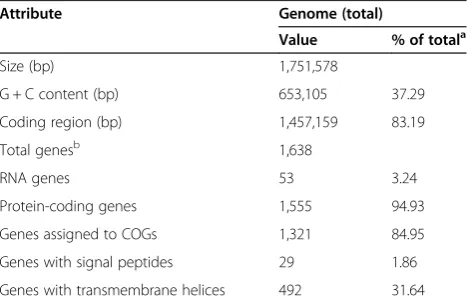
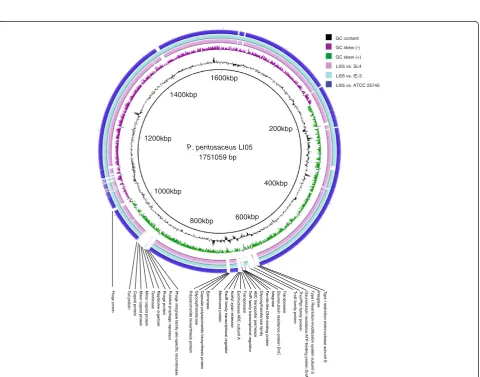
chromosome, 1,638 genes were predicted, 1,555 of which were coding genes. A total of 1,321 protein-coding genes were assigned to putative functions, and the remainder were classified as hypothetical proteins. This genome contained 50 tRNAs and a complete 5S-23S-16S rRNA gene family. The properties and statistics of the genome are shown in Table 1 and Figure 2. As shown in Figure 3, the genome sequence of P. pentosa-ceus LI05 was highly conserved compared with those of
P. pentosaceus ATCC 25745, P. pentosaceus SL4 and
P. pentosaceusIE-3.
Genome ofP. pentosaceusLI05 exhibits probiotic properties
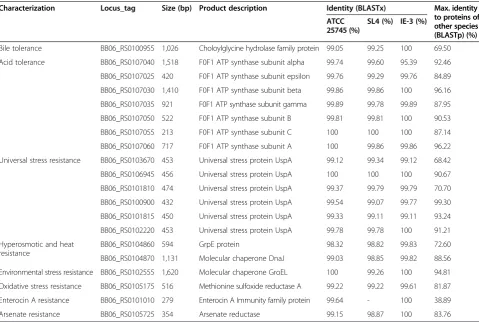
In a previous study, we have observed that P. pentosa-ceus LI05 is resistant to gastric acidity and bile com-pounds [7]. This was supported by the genomic data from this study, in which a gene encoding cholylglycine hydrolase, which is related to bile salt resistance, and genes encoding F0F1 ATP synthases, which are import-ant for acid tolerance, were detected (Table 2). Addition-ally, six universal stress proteins (UspA), the chaperone protein DnaJ, the cofactor GrpE, which participates in the hyperosmotic and heat shock responses, the chaperone GroEL, which protects against environmental stresses, an enterocin A immunity family protein, an ar-senate reductase, and methionine sulfoxide reductase A, which protects against oxidative stresses, were annotated. These representative stress resistance genes were highly conserved between P. pentosaceus LI05 and P. pentosa-ceus ATCC 25745, P.pentosaceusIE-3 or P. pentosaceus sL4, but most of them showed significant divergences from other species.
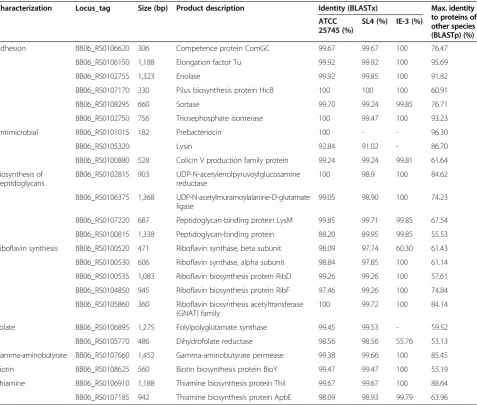
The ability to adhere to gastrointestinal mucosa is an important property of most probiotics [21,22]. Several proteins encoded byP. pentosaceusLI05 genes had pre-dicted adhesive potentials (Table 3). For example, sortase attaches surface proteins, including enzymes, pilins and adhesion-mediating large surface glycoproteins, to cell walls. Other proteins included a pilin-like competence protein ComGC, elongation factor Tu (EF-Tu), an eno-lase capable of binding to host extracellular fibronectin and the pilus biosynthesis protein HicB. Abundant adhesion proteins encoded by the genomic regions were consistent with the strong adhesion properties of
P. pentosaceus LI05. However, these proteins have also
been predicted in the other tested strains. These find-ings may represent a possible reason for the extensive colonization ofP. pentosaceusin the gut. However, the examinations of many more genes or proteins may be required to evaluate the adhesive abilities of probiotics.
The P. pentosaceus LI05 genes also encoded three
antimicrobials, which is consistent with the excellent antimicrobial ability of this strain. As shown in Table 3, genes encoding prebacteriocin were annotated in the ge-nomes of both P. pentosaceus LI05 and P. pentosaceus ATCC 25745. Alternatively, the pedA gene (PCPN_1274) encoding pediocin PA-1 was detected in P. pentosaceus IE-3, but it was not identical to the prebacteriocin gene
of P. pentosaceus LI05. Furthermore, genes encoding
colicin V discovered in strain L105 was different from that of the other spicies. Additionally, genes encoding lysin were detected inP. pentosaceus LI05 and P.
pento-saceus ATCC 25745. As an antimicrobial agent, lysin is
potentially immunogenic [24]. Therefore, P. pentosaceus LI05 can achieve “competitive exclusion” not only by limiting the surface area available but also by secreting antimicrobial substances.
In the genome ofP. pentosaceusLI05, we also detected potentially beneficial properties that were not experi-mentally confirmed. This strain contained genes involved in the biosynthesis of not only important vitamins, such as riboflavin, folate, thiamine and biotin but also of func-tional factors, such as gamma-aminobutyrate (Table 3) [25]. In Gram-positive bacteria, peptidoglycan is one of the most important host immune regulators [26]. Although
Table 1 Genomic nucleotide content and gene counts
Attribute Genome (total)
Value % of totala
Size (bp) 1,751,578
G + C content (bp) 653,105 37.29
Coding region (bp) 1,457,159 83.19
Total genesb 1,638
RNA genes 53 3.24
Protein-coding genes 1,555 94.93
Genes assigned to COGs 1,321 84.95
Genes with signal peptides 29 1.86
Genes with transmembrane helices 492 31.64 a)
The total is based either on the size of the genome in base pairs or the total number of protein-coding genes in the annotated genome.
b)
Also includes 35 other genes.
P. pentosaceus ATCC 25745 (NR_075052.1)
P. pentosaceus IE-3 (CAHU01000036.1) P. pentosaceus LI05 (CGMCC 7049) (AM709786)
P. pentosaceus SL4 (CP006854.1)
P. pentosaceus DSM 20336 (AJ305321) P. acidilactici DSM 20284 (AJ305320)
P. stilesii LMG23082 (AJ973157)
P. argentinicus LMG 23999 (AM709786)
P. claussenii DSM14800 (AJ621555)
P. parvulus JCM5889 (D88528)
P. inopinatus DSM 20285 (AJ271383)
P. damnosus DSM 20331 (AJ318414) P. ethanolidurans Z-9 (AY956789)
P. cellicola Z-8 (AY956788)
P. siamensis MCH3-2 (AB258357)
97
61 57 71
100 64
89 67
99 49
64
0.002
T
T
T
T
T
T
T
T
T T
P. pentosaceus LI05 (CGMCC 7049)
P. pentosaceus IE-3 P. pentosaceus ATCC 25745
P. pentosaceus SL4
99
0.0005 A
B
T
Figure 1The position ofP. pentosaceusLI05 relative to the representative strains and the evolutionary relationships of the four strains ofP. pentosaceus. A. Phylogenetic tree highlighting the position ofP. pentosaceusLI05 relative to the representative strains. The tree was constructed by the neighbor-joining method based on alignments of 16S rRNA gene sequences. Corresponding NCBI accession numbers are shown in parentheses. Numbers at the nodes indicate support values obtained from 1,000 bootstrap replications.B. Phylogenetic tree highlighting the evolutionary relationships of the four strains ofP. pentosaceusbased on concatenated nucleotide sequences of thednaA,dnaJ,dnaK,pheS,pryH,
Translation (146) Transcription (128)
Replication, recombination and repair (91) Cell cycle control, mitosis and meiosis (16) Defense mechanisms (25)
Signal transduction mechanisms (52) Cell wall/membrane biogenesis (85) Cell motility (7)
Intracellular trafficking and secretion (21) Posttranslational modification, protein turnover, chaperones (43)
Energy production and conversion (51) Carbohydrate transport and metabolism (122) Amino acid transport and metabolism (96) Nucleotide transport and metabolism (71) Coenzyme transport and metabolism (39) Lipid transport and metabolism (45) Inorganic ion transport and metabolism (59) Secondary metabolites biosynthesis, transport and catabolism (16) General function prediction only (178) Function unknown (136)
Not in COGs (234)
Figure 2The distribution of the genes associated with the 25 general COG functional categories inP. pentosaceusLI05.The number of genes is shown in parentheses.
1600kbp
200kbp
400kbp
600kbp 800kbp
1000kbp 1200kbp
1400kbp
GC content GC skew (-) GC skew (+) LI05 vs. ATCC 25745 LI05 vs. SL4 LI05 vs. IE-3
Integrase Type I restriction endonuclease subunit S
T
ype I Restriction-modification system subunit S
Daunorubicin resistance
A
T
P-binding protein Drr
A
ThiJ/PfpI family protein
T
raX family protein
ABC transporter permease T
ransposase
Daunorubicin resistance protein DrrC
Integrase
Ferritin-like DNA-binding protein
Glycosyltransferase family
T
e
tR family transcriptional regulator
T
ransposase
Excinuclease ABC
subunit A
Acetyl xylan esterase
PadR family transcriptional regulator
Membrane protein
Epimerase
Capsular polysaccharide biosynthesis protein
Glycosyltransferase
Polysaccharide biosynthesis protein
Phage protein Phage integrase family site-specific recombinase
r
o
s
s
er
p
er
e
g
a
h
p
orp
e
vi
t
at
u
P
Phage protein
Replisome organizer
T
e
rminase
Minor capsid protein
Minor capsid protein
Capsid protein
T
a
il protein
P. pentosaceus LI05 1751059 bp
the genes and coding proteins related to the peptidoglycan pathway were conserved in the four strains ofP. pentosa-ceus, they were not significantly similar to those of the other species. These findings will contribute to the elucida-tion of the mechanisms of immune regulaelucida-tion inP. pento-saceusLI05.
Comparisons with other fully sequenced genomes
Fifty-three proteins encoded by P. pentosaceus LI05
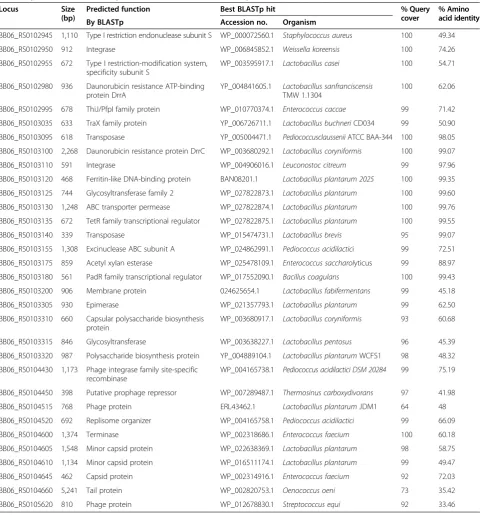
genes were not detected or had sequence similarities of less than 50% in the comparative analysis with the three known food-borne strains, P. pentosaceus ATCC 25745, SL4 and IE-3. Among these proteins, 21 hypothetical proteins with no clear functions were not further ana-lyzed; the other 32 proteins are listed in Table 4, demon-strated in Figure 3, and further discussed below.
Five putative exopolysaccharide biosynthesis proteins were detected only in P. pentosaceus LI05, including an epimerase, a capsular polysaccharide biosynthesis protein, two glycosyltransferases (key enzymes for the biosyntheses of the exopolysaccharide repeating units) and a polysaccharide biosynthesis protein. Four of these enzymes need to be examined in further detail because
they are not only potentially novel but also probably induce variations in the structures of their encoded poly-saccharides that may have influenced adherence, biofilm formation and the nature of the immune response [27].
P. pentosaceus LI05 was characterized by three
extra-environmental stress tolerance proteins, including a putative ferritin-like DNA-binding protein, which main-tains a steady state of iron ions and responds to stresses, such as those involving temperature, humidity, and ioniz-ing and redox processes [28], a putative PadR family tran-scriptional regulator, which functions against phenolic acid stress, and a putative ThiJ/PfpI family protein, which is involved in cellular protection against environmental stresses [29].
Fourteen proteins related to the intrusion of
exogen-ous DNA were identified in P. pentosaceus LI05. One
group was comprised of twelve prophage-related pro-teins, including a phage integrase family site-specific re-combinase, two integrases, a putative prophage repressor, two phage proteins, a replisome organizer, a terminase, two minor capsid proteins, a capsid protein and a tail tein. It is not rare for bacteria to contain multiple pro-phages in their chromosomes, which then constitute a
Table 2 Comparison of important genes encoding stress resistance proteins inP. pentosaceusLI05,P. pentosaceus ATCC 25745,P. pentosaceusSL4 andP. pentosaceusIE-3
Characterization Locus_tag Size (bp) Product description Identity (BLASTx) Max. identity to proteins of other species (BLASTp) (%) ATCC
25745 (%)
SL4 (%) IE-3 (%)
Bile tolerance BB06_RS0100955 1,026 Choloylglycine hydrolase family protein 99.05 99.25 100 69.50
Acid tolerance BB06_RS0107040 1,518 F0F1 ATP synthase subunit alpha 99.74 99.60 95.39 92.46
BB06_RS0107025 420 F0F1 ATP synthase subunit epsilon 99.76 99.29 99.76 84.89
BB06_RS0107030 1,410 F0F1 ATP synthase subunit beta 99.86 99.86 100 96.16
BB06_RS0107035 921 F0F1 ATP synthase subunit gamma 99.89 99.78 99.89 87.95
BB06_RS0107050 522 F0F1 ATP synthase subunit B 99.81 99.81 100 90.53
BB06_RS0107055 213 F0F1 ATP synthase subunit C 100 100 100 87.14
BB06_RS0107060 717 F0F1 ATP synthase subunit A 100 99.86 99.86 96.22
Universal stress resistance BB06_RS0103670 453 Universal stress protein UspA 99.12 99.34 99.12 68.42
BB06_RS0106945 456 Universal stress protein UspA 100 100 100 90.67
BB06_RS0101810 474 Universal stress protein UspA 99.37 99.79 99.79 70.70
BB06_RS0100900 432 Universal stress protein UspA 99.54 99.07 99.77 99.30
BB06_RS0101815 450 Universal stress protein UspA 99.33 99.11 99.11 93.24
BB06_RS0102220 453 Universal stress protein UspA 99.78 99.78 100 91.21
Hyperosmotic and heat resistance
BB06_RS0104860 594 GrpE protein 98.32 98.82 99.83 72.60
BB06_RS0104870 1,131 Molecular chaperone DnaJ 99.03 98.85 99.82 88.56
Environmental stress resistance BB06_RS0102555 1,620 Molecular chaperone GroEL 100 99.26 100 94.81
Oxidative stress resistance BB06_RS0105175 516 Methionine sulfoxide reductase A 99.22 99.22 99.61 81.87
Enterocin A resistance BB06_RS0101010 279 Enterocin A Immunity family protein 99.64 - 100 38.89
Arsenate resistance BB06_RS0105725 354 Arsenate reductase 99.15 98.87 100 83.76
sizable proportion of their total chromosomal material [30]. Pathogenic, commensal, and symbiotic bacteria have been observed to play roles in a variety of bacterial adapta-tions in hosts [31]. Phage-related proteins were encoded by genes in each of the three food-borne strains. The other genes detected in the P. pentosaceus LI05 included two encoding bacterial DNA type I restriction endonucleases, which are involved in prokaryotic DNA restriction-modification mechanisms that protect the bacteria against invading foreign DNA [32].
Two putative doxorubicin-daunorubicin resistance pro-teins existed in P. pentosaceus LI05. One ORF encoded DrrA, which is part of the ABC transporter complex DrrAB. The other ORF encoded DrrC, which is part of the ABC transporter permease protein. This finding partially reflects the complex interactions between drugs and
gut-associated microbes [33]. Both daunorubicin and doxo-rubicin are antitumor drugs and are thus not suitable for antibacterial applications. Therefore, these two genes will not affect the control ofP. pentosaceusLI05.
Additionally, there were eight extra putative multifunc-tional proteins in P. pentosaceus LI05. These included a TetR family transcriptional regulator, an ABC transporter permease, an exonuclease ABC subunit A, a transposase, an acetyl xylan esterase, a PadR family transcriptional regu-lator, a membrane protein and a TraX family protein.
Conclusions
Strains ofP. pentosaceusare frequently identified in food and in the human gastrointestinal tract and are known to reduce inflammation, encephalopathy, obesity and fatty liver in animals. Therefore, it is imperative to study
Table 3 Comparison of important genes encoding beneficial proteins inP. pentosaceusLI05,P. pentosaceusATCC 25745,P. pentosaceusSL4 andP. pentosaceusIE-3
Characterization Locus_tag Size (bp) Product description Identity (BLASTx) Max. identity to proteins of other species (BLASTp) (%) ATCC
25745 (%)
SL4 (%) IE-3 (%)
Adhesion BB06_RS0106620 306 Competence protein ComGC 99.67 99.67 100 76.47
BB06_RS0106150 1,188 Elongation factor Tu 99.92 99.92 100 95.69
BB06_RS0102755 1,323 Enolase 99.92 99.85 100 91.82
BB06_RS0107170 330 Pilus biosynthesis protein HicB 100 100 100 60.91
BB06_RS0108295 660 Sortase 99.70 99.24 99.85 76.71
BB06_RS0102750 756 Triosephosphate isomerase 100 99.47 100 93.23
Antimicrobial BB06_RS0101015 182 Prebacteriocin 100 - - 96.30
BB06_RS0105320 Lysin 92.84 91.02 - 86.70
BB06_RS0100880 528 Colicin V production family protein 99.24 99.24 99.81 61.64
Biosynthesis of peptidoglycans
BB06_RS0102815 903 UDP-N-acetylenolpyruvoylglucosamine reductase
100 98.9 100 84.62
BB06_RS0106375 1,368 UDP-N-acetylmuramoylalanine-D-glutamate ligase
99.05 98.90 100 74.23
BB06_RS0107220 687 Peptidoglycan-binding protein LysM 99.85 99.71 99.85 67.54
BB06_RS0100815 1,338 Peptidoglycan-binding protein 88.20 89.95 99.85 55.53
Riboflavin synthesis BB06_RS0100520 471 Riboflavin synthase, beta subunit 98.09 97.74 60.30 61.43
BB06_RS0100530 606 Riboflavin synthase, alpha subunit 98.84 97.85 100 61.14
BB06_RS0100535 1,083 Riboflavin biosynthesis protein RibD 99.26 99.26 100 57.61
BB06_RS0104850 945 Riboflavin biosynthesis protein RibF 97.46 99.26 100 74.84
BB06_RS0105860 360 Riboflavin biosynthesis acetyltransferase (GNAT) family
100 99.72 100 84.14
Folate BB06_RS0106895 1,275 Folylpolyglutamate synthase 99.45 99.53 - 59.52
BB06_RS0105770 486 Dihydrofolate reductase 98.56 98.56 55.76 53.13
Gamma-aminobutyrate BB06_RS0107660 1,452 Gamma-aminobutyrate permease 99.38 99.66 100 85.45
Biotin BB06_RS0108625 560 Biotin biosynthesis protein BioY 99.47 99.47 100 55.19
Thiamine BB06_RS0106910 1,188 Thiamine biosynthesis protein ThiI 99.67 99.67 100 88.64
BB06_RS0107185 942 Thiamine biosynthesis protein ApbE 98.09 98.93 99.79 63.96
the probiotic ability of this organism. Future studies will focus on delineating the interactions between the host
and P. pentosaceus. The genome sequences of P.
pento-saceus LI05 isolated from the human gastrointestinal
tract allow for a deeper understanding of its probiotic abilities, facilitating the future development of drugs for microbiota-related diseases.
Availability of supporting data
The whole-genome sequencing project of P.
pentosa-ceus LI05 has been submitted to GenBank under
the project accession number PRJNA237570. The project version entailing the draft assembly described herein has been deposited under the accession number JDVW00000000.
Table 4 Genes and their encoded proteins detected inP. pentosaceusLI05 with sequence similarities of less than 50% with sequences from bothP. pentosaceusATCC 25745 andP. pentosaceusSL4
Locus Size
(bp)
Predicted function Best BLASTp hit % Query
cover
% Amino acid identity
By BLASTp Accession no. Organism
BB06_RS0102945 1,110 Type I restriction endonuclease subunit S WP_000072560.1 Staphylococcus aureus 100 49.34
BB06_RS0102950 912 Integrase WP_006845852.1 Weissella koreensis 100 74.26
BB06_RS0102955 672 Type I restriction-modification system, specificity subunit S
WP_003595917.1 Lactobacillus casei 100 54.71
BB06_RS0102980 936 Daunorubicin resistance ATP-binding protein DrrA
YP_004841605.1 Lactobacillus sanfranciscensis
TMW 1.1304
100 62.06
BB06_RS0102995 678 ThiJ/PfpI family protein WP_010770374.1 Enterococcus caccae 99 71.42
BB06_RS0103035 633 TraX family protein YP_006726711.1 Lactobacillus buchneriCD034 99 50.90
BB06_RS0103095 618 Transposase YP_005004471.1 PediococcusclausseniiATCC BAA-344 100 98.05
BB06_RS0103100 2,268 Daunorubicin resistance protein DrrC WP_003680292.1 Lactobacillus coryniformis 100 99.07
BB06_RS0103110 591 Integrase WP_004906016.1 Leuconostoc citreum 99 97.96
BB06_RS0103120 468 Ferritin-like DNA-binding protein BAN08201.1 Lactobacillus plantarum 2025 100 99.35
BB06_RS0103125 744 Glycosyltransferase family 2 WP_027822873.1 Lactobacillus plantarum 100 99.60
BB06_RS0103130 1,248 ABC transporter permease WP_027822874.1 Lactobacillus plantarum 100 99.76
BB06_RS0103135 672 TetR family transcriptional regulator WP_027822875.1 Lactobacillus plantarum 100 99.55
BB06_RS0103140 339 Transposase WP_015474731.1 Lactobacillus brevis 95 99.07
BB06_RS0103155 1,308 Excinuclease ABC subunit A WP_024862991.1 Pediococcus acidilactici 99 72.51
BB06_RS0103175 859 Acetyl xylan esterase WP_025478109.1 Enterococcus saccharolyticus 99 88.97
BB06_RS0103180 561 PadR family transcriptional regulator WP_017552090.1 Bacillus coagulans 100 99.43
BB06_RS0103200 906 Membrane protein 024625654.1 Lactobacillus fabifermentans 99 45.18
BB06_RS0103305 930 Epimerase WP_021357793.1 Lactobacillus plantarum 99 62.50
BB06_RS0103310 660 Capsular polysaccharide biosynthesis protein
WP_003680917.1 Lactobacillus coryniformis 93 60.68
BB06_RS0103315 846 Glycosyltransferase WP_003638227.1 Lactobacillus pentosus 96 45.39
BB06_RS0103320 987 Polysaccharide biosynthesis protein YP_004889104.1 Lactobacillus plantarumWCFS1 98 48.32
BB06_RS0104430 1,173 Phage integrase family site-specific recombinase
WP_004165738.1 Pediococcus acidilactici DSM 20284 99 75.19
BB06_RS0104450 398 Putative prophage repressor WP_007289487.1 Thermosinus carboxydivorans 97 41.98
BB06_RS0104515 768 Phage protein ERL43462.1 Lactobacillus plantarumJDM1 64 48
BB06_RS0104520 692 Replisome organizer WP_004165758.1 Pediococcus acidilactici 99 66.09
BB06_RS0104600 1,374 Terminase WP_002318686.1 Enterococcus faecium 100 60.18
BB06_RS0104605 1,548 Minor capsid protein WP_022638369.1 Lactobacillus plantarum 98 58.75
BB06_RS0104610 1,134 Minor capsid protein WP_016511174.1 Lactobacillus plantarum 99 49.47
BB06_RS0104645 462 Capsid protein WP_002314916.1 Enterococcus faecium 92 72.03
BB06_RS0104660 5,241 Tail protein WP_002820753.1 Oenococcus oeni 73 35.42
Additional files
Additional file 1: Figure S1.Scanning electron micrograph (A) and transmission electron micrograph (B) ofP. pentosaceusLI05.
Additional file 2: Table S1.Ability ofP. pentosaceusLI05 to grow using specific carbohydrates.
Competing interests
The authors declare no competing interests.
Authors’contributions
L-JL designed the study, interpreted the results and edited the manuscript. L-XL and Y-DL conducted the Illumina sequencing, performed the assemblies, analyzed the genome, and performed the annotations. X-JH provided advice related to the outbreak and strain features, characterized the strain and maintained it in pure cultures. H-YS contributed to the microbiology of the strain and prepared high-molecular-weight DNA for the genome sequencing. All authors read and approved the manuscript prior to submission.
Acknowledgments
This study was supported by the National Basic Research Program of China (973 Program) (No. 2013CB531401) and the Key Program of the National Natural Science Foundation of China (No. 81330011).
Author details
1State Key Laboratory for Diagnosis and Treatment of Infectious Disease, The First Affiliated Hospital, Zhejiang University, Hangzhou 310003, PR China. 2Food Safety Key Lab of Zhejiang Province, Zhejiang Gongshang University, Hangzhou, PR China.3Collaborative Innovation Center for Diagnosis and Treatment of Infectious Diseases, Hangzhou, China.
Received: 19 June 2014 Accepted: 18 August 2014 Published: 30 August 2014
References
1. Wieme A, Cleenwerck I, Van Landschoot A, Vandamme P:Pediococcus lolii DSM 19927 T and JCM 15055 T are strains ofPediococcus acidilactici.Int J Syst Evol Microbiol2012,62:3105–3108.
2. Leroy F, Verluyten J, De Vuyst L:Functional meat starter cultures for improved sausage fermentation.Int J Food Microbiol2006,106:270–285. 3. Martino ME, Maifreni M, Marino M, Bartolomeoli I, Carraro L, Fasolato L,
Cardazzo B:Genotypic and phenotypic diversity ofPediococcus pentosaceusstrains isolated from food matrices and characterisation of the penocin operon.Antonie Van Leeuwenhoek2013,103:1149–1163. 4. Bengmark S:Bio-ecological control of chronic liver disease and
encephalopathy.Metab Brain Dis2009,24:223–236.
5. Zhao X, Higashikawa F, Noda M, Kawamura Y, Matoba Y, Kumagai T, Sugiyama M:The obesity and fatty liver are reduced by plant-derived Pediococcus pentosaceusLP28 in high fat diet-induced obese mice.PLoS One2012,7:e30696.
6. Varsha KK, Priya S, Devendra L, Nampoothiri KM:Control of Spoilage Fungi by Protective Lactic Acid Bacteria Displaying Probiotic Properties.Appl Biochem Biotechnol2014,172:3402–3413.
7. Lv LX, Hu XJ, Qian GR, Zhang H, Lu HF, Zheng BW, Jiang L, Li LJ: Administration ofLactobacillus salivariusLI01 orPediococcus pentosaceus LI05 improves acute liver injury induced by D-galactosamine in rats.Appl Microbiol Biotechnol2014,98:5619–5632.
8. Dantoft SH, Bielak EM, Seo JG, Chung MJ, Jensen PR:Complete genome sequence ofPediococcus pentosaceusstrain SL4.Genome Announc2013, 26:e01106–e01113.
9. Midha S, Ranjan M, Sharma V, Kumari A, Singh PK, Korpole S, Patil PB: Genome sequence ofPediococcus pentosaceusstrain IE-3.J Bacteriol2012, 194:4468.
10. Makarova K, Slesarev A, Wolf Y, Sorokin A, Mirkin B, Koonin E, Pavlov A, Pavlova N, Karamychev V, Polouchine N, Shakhova V, Grigoriev I, Lou Y, Rohksar D, Lucas S, Huang K, Goodstein DM, Hawkins T, Plengvidhya V, Welker D, Hughes J, Goh Y, Benson A, Baldwin K, Lee JH, Díaz-Muñiz I, Dosti B, Smeianov V, Wechter W, Barabote R,et al:Comparative genomics of the lactic acid bacteria.Proc Natl Acad Sci U S A2006, 103:15611–15616.
11. Smibert RM, Krieg NR:Phenotypic Characterization. InMethods for General and Molecular Bacteriology.Washington, DC, USA: American Society for Microbiology Press; 1994:607–654.
12. Tamura K, Dudley J, Nei M, Kumar S:MEGA4: Molecular Evolutionary Genetics Analysis (MEGA) software version 4.0.Mol Biol Evol2007, 24:1596–1599.
13. Luo R, Liu BH, Xie YL:SOAPdenovo2: an empirically improved memory-efficient short-read de novoassembler.GigaScience2012,1:18.
14. Delcher AL, Bratke KA, Powers EC, Salzberg SL:Identifying bacterial genes and endosymbiont DNA with Glimmer.Bioinformatics2007,23:673–679. 15. Lowe TM, Eddy SR:tRNAscan-SE: a program for improved detection of
transfer RNAgenes in genomic sequence.Nucleic Acids Res1997, 25:955–964.
16. Benson G:Tandem repeats finder: a program to analyze DNA sequences.
Nucleic Acids Res1999,27:573–580.
17. Petersen TN, Brunak S, von Heijne G, Nielsen H:SignalP 4.0: discriminating signal peptides from transmembrane regions.Nat Methods2011, 8:785–786.
18. Krogh A, Larsson B, von Heijne G, Sonnhammer EL:Predicting transmembrane protein topology with a hidden Markov model: application to complete genomes.J Mol Biol2001,305:567–580. 19. Markowitz VM, Chen IM, Palaniappan K, Chu K, Szeto E, Pillay M, Ratner A,
Huang J, Woyke T, Huntemann M, Anderson I, Billis K, Varghese N, Mavromatis K, Pati A, Ivanova NN, Kyrpides NC:IMG 4 version of the integrated microbial genomes comparative analysis system.Nucleic Acids Res2014,42:D560–D567.
20. Alikhan NF, Petty NK, Ben Zakour NL, Beatson SA:BLAST Ring Image Generator (BRIG): simple prokaryote genome comparisons.BMC Genomics2011,12:402.
21. Senan S, Prajapati JB, Joshi CG:Whole-genome based validation of the adaptive properties of Indian origin probioticLactobacillus helveticus MTCC 5463.J Sci Food Agric2014, doi:10.1002/jsfa.6721.
22. Grover S, Rashmi HM, Srivastava AK, Batish VK:Probiotics for human health -new innovations and emerging trends.Gut Pathog2012,4:15.
23. Kim YC, Tarr AW, Penfold CN:Colicin import intoE. colicells: a model system for insights into the import mechanisms of bacteriocins.Biochim Biophys Acta1843,2014:1717–1731.
24. Pastagia M, Schuch R, Fischetti VA, Huang DB:Lysins: the arrival of pathogen-directed anti-infectives.J Med Microbiol2013,62:1506–1516. 25. Capozzi V, Russo P, Duenas MT, Lopez P, Spano G:Lactic acid bacteria
producing B-group vitamins: a great potential for functional cereals products.Appl Microbiol Biotechnol2012,96:1383–1394.
26. Kanmani P, Satish Kumar R, Yuvaraj N, Paari KA, Pattukumar V, Arul V: Probiotics and its functionally valuable products-a review.Crit Rev Food Sci Nutr2013,53:641–658.
27. Nadkarni MA, Chen Z, Wilkins MR, Hunter N:Comparative genome analysis ofLactobacillus rhamnosusclinical isolates from initial stages of dental pulp infection: identification of a new exopolysaccharide cluster.PLoS One2014,9:e90643.
28. Smith JL:The physiological role of ferritin-like compounds in bacteria.
Crit Rev Microbiol2004,30:173–185.
29. Zhan D, Han W, Feng Y:Experimental and computational studies indicate the mutation of Glu12 to increase the thermostability of oligomeric protease fromPyrococcus horikoshii.J Mol Model2011,17:1241–1249. 30. Canchaya C, Proux C, Fournous G, Bruttin A, Brussow H:Prophage
genomics.Microbiol Mol Biol Rev2003,67:238–276.
31. Hooper LV, Gordon JI:Commensal host-bacterial relationships in the gut.
Science2001,292:1115–1118.
32. Loenen WA, Raleigh EA:The other face of restriction: modification-dependent enzymes.Nucleic Acids Res2014,42:56–69.
33. Saad R, Rizkallah MR, Aziz RK:Gut Pharmacomicrobiomics: the tip of an iceberg of complex interactions between drugs and gut-associated microbes.Gut Pathog2012,4:16.
doi:10.1186/s13099-014-0036-y
Cite this article as:Lvet al.:Whole-genome sequence assembly of
Pediococcus pentosaceusLI05 (CGMCC 7049) from the human