Address for correspondence
RP-HPLC METHOD DEVELOPMENT AND VALIDATION OF AMLODIPINE AND
LOSARTAN IN BINARY MIXTURE
1. INTRODUCTION:
A combination1 of antihypertensive agents can better control blood pressure and reduce the number and severity of side effects than a monotherapy. To increase the compliance, combination therapy may have other advantages over monotherapy, such as synergistic mechanisms of action for controlling hypertension since both CCBs (calcium channel blockers) and ARBs (angiotensin II receptor type-1 blockers) are current and effective antihypertensive drugs, this study assessed the synergistic antihypertensive effects as well as the optimal combination ratio of these two drugs The present literature shows that there are only 2 RP-HPLC2,3are available in combination with Amlodipine and Losartan. Few analytical methods are in combination with other drugs including LC-MS/MS4-6, HPLC7-30, HPTLC31-32 and spectroscopic33 methods.
2. MATERIALS AND METHODS Instrumentation and Chemicals
The liquid chromatographic system consisting of the following components was used for analysis. LC-20AT VP series model chromatograph equipped Spinchrome software. Detection of the drug was done by using a SPD-20A UV-Visible detector. The reference standard Amlodipine besilate and Losartan potassium were obtained from AIZANT Drug Research Solutions pvt. Ltd. Acetonitrile and orthophosphoric acid were of HPLC grade, while potassium dihydrogen phosphate is of GR grade (Merck Ltd. Mumbai, India) milli-Q water was used for the analysis.
Preparation of Buffer pH 3.70: About 3.4 gm of potassium dihydrogen phosphate was weighed accurately and transferred into 1000 mL of beaker containing milli-Q water, mixed well. The pH was adjusted to 3.70 ± 0.05 with Research Article
A Novel, selective and rapid Gradient Reversed Phase High Performance Liquid Chromatographic (RPHPLC) method for the analysis of Amlodipine and Losartan in binary mixture has been developed and validated. The chromatographic system consisted of a LC-20AT VP series model chromatograph equipped Spinchrome software. The separation was achieved from a Inertsil ODS 3V C18 (150 X 4.6 mm, 5µm) at ambient temperature with a mobile phase containing a mixture mobile Phase-A with 70% v/v of buffer pH-3.7 and 30%v/v of acetonitrile and mobile phase–B containing 70% v/v of acetonitrile and 30% v/v of buffer pH-3.7. The samples were monitored at 237 nm for detection at a flow rate of 1.0 mL/min and the retention time was about 5.13 and 11.11 mins for Amlodipine and Losartan respectively. The calibration curve was linear over the concentration range 1.25-7.5 µg/mL and 12.5-75 µg/mL for Amlodipine and Losartan respectively. The proposed method is accurate in the range of 99.95% - 100.133% recovery and precise (%RSD of intraday variation and %RSD of inter day variation were found to be within the acceptance criteria). Therefore, this method can be used as a more convenient and efficient option for the analysis of Amlodipine and Losartan in Quality control laboratory.
Keywords:RP-HPLC, Amlodipine, Losartan, Gradient.
ABSTRACT K. Krishna Chaitanya*,
D. Gowri Sankar, D. Samson Israel
Department of Pharmaceutical Analysis and Quality Assurance A.U.College of Pharmaceutical sciences, Andhra University,
Visakhapatnam-530 003, A.P, India.
Journal of Global Trends in Pharmaceutical Sciences
Available online at www.JGTPS.com
ISSN: 2230-7346
dilute orthophosphoric acid and filtered through 0.45 µm membrane filter.
Preparation of Mobile phase:
Mobile Phase-A: pH 3.70 phosphate buffer was mixed with acetonitrile in the ratio 70:30 %v/v.
Mobile Phase-B: Acetonitrile was mixed with pH 3.70 phosphate buffer in the ratio 70:30 % v/v.
Diluent Preparation: Water and methanol was mixed in the ratio of 50:50%v/v was prepared and degassed for about 5 mins in a sonicator.
Preparation of Amlodipine besilate Standard Stock Solution: 10 mg of Amlodipine besilate working standard was weighed quantitatively and transferred into a 200 mL volumetric flask. 20 mL of methanol was added, sonicated to dissolve and volume was made up with diluent, mixed well.
Preparation of Losartan potassium Standard Stock Solution: 50 mg of Losartan potassium was weighed quantitatively and transferred into a 100 mL volumetric flask. 5 mL of methanol was added, sonicated to dissolve, volume was made up with diluent and mixed well.
Preparation of Mixed Standard:5 mL of each Amlodipine besilate and Losartan potassium standard stock solutions was transferred into 50 mL volumetric flask and volume was diluted with diluent, mixed well.
Method Development: To develop a suitable (specific) and robust LC method for the determination of Amlodipine and Losartan, different mobile phases were employed to achieve the best separation and resolution. The method development was started with Inertsil ODS 3V C18 (150 X 4.6 mm, 5µm) with the Flow rate of 1.0 mL/min and the column temperature was monitored at 25ºC and the injection was 20 µL. UV detection was performed at 237 nm and the sample temperature was maintained at 25ºC. mobile phase containing a mixture mobile Phase-A with 70% v/v of buffer pH-3.7 and 30%v/v of acetonitrile and mobile phase–B containing
Table: 1Gradient Program for Amlodipine and Losartan
Time (mins)
Mobile Phase-A(%v/v)
Mobile Phase-B (%v/v)
0 90 10
5 85 15
6 80 20
10 50 50
13 50 50
14 0 100
18 0 100
19 90 10
25 90 10
The retention time of Amlodipine and Losartan is 5.13 and 11.11 mins and the peak shape was good. The chromatogram of Amlodipine and Losartan blank, placebo and standard were shown in Figure: 1.1, 1.2 and 1.3.
Figure:1.1 Atypical chromatogram of Amlodipine and Losartan Blank
Figure:1.2 Atypical chromatogram of Amlodipine and Losartan Placebo
3. METHOD VALIDATION
The developed LC method extensively validated for assay of Amlodipine and Losartan using the following parameters.
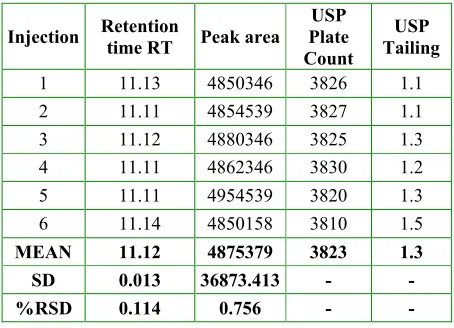
System Suitability: According to USP system suitability tests are an integral part of chromatographic method validation. The tests were used to verify that the reproducibility of the chromatographic system is adequate for analysis. To ascertain its effectiveness system suitability tests were carried out on freshly prepared standard stock solution and 6 replicates of working standard samples were injected into the optimized chromatographic system, parameters like retention time (RT), plate number (N), peak area and peak asymmetry of sample were calculated these results are presented in the Table: 2 and 3 for Amlodipine and Losartan respectively.
Table 2:System Suitability of Amlodipine
Injection Retention time RT
Peak
area USP Plate Count TailingUSP
1 5.13 513107 5912 1.5
2 5.14 513891 5918 1.5
3 5.13 518756 5906 1.4
4 5.13 516431 5911 1.4
5 5.12 514678 5830 1.5
6 5.13 517230 5804 1.4
MEAN 5.13 515682 5880 1.5
SD 0.006 1968.633 -
-%RSD 0.123 0.382 -
-Table 3:System Suitability of Losartan
Injection Retention time RT Peak area Plate USP Count
USP Tailing
1 11.13 4850346 3826 1.1
2 11.11 4854539 3827 1.1
3 11.12 4880346 3825 1.3
4 11.11 4862346 3830 1.2
5 11.11 4954539 3820 1.3
6 11.14 4850158 3810 1.5
MEAN 11.12 4875379 3823 1.3
SD 0.013 36873.413 -
-%RSD 0.114 0.756 -
-Precision: The ICH documents recommended that repeatability should be assessed by using a minimum of nine determinations covering the specified range for the procedures (i.e., three concentrations and three replicates of each concentration).
Precision was studied to find out intra and inter day variations of the proposed method at three different levels (2.5, 5 and 7.5 µg/mL for Amlodipine and 25, 50 and 75 µg/mL for Losartan) on the same and on three different days. The results were interpreted by statistical analysis by calculating % RSD values and tabulated in the Table: 4.
Table 4:Summary of Intraday and Inter day precision
Conc. (µg/mL) MeanIntra-day Inter-day
Amount Found (µg/mL) ±SD %RSD Amount Found (µg/mL)Mean ±SD %RSD Amlodipine
2.5 2.487 0.006 0.232 2.502 0.007 0.280
5 5.023 0.035 0.699 4.999 0.012 0.240
7.5 7.493 0.015 0.204 7.498 0.001 0.013
Losartan
25 25.003 0.012 0.046 24.990 0.020 0.080
50 49.997 0.012 0.023 49.987 0.006 0.012
Accuracy : The accuracy of the HPLC method was confirmed by recovery studies by spiking 50, 100 & 150% of pure drugs to the pre analyzed samples and the samples after dilution injected into the system (n=3). The peak area
of each drug was measured and the recovery data for Amlodipine and Losartan were given in the Table: 5 and 6.
Table 5:Accuracy of Amlodipine
Amount added
(µg/mL) Amount found (µg/mL) % Recovery Statistical Analysis of % recovery
2.5 2.499 99.960 MEAN 99.987
2.5 2.498 99.920 SD 0.083
2.5 2.502 100.080 %RSD 0.083
5 5.020 100.400 MEAN 100.133
5 5.010 100.200 SD 0.306
5 4.990 99.800 %RSD 0.305
7.5 7.490 99.867 MEAN 99.956
7.5 7.510 100.133 SD 0.154
7.5 7.490 99.867 %RSD 0.154
Table 6:Accuracy of Losartan
Amount added (µg/mL) Amount found (µg/mL) % Recovery Statistical Analysis of % recovery
25 24.99 99.960 MEAN 99.973
25 24.98 99.920 SD 0.061
25 25.01 100.040 %RSD 0.061
50 50.01 100.020 MEAN 99.987
50 49.99 99.980 SD 0.031
50 49.98 99.960 %RSD 0.031
75 74.98 99.973 MEAN 99.978
75 74.99 99.987 SD 0.008
75 74.98 99.973 %RSD 0.008
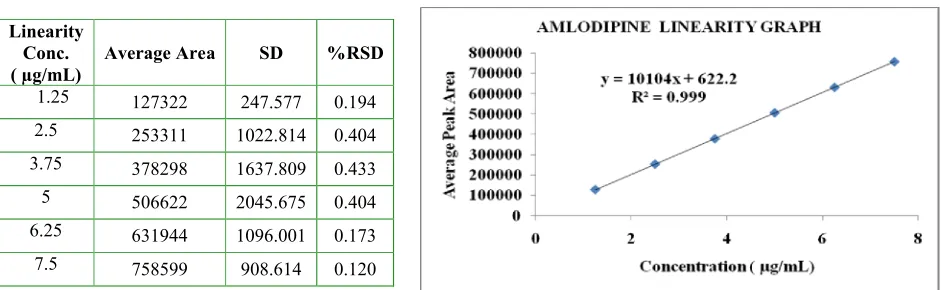
Linearity & Range: The linearity was established with a series of working standard solutions prepared by diluting the stock solution with mobile phase. A linear response of peak area was observed over the concentration range 1.25-7.5 µg/mL and 12.5-75 µg/mL for Amlodipine and Losartan respectively. 20 µL of each samples solution was injected (n=3) under above chromatographic conditions and average peak area for Amlodipine and Losartan was measured. Calibrated curves were constructed and presented in Figure: 4 and 5. The regression data is summarized in the Table: 7 and 8 for Amlodipine and Losartan.
Table 7:Linearity of Amlodipine Figure: 4 Linearity graph of Amlodipine
Linearity Conc.
( µg/mL) Average Area SD %RSD 1.25 127322 247.577 0.194
2.5 253311 1022.814 0.404 3.75 378298 1637.809 0.433
5 506622 2045.675 0.404
Figure: 5 Linearity graph of Losartan Table 8:Linearity of Losartan
LIMIT OF DETECTION (LOD) AND LIMIT OF QUANTITATION (LOQ)
A study to establish the limit of detection and limit of quantification for Amlodipine and Losartan. A series of solutions having Amlodipine and Losartan were injected were established by identifying the concentration which gives signal to noise ratio about 3. Limit of quantitation was established by identifying the concentration which gives signal to noise ratio about 10. The limit of detection was found to be 0.041 µg/mL for Amlodipine and 0.080 µg/mL for Losartan. The limit of quantitation was found to be 0.135 µg/mL for Amlodipine and 0.264 µg/mL for Losartan, data were summarized in Table: 9
Table 9:Limit of Detection and Limit of Quantitation
Parameter LOD (µg/mL) LOQ (µg/mL) Amlodipine 0.041 0.135
Losartan 0.080 0.264
ROBUSTNESS
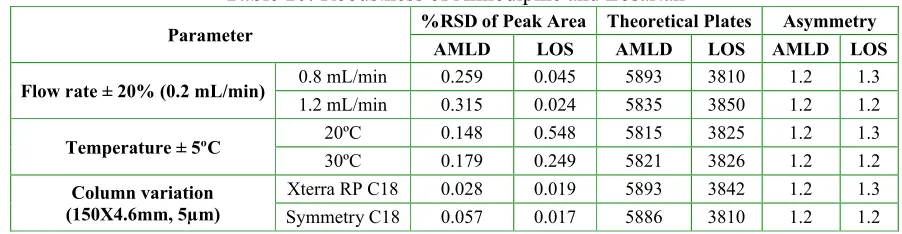
The robustness of the method was determined as per USP guidelines under a variety of conditions including changing the flow rate by ± 20% or ±0.2 mL, temperature by ± 5ºC and using different columns. No marked changes were observed in the system suitability parameters and peak area. The results obtained by deliberately variation in method parameters and data are summarized below as Table: 10.
Table 10:Robustness of Amlodipine and Losartan
Parameter %RSD of Peak Area Theoretical Plates Asymmetry
AMLD LOS AMLD LOS AMLD LOS
Flow rate ± 20% (0.2 mL/min) 0.8 mL/min 0.259 0.045 5893 3810 1.2 1.3
1.2 mL/min 0.315 0.024 5835 3850 1.2 1.2
Temperature ± 5ºC 20ºC 0.148 0.548 5815 3825 1.2 1.3
30ºC 0.179 0.249 5821 3826 1.2 1.2
Column variation (150X4.6mm, 5µm)
Xterra RP C18 0.028 0.019 5893 3842 1.2 1.3
Symmetry C18 0.057 0.017 5886 3810 1.2 1.2
Estimation of Pharmaceutical Formulations:
ACORD-L is a commercial formulation containing a Amlodipine and Losartan of 5 mg and 50 mg which has been taken up for checking the applicability of the proposed method to the formulation. 5 tablets were weighed and transferred into a 100 mL volumetric flask, 20 mL of diluent was added and sonicated with intermediate shaking for 15
mins. Made up to the volume with diluent and filtered through 0.45 µm nylon membrane filter. 2 mL of sample was pipette out and transferred into 10 mL volumetric flask and diluted up to the mark. 20 µL of sample was injected and chromatographed.
A typical chromatogram of ACORD-L tablet formulation is shown in Figure: 6
Linearity Conc.
( µg/mL) Average Area SD %RSD 12.5 1226257 9714.509 0.792
25 2437649 22325.16 0.916 37.5 3642796 17922.52 0.492 50 4849014 16790.12 0.346 62.5 6050240 32206.68 0.532
Figure 6:A Typical Chromatogram of ACORD-L tablet
Table 11:Recovery of ACRD-L Tablets
Drug
Label claim (mg/tablet)
*N=3
Amount found (mg/tablet)
± SD
%
Recovery RSD%
Amlodipine 5 5.003 ± 0.012 100.067 0.231
Losartan 50 49.997 ± 0.012 99.993 0.042
RESULTS AND DISCUSSION
To optimize the mobile phase, various proportions of buffer with acetonitrile and were tested. Mobile phase containing a gradient mixture of mobile phase- A with buffer pH 3 and acetonitrile in the ratio of 70:30% v/v. Mobile phase-B containing a mixture of acetonitrile and buffer pH 3.7 in the ratio 70:30%v/v, resulted in peaks with good shape and resolution. A flow rate of 1.0 mL/min was found to be optimum in the 0.8-1.2 mL/min range resulting in the short retention time, baseline stability and minimum noise.
By applying the proposed method, the retention times of Amlodipine and Losartan were found to be 5.13 min and 11.11 min respectively. Quantitative linearity was obeyed in the concentration range of 1.25-7.5 and 12.5-75 μg/mL for Amlodipine and Losartan respectively. The regression equations of concentration Amlodipine and Losartan over their peak areas were found to be y = 10104x + 622.2 (R² = 0.999), and y = 96472x + 23464 (R² = 0.999) where y is the peak area and x is the concentrations of Amlodipine and Losartan (μg/mL). The numbers of theoretical plates
efficiency of the column. The limit of detection and limit of quantitation were found to be 0.041 and 0.080 μg/mL, 0.135 and 0.264 μg/mL for Amlodipine and Losartan respectively, which indicates the sensitivity of the method. The high percentage recovery indicates that the proposed method is highly accurate. No interfering peaks were found in the chromatogram indicating that excipients used in tablet formulations did not interfere with the estimation of the drug by the proposed HPLC method.
CONCLUSION
A simple, specific, accurate, precise, stability indicating reverse phase high performance liquid chromatography method has been developed which can be used for accurately quantitative estimation Amlodipine and Losartan for routine analysis of individual and combination of drugs. Method was validated as per ICH Q2 (R1) so it can be used by pharmaceutical industries.
ACKNOWLEDGMENT:
The author thankful to University grants Commission for awarding “Rajiv Gandhi National Fellowship” to carryout research work and Prof. D. Gowri Sankar for his guidance to done the research work.
REFERENCES:
2. Jayaseelan*, M. Rajasekar, S. Ganesh, V. Sekar, P. Perumal, “RP-HPLC method development and validation for simultaneous estimation of Losartan Potassium, Amlodipine Besilate and Hydrochlorthiazide in tablet dosage form”, Der Pharma Chemica, 2(3): 2010, 31-36.
3. Priyanka R. Patil*, Sachin U. Rakesh, Prof. P. N. Dhabale, Prof. K. B. Burade, “RP- HPLC Method for Simultaneous Estimation of Losartan potassium and Amlodipine besylate in Tablet Formulation”, International Journal of Chem Tech Research, 1(3): July-Sept 2009, 464-469.
4. Lena Kristoffersen∗, Elisabeth Leere oiestad, Mimi Stokke Opdal, Mette Krogh, lsa Lundanes, Asbjorg Solberg Christophersen, “Simultaneous determination of 6 beta-blockers, 3 calcium-channel antagonists, 4 angiotensin-II antagonists and 1 antiarrhytmic drug in post-mortem whole blood by automated Solid Phase Extraction And Liquid Chromatography Mass Spectrometry Method development and robustness testing by experimental design”, Journal of Chromatography B, 850: 2007, 147–160.
5. Amlan Kanti Sarkar, Debotri Ghosh, Ayan Das, P. Senthamil Selvan, K. Veeran Gowda, Uttam Mandal, Anirbandeep Bose, Sangeeta Agarwal, Uttam Bhaumik, Tapan Kumar Pal*,“Simultaneous determination of Metoprolol succinate and Amlodipine besylate in human plasma by Liquid
Chromatography–Tandem Mass
Spectrometry method and its application in bioequivalence study”, Journal of Chromatography B, 873: 2008, 77–85. 6. S.V.S.G.B.Prasad*, Savithiri Shivakumar,
T.Sudhir, R.Mital, G.Devala Rao,
“LC/MS/MS Method for the
Simultaneous Estimation of Losartan Potassium and Irbesartan in Rat Plasma”, International Journal of Pharmacy and Pharmaceutical Sciences, Vol. 1(1), Nov.-Dec. 2009, 206-215.
7. SS Chitlange*, Kiran Bagri, DM Sakarkar, “Stability Indicating RP- HPLC
Method for Simultaneous Estimation of Valsartan and Amlodipine in Capsule Formulation”. Asian Journal Research Chem., 1(1): July-Sept. 2008, 15-18. 8. Mustafa Celebier, Mustafa Sinan Kaynak,
Sacide Altinoz1*, Selma Sahin, “HPLC method development for the simultaneous analysis of Amlodipine and Valsartan in combined dosage forms and in vitro dissolution studies”, Brazilian Journal of Pharmaceutical Sciences, 46(4): 2010, 761-768.
9. R. A. Mhaske*, D. J. Garole, A. A. Mhaske, S. Sahasrabudhe, “RP-HPLC Method for Simultaneous Determination of Amlodipine Besylate, Valsartan, Telmisartan, Hydrochlorothiazide and Chlorthalidone: Application to Commercially Available Drug Products”, International Journal of Pharmaceutical Sciences and Research, 3(1); 2012, 141-149.
10. Mohammad Younus*, T. Karnaker Reddy, Y. Ravindra Reddy, Md. Fasiuddin Arif, “RP-HPLC Method Development and Validation for Simultaneous Estimation of Amlodipine
besylate, Valsartan and
Hydrochlorothiazide in Tablet Dosage Form”, Journal of Pharmacy Research, 3(11): 2010, 2647-2650.
11. Md. Ahsanul Haque, Asma Naznin, A.N.M Hamidul Kabir, Md. Khalid Hossain, S.M. Ashraful Islam, “Development and Validation of RP-HPLC Method for the Simultaneous Estimation of Atenolol and Amlodipine in Tablet Dosage Form”, Dhaka University Journal of Pharmaceutical Sciences, 9(2): December 2010,131-138.
12. Pournima s. Patil*, Harinath N. More, Sachin A. Pishwikar, “RPHPLC Method for Simultaneous Estimation of Amlodipine Besylate and Olmesartan Medoxomil from Tablet”, International Journal of Pharmacy and Pharmaceutical Sciences, 3(3):2011, 146-149.
`
Olmesartan medoxomil and Amlodipine in Bulk and Pharmaceutical dosage form”, Journal of Pharmacy Research, 5(1): 2012, 43-46.
14. Aniruddha R. Chabukswar*, Bhanudas S. Kuchekar, Swati C. Jagdale, Dipali M. Mehetre, Archana S More and Pradeep D. Lokhande, “Development and validation of a RP-HPLC method for simultaneous estimation of Olmesartan Medoxomil and Amlodipine Besylate in tablet dosage form”, Archives of Applied Science Research, 2 (4): 2010, 307-312.
15. CH.M.M.Prasada Rao*, S.A.Rahaman, Y.Ragjendra Prasad, P. Gangi Reddy, “RP-HPLC method of Simultaneous Estimation of Amlodipine Besylate and Metoprolol in Combined Dosage Form”, International Journal of Pharma Research & Development, 2(9): NOV 2010, 69-76. 16. Vaijanath G. Dongre*, Sweta B. Shah,
Pravin P. Karmusea, Manisha Phadke, Vivek K. Jadhav, “Simultaneous determination of Metoprolol succinate and Amlodipine besylate in pharmaceutical dosage form by HPLC”, Journal of Pharmaceutical and Biomedical Analysis, 46: 2008, 583–586.
a. Mohammadia*, N. Rezanour, M. Ansari Dogaheh, F. Ghorbani Bidkorbeh, M. Hashem, R.B. Walker, “A Stability-Indicating High Performance Liquid Chromatographic (HPLC) assay for the simultaneous determination of atorvastatin and amlodipine in commercial tablets”, Journal of Chromatography B, 846: 2007, 215–221. 17. Mahmoud Reza Sohrabi, Parviz
Abdolmaleki, Maryam Dehroudi*, “Simultaneous quantitative determination of Amlodipine and Atorvastatin in tablets using artificial neural networks”, Mathematical and Computer Modelling, Accepted 13 November 2011. (In press) 18. Saurabh K Sinha, Prabhat K Shrivastava,
Sushant K Shrivastava*, “Development and validation of a HPLC method for the simultaneous estimation of Amlodipin and Telmisartan in pharmaceutical dosage form”, Asian Pacific Journal of Tropical
19. K. Raghu Naidu, Udhav N. Kale, Murlidhar S. Shingare*, “Stability Indicating RP-HPLC method for simultaneous determination of Amlodipine and Benazepril hydrochloride from their combination drug product”, Journal of Pharmaceutical and Biomedical Analysis, 39: 2005, 147–155.
20. Jignesh Prajapati*, Ajay Patel, Dr.M.B.Patel, Nimesh Prajapati, Rashmika Prajapati, “Analytical method development and validation of Amlodipine besylate and Perindopril erbumine in combine dosage form by RP-HPLC”, International Journal of Pharm Tech Research, 3(2): April-June 2011, 801-808.
21. XiaoyiWei, Gengliang Yang*, Li Qi, Yi Chen, “Determination of Nicardipine and Amlodipine in human plasma using on-line Solid-Phase Extraction with a monolithic weak cation-exchange column”, Talanta, 77: 2009, 1197–1202. 22. Deanne L. Hertzog,*, Jennifer Finnegan
McCafferty, Xueguang Fang, R. Jeffrey Tyrrell, Robert A. Reed, “Development and validation of a Stability-Indicating HPLC method for the simultaneous determination of Losartan potassium, Hydrochlorothiazide, and their degradation products”, Journal of Pharmaceutical and Biomedical Analysis, 30: 2002, 747–760.
23. Nevin Erk*, “Analysis of binary mixtures of Losartan potassium and Hydrochlorothiazide by using High Performance Liquid Chromatography, ratio derivative spectrophotometric and compensation technique”, Journal of Pharmaceutical and Biomedical Analysis, 24: 2001, 603–611.
25. Giuseppe Carlucci*, Giancarlo Palumbo, Pietro Mazzeo, Maria Giovanna Quaglia, “Simultaneous determination of Losartan and Hydrochlorothiazide in tablets by
High-Performance Liquid
Chromatography”, Journal of Pharmaceutical and Biomedical Analysis, 23: 2000, 185–189.
26. R.R Kirtawade*, P.L Salve, A.S.Kulkarni and P.N. Dhabale, “RP- HPLC method for simultaneous estimation of Losartan potassium and Atenolol in tablet Formulation”, Pharma Science Monitor an International Journal of Pharmaceutical Sciences, Vol-1(2), 2010, 50-57.
27. Abdussaleem.K, D.Boopathy*, P.Perumal, “Analytical Method Development And Validation Of Losartan Potassium And Atenolol In Combined
Dosage Form By RP-HPLC”,
International Journal Of Pharmtech Research, 2(1):Jan-Mar 2010, 471-474. 28. R. A. Mhaske*, S. Sahasrabudhe, A. A.
Mhaske, “RP-HPLC Method for Simultaneous Determination of Irbesartan, Losartan, Hydrochlorothiazide And Chlorthalidone–Application to Commercially Available Drug Products”, International Journal of Pharmaceutical Sciences and Research, 3(4): 2012, 1116-1123.
29. Rajesh Sharma, Sunil Khanna & Ganesh Prasad Mishra, “Development and Validation of RP-HPLC Method for Simultaneous Estimation of Losartan
Potassium and Atorvastatin Calcium in Pharmaceutical Preparations”, Journal of Pharmacy Research, 5(1): 2012, 398-400. 30. Ramkumar Dubey, Vidhya k. Bhusari,
Sunil R. Dhaneshwar*, “Validated RP-HPLC Method for Simultaneous Quantitation of Losartan Potassium and Metolazone in Bulk Drug and Formulation”, Scientia Pharmaceutica, 79: 2011, 545–554.
31. A.P. Argekar*, S.G. Powar, “Simultaneous determination of Atenolol and Amlodipine in tablets by
High-Performance Thin-Layer
Chromatography”, Journal of Pharmaceutical and Biomedical Analysis, 21: 2000, 1137–1142.
32. B.Dhandapani*, N.Anjaneyulu, Y.Venkateshwarlu and Shaik Harun Rasheed, “HPTLC Method Development and Validation for the Simultaneous Estimation of Amlodipine Besylate and Nebivolol Hydrochloride in tablet dosage form”, Journal of Pharmacy Research, 3(2): 2010, 332-334.