Knowledge and Attitude Regarding Temporary Spacing Methods among
Reproductive Age Women
1. INTRODUCTION:
Every day morning, the population clock shows that inspite of our efforts, the population of India is increasing at rapid rate. The world population is estimated to be 6 billion. The single greatest threat to India’s health, political, economic and social development is uncontrolled population growth with its population already exceeding one billion, it is all set to overtake china and become the most populous country in the world in 2045. India’s current demographic phase is characterized by high fertility and moderate mortality rates. As a result, the country’s population is growing rapidly with about 2.8 billion people being added to it annually to give a 2.1% increase per annum. Many couples in India never use a reversible method to delay or space birth but instead adopt sterilization as the first and only method. Little is known about the factors that distinguish sterilized couples who have used spacing methods from those who go directly in using a permanent method.
2. STATEMENT OF THE PROBLEM:
A descriptive study to assess the knowledge and attitude regarding temporary spacing methods among reproductive age women in urban slums of Naka Chandravadani, Gwalior Madhya Pradesh
3. OBJECTIVES:
To assess the knowledge of reproductive age women on temporary spacing methods To assess the attitudes of reproductive age women on temporary spacing methods.
To assess the correlation between knowledge and attitude of reproductive age women on temporary spacing methods.
To assess the association between knowledge and selected demographic variables on temporary spacing methods among reproductive age women.
To assess the association between attitude and selected demographic variables on temporary spacing methods among reproductive age women.
4. HYPOTHESIS:
H1:There is a significant relationship between the knowledge and attitude regarding temporary spacing methods among reproductive age women.
H2:There is a significant association between knowledge and selected demographic variables regarding temporary spacing methods among reproductive age women.
H3:There is significant association between attitude and selected demographic variables regarding temporary spacing methods among reproductive age women.
5. MATERIALS AND METHODS:
Abstract: Every day morning, the population clock shows that inspite of our efforts, the population of India is
increasing at rapid rate. The world population is estimated to be 6 billion. The single greatest threat to India’s
health, political, economic and social development is uncontrolled population growth with its population already exceeding one billion, it is all set to overtake china and become the most populous country in the world in 2045.
India’s current demographic phase is characterized by high fertility and moderate mortality rates. As a result, the country’s population is growing rapidly with about 2.8 billion people being added to it annually to give a 2.1% increase per annum. Many couples in India never use a reversible method to delay or space birth but instead adopt sterilization as the first and only method. Little is known about the factors that distinguish sterilized couples who have used spacing methods from those who go directly in using a permanent method.
Keywords: Population, political, social, economic, deographi, fertility, mortality, couples, birth, sterilization,
Research approach: Descriptive approach Research Design: Non Experimental Design
Setting: The study was conducted in the urban Slums of Naka Chandravadani, Ward No 56 in Gwalior Madhya Pradesh.
Population: The study population comprises of all the reproductive age women between (18-35 Years) residing in the above selected area.
Sampling technique:
. Non probability sampling technique where the convenient sampling technique is used to select the sample.
Sample size:
The sample size for the study was 120 reproductive age women (18-35years) who are residing in the selected area and who satisfied the inclusive criteria
Data Collection tools and techniques
Table: 01 Schematic representation of tools and techniques
S.NO TOOLS TECHNIQUE
01 Structured questionaire Questioning
02 Attitude scale Statement
Description of the structured questionnaire It consist of 2 parts
a) Questionnaire related to background information of the subject
b) Questionnaire related to knowledge regarding temporary spacing methods
Part A consisted of 8 items for obtaining the background information of the study subjects such as Type of family, Age, Education, Occupation, Number of children ,Age at marriage, Use of contraceptives, Health information related to family planning.
Part B consisted of 40 structured questionnaire with 4 options from which one was correct answer . This structured questionnaires were based on General knowledge regarding family planning, Condom, Oral contraceptive pills and Emergency contraceptive pills. Maximum score was 40.
Part C consisted of : 5 point attitude scale to assess the attitude. The attitude scale is divided into 4 parts Family planning, Condom, Oral contraceptive pills, Emergency contraceptive pills. Maximum score was 100.
Pilot study
A formal permission was obtained from the Municipal Corporator of Naka Chandravadani, Ward No 56, Gwalior. Pilot study was conducted for 7 days for 21/2/2011 to 27/2/2011.
6. MAJOR FINDINGS:
1. Characteristics of the sample subjects
2 . Findings related to knowledge score
Mean median and standard deviation of knowledge score on temporary spacing methods.
TABLE-2
3. Findings related to attitude score
Table 02 Shows Mean, median, mean % and standard deviation of attitude score on temporary spacing methods
N=120
The above table indicates that the mean for Temporary spacing methods was 22.22; mean % was 55.55%; median was 22; and standard deviation was 2.62.
1. Findings related to co relation between knowledge and attitude score
Relationship between knowledge and attitude score is analysed by using Karl Pearson co-relation Coefficient. There is a slight positive significant relationship between knowledge and attitude score, r=0.0052, which indicates that there is a slight significant positive co-relation between knowledge and attitude score.
TABLE 3
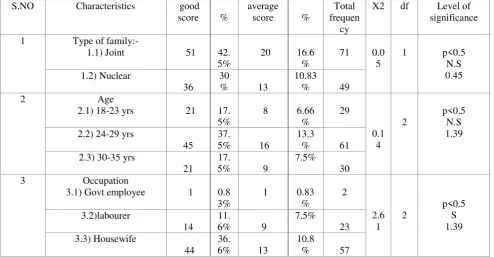
Association of the knowledge score with selected demographic variables like type of family, age, occupation, education, age of marriage, no of children, family income, use of contraceptives, Information related to family planning.
S.NO DESCRIPTION MEAN MEAN% MEDIAN STANDARD
DEVIATION 1 Knowledge score
Temporary spacing methods
22.22 55.55% 22 2.62
S.no Description Mean Mean% Median Standard
deviation 1 Attitude score
Temporary spacing method
55.98 55.98% 56 10.12
S.NO Characteristics good score %
average score %
Total frequen
cy
X2 df Level of significance
1 Type of family:- 1.1) Joint
51 42. 5%
20 16.6 %
71 0.0 5
1 p<0.5 N.S 0.45 1.2) Nuclear
36 30
%
13
10.83
% 49
2 Age
2.1) 18-23 yrs
21 17. 5%
8 6.66 %
29
0.1 4
2
p<0.5 N.S 1.39 2.2) 24-29 yrs
45
37.
5% 16
13.3
% 61 2.3) 30-35 yrs
21
17.
5% 9
7.5% 30 3 Occupation
3.1) Govt employee
1 0.8 3%
1 0.83 %
2
2.6 1
2
p<0.5 S 1.39 3.2)labourer
14
11. 6%
9
7.5% 23 3.3) Housewife
44 36. 6%
13
10.8
*p< 0.5, **p<0.001
S = Significant NS = Non Significant
3.4) others 28 23. 3% 10 8.33
% 38 4 Education
4.1) Illiterate
10 8.3 3%
4 3.33 %
14
2.6
3 p<0.5 S 2.37 4.2) Primary level
39 32. 5% 13 10.83
% 52 4.3) Higher secondary
level 29 24. 16 % 15 12.5
% 44
4.4) Graduate 9 7.5 % 1 0.83
% 10 5 Age at marriage
5.1) 15-21years 46 38. 33 %
18 15% 64 0.0
2
1 p<0.5 N.S 0.45 5.2) 22-28/ 29-35 years
41 34. 16 % 15 12.5
% 56
6 No of children
6.1) 1-2 55 45. 83 %
16 13.33 %
71
13. 9
2 p<0.001 S 12.82 6.2) 3-4 30 25 % 10 8.33 % 40 6.3) Above 5
1 0.8 3% 5 4.16 % 6 6.4) None 1 0.8 3% 2 1.66
% 3 7 Family income
7.1) Rs500-2000/2000-3500
14 11. 66 %
5 4.16 %
19 0.0
1
2 p<0.5 N.S 1.39 7.2) Rs350-5000 41 34. 16 % 20 16.66 % 61
7.3) Rs 5000 and above 28 23. 33 % 12 10% 40
8 Use of contraceptives
8.1) Condom 19 15.
83
% 12 10% 31
0.1 2
1 p<0.5 N.S 0.45 8.2) OCP/ECP 36 30 % 10 8.33
% 46 8.3) None 29 24. 16 % 10 8.33
% 39
8.4) Others 3 2.5 % 1 0.83 % 4 9 Information regarding
family planning 9.1) family members and
friends/ mass media 22 18. 33 %
87 72.5 %
109 14. 4
1 p<0.5 NS 0.45 9.2) newspapers and
TABLE 4
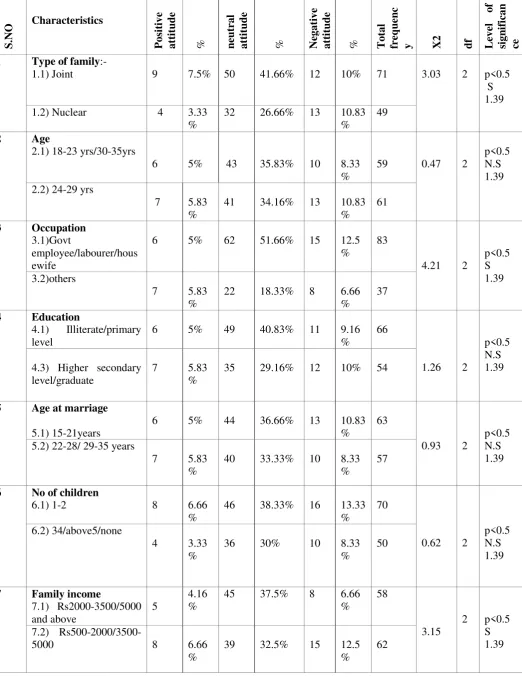
Association of the attitude score with selected demographic variables like type of family, age, occupation, education, age of marriage, no of children, family income, use of contraceptives, Information related to family planning
S.N O Characteristics Posi ti ve at ti tud e % neutr a l at ti tud e
% Negat
ive
at
ti
tud
e
% Tot
al
fre
qu
en
c
y X2 df Leve
l o f si gn if ican ce
1 Type of family:-
1.1) Joint
9 7.5% 50 41.66% 12 10% 71 3.03 2 p<0.5 S 1.39
1.2) Nuclear 4 3.33
%
32 26.66% 13 10.83 %
49
2 Age
2.1) 18-23 yrs/30-35yrs
6 5% 43 35.83% 10 8.33
%
59 0.47 2
p<0.5 N.S 1.39 2.2) 24-29 yrs
7 5.83 %
41 34.16% 13 10.83 %
61
3 Occupation
3.1)Govt
employee/labourer/hous ewife
6 5% 62 51.66% 15 12.5
%
83
4.21 2
p<0.5 S 1.39 3.2)others
7 5.83
%
22 18.33% 8 6.66
%
37
4 Education
4.1) Illiterate/primary level
6 5% 49 40.83% 11 9.16
%
66
1.26 2
p<0.5 N.S 1.39 4.3) Higher secondary
level/graduate
7 5.83
%
35 29.16% 12 10% 54
5 Age at marriage
5.1) 15-21years
6 5% 44 36.66% 13 10.83
%
63
0.93 2
p<0.5 N.S 1.39 5.2) 22-28/ 29-35 years
7 5.83
%
40 33.33% 10 8.33 %
57
6 No of children
6.1) 1-2 8 6.66
%
46 38.33% 16 13.33 %
70
0.62 2
p<0.5 N.S 1.39 6.2) 34/above5/none
4 3.33
%
36 30% 10 8.33
%
50
7 Family income
7.1) Rs2000-3500/5000 and above
5
4.16 %
45 37.5% 8 6.66
%
58
3.15
2 p<0.5 S 1.39 7.2)
Rs500-2000/3500-5000 8 6.66
%
39 32.5% 15 12.5
%
8 Use of contraceptives
8.1) Condom/OCP/ECP 7 5.83 %
56 46.66% 14 11.66 %
77
1.35 2
p<0.5 N.S 1.39 8.2) None/others
6 5% 27 22.5% 10 8.33
%
43
9 Information regarding
family planning
9.1) family members
and friends/ newspaper 4 3.33 %
29 24.16% 9 7.5% 42
0.28
2 p<0.5 N.S 1.39 9.2) mass media
9 7.5% 55 45.83% 14 11.66
%
78
*p < 0.5
S = Significant NS = Non Significant
6. CONCLUSION:
The major findings of the study were:-
Regarding the existing knowledge of the mothers, there was a lack of knowledge regarding use and availability of temporary spacing methods.
Majority of the women (61.67%) had negative or unfavourable attitude towards temporary spacing methods whereas 38.33% had positive or favourable attitude towards the same.
The study findings revealed that there a slight positive correlation i,e. r=0.0052 between knowledge score and attitude score.
It also stated that there is a significant association between knowledge of reproductive age women and occupation, education ( p<0.5) ,number of the children and(p<0.001) with selected socio demographic variables .
It also concluded that there is a significant association between attitude of reproductive age women and type of family, occupation and family income(p<0.5) with the selected demographic variables
RECOMMENDATIONS:
The investigator recommends the following studies in the field of nursing research. The study can be replicated on larger samples for better generalization The study can be replicated on different setting.
A similar study can be done to assess the knowledge and attitudes of nursing staff regarding temporary spacing method.
A study can be done to assess the knowledge and attitude of the primi postnatal mothers regarding spacing methods of contraception.
REFERENCES: BOOKS
1. 1 .Adele Pilliteri. “Maternal and child health nursing”., New York., Published by Lippincott., Third edition., 2000., Pp 96-111.
2. Annamma Jacob., “A comprehensive textbook of midwifery”., New Delhi., J.P Medical publishers., Second edition., 2008.,Pp 252-266.
3. Barbara Hazard Munro., “Statistical Methods For Health care research”., Philadelphia., Lippincott Williams and Wilkins., Fifth edition.,2005.,Pp 241,363-364.
4. BT Basavanthappa., “Community Health Nursing”., New Delhi., J.P Medical publishers., Second edition.,2008., Pp 569-577.
5. Burroughs. “Maternity Nursing”., London., WB Saunders Company., Seventh edition.,1997., Pp 495-502. 6. C P Thresyamma., “A Guide Of midwifery students”., New Delhi., Jaypee Brothers Publishers., First
JOURNALS
7. Agha S, “Intentions to use contraceptives”., British Medical council Public Health., 2010., Vol 10.,no(4)., Pp 450-4.
8. Amajit mukherjee., “Increases in self-reported consistent condom use among male clients of female sex workers”., British medical journal.,October.,2009., Vol 35.,no(7)., Pp 23-6.
9. Anju Puri,et.al., “Unmet need for contraception”., Indian Journal of Community Medicine., 2009., Vol 29.,no(3)., Pp 23-9.
10. Ariane Van Der Straten, et.al., “Change in condom and other barrier method use during and after HIV prevention trial” .,Journal of International Aids society.,October.,2010.,Vol 13.,no(2).,Pp.52-58.
11. Arshiya Masood,et.al., “Distribution of permanent method of contraception acceptors”., Health and population: perspectives and issues., 2009., Vol 32.,no(1)., Pp 54-58.
12. Azeem Sultan Mir,et.al., “Emergency contraceptives pills”., North American Journal of medical sciences., August., 2010., Vol 2.,no(8)., Pp 192-99.