w w w . a a s s j o u r n a l . c o m ISSN (Online): 2322 – 4479 ISSN (Print): 2476–4981
Original Article
www.AESAsport.com Received: 19/07/2017 Accepted: 21/09/2017
The Effect of Focus Instructions on Dart Throwing Performance
in Children With and Without Developmental Coordination
Disorder
1
Shabnam Fathi Khatab,
1Abdollah Ghasemi
*,
3Seyed Kazem Mousavi Sadati
1Motor Behavior Department, Physical Education Faculty, Science and Research Branch, Islamic Azad University, Tehran, Iran. 2Motor Behavior Department, Physical Education Faculty, East Tehran Branch, Islamic Azad University, Tehran, Iran.
ABSTRACT
Background. Adults benefit more from external focus than internal focus when performing motor skills. Objectives. The aim of this study was to investigate the effects of internal and external focus of attention on dart throwing performance in children with and without developmental coordination disorder. Methods. Twenty men, 20 normal boys and 20 boys with developmental coordination disorder were selected by Motor Observation Questionnaire for Teachers. The task was to throw the darts to the target which was performed in two experimental conditions including internal (related to the movements of the fingers and arm) and external (related to target and dart’s course) focus of attention. Results. The results of ANOVA with repeated measures indicated that along with Constrained Action Hypothesis, adults performed better in condition of external focus of attention. However, for normal children, the use of internal focus of attention was more effective and in children with developmental coordination disorder, no significant difference between two conditions was found. Conclusion. According to results of this study, therapists and coaches should adjust their methods and instructions based on age, experience and developmental conditions of individuals.
KEY WORDS:Focus Of Attention, Children, DCD, Dart Throw, Constrained Action Hypothesis.
INTRODUCTION
Developmental coordination disorder (DCD) is a disability in which a child’s motor coordination problems significantly interfere with daily activities and academic achievement. It affects 5– 6% of children in schools. These children have difficulty with motor skills, motor learning, and motor performance. They don’t participate in play and activities, which can result in depression, isolation, and decreasing the quality of life (1).
Occupational therapists usually want to direct the learners’ attention to different environmental cues or body movements to improve their motor learning. Studies on adults have shown that, directing the learners’ attention to an external cue (impact of the movement on the environment) is more effectual than an internal cue (body movement) (1-3) and causes more effective arousal (4).
These results have been shown in tasks and sports skills such as balance in healthy people (5), balance in individuals with Parkinson disease (6), long jump (7), endurance activity (8), golf (9), volleyball (10), and Football (11).
The constrained action hypothesis is used to explain the benefits of utilizing an external rather than an internal focus of attention. According to this hypothesis, when learners are asked to utilize an internal focus, they consciously control their movement, which constrains the motor system and disrupts automatic control processes. Nevertheless, utilizing an external focus (on the movement effect), allows unconscious or automatic processes to control the movement, and results in more effective performance and learning (11).However, studies have shown that there is a significant interaction effect between the type of attentional instruction and skill level. Highly skilled performers act better in condition of external focus of attention, whereas less-skilled performers act better in condition of internal focus of attention (12,13).
We can assume that children are similar to novice performers in their lack of experience, unfamiliarity with skills, and low motor repertoire. In contrast, adults have had a lot of motor experiences. Moreover, children have difficulty in focusing during motor performance (14). However, we couldn’t find enough research regarding the effects of focus of attention on motor performance of children especially children with DCD. Some research have mentioned the advantage of an external focus of attention for children (15,16),whereas some others have reported the opposite results (17,18). Presumably, developmental differences would affect motor performance, so the better focus of attention for children may be different from that of adults (15, 18). Thus, the aim of this study is to investigate the effects of internal and external focus of attention on motor performance of adults and children with and without DCD. The task we used was dart throwing. We supposed that the effects of internal and external focus of attention are different in adults and children with and without DCD.
MATERIALS AND METHODS
Participants. Three groups of people
aged 19 – 23that were students of a university), normal children (20 healthy boys aged 7-11) and DCD children (20 boys aged 7-11 who were diagnosed by the researcher as DCDs). All children were selected from an elementary school. Inclusion criteria for participants were: being right handed, being unfamiliar with the task, participants’ satisfaction for cooperation, parents’ satisfaction for children, and absence of obvious nervous, muscular, skeletal or mental problems.
Apparatus and task. To select the children with DCD, we used the Persian version of motor observation questionnaire for teachers (19). This questionnaire is used to screen the children with DCD aged 5-11 years old. It consists of 18 items including two subscales (14 items related to general motor function and 4 items related to writing) and teacher has to answer the questions by considering the child’s behavior. The reliability of the questionnaire (0.91) has been approved. According to the questionnaire, children under the 16th percentile were diagnosed as DCDs (19) and then, normal children were matched with DCDs in terms of age.
The task was to throw darts at a dartboard which was 38 cm in diameter. The dartboard had nine concentric rings, each 2 cm in width, and 2 cm diameter bull’s eye in the center. The bull’s eye’s height and distance were adjusted according to age (the height for adults 1.70 m and for children 1.22 m; the distance for adults 2.30 m and for children 1.50 m), as recommended by Emanuel et al (18). The task required participants to throw darts at the bull’s eye. A dart that hit the bull’s eye was given 10 points, and so on, with a dart that hit the outermost ring was given 1 point. Darts that missed the dartboard were given 0 points (20).
Procedure. The research was conducted in a quiet room. At first, the examiner spoke with each participant to explain and show the basic technique of the task. All participants were given the same instructions about the task goal. Instructions for the internal focus were related to the movements of the fingers and arm and they included: 1. Feel the weight of the dart. 2. Flex your arm and bring the dart back. 3. Be ready and feel the movement of your arm when you extend your arm forward. 4. Feel the dart when it leaves your fingers. 5. Think about throwing the dart
differently to get it closer to the target. Instructions for the external focus were related to the target, the dart and its course and they included: 1. Focus on the target.2. When ready, throw the dart towards the dartboard.3.Follow the flight of the dart, focusing on it to strike thedartboard.4. Maintain your focus until the dart strikes the dartboard (18, 21). Using a within-participant design, the ordering of conditions of attentional focus was counterbalanced across participants over two consecutive days of testing. Each participant was assigned a different condition of focus of attention each day. In each condition, participants threw 50 darts in 5 trial blocks (10 throws per block) (18). Ten darts were used for each trial block. After each trial block, the darts were removed from the dartboard by the experimenter and were used again for the next trial block. At the beginning of each trial block, the examiner reminded the participants of the instructions.
Average scores in each trial block were calculated and used for statistical analysis.
Data analysis. We checked the data for normality with the Kolmogorov-Smirnov test. Data were analyzed by a 3 (groups: adults, normal children, children with DCD) × 2 (focus of attention: internal vs. external) × 5 (trial blocks) mixed analysis of variance (ANOVA) with repeated measures, and because the within subject (trial block) had five levels, Mauchly’s test was used to determine sphericity. Tukey post hoc test was used to specify experimental groups with different means. Then a 2 (focus of attention: internal vs. external) × 5 (trial blocks) mixed ANOVA with repeated measures was used for each experimental groups and Bonferroni post hoc test was used to specify trial blocks with different means. SPSS-18 Statistics was used and statistical significance was set at p < 0.05.
RESULTS
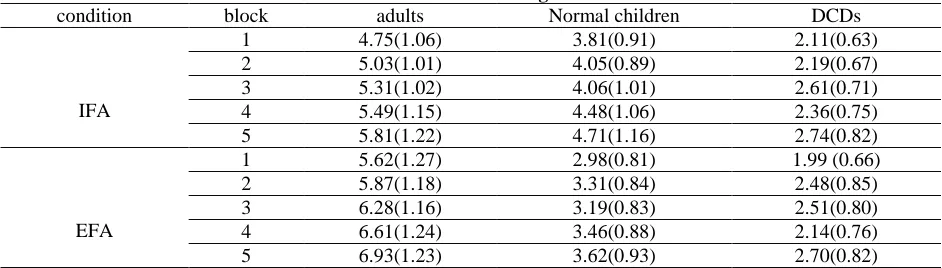
Score results of dart throwing for three experimental groups in two conditions of focus of attention during the five trial blocks are shown in the table 1 and figures 1.
Table 1. Mean (standard deviation) for Scores of dart throwing for three experimental groups in two conditions of focus of attention during the five trial blocks
condition block adults Normal children DCDs
IFA
1 4.75(1.06) 3.81(0.91) 2.11(0.63)
2 5.03(1.01) 4.05(0.89) 2.19(0.67)
3 5.31(1.02) 4.06(1.01) 2.61(0.71)
4 5.49(1.15) 4.48(1.06) 2.36(0.75)
5 5.81(1.22) 4.71(1.16) 2.74(0.82)
EFA
1 5.62(1.27) 2.98(0.81) 1.99 (0.66)
2 5.87(1.18) 3.31(0.84) 2.48(0.85)
3 6.28(1.16) 3.19(0.83) 2.51(0.80)
4 6.61(1.24) 3.46(0.88) 2.14(0.76)
5 6.93(1.23) 3.62(0.93) 2.70(0.82)
IFA: Internal Focus of Attention. EFA: External Focus of Attention
According to results of the three-way mixed ANOVA, the main effect for the group (F(2)=476.473, p=0.000) and block (F(4,228)=476.473, p=0.000) and the interaction effect between focus of attention and group (F(2,57)=476.473, p=0.000) were significant. The results of Tukey test indicated that there was a significant difference between the performance of adults and normal children (p=0.000) as well as normal children and children with DCD (p=0.000).
The results of 2-way ANOVA with repeated measures for each group indicated that in adults, the main effect of the focus of attention was significant (F(1,19)=33.347, p=0.000). Therefore, the mean of scores was better in condition of external focus of attention. The main effect of the trial block was also significant (F(4,76)=7.665, p=0.000) and according to Bonferroni test, there was a significant difference between the first and fourth (p=0.048), first and fifth (p=0.000), and second and fifth (p=0.027) blocks.
Figure1. Scores of dart throwing for three experimental groups in two conditions of focus of attention during the five trial blocks
In normal children, the main effect of the focus of attention was significant (F(1,19)=30.834, p=0.000). Therefore, the mean of scores was better in condition of internal focus of attention. The main effect of the trial block was also significant (F(4,76)=4.602, p=0.010) and according to Bonferroni test, the only significant difference was between the first and fourth blocks (p=0.004).
In children with DCD, the main effect of the focus of attention wasn’t significant (F(1,19)=0.105, p=0.749). Therefore, there was no significant difference between two conditions of focus of attention. However, the main effect of the trial block was significant (F(4,76)=15.0087, p=0.001) and according to Bonferroni test, there were significant differences between the first and third (p=0.007) and first and fifth (p=0.014) blocks. No other main or interaction effects were found in any of the groups except those mentioned.
DISCUSSION
As expected, adults performed better than normal children and normal children performed better than DCD peers. Maybe the feelings of frustration manifest as lack of focus and effort, which was leading to poor performance in DCDs.
This behavior is usually seen in DCDs when exposed to motor-based tasks, especially when the tasks are challenging (22). It was assumed that children with DCD have problems in internal models of movements and feed forward controls which can interfere with their suitable movements (23). It has been demonstrated that these problems can be attributed to dysfunction of brain areas such as cerebellum and basal ganglia. Abnormal brain networks may lead to poor motor performance; however, the underlying mechanisms are unclear (24).
The results of this study didn’t support the constrained action hypothesis (11) in children. Along with previous research (5-11), adults performed better in condition of external focus of attention, whereas for normal children, the use of internal focus of attention was more effectual and in DCDs, no significant difference between two conditions of focus of attention was found.
In addition to the subject of different levels of automation in children and adults, other explanations for the differences of focus of attention between children and adults include visual system and information processing differences. Adults tend to use visual information automatically, whereas children, who aren’t mature in information processing, operate
1.5 2.5 3.5 4.5 5.5 6.5 7.5
1 2 3 4 5
Sco
re
Block
adults - internal
adults - external
children - internal
children - external
DCDs - internal
DCDs - external
is slow and usually collects unrelated cues from the visual field. Therefore, directing their attention to the visual cues (the target and the dart [external focus of attention]) reduces their performance (18).
Children with DCD have difficulty with motor skills, motor learning, and motor performance that significantly interfere with their daily activities and academic achievement (1). For the DCD group in this study, the lack of difference between external and internal focus of attention may indicate delayed motor learning, potentially a disability to follow, or apply the focus of attention instructions during performance of task. This indicates that these children may need guidance and instructions more than what was given in this research. Repeated prompting to keep the focus may be important to compensate for executive control issues that are usually observed in these children (25). Maybe the dart throwing task used in this study was challenging for DCD group and they may have ignored or failed to understand the given instructions. This failure to comprehend or follow the instructions may have caused the lack of statistical difference between the two experimental conditions. In future research, it may be helpful to use simpler tasks for children with DCD. It may result in being able to more effectively use the instructions resulting in different performance in two conditions of focus of attention.
The professions for which the results of this study would be most related are physical education, occupational, and physical therapy. They work with people on skill acquisition and could benefit by recognizing the more effective type of feedback and instructions to use with patients. According to results of this research, therapists and coaches should adjust their methods and instructions based on age, experience and developmental conditions of individuals.
CONCLUSION
One of the limitations of this study was that we didn’t consider the possibility of noncompliance
of the instructions by participants. Maybe some participants changed their focus of attention and utilized their preferable focus which was different from what they were asked to do. Thus, it may be valuable to consider and control this issue in future studies. Furthermore, a third experimental condition could be added where groups are not given any instructions about focus of attention. It is suggested that the effect of focus of attention not just on performance but also on retention and transfer should be studied. Moreover, using the different types of tasks with different level of complexity can be useful in future research. To generalize the results, future studies can also examine the effect of focus of attention on adults with motor impairment. Therapists and coaches can use the results of this research so that, unlike adults, with the children who intend to learn or relearn a motor skill in the clinic, the instructions related to internal focus of attention should be used more often. Therapists and coaches should consider that children with DCD may need repeated instructions related to both types of internal and external focus of attention. Although it seems that different focus of attention is recruited in children with DCD compared with normal children, this study couldn’t explore the mechanisms completely. Thus, future studies are needed in this field.
REFERENCES
1. Jarus T, Ghanouni P, Abel RL, Fomenoff SL, Lundberg J, Davidson S, et al. Effect of internal versus external focus of attention on implicit motor learning in children with developmental coordination disorder. Res Dev Disabil. 2015;37:119-26.
APPLICABLE REMARKS
For adults, instructions on externalfocus of attention results in more effective performance.
For children, instructions on internal focus of attention results in more effective performance.
Children with DCD need repeated instructions related to both types of internal and external focus of attention during execution of task.
2. Wulf G, Lewthwaite R, Cardozo P, Chiviacowsky S. Triple play: Additive contributions of enhanced expectancies, autonomy support, and external attentional focus to motor learning. The Quarterly Journal of Experimental Psychology. 2017:1-9.
3. Pelleck V, Passmore SR. Location versus task relevance: the impact of differing internal focus of attention instructions on motor performance. Acta Psychol (Amst). 2017;176:23-31.
4. Lewthwaite R, Wulf G. Optimizing motivation and attention for motor performance and learning. Current Opinion in Psychology. 2017.
5. Richer N, Saunders D, Polskaia N, Lajoie Y. The effects of attentional focus and cognitive tasks on postural sway may be the result of automaticity. Gait Posture. 2017;54:45-9.
6. Wulf G, Landers M, Lewthwaite R, Toöllner T. External focus instructions reduce postural instability in individuals with Parkinson disease. Phys Ther. 2016;89(2):162-8.
7. Ducharme SW, Wu WF, Lim K, Porter JM, Geraldo F. Standing long jump performance with an external focus of attention is improved as a result of a more effective projection angle. The Journal of Strength & Conditioning Research. 2016;30(1):276-81
8. Schücker L, Fleddermann M, de Lussanet M, Elischer J, Böhmer C, Zentgraf K. Focusing attention on circular pedaling reduces movement economy in cycling. Psychol Sport Exerc. 2016;27:9-17.
9. Wulf G, Lauterbach B, Toole T. The learning advantages of an external focus of attention in golf. Res Q Exerc Sport. 1999;70(2):120-6.
10. Wulf G, McConnel N, Gärtner M, Schwarz A. Enhancing the learning of sport skills through external-focus feedback. Journal of motor behavior. 2002;34(2):171-82.
11. Wulf G, McNevin N, Shea CH. The automaticity of complex motor skill learning as a function of attentional focus. The Quarterly Journal of Experimental Psychology: Section A. 2001;54(4):1143-54.
12. Beilock SL, Carr TH, MacMahon C, Starkes JL. When paying attention becomes counterproductive: impact of divided versus skill-focused attention on novice and experienced performance of sensorimotor skills. J Exp Psychol Appl. 2002;8(1):6.
13. Perkins-Ceccato N, Passmore SR, Lee TD. Effects of focus of attention depend on golfers' skill. J Sports Sci. 2003;21(8):593-600.
14. Lidor R, Singer RN. Preperformance routines in self-paced tasks: Developmental and educational considerations. The psychology of team sports. 2003:69-98.
15. Saemi E, Porter J, Wulf G, Ghotbi–Varzaneh A, Bakhtiari S. Adopting an external focus of attention facilitates motor learning in children with attention deficit hyperactivity disorder. Kineziologija. 2013;45(2):179-85. 16. Abdollahipour R, Nieto MP, Psotta R, Wulf G. External focus of attention and autonomy support have additive
benefits for motor performance in children. Psychol Sport Exerc. 2017.
17. Andy C, van Ginneken WF. Children's conscious control propensity moderates the role of attentional focus in motor skill acquisition. Psychol Sport Exerc. 2017;31:35-9.
18. Emanuel M, Jarus T, Bart O. Effect of focus of attention and age on motor acquisition, retention, and transfer: a randomized trial. Phys Ther. 2008;88(2):251.
19. Salehi H, Zarezadeh M, Salek B. Validity and Reliability of the Persian Version of Motor Observation Questionnaire for Teachers (PMOQ-T). Iranian Journal of Psychiatry and Clinical Psychology. 2012;18(3):211-9 [Article in Farsi].
20. McKay B, Wulf G. A distal external focus enhances novice dart throwing performance. International Journal of Sport and Exercise Psychology. 2012;10(2):149-56.
21. Marchant DC, Clough PJ, Crawshaw M. The effects of attentional focusing strategies on novice dart throwing performance and their task experiences. International Journal of Sport and Exercise Psychology. 2007;5(3):291-303.
22. Watemberg N, Waiserberg N, Zuk L, Lerman‐Sagie T. Developmental coordination disorder in children with attention‐deficit–hyperactivity disorder and physical therapy intervention. Dev Med Child Neurol. 2007;49(12):920-5.
23. Wilson PH, Ruddock S, SMITS‐ENGELSMAN B, Polatajko H, Blank R. Understanding performance deficits in developmental coordination disorder: a meta‐analysis of recent research. Dev Med Child Neurol. 2013;55(3):217-28.
24. Bo J, Lee C-M. Motor skill learning in children with developmental coordination disorder. Res Dev Disabil. 2013;34(6):2047-55.
25. Piek JP, Dyck MJ, Francis M, Conwell A. Working memory, processing speed, and set‐shifting in children with developmental coordination disorder and attention‐deficit–hyperactivity disorder. Dev Med Child Neurol.