Abstract. In a distributed computing environment, it is vital to maintain the states of the processes involved in order to cater to failures that are arbitrary in nature. To reach a consistent state among all the processes, checkpoints are taken locally by each process and are combined together based on uniformity criteria such as consistency, transitlessness, and strong consistency. In this article, first, the necessary and sufficient conditions of consistency criteria are stated and then an expert system, implemented based on these criteria, is presented. The expert system discovers and illustrates consistent, transitless, strongly consistent and globally consistent checkpoints in a given distributed system. Moreover, it offers facilities for evaluating checkpointing algorithms by measuring different quality assessment parameters.
1. INTRODUCTION. A distributed computing environment consists of a number of processes involved in com-putation and communicating with each other. In such an environment, there is a need for a mechanism to recover and proceed with the computation, if one or more of the processes fail at any instant of time during computation. Variety of checkpointing and recovery techniques have been proposed (synchronous, asynchronous, hybrid to name a few), in order to minimize re-computing involved in the recovery steps [5, 6, 7]. Generally, recovery includes the rollback of the processes involved in the computation to a point, from where if the computation were to restart, the final result would be the same as that without the failure(s). This is termed as a globally consistent state or a recovery line. In section 2, some background regarding checkpointing and its consistency issues are given.
This paper presents an expert system capable of finding all the possible globally consistent states over a fixed time interval. It also traces consistent, transitless and strongly consistent states between any two or more processes in a distributed system. With these features, the tool may be used for verification of the correctness and efficiency of other checkpointing and recovery algorithms. These algorithms can be checked for their correctness in providing/discovering recovery lines or to see if the consistency criteria are being exposed accurately. Moreover, the system provides facilities for evaluating different algorithms by comparing their features. Currently, the software calculates the following characteristics for a given checkpointing algorithm:
• average number of the checkpoints taken by a process in a given time, • number of globally consistent checkpoints in a given time,
• average number of checkpoints skipped by a process when rolling back to a recovery line, and • average elapsed time when rolling back to a recovery line.
To our knowledge, there exists no tool with features matching or even close to the proposed system.
Originally, a C++ program, and not an expert system, was implemented with some of the noted features. The program was extremely slow due to the exhaustive search process for determination of the consistent pairs of the checkpoints. Moreover, implementation of the consistency criteria (based on the theorems, lemmas and definitions discussed in the next section), using a sequential/procedural language such as C++ produced a complex and hard to modify code. Because of these drawbacks, a non-procedural, declarative rule-based engine, Java Expert System Shell (JESS) [4], was employed to develop the system. Using JESS considerably simplified the code, improved the performance in average over four times, and eased the maintenance and upgrade of the system. The reason for these improvements lies under the fact that in a rule-based program, any of the rules may become activated and put on the agenda if its antecedent matches the facts, while the order that the rules were entered does not affect which rules are activated. Thus, the order of the the program statements does not specify a rigid control flow which makes it a logical fit for the framework of the consistency criteria. This is because the consistency criteria are materialized using theorems, lemmas and definitions that could be treated opportunistically.
In section 2, a brief description of a distributed system is given and definitions of consistency, transitlessness and strong consistency are stated. Moreover, methods of finding these criteria in a general graph are explained in this section. In section 3, the architecture of the expert system for the analysis of consistency criteria is presented and its correctness is verified in section 4, using an example. The paper is concluded with a summery and future work section.
2. CONSISTENCY ISSUES IN DISTRIBUTED CHECKPOINTS. Consider a distributed computing
environ-ment consisting ofN processes that interact with each other by exchange of messages. An event occurs each time a process sends or receives a message.Lamport’s happened-beforerelationship is used to define these events. Ifahb
→bthen ∗Department of Computer Science, Southern Illinois University, Carbondale, Illinois 62901.
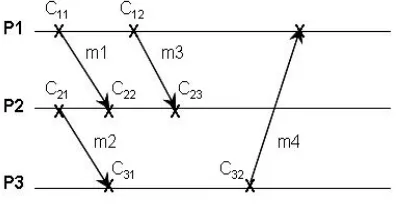
FIG. 1.Local Checkpoints.
it is said that eventacaused eventb, or acausal pathexists betweenaandb[2]. An example of ahappened-before
relationship is where a process,P1, sends a message to another procss,P2. Since the”send”event,a, from ProcessP1
happens before, and is the cause for the”receive”event,b, at processP2, it is defined asahb→bIf two eventsaandbdo
not have ahappened-beforerelationship between them, then it is said that they areunordered, otherwise they areordered. In a multi-process system, a global state is recorded by combining local checkpoints (periodical snapshots of the processes involved in the computation), one per participating process. In order to group the local checkpoints into a global checkpoint, the necessary and sufficient conditions, proved in [1] are used. A local checkpoint might be taken
synchronously[5, 11], enabling easy recovery, orasynchronously[6], which reduces the number of message exchanges among processes, depending on the preferred algorithm. In this paper, the notationCij is interpreted as thejth local
checkpoint of processPi. In Fig.1, local checkpoints labeled asC11,C11,C21,C22andC31record corresponding local
states of the processesP1,P2andP3respectively. IfC11,C21andC31are combined together then they define a global
checkpoint [2].
These global states play a vital role when one of the processes involved in computation fails and the entire system has to be restored to a state from where the computation can resume without affecting the final result. Therefore the choice of a consistent global state has to be carefully made. In Fig.1,C12,C22andC31, if combined together, constitute a safe
global checkpoint in case of the failure ofP1,P2and/orP3. However,C11,C21andC31, if grouped together, do not yield
a globally consistent state for recovery. This is because any message sent after the checkpointC21 fromP2, before the
checkpointC31to processP3, will be lost and produce an incorrect final result.
In [1], Helary describes the transformation of a happened-before relationship to a Z-graph. If a Z-graph exists between two checkpoints, belonging to two different processes, then the checkpoints are not consistent with each other. Another possible transformation of a happened-before relationship could be to aτ-graph used to decide the transitlessness of two checkpoints belonging to two different processes. An S-graph is defined as a union of aτ-graph and a Z-graph and is used to find strongly consistent checkpoints. Z-graph,τ-graph, and S-graph are discussed in detail later in this section.
In this section, the definitions of consistency, transitlessness and strong consistency are reviewed and the necessary and sufficient conditions are stated. However, proofs are considered beyond the scope of this paper.
2.1. Consistency Criterion. A pair of consistent checkpoints [10, 12] should not have any causal path between them. In other words, consistent checkpoints cannot exhibit messages received but not yet sent. That is there cannot be an
orphanmessage between any pair of consistent checkpoints. A messagemsent by a process,Pi, to a process,Pj, is called
orphan with respect to the ordered pair of local checkpoints (Cix,Cjy) if and only if the delivery ofmbelongs toCjy (deliver(m)∈Cjy)while its sending event does not belong toCix(send(m)∈/ Cix). In Fig 2, messagem1is an orphan
message because the sending of messagem1is not recorded byC11but the receiving ofm1is recorded by checkpoint C21. Therefore, the ordered pair of local checkpoints (C11,C21) is not consistent. However, the ordered pair of local
checkpoints (C12,C22) is consistent due to the absence of any orphan messages. Similarly, the pair of checkpoints (C22, C31) and (C12,C31) are consistent. Together they constitute globally consistent checkpoints (C12,C22, andC31).
We can thus define a consistent global checkpoint as follows:
DEFINITION 1:A global checkpoint is consistent if all its pairs of local checkpoints are consistent.
2.1.1. Z- Path Instantiation. Definition 1 can be used to transform the graph displayed in Fig. 2 into aZ-graph that helps to detect theZ-paths and therefore eliminate those checkpoints that cannot be considered for global consistency. As [1] enunciates, a graph (as shown in Fig. 2) is said to have aZ-path between two checkpointsCiandCj, taken before an
eventeiin processPiand after an eventejin processPjrespectively, ifeiandejare communication events betweenPi
FIG. 2.m1 is an orphan message betweenC11andC22and in-transit betweenC12andC21.
FIG. 3.A Z-Path between ordered pair of local checkpoints (C11,C22) and (C12,C23).
Fig. 3 modifies Fig. 2 to demonstrate the existence of theZ paths, which are represented by dotted lines. Since the checkpointsC11 andC22 have aZ-Path between them, they cannot participate in a globally consistent checkpoint. For
similar reasons,C13andC32cannot participate in a globally consistent checkpoint either.
2.1.2. Necessary and Sufficient Conditions for Consistent Checkpoints. Lemma 1 states thatPcan be a globally consistent checkpoint if and only if there exists noZ-Path between any two ordered pair of local checkpoints that are in P
. Similar inferences for a set of local checkpointsMand a local checkpointCfollows. Note the direction of the arrows decide the nature of the path. In Fig. 3,Z-path exists betweenC11andC22and is depicted using dotted lines.
LEMMA 1. A global checkpointPis consistent if and only if¬(PZ
→ P
).
THEOREM 1.Let M be a set of local checkpoints from different processes. M can be extended to a consistent global checkpoint if an only if¬(MZ
→M).
COROLLARY 1.Let C be a local checkpoint. C can be a member of consistent global checkpoint if an only if
¬(CZ
→C).
2.2. Transitless Criterion. Transitless checkpoints cannot exhibit messages sent but not yet received and therefore are the dual opposites of the consistent checkpoints explained in section 2.1. As we can see, this condition suggests that there cannot be any messagein-transitfor an ordered pair of checkpoints to be transitless. It may include messages re-ceived but not yet sent; in such cases, the checkpoints can be only transitless and not strongly consistent. This is explained further in section 2.3. Messagemsent by processPito processPjis said to be in-transit with respect to the ordered pair
of checkpoints (Cix,Cjy) if and only if the sending ofmbelongs toCix(send(m)∈Cix) while the receiving ofmdoes
not belong toCiy(receive(m)∈/Ciy). In Figure 2, the ordered pair (C12,C21) is an ordered pair of checkpoints that have
messagem1in-transit. This is because the checkpointC12records the sending of messagem1whileC21does not record
the receiving of the messagem1. However the ordered pair (C12,C22) is transitless as it does not involve any messages
in-transit.
FIG. 4.τ-path exists between ordered pair of checkpoints (C12,C21).
FIG. 5.An S- Path betweenC12,C22,C31.
In Fig. 2, CheckpointsC12,C22, andC31constitute a globally transitless checkpoint since the ordered pairs (C12, C22), (C22,C31), and (C12,C31) are all transitless.
2.2.1. τ - Path Instantiation. The idea of having no in-transit messages can be extended to aτ-Path. Assuming that a checkpointCiis taken before eventeiin processPiand checkpointCjis taken after eventejin processPj, where ei andej are communication events betweenPi andPj and concern the same message,m, which is in-transit between PiandPj (i. e., eventseiandejyield a happened-before relationship which is also called a c-edge), then the graph (as
shown in Fig. 2) is said to have aτ-path between the two checkpointsCiandCj. In other words, aτ-path exists if there
is any in-transit message between two checkpoints. Fig. 4 modifies Fig. 2 to show the existence ofτ-path using dotted lines.
2.2.2. Necessary and Sufficient Conditions for Transitless Global Checkpoint. Theorem 2 states thatM can be a transitless global checkpoint if and only if there exists noτ-path between any two ordered pair of local checkpoints that are inM.
THEOREM 2.Let M be a set of local checkpoints that belong to different processes. M can be extended to a transitless global checkpoint if an only if¬(Mτ
→M).
2.3. Strong Consistency Criterion. A strongly consistent global checkpoint is made up of local checkpoints that are both consistent and transitless [1]. For example in Fig. 2 local checkpointsC12,C22andC31make up a global
check-point that is both consistent and transitless; therefore,C12,C22, andC31are strongly consistent.
DEFINITION 3: A global checkpoint is strongly consistent if all its pairs of local checkpoints are consistent and transitless.
2.3.1. S-Path Instantiation. AnS-path is the union of aZ-path and aτ-path [1]. Fig. 5 displays anS-path that exists betweenC12,C21andC31and therefore, do not form a strongly consistent global checkpoint. However,C12,C22and C31constitute a strongly consistent checkpoint due to the absence of aSpath between them.
2.3.2. Necessary and Sufficient Conditions for Strongly Consistent Global Checkpoint. Theorem 3 states that
FIG. 6.Example of an input file.
FIG. 7.Structure of a single line of the input file.
THEOREM 3. LetM be a set of local checkpoints from different processes. M can be extended to a strongly consistent global checkpoint if an only if¬(MS
→M)[1].
3. THE EXPERT SYSTEM IMPLEMENTATION. Based on the definitions and theorems as well as the neces-sary and sufficient conditions described in section 2, an expert system was implemented to determine consistent, transit-less, strongly consistent, and globally consistent checkpoints in a distributed environment. Moreover, some features for evaluation purposes were included, such as determining the average number of checkpoints taken by a process, the num-ber of globally consistent checkpoints in a time interval, and the numnum-ber of messages sent and received for checkpointing purposes.
The application is implemented in Java using the Java Expert System Shell (JESS) [4]. JESS is the Java version of CLIPS (C Language Integrated Production System) [8]. The rule base of the expert system is created from rules that determine various consistency criteria. A snapshot of the distributed system containing the time of the sent and the received messages and the times of the checkpoints taken by each process involved in the computation is fed to the expert system as a set of facts (input). On execution, the facts are evaluated against the rule base to determine the consistency criteria. This section presents the structure of the expert system by discussing its various components at a greater detail.
3.1. Input and Display of Events. The presented expert system takes an ordered set of events, with respect to each process, as its input. Fig. 6 illustrates a sample input file while Fig. 7 describes the generic structure of the contents of the file consisting of send and receive events for a single process.
Each process’s event, presented in the input file, has four elements. The first element of each event is the event type denoted bysend, for a sent message, andrecv, for a received message. The second element is the name of the process to which a message is sent or from which a message is received; the third element is the name tag of the message. Finally, the estimated time at which the send or receive events occurs is given. Time is represented by generic unit and it is up to the user to decide the representation that is most useful; time is calculated not from the initiation of a process but from the execution of the last event.
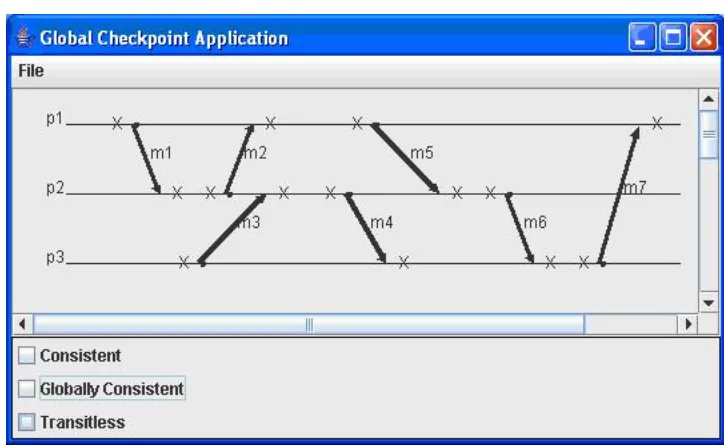
The file is then parsed and a graphical display of the communication events between the processes, as specified in the input file, is demonstrated with arrows indicating thesendand therecvevents (Figure 8). Also, as the input file is parsed, the local checkpoints are depicted based on the checkpointing scheme employed in the system. This is done through the use of another input file calledcheckpointing file, which is formed either manually by the user or by the processes involved in the distributed computation. Each line of this file represents the estimated time of checkpoints taken by a particular process. In this paper, we have assumed that the checkpoints are taken before thesendand after therecvevents.
The Java implementation consists of several classes, but the most important ones areAll ProcessesandProcess. The
All Processesclass has a java defined Vector of Process object. When the program begins execution the main method of the classCheckpoints’is called. The main method instantiates aCheckpointFrameobject which then instantiates a
DrawingPanelobject. TheDrawingPanelobject overrides thepaintComponentmethod of theJPanelclass. The paint-Componentmethod is where all the drawing to theJPanelis done. Inside thepaintComponent method theparseFile
method of theAll Processesclass is called. This is an important method that parses through the given input files and buildsNprocess objects, whereNis the number of user defined Processes. Each Process object has anevents’vector, an
FIG. 8.Illustration of the events and checkpoints of a distributed system consisting of three processes.
vector. Once the events are read in, then the coordinates of each event are defined (discussed later in this section) and then are added to theProcessclass’s vector. Currently ten pixels are drawn for every time unit that the user defines. So if the user puts in a 7 then 70 pixels are drawn from the last event to the current event. Moreover, as the input file is parsed, local checkpoints are added to the events andeventCoordsvector, by reading in the checkpointing file.
Once theAll Processes’ parseFilemethod is completed, the control returns to thepaintComponentmethod of the
DrawingPanelclass. The paintComponentmethod then uses the methods of All Processes to examine eachProcess
object and its events andeventsCoordsvector. The directed graph is drawn from the information given in the events and
eventsCoordsmethods of each Process object. The display depicted from the input file, shown in Fig. 6, is exhibited in Fig. 8.
3.2. Converting the Events to JESS Facts. The input file is further interpreted in Java to producevector points, one vector point for each process. For instance, processPiis assigned vector pointViwhich consists ofNcoordinates for Nprocesses involved in the distributed system. The concept of vector clocks [9] is modified and utilized to assign values to these vector points. The modified vector clock algorithm facilitates tracking concurrent events among processes and therefore helps the expert system to apply the consistency criteria.
To further describe the vector points, a system with three processes involved in mutual communication is considered in the following example. Since there are three processes involved, the vector point of processPi,Vi, consists of three
coordinates, (Vi1,Vi2,Vi3). CoordinateVij acts as a counter that keeps track of the number ofsend andrecvevents of
processPj for processPi. Following are the rules used to assign values to each vector point, which, as was mentioned
before, is a modified version of vector clock algorithm.
VC1: Initially, all clocks are 0 on all components.VC2:PisetsVi[i] :=Vi[i] + 1 just before time stamping an event. VC3: Pi includes t =Viin every message it sends to the other processes. VC4: Pi receives a timestamp t fromPj, and
then computes:Vi[j] := max(Vi[j], t[j])
The only modification to vector clock algorithm is done for ruleVC4. In the original vector clock algorithm,Vi[j] := max(Vi[j], t[j])is executed forj = 1 to N. However, in the modified version, it is executed only for processPjcoordinate
from whichPiis receiving the message. This is because of the importance of the pair wise evaluation of the checkpoints
for consistency and transitless evaluations in the rule base, which makes the foundation for other evaluations as well. Fig. 9 displays the vector points for the events displayed in Fig. 8.
FIG. 9.Vector points formed using a modified vector clock algorithm.
FIG. 10.Asserting vector points as facts into the expert system.
3.3. Mechanism for Consistency Criterion. Once the vector points are asserted as facts, the expert system checks them against the rule-base and forms sets of consistent checkpoints. For instance, while dealing with processesP1andP2,
our rule states that if the first coordinate forP1vector point is greater than that ofP2and the 2nd coordinate forP2vector
point is greater than that ofP1then the vector points are consistent. Likewise for processesP2 andP3, we test to see if
the 2nd coordinate forP2vector point is greater than that ofP3and the 3rd coordinate forP3vector point is greater than
that ofP2then the two points are consistent. The pattern for processesnandmis that if thenthcoordinate for process nis greater than that of processmand themth
coordinate of processmis greater than that of processnthen thenth
and
mth
processes share consistent checkpoints. The consistent vector points are asserted as a new fact in the form of:
FIG. 11.The expert system rule for finding consistent local checkpoints developed in JESS.
FIG. 12.Locally consistent checkpoints; different colors indicate consistency between checkpoints of different process pairs.
Interpretation of the above fact template for consistency rules is as follows: Vector points of Process 1 and Process 2, determined by index1 and index2 respectively, constitute a pair of consistent checkpoints. The expert system rule for determining a pair of consistent checkpoints between any pair of processes in a distributed environment ofnprocesses is given in Fig. 11.
A snapshot of the output of the application, displaying the consistent checkpoints between every ordered pair of participating processes, is given in Fig. 12. The program utilizes a color convention for assigning different colors for different pairs of processes. In Fig. 12, system has selected green for consistent pairs between process 1 and process 2, blue for consistent pairs between process 2 and process 3, and red for ordered pairs between process 1 and process 3.
3.4. Mechanism for Transitlessness Evaluation. Once the vector points are asserted as facts, the expert system transitlessness evaluation rule forms sets of transitless checkpoints. When dealing with processesP1 andP2, the rule
states that if the 1st coordinate forP1vector point is greater than that ofP2, then the vector points are transitless. Likewise
for processesP2andP3the rule tests to see if the2ndcoordinate for processP2is greater than that of processP3, and if
so, then the two points are transitless. The pattern for any processnand processmis that if thenth
coordinate of process
nvector point is greater than themth
coordinate for processmthen processnandmshare a transitless checkpoint. The transitless vector points are then asserted as a new fact in the form of:
(deftemplate transitless (slot process1) (slot index1) (slot process2) (slot index2))
The rule for transitlessness between any two processes’ checkpoints among N processes is given in Fig. 13. A snapshot of the Java application displaying the resulting transitless checkpoints is given in Fig. 14.
check-FIG. 13.The expert system rule for finding transitless local checkpoints.
FIG. 14.Locally transitless checkpoints.
points are executed and then matching checkpoints are searched for. If the algorithms for transitlessness and consistent checkpoints have the same checkpoints then those checkpoints are considered strongly consistent. Therefore, all check-points that are found to be consistent and transitless will be displayed as strongly consistent. An example of the application finding strongly consistent checkpoints is shown in Fig. 15.
3.6. Mechanism for Global Consistency. Globally Consistent checkpoints are composed of local consistent check-points (DEFINITION 1). Once the vector check-points are asserted as facts, the expert system determines the locally consistent checkpoints, as explained in section 3.3, and then checks the set of locally consistent checkpoints against the rule base to determine globally consistent checkpoints. Only the complete sets of local checkpoints that include one local checkpoint per process and in which every pair of the local checkpoints is consistent are retained (THEOREM 1). The rule respon-sible for finding global consistent checkpoint is assigned a lower salience and therefore is executed after the execution of the rule for consistent local checkpoints. Fig 16 displays the global consistencies in the given distributed system.
4. VERIFICATION. Since the presented expert system was developed based on the thermos, definitions and lem-mas presented in section 2 and proven in [1]; therefore, theoretically, it should perform accurately. However, to further verify the accuracy of the system, one hundred randomly formed distributed systems, with 50 processes in each, were generated to evaluate the correctness of the expert system. In these randomly generated distributed systems, the average number of messages set by each process, during the lifetime of the systems, was set to 20 messages, while the aver-age number of the processes that each process communicated with was set to 10 (20 percent of the total number of the processes in each system). The expert system produced accurate results for all of these cases.
FIG. 15.Strongly Consistent Checkpoints.
FIG. 16.Globally Consistent Checkpoints.
4.1. Consistent Checkpoints. In this subsection, using Fig. 9, we examine the values assigned to the vector points, corresponding to every local checkpoint, and observe the way these values influence the determination of consistent checkpoints. Consider the ordered pair of local checkpoints (C11,C21), with coordinates ({1,0,0},{1,1,0}),
correspond-ing to processP1 vector point (V11, V12, V13) and process P2 vector point (V21, V22, V23) respectively. The JESS
rule for consistent checkpoints compares the Vi1 andVi2 coordinates as was described before. Since the V11
coor-dinate of C11 is not less than the V21 coordinate of C21, the ordered pair (C11, C21) is not asserted as consistent
checkpoint. For the ordered pair of local checkpoints (C21, C31), the rule in JESS will compare theVi2, Vi3
coor-dinates of ({1,2,0},{0,0,1}). This satisfies the conditions of the rule for consistent checkpoints because theV22
co-ordinate of C21 is greater than that of C31 and theV23 coordinate of C21 is less than that of C31; therefore, a fact
that says the ordered pair (C21, C31) is consistent is asserted. Fig. 12 is a screen shot of all possible consistent
In the ordered pair of local checkpoints (C11,C21), the coordinates are ({1,0,0},{1,1,0}). Since the receiving of message m1is recorded inC21, the ordered pair is transitless. The transitless rule will now check for theV11coordinate ofC11to
be greater thanV21ofC21, since this is satisfied, (C11,C21) is identified as transitless.
The assignment of the coordinate values for each checkpoint is done is such a way that JESS rules filters the pairs that are not transitless. Finding such pairs to cover all the processes involved in the computation results in a globally transitless checkpoint. Checkpoints that are consistent and transitless are determined as strongly consistent checkpoints by the system.
4.3. Globally Consistent Checkpoints. The determination of globally consistent checkpoints is carried out in two steps; firstly, determination of locally consistent checkpoints, and secondly, looking for sets of locally consistent check-points that include at least one checkpoint per participating process. Extending the verification procedure explained in sections 4.1 determines that the ordered pairs of local checkpoints namely (C14,C25), (C25,C32) and (C32,C14) are
locally consistent. Now from DEFINITION 1, we know that a set of checkpoints, if all of its pairs are consistent, becomes a globally consistent checkpoint given that there exists a single checkpoint in the set for every process in the system. In the above example, the three checkpoint pairs are consistent, and every process in the system has a checkpoint participated in the pairs. Therefore, they form a global checkpoint as the expert system accurately detects. Following a similar procedure the expert system traces all possible globally consistent checkpoints.
5. Conclusion and Future Work. The importance of fault-tolerant distributed and grid computing has attracted many researchers to this area. Different checkpointing methodologies, as cost effective solutions for system recovery, have been introduced for many year. This work presents an expert system that could be utilized for evaluating the correct-ness of various checkpointing algorithms by detecting consistent, transitless, strongly consistent and globally consistent checkpoints produced by recovery algorithms. Moreover, the expert system is capable of comparing features of check-pointing algorithms by calculating, in a given time window, the average number of the checkpoints taken by a process, the number of globally consistent checkpoints, the average number of checkpoints skipped by a process when rolling back to a recovery line, and the average elapsed time when rolling back to a recovery line. It can also help to discover if a checkpointing algorithm is suffering from domino Effect.
Currently new features are being added to the system one of which is to allow processes to supply their checkpointing and message transmission data, in real time, so the determination of the consistency criteria is performed dynamically. The expert system would also need to accommodate dynamic inclusion and exclusion of participating processes in the distributed environment. We claim the presented expert system makes a considerable contribution to research in fault-tolerant distributed computing by serving as an evaluator and a test-bed for checkpointing algorithms.
REFERENCES
[1] HELARY, J. M.,ANDNETZER, R. H. B.,Consistency Issues in Distributed Checkpoints, IEEE Transactions on Software Engineering, vol. 25, no. 2, pp 274–281, March/April 1999.
[2] MANIVANNAN, D.ET AL.,Finding Consistent Global Checkpoints in a Distributed Computation, IEEE Transactions on Parallel and Distributed Systems, vol. 8, no. 6, (June 1997), pp. 623–627.
[3] NETZER, R. H. B,ANDXU, JIAN,Necessary and Sufficient Conditions for Consistent Global Snapshots, IEEE Transactions on Parallel and Distributed Systems, vol. 6, no. 2, Feburary 1995, pp 165–169.
[4] JESSTM, the Rule Engine for JavaTM Platform,http://herzberg.ca.sandia.gov/jess/docs/70/table of contents.html
Retrieved November 2004.
[5] CAO, J., JIA, W., JIA, X.,ANDCHEUNG, T,Design and Analysis of an Efficient Algorithm for Coordinated Checkpointing in Distributed Systems, Advances in Parallel and Distributed Computing, Proceedings, (19-21 March 1997 ), pp 261–268.
[6] MANIVANNAN, D.,ANDSINGHAL, M,Quasi-Synchronous Checkpointing: Models, Characterization, and Classification, IEEE Transactions on Parallel and Distributed Systems, vol. 10, no. 7, July 1999, pp. 703–713.
[7] ALVISI, L., ELNOZAHY, E., RAO, S., HUSAIN, S. A.,AND DEMEL, A.,An Analysis of Communication Induced Checkpointing, Fault-Tolerant Computing, Digest of Papers. Twenty-Ninth Annual International Symposium, 15-18 June 1999, pp 242–249.
[8] GIRRATANO, J.ANDRILEY, G.,Expert Systems Principles and Programming (Third Edition), Boston: Course Technology, Inc.