Available Online At www.ijpret.com
INTERNATIONAL JOURNAL OF PURE AND
APPLIED RESEARCH IN ENGINEERING AND
TECHNOLOGY
A PATH FOR HORIZING YOUR INNOVATIVE WORK
DATA ENCRYPTION TECHNIQUE IN VIDEO USING AES ALGORITHMS FOR
SHARING DATA SECRETLY
PROF. D.S.MAIND, SHILPA R. JADHAV
1. Department of Information Technology, IBSS College of Engg, Amravati.
2. Asst Professor, Department of Electronics & Telecommunication, IBSS College of Engg, Amravati.
Accepted Date:
27/02/2013 Publish Date:
01/04/2013
Keywords
Data Encryption; Advance encryption standard;
Security; Data hiding; Data hiding
Corresponding Author Prof. D. S. Maind
Abstract
Available Online At www.ijpret.com I. INTRODUCTION
Video Steganogaphy deals with hiding secret
data or information within a video. In this
project, a based least significant bit (LSB)
technique has been proposed. A spatial domain
technique where the secret information is
embedded in the LSB of the cover frames. Eight
bits of the secret information is divided into
3,3,2 and embedded into the RGB pixel values of
the cover frames respectively. A function is used
to select the position of insertion in LSB bits. The
proposed method is analyzed in terms of both
Peak Signal to Noise Ratio (PSNR) compared to
the original cover video as well as the Mean
Square Error (MSE) measured between the
original and steganographic files averaged over
all video frames. Image Fidelity (IF) is also
measured and the results show minimal
degradation of the steganographic video file.
The proposed technique is compared with
existing LSB based steganography and the
results are found to be encouraging. An estimate
of the embedding capacity of the technique in
the test video file along with an application of
the proposed method has also been presented.
II. LITERATURE REVIEW
Several steganographic methods have been
proposed in literature and most of which are
performed in pixel domain. However major
contribution is in the domain of Image
Steganography. The existing methods are mainly
based on LSB where LSBs of the cover file are
directly changed with message bits. In [1] a
robust image steganography technique based on
LSB insertion and RSA encryption technique has
been used. Masud et.al has proposed a LSB
technique for RGB true color image by
enhancing the existing LSB substitution
techniques to improve the security level of
hidden information. Other Examples of LSB
schemes can be found in . Whereas EzStego
developed by Machado embed information into
an image in the GIF format. It sorts the palette
to ensure the difference between two adjacent
colors is visually indistinguishable. Tseng and
Pan presented a data hiding scheme in 2-color
images, it embeds the information in any bit
where at least one of the adjacent bits is the
same as the original unchanged bit. Proposes bit
plane complexity segmentation (BPCS) method
to embed information into the noisy areas of the
image. These techniques are not limited to the
Available Online At www.ijpret.com
Steganos, S-tools and Hide4PGP, are based on
LSB.
Video steganography of late has also gained
quite significance for researchers. Various
techniques of LSB exists, where proposes the
data is first encrypted using a key and then
embedded in the carrier AVI video file in LSB
keeping the key of encryption in a separate file
called key file. Whereas in selected LSB
steganography algorithm is proposed. Other
steganography techniques in uncompressed raw
video, is illustrated [2], [3] and [7].
Steganography techniques for compressed video
stream can be found in [5]. Another video
steganography scheme based on motion vectors
and linear block codes has been proposed in [6].
Steganography comes from the Greek
words Steganós (Covered) and Graptos
(Writing). The origin of steganography is
biological and physiological. The term
“steganography” came into use in 1500’s after
the appearance of Trithemius’ book on the
subject “Steganographia”. A short overview in
this field can be divided into three parts and
they are Past, Present and Future [4].
2.1 Past
The word “Steganography” technically means
“covered or hidden writing”. Its ancient origins
can be traced back to 440 BC. Although the term
steganography was only coined at the end of the
15th century, the use of steganography dates
back several millennia. In ancient times,
messages were hidden on the back of wax
writing tables, written on the stomachs of
rabbits, or tattooed on the scalp of slaves.
Invisible ink has been in use for centuries—for
fun by children and students and for serious
espionage by spies and terrorists [8, 9].
Cryptography became very common place in the
middle ages. Secret writing was employed by the
Catholic Church in its various struggles down the
ages and by the major governments of the time.
Steganography was normally used in conjunction
with cryptography to further hide secret
information [8, 10].
2.2 Present
The majority of today’s steganographic systems
uses multimedia objects like image, audio, video
etc as cover media because people often
transmit digital pictures over email and other
Internet communication [11]. In modern
Available Online At www.ijpret.com
object, steganography can be divided into five
types:
• Text Steganography
• Image Steganography
• Audio Steganography
• Video Steganography
• Protocol Steganography
Information can be hidden inside a multimedia
object using many suitable techniques. As a
cover object, we can select image, audio or
video file. Depending on the type of the cover
object, definite and appropriate technique is
followed in order to obtain security. In this
section, we will discuss different techniques or
methods which are often used in image, audio
and video steganography.
• Text Steganography
Since everyone can read, encoding text in
neutral sentences is doubtfully effective. But
taking the first letter of each word of the
previous sentence, you will see that it is possible
and not very difficult. Hiding information in plain
text can be done in many different ways [8].
Many techniques involve the modification of the
layout of a text, rules like using every nth
character or the altering of the amount of white
space after lines or between words [12]. The last
technique was successfully used in practice and
even after a text has been printed and copied on
paper for ten times, the secret message could
still be retrieved. Another possible way of
storing a secret inside a text is using a publicly
available cover source, a book or a newspaper,
and using a code which consists for example of a
combination of a page number, a line number
and a character number. This way, no
information stored inside the cover source will
lead to the hidden message. Discovering it relies
solely on gaining knowledge of the secret key.
• Image Steganography
To hide information, straight message insertion
may encode every bit of information in the
image or selectively embed the message in
“noisy” areas that draw less attention—those
areas where there is a great deal of natural color
variation. The message may also be scattered
randomly throughout the image. A number of
ways exist to hide information in digital media.
Common approaches include
Available Online At www.ijpret.com
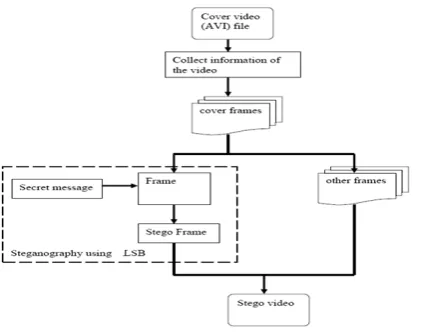
The technique is a Least Significant Bit (LSB)
technique for Video Steganogaphy has been
proposed. The flow diagram of the same is given
in Figure 4.1.
Figure 4.1: A) Block diagram of LSB Video
Steganogaphy technique Encoding
A video stream (AVI) consists of collection of
frames and the secret data is embedded in these
frames as payload. The information of the cover
video (AVI) such as number of frames (n), frame
speed (fp/sec), frame height (H) and width (W)
are extracted from the header. The cover video
is then broken down into frames. Now the
proposed LSB based technique has been applied
to conceal the data in the carrier frames. The
size of the message does not matter in video
steganogaphy as the message can be embedded
in multiple frames.
The proposed technique takes sixteen bits of
secret data at a time and conceals them in LSB.
Figure 4.1: B) Block diagram of LSB Video
Steganogaphy technique Decoding
The embedding positions of the 16 bits of LSB is
obtained using a LSB function of the form,
k= p % n…..
(1)
where, k is LSB bit position within the pixel, p
represents the position of each frames and n is
Available Online At www.ijpret.com IV. SYSTEM IMPLEMENTATION
In this section the various forma that are
used for the system implementation
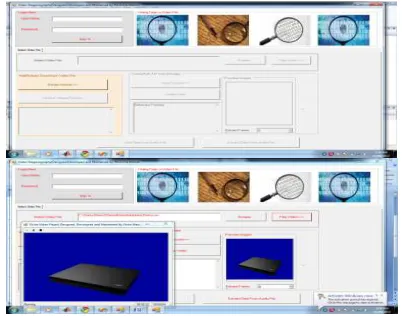
Figure 5.1 Login Form
Figure 5.2 Selection of Input Video
Figure 5.1 shows the login form. It contains the
username and password field. After login
successfully the system started working. After
successful login the rest of the buttons present
on the forms become enabled, otherwise
buttons are disabled. If the username and
password is incorrect then it displays the
message.
From the above figure it is observed that there
are various buttons such as extract sound,
Extract images, insert sound etc. The working of
various buttons can be explained accordingly
they can be used during the project running
state.
After succefully login we move towards the next
form. Figure 5.2 shows the form which shows
the selection of the input video.
• The video can be selected with the help of select video field.
• Browse button is useful to show the path for the selection of the video.
• Play video button is useful to play the video. The window in the above figure shows the
playing video and preview image field is
useful to show the image.
• Extract Frame field is useful to represent the number of frames present inside the video
because every video is developed by
combining the number of frames.
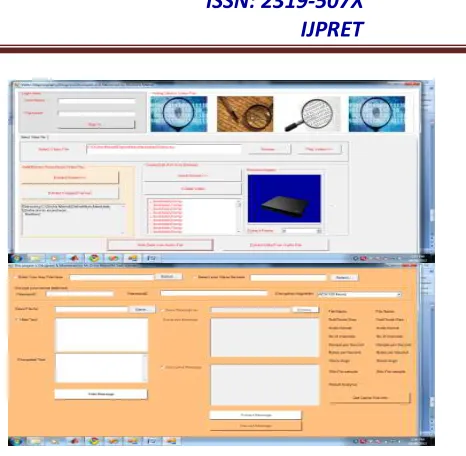
Figure 5.3 Extraction of Sound
Available Online At www.ijpret.com
After the selection of the video we want to
extract the sound as well as the number of
frames present inside the video. The sound will
be extracted with the help of extract sound
button. By using this button we can separate the
sound present inside the video. The field present
below the extract image is useful to show the
message that the sound is extracted.
The sound which is extracted is stored inside the
sound.wav file. The stored sound file is used
later during the process of stegnography. The
detailed working of the extraction of the sound
from the selected video is shown in figure 5.3.
After successfully extract the sound from the
video in the previous figure now we have to
extract the frames from the video. The frames
can be extracted from the video by using extract
frame button. These frames are nothing but
images that are present inside the video. The
number of frames that are extracted from the
video is shown by using extract frames field. The
field below the create video represents the
frames that are present inside the video. The
frames are stored in .bmp format. The detailed
working of the extraction of the frames is shown
in figure 5.4.
Figure 5.5 Data Hiding
Figure 5.6 Audio Steganography
After extracting the frames and the sound from
the video we have to hide the data inside the
video. To hide the data inside the video we first
extract the sound and frame. The data can be
hiding inside the video by using hide data in
audio file. This button is useful to hide data
inside the audio we use the hide the data inside
the sound. In our system we hide the data in the
audio file by using hide data button. For hiding
the data inside the audio file we used encryption
algorithm. The working of hiding the data inside
is shown in figure 5.5. Figure 5.6 show the form
which is useful for audio steganography. For
audio steganography we require two key files.
These key files can be including by using Enter
your key file. After selecting the key files the
Available Online At www.ijpret.com
This algorithm is worked for the 128 keys. After
performing the encryption the data can be
protected by using two passwords. This
password is inserted by using two password
fields. After protecting the data with the help of
password the file can be saved at the proper
location. Save button is used to save the data.
Hide text field is useful to hide the text and the
encrypted text field is useful to show the data in
the encrypted format this data is encrypted by
using AES algorithm. Extract Message and
Decrypt message button is useful to extract the
message and decrypt the data.
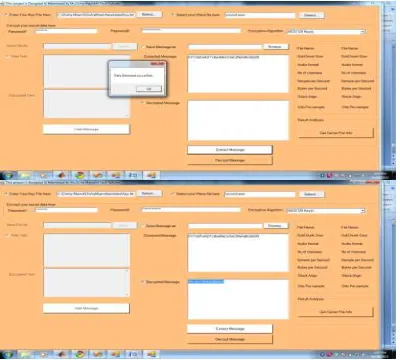
Figure 5.7 Data Hiding in Extracted Audio File,
Figure 5.8 Create video from Extracted Images
The process of hiding the data inside the audio
file is shown in figure 5.7. The above figure
shows the use of key files. The password is
inserted inside the Passwords field. There is one
criterion while entering the password the length
of password is greater than or equal to eight.
The working of hide text and the encrypted text
is shown in the above figure. After successfully
hiding the data inside the audio file it display the
message that hiding data successfully.Figure 5.8
shows the working of creation of the video from
the extracted images.
Figure 5.9 Video Created from Extracted frames,
Figure 5.10 Sound Insertions in Video
When we extract the sound and the frames from
the video. After that with the help of AES
algorithm we hide the data inside the audio
filed. Then we create the video. The video in
which we hide the data is shown in figure 5.9.
After hiding the data inside the audio file with
Available Online At www.ijpret.com
to add that file inside the audio. The need to add
the sound is require because we create the
video. The detailed working of adding the sound
is shown in figure 5.10. The small window shows
the path from where we have to add the sound.
The sound is inserted by using insert sound
button.
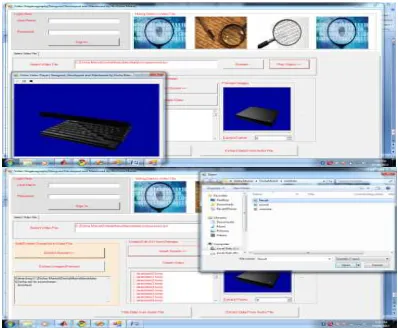
Figure 5.11 Sound Added Status,
Figure 5.12 Steg Video
Figure 5.11 show the working of form after
adding the sound successfully. When we add the
sound successfully it displays the message in the
message field. After performing each procedure
properly related with adding the sound, encrypt
the data; apply the algorithm, reunion of the
sound and frames for the creation of their video
in which we hide the data. After performing all
operations we play the video. The video play is
shown in figure 5.12.
Figure 5.13 Sound Extracted from Stego Video ,
Figure 5.14 Extract Data from Audio file
After hiding the data inside the video we want to
find the related information that is stored inside
the video in encrypted format. To find the
information from the encrypted video we have
to first extract the sound from the stego video.
The sound that is extracted from the stego video
is shown in figure 5.13.Once we extract the
sound from the stego video it display the
message with the elated information.
Once we extract the audio from the stego video
we have to extract the data from the audio file.
The data can be extracted by double clicking on
the Extract data from the audio file button. After
Available Online At www.ijpret.com
audio file. Figure 5.14 show the procedure of
extracting the data from the audio file.
Figure 5.15 Extracted Data
Figure 5.16 Decrypted Data
Figure 5.15 shows the successful extraction of
data from the video. Figure 5.16 shows the
decrypted data from the video
V. RESULT ANALYSIS
Figure 6.1 shows the analysis of LSB bit method
by performing the test on the bits
Sr N o Original Sample in Binary Origin al Sampl e in Decim al Dat a Bit (1) Dat a Bit (0) Resultan t Bit in Binary
Resulta nt Bit in Decimal
Q Erro r
1 0001110
0 0101110 0
7276 Nil 0 0001110
0 0101110 0
7276 0
2 0001110
0 0101110 0
7276 1 Nil 0001110
0 0101110 1
7277 1
3 0001110
0 0101111 0
7278 Nil 0 0001110
0 0101111 0
7278 0
4 0001110
0 0101111 0
7278 1 Nil 0001110
0 0101111 1
7279 1
5 0001110
0 0101010 0
7268 Nil 0 0001110
0 0101010 0
7268 0
6 0001110
0 0101010 0
7268 1 Nil 0001110
0 0101010 1
7269 1
7 0001110
0 0101000 0
7264 Nil 0 0001110
0 0101000 0
7264 0
8 0001110
0 0101000 0
7264 1 Nil 0001110
0 0101000 1
7265 1
9 0000110
0 0101110 0
3180 Nil 0 0000110
0 0101110 0
3180 0
10 0000110
0 0101110 0
3180 1 Nil 0000110
0 0101110 1
3181 1
11 0000110
0 0101100 0
3176 Nil 0 0000110
0 0101100 0
3176 0
12 0000110
0 0101100 0
3176 1 Nil 0000110
0 0101100 1
3177 1
13 0000110
0 0101000 0
3168 Nil 0 0000110
0 0101000 0
3168 0
14 0000110
0 0101000 0
3168 1 Nil 0000110
0 0101000 1
Available Online At www.ijpret.com
Figure 6.1 Test by using LSB Method
Figure 6.2 Graph between Qerror and the Number
of test performed using LSB method
Figure 6.3 Graph given by Tao and Ping
When we compare the figure 6.2 and 6.3 we
come to know that LSB method is useful for
video steganography because it gives
proportionate graph. While the graph plot by
Tao and Ping is invariant. After analyzing both
the graph we conclude that our graph provide
better results as compare to Tao and Ping. Our
results are god because we get proportionate
graph.
Figure 6.4 shows the signals phase after
encoding. The left signal represent the original
signal and the right show the encoded signal.
Figure 6.4 Signals Before and After Phase Coding
Figure 6.6 shows the general example of
spectrogram in which we show the wave before
and after implementing the LSB method
0 0.5 1 1.5
0 5 10
Q
errorAvailable Online At www.ijpret.com
Figure 6.5 Signal Comparison between a WAV
File (above) and after (below) the LSB Coding
VI. CONCLUSION
A secured LSB technique for video
steganography has been presented in this
project. This technique utilizes cover video files
in spatial domain to conceal the presence of
sensitive data regardless of its format.
Performance analysis of the proposed technique
after comparison is quite encouraging. The
proposed technique is applied to video files;
however it can work with any other formats with
minor procedural modification. For compressed
video files like MPEG the video needs to first
decompress then the technique can be applied
to the uncompressed video. Whereas for Flash
Video FLV files the technique can be applied
without modification. Software based
Steganographic Engine for video steganography
is the future scope of the technique.
I have described how to split uncompressed
video so that I can embedded encrypted data in
to it, Efficient Data Encryption Technique in
Video for Secret Sharing for encrypted data and
able to embed data in video and then to decrypt
the data and to rebuild the original video by
removing the hidden Encrypted data.
Many different techniques exist and
continue to be developed, while the ways of
detecting hidden messages also advance quickly.
Since detection can never give a guarantee of
finding all hidden information, it can be used
together with methods of defeating
steganography, to minimize the chances of
hidden communication taking place. Even then,
perfect steganography, where the secret key will
merely point out parts of a cover source which
form the message, will pass undetected,
because the cover source contains no
information about the secret message at all. In
the near future, the most important use of
steganographic techniques will probably be lying
in the field of digital watermarking. Content
providers are eager to protect their copyrighted
works against illegal distribution and digital
watermarks provide a way of tracking the
owners of these materials. Although it will not
prevent the distribution itself, it will enable the
content provider to start legal actions against
the violators of the copyrights, as they can now
be tracked down. Steganography might also
become limited under laws, since governments
already claimed that criminals use these
techniques to communicate. More restrictions
on the use of privacy-protecting technologies
Available Online At www.ijpret.com
time with great anxiety of terrorist and other
attacks.
VII. FUTURE SCOPE
As video steganography continues on its
evolutionary path researchers have unearthed
new platforms where steganographic techniques
could be employed to hide information
seamlessly. Such research efforts have rekindled
the research and development efforts oriented
towards steganography platforms and
steganalysis and a number of researchers are
working towards discovering new platforms that
miscreants could potentially use to hide
information. For instance, researchers have
shown that voice over Internet protocol (VoIP)
could emerge into a popular platform for
steganography owing to its ubiquity and the
difficulty in detecting hidden information in VoIP
streams. In addition to VoIP, platforms such as
images and other multimedia content are
expected to be widely used for concealing
information.
Current research in video steganography is
focused on identifying various platforms through
which one can hide information,’ notes the
analyst of this research service. 'Apart from the
traditional platforms such as audio, video, and
images, researchers are looking for additional
platforms through which information can be
hidden.' An interesting idea under consideration
is to have a separate steganographic channel in
a network to send messages. Although each
mode has many benefits, it is very difficult to
ascertain the single best platform to send
hidden messages. Steganography is capable of
mitigating piracy by aiding copyright marking.
In the future, digital camera manufacturers
could implement steganographic features as a
part of camera firmware to annotate pictures
with the photographer's copyright information.
Camcorder manufacturers could also follow suit
and implement steganography and
watermarking techniques for protecting video
content captured on camcorders and video
cameras. Going forward, legitimate applications
such as tagging of multimedia content with
hidden information could become an important
application area for steganography.
There is a distinct lack of awareness about video
steganography, particularly among the business
community. A major challenge associated with
the field is convincing organizations to deploy
tools to detect insider use of steganography,
which requires complete awareness of the way
data could be embedded and various
Available Online At www.ijpret.com REFRENCES
1. Fillatre. L, Designing of Robust Image
Steganography Technique Based on LSB
Insertion and Encryption, IEEE Transactions on
Signal Processing, Volume 60, Issue:2, pp.
556-569, Feb, 2012
2. A.K. Bhaumik, M. Choi, R.J. Robles and M.O.
Balitanas, Data Hiding in Video in International
Journal of Database Theory and Application Vol.
2, No. 2, pp. 9-16, June 2009.
3. J. J. Chae, B. S. Manjunath, Data Hiding in
Video, Proceedings of the 6th IEEE International
Conference on Image Processing, pp.311-315,
1999.
4. Stefan Katzenbeisser and Fabien A. P.
Petitcolas, Information Hiding Techniques for
Steganography and Digital Watermarking,
Artech House Books, ISBN 1-58053-035-4, 1999.
5. A. Giannoula, D. Hatzinakos, “Compressive
Data Hiding for Video Signals”, in Proceedings of
International Conference on Image Processing,
pp. I529- I532, 2003.
6. Feng Pan, Li Xiang, Xiao-Yuan Yang and Yao
Guo, Video steganography using motion vector
and linear block codes, in Proceedings of IEEE
International Conference on Software
Engineering and Service Sciences (ICSESS-
20100), pp. 592-595, 2010.
7. Melih Pazarci, Vadi Dipcin, Data Embedding in
Scrambled Digital Video, in Proceedings of the
8th IEEE International Symposium on Computers
and Communication, pp. 498-503, 2003.
8. Feng Pan, Li Xiang, Xiao-Yuan Yang and Yao
Guo, Video Steganography using Motion Vector
and Linear Block Codes, in IEEE
978-1-4244-6055-7/10/, pp. 592-595,2010.
9. Juan Jose Roque and Jesus Maria Minguet,
SLSB: Improving the Steganographic Algorithm
LSB, in the 7th International Workshop on
Security in Information Systems (WOSIS 2009),
Milan, Italy, pp.1-11, 2009.
10.A. Westfield, and A. Pfitzmann, Attacks on
Steganographic Systems, in Proceedings of 3rd
Info.Hiding Workshop, Dresden, Germany, Sept.
28−Oct. 1, pp. 61-75, 1999.
11.D. Stanescu, M. Stratulat, B. Ciubotaru, D
Chiciudean, R. Cioarga and M. Micea,
Embedding Data in Video Stream using
Steganography, in 4th International Symposium
on Applied Computational Intelligence and
Available Online At www.ijpret.com
12.N. F. Johnson and S. Jajodia, Steganalysis of
Images Created using Current Steganography
Software, in Lecture Notes in Computer Science,