Occurrence of Nitrate and Fluoride in Groundwater and their in Parts
of Govindaraopet mandal Warangal District, Telangana, India
1
Sammaiah Banoth,
2Sandhyarani D,
3Vijayakumar J
1
Research Scholar,
2Research Scholar,
3Professor
1
Department of Geology,
2Department of Environmental Science,
3Department of Geology
University College of Science,
Osmania University, Hyderabad
Email - [email protected]
1. INTRODUCTION:
Any natural or manmade activity on the surface of the earth will have its impact on the quality of water which will be taken into the biospheric systems. Agricultural development Industrialization and urbanization are among the major causes for all modifications on the quality of water. The chemical constituents present in the water determine its usefulness for human consumption and other uses owing to the toxicity of certain constituents of natural and manmade origin. As groundwater is relatively pure from suspended matter and pathogenic microorganisms, it is a reliable source of water supply for all the seasons. Andhra Pradesh, the southernmost state of India, does not have perennial surface water resources. Major part of the area is underlain by hard rock’s of limited ground water potential. The quality of ground water in these formations is influenced by natural factors like lithology and recharge characteristics, climate, and vegetation, as well as by anthropogenic factors like habitation, industrialization etc. Among the various constituents of natural and anthropogenic origin, nitrate and fluoride are of particular concern because of their potential health hazard. Though Fluoride is a natural constituent and it is required in small quantities for the healthy formation of bones and teeth, it becomes toxic at levels exceeding 1.5 mg/I. Similarly, all living organisms need nitrogen to exist. But higher organisms are not capable of using simple forms of nitrogen such as nitrates.
Abstract: A detailed study was carried out to assess the groundwater quality in Parts of Govindaraopet Mandal,
Warangal district, Telangana, India. The study area lies between latitudes 18°0'10" to 18°15'0" North and Longitudes 80°0'0" and 80°15'0" East with an areal extent of 98 sq. kms. Samples were collected from 28 wells used for domestic, agricultural and industrial purposes. Groundwater samples were collected from these wells during the month of December, 2013 and analyzed for all the major constituents. The samples were collected from the wells located in both phreatic and deeper fractured zones. The analytical results revealed that the groundwater in the major part of the area is highly mineralized with high concentrations of Nitrate and Fluoride. Out of 28 ground water samples analyzed, 16 samples were found to have nitrate concentration more than 45mg/l. The maximum concentration of nitrate in the area is 379 mg/l. The concentration of nitrate in excess of the permissible limit i.e., 45 mg/I in drinking water causes methaemoglobinemia, particularly in infants. The concentration of fluoride also exceeded the permissible limit of 1.50 mg/l in 7.14 percent of the total samples analyzed. Fluoride concentration in excess of 1.5 mg/l in drinking water causes dental and skeletal fluorosis. The highest value of fluoride concentrated in the area is 2.56 mg/l. These two constituents, at very high concentrations, constitute a potential risk for the inhabitants that consume these waters. The occurrence of nitrate and fluoride in the study area, their genesis, and role in metabolism, health effects and the factors controlling the chemistry of these constituents in groundwater are discussed in this paper.
Figure 1:
Locations of the samples collected is Govindaraopet Mandal, Warangal District, Teangana, India.Toxicity and must get complex forms of nitrogen synthesized by plants. The occurrence of these two constituents in groundwater in Govindaraopet Mandal and their impacts are discussed in this paper.
2. Geology of the study area:
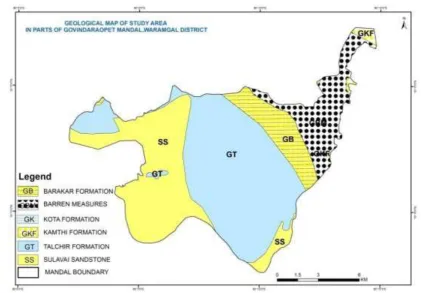
In the Govindaraopet study area, rocks of the Precambrian Sullavai Formation form the basement for the Lower Gondwana sequence. The stratigraphic succession is as fallows.
Table 1.
Stratigraphic Succession of the study area
Age Group Formation Thickness (m)
Upper Permian
Lower Gondwana
Raniganj Formation (Upper Coal
Measure) More than 400
Middle Permian Barren Measure (Middle Measure) 450-475
Lower Permian Barakar Formation (Lower Coal
Measure) 250-300
Permo-carboniferous Talchir Formation
---Unconformity---
Precambrian Sullavai Formation
Plate II. Geological map, Govindaraopet Mandal,Telangana,india.
3. Hydrogeology:
This area is having valley, hills and plain lands. Elevation varies from 61 to 269m (amsl): Climate of this area is tropical semi arid.
Peddavagu River flows along the South west boundary of this area, in S-N direction and at a distance of about l5 km. Groundwater in these formations generally occurs under phreatic conditions particularly in shallow weathered zones. At place, it occurs under semi-confined and confined conditions at deeper fracture zones (GW Tech. Report, 1987). Average depths of weathered zone vary from 5.75 to 13.45 m. Depth of groundwater table lies in between 5to 15-0 m bgl and there is variation formation. Main crops are paddy, mango bhag,jawar, maize, cotton, chilies, groundnut and soya beans etc.
. Ground water occurs generally under water-table conditions in the weathered residuum and under semi-confined to confined conditions in jointed and fractured rocks at deeper levels. Ground water development is through dug wells, dug-cum-bore wells and bore wells. The depth to water table during post-monsoon period (December 2011) varied from less than 1 m. bgl to 20 m. bgl. The water table elevation in the area ranges from 230 m. amsl (northern part) to more than 300m amsl (southern part). The ground water flow direction, in general, is towards south western, north and northwestern directions.
4. Literary Reviews:
Hem, J.D, 1970. Study and interpretation of the chemical characteristic of natural water. USGS water supply paper. 1473.
Indian standard drinking water specification . IS 10500.BIS 1991. New Delhi.
Krishnamachari K ., 1978. Studies on Fluorosis. Indian journal of Medical Reasearch 68(supplement) October 1978 p. 94-98.
5. Materials and Methods
Ground water samples were collected from 28 abstraction structures used for domestic, agricultural and industrial purposes during December 2011. All the samples were analysed for pH, Electrical conductivity (EC), Total hardness, Calcium, Magnesium, Sodium, Potassium, Carbonate, Bicarbonate, Chloride, Sulfate, Nitrate and Fluoride as per the standard analytical procedures of American Public Health Association (APHA).
6. Results and discussion:
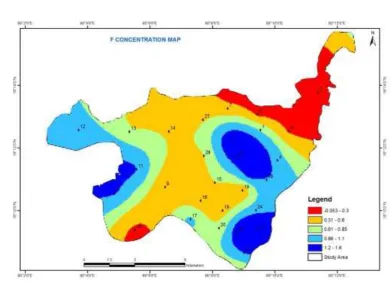
The analytical results of the samples collected from the area indicate that the ground water is generally alkaline in nature. The pH ranges from7.1 to 8.2. The Electrical Conductivity (EC) varies from 156 µS/cm to4843 µS/cm at 25°C. Ground water samples from wells located near the tanneries are found to be highly mineralized. Fluoride concentration varies from 0.21 mg/l to 2.56 mg/1 at balaji nagar and Nehru thanda respectively (Plate-I). Fluoride concentration in the shallow formation ranges from 0,21mg/1 to 1.16mg/1 whereas in the deep aquifers it ranges from 0.44mg/1 to 1.36mg/l. It is less than 1.00 mg/l in about 75 percent samples, between 1.04 and 1.78 mg/l in about 21 percent samples and more than the permissible limit of 1.78 mg/l in the rest. The distribution of fluoride in the area is shown in Plate-III, Ground waters rich in Fluoride are generally sodium bicarbonate type (NaHC03).
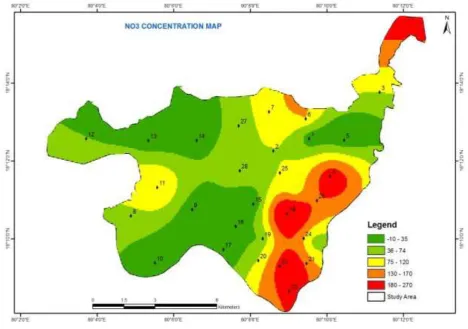
The concentration of Nitrate in the area varies from less than 1 mg/l to 407 mg/l . It is in excess of 45 mg/l, the prescribed limit for drinking, in more than 70percent of samples. The highest concentration of Nitrate (407.4 mg/l) was detected in the sample from a bore well at Umdam village. The distribution of Nitrate in the area is shown in plate-IV.
Figure V: Distribution of fluoride in the study area
7. Impacts on health:
The most common contaminant identified in ground water is dissolved nitrogen in the form of nitrate (NO). The World Health Organization (WHO), Bureau of Indian Standards (BlS), and the US Environmental Protection Agency (USEPA) have laid down 45mg/1 as the maximum permissible limit. Nitrate is an oxidizing agent and it readily oxidizes hemoglobin (Hb) into methaemoglobin (MeHb) a blue colored pigment and gets reduced to nitrite (NO2). The oxidized
Hb impairs the oxygen carrying capacity of the blood and thus causes hypoxia, which may have fatal consequences in anemic individuals and infants. The MeHb formed in the infant's blood gives a characteristic blue hue to the skin and mucous membrane, thus giving the name blue baby disease or methaemoglobinemia. This condition is particularly important in the case of infants because the infant and fetal Hb which is a2g2 type have greater affinity for oxygen than
adult Hb which is a2.b2, type. This condition may also-result by birth due to the deficiency of enzyme known as
methaemoglobin reductace in the fetal blood. Nitrite formed from the reduction of nitrate may react with some amino acids in the intestinal tract and stomach to form nitrosoamines, which are potential carcinogens. Chronic consumption of high nitrate waters may cause cancer and hence adverse effects on cardiovascular system and central nervous system. Fluoride in water can be a blessing or a hazard depending on the concentration levels. There is plenty of evidence to show that the fluoride content up to 1.00mg/1 is beneficial for the formation of bones and teeth. Bureau of Indian Standards (BlS) recommends 1.00 mg/l as the desirable limit and 1.50 mg/l as the maximum permissible limit. The guide line values vary depending on the climate and total fluoride intake from other sources since the absorption of fluoride by body fluids depends on temperature. Chronic ingestion of high fluoride causes dental and skeletal fluorosis. Fluorosis is characteristised by mottling of teeth enamel, abnormal calcification of spines,
Joint and ligaments. Dental fluorosis or mottled enamel occurs in human beings consuming water containing 1.50mg/l or more of fluorides, particularly during the first eight years of life. Mottled enamel usually takes the shape of modification of tooth enamel to produce yellow or brown stains or an unnatural opaque chalky white appearance with occasional striations and pitting. Skeletal fluorosis is reported from areas in India where the drinking water contains 2.0 to 4.0 mg /l of fluoride. As a tissue bone is metabolically active and it is continuously being destroyed and renewed by the process of formation and subsequent mineralization. Normally the rate of destruction and renewal are tightly coupled SO that no net change in b n mineralisation occurs. Fluoride ion in excess disturbs this equilibrium through interaction with calcium in teeth and bone.
Calcium in the bone mainly exists in the form of hydroxyapatite (Ca5 (OH) (P04)3 which forms needle shaped
crystals and composes the supporting substance in the bones. Thorough exchange with OH- group F- enters the bone
lattice structure as well as the enamel and produces larger crystals more resistant to resorption. Fluoride thus accumulates in the body and absorbed F- ion binds calcium from food and blood. Formation of new bone is stimulated resulting in
prevalent in area where ground water is low in calcium high in alkalinity, thus favoring high concentration of fluoride in ground water. Calcification of certain ligaments rendering movement of joint difficult is the early symptom of fluorosis. The bone structure is found to be blurred and it becomes diffuse structure less and shallow with uneven contours. These changes are marked in spine and ribs. There are few early symptoms but late development includes stiffness, inability to move the spine and neurological disorders.
8. Sources of fluoride in the area:
The occurrence of fluoride in ground water in the area is basically a natural phenomenon influenced by local and regional geological setting and hydrogeological conditions. Fluoride enrichment in ground water takes place mainly through leaching and weathering of the fluoride bearing minerals present in rocks and sediments. Geologically the area is underlain by crystalline rocks of Proterozoic age with varied composition. These are potential sources of fluoride bearing mineral. The major fluoride bearing mineral found in igneous & metamorphic rocks are Fluorapatite, Fluorite, Cryolite, Biotite, Muscovite, Lepidolite, Tourmaline, Hornblend series minerals, Asbestos etc. The most plausible process responsible for the evolution of fluoride rich natural water is the effective chemical weathering of fluoride-rich mineral. On vegetated ground and soils water acquires biologically produced carbon dioxide several times greater than the atmospheric levels, thereby enhancing the chemical decornposition of rock minerals. The arid to semi arid climate of the area is conducive to weathering. There is effective chemical weathering in wet season and evapotranspiration in dry season. Therefore the total salinity together with fluoride of surface waters and shallow ground waters increase conspicuously. Enrichment proc s must have been repeated for a long time to achieve present levels of concentration. High fluoride ground waters in the area are concentrated mostly in the discharge area. The ground water moves along its flow paths from recharge to discharge area, vapotranspiration increases. The dry climate with low rainfall favors salinisation of ground water along the flow direction. As result, precipitation of calcite occurs in the form of kankar, which is noticed in some places in the area. Soils become more alkaline with very high pH, which limits the solubility of calcite. The conditions allow fluoride to accumulate in ground water environment.
9. Geochemical characteristics:
The geochemical evolution of high fluoride ground waters follows some common features (Jacks et.al, 1991). The analytical data are studied in detail and comparisons were made among various chemical constituents to observe whether they conform to the following characteristics of fluoride rich ground waters.
Ground waters with high fluoride generally contain low levels of calcium.
The calcium ion activity in the natural environment is controlled mainly by carbonate ion, which forms insoluble calcite. The fluoride concentration in ground water is controlled by fluorite.
CaF2 ↔ Ca2+ +2F
K sp = (Ca2+). (F-) 2 = 10-10.40
Where K SP is solubility product constant and the bracketed terms are activities of the corresponding Ions. Thus the
activities of calcium and fluoride are negatively correlated. Hence if soils and ground water are low in calcium fluoride can accumulate in water. The negative correlation between calcium and fluoride is shown in figure-I though it is non-linear.
Fluoride ion concentration is positively correlated with alkalinity. The arid climate with low rainfall increases evapotranspiration, which leads to increased alkalinity of soil and ground water. Ground water in contact with calcite and fluorite develops equilibrium reactions with both solid phases. By applying thermodynamics the combined equilibrium reaction may be written as (Handa. B.K 1975)
CaC03 + 2F- + H+↔ CaF2+HCO-3
Handa used a combined law of mass equation
K CaF2 ↔ Ca CO3 = (HCO- 3) / (H+) . (F-) 2
Since K CaF2 ↔ Ca CO3 is a constant any change in HCO
-3 concentrations will be accompanied by a corresponding
change in F- concentration indicating a positive correlation between these variables. The analytical results indicate
ground waters having high concentration of fluoride are mostly alkaline and have Residual alkalinity that is alkalinity in excess of calcium and magnesium. The positive correlation between alkalinity between these variables is shown in figure-II.
1. High fluoride ground water is usually close to saturation with respect to fluorite and saturated or over saturated with respect to calcite.
The analytical data are studied in detail and the langlier saturation index (SI) is calculated using the formula, SI = pH – pH s
Where PHS = A+B -log (Ca)-log (alkalinity). A and B are constants related to temperature and Total dissolved
10. Sources of Nitrate in the area:
The analytical results reveal that 12 wells have nitrate below 45mg/l, the safe limit for human consumption. 08 wells have nitrate in the range of 46 to 100 mg/1 and 08 wells show nitrate in the range of 101 to 379 mg/1. The origin of nitrate in the area is ascribed to industrial activity, sewage and animal wastes and agricultural sources.
Most of the monitoring wells located near the town show high nitrate values. The extensive use of organic and chemical fertilizers in the area is also responsible for the incidence of high concentration of nitrate. All the nitrate salts, which are in anionic form are highly soluble in water and are repelled by most of the clay minerals invariably found in all soils. Its high mobility favors the transport of this anion to very long distances in the shallow zone. As the shallow formation water is saturated with dissolved oxygen, anaerobic conditions does not exist which favors high nitrate ground waters. The high levels of potassium with nitrate show the relation between fertilizer use and occurrence of nitrate. Most of the wells in the cultivated area have high nitrate levels, which confirm the contribution of nitrate from fertilizer use. Because fertilizers are used continuously, infiltrating water downward to the water table where they can migrate in the ground water flow regime carries a considerable part of them.
11. Recommendations:
The following measures are suggested to mitigate the problems related to excess nitrate, and fluoride.
Alternate water supply sources may be identified for supply of safe drinking water in areas having fluoride and nitrate in excess of permissible limits.
Treatment techniques to remove excess fluoride and nitrate may be adopted on domestic and village basis.
Higher intake of calcium with vitamin C in the endemic area by people for combating fluorosis.
In the study area it is found that uncontaminated fresh water occurs in the recharge areas that is southeastern parts. Hence drinking water wells could be located in that area,
Detailed study of hydrogeological and hydrochemical aspects of occurrence of fluoride should be carried out to study the factors controlling their occurrence.
Proper solid waste and effluent treatment .techniques should be adopted for all industries.
Detailed study on fluorosis and methaemoglobinemia among the people should be conducted and the public should be told about water quality and heath.
Artificial recharge techniques may be adopted at suitable locations to minimize the concentration of pollutants.
Excessive use of nitrogenous fertilizers should be avoided and the nitrate-rich water may be used for agricultural purposes only.
Feasibility of insitu treatment techniques like bio-remediation may be studied for minimizing excess nitrate.
REFERENCES:
1. Anitha pious, Appa Rao, B V. and karthikeyan, G., 1999. Role of calcium in the amelioration of fluorosis. Indian journal of environmental health.Vol. 41, No.2, p, 121-125.
2. Chakkarapani, R 1988. Ground water resource and development potential of Anna district. Tamilnadu state. CGWB.P 41.
3. Guidelines of drinking water. Second edition .1996.Vol 1&2.WHO. Geneva.
4. Srikantha, SG , 1974. Permissible levels of fluoride in drinking water .National Institute of Nutrition. Hyderabad.
5. Sinham A.K., 2000. Fluoride concentration in ground water . Focus on arid regions of Rajasthan. Seminar on women and water 255-262.