Formulation Development and
In-vitro
Evaluation of Mouth Dissolving Tablets of
Celecoxib Employing Distinctive Proportion of Disintegrating Agents
Daljit Masih
1*, Rajesh Gupta
21
J.J.T. University, Chudela, Jhunjhunu, (Rajasthan), India
2Sri Sai College of Pharmacy, Pathankot, (Punjab), India
Article Information Received 26 Feb 2014
Received in revised form 02 April 2014 Accepted 05 April 2014
Abstract
In present study we planned to formulate and evaluate mouth dissolving tablets of Celecoxib
using superdisintegrants agents namely Crospovidone and Sodium starch glycolate in various
ratios. The mouth dissolving tablets were prepared by direct compression method using
Crospovidone and Sodium starch glycolate. Tablets blends were evaluated for loose bulk density,
tapped bulk density, compressibility index and angle of repose, shows satisfactory results. The
compressed tablets were then evaluated for various physical tests like thickness, friability,
hardness, weight variation, wetting time, water absorption ratio and disintegration test by using
standard procedures. The results of all these tests were found to be satisfactory. The in-vitro
dissolution study was carried out for 14 min using paddle method in phosphate buffer (pH 6.8) as
dissolution media. The data of in-vitro dissolution of tablets revealed that 76 to 100% of drug
release from various formulations at 14 min. The formulation C7 exhibited better results as
compared to other formulations. Keywords:
Celecoxib Crospovidone Sodium starch glycolate Mouth dissolving tablets *
Corresponding Author: E-mail: [email protected] Tel.: +918699200098
1 Introduction
The oral route of drug administration is mostly used and acceptable
comparable to other dosage form which produces systemic delivery
of therapeutic agents. The low cost of oral administration enhance it
demands. Among oral route of administration, the tablets are widely
used because of their special properties such as suitability to
self-administration, improved stability, accurate dosing, ease of handling,
versatility with respect to type and dose of the drug, and suitability to
scale up. But sometime tablets fails to prove it’s useful in some
circumstance. The elderly patient face problem in taking
conventional oral dosage forms like solutions, suspensions, tablets,
capsules, due to hand tremors and dysphagia. The pediatric patients
face difficulties in swallowing of tablets which leads to poor
compliance. The mentally ill, developmentally disabled patients, and
patients who are uncooperative or who are suffering from severe
nausea gets problems in taking conventional oral dosage form1-4. However, this form of dosage has some limitation like motion
sickness, sudden episodes of allergic attacks or coughing and unavailability of water, but one important drawback is ‘dysphagia’ or
difficulty in swallowing5. Additionally, there are many instances where
tablets may not suit the given indication. Above mentioned task can
be overcome by substituting conventional tablets and capsules with
mouth dissolving tablets.
Celecoxib is the selective COX-2 inhibitor, it belong to nonsteroidal
anti-inflammatory category. It has highly demand in the healing of
osteoarthritis, rheumatoid arthritis and dysmenorrhea in adult
patients. Celecoxib tablets have rate limiting steps in the process of
drug absorption due to its poor water solubility properties.
Additionally, it displayed poor absorption in large intestine.
Conventional Celecoxib tablet available in the market are not
suitable for urgent response of drug where quick onset of action of
drug is required. The rapidly disintegrating tablets in oral cavity can
be swallowed with a small amount of water or saliva6-9. Hence, an attempt was made to improve the dissolution of Celecoxib through
the formulation of mouth-dissolving tablets with appropriate
mechanical strength, which would disintegrate in oral cavity, in less
than 30 seconds, and would provide an immediate relief to patients
due to its faster dissolution in gastrointestinal tract.
2 Materials and Methods 2.1 Materials
UK Journal of Pharmaceutical and Biosciences
UK J Pharm & Biosci, 2014: 2(2); 17 Celecoxib was obtained from Centaur Pharmaceuticals Pvt Ltd Goa.
Crospovidone and sodium starch glycolate were obtained as gift
samples from Micro Labs, Bangalore.
2.2 Methods
2.2.1 Preparation of mouth dissolving tablets
Tablets of Celecoxib were prepared by direct compression method.
All the formulation ingredients mentioned in formulation table 1 were
weighed accordingly and mixed in a mortar and pestle. This powder
blend was then allowed to dry for few moments and then again
mixed well and passed through sieve no 60. Then blend were used
for further processing.
2.2.2 Evaluation of pre-compression characteristics of powder
blend10-12
Powder blend prepared were evaluated for various rheological
properties like bulk density, tapped density, Hausner’s ratio, angle of
repose by using standard procedures. All these properties were
carried out in triplicate (n=3) and average values were reported.
2.2.3 Bulk density
Bulk density was determined by placing the powders blend in a
measuring cylinder and the total volume is noted. The weight of
powder bed was determined by using digital weighing balance. Bulk
density was calculated using the following formula:
Bulk Density = Weight of the powder / Volume of the powder
2.2.4 Tapped density
Tapped density was determined by taking the dried powders in a
measuring cylinder and measures the volume of powders after 100 tapping’s and take weight of the total powders.
Tapped Density = Weight of the powder / Tapped Volume of the
powder
2.2.5 Angle of repose
Angle of repose was determined by measuring the height and radius
of the heap of the powder bed. A cylindrical two side open tube of 6
cm length is place on graph paper. Powders are placed in the tube
and slowly removed the tube vertically. With the help of scale the
height and radius of the heap were measure and note.
θ= tan-1
h / r
Where, h = height of heap of granular bed, r = radius of heap of
granular bed.
2.2.6 Hausner’s ratio
It is expressed in percentage and is expressed by
H=Dt/Db
Where Dt is the tapped density of the powder
Db is the bulk density of the powder.
2.2.7 Evaluation of compression characteristics of mouth dissolving
tablets13-16
The prepared tablets were evaluated for their thickness, friability,
hardness, weight variation and dissolution test by using standard
procedures.
2.2.8 Weight variation test
20 tablets are taken and their weight is determined individually and
collectively on a digital weighting balance. The average weight of
one tablet is determined from the collective weight. Note more than 2
of the individual weights may deviate from the average weight by
more than the percentage deviation given in the monographs and
none should deviate by more than twice that percentage given in the
monographs.
2.2.9 Thickness test
The tablets were evaluated for their thickness using a venirer caliper
measured in terms of micrometer. Averages of three readings were
taken and the results were tabulated (n = 3)
2.2.10 Hardness test
Prepared tablets were evaluated for their hardness by using
Monsanto hardness tester. The hardness was measured in terms of
kg/cm2. Triplicate readings were taken and average was determined.
2.2.11 Friability test
Roche friabilator was used for testing the friability of the tablets. For
this test, 20 tablets were weighted accurately and placed in the
friabilator chamber and rotated at 25 rpm for a period of 4 min.
Tablets were again weighted and the percentage weight loss was
determining by using formula given below.
% Friability = [(W1-W2)100]/W1
Where,
W1= Weight of tablet before test
W2 = Weight of tablet after test.
2.2.12 Drug content
Three tablets were weighed and ground in a mortar with pestle to get
fine powder. Powder equivalent to the mass of one tablet was
dissolved in pH 6.8 phosphate. This solution was diluted with pH 6.8
phosphate buffer. The absorbance of diluted sample of Celecoxib
UK J Pharm & Biosci, 2014: 2(2); 18 content was calculated using equation obtained from a standard
calibration curve.
2.2.13 Wetting time
A piece of tissue paper folded twice was placed in a small Petri dish
containing 6 ml of purified water, then a tablet was placed on the
paper and the time required for complete wetting was measured.
Wetting time corresponds to the time taken for the tablet to
disintegrate when placed gently on the tissue paper in a Petridish.
Less wetting time indicates more porous tablets.
2.2.14 Water absorption ratio
A piece of tissue paper folded twice was placed in a small petri plate
containing 6 ml of distilled water. A tablet was put on the paper and
time required for complete wetting was measured. The wetted tablet
was then weighed. Water absorption ratio R was calculated using
equation.
R = 100 {(Wa – Wb)/Wb}
Wa = weight of the tablet after water absorption
Where, Wb = weight of the tablet before water absorption
2.2.15 In-vitro disintegration time
The process of breakdown of a tablet into smaller particles is called
as disintegration. The in vitro disintegration time of a tablet was
determined using disintegration test apparatus as per IP
specifications. Place one tablet in each of the 6 tubes of the basket.
Add a disc to each tube and run the apparatus using pH 6.8
(simulated saliva fluid) maintained at 37±2 °C as the immersion
liquid. The assembly should be raised and lowered between 30
cycles per minute in the pH 6.8 maintained at 37±2 °C. The time in
seconds taken for complete disintegration of the tablet with no
palpable mass remaining in the apparatus was measured and
recorded
2.2.16 In-vitro drug release study
In vitro release study was performed using tablet dissolution test
apparatus USP XXIII, apparatus I. The dissolution medium consists
of 900 mL phosphate buffer pH6.8 maintained at 37 ± 1°C rotated at
50 rpm. At different interval of time 10 mL sample was withdrawn
and replaced with fresh medium. 10 mL sample was diluted to 100
mL phosphate buffer pH 6.8, the aliquots were assayed
spectrophotometrically at 252 nm for Celecoxib.
3 Results and Discussion
3.1 Evaluation of pre-compression characteristics of powder
blend
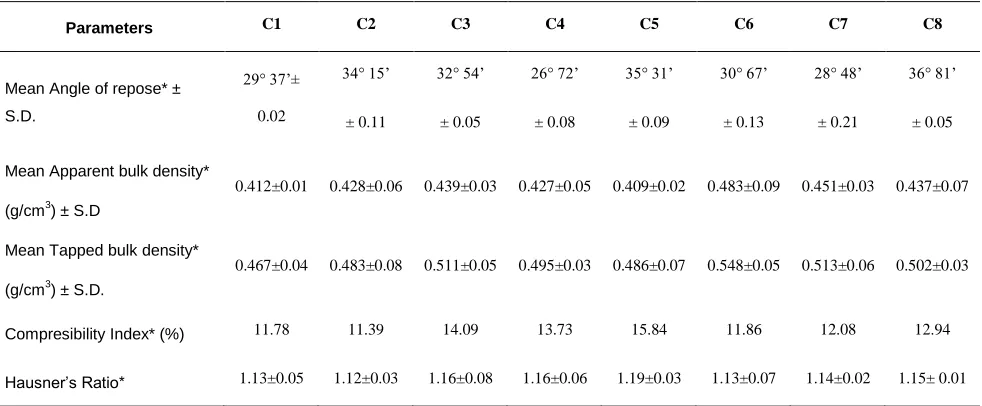
The powders were evaluated for bulk density, tapped density,
Hausner’s ratio and angle of repose and consistency in data
obtained as indicated by their standard deviation values shown in
table 2.
Bulk density and tapped density of different formulations were
calculated. The result of bulk density range from 0.473 to 0.483 and tapped density from 0.467 to 0.513. Hausner’s ratio was found to be
in between 1.12 to 1.19; and Compressibility index from 11.39 to
14.09. Angle of repose showed good to excellent flow properties of
the powdered blend (Table 2).
The tablet dimension includes diameter and thickness of tablets.
Thickness of all formulations was found to be between 2.25 to 2.84
(Table 3). No significant difference was observed in the thickness of
individual tablet from the average value. No significant difference
was observed in the weight of individual tablets form the average
weight.
From table 3 it has been observed that tablet weights of all bathes
were found with in recommended USP limits, between 218 ± 1 mg.
Hardness of tablets of all batches are in between 3.14 to 3.72
(Kg/cm2) which is acceptable limits, which shows in the literature.
Friability of all the formulation showed % friability less than 1% that
indicates ability of tablets to withstand shocks, which may
encountered. The data of uniformity of content which was performed
by UV spectroscopy indicated that tablets of all batches had drug
content within USP limits i.e. between 97.43 to 99.34%. In guidance
of industrial scientist different parameter of tablet like flow property,
dimension hardness, drug content etc. were studied which results in
successful trials.
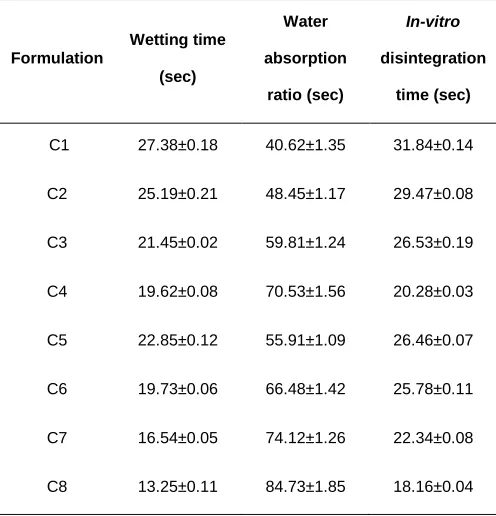
The wetting time and water absorption ratio were found to be 13.25
to 27.38 seconds and 84.73 to 40.62 seconds (Table 4),
respectively. The disintegration time of mouth dissolving tablets
ranges from 18.16 to 31.84 seconds (Table 4).
From above result it has been observed that C7 formulation
exhibited excellent wetting time, water absorption ratio and
disintegration time as compared to other formulations. Moreover the
C8 formulation exhibited lowest wetting time and disintegration time;
and highest water absorption ratio. This parameter enhances due to
gelling and its subsequent viscosity producing effects.
3.2 In vitro drug release studies
Figure 1 displayed in-vitro dissolution of tablets, it revealed that 76 to
100% of drug release from various formulations. The 50% of the
drug was released from the C7 and C8 within 4 minutes. The rapid
drug dissolution might be due to easy breakdown of particle by
UK J Pharm & Biosci, 2014: 2(2); 19 observed that 98.89% of Celecoxib released in 14 minutes indicates
that the tablet complies as per IP specifications, that is, 85%–110%.
The dissolution rate was found to increase linearly with increase in
the concentration of superdisintegrant. Mechanism it followed was
wicking and swelling with minimum gelling. It was observed that C8
formulation released 98.73% drug in 12 minutes. This formulation
has maximum amount of superdisintegrant that may cause tablets
fragile.
Table 1: Formulation of mouth dissolving Celecoxib tablet
Table 2: Data of pre-compression characteristics of Celecoxib powder blend
Parameters C1 C2 C3 C4 C5 C6 C7 C8
Mean Angle of repose* ±
S.D.
29° 37’±
0.02
34° 15’
± 0.11
32° 54’
± 0.05
26° 72’
± 0.08
35° 31’
± 0.09
30° 67’
± 0.13
28° 48’
± 0.21
36° 81’
± 0.05
Mean Apparent bulk density*
(g/cm3) ± S.D
0.412±0.01 0.428±0.06 0.439±0.03 0.427±0.05 0.409±0.02 0.483±0.09 0.451±0.03 0.437±0.07
Mean Tapped bulk density*
(g/cm3) ± S.D.
0.467±0.04 0.483±0.08 0.511±0.05 0.495±0.03 0.486±0.07 0.548±0.05 0.513±0.06 0.502±0.03
Compresibility Index* (%) 11.78 11.39 14.09 13.73 15.84 11.86 12.08 12.94
Hausner’s Ratio* 1.13±0.05 1.12±0.03 1.16±0.08 1.16±0.06 1.19±0.03 1.13±0.07 1.14±0.02 1.15± 0.01
*Value shown in tables is mean of three determinations
4 Conclusions
It was concluded that mouth dissolving tablets of Celecoxib can be
successfully prepared by direct compression techniques using
various superdisintegrants for the better patient compliance and
effective therapy. It was also found that the superdisintegrants are
effective at an optimum concentration, on increasing the ratio of
Crospovidone and Sodium starch glycolate concentration above their
optimum concentration this enhance the gelling effects of
formulation. The formulation C7 exhibited better results as compared
to other formulations. Further these formulations can be select for in
vivo study.
Ingredients C1 C2 C3 C4 C5 C6 C7 C8
Celecoxib 100 100 100 100 100 100 100 100
Crospovidone 4 4 4 4 6 6 6 6
Sodium starch glycolate 4 6 8 10 4 6 8 10
Microcrystalline cellulose 15 15 15 15 15 15 15 15
Mannitol 90 88 86 84 88 86 84 82
Mg. Stearate 2 2 2 2 2 2 2 2
Talc 1 1 1 1 1 1 1 1
Aspartame 2 2 2 2 2 2 2 2
UK J Pharm & Biosci, 2014: 2(2); 20 5 References
1. Sastry S, Nyshdham J, Fix J. Recent technological advances
in oral drug delivery: a review. AAPS Pharm. Sci. Tech.
2000; 3:138-144.
2. Yeola B, Pisal S, Paradkar A, Mahadik K. New drug delivery
system for Elderly. Indian Drugs, 2000; 37(7): 312-318.
3. Chang R, Guo X, Burnside B. A review of fast dissolving
tablets. Pharm. Tech. 2000; 52-54.
4. Kuchekar BS, Badhan AC, Mahajan HS. Mouth Dissolving
Tablets: A novel drug delivery system. Pharma Times. 2003;
35:10-17.
5. Masih D, Gupta R. Formulation and Evaluation of Mouth
Dissolving Tablets of Tolperisone. UK Journal of
Pharmaceutical and Biosciences. 2013; 1(1), 1-6.
6. Primo FT, Froehlich PE. Celecoxib Identification Methods.
Acta Farm Bonaerense. 2005; 24(3): 421-5.
7. Krishnaveni G, Sathyannaryana PVV, (2012). A novel
RP-HPLC method for the quantification of Celecoxib in
formulations, Research Journal of Pharmaceutical. Biological
and Chemical Sciences. 2012; 3(1): 340-346.
Table 3: Evaluation of Celecoxib mouth dissolving tablets
Parameters C1 C2 C3 C4 C5 C6 C7 C8
Uniformity of
weight (mg)* 218.19±1.53 218.53±1.28 217.62±1.17 217.35±1.82 218.47±1.54 217.73±1.47 218.26±1.63 217.86±1.34
Thickness
(mm)* 2.25±0.02 2.84±0.03 2.41±0.05 2.64±0.04 2.36±0.06 2.47±0.02 2.73±0.05 2.28±0.01
Friability (%)* 0.18±0.03 0.15±0.05 0.21±0.02 0.27±0.06 0.22±0.03 0.28±0.02 0.23±0.04 0.21±0.05
Tablet
Hardness (Kp)* 3.43±0.05 3.59±0.02 3.14±0.04 3.72±0.01 3.38±0.05 3.19±0.06 3.24±0.05 3.17±0.02
Assay (%) 99.21±0.18 98.53±0.35 98.81±0.48 97.43±0.52 98.59±0.05 99.34±0.41 98.17±0.37 98.28±0.85
*Average of three times measure
Table 4: Evaluation of wetting time, water absorption ratio and
in-vitro disintegration time of mouth dissolving tablets
Formulation
Wetting time (sec)
Water absorption
ratio (sec)
In-vitro
disintegration time (sec)
C1 27.38±0.18 40.62±1.35 31.84±0.14
C2 25.19±0.21 48.45±1.17 29.47±0.08
C3 21.45±0.02 59.81±1.24 26.53±0.19
C4 19.62±0.08 70.53±1.56 20.28±0.03
C5 22.85±0.12 55.91±1.09 26.46±0.07
C6 19.73±0.06 66.48±1.42 25.78±0.11
C7 16.54±0.05 74.12±1.26 22.34±0.08
C8 13.25±0.11 84.73±1.85 18.16±0.04
Value shown in tables is mean of three determinations
Fig 1: In-vitro drug release profile of Celecoxib mouth dissolving tablets
8. Yelland MJ, Nikles CJ, McNairn N, Del Mar CB, Schluter
PJ, Brown RM. Celecoxib compared with sustained
release paracetamol for osteoarthritis: a series of n-of-1
trials. Rheumatology. 2007; 46(1): 135–140.
9. Lu Z, Xiong X, Zhang B, Lin G, Shi Y, Liu Z, Meng J, Zhou
UK J Pharm & Biosci, 2014: 2(2); 21 effect and selectivity to cyclooxygenase-2/1, Acta
Pharmacologica Sinica. 2005; 26(12): 1505-1511.
10. Sharma PP, Sharma S, Khokra SL, Sahu RK, Jangde R,
Singh J. Formulation, development and evaluation of
sustained release matrix tablets containing salbutamol
sulphate. Pharmacologyonline. 2011; 2: 1197-1203.
11. Sharma V, Sharma S, Khokra SL, Sahu RK, Jangde R,
Singh J. Formulation, development and evaluation of
Pregabalin sustained release matrix tablets. Der
Pharmacia Lettre. 2011; 3(5): 326-33.
12. Atri S, Sharma S, Khokra SL, Sahu RK, Jangde R. Design
and evaluation of HPMC and xathan gum-based sustained
release matrix tablets of Theophyllie. Pharmacologyonline.
2011; 2: 463-469.
13. Arya A, Sharma S, Kumar J, Chandra A, Jaiswal P.
Formulation and evaluation of mouth dissolving tablets of
Ranitidine HCL. International Journal of Pharm Tech
Research. 2010; 2(2): 1574–1577.
14. Parmar RB, Baria AH, Tank HM, Faldu SD. Formulation
and evaluation of Domperidone fast dissolving tablets.
International Journal of Pharm Tech Research. 2009; 1(3);
483–487.
15. Senthilnathan B, Rupenagunta A. Formulation
development and evaluation of Venlafaxine hydrochloride
orodispersible tablets. International Journal of Pharmaceutical Sciences and Research. 2011; 2(4): 913–
921.
16. Anjankumar PB, Nazmuddin M, Kulkarni U, Hariprasanna
RC. Formulation and evaluation of Lornoxicam fast
dissolving tablet. International Research Journal of