SOILS AROUND THE VICINITY OF BRICK KILN IN BANGLADESH
Ram Proshad1, Md. Mahfuzur Rahman2, Md. Shozibul Islam3, Tapan Kumar4 and Md. Monirul Islam5
1,2,4,5
Department of Soil Science, Patuakhali Science and Technology University, Dumki, Patuakhali-8602 3
Forestry & wood technology discipline, Life science school, Khulna University, Khulna-9208
Abstract
Natural and anthropogenic factors affect soil pollution which significantly reduces environmental quality. In this study, six hazardous elements (Cr, Ni, Cu, As, Cd and Pb) in 12 different sampling sites around brick kiln vicinity from Bangladesh were assessed. The ranges of Cr, Ni, Cu, As, Cd and Pb in studied soils were 0.77–21.71, 4.74– 27.67, 3.08–38.56, 2.51–28.44, 1.03–8.06 and 2.23–18.31 mg/kg, respectively. The presence of these hazardous elements in soils indicating a potential risk to the environment. Certain indices, including the enrichment factor (EF), pollution load index (PLI) and contamination factor (Cif), geoaccumulation index (Igeo), toxic unit analysis and principal component analysis (PCA) were used to assess the ecological risk posed by hazardous elements in soils. The Cif values of As (15.34) and Cd (37.89) revealed that the examined soils were strongly impacted by As and Cd where Pollution load index in As(1.01) and Cd (2.61) indicating progressive deterioration of soil due to metal contamination. In view of the above results, soils from all sampling sites showed considerable to very high potential ecological risk.
Keywords: Heavy metals, Arsenic, Cadmium, Soil, Brick kiln, Enrichment factors, Pollution load
index
I. INTRODUCTION
risks because the rate of emission of toxic substance is very high in developing countries, especially in Bangladesh as the rules and regulations are being broken which should be maintained for brick kiln. Different methods are usually used to determine hazardous elements contamination in soil like contamination factor (CF), enrichment factor (EF), geoaccumulation index (Igeo), pollution load index (PLI) etc. [10]. The EF of an area indicates the relative enrichment in any contaminant when compared to pre-industrial soils from the same environment [11, 12]. As soil pollution arising from brick kiln, the study area has raised attention due to its environmental pollution which is facing serious threats due to elemental pollution originated from the rapid expansion, congestion, and activities from brick kilns [13]. Several studies have reported the concentration of hazardous elements in agricultural soils due to brick kiln in Bangladesh [14, 15]. The main aim to present research is to address the problem of hazardous elements like Cr, Ni, Cu, As, Cd, and Pb around brick kiln area soils and to find out the ecological risk of such hazardous elements in soils around brick kiln area in Bangladesh.
II. MATERIALS AND METHODS
2.1 Study area and sampling
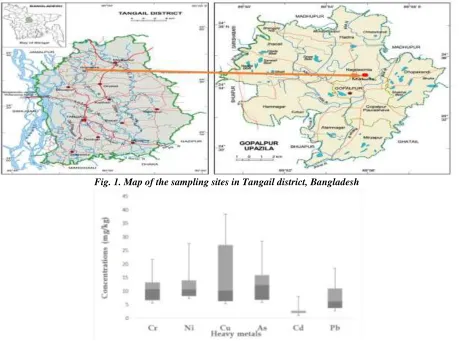
Twelve different sampling sites were selected for this study in Tangail district, Bangladesh (Fig.1). The area of Tangail district is 3414.28 km2 and located at the center point in Bangladesh. Tangail district is one of the most densely polluted areas in Bangladesh where the density of population is 1,100/km2 (2011 census). The study area is situated between 24° 01′ and 24° 47′ north latitudes and between 89° 44′ and 90° 18′ east longitudes (Wikipedia). During March- April, 2016 soil samples were collected. Twelve sampling sites were selected around the brick kiln area. In every sampling site, agricultural soil samples (surface soils) were accumulated in the form of three subsamples. To make a composite sample, three subsamples were mixed together. Samples were kept in cool place and dried in air at room temperature for two weeks, then these were ground and homogenized for determination of hazardous elements. A porcelain mortar and pestle were used to crumble the soils and 2 mm nylon sieve was used to sieve the soils and stored in an airtight clean Ziploc bag and kept frozen until chemical analysis.
2.2 Sample analysis
For sample analysis, analytical grade reagents were used and for solution preparation, Milli-Q (Elix UV5 and MilliQ, Millipore, USA) water was used. 0.3 g of the soil sample was mixed with 1.5 mL 69% HNO3 (Kanto Chemical Co, Tokyo, Japan) and 4.5 mL 35% HCl (Kanto Chemical Co, Tokyo, Japan) in a closed Teflon vessel and was digested in a Microwave Digestion System (Berghof speedwave ®, Eningen, Germany) for metal analysis. By using a syringe filter (DISMIC®-25HP PTFE, pore size = 0.45 μm) [16, 17, 18, 19] Toyo Roshi Kaisha, Ltd., Tokyo, Japan the solution was digested and 50 mL polypropylene tubes (Nalgene, New York) were used for storing.
2.3 Quality control and instrumental analysis
Inductively coupled plasma mass spectrometer (ICP-MS, 7700 series) was used for sample analysis. To prepare calibration curve, Multi-element Standard XSTC-13 (SpexCertiPrep®, Metuchen, USA) solutions were used. Due to cover more range of masses of elements, 1.0 μg/L multi-element solution was used as tuning solution. An internal quality system was used for evaluation every test batches. Once defined Internal Quality Controls (IQCs) was satisfied than it was validated.
2.4 Ecological risk assessment for soil pollution a Contamination factor (Cif)
The (Cif) may be defined as the ratio of the metal concentration in the soil to that of baseline or background value (background value is considered as toxic elements in the pre-industrial soil around research vicinity):
According to the intensities of contamination, the levels of contamination may be divided into six categories which range from 1 to 6: very high degree (Cif ≥ 6), considerable degree (3 ≤ Cif < 6), moderate degree (1 ≤ Ci
f < 3) and low degree (Cif <1) [20, 21, 22] Thus, the enrichment of each metal may be monitored by Cif values over a long time in soils.
b Enrichment factor (EF)
For assessing the magnitude of hazardous elements in the environment, enrichment factor is assumed impressive tool [23] For determination anthropogenic influences of hazardous elements in soil, enrichment factor was calculated using the following formula [24]:
EF = (CM/CAl)sample/ (CM/CAl))background (b)
Where, (CM/CAl)sample is assumed as ratio of hazardous element concentration of (CM) to that of aluminum (CAl) in the soil sample, and (CM/CAl))background is the same reference ratio in the background sample. If the EF value of heavy metals is 1, it means that metal may be entirely from crustal materials or natural weathering processes [25]. It is stating a fact of human interference if enrichment factor of samples is more than1.5. An EF of 1.5–3, 3–5, 5–10 and >10 is considered the evidence of minor, moderate, severe, and very severe modification [26].
c Geoaccumulation index (Igeo)
Geoaccumulation index (Igeo) may be considered as an effective tool for assessing degree of contamination from hazardous element. It uses universally for determination of soil concentration now a days [27].One of the most important purposes of assessing geoaccumulation index (Igeo) is to characterize the level of pollution from soil. Geoaccumulation index (Igeo) can be determined to adopt following equation,
Igeo = log2 (Cn/1.5Bn) (c)
Where, Cn is the assessed metal (n) concentration in the soil and Bn is considered as the geochemical baseline value of metal n in the baseline sample [28, 29]. For reducing the probable variations in the baseline values of metal n, factor 1.5 is used that can be ascribed to lithogenic effects. Geoaccumulation index (Igeo) values were categorized as: 5 < Igeo – extremely contaminated; 4 ≤ Igeo ≤ 5 – heavily to extremely contaminated; 3 ≤ Igeo ≤ 4 – heavily contaminated; 2 ≤ Igeo ≤ 3 – moderately to heavily contaminated; 1 ≤ Igeo ≤ 2 – moderately contaminated; 0 ≤ Igeo ≤ 1 – uncontaminated to moderately contaminated; and Igeo ≤ 0 – practically uncontaminated.
d Pollution load index (PLI)
Pollution load index act as an integrated approach which assesses soil quality of the six metals is calculated According to Suresh et al. 2011 [30] pollution load index may be assessed from six hazardous elements (Cr, Ni, Cu, As, Cd and Pb). The PLI can be calculated by using following formula:
PLI= (CF1 ×CF2 ×CF3 × . . . ×CFn) 1/n (d)
The overall toxicity status of heavy metals in soils may be assessed from Pollution load index (PLI) calculation. PLI is the share of conclusion of six heavy metals.
E Statistical analysis
The data were statistically analysed using the statistical package, SPSS 20.0 (SPSS, USA). The means of the hazardous element concentrations in soils were calculated. Multivariate methods in terms of principal component analysis (PCA) were used to interpret the potential sources of hazardous element in soil. Other calculations were performed by Microsoft Excel 2010.
III. RESULTS AND DISCUSSION
3.1 Physicochemical Properties and Metals in Soil:
negligible on crop plants. Organic carbon (%C) ranges from 0.551 to 3.65 where the highest value was observed in soil collected from the S5 site. The textural class of the soils were loam, sandy loam and silt loam (Table 1) according to the United States soil texture classification. The concentrations of heavy metals were measured to estimate the contamination factors and enrichment factors with pollution load index of soil. Mean concentrations of Cr, Ni, Cu, As, Cd and Pb in soil were 10.41, 12.69, 15.66, 12.15, 3.1, and 7.98 mg/kg, respectively (Table 2 and Fig. 2) found around brick kiln area of Tangail district, Bangladesh. Metals in soils were compared with the other studies in Bangladesh and other countries. Arsenic and cadmium concentrations of the present study were higher than those of the study conducted in Bangladesh, India, Spain, and Turkey (Table 3), pointing out that soils were contaminated by As and Cd. The mean concentrations of As were above the Canadian guideline and Cd in the present study were above the Dutch soil quality standard [32], Canadian guideline and Australian guideline (Table 2).The contaminations of these agricultural fields’ soils are a major concern because foods are still being grown on these soils. The Dutch soil quality standard is regarded as the most suitable guideline indicating all possible exposure pathways for protecting humans, plants, and animals. If any metal concentration in soil is below its respective Dutch Target Value, the soil is considered clean. If the concentration level lies between the target values and intervention values, the soil is regarded to be slight to moderately contaminate. In contrast, if the value is above the Dutch Intervention Value, the soil is considered detrimental to humans, plants, and animals. According to Table 2, Cd was in the worst situation among the studied metals as the mean concentration of Cd was more than 4 times higher than the Dutch Target value.
Fig. 1. Map of the sampling sites in Tangail district, Bangladesh
3.2 Source analysis of hazardous elements in soil
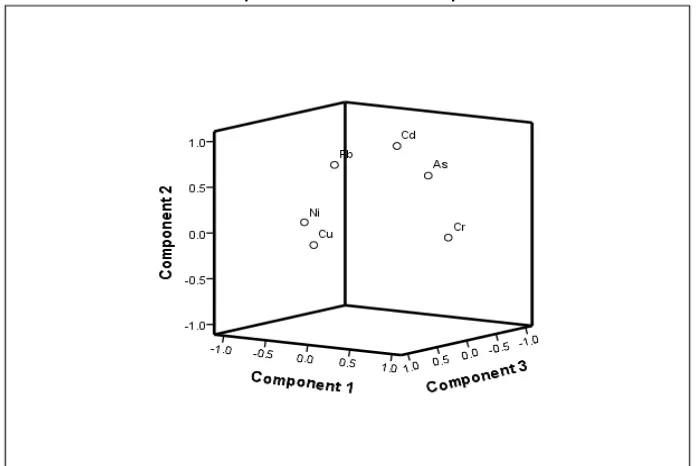
Principal component analysis (PCA) was carried out to associate the source of heavy metals in soils of several sampling sites of the Tangail district, Bangladesh. PCA is assumed ideal act for identification of sources [33, 34]. Due to source analysis of hazardous element, there prevalent three principal components (Table 4 and Fig. 3). Total variation was computed for 80.12% of source analysis. First principal component (PC1) comprised Cr, As and Cd describing the largest variance (35.9%); Ni and Cu comprised second principal component (PC2) which expound 24.74% of the variance. Only Pb comprised third principal component (PC3), describing 19.48% of the total variance (Fig. 3 and table 4).
Fig. 3. Principle component analysis (PCA) of heavy metals in soils of brick kiln area of Tangail district, Bangladesh
3.3 Toxic unit analysis
Aggregation of Toxic units (ΣTUs) can comprise potential acute toxicity of heavy metals. Toxic units may be defined as the ratio of the determined concentration of metal in soil to probable effect levels (PELs) [35]. Toxic unit (TU) and sum of toxic units (ΣTUs) for heavy metals in different soil sampling sites were shown in Fig. 4. If the sum of toxic units of soils was more than 4, toxicity of heavy metals is moderate to serious [36]. In the present study, sum of toxic units (ΣTUs) for the sampling sites SS-7 was higher than 4 as well as the other sites, which indicate serious toxicity of heavy metals.
Fig. 4. Estimated sum of the toxic unit in soils of brick kiln area of Tangail district, Bangladesh
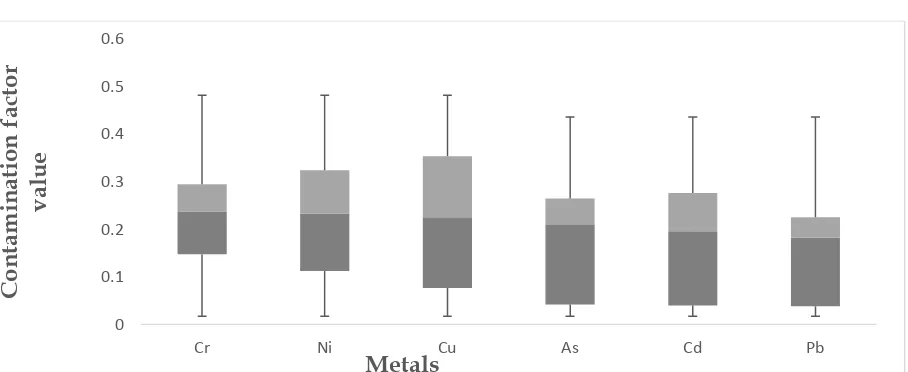
Fig. 5. Contamination Factor (CF) of Heavy metals in soils of Brick kiln area of Tangail district, Bangladesh
3.4 Metal pollution determination in soils:
The EF values of several soils are given in Fig. 6. Average EF values of metals in the present study indicate enrichments in soils of various sampling sites in Tangail district, Bangladesh. As and Cd showed the highest EF value indicate the soil pollution for all the sampling sites.
Geoaccumulation index (Igeo) values of present study were presented in Fig. 7. For all heavy metals, the Igeo values indicated the decreasing order of Cd > As > Cu > Ni > Pb> Cr. The mean of Igeo values for Cd was 3.104 indicating the soils were heavily contaminated with Cd.
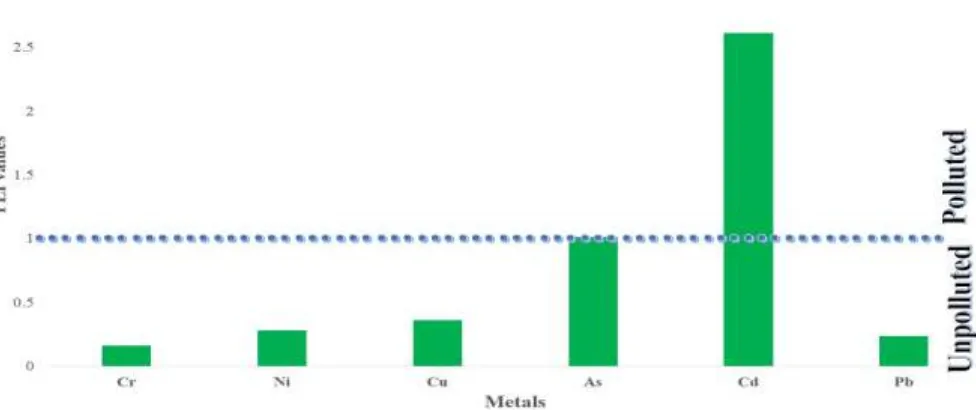
Pollution load index (PLI) value is zero means perfection. If PLI value is equal to 1, it indicates the pollutants are in background level and PLI values more than 1 comprise the soil is in progressive deterioration contamination of heavy metals [37]. The pollution state is proportional to numerical PLI value. As per above-mentioned value, studied soils were contaminated by cadmium and it was noticed that PLI values of all sampling sites were more than one (Fig. 8).
0 0.1 0.2 0.3 0.4 0.5 0.6
Cr Ni Cu As Cd Pb
Contami
nat
ion
fact
or
val
ue
Fig. 6. Enrichment factor (EF) values for heavy metals in soils of sampling sites in Tangail district (the horizontal dot lines represent EF value of 1.5)
Fig. 7. Geo accumulation index (Igeo) value of heavy metals in soils of brick kiln area of Tangail district,
Bangladesh
Fig. 8. Pollution load index (PLI) value of heavy metals in soils of brick kiln area of Tangail district, Bangladesh -15
-10 -5 0 5
Cr Ni Cu As Cd Pb
Ig
eo
v
al
ue
IV. CONCLUSIONS
This study presented that soils of all sampling sites were severely contaminated by heavy metals like As and Cd (around 80% samples crossed the Dutch soil quality target value). The study also assured that concentrations of heavy metal in brick kiln area soils of Bangladesh were varied with different sampling sites. The heavy metals enrichment in soil is also cause of anthropogenic and geogenic elements. As and Cd had very Severe ecological risk for most of the sites for individual heavy metals and the study area comprises ecological risk indexes of these heavy metals were too high. However, it is necessary to conduct further study for describing the causes for the higher potential ecological risk caused primarily by As and Cd in several sampling sites around brick kiln area in Bangladesh.
V. ACKNOWLEDGMENTS
The authors thank the authority of Patuakhali Science and Technology University (PSTU), Bangladesh and Yokohama National University, Japan for providing laboratory facilities to complete this study. The authors also delighted to express their gratefulness and sincerest thanks to Dr. Md. Saiful Islam, Associate Professor, Department of Soil Science Patuakhali Science and Technology University, for his valuable suggestions and cooperation to carry out this research.
REFERENCES
[1] Luo, W.; Lu, Y.; Gisey, J. P.; Wang, T.; Shi, Y.; Wang, G. and Xing, Y. 2007. Effects of land use on concentrations of metals in surface soils and ecological risk around Guanting Reservoir, China. Environ. Geochem. Health 29, 459–471. [2] Islam, M.S.; Ahmed, M.K.; Al-Mamun, M.H. and Hoque, M.F. 2014. Preliminary assessment ofheavy metal
contamination in surface sediments from a river in Bangladesh. Environ. Earth Sci. http://dx.doi.org/10.1007/s12665-014-3538-5.
[3] Lei, M.; Zhang, Y.; Khan, S.; Qin, Pu. and Liao, Bo. 2010. Pollution, fractionation and mobility of Pb, Cd, Cu, and Zn in garden and paddy soils from a Pb/Zn mining area. Environmental Monitoring and Assessment 168, 215–222.
[4] Islam, M.S.; Han, S and Masunaga, S. 2014. Assessment of trace metal contamination in water and sediment of some rivers in Bangladesh. J. Water Environ. Technol. 12, 109–121.
[5] UNDP (United Nations Development Program). 2011. Eco-friendly brick technique helps build a cleaner.
[6] Wei, B.G. and Yang, L.S. 2010. A review of heavy metal contaminations in urban soils, urban road dusts and agricultural soils from China. Microchem. J. 94, 99–107.
[7] Khan, M.H.R.; Rahman, M.K.; Rouf, A.J.M.A.; Oki,Y. and Adachi, T. 2006. Evaluation of degradation of agicultural soils associated with brick burning in selected soil profiles in the eastern reigon of Bangladesh. Jap. J. of Trop. Agri. 50: 15-30.
[9] Yuan, G.L.; Sun, T.H.; Han, P.; Li, J. and Lang, X.X. 2014. Source identification and ecological risk assessment of heavy metals in topsoil using environmental geochemical mapping: typical urban renewal area in Beijing, China. J. Geochem. Explor. 136, 40–67.
[10]Liu, G.; Yu, Y.; Hou, J.; Xue,W.; Liu, X.; Liu, Y.;Wang,W.; Alsaedi, A.; Hayat, T. and Liu, Z. 2014. An ecological risk assessment of heavy metal pollution of the agricultural ecosystemnear a lead-acid battery factory. Ecol. Indic. http://dx.doi.org/10.1016/j.ecolind.2014.04.040.
[11]Dias, C. L.; Oliveira, M. L. S.; Hower, J. C.; Taffarel, S. R.; Kautzmann, R. M. & Silva, L. F. O. 2014. Nanominerals and ultrafine particles from coal fires from Santa Catarina, South Brazil. International Journal of Coal Geology, 122, 50– 60
[12]Hower, J. C.; O’Keefe, J. M. K.; Henke, K. R.; Wagner, N. J.; Copley, G.; Blake, D. R.; Garrison, T.; Oliveira, M. L. S.; Kautzmann, R. M. & Silva, L. F. O. 2013. Gaseous emissions and sublimates from the Truman Shepherd coal fire, Floyd County, Kentucky: a re-investigation following attempted mitigation of the fire. International Journal ofCoal Geology, 116, 63–74.
[13]Islam, M.S.; Ahmed, M.K.; Raknuzzaman, M.; Al-Mamun, M.H. and Islam, M.K. 2015. Heavy metal pollution in surface water and sediment: a preliminary assessment of an urban river in a developing country. Ecol. Indic. 48, 282– 291.
[14]Sikder,A.H.F.; Molla,M.D.H. and Hossain,M.F. 2015.Lead and cadmium accumulation in nearby brick kiln agri-environmental ecosystems. Bangladesh J. Sci. Res. 28(1): 51-59
[15]Ravankhah, M.; Mirzaei, R. and Masoum, S. 2016 Determination of heavy metals in surface soils around the brick kilns in an arid region, Iran .Geochem. Explor. DOI: 10.1016/j.gexplo.2016.01.005.
[16]Arenas-Lago, D.; Vega, F.A.; Silva, L.F.O. and Andrade, M.L. 2013. Soil interaction and fractionation of added cadmium in some Galician soils. Microchem. J. 110, 681–690 (Print).
[17]Arenas-Lago, D.; Vega, F.A.; Silva, L.F.O. and Andrade,M.L. 2014. Copper distribution in surface and subsurface soil horizons. Environ. Sci. Pollut. Res. Int. 21, 10997–11008.
[18]Cerqueira, B.; Vega, F.A.; Serra, C.; Silva, L.F.O. and Andrade, M.L. 2011. Time of flight secondary ion mass spectrometry and high-resolution transmission electron microscopy/energy dispersive spectroscopy: a preliminary study of the distribution of Cu2+ and Cu2+/Pb2+ on a Bt horizon surfaces. J. Hazard. Mater. 422–431 (Print).
[19]Cerqueira, B.; Vega, F.A.; Silva, L.F.O. and Andrade, L. 2012. Effects of vegetation on chemical and mineralogical characteristics of soils developed on a decantation bank from a copper mine. Sci. Total Environ. 421–422, 220–229. [20]Luo,W.; Lu, Y.; Gisey, J.P.; Wang, T.; Shi, Y.; Wang, G. and Xing, Y. 2007. Effects of land use on concentrations of
metals in surface soils and ecological risk around Guanting Reservoir, China. Environ. Geochem. Health 29, 459–471. [21]Rashed, M.N. 2010. Monitoring of contaminated toxic and heavy metals, from mine tailings through age accumulation,
in soil and some wild plants at Southeast Egypt. J. Hazard. Mater. 178, 739–746.
[22]Islam, M. S.; Ahmed, M. K. and Al-Mamun, M. H. 2015. Metal speciation in soil and health risk due to vegetables consumption in Bangladesh. Environmental Monitoring and Assessment, 187, 288–303.
[23]Franco-Uria, A.; Lopez-Mateo, C.; Roca, E. and Fernandez-Marcos, M.L. 2009. Source identification of heavy metals in pasture land by multivariate analysis in NW Spain. J. Hazard. Mater. 165, 1008–1015.
[24]Selvaraj, K.; Ram Mohan, V. and Szefer, P. 2004. Evaluation of metal contamination in coastal sediments of the Bay of Bengal, India: geochemical and statistical approaches. Mar. Pollut. Bull. 49, 174–185.
[25]Zhang, J. and Liu, C.L. 2002. Riverine composition and estuarine geochemistry of particulate metals in China-weathering features, anthropogenic impact and chemical fluxes. Estuar. Coastal Shelf Sci. 54, 1051–1070.
[26]Birch, G.F. and Olmos, M.A. 2008. Sediment-bound heavy metals as indicators of human influence and biological risk in coastal water bodies. ICES. J. Mar. Sci. 65, 1407–1413.
[27]Santos Bermejo, J.C.; Beltrán, R. and Gómez Ariza, J.L. 2003. Spatial variations of heavy metals contamination in sediments from Odiel River (Southwest Spain). Environ. Int. 29, 69–77.
[28]Rudnick, R.L. and Gao, S. 2003. Composition of the continental crust. In: Holland, H.D., Turekian, K.K. (Eds.), Treatise on Geochemistry, vol. 3. Elsevier, Amsterdam, Netherlands, pp. 1–64.
[29]Yu, G.B.; Liu, Y.; Yu, S.; Wu, S.C.; Leung, A.O.W.; Luo, X.S.; Xu, B.; Li, H.B. and Wong, M.H. 2011. Inconsistency and comprehensiveness of risk assessments for heavy metals in urban surface sediments. Chemosphere 85, 1080–1087. [30]Suresh, G.; Ramasamy, V.; Meenakshisundaram, V.; Venkatachalapathy, R. and Ponnusamy, V. 2011. Influence of
mineralogical and heavy metal composition on natural radionuclide contents in the river sediments. Appl. Radiat. Isot. 69, 1466–1474.
[31]Ahmad, S.; Siddiqui, E. N. and Khalid, S. Studies on certain physic chemical properties of soil of two fresh water ponds of Darbhanga. Environ. Pollut. 1996, 31, 31−39.
[33]Bai, J.; Xiao, R.; Cui, B.; Zhang, K.; Wang, Q.; Liu, X.; Gao, H. and Huang, L. 2011. Assessment of heavy metal pollution in wetland soils from the young and old reclaimed regions in the Pearl River Estuary, South China. Environ. Pollut. 159, 817–824.
[34]Anju, M. and Banerjee, D.K. 2012. Multivariate statistical analysis of heavy metals in soils of a Pb–Zn mining area, India. Environ. Monit. Assess. 184, 4191–4206.
[35]Zheng, N.; Wang, Q.; Liang, Z. and Zheng, D. 2008. Characterization of heavymetal concentrations in the sediments of three freshwater rivers in Huludao City, Northeast China. Environ. Pollut. 154, 135–142.
[36]Bai, J.; Xiao, R.; Cui, B.; Zhang, K.;Wang, Q.; Liu, X.; Gao, H. and Huang, L. 2011. Assessment ofcheavy metal pollution in wetland soils from the young and old reclaimed regions in the Pearl River Estuary, South China. Environ. Pollut. 159, 817–824