Introduction
Streptococcus pneumoniae is an encapsulated, Gram-positive coccoid shaped, facultative anaerobic bacterium. In addition, S. pneumoniae is alpha-hemolytic under aerobic conditions and beta-hemolytic under anaerobic conditions. It can be distinguished from other Streptococcus species using optochin and bile susceptibility tests, although there are exceptions. The organism is somewhat fastidious, and thus only 20-30% of pneumococcal pneumonia cases are blood culture positive [1, 2]. Due to its fastidious nature and other factors, such as autolysin production in the stationary growth phase [3, 4], culture remains difficult. There are 90 serotypes of S. pneumoniae, but a much smaller subset of these cause significant human disease, making vaccine development a successful endeavor in reducing disease in at-risk populations [5, 6].
The CDC states that there are 400,000 hospitalizations per year in the US, and 36% of Community-acquired pneumonia is due to pneumococcus [7]. Of these cases, 25-30% become bacteremic, with an overall mortality rate of 5-7% [7]. Adults most commonly present with pneumonia after a brief one to three-day incubation period. After an abrupt onset of fever and chills, other symptoms such as chest pain, productive cough,
shortness of breath, malaise and weakness may follow [7].
Complications of pneumococcal pneumonia include empyema, pericarditis and respiratory failure. According to the most recent 2013 Active Bacterial Core Surveillance (ABCs) Report from the CDC’s Emerging Infections Program Network [8],
S. pneumoniae was the cause of 69.1% of cases of pneumonia with bacteremia; 16.7% of cases of bacteremia (with no focus); and 6.4% of cases of meningitis based on a survey population of over 30 million people. In this population-based survey, invasive S. pneumoniae in children <4 years of age comprised 6.42% of all cases and adults >65 years of age comprised 37.5% of all cases [8].
Since the year 2000, polyvalent vaccines that cover 7, 13 or 23 different serotypes have been used to protect the most vulnerable populations. The pneumococcal conjugate vaccine (PCV13) is administered as a series for children under two years of age and adults 65 years and older [9]. The pneumococcal polysaccharide vaccine (PPSV23) is recommended for adults age 65 years and older, as well as anyone two years old and above at high risk of disease [9]. Persons who are immunocompromised, smoke or have asthma, are also candidates for these vaccines. While the introduction of vaccines that protect against multiple common S. pneumoniae serotypes has reduced pneumococcal disease significantly, cases still occur. Invasive pneumococcal disease is on the national notifiable diseases list, as well as the Kentucky
University of Louisville
Journal of Respiratory Infections
Preliminary Evaluation of an
lytA
PCR Assay for Detection of
Streptococcus pneumoniae
in Urine Specimens from Hospitalized
Patients with Community-Acquired Pneumonia
Subathra Marimuthu, James T. Summersgill, Kuldeep Ghosh, and *Leslie A. Wolf
DOI: 10.18297/jri/vol1/iss4/5 Received Date: July 20, 2017 Accepted Date: August 23, 2017 Website: https://ir.library.louisville.edu/jri Affiliations:
University of Louisville Division of Infectious Diseases,
Department of Medicine, Louisville, KY
©2017, The Authors
*Correspondence To: Leslie A. Wolf
Work: Address: Infectious Diseases Laboratory, Division of Infectious Diseases, University of Louisville
Work Email: [email protected]
Abstract
Community-acquired pneumonia (CAP) due to Streptococcus pneumoniae still occurs in at risk populations, despite the availability of effective vaccines. Laboratory confirmation of S. pneumoniae
remains challenging in cases of CAP despite advances in blood culture techniques and the availability of nucleic acid amplification tests such as PCR-based methods. Urine specimens are an attractive sample type because they are non-invasive compared to bronchial washes or whole blood specimens for patients with CAP. While urine specimens have been used successfully in antigen detection assays, they have not been extensively evaluated for PCR-based assays. In this preliminary study, we evaluated the potential for a real-time PCR assay targeting the S. pneumoniae autolysin gene (lytA) to detect in archived urine samples from patients with CAP. Results indicate that the real time lytA PCR assay on the Luminex ARIES® system shows promise as a screening tool for patients with CAP based on comparison to urine antigen detection assay results.
Reportable Diseases and Conditions list, and tracking drug resistance patterns remains important. As of 2013, the ABCs report indicated that among 2898 isolates of S. pneumoniae, 2.2% were resistant to penicillin, 28.2% were resistant to erythromycin and 10.3% were resistant to tetracycline [8].
Laboratory diagnosis remains challenging for S. pneumoniae, however. Available diagnostic testing methods fall into three major categories at this time, including microscopy with microbiological culture, urine antigen detection assays and molecular testing such as PCR on cerebrospinal fluid (CSF), sputum or whole blood; however, no gold standard has been agreed upon. Molecular diagnostic testing is attractive, due to increased speed and sensitivity. One promising PCR target is the lytA gene of S. pneumoniae because the lytA gene is specific to S. pneumoniae [1]. This gene encodes a well-documented virulence factor and has little genetic variation within the species [10].
While lytA has been published as a promising PCR target for whole blood, sputum, serum samples, middle ear fluid and CSF specimen types [1, 2], it has not been tested extensively on urine samples. Our aim was to assess the feasibility of fully validating a rapid and sensitive PCR assay on the Luminex ARIES® platform using a non-invasive specimen type in order
to detect S. pneumoniae from patients with a clinical diagnosis of pneumonia. The design of this study was to use archived urine samples from hospitalized patients with Community-acquired pneumonia (CAP) [11] for PCR analysis using the lytA gene target with Multicode® primers. Because previous laboratory
results were available for these cases, the selected urine samples were either from patients with S. pneumoniae blood culture positive results or from patients, who by laboratory analysis, were negative for S. pneumoniae. In addition, urine samples from healthy volunteers were used as negative controls for this study. Preliminary results are promising for this assay and warrant further research and development.
Methods and Materials
Archived Urine Specimens: Sixty archived urine specimens were obtained from the University of Louisville Respiratory Biorepository in the Division of Infectious Diseases. Urine specimens selected for this study were collected between 2014-2016 [11]. Briefly, the original urine samples from patients hospitalized with Community-acquired pneumonia (CAP) were held at 4°C, then processed within 28 hours of collection by adding 0.5 mL of 0.5M PIPES buffer (VWR, Radnor, PA, Part Number BB-121-250 mL) to 9.5 mL of urine. After mixing well, aliquots were frozen at -80°C in the Biorepository until thawed once for lytA PCR and BinaxNOW® S. pneumoniae antigen card
testing. Aliquots of 200 μL of archived urine samples were used from 30 pneumococcus negative patients (having no laboratory evidence of Streptococcus pneumoniae infection) and 30 patients having Streptococcus pneumoniae blood culture positive results.
Fresh Urine Specimens (Negative Controls): An additional 30 fresh urine samples were collected from healthy volunteers. These urine samples were collected and stored at 4°C less than 28 hours prior to processing by adding 0.5 mL of 0.5M PIPES buffer to 9.5 mL of urine. They were tested first after refrigerating, and again after freezing once at -20°C for 1-4
weeks, with no change in lytA PCR or BinaxNOW® test results.
ARIES® Instrument, ReadyMix®, Cassettes and PCR Analysis:
The universal thermal profile settings on the ARIES®
instrument were used for PCR. Cassettes (Part Number 50-10026) and ReadyMix® (Part Number 3697) were purchased
from Luminex (Austin, TX). The ARIES® software automatically
generated the amplification and melt curves and assigned the corresponding cycle threshold (Ct) and melting temperature (Tm) values. Specimens were considered positive only if lytA and the specimen processing control Mouse Hepatitis Virus-2 (MHV2) were detected in the Ct and Tm ranges established for this assay (see Table 1). A sample was called “Invalid” if the MHV2 amplification failed.
Reagents: MultiCode® primer pairs for the Streptococcus
pneumoniae lytA gene were obtained from Integrated DNA Technologies, Inc. (Coralville, IA). The MultiCode® primer
sequence for lytA forward primer is /56-FAM//iMe-isodC/A CGC AAT CTA GCA GAT GAA GCA and the reverse primer is CTC CCT GTA TCA AGC GTT TTC GGC, based on a previous publication [1]. The MHV2 primer set (proprietary primer sequences, Luminex, Part Number 3803) was used as the sample processing control (SPC) in order to confirm that PCR inhibitors were not present. Furthermore, melt curve (Tm) data allows for calibration of detected melting temperatures for both lytA and MHV2 PCR amplifications. The lytA primer set was assigned to the FAM channel and MHV2 primer set was assigned to the AP525 channel.
Primer Pool Preparation: 50 μL of 5 µM lytA forward primer, 50 μL of 5 µM lytA reverse primer and 100 μL of MHV2 primer set were mixed together. Frozen aliquots of the primer mix were stored at -20°C. From these aliquots, 4 μL of the primer pool (giving a final concentration of 200 nM) were used per ReadyMix® vial.
Control Material: Titered Streptococcus pneumoniae (ZeptoMetrix, Buffalo, NY, Part Number 0801439) was purchased and used for accuracy and analytical sensitivity studies by diluting it in negative urine specimens at various concentrations. Urine samples were screened by the BinaxNOW® S. pneumoniae antigen card and lytA PCR assay
prior to use to ensure specimens were negative by both methods.
Analytical Sensitivity and Precision: For analytical sensitivity, the limit of detection (LOD) was determined for the lytA target using titered S. pneumoniae in negative urine (screened by BinaxNOW® S. pneumoniae antigen card and lytA PCR assay).
S. pneumoniae was spiked into negative urine specimens using 0.2 mL aliquots per cassette at 1 x 10³ CFU/mL (200 CFU/
cassette), 1 x 10² CFU/mL (20 CFU cassette), 1 x 101 CFU/
mL (2 CFU/cassette), 1 x 100 CFU/mL (0.2 CFU/cassette), 1
x 10-1 CFU/mL (0.02 CFU/cassette), 1 x 10⁻² CFU/mL (0.002
CFU/cassette) concentrations and tested. The LOD assay was repeated three times, independently, to demonstrate inter-assay precision as well as sensitivity.
Accuracy: For the accuracy study, 11 known negative urine samples and 16 known positive samples, made up of various concentrations of Streptococcus pneumoniae that were spiked into negative urine (screened by BinaxNOW®S. pneumoniae
Clinical Criteria
Invasive Pneumococcal (Streptococcus pneumoniae) Disease, or IPD, causes many clinical syndromes, depending on the site of infection (e.g., bacteremia, meningitis.)
Laboratory Criteria for Diagnosis
Supportive: Identification of S. pneumoniae from a normally sterile body site by a culture independent diagnostic test [CIDT] without isolation of the bacteria.
Confirmatory: Isolation of S. pneumoniae from a normally sterile body site.
Comments
The use of CIDTs as stand-alone tests for the direct detection of S. pneumoniae from clinical specimens is increasing. Data regarding their performance indicate variability in the sensitivity, specificity, and positive predictive value of these assays depending on the manufacturer and validation methods used. It is therefore useful to collect information on the laboratory conducting the testing, and the type and manufacturer of the CIDT used to diagnose each IPD case. Culture confirmation of CIDT-positive specimens is still the ideal method of confirming a case of IPD.
tested by staff members that did not prepare the accuracy panel.
Box 1 Council of State and Territorial Epidemiologists (CSTE) Case Definition [12]
Data Analysis: Mean and standard deviation were calculated using Microsoft Excel. The MEDCALC Diagnostic Test Evaluation tool was used to determine analytic sensitivity and
specificity [13]. Luminex SYNCT® software was used to analyze
the PCR data. The highest Ct value for an lytA true positive was 40.4, so the lytA target was set at 40.5 (Table 1). The mean of the Tm for an lytA true positive was 79.21°C, and was used as the melt curve window ± 2, and 20% of deepest Tm Δ RFU (change in relative fluorescence units) was set as Tm peak threshold cutoff (Table 1). The SPC MHV2 cutoff was set the same way as the S. pneumoniae lytA. After completing PCR assay data analysis, cut off values were fixed on the SYNCT® software (Table 1) assay file
and locked on the ARIES® instrument for subsequent specimen
testing.
Table 1 ARIES lytA PCR Assay Conditions
Alere BinaxNOW® S. pneumoniae Antigen Card: For this study,
90 urine specimens were tested by BinaxNOW®, 30 from each
group described in “Specimens” section. Urine samples were screened following the manufacturer’s instructions [14]. Briefly, the swab provided with the Alere kit was dipped into the urine specimen to be tested, the swab was placed in the
BinaxNOW® device, and three drops of reagent were added to
swab. Result was read at 15 minutes. Per the package insert (14), the limit of detection if 105 cells/mL or 1:250 dilution of a known
positive patient urine.
Results
The analytical sensitivity for Streptococcus pneumoniae in urine with this PCR assay was 10 CFU/mL. Results are represented in
Table 2 as mean ± standard deviation, calculated from three independent experiments. No mean and standard deviation were calculated for the 1 CFU/mL concentration, which was only positive in one out of three runs (33%). Inter-assay precision, as illustrated by the small standard deviations for Ct values and Tm values (Table 2), was excellent. There was little variation among three independent runs at the 1000 CFU/mL, 100 CFU/mL and 10 CFU/mL dilutions.
S. No Conditions S. pneumoniae
lytA SPCMHV2
1 Amplification curve (CT) Cutoff 1-40.5 1-45 2 Melt curve (Tm) cutoff in in °C (±2 degrees of the 77.21-81.21
average)
74.88±79.88 (±2 degrees of the
average) 3 threshold Cutoff (Melt curve (Tm) peak DRFU) -400,000 -175,000
Table 2 Streptococcus pneumoniae PCR LOD
The accuracy of the assay was tested using a blinded panel of negative urine samples spiked with known quantities of S. pneumoniae. There were no false negative results, but one apparent “false” positive result. This was from a sample spiked with 1 CFU/mL, which is below the established LOD, but S. pneumoniae was present in sample. We found that this level could be detected 33% of the time (Table 2). Based on results shown in Table 3, the sensitivity was 100% [95% Confidence Interval (CI) 79.41% to 100%] and the specificity was 90.91% (95% CI 58.71% to 99.77%).
Table 3 Accuracy of lytA PCR Assay in Urine Spiked with S. pneumoniae
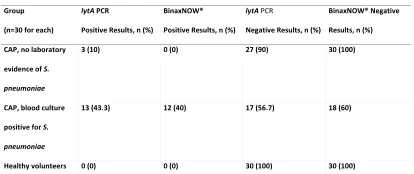
The performance of the lytA PCR assay was compared to the BinaxNOW® S. pneumoniae urine antigen test using clinical
samples (Table 4). These 90 clinical samples consisted of three different groups as indicated in Table 4. Archived urine samples from patients with CAP, but no laboratory evidence of S. pneumoniae infection, were tested with the lytA PCR assay and the BinaxNOW® S. pneumoniae assay. This group was comprised
of 16 females (53.3%) and 14 males (46.7%) with an average age of 60.7 years (range 31-81 years old). Three (3) samples were lytA PCR positive out of 30 negative urine sample tests, giving a 10% PCR positivity rate for S. pneumoniae on this sample set (Table 4). No inhibition was observed based on MHV2 Ct values and Tm data. BinaxNOW® S. pneumoniae antigen results for this clinical
sample was 100% negative (30/30) (Table 4), which gave the lytA PCR assay a 90% specificity (95% CI 73.47% to 97.8%). A second set of archived urine samples from patients with CAP who were blood culture positive for S. pneumoniae were also tested by lytA PCR and BinaxNOW®. This group was comprised of 15
females (50%) and 15 males (50%), with an age range of 20 to 100 years old (average 63.5 years). Of this group, 13 out of 30 urine samples were lytA positive by PCR, giving a 43.3% positivity rate for this sample set (Table 4). No inhibition was observed bazsed on MHV2 Ct and Tm data. BinaxNOW® S. pneumoniae
urine antigen results for this sample set was 83.3% in agreement (25/30 total results) with ] the lytA PCR assay (Table 4). It is interesting to note that there were five (16.7%) discrepant results (3 lytA PCR positive, but BINAX NOW negative; 2 lytA PCR negative, but BINAX NOW positive). Comparing performance of the lytA PCR assay to BinaxNOW® S. pneumoniae urine
antigen results for the blood culture positive group as the “gold standard,” the sensitivity of the PCR assay was 85.71% (95% CI 57.91% to 98.22%) while the specificity was 85.71% (95% CI 63.66% to 96.95%).
Sample ID lytA Ct ±SD lytA Tm ±SD MHV2 Ct ±SD MHV2 Tm ±SD
S. pneumoniae 1000 CFU/mL 30.4 ±0.44 79.25±0.1 24±0.46 77.56±0.32
S. pneumoniae 100 CFU/mL 34.23±1.1 79.12±0.06 24.6±1.47 77.4+0.46
S. pneumoniae 10 CFU/mL 37.13±1.63 79.22±0.12 23.97±0.5 77.53±0.21
S. pneumoniae 1 CFU/mL 38.2 79.5 24.2±0.56 77.47±0.32
S. pneumoniae 0.1 CFU/mL 24.73±0.38 77.47±0.35
S. pneumoniae 0.01 CFU/mL 24.27±0.87 77.53±0.21
SD=Standard Deviation
lytA Detection by PCRObserved Positive Observed Negative
Expected Positive (16) 16 0
Table 4 Clinical Urine Sample Summary Results
The final group of 30 urines tested by lytA PCR and BinaxNOW®
was from healthy volunteers consisting of 17 males (56.7%) and 13 females (43.3%), with an age range of 23 to 65 years old (average 34.6 years). None of these urine samples was lytA positive or BinaxNOW® antigen positive (Table 4), which
gave the lytA PCR assay a 100% specificity. No inhibition was observed based on MHV2 Ct values and Tm data.
Specificity studies were not done in this preliminary study due to lytA PCR specificity data being available from three previously published studies also using the lytA target used in this report. Carvalho et al. [1] used an extensive strain collection from the CDC Streptococcus Laboratory to assess specificity of the lytA primer set. Carvalho demonstrated that using 5 ng/µL DNA extracted from 67 strains, representing 44 different serotypes of S. pneumoniae isolates, and 104 non pneumococcal isolates, there was 100% specificity for S. pneumoniae. In another study demonstrating specificity, Sheppard et al. [2] used a panel of 59 isolates including 18 species of streptococci and 21 other closely related species or common pathogens and found no crossreactivity with an lytA primer set. Finally, McAvin et al. used 44 organisms from diverse genera and 26 negative control organisms, including 7 Streptococcus species, and also observed 100% specificity with no cross-reactivity with an lytA PCR assay [10].
Discussion
The goal of this preliminary study was to assess the feasibility of fully validating the performance of an lytA PCR assay in urine specimens from patients diagnosed with CAP [11] for use in a future, prospective study. The lytA target was chosen due to several publications indicating high specificity of the autolysin gene for S. pneumoniae [1]. Using the Luminex ARIES®
platform that automates DNA extraction, PCR amplification and real-time detection, we found that the MultiCode®lytA assay
could reliably detect 10 CFU/mL in urine. Accuracy studies using negative urine samples spiked with known quantities of S. pneumoniae demonstrated 16/16 (100%) lytA positive for known positive samples and 10/11 (90.9%) lytA negative for known negative samples. With archived clinical samples, we observed 43.3% lytA positive urine samples from S. pneumoniae blood culture positive CAP patients and 10% lytA positive urine samples from CAP patients with no laboratory evidence of S. pneumoniae infection. None of the urine samples from 30 healthy volunteers were positive for lytA. All 90 urine specimens were tested by the BinaxNOW® S. pneumoniae antigen card test
as well as by PCR after one freeze-thaw cycle. The only group with any positive BinaxNOW®S. pneumoniae antigen results
was the blood culture positive patients. The BinaxNOW®S.
pneumoniae antigen card did not perform as well as stated in the package insert [14] in our study, however. The urine antigen detection assay BinaxNOW® for S. pneumoniae has a stated
sensitivity of 86% and specificity of 94% [14] in adults, based on a retrospective study of urine specimens from blood culture positive patients. The package insert does not specify either the length of time or freezer temperature storage conditions that ensure the test results are valid for urine, thus it is possible that long-term storage at -80°C affected assay performance. As noted in our results, there were five discrepant results out of 30 CAP patients with S. pneumoniae positive blood cultures, but overall the two assays detected similar numbers of positive results in this group (Table 4). Three of these were lytA positive with the lytA PCR assay, but BinaxNOW® negative, while two patients were
lytA negative but BinaxNOW® positive. Another explanation
for the discrepant results (besides long-term storage at -80°C) is that the targets of each assay are different (DNA versus antigens). Further study of these patient specimens would be required to truly understand these interesting differences, as well as completing a prospective study with similar groups using fresh urine specimens rather than long-term frozen urine specimens.
To place these results in context of other standard laboratory diagnostic tests, only 15-30% of patients with CAP due to S. pneumoniae have positive blood cultures [1, 2]. While numerous lytA PCR assays have been reported for use with multiple specimen types, urine has not been evaluated extensively. Whole blood was evaluated in one study for patients with either pneumococcal septicemia or with pneumococcal pneumonia with positive blood cultures [2]. For the septicemic patient group, 51.7% of the whole blood specimens were lytA positive, while for the pneumonia patient group, 39.5% were positive [2]. Additional testing by this group found that for 105 blood culture positive samples, 42.9% were positive for lytA [2]. This is in contrast to 100% of CSF specimens, sputum specimens and lung biopsy tissue giving positive results with the lytA PCR assay [2]. In a study by Murdoch et al. [15], using the pseudolysin (ply) gene instead of lytA, throat swabs and sputum specimens demonstrated 55% and 81% PCR positivity, respectively. Results for plasma, buffy coat and urine were 2% using the same ply PCR assay [13].
Despite the findings of these previous studies, urine remains an attractive specimen type due to its non-invasive collection method for patients with CAP. Urine antigen assays are widely used because they are rapid and perform well on adults [2] despite the highly variable carriage rate in healthy adults [5]. The BinaxNOW® S. pneumoniae urine antigen assay is
not recommended pediatric patients, however, due to well- documented issues with S. pneumoniae nasopharyngeal carriage in children [16]. The potential benefit of PCR assays is the ability to quantify the amount of DNA present and to set thresholds for carriage versus infection rates. Future studies could address the utility of a quantitative PCR assay with urine from children suspected of having streptococcal infections.
This preliminary study has some limitations. The first is that only the lytA autolysin gene target was used for PCR analysis in urine. Future studies may involve S. pneumoniae psaA MultiCode primer sets, or other published gene targets specific to S. pneumoniae, to serve as a confirmatory test after screening positive with the lytA PCR assay. A second limitation is that the urine samples were archived from patients hospitalized with CAP, stored at -80°C since January 2014. Repeated freeze thawing of certain sample types is known to reduce sensitivity of
Group
(n=30 for each) lytA PCR
Positive Results, n (%) BinaxNOW®
Positive Results, n (%) lytA PCR
Negative Results, n (%)
BinaxNOW® Negative
Results, n (%)
CAP, no laboratory
evidence of S.
pneumoniae
3 (10) 0 (0) 27 (90) 30 (100)
CAP, blood culture
positive for S.
pneumoniae
13 (43.3) 12 (40) 17 (56.7) 18 (60)
PCR assays and the effect of long term storage at -80°C on the BinaxNOW® antigen test remains unclear. Specimen stability
experiments will need to be performed in a prospective study to address these variables. Finally, the urine sample sizes are small due to the availability of archived urine samples that met the criteria established for this study (i.e. urine had to be from patients with CAP having a positive blood culture versus those patients having all negative laboratory results for S. pneumoniae). If the preliminary data hold true when testing additional urine from patients with CAP, then future studies could be performed to validate other MultiCode® primers on the
ARIES® platform. Upon completion of the full validation study,
a cost comparison of the lytA PCR assay and the urinary antigen test would be useful information. The potential to develop MultiCode® primer sets to detect key antibiotic resistance
markers in addition to identifying Streptococcus pneumoniae would be an advance in laboratory diagnostics for patients with CAP.
Acknowledgements: We appreciate the support of Drs. Julio Ramirez and Senen Pena Oliva in the Division of Infectious Diseases for this research project. The urine PCR study was conducted under University of Louisville IRB Number 13.0001.
References
1. Carvalho MG, Tondella ML, McCaustland K, Weidlich L, McGee L, Mayer LW et al. Evaluation and improvement of real time PCR assays targeting lytA, ply, and psaA genes for detection of pneumococcal DNA. J Clin Microbiol. 2007 Aug;45(8):2460-66.
2. Sheppard CL, Harrison TG, Morris R, Hogan A, George RC. Autolysin-targeted LightCycler assay including internal process control for detection of Streptococcus pneumoniae DNA in clinical samples. J Med Microbiol. 2004 Mar;53(Pt 3):189–95.
3. Severin A, Horne D, Tomasz A. Autolysis and cell wall degradation in a choline-independent strain of Streptococcus pneumoniae. Microb Drug Resist. 1997;3(4):391–400.
4. López R, García E, García P, García JL. The pneumococcal cell wall degrading enzymes: a modular design to create new lysins? Microb Drug Resist. 1997;3(2):199–211. 5. Centers for Disease Control and Prevention. Pneumococcal
Disease/For Clinicians, Streptococcus pneumoniae. https://www.cdc.gov/pneumococcal/clinicians/ streptococcus-pneumoniae.html, accessed 7/21/2017. 6. Centers for Disease Control and Prevention. Pneumococcal
Disease/Pneumococcal Home, Surveillance and Reporting. https://www.cdc.gov/pneumococcal/surveillance.html, accessed 7/21/2017.
7. Centers for Disease Control and Prevention. Pneumococcal Disease/For Clinicians, Clinical Features. https://www. cdc.gov/pneumococcal/clinicians/clinical-features.html, accessed 7/21/2017.
8. Centers for Disease Control and Prevention. Active Bacterial Core surveillance (ABCs)/Reports and Findings, ABCs Report: Group A Streptococcus, 2013. https://www. cdc.gov/abcs/reports-findings/survreports/gas13.html, accessed 7/21/2017.
9. Centers for Disease Control and Prevention. Pneumococcal Disease/For Clinicians, Prevention. https://www.cdc. gov/pneumococcal/clinicians/prevention.html, accessed 7/21/2017.
10. McAvin JC, Reilly PA, Roudabush RM, Barnes WJ, Salmen A, Jackson GW et al. Sensitive and specific method for rapid identification of Streptococcus pneumoniae using real-time fluorescence PCR. J Clin Microbiol. 2001 Oct;39(10):3446–51.
11. Ramirez JA, Wiemken TL, Peyrani P, Arnold FW, Kelley R, Mattingly WA et al. Adults Hospitalized with Pneumonia in the United States: Incidence, Epidemiology & Mortality. Clin Infect Dis. Forthcoming 2017 Jul.
12. Centers for Disease Control and Prevention. National Notifiable Diseases Survillance System (NNDSS)/ surveillance Case Definitions/Invasive Pneumococcal Disease, Invasive Pneumococcal Disease (IPD) (Streptococcus pneumoniae) 2017 Case Definition. https:// wwwn.cdc.gov/nndss/conditions/invasive-pneumococcal-disease/case-definition/2017/, accessed 7/21/2017. 13. MEDCALC® Diagnostic Test Evaluation tool. https://
www.medcalc.org/calc/diagnostic_test.php, accessed 8/16/2017.
14. “Alere” Binax NOW® S. pneumoniae Antigen Card http://
www.alere.com/en/home/product-details/binaxnow-streptococcus-pneumoniae.html accessed 8/15/2017. 15. Murdoch DR, Anderson TP, Beynon KA, Chua A, Fleming
AM, Laing RT et al. Evaluation of a PCR assay for detection of Streptococcus pneumoniae in respiratory and nonrespiratory samples from adults with community-acquired pneumonia. J Clin Microbiol. 2003 Jan;41(1):63– 6.