A New Approach for Detecting Memory
Errors in JPEG2000 Standard
M.Pradeep Raj
#, E.Dinesh
* #PG Student,*Assistant Professor, Department of ECE M. Kumarasamy College of Engineering, Karur, TamilNadu, India
[email protected] , [email protected]
Abstract—The rapid growth of image compression has dramatically increased to reduce memory size without degrading the quality of the image. This paper provides adaptive memory compensation errors in JPEG2000. Furthermore, we use algorithm-specific techniques such as DWT to compensate memory consumption and propose Huffman coding, MQ-Coding for compensating the memory errors without the need of tile memory. The Huffman coder can be used to compress and store large amount of data in a memory. These techniques do not require any additional memory can minimize the memory requirements having the less computation complexity with larger area and power consumption. The proposed architecture is used to increase the image quality as well as the compression rates. By this method, memory compensation and memory errors can be reduced. The image quality can also be increased with the help of Discrete Wavelet Transform.
Index Terms—JPEG; JPEG2000; MQ-CODER; SRAM errors; adaptive error control coding
1.INTRODUCTION
JPEG and JPEG2000 are the most widely used image compression standards in compensating memory errors. JPEG has slightly less compression performance than JPEG2000 [1]. JPEG is based on DCT whereas; JPEG2000 is based on DWT where each sub-band is divided into rectangular blocks, called code-blocks. DWT provides less computational complexity which can compensate memory errors drastically [2]. JPEG2000 outperforms JPEG in terms of compression ratio. JPEG2000 algorithm produces excellent results, better image quality as compared to JPEG [3].Set partitioning in hierarchical tress (SPHIT) is also most widely used compression algorithm. It can also be combined with DCT and DWT for higher compression efficiency. It provides good image quality but cannot compensate the memory errors [4]. Block truncation coding (BTC) algorithm were also used for colour image compression which also provides good image quality cannot reduce memory errors [5]. Hence, JPEG2000 will be effective to operate SRAM under low-power mode which is a DWT based image compression standard can also compensate memory errors [6]. An effective way of reducing memory power is voltage scaling. About 35% powers saving is possible in the following JPEG2000 when memory operates at Scaled voltages [7]. This paper explains error control coding schemes such as adaptive Error control coding, single error correction double error detection (SECDED). The errors such as random errors and burst errors are replaced by these codes. These schemes are most suitable for SRAM [8].
For high performance JPEG2000 architecture, a QCB (quad code block)-based DWT method is proposed to achieve high parallelism in the JPEG2000 coprocessor for reducing the memory size [9]. In JPEG2000, if we process static images like pictures, Huffman encoding is enough. But if we operate the JPEG2000 for video transmission, Huffman-encoder is not sufficient because videos are transmitted at frames/sec. So if the clock frequency is high, then the dynamic images can be processed. For this case, JPEG based on entropy coder will be sufficient [1]. For JPEG2000 architecture, it uses an efficient 2-D DWT that is capable of computing four coefficients per clock cycle [10]. Memory is the main issue to store the number of images and videos. Here, we propose a technique called multiple-lifting scheme which can reduce not only average memory bandwidth but also 50% area of line buffer in 2-D DWT module [11].
[12]. In JPEG2000, the most significant block is EBCOT which alone takes about 70% of the overall processing time for compression of image to compensate memory failures. The EBCOT is divided into two coding steps namely, Tier-1(binary arithmetic coding –MQ CODER) and Tier-2 (organization of the bit-stream) [13].Here we use high speed VLSI implementation of the EBCOT algorithm. The main concept is based on parallel access to memories which provides reduction in memory access requirements, as well as a net increase of processing speed by dramatically reducing the number of clock cycles [10].These techniques do not require any additional memory, have low circuit overhead, reduces the power with only a small reduction in image quality. In JPEG2000 architecture, the tile memory occupies more than 50% of area. Hence to solve this problem, we propose stripe pipeline scheme. Due to stripe-pipelining scheme, the initial level algorithms are changed as level switch discrete wavelet Transform (LS-DWT) and code block switch embedded block coding (CS-EBC). Because of this, the overall memory requirements can be reduced to only 8.5% comparing with conventional architecture [15].
2.RELATED WORK
A. SRAM failure analysis
In this paper, we analyse SRAM failures caused by voltage scaling. The voltage scaling is an effective way of reducing memory power. In JPEG2000 about 25% to 35% power saving is possible when the memory operates at scaled voltages [7].But voltage scaling introduces SRAM memory failures especially in scaled technologies. SRAM failure rate is affected by threshold voltage (Vt). SRAM failures include [16]:
1. Read stability failure (occurs during a read access, when current flows from the pre charged bit line). 2. Read latency failure (occurs during a read access, when the cell fails to pull down one of the bit lines). 3. Write latency failure (occurs during a write access, when the high voltage storage node cannot be pulled below the trip point).
4. Minimum hold voltage (occurs during the time when SRAM cell is not accessed).
The JPEG2000 can operate at low voltages used to store more data. It has high compression ratio but introduces memory failures due to low voltage operation. The three main factors that contribute overall SRAM failure rates [17]:
i) Read upset - occurs during read cycles because of unbalanced voltage sharing at the read node. ii) Write access - occurs due to high drop or increase in the read and write current.
iii) Read access - occurs when the scaled voltage is dropped drastically.
To compensate memory errors we use algorithmic specific techniques such as DCT, IDCT in JPEG and DWT, IDWT in JPEG2000 [6].But JPEG2000 is effective in compensating memory errors. Here we also use proposed stripe pipelining scheme but cannot reduce SRAM errors [15].
B. JPEG summary
JPEG is the most widely used image compression standard in today’s world. It has lesser compression performance than JPEG2000 but has high PSNR value than JPEG2000 [3]. Because of simple structure and ease of simple implementation, it is still very popular. Memory errors can be compensated in JPEG implementation. An algorithmic-specific technique such as 2D-DCT is used to mitigate SRAM errors caused by voltage scaling. The three main features include [1]:
i) The number of sign extension bits is determined in the quantization step.
ii) Two adjacent AC coefficients after zigzag scan have similar values .Hence this is the main feature for JPEG. iii) Coefficients corresponding to higher frequencies have lesser values.
Fig.1.Block diagram of JPEG
In general, DC coefficient which is encoded in differential order by subtracting the DC coefficient of the previous block and encoding the difference using the Huffman table in baseline JPEG; the rest of the AC coefficients are encoded using another Huffman table. During Quantization, every coefficient in the 8*8 DCT matrixes is divided by the corresponding quantization value [6]. Zigzag scanning is used to order the 8*8 quantized coefficients into one dimensional vector in which low frequency coefficients are placed in front of high frequency coefficients [1]. The JPEG is a lossy coding method that results in some loss of details and unrecoverable distortion [6]. It has high PSNR value but lower compression ratio than JPEG2000.
C. JPEG2000
Fig.2.Three-level DWT decomposition of image tile
The adaptive binary arithmetic coder called MQ-CODER is used in JPEG2000 standard. The MQ-CODER utilizes a probability model for its encoding process. This model is implemented as a finite state machine (FSM) of 47 states. It consists of following algorithms: [12]
i) CODEMPS algorithm (if most probable symbol has occurred, the CODEMPS algorithm is performed). ii) CODELPS algorithm (if least probable symbol has occurred, the CODELPS algorithm is performed). Another significant block is rate control. Rate control is responsible for improving layer bit-rate targets. This can be achieved by two mechanisms:
i) The choice of quantized step sizes.
ii) The selection of subset of the coding to combine the code stream [13].
D. ADAPTIVE ECC
Here we use adaptive SECDED schemes where the stronger codes can be derived from weaker but longer codes. We use three different SECDED codes: (72, 64), (39, 32) and (22, 16). Among all these, SECDED codes (22, 16) is the strongest code with an area extension of 37.5% followed by (39, 32) with area extension of 21.9% and (22, 16) with an area increase of 12.5% [17]. The main aspect of these codes is that the parity generator matrix of the shorter code(stronger) can be derived from the parity generator matrix of the longer code(weaker).This can be utilized to design the hardware that can be shared for multiple codes. The parity generator matrix of (72, 64) with (39, 32) code consists of 8 rows (equal to number of parity bits).The first half of code (column 1 to 32) except the seventh row can be used to generate the parity Matrix of (39, 32) code since the seventh row consists of all zeros [17]. These adaptive error control coding schemes introduce little circuit overhead and no additional data storage is need for these codes. Similarly, the parity matrix of (22, 16) can be derived from the matrix of (39, 32) code by taking into an account the first 16 columns and dropping the all zero row.
Error correction code (ECC) techniques have been used to improve memory reliability. Especially, the extended Hamming and odd-weight column codes in the category of single error correction and double error detection (SEC-DED) codes are commonly used [8]. The overall bits computation is eliminated by check bit pre-computation during the write operation of memory despite using the error locator and double error detection code, which coincides with those of extended Hamming code.
3. RESULTS
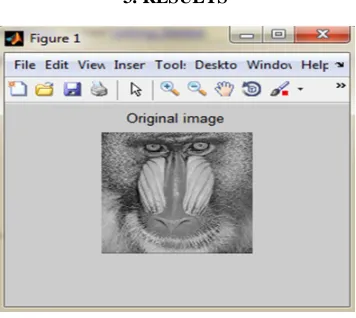
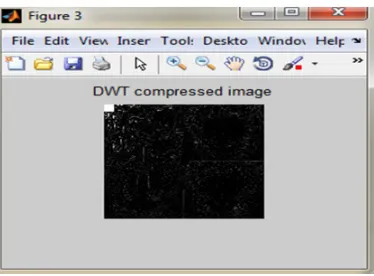
Fig 2.Image after DWT Compression
Fig 3.Graph of Original Image
Fig 5.Performance Comparison
4.CONCLUSIONSANDFUTUREWORK
In this paper, we presented various compression techniques such as DCT in JPEG and DWT in JPEG2000 for compensating memory errors. JPEG2000 is widely used as it outperforms JPEG. We also used Adaptive error control coding algorithm to mitigate memory failures caused by aggressive voltage scaling. Huffman coding is mainly used to compress more data. The proposed stripe pipeline scheme uses the LS-DWT and CS-EBC algorithm. These schemes do not require tile memory but can compensate SRAM errors having high working speed but having larger power consumption. Even though compression is done by the usage of Discrete Wavelet Transform, but it has less amount of reduction in image quality. Because in JPEG2000, there is some loss in quality of image. So SPIHT compression method can be used to increase the quality of the image in addition with Discrete Wavelet Transform which provides; high image quality and better compression ratio.
REFERENCES
[1] Y. Emre and C. Chakrabarti, “Data-path and memory error compensation technique for low power JPEG implementation,” school of Eng., Arizona State Univ,
[2] M. H. Chowdhury and A. Khatun, “Image compression using Discrete Wavelet Transform,” Int. Journal of Comp .Sci., Jahangir Univ, vol. 9, no. 1, pp. 327–330,July 2012.
[3] S. N. Sivanandam, A. Pasumpon Pandian and P. Rani, “Lossy still image compression standards: JPEG and JPEG2000,” Int. Journal of Comp and Mgmt., vol. 17, no. 2, pp.69-84, May 2009
[4] C.Kaur and S.Budhiraja, “Improvements of SPIHT in image compression,” Int. Journal of Emerging Technology and Advanced Engineering., vol. 3, no. 1, pp. 652-656, Jan 2013.
[5] R. Kaur, H.Singh, J. Singh and S.Kaur, “Literature survey on colour image compression,” IJCST., vol. 4, no. 2, pp. 293–298, June. 2013.
[6] M. B. Bhammar and K. A. Mehta, “Survey of various image compression techniques,” Int. Journal of Darshan Ins. on Engg, Research and Emerging Technology., vol. 1, no. 1, pp. 85–90, 2012.
[7] M. A. Makhzan,A.Khajeh,A.Eltawil and F.J.Kurdahi, “A low power JPEG2000 encoder with iterative and fault tolerant error concealment,” IEEE Trans. Very Large Scale Integration (VLSI) syst.,vol.17,no.6,pp.827-837,Jun.2009.
[8] S. Cha and H. Yoon, “Efficient implementation of single error correction and double error detection code with check bit pre-computation for memories,” Journal of Semiconductor technology and science., vol. 12, no. 4 , Dec 2012.
[9] B.F. Wu and C.F. Lin, “Analysis and architecture design for high performance JPEG2000 coprocessor,” in Proc. IEEE Workshop., pp. 225-228, 2010.
[10] D.Modrzyk and M.Staworko, high- performance architecture of JPEG2000 encoder,” European Signal Process. conf., pp. 569–573, Sept. 2011.
[11] C. C. Cheng, C. T. Huang, P. C. Tseng, C. H. Pan and L. G. Chen, “Multiple-lifting scheme: memory-efficient VLSI implementation for line-based 2-D DWT,” in Proc. IEEE Workshop., pp. 5190–5193, 2005.
[12] M. Ahmadvand and A. Ezhdehakosh, “A new pipelined architecture for JPEG2000 MQ-coder,” Proc. World Cong on Engg and Comp. Sci., vol. 2, Oct. 2008.
[13] S. Medouakh and Z. E. Baarir, “Entropy encoding EBCOT(embedded block coding with optimized truncation) in JPEG2000, ” Int. Journal of Comp. Sci., Univ of Biskra, vol. 8, no. 1, pp. 531–536, July 2011.
[14] A. Mansouri, A. Ahaitouf and F.Abdi, “Fast FPGA implementation of EBCOT block in JPEG2000 standard,” Int. Journal of Comp. Sci., vol. 8, no. 3, pp. 551–557, Sept 2011.
[15] H. C. Fang, Y. W. Chang, C. C. Cheng, C. C. Chen, L. G. Chen, “Memory efficient JPEG2000 architecture with stripe pipeline scheme,” in Proc. IEEE Workshop., National Taiwan Univ. 2005.
[16] J. Kim, M. McCartney, K. Mai and B. Falsafi, “Modeling SRAM failures rates to enable fast, dense, low-power caches.” [Online]. Available: http://www.ece.cmu.edu/~truss.
[17] Y. Emre and C. Chakrabarti, “Memory error compensation techniques for JPEG2000,” in Proc. IEEE Workshop Signal Process. Syst., pp. 36- 41, 2010.
[18] C. J. Lian, K. F. Chen, H. H. Chen and L. G. Chen, “Analysis and architecture design of block-coding engine for EBCOT in JPEG2000,” IEEE Trans. On Circuits and Systems for Video Technology. vol. 13, no. 3, pp. 219-230, Mar. 2003.
[19] D. Taubman, “High performance scalable image compression with EBCOT,” Univ. of New South Wales.