Short Report
Investigating the possible causal role of coffee consumption
with prostate cancer risk and progression using Mendelian
randomization analysis
Amy E. Taylor1,2, Richard M. Martin1,3,4, Milan S. Geybels5, Janet L. Stanford5,6, Irene Shui5, Rosalind Eeles7,8, Doug Easton9, Zsofia Kote-Jarai7, Ali Amin Al Olama9, Sara Benlloch9, Kenneth Muir10, Graham G Giles11,12, Fredrik Wiklund13, Henrik Gronberg13, Christopher A Haiman14, Johanna Schleutker15,16, Børge G. Nordestgaard17, Ruth C Travis18, David Neal19, Nora Pashayan12,20, Kay-Tee Khaw21, William Blot22, Stephen Thibodeau23,
Christiane Maier24,25, Adam S Kibel26,27, Cezary Cybulski28, Lisa Cannon-Albright29, Hermann Brenner30,31,32, Jong Park33, Radka Kaneva34, Jyotsna Batra35, Manuel R Teixeira36,37, Hardev Pandha38, and the PRACTICAL Consortium,
Jenny Donovan3and Marcus R. Munafo1,2
1
MRC Integrative Epidemiology Unit (IEU) at the University of Bristol, Bristol, United Kingdom
2School of Experimental Psychology and UK Centre for Tobacco and Alcohol Studies, University of Bristol, Bristol, United Kingdom 3
School of Social and Community Medicine, University of Bristol, Bristol, United Kingdom
4The NIHR Bristol Nutrition Biomedical Research Unit, University Hospitals Bristol NHS Foundation Trust and the University of Bristol 5
Division of Public Health Sciences, Fred Hutchinson Cancer Research Center, Seattle, WA 6Department of Epidemiology, School of Public Health, University of Washington, Seattle, WA Key words:prostate cancer, coffee, Mendelian randomization
Additional Supporting Information may be found in the online version of this article.
Conflicts of interest: Rosalind Eeles received an honorarium from the genito-urinary American Society of Clinical Oncology (ASCO) meeting 2016. Grant sponsor:UK Centre for Tobacco and Alcohol Studies, a UKCRC Public Health Research: Centre of Excellence (to A.E.T. and M.R.M.); British Heart Foundation, Cancer Research UK, Economic and Social Research Council, Medical Research Council, and the National Institute for Health Research, under the auspices of the UK Clinical Research Collaboration;Grant sponsor:Cancer Research UK (to R.M.M. and Caroline Relton (Integrative Cancer Epidemiology Programme));Grant number:C18281/A19169;Grant sponsor:Canadian Institutes of Health Research; (CRUK study and the PRACTICAL consortium);Grant sponsor:European Commission’s Seventh Framework Programme; Grant number:223175 (HEALTH-F2-2009–223175);Grant sponsor:Cancer Research UK;Grant numbers:C5047/A7357, C1287/A10118, C5047/A3354, C5047/A10692, C16913/A6135;Grant sponsor:National Institute of Health (NIH) Cancer Post-Cancer GWAS initiative (the GAME-ON initiative);Grant number:1 U19 CA 148537–01;Grant sponsor:European Community’s Seventh Framework Programme (iCOGS infrastructure);Grant number:223175 (HEALTH-F2-2009–223175) (iCOGS);Grant sponsor:Cancer Research UK;Grant numbers:C1287/ A10118, C1287/A 10710, C12292/A11174, C1281/A12014, C5047/A8384, C5047/A15007, C5047/A10692;Grant sponsor:National Institutes of Health;Grant number:CA128978;Grant sponsor:Post-Cancer GWAS initiative;Grant numbers:1U19 CA148537, 1U19 CA148065 and 1U19 CA148112 (GAME-ON initiative);Grant sponsor:Department of Defence;Grant number:W81XWH-10–1-0341;Grant sponsor: Canadian Institutes of Health Research (CIHR) for the CIHR Team in Familial Risks of Breast Cancer, Komen Foundation for the Cure, the Breast Cancer Research Foundation, and the Ovarian Cancer Research Fund;Grant sponsor:VicHealth and Cancer Council Victoria (MCCS cohort recruitment);Grant sponsor:Australian NHMRC;Grant numbers:209057, 251553 and 504711;Grant sponsor:Victorian Cancer Registry (VCR) and Australian Institute of Health and Welfare (AIHW), including the National Death Index and the Australian Cancer Database;Grant sponsor:U.K. Health Technology Assessment (HTA) Programme of the NIH Research (ProtecT study);Grant numbers:HTA 96/20/99; ISRCTN20141297;Grant sponsor:National Cancer Research Institute (NCRI) formed by the Department of Health, the Medical Research Council and Cancer Research UK [NHS R&D Directorate supported Prodigal study and the ProMPT (Prostate Mechanisms of Progression and Treatment)];Grant number:G0500966/75466;Grant sponsor:Cancer Research UK (to R.A.E. and Z.K.J.);Grant number:C5047/A7357; Grant sponsor:NIHR Biomedical Research Centre at The Institute of Cancer Research and Royal Marsden NHS Foundation Trust (to RAE and ZKJ); Grant sponsors:National Institute for Health Research Bristol Nutrition Biomedical Research Unit based at University Hospitals Bristol NHS Foundation Trust and the University of Bristol (to R.M.M.);Grant sponsor:NIHR Senior Investigators (to F.C.H., D.E.N. and J.L.D.); Grant sponsors:MRC and the University of Bristol (Integrative Epidemiology Unit);Grant numbers:G0600705, MC_UU_12013/6 DOI:10.1002/ijc.30462
This is an open access article under the terms of the Creative Commons Attribution License, which permits use, distribution and reproduction in any medium, provided the original work is properly cited.
History:Received 27 Apr 2016; Accepted 5 Sep 2016; Online 14 Oct 2016
Correspondence to: Dr. Amy Taylor, School of Experimental Psychology, 12a Priory Road, University of Bristol, Bristol, UK, Tel.: 0117 928 8547, Fax: 0117 928 8588, E-mail: [email protected]
Cancer
Epidemiology
7
The Institute of Cancer Research, London, SM2 5NG, United Kingdom 8The Royal Marsden NHS Foundation Trust, London, SW3 6JJ, United Kingdom 9
Strangeways Laboratory, Centre for Cancer Genetic Epidemiology, Department of Public Health and Primary Care, University of Cambridge, Worts Causeway, Cambridge, United Kingdom
10
Institute of Population Health, University of Manchester, Manchester, United Kingdom
11Cancer Epidemiology Centre, Cancer Council Victoria, 615 St Kilda Road, Melbourne, VIC, Australia 12
Centre for Epidemiology and Biostatistics, Melbourne School of Population and Global Health, The University of Melbourne, Melbourne, VIC, Australia 13Department of Medical Epidemiology and Biostatistics, Karolinska Institute, Stockholm, Sweden
14
Department of Preventive Medicine, Keck School of Medicine, University of Southern California/Norris Comprehensive Cancer Center, Los Angeles, CA 15Department of Medical Biochemistry and Genetics, University of Turku, Turku, Finland
16
Institute of Biomedical Technology/BioMediTech, University of Tampere and FimLab Laboratories, Tampere, Finland
17Department of Clinical Biochemistry, Herlev Hospital, Copenhagen University Hospital, Herlev Ringvej 75, Herlev, 2730, Denmark 18
Cancer Epidemiology Unit, Nuffield Department of Clinical Medicine, University of Oxford, Oxford, United Kingdom
19Surgical Oncology (Uro-Oncology: S4), University of Cambridge, Addenbrooke’s Hospital, Hills Road, Box 279, Cambridge, United Kingdom 20
Department of Applied Health Research, University College London, 1-19 Torrington Place, London, WC1E 7HB, United Kingdom 21Cambridge Institute of Public Health, University of Cambridge, Forvie Site, Robinson Way, Cambridge, CB2 0SR, United Kingdom 22
International Epidemiology Institute, 1455 Research Blvd, Suite 550, Rockville, MD 23Mayo Clinic, Rochester, MN
24
Department of Urology, University Hospital Ulm, Ulm, Germany 25Institute of Human Genetics, University Hospital Ulm, Ulm, Germany 26
Brigham and Women’s Hospital/Dana-Farber Cancer Institute, 45 Francis Street-ASB II-3, Boston, MA 27Washington University, School of Medicine, St. Louis, MO
28
International Hereditary Cancer Center, Department of Genetics and Pathology, Pomeranian Medical University, Szczecin, Poland 29Division of Genetic Epidemiology, Department of Medicine, University of Utah School of Medicine, Salt Lake City, UT
30
Division of Clinical Epidemiology and Aging Research, German Cancer Research Center (DKFZ), Heidelberg, Germany 31Division of Preventive Oncology, German Cancer Research Center (DKFZ), Heidelberg, Germany
32
German Cancer Consortium (DKTK), German Cancer Research Center (DKFZ), Heidelberg, Germany 33Division of Cancer Prevention and Control, H. Lee Moffitt Cancer Center, 12902 Magnolia Dr, Tampa, FL 34
Molecular Medicine Center and Department of Medical Chemistry and Biochemistry, Medical University Sofia, 2 Zdrave St, Sofia, 1431, Bulgaria 35Australian Prostate Cancer Research Centre-Qld, Institute of Health and Biomedical Innovation and School of Biomedical Sciences, Queensland
University of Technology, Brisbane, QLD, Australia
36Department of Genetics, Portuguese Oncology Institute, Porto, Portugal 37
Biomedical Sciences Institute (ICBAS), Porto University, Porto, Portugal
38Faculty of Health & Medical Sciences, University of Surrey, Guildford, Surrey, GU2 7XH, United Kingdom
Coffee consumption has been shown in some studies to be associated with lower risk of prostate cancer. However, it is unclear if this association is causal or due to confounding or reverse causality. We conducted a Mendelian randomisation analysis to investigate the causal effects of coffee consumption on prostate cancer risk and progression. We used two genetic variants robustly associated with caffeine intake (rs4410790 and rs2472297) as proxies for coffee consumption in a sample of 46,687 men of European ancestry from 25 studies in the PRACTICAL consortium. Associations between genetic variants and prostate cancer case status, stage and grade were assessed by logistic regression and with all-cause and prostate cancer-specific mortality using Cox proportional hazards regression. There was no clear evidence that a genetic risk score combining rs4410790 and rs2472297 was associated with prostate cancer risk (OR per additional coffee increasing allele: 1.01, 95% CI: 0.98,1.03) or having high-grade compared to low-grade disease (OR: 1.01, 95% CI: 0.97,1.04). There was some evidence that the genetic risk score was associated with higher odds of having nonlocalised compared to localised stage disease (OR: 1.03, 95% CI: 1.01, 1.06). Amongst men with prostate cancer, there was no clear association between the genetic risk score and all-cause mortality (HR: 1.00, 95% CI: 0.97,1.04) or prostate cancer-specific mortality (HR: 1.03, 95% CI: 0.98,1.08). These results, which should have less bias from confounding than observational estimates, are not consistent with a substantial effect of coffee consumption on reducing prostate cancer incidence or progression.
What’s new?
Does coffee consumption reduce prostate cancer risk? It’s biologically plausible that it could, but studies showing a link have relied on observational evidence, which could be affected by confounding factors. These authors set out to isolate coffee’s contribution. They focused on two genetic variants that correspond with caffeine intake, and used them as proxies for coffee drinking. Alleles are not affected by behavior or demographic factors, nor can behavior changes after diagnosis change whether a person carries an allele. The authors found no correlation between either of the alleles and prostate cancer risk, suggesting drinking coffee may not protect against prostate cancer.
Cancer
Coffee consumption has been reported to be inversely associ-ated with prostate cancer risk,1,2and progression to advanced disease and mortality.2–6In a recent meta-analysis of 12 case control and 9 cohort studies, the odds of prostate cancer amongst individuals in the highest category of coffee con-sumption were 0.91 times that in the lowest category.2 Evi-dence is, however, mixed; not all studies have found strong evidence for a link between coffee and prostate cancer.7,8 A protective effect is biologically plausible, given coffee’s abun-dance of compounds with anti-oxidant and anti-inflammatory effects8 and reported effects on insulin levels.9 However, infer-ring causality from observational data is difficult due to often intractable problems of confounding and reverse causality. For example, coffee consumption is associated with socioeconomic status, alcohol consumption and smoking.10
Mendelian randomization, which uses genetic variants that are associated with exposures of interest as proxies for measured exposures, may help to strengthen causal inference about potentially modifiable exposures.11Due to the way that alleles are randomly assigned during gamete formation and conception, alleles that are associated with coffee consump-tion should not be associated with lifestyle and demographic factors which distort the observational relationship between coffee and prostate cancer.11 Furthermore, as it is not possi-ble to change the germline genotype that an individual is born with, reverse causality is not an issue in such analyses.
Genetic variants which demonstrate robust associations with caffeine intake have been identified in recent genome-wide association studies (GWAS) of coffee consumption.12–14 Two key genetic loci are close to the cytochrome P450 1A1/2 (CYP1A1/CYP1A2) and aryl hydrocarbon receptor (AHR) genes, which are known to play a functional role in caffeine metabolism.12,14 CYP1A2 is the primary enzyme responsible for metabolizing caffeine, whilst AHR controls transcription of CYP1A2.15 Combining variants in these regions into a multiple allelic genetic risk score increases the proportion of variance in caffeine consumption explained and hence increases power.10 It is important to note that these variants are likely to affect consumption through their effects on caf-feine metabolism (i.e., slow metabolism of cafcaf-feine results in reduced consumption), so these instruments may have opposing effects on blood caffeine levels; the allele in AHR which increases coffee consumption was associated with low-er blood caffeine in a GWAS of blood metabolites.16 Although these variants appear related to caffeine intake in general rather than coffee consumption specifically, they demonstrate robust associations with coffee consumption.12 Given that many of the proposed mechanisms for the protec-tive effect of coffee are related to noncaffeine compounds,2 these genetic markers are likely to be informative instruments for these analyses.
Using variants in these two loci as instruments for coffee consumption, we performed a Mendelian randomization analysis in 46,687 prostate cancer cases and controls from the PRACTICAL consortium to investigate whether coffee
consumption is causally associated with prostate cancer risk, stage, grade and mortality. If coffee consumption causes a reduction in prostate cancer risk or progression via com-pounds other than caffeine, we might expect to see an inverse relationship between number of coffee consumption increas-ing alleles and these outcomes.
Materials and Methods Studies
We used data on prostate cancer cases and controls from 25 studies in the PRACTICAL Consortium (PRostate cancer AssoCiation group To Investigate Cancer Associated aLtera-tions in the genome, practical.ccge.medschl.cam.ac.uk). Men included in the analysis were of European genotypic ancestry. Full details of the individual participating studies have been published previously17,18 and are available at: http://www. nature.com/ng/journal/v45/n4/extref/ng.2560-S1.pdf. All stud-ies met the appropriate ethical criteria for each country in accordance with the Declaration of Helsinki.
Genotyping
The two caffeine-related single nucleotide polymorphisms (SNPs) (rs4410790 in AHR and rs2472297 near CYP1A1/ CYP1A2) were imputed using a HapMap 2 CEU reference panel from a Custom Infinium genotyping array (iCOGS). This array was designed for the Collaborative Oncological Gene-environment Study (COGS) and consisted of 211,155 SNPs (details at: http://ec.europa.eu/research/health/medical-research/cancer/fp7projects/cogs_en.html).
Full details of the genotyping and imputation have been published previously.17,18 After quality control, excluding SNPs with low call rates (<95%) or SNPs that deviated from Hardy Weinberg Equilibrium in controls (P<1 3 1027), 201,598 SNPs remained. These SNPs were used to impute 2.6 million SNPs; poorly imputed SNPs (R2<0.3) were excluded.19
Genetic risk scores for coffee consumption
Genetic risk scores were created by summing the number of coffee consumption increasing alleles (the minor allele for rs2472297 and major allele for rs4410790) for the two SNPs, assuming an additive genetic model. We used allele dosages from imputation (which range on a continuous scale from 0 to 2 for each genetic locus) to indicate the number of coffee increasing alleles. This accounts for uncertainty in the impu-tation of each genotype.
Cancer stage and grade
Cancers were categorised into low or high grade, according to Gleason score (low grade6, high grade 7). Cancers were categorised into clinically localised and nonlocalised, using TNM staging (T1/T2/N0/NX/M0/MX for localised, T3/ T4/N1/M1 for nonlocalised) or SEER staging, where TNM staging was not available (“local” for localised, “regional” or “distant” for nonlocalised).
Cancer
All cause and prostate cancer specific mortality
Analyses were limited to studies for which mortality follow-up amongst cases was at least 90% complete and had at least five prostate cancer deaths (for the prostate cancer-specific mortality analysis). Individuals with vital status recorded as “unknown” were excluded from these analyses. Individuals with an unknown cause of death were assumed not to have died of prostate cancer.
Coffee and tea consumption
Data on coffee and tea consumption were available for four of the studies (ESTHER, FHCRC, MCCS and UKGPCS). Out of these studies, information on whether coffee or tea was caffein-ated or decaffeincaffein-ated was only available in UKGPCS. Informa-tion about frequency of coffee and tea consumpInforma-tion was collected in categories, but for the purposes of analysis was recoded to number of consumed cups per day using the mid-point of each category. Further details of the coding of these variables and how coffee and tea data were collected in each study are available in Supporting Information (Table S1).
Statistical analysis
Analyses were conducted in Stata (version 14). Associations between the genetic risk score and consumption of coffee, tea and coffee and tea combined were assessed using linear regression, adjusting for the top eight principal components that reflect the genetic structure of the population (to control for confounding by population stratification). Robust stan-dard errors were calculated to account for the right skewed nature of the coffee and tea variables. Analyses were con-ducted within each of the four studies with coffee and tea consumption data available and combined in a random effects meta-analysis using themetancommand in Stata.
Associations between the coffee-related SNPs and prostate cancer risk (case/control status) were assessed using logistic regression. For these analyses, we only included studies con-tributing both cases and controls (N523, ProMPT and WUGS excluded). Within prostate cancer cases, we used logistic regression to investigate associations of these SNPs with high grade compared to low grade and nonlocalised compared to localised cancer. For the nonlocalised vs
Figure 1.Associations of genetic risk score with tea and coffee consumption in ESTHER, FHCRC, MCCS and UKGPCS. [Color figure can be viewed at wileyonlinelibrary.com]
Cancer
localised analysis, we excluded studies with no nonlocalised cancers (N52). In men diagnosed with prostate cancer, we used Cox proportional hazards regression to investigate wheth-er the caffeine-related SNPs wwheth-ere associated with all-cause mortality and prostate cancer-specific mortality. For these analyses, we used age at diagnosis as the start date and age of death or age of last follow up (for individuals who were still alive at the end of the study) as the censoring date. All analyses of the associations between the coffee-related genetic variants and prostate cancer were adjusted for genetic principal compo-nents and study and robust standard errors were used to account for clustering by study. To investigate between-study heterogeneity we calculated estimates separately for each study and combined these in a fixed effects meta-analysis using the metan command in Stata. Between-study heterogeneity was low (I234%), so we report the combined estimates.
Results
A total of 46,687 men of European ancestry from 25 studies in the PRACTICAL consortium contributed to the analyses (see Supporting Information Table S2). Mean age at prostate cancer diagnosis was 65 years (SD 8) with mean age across the studies ranging from 59 to 72 years. Reflecting the variety of clinical populations across the included studies, the
proportion of men with nonlocalised cancer ranged from 0% to 65% and with high grade cancer from 28% to 84%.
Association of coffee SNPs with coffee and tea consumption
Data on coffee and/or tea consumption were available for 4,722 individuals (2,591 controls and 2,131 cases). Associa-tions between the genetic risk score and tea and coffee con-sumption were in the expected directions and of similar magnitude to those observed in coffee consumption GWAS12,13(Fig. 1). In the combined estimate, each additional coffee consuming allele was associated with a 0.10 cup (95% CI: 0.02, 0.19) increase in combined coffee and tea consump-tion. Associations with coffee (0.06, 95% CI:20.03, 0.15) and tea (0.06, 95% CI: 0.003, 0.11) individually were consistent but weaker. There was evidence for heterogeneity in these estimates between studies (I2>33%).
Association of coffee SNPs with prostate cancer risk, stage and grade
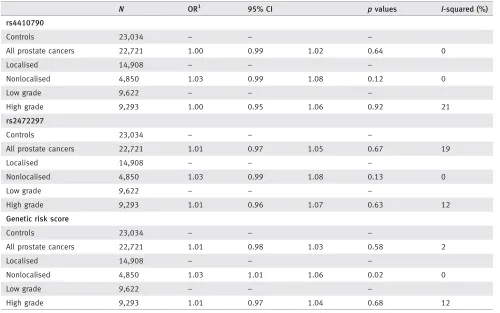
There was no clear evidence that the coffee-related SNPs were associated with prostate cancer case status or having high grade compared to low grade disease (Table 1). The odds ratios (OR) for prostate cancer and high grade disease
Table 1.Associations of coffee related SNPs with prostate cancer risk, stage and grade
N OR1 95% CI pvalues I-squared (%)
rs4410790
Controls 23,034 – – –
All prostate cancers 22,721 1.00 0.99 1.02 0.64 0
Localised 14,908 – – –
Nonlocalised 4,850 1.03 0.99 1.08 0.12 0
Low grade 9,622 – – –
High grade 9,293 1.00 0.95 1.06 0.92 21
rs2472297
Controls 23,034 – – –
All prostate cancers 22,721 1.01 0.97 1.05 0.67 19
Localised 14,908 – – –
Nonlocalised 4,850 1.03 0.99 1.08 0.13 0
Low grade 9,622 – – –
High grade 9,293 1.01 0.96 1.07 0.63 12
Genetic risk score
Controls 23,034 – – –
All prostate cancers 22,721 1.01 0.98 1.03 0.58 2
Localised 14,908 – – –
Nonlocalised 4,850 1.03 1.01 1.06 0.02 0
Low grade 9,622 – – –
High grade 9,293 1.01 0.97 1.04 0.68 12
Analyses are adjusted for principal components and study and robust standard errors used to account for within study clustering. For the case trol analyses, the following studies did not contribute data: ProMPT, WUGS. For analyses of prostate cancer stage, the following studies did not con-tribute data: CPCS1, CPCS2, EPIC- Norfolk, QLD. For analyses of prostate cancer grade, the following studies did not concon-tribute data: MEC, UTAH.
1Associations are per coffee consumption increasing allele.
Cancer
per additional coffee increasing allele in the genetic risk score were 1.01 (95% CI: 0.98 to 1.03) and 1.01 (95% CI: 0.97 to 1.04) respectively. However, there was suggestive evidence that the genetic risk score for coffee consumption was associ-ated with higher odds of nonlocalised disease (OR per coffee increasing allele 1.03, 95% CI: 1.01 to 1.06).
Association of coffee SNPs with all-cause and prostate cancer-specific mortality
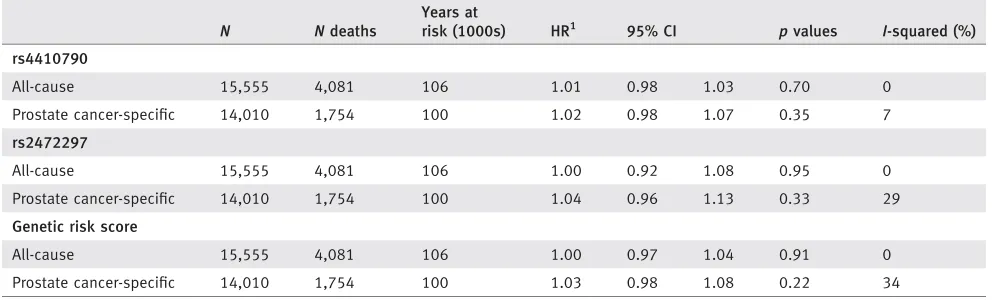
The 15,555 men who contributed to the all-cause mortality analysis were followed up for an average of 6.8 years, during which 4,081 died. The 14,010 men who contributed to the prostate-cancer specific analysis were followed up for an average of 7.1 years during which 1,754 died of prostate can-cer. There was no clear evidence that the individual coffee related SNPs or the genetic risk score for coffee consumption were associated with all-cause mortality (hazard ratio per cof-fee increasing allele of the genetic risk score: 1.00 (95% CI: 0.97 to 1.04)) or with prostate cancer mortality: HR 1.03 (95% CI: 0.98 to 1.08) (Table 2). There was no evidence to suggest that the proportional hazards assumption of Cox regression was not met in this analysis.
Discussion
We performed a Mendelian randomization analysis in a large prostate cancer case control study to investigate whether cof-fee consumption causally influences prostate cancer incidence and progression. We found no clear evidence to suggest that coffee consumption is causally associated with risk of prostate cancer, disease grade or mortality amongst men diagnosed with prostate cancer.
Our findings suggest that observational associations indi-cating that coffee consumption reduce prostate cancer risk and progression1,3,4,20 may not be causal and could be explained by residual confounding or by other lifestyle or demographic factors. Given that the associations between the
genetic risk score and blood caffeine levels may be null or in the opposing direction to coffee consumption,16 we cannot use these results to draw strong conclusions about any poten-tial role of caffeine in the development of prostate cancer.
Our finding of a weak positive association between the coffee genetic risk score and increased risk of nonlocalised disease is in the opposite direction to observational evidence suggesting that coffee may reduce risk of disease progres-sion.3 Interestingly, this raises the possibility that higher cof-fee, tea or caffeine consumption or, conversely, that lower blood caffeine levels (due to faster caffeine metabolism) could be associated with progression to more severe disease. How-ever, given that the case definition for prostate cancer (including stage of cancer cases) and quality of survival follow-up data differed between studies, we cannot rule out the possibility that this result could be due to selection bias. This finding requires replication in further studies before any conclusions can be made with respect to causality.
There are several limitations to these analyses. First, as aforementioned, there is heterogeneity between studies in terms of case definition, treatment received, classification of stage, grade and mortality follow up. Second, as discussed previously and shown by the associations in the four PRAC-TICAL studies with caffeine consumption data, these genetic instruments are not specific to coffee and associate with con-sumption of other caffeinated beverages (e.g., tea), and even with decaffeinated coffee.10,13 Although we did not find strong evidence for an association with coffee specifically in our subsample, coffee consumption is widespread in most European and North American populations, so it is likely that coffee is consumed at high enough levels in the full sam-ple for the genetic instrument to be sufficiently strongly asso-ciated with coffee.21,22 Whilst we cannot attribute any effects of these variants to coffee specifically, lack of a negative asso-ciation of these SNPs with prostate cancer outcomes still pro-vides evidence against coffee being protective for prostate
Table 2.Associations of coffee related SNPs with all-cause and prostate cancer-specific mortality in prostate cancer cases
N Ndeaths
Years at
risk (1000s) HR1 95% CI pvalues I-squared (%)
rs4410790
All-cause 15,555 4,081 106 1.01 0.98 1.03 0.70 0
Prostate cancer-specific 14,010 1,754 100 1.02 0.98 1.07 0.35 7
rs2472297
All-cause 15,555 4,081 106 1.00 0.92 1.08 0.95 0
Prostate cancer-specific 14,010 1,754 100 1.04 0.96 1.13 0.33 29
Genetic risk score
All-cause 15,555 4,081 106 1.00 0.97 1.04 0.91 0
Prostate cancer-specific 14,010 1,754 100 1.03 0.98 1.08 0.22 34
Analyses are adjusted for principal components and study and robust standard errors used to account for within study clustering. For analyses of all-cause mortality, the following studies contributed data: CAPS, CPCS1, EPIC, ESTHER, FHCRC, IPO-Porto, MAYO, MEC, PPF-UNIS, Poland, SEARCH, TAMPERE, UKGPCS, UTAH, WUGS. For analyses of prostate cancer mortality, the following studies contributed data: CAPS, CPCS1, EPIC, ESTHER, FHCRC, MAYO, MEC, PPF-UNIS, SEARCH, TAMPERE, UKGPCS, UTAH.
1Associations are per coffee consumption increasing allele.
Cancer
cancer. Thirdly, we were also unable to test the association of these instruments with potential confounders of the coffee-prostate cancer relationship within these samples so cannot rule out the possibility of pleiotropy (that the genetic variants act on prostate cancer through pathways unrelated to coffee/ caffeine consumption). SNPs in these gene regions (AHR and CYP1A1/2) have been identified in GWAS of blood pressure, bladder cancer and Parkinson’s disease,23,24 although these may be explained by downstream effects of caffeine or coffee consumption or metabolism. We know thatCYP1A2 metabo-lises other xenobiotic substrates other than caffeine and although neither of the SNPs used in this analysis were found to associate with blood metabolites (other than caffeine) at genome wide significance level,16we cannot rule out the pos-sibility that associations with prostate cancer occur via metabolism of these other compounds. In addition, cigarette smoking increases caffeine metabolism via induction of CYP1A2,25 so it is possible that effects could differ in smok-ers and nonsmoksmok-ers. In the subsample with information on smoking data, we found no clear evidence that the associa-tion of the genetic risk score with prostate cancer differed between ever and never smokers (Supporting Information Fig. 1). However, it is unlikely that we had sufficient power to detect an interaction. Finally, statistical power to detect associations in Mendelian randomization studies is substan-tially lower than conventional observational analyses. Although point estimates are very close to the null for most
findings, we cannot rule out the possibility that coffee may have small effects on prostate cancer. For example, the meta-analysis of coffee and prostate cancer conducted by Lu and colleagues in 2014 reports an OR of 0.96 for prostate cancer risk for the highest (at least 4 cups per day) compared to the lowest categories of consumption (generally<1 cup per day).2This would equate to an OR close to 0.999 for prostate cancer risk per additional 0.06 cups of coffee consumed. Our analysis was only powered to detect ORs in the region of 0.98 per additional 0.06 cups of coffee consumed.
In conclusion, our findings do not support a causal role of coffee consumption in prostate cancer incidence or grade and suggest that observational findings that coffee consumption is associated with a reduced risk for prostate cancer may be due to confounding by other lifestyle factors. Further investiga-tion of our finding that the genetic risk score was positively associated with risk of nonlocalised disease is required in samples which also have data on coffee consumption, and which have greater power to investigate a subsequent impact on prostate cancer specific mortality.
Acknowledgements
No funding body has influenced data collection, analysis or its interpreta-tions. The views expressed are those of the authors and not necessarily those of the NHS, the NIHR or the Department of Health. This publication is the work of the authors, who serve as the guarantors for the contents of this paper.
References
1. Cao S, Liu L, Yin X,et al. Coffee consumption and risk of prostate cancer: a meta-analysis of prospec-tive cohort studies.Carcinogenesis2014;35:256–61. 2. Lu Y, Zhai L, Zeng J,et al. Coffee consumption and prostate cancer risk: an updated meta-analy-sis.Cancer Causes Control2014;25:591–604. 3. Wilson KM, Balter K, Moller E,et al. Coffee and
risk of prostate cancer incidence and mortality in the Cancer of the Prostate in Sweden Study. Can-cer Causes Control2013;24:1575–81.
4. Shafique K, McLoone P, Qureshi K,et al. Coffee consumption and prostate cancer risk: further evi-dence for inverse relationship.Nutr J2012;11:42. 5. Wilson KM, Kasperzyk JL, Rider JR,et al. Coffee
consumption and prostate cancer risk and pro-gression in the Health Professionals Follow-up Study.J Natl Cancer Inst2011;103:876–84. 6. Discacciati A, Orsini N, Wolk A. Coffee
con-sumption and risk of nonaggressive, aggressive and fatal prostate cancer–a dose-response meta-analysis.Ann Oncol2014;25:584–91. 7. Jacobsen BK, Bjelke E, Kvale G,et al. Coffee
drinking, mortality, and cancer incidence: results from a Norwegian prospective study.J Natl Can-cer Inst1986;76:823–31.
8. Bosire C, Stampfer MJ, Subar AF,et al. Coffee con-sumption and the risk of overall and fatal prostate cancer in the NIH-AARP Diet and Health Study. Cancer Causes Control2013;24:1527–34. 9. Tunnicliffe JM, Shearer J. Coffee, glucose
homeo-stasis, and insulin resistance: physiological mech-anisms and mediators.Appl Physiol Nutr Metab 2008;33:1290–300.
10. McMahon G, Taylor AE, Davey Smith G,et al. Phenotype Refinement Strengthens the Associa-tion of AHR and CYP1A1 Genotype with Caf-feine Consumption.PloS One2014;9:e103448 11. Davey Smith G, Ebrahim S. ’Mendelian
randomi-zation’: can genetic epidemiology contribute to understanding environmental determinants of disease?Int J Epidemiol2003;32:1–22. 12. Cornelis MC, Monda KL, Yu K,et al.
Genome-wide meta-analysis identifies regions on 7p21 (AHR) and 15q24 (CYP1A2) as determinants of habitual caffeine consumption.PLoS Genet2011; 7:e1002033.
13. Coffee and Caffeine Genetics Consortium, Cornelis MC, Byrne EM,et al. Genome-wide meta-analysis identifies six novel loci associated with habitual coffee consumption.Mol Psychiatry 2015;20:647–56
14. Amin N, Byrne E, Johnson J,et al. Genome-wide association analysis of coffee drinking suggests association with CYP1A1/CYP1A2 and NRCAM. Mol Psychiatry2012;17:1116–29.
15. Hukkanen J, Jacob P, III, Peng M,et al. Effect of nicotine on cytochrome P450 1A2 activity.Br J Clin Pharmacol2011;72:836–8.
16. Shin SY, Fauman EB, Petersen AK,et al. An atlas of genetic influences on human blood metabo-lites.Nat Genet2014;46:543–50.
17. Kote-Jarai Z, Easton DF, Stanford JL,et al. Multi-ple novel prostate cancer predisposition loci con-firmed by an international study: the
PRACTICAL Consortium.Cancer Epidemiol Bio-markers Prev2008;17:2052–61.
18. Eeles RA, Olama AA, Benlloch S,et al. Identifica-tion of 23 new prostate cancer susceptibility loci using the iCOGS custom genotyping array.Nat Genet2013;45:385–91. 91e1-2.
19. Davies NM, Gaunt TR, Lewis SJ,et al. The effects of height and BMI on prostate cancer incidence and mortality: a Mendelian randomization study in 20,848 cases and 20,214 controls from the PRACTICAL consortium.Cancer Cause Control 2015;26:1603–16.
20. Yu X, Bao Z, Zou J,et al. Coffee consumption and risk of cancers: a meta-analysis of cohort studies.BMC Cancer2011;11:96
21. Freedman ND, Park Y, Abnet CC,et al. Associa-tion of coffee drinking with total and cause-specific mortality.N Engl J Med2012;366:1891–904. 22. Heatherley SV, Mullings EL, Tidbury MA,et al.
The dietary caffeine and health study: administra-tion of a large postal survey in Bristol.Appetite 2006;47:257–79.
23. Levy D, Ehret GB, Rice K,et al. Genome-wide association study of blood pressure and hyperten-sion.Nat Genet2009;41:677–87.
24. Burdett T, Hall PN, Hasting E, Hindorff LA, Junkins HA, Klemm AK, MacArthur J, Manolio TA, Morales J, Parkinson H, Welter D.The NHGRI-EBI Catalog of published genome-wide association studies.Available at: www.ebi.ac.uk/ gwas. Accessed 01/04/2016, version v1.0. 25. Benowitz NL, Peng M, Jacob P, III. Effects of
cig-arette smoking and carbon monoxide on chlor-zoxazone and caffeine metabolism.Clin Pharmacol Ther2003;74:468–74.