_____________________________________________________________________________________________________
Occurrence, Distribution and Antibiotic Sensitivity
Pattern of Bacteria Isolated from Some Selected
Fishes Sold in Bodija Market, Ibadan, Nigeria
O. B. Balogun
1*, O. Ogunsanmi
2and I. O. Olutimehin
31Department of Biological Sciences, Joseph Ayo Babalola University, Ikeji-Arakeji,Nigeria. 2
Department of Microbiology, Federal University of Technology, Akure, Nigeria.
3
Department of Animal Production, Joseph Ayo Babalola University, Ikeji-Arakeji, Nigeria.
Authors’ contributions
This work was carried out in collaboration among all authors. All authors read and approved the final manuscript.
Article Information
DOI: 10.9734/JAMB/2019/v15i430111 Editor(s): (1)Dr. Muhsin Jamal, Department of Microbiology, Abdul Wali Khan University, Garden Campus, Mardan, Pakistan. Reviewers: (1)Dr. S. Murugesan, University of Madras, India. (2)Prof. Moses Mwajar Ngeiywa, University of Eldoret, Kenya. Complete Peer review History:http://www.sdiarticle3.com/review-history/47189
Received 27 November 2018 Accepted 07 February 2019
Published 06 April 2019
ABSTRACT
Fish constitutes the cheapest source of animal protein in the world. The nutritional qualities and the shelf ability of fish can be affected due to microbial contamination after harvesting. Hence, this study is designed to investigate the microbiological analysis of fish and the antibiotic sensitivity pattern of the isolated bacteria from some selected fish sold in Bodija Market in Ibadan, Nigeria.
Three different fish samples: Catfish (Clarias gariepinus), Sabalo fish (Prochilodus lineatus) and
Tadpole fish (Raniceps raninus) were bought from Bodija market in an ice packed bag and then
transported to Microbiology laboratory for further analyses. Microbial analysis were carried out using serial dilution and pour plate methods. The antibiotic sensitivity pattern on the bacteria
isolates were carried out using commercial antibiotics. E. coli, Pseudomonas aureginosa,
Staphylococcus aureus, Serratia spp, Klebsiella spp, Salmonella spp, Shigella spp were isolated. Gram negative bacteria were more susceptible to most of the antibiotics used than gram positive
bacteria. E. coli showed the highest susceptibility to all the antibiotics with varied zone of
inhibitions. Salmonella spp show the highest susceptibility to septrin with the lowest zone of
inhibition to pefloxacin. Shigella spp had the lowest zone of inhibition to gentamycin, rocephin,
septrin and erythromycin when compared to other bacterial isolates. Serratia spp exhibited highest
zone of inhibition to gentamycin. Fish contamination can be averted by employing good environmental conditions and preservation methods to avoid spoilage. The antibiotics sensitivity showed that all the bacteria isolated were more susceptible to antibiotics, thereby developing a resistant strain.
Keywords: Antibiotic sensitivity; zone of inhibition selected fishes; Bodija market.
1. INTRODUCTION
Fish constitutes the cheapest source of animal protein in Africa. It is one of the main food components of human for many centuries and still constitutes an important part of the diet of
many homes [1]. The advantage of fish as a food
resulted from its easy digestibility and high nutritional value. Fishes are naturally found in water or artificially bred either for individual consumption or for commercial purposes. An earth surface is covered by 70% of water. The fresh water and salt water serve as natural
reservoir for different type of fishes [2]. The
quality of fish as well as its potential keeping time deteriorates rapidly leading to losses with regards to acceptable quality due to the growth of microorganisms or non-microbial causing lipid oxidation. Africa is endowed and constitute a rich source of numerous species of fresh fishes which
include Clarias spp, Bagrus spp, Tilapia and
others [3]. The smoking of fish from smouldering
wood helps in fish preservation giving the product a desirable taste and odour, longer shelf life through its antibacterial and oxidative effect, lowering of pH, impartation of desirable colouration and antagonising spoilage agents. Spoilage of food products can be due to
chemical, enzymatic or microbial activities [4].
Chemical deterioration and microbial spoilage are responsible for loss of 25% of gross primary agricultural and fish products every year and one-fourth of the world’s food supplies through microbial activity alone. Around 4-5 million tons of trawled and shrimp fish are lost every year due to enzymatic and microbial spoilage because of
improper on-site storage [5]. Spoilage of fish
result in changes in its components forming a new compounds which are responsible for the changes in odour, flavour and texture of the fish
meat [6]. Higher energy demanding
freeze-storage, preservation can be altered by synthetic or natural preservatives for control of lipid oxidation and microbial growth in fish during storage. Combination of different preservation methods such as smoking and refrigeration
retard the growth of spoilage microorganisms [7].
Compositional changes during fish spoilage result in lipid oxidation and protein degradation as well as the loss of other valuable molecules
[8]. In order to develop optimum preservation
techniques for these value added products in active forms, deep understanding of the mechanism responsible for their degradation is
essential [9]. Bacteriological quality is of
importance to public health as it directly relates to spoilage of fish and becomes the cause of food poisoning. Microbial hazards causing infections and poor health are closely related to food safety concerning the animal proteins derived from marketed food fish, fishery products and meat products. This creates a burning question for all consumers with a high risk commodity with regard to pathogenic bacteria contaminations which is alarming to food safety
challenge [10]. Food borne disease results from
the ingestion of bacteria and the toxins produced by microorganisms present in the marketed. However, this study isolates and enumerate microorganisms associated with three different species, fish commonly sold in Bodija market, Ibadan and also to know the antibiotic sensitivity pattern of the microorganism isolated from the fish species.
2. MATERIALS AND METHODS
2.1 Sample Collection
Fish samples: Catfish (Clarias gariepinus),
Sabalo fish (Prochilodus lineatus) and Tadpole
fish (Raniceps raninus) were bought from Bodija
Market, Oyo State from five different sellers between January and March. The samples were collected in an ice-packed bag and the immediately transported to the Microbiology laboratory for further microbiological analyses.
2.2 Isolation, Enumeration and
Identification of Bacterial Isolates
fish samples as described by [8]. About 10 g of the fish samples was cut from the head, middle and tail regions with a sterile knife. The samples were crushed into small pieces in a sterile mortar and homogenized in 10 ml sterile distilled water; 1 ml aliquot was measured and dispensed into a test tube containing 9 ml sterile distilled water
and serially diluted up to 106 dilution factor. Zero
point one milliliter (0.1ml) of the diluent was aseptically pipetted and dispensed into sterile Petri dishes. The inoculated plates were pour plated using already sterilized molten agar
medium (Nutrient agar, Salmonella Shigella agar
and Mannitol salt agar). The plates were
incubated at 37ºC for 24 hrs. After incubation, the
colonies were enumerated and recorded. Pure cultures of the bacterial isolates were obtained by continuous streak on the appropriate medium. The bacterial isolates were identified based on their morphological and biochemical
characteristics [8].
2.3 Antibiotics Sensitivity Test
Antibiotic sensitivity of the bacterial isolates was tested by disc diffusion method with an inoculums and agar dilution method. The interpretive categories were defined according to the zone diameter of inhibition. The broth culture of the bacterial isolates were prepared. Sterilized Muller Hinton agar was poured into sterile Petri dish allowed to gel, and was seeded with 16-24 hr old broth culture by swabbing using a sterile glass spreader. The commercial antibiotics sensitivity disc were gently placed on the plate
and labeled. The plates were inoculated at 37ºC
for 24 hrs and then examined for zones of
inhibition. The antibacterial susceptibility pattern was measured by the zones of inhibition,
examined and interpreted accordingly [10]. The
antibiotics used were PEF- Pefloxacin, GEN-Gentamycin, APX-Ampliclox, Z-Zinnacef, AM-Amoxacillin, R-Rocephin, CPX- Ciprofloxacin, SXT- Septrin and E-Erythromycin.
3. RESULTS
3.1 Total Bacterial Counts
Table 1 shows the total bacterial counts from the fish samples. The highest bacterial loads 2.0
were obtained from Sabalo fish (Prochilodus
lineatus) while the Catfish (Clarias gariepinus)
and Tadpole fish (Raniceps raninus) showed no
significant difference in their least counts 1.0.
The bacteria isolated were E. coli, Pseudomona
auroginosa, Staphylococcus aureus, Serratia
spp, Klebsiella spp, Salmonella spp, Shigella spp
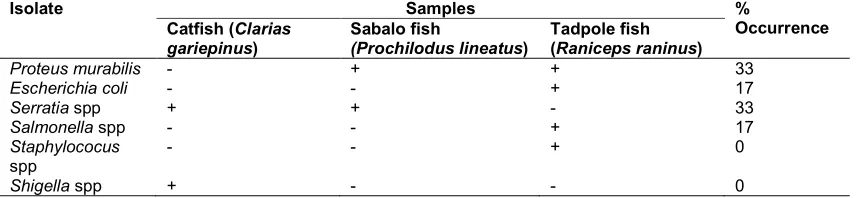
(Table 2). Proteus spp and Serratia spp were
found to be most occurring bacteria followed by
Esherichia coli and Salmonella spp while
Staphylococus spp and Shigella spp had no occurrence.
3.2 Morphological and Biochemical Characterization of Bacterial Isolates
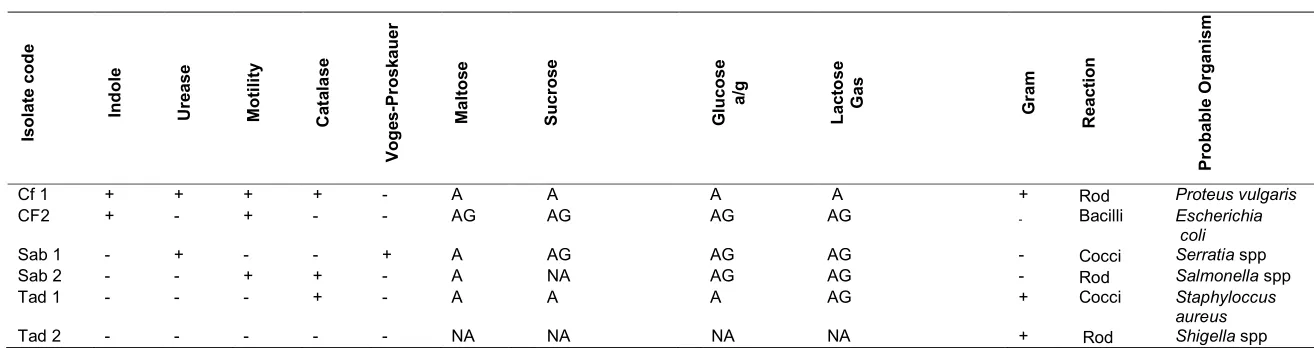
Tables 3 and 4 show the morphological and biochemical characterization of the bacterial
isolates. The bacteria isolated were E. coli,
Pseudomonas aureginosa, Staphylococcus aureus, Serratia spp, Klebsiella spp, Salmonella
spp, Shigella spp.
Table 1. Total bacterial counts from the fish samples
Sample Total bacterial counts (cfu/g) x 105
Catfish (Clariasgariepinus) 1.0
Sabalo fish (Prochilodus lineatus) 2.0
Tadpole fish (Raniceps raninus) 1.0
Table 2. Occurrence and percentage occurrence of bacteria isolated from fish sample
Isolate Samples %
Occurrence Catfish (Clarias
gariepinus)
Sabalo fish
(Prochilodus lineatus)
Tadpole fish (Raniceps raninus)
Proteus murabilis - + + 33
Escherichia coli - - + 17
Serratia spp + + - 33
Salmonella spp - - + 17
Staphylococus spp
- - + 0
4
Table 3. Morphological characterization of the bacterial isolates
Isolate code Elevation Edges Optical characteristic Colour Surface Cell arrangement
Cf 1 Raised Entire Opaque Pink Smooth Chain
Cf 2 Raised Entire Opaque Cream Smooth Cluster
Sab1 Raised Entire Translucent Dark green Smooth Cluster
Sab 2 Flat Entire Opaque Cream Smooth Cluster
Tad 1 Flat Entire Opaque Cream Smooth Cluster
Tad 2 Entire Entire Opaque Yellow Smooth Cluster
Table 4. Biochemical characteristics of the bacterial isolates
Isolate
cod
e
Ind
ole
Ur
ea
se
Motili
ty
Ca
ta
la
se
Vog
e
s
-Pr
os
k
au
er
Malto
s
e
Suc
rose
G
lucos
e
a/
g
Lac
to
se
Gas Gram
Rea
ct
ion
Pro
bab
le
Or
gan
ism
Cf 1 + + + + - A A A A + Rod Proteus vulgaris
CF2 + - + - - AG AG AG AG - Bacilli Escherichia
coli
Sab 1 - + - - + A AG AG AG - Cocci Serratia spp
Sab 2 - - + + - A NA AG AG - Rod Salmonella spp
Tad 1 - - - + - A A A AG + Cocci Staphyloccus
aureus
Tad 2 - - - NA NA NA NA + Rod Shigella spp
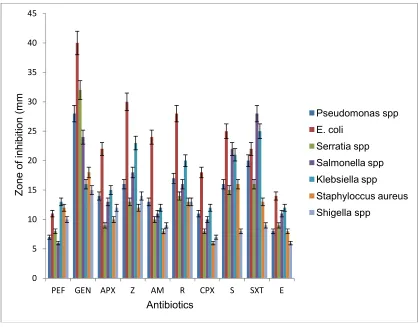
Fig. 1. Antibiotic sensitivity test on the bacterial isolates
Key: PEF- Pefloxacin, GEN-Gentamycin, APX- Ampliclox, Z-Zinnacef, AM-Amoxacillin, R-Rocephin, CPX- Ciprofloxacin, SXT- Septrin, E-Erythromycin, S- Septromycin
3.3 Antibiotic Sensitivity Test of the Bacterial Isolates
Fig. 1 shows the antibiotics sensitivity test of the bacterial isolates. All the bacteria isolated were
susceptible to all the antibiotics used E. coli
showed the highest susceptibility to all the antibiotics with varied zone of inhibitions.
Salmonella spp show the highest susceptibility to SXT with the least zone of inhibition to
pefloxacin. E. coli had the highest zone of
inhibition to gentamycin when compared to other
isolates. Shigella spp had the least zone of
inhibition to gentamycin, rocephin, septrin and erythromycin when compared to other bacterial
isolates. Serratia spp exhibited highest zone of
inhibition to gentamycin.
4. DISCUSSION
The growth and survival of fishes in a water depend on the physico-chemical conditions
surrounding the water environment. The
presence or accumulation of hazardous waste material in the water bodies might affect the
survival and quality of fishes. Different
microorganisms are present in nature likewise those found in the water body can be natural microflora of fish. The growth of these
microorganisms when considered in
commercially sold fish might render it
unacceptable. This could pose health concern by ensuring fishes are free of contaminant mostly the pathogenic microorganisms. The occurrence of this microorganisms might arise possibly contamination during sales and unhygienic handling of fish products, organic waste used for feeding of the fishes and their ability to survive in
different habitats. Isolation of E. coli and
Salmonella spp from marketed pawpaw fruit has
been reported [11]. The presence of
Staphyloccus aureus may lead to contamination of food and eventually affects the health of the
consumers. Oni et al. [12] reported the
0 5 10 15 20 25 30 35 40 45
PEF GEN APX Z AM R CPX S SXT E
Z
o
n
e
o
f
in
h
ib
it
io
n
(
m
m
Antibiotics
Pseudomonas spp
E. coli
Serratia spp
Salmonella spp
Klebsiella spp
Staphyloccus aureus
occurrence of Staphylococcus aureus, Escherichia coli and Samonella spp from ponmo sold in Ogbese market. The result obtained from
this study agrees with the findings of [13] who
reported isolation of Staphylococcus aureus from
smoked fish.
Assessment of the antibiotic resistance among bacteria against antimicrobial agents is important for update on the bacterial antibiotic resistance patterns. It is part of a surveillance system aiming at monitoring emerging antibiotic resistant bacteria and their widespread. Isolation of antibiotic resistant bacteria from fish and aquaculture environment indicates the health risk associated with the aquaculture. The antibiotic sensitivity test helps to ascertain their level of susceptibility or resistance of microorganisms to commonly used antibiotics. The relatively high level of resistance to antimicrobial agents is a reflection of misuse or abuse of these agents in the environment. The high susceptibility level of
E.coli to gentamycin when compared to other antibiotics had been reported by Spanggard et al.
[14]. The resistance of microorganisms to some
antibiotics might be due to resistance gene possess by them thereby causing cell lysis reported susceptibility of most pathogenic microorganisms to gentamicin and Zinnacef. Low frequency of antibiotic resistant bacteria may indicate the less activity associated with the
contamination of antibiotics in the area [15]. The
use of antibiotics clearly show its effectiveness in control the growth of pathogenic microorganisms, inhibiting protein synthesis, which prevent their
permeability through their peptidoglycan layer [16
and 17]. The development of resistance is inevitable following the introduction of a new antibiotic. Initial rates of resistance to new drugs are normally on the order of 1%. However, modern uses of antibiotics have caused a huge increase in the number of resistant bacteria.
5. CONCLUSION
High microbial load encountered in this study could account for the pathogenic microorganisms isolated and this can be controlled through proper hygienic and good maintenance of fish and fish products. The use of antibiotics inhibits
the growth of spoilage and pathogenic
microorganisms. Therefore, awareness of
antibiotic resistance threat should be instilled in the community regardless of age as precaution and prevention step against dissemination of antibiotic resistant bacteria.
ETHICAL APPROVAL
As per international standard or university standard written ethical permission has been collected and preserved by the authors.
ACKNOWLEDGEMENTS
The authors appreciate Mr. Adeleke
Bartholomew for his tremendous impact to the research article. They also appreciate Prof K. I. T. Eniola, Prof Arutopin Mrs O. O. Ajayi, Mr.
Oresegun and Mr. Ayo for word of
encouragement. The authors also I appreciate my colleagues for their contribution.
COMPETING INTERESTS
Authors have declared that no competing interests exist.
REFERENCES
1. Abbas KA, Saleh AM, Mahmoud A,
Lasekan O. The relationship between water activity and fish spoilage during cold storage: A review. J. Food, Agric. Environ. 2009;7:86-90.
2. Adekoya BB, Ayansanwo TO, Iduwu AA,
Kudoro OA, Salisu AA. In directory of fish hatcheries in Ogun State. Agricultural
Development Programme (OGADEP).
Abeokuta. 2006;18.
3. Ajayi OO, Balogun OB, Oriowo-Olaleye M,
Faturoti MO. Microbial analysis and proximate composition of boiled and fried
local cheese (WARA). International
Journal of Scientific and Research
Publications. 2018;8(12):710-717.
4. Akinyele BJ, Oladejo BO, Bankefa EO,
Ayanyemi SA. Microbiological
analysis and antimicrobial sensitivity
pattern of microorganism isolated from
vegetables sold in Akure, Nigeria.
International Journal of Current
Microbiology and Applied Sciences. 2013; 2(10):306-313.
5. Archer DL. Evidence that ingested nitrate
and nitrite are beneficial to health. J. Food Protect. 2002;65:872-875.
6. Charo H, Oirere W. River-based artificial
propagation of the African Catfish,
7. Hirsch R, Ternes T, Haberer K, Kratz KL. Occurrence of antibiotics in the aquatic
environment. Science of the Total
Environment. 1999;225:109-118.
8. Holt JC, Krieg NR, Sneath PHA, Stalley
JT, Williams ST. Bergey′s manual of determinative bacteriology. Nineth edition.
Philadelphia: Lippincott Williams and
Wilkins. 1994;20-90.
9. Kirby RM, Bartram B, Carr R. Water in
food production and processing. Quality and Food Control. 2003;14:283-299.
10. Kondro W. E. coli outbreak deaths spark
judicial inquiry in Canada. The Lancet. 2000;355:2058.
11. Olukitibi TA, Adetuyi FC, Adeleke BS, Abe
SC. Isolation and antibiogram of bacteria isolated from processed and unprocessed cowskin (Ponmo) in Ogbese Market. Journal of Advances in Microbiology. 2017; 2(4):1-8.
12. Oni OO, Olalemi AO, Balogun OB. The
effect of Aloe vera Gel on Microorganisms Associated with the Deterioration of Sweet
Orange Fruits (Citrus sinensis). Journal of
Advances in Microbiology. 2018;12(4): 1-12.
13. Reij MW, Den Aantrekker ED. Europe risk
analysis in microbiology task force 2. Recontamination as a source of pathogens in processed foods. International Journal of Food Microbiology; 2003. Article in press.
14. Spanggard B, Jorgenses FG, Huss HH.
Antibiotic resistance in bacteria isolated from three freshwater farms and an unpolluted stream in Demark. Aquaculture. 1993;115:195-207.
15. Tiamiyu AM, Soladoye MO, Adegboyega
TT, Adetona MO. Occurrence and
antibiotic sensitivity of bacterial strains
isolated from Nile Tilapia, Oreochromis
niloticus obtained in Ibadan, Southwest
Nigeria. Journal of Bioscience and
Medicine. 2015;3:19-26.
16. Venugopal V. Biosensors in fish production
and quality control. Biosensors and Bioelectronics. 2002;17:147-157.
17. Watkins SM, Reich A, Fleming LE,
Hammond R. Neurotoxic shellfishpoison-ing. Marine Drugs. 2008;6(3):431–455. _________________________________________________________________________________ © 2019 Balogun et al.; This is an Open Access article distributed under the terms of the Creative Commons Attribution License (http://creativecommons.org/licenses/by/4.0), which permits unrestricted use, distribution, and reproduction in any medium, provided the original work is properly cited.
Peer-review history: