www.wjpls.org 160 Department of Physiology, Indira Gandhi Medical College (IGMC), Shimla, India.
Article Received on 09/10/2019 Article Revised on 30/10/2019 Article Accepted on 20/11/2019
INTRODUCTION
Beta blockers form a common class of anti-hypertensive drugs used to treat human with high blood pressure by lowering the systolic and diastolic blood pressure upto 15-20% in a single drug treatment.[1] Atenolol, esmolol, metoprolol and propranolol (Fig. 1) are among the most commonly used beta blocker drugs for the treatment of various cardiovascular disorders such as angina pectoris, cardiac arrhythmia and systematic hypertension.[2] These are also used in the management of alcohol withdrawal, in anxiety states, migraine prophylaxis, hyperthyroidism and tremors or as an illegal doping agent in sports due to their soothing effects.[2-3] The excessive use and over dose of these drugs can lead to several health problems viz. bradycardia, severe hypotension, aggravation of cardiac failure, sinus pause, hypoglycemia and bronchospasm.[3-4] Therefore, for a better remedial effect,
it is highly desirable that the quality of marketed formulations of these drugs must be ensured. The beneficial effects of drugs are maximized when the plasmatic concentration remains under their therapeutic range. Therapeutic drug monitoring is a clinical practice, carried out through the quantification of the drug and its main metabolites in physiological fluids at several times after the ingestion of the pharmaceutical formulation.[5] Beta blockers have also been reported to occur in the water bodies affecting their quality characteristics via excretion with body fluids and substantial amounts of these drugs and their metabolites are discharged into hospital and domestic waste waters as well as industrial waste waters. Moreover, limited metabolism of these compounds in the human body as well as the lack of effective methods of their removal from the sewage cause additional problems.[6-7]
*Corresponding Author: Pushap Raj
Department of Chemistry, Himachal Pradesh University, Shimla, Himachal Pradesh, India.
ABSTRACT
The excessive use and over dose of beta blockers used for the treatment of various cardiovascular disorders can lead to several health problems. This necessitates new methodologies for the determination of these drug compounds. A simple, selective and precise RP-HPLC method was developed and validated for the assay of some beta blockers in commercial formulations, spiked water and biological samples. Gradient reverse phase elution of mobile phase comprising of methanol and water (90:10) with optimized flow rate of 0.8 mL min-1 on a low carbon loaded TSK 250-Biogel C-8, Phenyl-X Gel-7PW, HPLC column (150mm X 3.5µm, i.d. 4.6mm) was controlled to 65 minutes after complete resolution of the peaks present in the matrix without any interferences with the neighboring excipients with least HETP value. Beta blockers viz. atenolol, esmolol, propranolol and metoprolol were analyzed and quantified at retention time 30.1, 29.8, 33.4 and 34.2 minutes respectively at their corresponding absorption wavelengths of 226, 280, 291 and 262 nm by sensitive DAD detector embedded in the HPLC system. The method was validated as per ICH guidelines. The low values of LOD (10-3 µgL-1) and LOQ (10-1 µgL-1) calculated using standard calibration curve indicated high sensitivity of the proposed method. Excellent recoveries in the range 95.76-100.12% were recorded for the determination of these drugs in commercial formulations, spiked water and biological samples. The proposed method finds huge potential in the routine analysis of beta blockers.
Fig. 1: Chemical structures of atenolol, esmolol, propranolol and metoprolol.
In view of the above, the determination of these drugs in commercial formulations, biological fluids and water samples is of great importance. Literature survey revealed various methods for the analysis of these drugs in pharmaceutical formulations and in biological fluids
including spectrophotometry,[8-12] NMR,[13]
fluorimetry,[14-15] gas chromatography (GC),[16-18] high performance liquid chromatography (HPLC)[1,3,19-24] and capillary electrophoresis etc.[25-27] Despite the inherent simplicity, low cost, precision and accuracy of spectrophotometric methods, HPLC methods are more sensitive, robust and rapid than spectrophotometric methods. HPLC combined with fluorescence detection[21] or ultraviolet (UV) absorption[21,23] as well as liquid
chromatography-tandem mass spectrometry
(LCMS/MS)[4,28] are the preferred methods in terms of sensitivity and selectivity.
Most of the reported analytical methods did not focus exclusively on the determination of individual beta blockers but were used for the simultaneous determination with other drugs.[1,4,16,19-24] A thorough search of literature of beta blockers analysis indicated that the reported methods involve costly and hazardous solvents with moderate limits of detection. Furthermore, it was observed that the reported methods describe moderate HPLC separation of beta blockers. Besides, most of the methods utilized traditional sample treatment methods i.e. liquid-liquid extraction. In view of these facts, there is a great need of economically and environmentally viable solid phase extraction (SPE) and HPLC methods. Certainly, such methods will reduce the economic pressure faced by the pharmaceutical industries and research laboratories for beta-blockers development and analysis. SPE has the merits of less organic solvent consumption, high extraction recoveries and simultaneous extraction.
Considering the limitations of the existing methods, attempt have been made to develop simple, efficient and reproducible RP- HPLC method by employing a low carbon loaded TSK 250-Biogel C-8, Phenyl -X Gel-7PW, HPLC column (150 mm X 3.5µm, i.d. 4.6 mm)
resulting in the complete resolution of the peaks present in the matrix without any interferences with the neighboring excipients along with least HETP value with low detection limits for the determination of above mentioned beta blockers in commercial formulations and chemical and biological matrices.
MATERIALS AND METHODS
Chemicals and reagents
Analytical standards of atenolol (98%), esmolol (98%), propranolol (99%) and metoprolol (98%) of the active ingredient were procured from Sigma Aldrich Bangalore India. Methanol, acetonitrile and water (HPLC Grade; Merck, Germany) was used as such. AR grade chemicals were used in the analysis.
Instrumentation
RP-HPLC analysis were carried out on an Agilent 1200 series HPLC system with 1200 series binary pump (G1312B), a 1200 series gradient pump (G1310A) and a degasser (G1379B) (Agilent Technologies, Germany) connected to an autosampler with Chemstation 6.0 version software package along with a DAD detector(G1315D).
Development of HPLC Method
blockers was prepared by dissolving precisely weighed 10 mg of each pure drug compound in 100 mL of HPLC grade water. The working concentrations were prepared by diluting 1 mL of standard stock solution to 100 mL with water to form a standard solution having concentration 103 µg L-1.
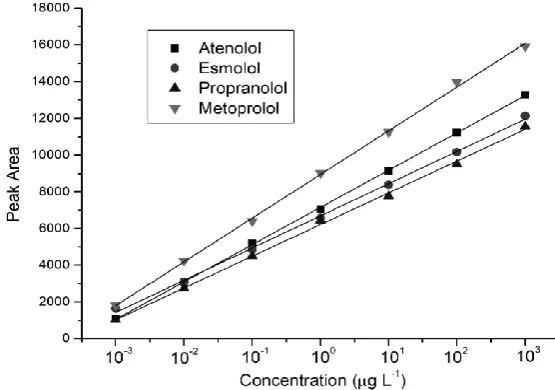
water to prepare working solutions containing 10 -10 µg L-1 of each drug for RP-HPLC analysis. Calibration curves for beta blockers were plotted between peak area (at their retention time) and concentration for their quantitative determination (Fig. 2).
Fig. 2: Calibration curves showing relationship between peak area and concentration of beta blockers.
Formulation analysis
Pharmaceutical formulations of atenolol, esmolol, propranolol and metoprolol were purchased from local authorized dealers ATEN-50 (Zydus Cadila Healthcare Ltd. India) and HIPRES-50 (Cipla Ltd. India) labelled to contain 50 mg of atenolol per Tablet, Neotach vials (Neon Laboratories Ltd. India) labelled to contain 10 mg of esmolol per mL of aqueous solution, Inderal-40 (Abbott Healthcare Pvt. Ltd. Himachal Pradesh, India) and Ciplar-10 (Cipla Ltd. Sikkim, India) labelled to contain 40 mg and 10 mg of propranolol per tablet respectively and Metolar-50 and Metolar-25 (Cipla Ltd. Goa, India) labelled to contain respectively 50 and 25 mg of metoprolol per tablet. The stock solution was prepared by dissolving accurately weighed amount equivalent to 50 mg of active ingredient of each drug in HPLC grade water and sonicated for 10 min. The solution was filtered and residue was washed 2-3 times with water. The
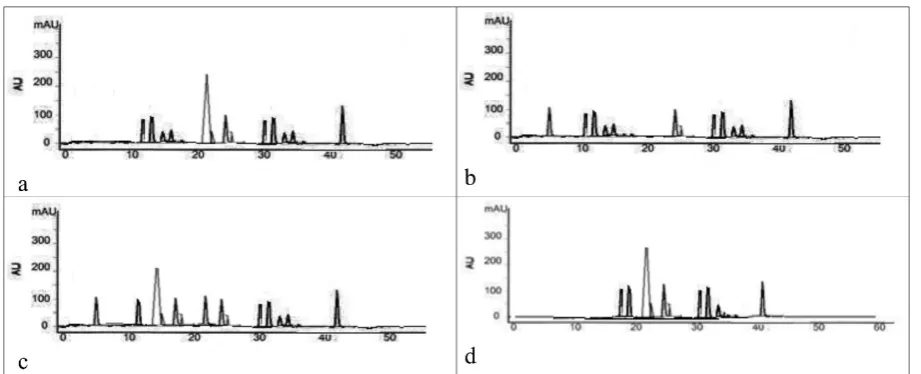
Fig. 3: Typical RP-HPLC chromatograms of beta blockers from various commercial formulations.
Quantification of beta blockers in spiked water and biological samples
Tap water and simulated biological fluids viz. blood plasma, urine and phosphate buffer saline 10 mL each were taken in different flasks and were added to various
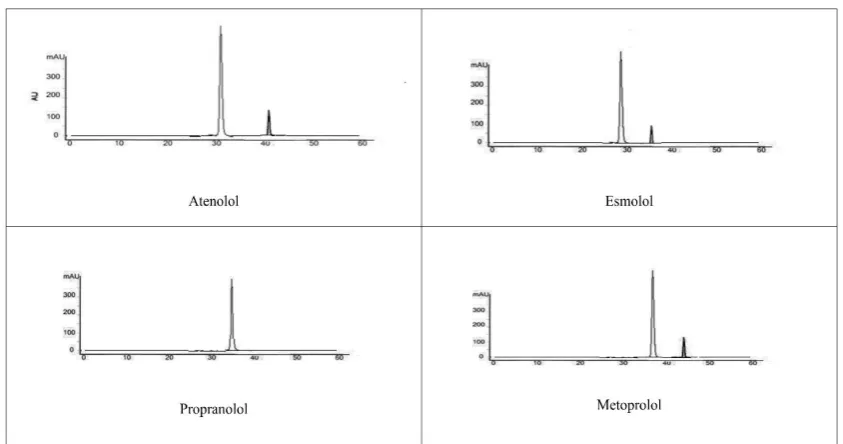
aliquots of the standard solution (103 µg L-1) of each drug. 10 µL of each solution was taken and processed for HPLC analysis as performed for pure drug compounds employing the developed RP-HPLC method. Typical HPLC chromatograms are shown in Fig. 4-7.
Fig. 4: RP-HPLC chromatograms for the quantification of atenolol from a: blood plasma, b: phosphate buffer, c: urine and d: water sample.
Fig. 6: RP-HPLC chromatogram of propranolol from a: blood plasma, b: phosphate buffer, c: urine and d: water sample.
Fig. 7: RP-HPLC chromatogram of metoprolol from a: blood plasma, b: phosphate buffer, c: urine and d: water sample.
RESULTS AND DISCUSSION
Chromatographic conditions were carefully optimized to develop the gradient reverse phase HPLC method for the determination of beta blockers for better separation and resolution. Different Mobile Phase and buffers combinations were tried and final mobile phase gradient was set (Table 1). The retention pattern of beta blockers in RP-HPLC is found to be susceptible to the changes in the type and concentration of organic solvent(s) in mobile phase. Since most of pure silica-based columns results poor peak symmetry using acetonitrile as mobile phase along with ammonium acetate of buffer capacity ~pH 6.5 that made us to test us additional mobile phases containing 100% of acetonitrile in the starting of the gradient. Beta blockers were not rentented at early stages because of their higher hydrophilicity and due to the presence of additional alkyl chains. Organic amines present in the structure of all beta blockers were not capable to decrease their RT during separation. Methanol was used concurrently with acetonitrile and drugs were
adequately detected (Fig. 2) with the highest peak symmetries particularly at a concentration of 30:70 (v:v) for methanol and acetonitrile respectively. Further, it was also demonstrated that, lipophilic alcohols are well adsorbed on silica. Whereas, Methanol is a moderately lipophilic alcohol and this can be the mechanism of the improvement in peak symmetries. It has also been found that use of ammonium acetate 10 mM improves peak shape by reducing tailing of the peaks than other buffers after fixing pH to 6.5. TSK 250-Biogel (C-8, Phenyl -X Gel-7PW) HPLC column (150 mm X 3.5µm,i.d. 4.6 mm) low carbon loaded (8 carbon atoms) was selected based on the structure, polarity and stability of beta blockers due to the presence of polar -OH, -NH2 and -O-
functional moieties in their structures.
mL min-1 using Van-Deemter equation and no peak
tailing was observed under these optimized
chromatographic conditions with well resolved peaks. Retention time of atenolol, esmolol, propranolol and metoprolol were found respectively at 30.1, 29.8, 33.4 and 34.2 min matched with their standard compounds. All data were subjected to strict quality control procedures, including the analysis of procedural blanks and spiked samples with each set of samples analyzed. The drugs were not detected in the procedural blanks and method performance was satisfactory.
The system suitability test was performed as per the international conference of harmonization (ICH) guidelines[29] to confirm the suitability and the reproducibility of the method. Three consecutive injections of the standard solution were performed and evaluated for repeatability. The method was linear over the range 10-1-103 µg L-1 for each drug compound (Tables 2-5).
Table 2: RP-HPLC quantization limits for standard atenolol solutions.
Dilution Number Concentration (µg L-1) Retention Time (min) Peak Area Limits S/N ratio
1 103 30.1 13279 21.9
2 102 30.1 11227 19.2
3 101 30.1 9141 15.1
4 100 30.1 7063 13.2
5 10-1 30.1 5197 LOQ 10.1
6 10-2 30.1 3083 7.6
7 10-3 30.1 1080 LOD 4.9
Table 3: RP-HPLC quantization limits for standard esmolol solutions.
Dilution Number Concentration (µg L-1) Retention Time (min) Peak Area Limits S/N ratio
1 103 29.8 12130 22.8
2 102 29.8 10172 19.5
3 101 29.8 8383 15.6
4 100 29.8 6568 13.9
5 10-1 29.8 4852 LOQ 10.6
6 10-2 29.8 3083 7.8
7 10-3 29.8 1654 LOD 3.9
Table 4: RP-HPLC quantization limits for standard propranolol solutions.
Dilution Number Concentration (µg L-1) Retention Time (min) Peak Area Limits S/N ratio
1 103 33.4 11558 21.1
2 102 33.4 9507 19.4
3 101 33.4 7764 16.5
4 100 33.4 6432 13.2
5 10-1 33.4 4508 LOQ 10.3
6 10-2 33.4 2739 7.3
7 10-3 33.4 1023 LOD 3.2
Table 5: RP-HPLC quantization limits for standard metoprolol solutions.
Dilution Number Concentration (µg L-1) Retention Time (min) Peak Area Limits S/N ratio
1 103 34.2 15917 21.5
2 102 34.2 13980 19.7
3 101 34.2 11263 16.1
4 100 34.2 9013 13.8
5 10-1 34.2 6401 LOQ 10.2
6 10-2 34.2 4230 6.9
7 10-3 34.2 1826 LOQ 3.4
The calibration curve was constructed by plotting response factor against concentration of drug. The high values of the correlation coefficient (r2; 0.9984, 0.9981, 0.9989 and 0.9998) and the small values of the y-intercepts of the regression equations (the linearity curve
10 97.78 1.78 98.16 1.97 98.22 1.95 *Values are mean of three determinations.
†Maker’s specifications established by independent methods[8,9].
Table 7: RP-HPLC assay results of some commercial formulations† of propranolol and metoprolol.
Amount Taken (μg L-1)
Propranolol Metoprolol
Inderal-40 Ciplar-10 Metolar-50 Metolar-25
Recovery* (%) RSD Recovery* (%) RSD Recovery* (%) RSD Recovery* (%) RSD
10-1 100.02 2.57 99.98 2.38 99.32 2.87 100.05 2.76
100 98.45 2.19 99.14 2.86 98.38 2.43 98.29 2.17
101 99.28 1.83 98.25 1.77 99.19 2.02 99.03 1.96
102 98.84 1.47 99.37 1.29 99.26 1.87 98.72 1.67
*Values are mean of three determinations.
†Maker’s specifications established by independent methods.[8,10]
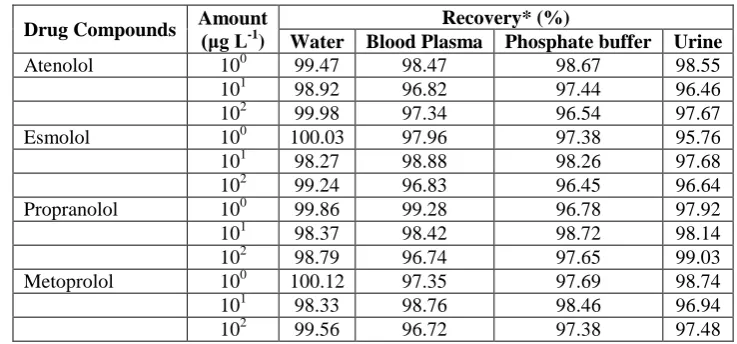
The method also gave good recoveries 95.76-100.12% (Table 8) when applied to the determination of these drug compounds in spiked water samples and simulated biological fluids.
Table 8: RP-HPLC assay results of beta blockers from spiked water samples and simulated biological fluids.
Drug Compounds Amount
(μg L-1)
Recovery* (%)
Water Blood Plasma Phosphate buffer Urine
Atenolol 100 99.47 98.47 98.67 98.55
101 98.92 96.82 97.44 96.46
102 99.98 97.34 96.54 97.67
Esmolol 100 100.03 97.96 97.38 95.76
101 98.27 98.88 98.26 97.68
102 99.24 96.83 96.45 96.64
Propranolol 100 99.86 99.28 96.78 97.92
101 98.37 98.42 98.72 98.14
102 98.79 96.74 97.65 99.03
Metoprolol 100 100.12 97.35 97.69 98.74
101 98.33 98.76 98.46 96.94
102 99.56 96.72 97.38 97.48
*Values are mean of three determinations.
CONCLUSION
This RP- HPLC method is simple, specific, sensitive and accurate and suitable for quantification of these beta blockers and can be potentially extended to their determination in other chemical and biological samples. The proposed method gives good resolution among the analyte and neighboring peaks. The method is simple as no complicated sample preparation is needed. High percentage recovery shows the method is free from
interference of excipients present in the formulation that establishes its high accuracy. Low LOD, good linearity range, high recoveries are the salient features of the developed RP-HPLC method. Low material cost in terms of HPLC column and ecofriendly mobile phases alongwith highly accurate and precise results of LOD and LOQ contribute towards the novelty of the
developed method. The validated method can
blockers in commercial formulations, water samples and simulated biological fluids and keeps pace with the advances of international technology.
CONFLICT OF INTERESTS
Authors declare that there are no competing interests.
REFERENCES
1. Elgawish MS, Mostafa SM, Elshanawane AA, Saudi Pharm J, 2011; 19: 43-9.
2. Bhushan R, Tanwar S, Chromatographia, 2009; 70: 1001-6.
3. Hemmati M, Asghari A, Bazregar M, Rajabi M, Anal Bioanal Chem, 2016; 408: 8163-76.
4. Khuroo A, Mishra S, Singh O, Saxena S, Monif T, Chromatographia, 2008; 68: 721-9.
5. Esteve-Romero J, Albiol-Chiva J, Peris-Vicente J, Anal Chim Acta, 2016; 926: 1-16.
6. Vieno NM, Tuhkanen T, Kronberg L, Water Res, 2007; 41: 1001-12.
7. Lee HB, Sarafin K, Peart TE, J Chromatogr A, 2007; 1148: 158-67.
8. Golcu A, J Anal Chem, 2008; 63(6): 538-43. 9. Narayana A, Rao CN, Rao CN, Sivakumar K, Indian
J Adv Chem Sci, 2014; 2: 289-93.
10. Amin AS, Ragab GH, Saleh H, J Pharm Biomed Anal, 2002; 30: 1347-53.
11. Sharma DK, Raj P, Int J Pharm Sci Res, 2017; 8(12): 5168-77.
12. Chavan AV, Patel AM, Narvekar VT, Kapase AR, Gaikwad S, World J Pharm Pharm Sci, 2019; 8(2): 582-618.
13. Zielinska-Pisklak MA, Pisklak DM, Wawer I, Magn Reson Chem, 2011; 49: 284-90.
14. Derayea S, Omar MA, Abdel-Lateef MA, Hassan AI, Open Chem, 2016; 14: 258-66.
15. Gorbani Y, Yilmaz H, Basan H, Luminescence, 2017; 32: 1391-7.
16. Jones OAH, Voulvoulis N, Lester JN,
Chromatographia, 2003; 58: 471-7.
17. Kumirska J, Łukaszewicz P, Caban M, Migowska N, Plenis A, Białk-Bielinska A, Czerwicka M, Qi F, Piotr S, Chemosphere, 2019; 232: 232-42.
18. Yilmaz B, Arslan S, Chromatographia, 2009; 70: 1399-404.
19. Vidyadhara S, Sasidhar RLC, Kumar BP, Ramarao NT, Sriharita N, Orient J Chem, 2012; 28(4): 1691-6.
20. Kamble N, Asirvatham S, Int J Pharm Res Bio-Sci, 2014; 3(6): 347-61.
21. Ranta VP, Toropainen E, Talvitie A, Auriola S, Urtti A, J Chromatogr B: Anal Technol Biomed Life Sci, 2002; 772(1): 81-7.
22. Vishnuvardhan C, Radhakrishnanand P, Navalgund SG, Atcha KR, Satheeshkumar N, Chromatographia, 2014; 77: 265-75.
23. Gracia MS, Köppl A, Unholzer S, Haen E, Biomed Chromatogr, 2017; 31: 1-11.
24. Imam SS, Ahad A, Aqil M, Sultana Y, Ali A, J Pharm Bioallied Sci, 2013; 5(1): 61-5.
25. Pazourek J, Perrin C, Massart DL, Chromatographia, 2002; 56: 597-603.
26. Wang Y, Wu Q, Cheng M, Cai C, J Chromatogr B, 2011; 879(13–14): 871-7.
27. Sun S, Wang Y, Liu X, Fu R, Yang L, Talanta, 2018; 180: 90-7.
28. Jakubus A, Gromelski M, Jagiello K, Puzyn T, Stepnowski P, Paszkiewicz M, Microchem J, 2019; 146: 258-69.