http://ijessr.com Page 194 RURAL AND URBAN DIFFERENTIAL IN TEACHING AND LEARNING GEOGRAPHY IN SENIOR SECONDARY SCHOOLS IN GOMBI EDUCATIONAL ZONE OF ADAMAWA
STATE
Dr Dorcas Oluremi Fareo
Department of Science Education, Adamawa State University, P. O. Box 411, Mubi Nigeria.
ABSTRACT
This study investigated the difference between teaching and learning of Geography by senior secondary school students in Gombi Educational Zone in Adamawa State. The research design that was adopted for this study was a descriptive research design. The population of the study comprised 120 senior secondary schools 300 Geography teachers. 100 Geography teachers were selected as sample from 50 senior secondary schools using stratified sampling techniques using sex and class strata.“Rural and Urban Deferential in Teaching and Learning Geography Questionnaire” (RUDTLGQ) was used to collect data. The instrument was validated by two experts in Counselling Psychology and Test and Measurement, Test-retest method was used to determine the reliability and the reliability coefficient of 0.85. Data collected were analyzed by using percentages and t-test analysis. The results revealed that there was a significant difference between the quality of teachers teaching Geography in rural and urban schools in Gombi Educational Zone. There was a significant difference between availability and adequacy of facilities and materials in teaching and learning Geography in rural and urban school in the study area. However, the study revealed that there was no significant difference between Geography urban and rural student performances in West African Examination Council (WAEC). In conclusion, secondary schools student from rural environment performed as well as students from urban environment. The government should ensure that all rural schools are provided with well-equipped weather station. The children should be provided with tools and equipment with which to learn by making the unfamiliar subject straight forward, practical, stimulating and interesting.
KEYWORDS: Geography; rural-urban school; rain gauge; thermometer and natural science
INTRODUCTION
http://ijessr.com Page 195 security and national development. The Australian Curriculum Assessment and Reporting Authority [ACARA] (2011) asserts that Geography potentially assists cross-disciplinary learning and helps students to recognize the connections between Geography and other fields of study or specialization. Therefore, knowledge of Geography is essential for successful living because of its practicable intellectual value.
According to ACARA (2011), Geography is so distinguished from other branches of study mainly because of its ability to achieve a holistic and integrated understanding of its subject matter by drawing on knowledge from the natural sciences, the social sciences and the humanities and as it incorporates such into geographic perspectives. Therefore, Geography is concerned with seeing a place in its total character and not in terms of a single phenomenon or a group of isolated phenomena (Abul, 2007).
Hence, the objectives of Geography according to Aman, (2012) include:
To enable students develop interest in both physical and cultural environment as a place, and home of humans and thus broaden their outlook,
To enable the pupils to acquire a knowledge of natural resources,
To develop in pupils an understanding of how environment and climatic factors have influenced our lives,
To develop in them an understanding of basic concepts, principles and theories relating to geographical and environmental phenomena,
To train the pupils in nature studies,
To help students to understand the concept of human environment relationships,
To help students to develop a sense of responsibility towards the physical and cultural aspects of environment,
To enable them recognize various landscape pattern,
To develop in students a scientific attitude and the ability to draw valid conclusions and independent thinking.
Thus, in line with the National Policy on Education which states that education is the right of every child (both rural and urban students) (Federal Republic of Nigeria [FRN], 2014), every child therefore (both in rural and urban schools) is in this light required to acquire geographical knowledge in order to live a healthy, successful life and contribute to the development of the nation. Hence, the odds associated with school location should not be justifiable criteria to deny rural or urban students from the acquisition of basic Geographical skills and knowledge.
http://ijessr.com Page 196 from the measures of individual to the measure of the environment. The reason that could be deduced for this trend range from the accurate prediction which measure of environment so as to bring about optimal condition for teaching and learning. For quite some time a general perception of the comparative inferiority of rural school has prevailed. This view implies the existence of rural-urban difference, also extends to many other socially desirable outcome of teaching and learning such as aptitude, intelligence and aspiration (De Young & Lawrence, 2009; Herzog & Pittman, 2009). Until recently, there has been little empirical evidence to challenge this view. Now however, a growing body of work has began to explain how well students performing teaching and learning in rural-urban schools.
The state of formal education at secondary level is a very important determinant of the quality and quantity of intake in tertiary level of education. On the same vein, the development of Geography studies in Nigeria is itself a function of the type of geographic education teaching going on in our various schools. The poor quality of Geography in Nigeria might become a caricature of the real thing especially in the new and less established school, which is in very bad condition for effective meaningful geographic teaching. The learning environments also have major roles to play in learning and the area where the students’ lives can determine their performance in their studies. Reason for the variations in achievement are geographic location, resources, availability of technology and also the quality of teacher to teach.
Not surprisingly, like many other issues in education, the research comparing rural students with their metropolitan counterpart in educational outcome in general and in academic achievement in particular, has yielded inconsistent finding (Khattri, Riley & Kane, 2010). A comparison of the performance on standardized test at student from all usually rural schools with those from larger often urban schools has not found any significant differences between the two groups. Monk and Haller (2010) found that students from rural school learn as well as student from larger or urban school. Some factors could be responsible for the potential rural urban differences in teaching and learning. One of them could be available of resources like books, computer and good quality of teacher. The availability of fewer resources in many rural schools than those in urban area are often related to more limited curricula are those school (De Young & Lawrence, 2009).
http://ijessr.com Page 197 According to Klenfield (2010), schools that achieve the best result do exhibit a strong teacher/administration/community partnership and school community agreement on educational programmes. She also reported that there is direct relationship between quality educational programmers and the ability of staff work toward and educational partnership with the community support for the school, with the school becoming a center and community activity. This in turn theoretically provides the students with a greater feeling of becoming to something in which they can participate and thus enable them to develop a better self-concept.
STATEMENT OF THE PROBLEM
The act of teaching and learning is fundamentally concern with passion, ideas, skills and attitudes from the teacher to the learners; in Nigeria for example; experience has shown that spoken words alone in communication of ideas are grossly ineffective and inefficient in producing desired learning outcome. Despite the fact that differences existing the teaching and learning of Geography in urban areas has raised dust in several quarters in most recent times. As at present, there is poor students’ enrolment in the basic Geography courses in the institution of higher learning. This is due to problems associated with Geography teaching in the various secondary schools such as field studies, textbooks and poor teaching method among others. These problems seem to be serious in the various rural schools for example, while it is not uncommon to find in some of the urban secondary schools an over concentration of qualified graduate teachers.
It is in this light that the research will be carried out to examine the differences in teaching and learning of Geography in urban and rural areas with a view to ascertain the causes of the differences.
Objectives
The objectives of the study are to:
i. Ascertain whether school locations affect school certificate Geography achievement. ii. Establish the quality of Geography teachers in secondary schools.
iii. Determine facilities and material for teaching Geography.
iv. Compare the differences between urban and rural teaching and learning of Geography
RESEARCH QUESTIONS
The study is guided by the following research question:
i. What are the quality of teachers teaching Geography in rural and urban area in Gombi Educational Zone in Adamawa State?
ii. What are the facilities and materials used in teaching Geography?
RESEARCH HYPOTHESES
http://ijessr.com Page 198 HO1: There is no significant difference between the quality of teacher teachingGeography in both rural and urban schools.
HO2: There is no significant difference in availability and adequacy of facilities and materials in teaching and learning of Geography in rural and urban schools.
HO3: There is no significant difference in Geography WAEC performance between students in urban and rural schools.
RESEARCH DESIGN
The research design that was adopted for this study was a descriptive research design because it is mainly concerned with the determination of relationship between variable and the testing of hypotheses. The study employed the descriptive survey design to gather information from a respective sample of the population under study. According to the Nworgu (1991), a descriptive survey research design is one in which a group of people or items is studied by collecting and analyzing data from only a few people or item considered to be representative at the entire group the situation are describe as they naturally happen without any manipulation of the variable, which lead to an interpretation of the theoretical meaning of the finding; provide knowledge of the variable and the study population finding from this sample are expected to be generalized to the entire population.
POPULATION AND SAMPLE
The study comprised 120 senior secondary schools with population of 300 Geography teachers in Gombi Education Zone in Adamawa State. 100 Geography teachers were selected as sample from 50 senior secondary school by stratified sampling techniques using sex and class as strata.
RESEARCH INSTRUMENT
The research instrument tilted ‘Rural and Urban Deferential in Teaching and Learning Geography ‘Questionnaire’ (RUDTLGQ)’ was adopted from Salami and Salami (2013). It contained two sections. Section A contained demographic characteristic such as sex, age, length of security name of school, local government area, school location and teachers’ qualifications. Section B comprised ten items relating to facilities and material for teaching Geography.
VALIDITY OF THE INSTRUMENT
The content and face validity of the instrument was carried out by two experts in Counselling Psychology and Test and Measurement in the Department of Science Education, Adamawa State University, Mubi. Appropriate suggestions were made to improve the quality of the questionnaire by deleting the appropriate question items and by modifying some.
http://ijessr.com Page 199 To ascertain the reliability of the instrument, a pilot test was carried out in General Murtala Muhammed College, Yola. The sample from the pilot test was subjected to test retest method and the reliability coefficient was 0.85
DATA COLLECTION AND ANALYSIS
Data were administered collected by the researcher on the spot. Data collected were analyzed using descriptive and inferential statistics such as percentages, mean, Standard Deviation and t-test analysis.
RESULTS
Research Question 1: What are the qualities of teachers teaching Geography in Rural and Urban area in Gombi Educational Zone in Adamawa State?
Table 1: Qualities of Geography teachers in Gombi Educational Zone.
S/N Demography characteristics of Geography Teachers Total
1. Qualification NCE
(55%)
BSC (27%)
BSC edu (17%)
M.sc (1%)
100%
2. Experience 1-10years
(54%)
11-20years (42%)
21-30years (3%)
Above 30years (1%)
100%
Table 1 shows the Demography characteristics of Geography teachers. Quality of teachers by this work is measured by teacher’s qualifications, other academic credentials and teaching experience. There are B.Ed degree holders with Geography as teaching subject, other degree are B.Sc and B.A. Incidentally, there are NCE holders. Table 1 shows M.sc is the highest teaching qualification, and NCE is the lowest in Gombi educational Zone. The lowest of years of teaching experience is 1-10 years (54%), 11-20years is (42%) 21-30years (3%) and above 30years (1%)
Research Question 2:What are the facilities and materials used in teaching Geography?
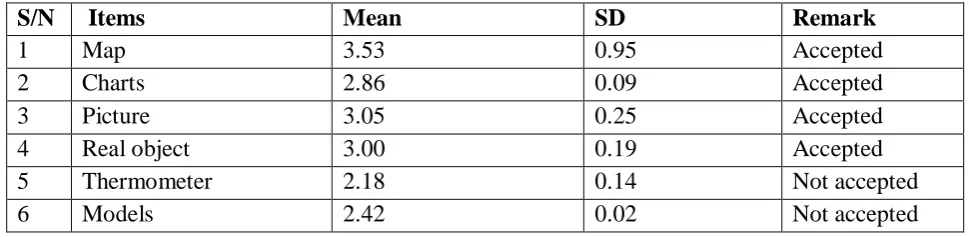
Table 2: mean scores of respondents on facilities and materials used in teaching Geography.
S/N Items Mean SD Remark
1 Map 3.53 0.95 Accepted
2 Charts 2.86 0.09 Accepted
3 Picture 3.05 0.25 Accepted
4 Real object 3.00 0.19 Accepted
5 Thermometer 2.18 0.14 Not accepted
http://ijessr.com Page 200
7 Globes 2.61 0.00 Accepted
8 Wing van 2.01 0.29 Not accepted
9 Rain gauge 2.02 0.28 Not accepted
10 Barometer 1.85 0.49 Not accepted
* Accepted ( = 2.5 and above; Not accepted ( = less than 2.5)
Table 2 shows the facilities and material used in teaching Geography in Gombi Educational Zone. The table revealed the respondents strongly agree to Map (=3.53). It shows further in the table the respondents agreed to the following factors: chart ( =3.05), real object ( =3.00) and Globe ( =2.61). The respondents however disagreed with the following facilities and material used in teaching Geography; thermometer ( = 2.18), model ( =2.42), wind vain ( =2.01), rain gauge ( =2.02) and Barometer ( =1.85). Based on the result from this table, it can be conclude that the facilities and material used in teaching Geography in Gombi Educational Zone are Map, chart, Picture, Real object and globes.
HO1: There is no significance difference in quality of teacher teaching Geography in both rural and urban Schools.
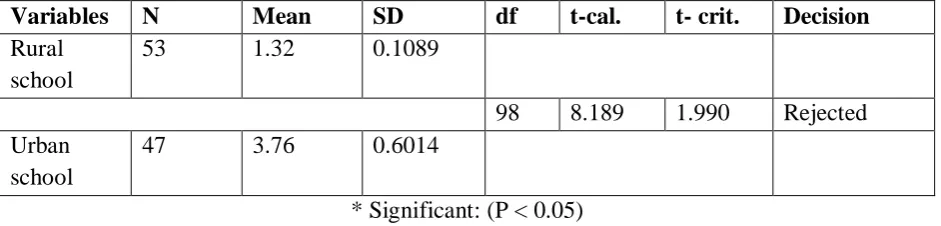
Table 3: t- test analysis in quality of teacher teaching Geography in both rural and Urban Schools.
Variables N Mean SD df t-cal. t- crit. Decision
Rural school
53 1.32 0.1089
98 8.189 1.990 Rejected
Urban school
47 3.76 0.6014
* Significant: (P < 0.05)
Table 3 shows that t-cal. (8.189) is greater than t-crit. (1.990) at 0.05 level of significance. The null hypothesis, which state that there is no significant difference between the quality of teachers teaching Geography in both rural and urban schools, is thereby rejected. It implies that there is significant difference between the quality of teachers teaching Geography in both Rural and Urban Schools in Gombi Educational Zone in Adamawa State.
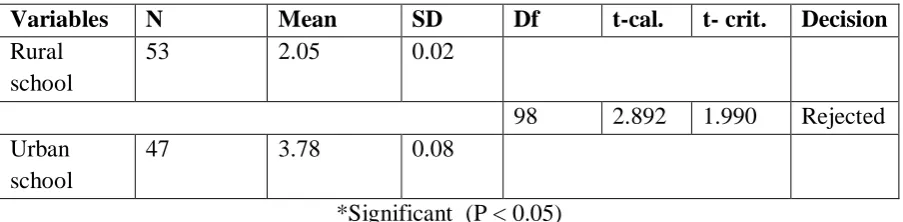
http://ijessr.com Page 201 Table 4: t-test analysis on availability and adequacy of facilities and materials in teaching and
learning Geography in rural and urban schools
Variables N Mean SD Df t-cal. t- crit. Decision
Rural school
53 2.05 0.02
98 2.892 1.990 Rejected
Urban school
47 3.78 0.08
*Significant (P < 0.05)
Table 4 reveals that t-cal. (2.892) is greater than t-crit. (1.990) at 0.05 level of significance. The null hypothesis, which states that there is no significant difference in availability and adequacy of facilities and materials in teaching and learning of Geography in rural and urban schools, is rejected. Therefore, there is no significant different in availabilities and adequacy of facilities and materials in teaching and learning of Geography in rural and urban schools in the study area.
HO3: There is no significant difference in Geography WAEC performance between urban and rural school.
Table 5: t-test analysis on Geography WAEC Performance between urban and rural students.
Variables N Mean SD Df t-cal. t- crit. Decision
Rural school
53 4.94 192
98 1.206 1.990 Accepted
Urban school
47 12.66 546
*Not Significant (P > 0.05)
Table 5 shows that t-cal. (1.206) is less than t- crit. (1.990) at 0.05 level of significances. The null hypothesis, which states that there is no significant difference in Geography WAEC performance between students in urban and rural schools, is therefore accepted. This implies that there is no significance difference in Geography WAEC performance between Urban and Rural students in Gombi Educational Zone in Adamawa State.
DISCUSSION
http://ijessr.com Page 202 schools tend to have qualified teachers than rural schools. Teachers are important force in school learning as their personality and methods have direct and cumulative impact on the lives and learning habits of pupils Obasi (2010).
Research question two investigates the facilities and materials used in teaching Geography. An adequate supply for facilities and material is the basis for all successful programs in Geography Education. The implication of the above, therefore is that one cannot expect any successful teaching and learning of Geography material and security. As this study shows, the rural schools are the worst hint both in quality and availability of material and facilities of tending Geography subject which is in line with Obasi (2010).
Hypothesis one revealed that there is no significant difference between the quality of teachers teaching Geography in rural and urban schools in Gombi Educational Zone. The professional and academic training of the teachers can raise the prospect of the students’ performance and attainment. Ukeja (1978) remarked that there is a direct relationship between the quality of the teacher personnel and the quality of educational process in both urban and rural area.
Hypothesis two revealed that there is no significant difference in availability and adequacy of facilities and materials in teaching and learning Geography in Rural and Urban school in the study area. Wheeler and Richey (2005) posit that school that create learning environment that are safe and supportive for both learners and teachers ensure high teaching and learning outcome in both rural and urban areas.
Hypothesis three revealed that there is no significant difference in Geography WAEC performance between urban and rural student in Gombi Educational Zone in Adamawa State. This research finding conform to other research finding of Bosede and Emiloju (2013), which conclude that secondary school students from rural environment perform as well as students from urban environment. All else equal, rural students do not suffer disadvantage simply as the result of residence in rural areas or their attendance at rural schools.
CONCLUSION
The urban environment tends to be capable of raising and reinforcing children’s cognitive behaviour more than rural environment. That difference in the supply and availability of Geography teachers both in the right quantity and quality. Geography equipment, library and text books create differences in the teaching and learning of Geography in the rural and urban schools. Finally that giving the necessary qualified staff and equipment students in the rural schools will perform equally as well as those in the urban schools.
http://ijessr.com Page 203 The government should ensure that all rural schools are provided with well-equipped weather
station.
The children should be provided with tools and equipment with which to learn by making the unfamiliar subject straight forward, practical, stimulating and interesting.
Library assistants in charge of the various schools libraries should be made to undergo some basic training in librarianship. These suggestion are in line with the policy statement on school libraries in the national policy of education. According to the document “libraries are important educational service. Every state ministry needs to provide funds for the establishment of libraries in all our educational institutions and to train librarians and library assistants for this service. School administrators, educational planners and government take all these recommendation into
consideration and implements.
REFERENCES
Abul, J. N. (2007). Effect of fieldwork on students’ achievement in environmental education contents in senior secondary school Geography (Unpublished master’s thesis). University of Nigeria, Nsukka.
ACARA. (2011). Australian Curriculum Assessment and Reporting Authority Shape of the Australian curriculum: Geography. Sydney: http://www.acara.edu.au
Aman, S. (2013). What are the Different Types of Teaching Aids Used in Teaching Geography. Retrieved 21st 1, 2014 at www.preservearticles.com/what_are the different types of teaching aids. Amita, K., Jairo, K. M., Odhiambo, O. & Mary, E. A. (2013). Influence of teacher characteristics on students’ academic achievement among secondary schools, journal of education and practice, 4(3). Emiloju, B. (2013). Rural and urban differential in student’s academic performance among secondary school students in Ondo State. Journal of Educational and Social Research. 3(3)
DeYoung, A. J. & Lawrence, B. K. (2009). On hooniers, yankees and mountaineers. Phi Delta Kappan, 77:104-112.
Federal Government on Nigeria (2014) National Policy of Education (6th Ed.) Lagos: Nigeria Educational Research and Development Council (NERDC) Press. Herzog, M. J. R. & Pittman, R. B. (2000). Home, family and community: ingredients on the rural education. Phi Delta Kappan, 77:113-118.
Herzog, M. J. R. & Pittman, R. B. (2000). Home, family and community: ingredients on the rural education. Phi Delta Kappan, 77:113-118.
Iwena, O. A. (2012). Essential Geography for senior secondary schools (6th edition). Anambra: Tonad Publishers Ltd.
Khattri, N., Riley, K. W., & Kane, M. B. (1997). Students at risk in poor, rural areas: A view ofJournal of Research in Rural Education, 13:79-100.
http://ijessr.com Page 204 Monk, D. H. & Haller, E. J. (2010). Organizational alternatives for small rural schools. Cornell: New York State College of Agriculture and Life Sciences.
Mzokwana, (2003). Cited Uwameiye, R. (19980. The effects of socio economic background, European Journal of Scientific Research retrieved from http://www.eurojournaals. ccom/ejsr.htm. Nworgu, B. G. (1991). Educational research, basic issues and methodology. University Trust Publishers, Nsukka, Enugu.State.
Obasi, M. N. (2010). Urban-rural differential in teaching and learning of Geography in Ahiazu Mbaise and Owerri Municipal Council in Imo State. Report and Opinion, 2(9). 41-50. Salami, O. O.& Salami, O. O. (2013). The factor determine the choice of career among secondary schools students. The International Journal of Engineering and Science (IJES), 2 (6): 33-44. Ukeje , B. O. (1978). Crises in the Nigerianeducational sector. The Educator, 13: 1-9.