www.mojet.net
Effects of Cloud Computing Tools, Study
Type and Task Difficulty on Cognitive
Load and Performance
Zeliha DEMİR KAYMAK[1], Özcan Erkan AKGÜN [2]
http://dx.doi.org/10.17220/mojet.2019.04.011
[1] [email protected], Sakarya University, Turkey
[2] [email protected], Istanbul Medeniyet University, Turkey
ABSTRACT
The purpose of this research is to investigate the effects of using cloud computing technologies, study type and task difficulty on cognitive load and students’ performance. The research was conducted as 2x2x2 complex mixed design. The two experiment groups are the first factor of design. In the first experiment group students used non collaborative cognitive tools (NCCT), in the second group students used collaborative cloud computing (CCCT) for learning tasks. Second and third factors of the research as repeated measures are study type (individual – group) and task difficulty (easy – difficult). During the experiment process four different types of tasks were given to students. These tasks were individual and easy task (1), individual and difficult task (2), in group and easy task (3) and in group and difficult task (4). The depended variables of the research are cognitive load, performance and instructional efficiency scores. The experiment group consists of 57 females and 57 males totally 114 university students. 55 students used NCCT and 59 students used CCCT for learning tasks. Three factors mixed design ANOVA were used to analyze the gathered data. Analyzes showed that cloud computing improves learning performance and instructional efficiency while does not affect cognitive load. According to the results especially for the difficult tasks using cloud computing is suggested to improve students’ collaboration and performance.
Keywords: Cognitive Tools, Cloud Computing, Google Drive, Cognitive Load, Performance, Learning Efficiency.
INTRODUCTION
Cloud computing is a growing concept which stands out after Web 2.0 (Armutlu and Akçay, 2013; Foster, Zhao, Raicu and Lu, 2008; Höfer and Karagiannis, 2011). Despite coming out after Web 2.0, the core of cloud computing is based on the grid computing paradigm, and its associated utility computation, cluster computing, and distributed systems, which have begun to be used much earlier (Foster at al., 2008). In this context, cloud computing is seen as a new service that brings together previous technologies. There are many different and non-standard definitions of this concept that express the sum of cloud computing services (Foster at al., 2008; Sultan, 2010; Höfer and Karagiannis, 2011). In other words, there is no commonly accepted common definition of cloud computing.
Cloud computing is commonly referred to as a set of resources and services that are usually delivered over the Internet in a network environment (Foster at al., 2008; Sultan, 2010). Cloud computing is the introduction of computing-related possibilities to multi-user usage with internet Technologies (Stevens and Pettey, 2008). Information sharing is the most interesting aspect of cloud computing, but cloud computing is not just about sharing information (Armutlu and Akçay, 2013).
www.mojet.net Cloud computing refers to the service applications offered over the Internet and hardware and software services provided by data centers (Armbrust at al., 2010). In this definition, the hardware and software of data centers are also called cloud computing. Turan (2011) defined cloud computing users as using third-party online servers instead of using their own computers as a data storage medium. Cloud computing can be made more flexible and faster by providing access from every point of your life without having to be connected to a specific place with any means of performing internet access and it is a structure where the service scale can be rapidly increased and decreased and the usage of resources can be easily monitored and controlled and reported (Yıldız, 2009).
In general, when the definitions are examined, the concept of cloud computing is simply the online sharing and use of ICT tools. The main features of cloud computing are (1) massively scalable, (2) serving different levels of cloud services to customers outside the Cloud, (3) presenting to different scaled economies, and (4) as dynamically configurable on demand (Foster et al., 2008).
According to the results of the World Economic Forum's 2009 researches, education is one of the areas that cloud computing will be most affected. it has been suggested that cloud computing constitutes a new beginning in education (Sultan, 2010). Despite the importance of cloud computing in education, there are limited numbers of studies on cloud computing in education and these studies are theoretical research (Sevli, 2011). Studies on the integration of cloud computing tools into teaching processes are less common (Horzum, Kıyıcı and Akgün, 2015). For this reason, there is a need for practical research on the use of cloud computing in education. It is stated that cloud computing can be used for low-cost simulation, access to global resources and highly interactive collaborative learning while education is talking about the effects of cloud computing's education transformation and development, which is published in the World Economic Forum (2010).
Implementations based on cloud technology have an important use in education. Google and Microsoft are leading companies in the use of cloud computing, providing free e-mail service to the education sector in many countries (Unesco IITE, 2010). Applications developed by these companies present e-mail, instant messaging, calendar creation and management, document preparation, web page creation, storage of documents and collaborative work with others.
Google has become more than a search engine trough tools designed for productivity and collaboration that it offers along with a free user account (Thompson, 2008). Google Drive (GD) is also a set of applications based on cloud technology from Google. It first came up as "Google Docs" (Google Docs). Afterwards, this name was changed because it was understood to be just the function of adding and sharing documents. It also presents Google services and tools along with GD storage service.
Dekeyser and Watson (2006) stated that the most important benefits of GD are that it requires any installation and is easy to use because it is only used with one user login and allows simultaneous collaboration as it allows multiple users to work at the same time. Kittle and Hicks (2009) list the activities that can be done with GD for teaching purpose as follows:
- Create a list of ideas for the brainstorm.
- To facilitate sharing and checking the list of resources with group members with their links.
- Clarifying the aim and target audience for important and confusing words and phrases written for an assignment.
- Generating questions about the assignment for peer response.
- Highlighting or copying a piece of text to show important places.
- Asking questions about places and purposes that are not understood to discuss important points on a draft and invite users to comment.
- Responding to drafts via comments on a blog post, in the discussion page of a wiki, or with
www.mojet.net the comment feature in Google Docs.
- Editing the drafts, looking at the changes on it and discussing the mechanical and rhetorical decisions about the changes.
- Revising others’ work to clarify meaning, add detail, reorganize ideas, and contribute to the overall meaning of the writing
- Add discussions and notes to explain why and how changes are made.
Conducting activities in and out of the classroom through GD facilitates both teachers' management and evaluation, while integrating technology into classes enables more effective and productive learning. In addition, students do not need to have an additional technology to use GD and similar tools. Students can follow these activities either on a desktop computer, laptop, smartphone or tablet PC.
Yang (2010) mentioned the ease provided by the GD as a tool of language in teaching language in particular and emphasized the importance of ensuring simultaneous communication and the importance of students especially in the development of their writing skills. Oxnevad (2012) noted that while talking about the features of the GD presentation tool, students could develop digital literacy skills and collaborative working skills, especially for young learners who could integrate this technology into learning processes to improve problem-solving, critical thinking, communication skills and creativity. Godwin-Jones (2008) also noted that GD not only motivates students to work collaboratively but also enhances their advanced thinking skills, such as criticizing and evaluating each other's work.
The aim of this research is to examine the effects of the use of Google Drive tools one of the cloud computing tools in learning tasks, study type and task difficulty on student performance and cognitive load.
RESEARCH METHOD
Research Model
The research was conducted as 2x2x2 complex mixed design. The two experimental conditions are the first factor of design. In the first condition students used non collaborative cognitive tools (NCCT), in the second condition students used collaborative cloud computing (CCCT) for learning tasks. The second factor of the research is study type (individual – group). The third factor of the research is task difficulty (easy – difficult). During the experiment process four different types of tasks were given to students. These tasks were (1) individual and easy task, (2) individual and difficult task, (3) in group and easy task and (4) in group and difficult task. The depended variables of the research are cognitive load, performance and learning efficiency scores.
Participants
The experiment group consists of 57 females and 57 males totally 114 university students from a public university. 55 students used NCCT and 59 students used CCCT for learning tasks.
Data Collection Tools
In the current study, mental effort rating scale technique was used for measuring to cognitive load (DeLeeuw and Mayer, 2008). Cognitive Load Scale developed by Paas (1992) was used to reveal the cognitive load levels of the students. Students marked the perceived mental effort for learning tasks on the 9-point symmetrical category scale. The numerical values of the scale ranged from "1" to "9," corresponding to "very, very low mental effort" to "very, very high mental effort ".
Four rubrics were used for measuring performance. Since every task prepared for students is different from the others, rubrics were specific to tasks. Five experts involved in developing rubrics. Three experts evaluated students’ performance. The Kendall’s coefficient of concordance (the Kendall’s w) was calculated
www.mojet.net for agreement among three experts. The Kendall’s coefficient of concordance which is calculated between the scores given by the three experts (w1= .979, w2=.990, w3=.918, w4=.939, p = .000), shows that there is a
high-level agreement between the evaluators. The mean scores of experts were used for analyses as performance scores.
Paas and Van Merriënboer (1993) presented a formula in which students' performance and mental effort scores can be calculated by considering the performance of the students and their mental effort to provide an idea about the efficiency of instructional conditions. Tuovinen and Paas (2004) stated that the two-dimensional standardized cognitive load and performance scores of teaching efficiency can be calculated by dividing the standard deviation by the formula (E= (Zperformance-Zmental effort)/√2). This efficiency scores were
used to analyze instructional efficiency.
Experimental Procedures
Experimental processes were carried out in the course of "Research Methods". Because it has comprehensive and complex intended learning outcomes, needs collaboration and scrutiny, and expected competencies are not generally transferred to the learners even in the universities (Büyüköztürk, 1999: 258), and in addition to those reasons this course is carried out by the researchers.
Four learning tasks have been devised for the topics covered in the research. Instruction was done in all groups with the same methods and techniques and all the applications were completed in four weeks. In the first experiment group students used non collaborative cognitive tools (NCCT), office software existed in computers and not based on internet were used as NCCT. In the second group students used collaborative cloud computing (CCCT) for learning tasks. Cloud computing tools are also cognitive tools with allowing collaboration among students. Google Drive and its applications were used as cloud computing tools.
Four tasks were easy-individual task, difficult-individual task, easy-group task, difficult-group task. For task difficulty 8 experts pointed out the task difficulty from 1 to 10. First task was design as an easy task (task difficulty level=4,12) and students studied for this task individually. Second task was design as a difficult task (task difficulty level =8,75) and students studied for this task individually. Third task was design as an easy task (task difficulty level =4,5) and students studied for this task in group. Last task was design as a difficult task (task difficulty level =9) and students studied for this task in group.
FINDINGS
Before experimental process research groups were compared to each other with general foreknowledge about course topics and general academic points. For this comparison independent samples t-test was used. Analysis showed that there was no significant difference between the experimental groups about pretest (p=.067) and general academic points (p=.639).
Cognitive Load
Every student signed cognitive load scale as soon as completed the tasks. This cognitive load points were used for first research question. For this purpose, three-factor mixed ANOVA (one between-subjects and two within-subjects factors) used. Three factors of analyze are type of cognitive tools, study type and task difficulty as independent variables. The dependent variable is cognitive load for this analyze. Descriptive statistics (Table 1) and results of ANOVA (Table 2) are presented.
Table 1. Type of Cognitive Tools, Study Type, Task Difficulty and Cognitive Load
Type of Cognitive
Tools (Group) Study Type Task Difficulty
Sd Sd Sd
NCCT
Individual Easy 7.151 0.182 7.358 0.132
7.50 0.113 Difficult 7.566 0.160
Group Easy 7.321 0.201 7.642 0.141 Difficult 7.962 0.161
CCCT Individual Easy 6.930 0.176 7.202 0.127 7.36 0.109
X X X
www.mojet.net Difficult 7.474 0.155
Group Easy 6.912 0.194 7.518 0.136 Difficult 8.123 0.155
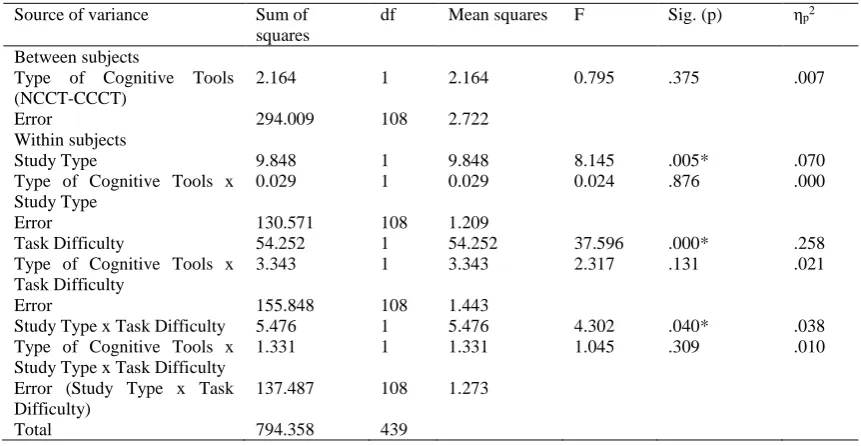
There was no significant difference between NCCT and CCCT group about cognitive load [F(1-108)=0.795,
p=.375, ηp2=.007]. There has been found a significant difference about study type [F(1-108)=8.145, p=.005,
ηp2=.070]. Cognitive load points in group tasks are higher ( =7.58) than individual tasks points. When
investigation of effect of task difficulty on cognitive load showed that it has been found significant difference [F(1-108)=37.596, p=.000, ηp2=.258]. Cognitive load in difficult tasks is higher ( =7.78).
Table 2: Results of three-factor mixed ANOVA for Type of Cognitive Tools, Study Type, Task Difficulty and Cognitive Load
Source of variance Sum of squares
df Mean squares F Sig. (p) ηp2
Between subjects
Type of Cognitive Tools (NCCT-CCCT)
2.164 1 2.164 0.795 .375 .007
Error 294.009 108 2.722
Within subjects
Study Type 9.848 1 9.848 8.145 .005* .070
Type of Cognitive Tools x Study Type
0.029 1 0.029 0.024 .876 .000
Error 130.571 108 1.209
Task Difficulty 54.252 1 54.252 37.596 .000* .258
Type of Cognitive Tools x Task Difficulty
3.343 1 3.343 2.317 .131 .021
Error 155.848 108 1.443
Study Type x Task Difficulty 5.476 1 5.476 4.302 .040* .038
Type of Cognitive Tools x Study Type x Task Difficulty
1.331 1 1.331 1.045 .309 .010
Error (Study Type x Task Difficulty)
137.487 108 1.273
Total 794.358 439
*p<.05
As a result of the mixed measurements ANOVA, there was no significant effect of cognitive tools type (NCCT - CCCT) and study type (individual – in group) variable on cognitive load [F (1-108) = 0.024, p =.876, ηp2 =. 000]. Similarly, there was no significant effect of cognitive tools type (NCCT - CCCT) and task difficulty level (easy - difficult) on cognitive load [F(1-108)=2.317, p=.131, ηp2=.021]. According to the results of ANOVA,
the common effect of the study type (individual - group) and task difficulty level (easy - difficult) variable on cognitive load scores was found to be significant [F (1-108) = 4.302, p =.040, ηp2 =.038]. The effect size was also low (ηp2 <.06). Bonferroni multiple comparison tests were conducted to investigate the source of this difference on cognitive load according to study type and task difficulty. According to results of multiple comparison tests in individual tasks there is significant difference (p<0.05) between easy tasks ( =7.040) and difficult tasks ( =7.520). Similarly, in group tasks, there is significant difference (p<0.05) between easy tasks ( =7.117) and difficult tasks ( =8.043). On the other hand in difficult tasks, cognitive load scores in group tasks significantly (p<.05) higher ( =8.043) than individual tasks ( =7.117). When the common effect of the variables, type of cognitive tools (NCCT - CCCT), study type (individual – group) and task difficulty (easy - difficult), on cognitive load examined and the common effect of three variables was not found significant [F(1-108)=1.045, p=.309, ηp2=.010].
X
X
X
X
X X
X X
www.mojet.net
Performance
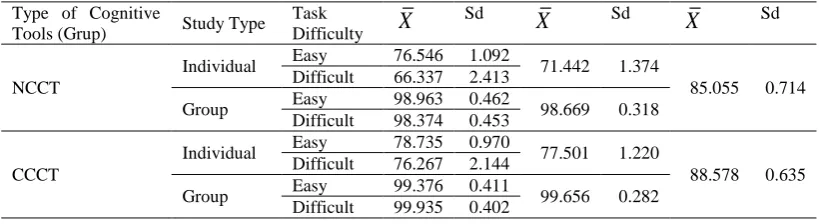
Three-way mixed ANOVA (one between-subject and two within-subjects factors) was used to investigate effects of type of cognitive tools, study type and task difficulty on performance. Performance scores were calculated with rubrics. The scores could be calculated from 0 to 100. Descriptive statistics about performance are presented on Table 3.
Table3: Type of Cognitive Tools, Study Type, Task Difficulty and Performance
Type of Cognitive
Tools (Grup) Study Type Task Difficulty
Sd Sd Sd
NCCT
Individual Easy 76.546 1.092 71.442 1.374
85.055 0.714 Difficult 66.337 2.413
Group Easy 98.963 0.462 98.669 0.318 Difficult 98.374 0.453
CCCT
Individual Easy 78.735 0.970 77.501 1.220
88.578 0.635 Difficult 76.267 2.144
Group Easy 99.376 0.411 99.656 0.282 Difficult 99.935 0.402
Results of three-way mixed ANOVA are presented on Table 4. According to results of analyze type of cognitive tools has significant effect [F(1-100) =13.601, p=.000, ηp2=.120] on performance. Impact size was found
to be moderate (.06<ηp2<.14). Students’ used NCCT performance ( =85.055) was found significantly lower
than students’ performance ( =88.578) used CCCT.
When the performance scores of the students are examined according to the study type (individual - group) there has been significant difference [F(1-100)=704.116, p=.000, ηp2=.876] on performance between
individual and group tasks. The calculated effect size value was observed to be wide (ηp2>.14). Performance
in group tasks ( =99.162) is significantly better than individual tasks ( =74.472). Effect of task difficulty is observed as significant [F(1-100)=12.914, p=.001, ηp2=.114] on performance. The effect size was found as
moderate (.06<ηp2<.14). Performance scores in easy tasks is higher than performance in difficult tasks.
Table 4: Results of three-factor mixed ANOVA for Type of Cognitive Tools, Study Type, Task Difficulty and Performance
Source of variance Sum of squares
df Mean squares F Sig. (p) ηp2
Between subjects
Type of Cognitive Tools (NCCT-CCCT)
1248.540 1 1248.540 13.601 .000* .120
Error 9180.090 100 91.801
Within subjects
Study Type 61321.310 1 61321.310 704.116 .000* .876
Type of Cognitive Tools x Study Type
647.027 1 647.027 7.429 .008* .069
Error 8708.978 100 87.090
Task Difficulty 1015.085 1 1015.085 12.914 .001* .114
Type of Cognitive Tools x Task Difficulty
496.611 1 496.611 6.318 .014* .059
Error 7860.521 100 78.605
Study Type x Task Difficulty 1005.626 1 1005.626 13.068 .000* .116 Type of Cognitive Tools x
Study Type x Task Difficulty
273.291 1 273.291 3.551 .062 .034
Error(Study Type x Task Difficulty)
7695.597 100 76.956
Total 99452.676 407
*p<,05
X X X
X
X
X X
www.mojet.net The common effect of type of cognitive tools and study type on performance was found significant [F (1-100) =7.429, p=.008, ηp2=.069]. Also the effect size was moderate (.06<ηp2<.14). This finding was examined
with Bonferroni multiple comparison tests. As a result of bilateral comparisons in experimental groups both used NCCT and used CCCT, students have higher performance scores in group tasks than individual tasks. Otherwise in both individual and group tasks students used CCCT had significantly better performance than students used NCCT.
The effect of both type of cognitive tools and task difficulty was found as significant [F(1-100) =6.318,
p=.014, ηp2=.059]. The effect size is low (ηp2<.06). According to results of Bonferroni multiple comparison
tests in group used NCCT there has been significant difference between easy and difficult tasks performance but in group used CCCT there has been no significant difference between easy and difficult tasks performance. In easy tasks it has no significant effect using NCCT or CCCT but in difficult tasks students used CCCT have better performance than students used NCCT.
Study type and task difficulty variables have a significant common effect on performance [F(1-100)
=13.68, p=.000, ηp2=.116] and the effect size is found as moderate (.06<ηp2<.14). Bonferroni multiple
comparison tests were used to examine the source of difference. It was found that both of easy and difficult tasks student performances in group tasks were significantly better. Also in individual tasks students have significant high performance scores in easy tasks.
Finally the three-factors mixed designed ANOVA showed that three independent variables (type of cognitive tools, study type and task difficulty) has not significant common effect on performance [F(1-100)
=3.551, p=.062, ηp2=.034].
Instructional Efficiency
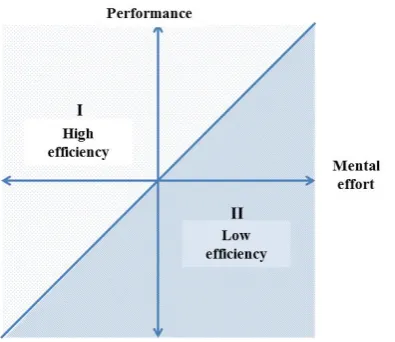
Instructional efficiency formula shows in a coordinate system where performance is the y-axis and mental effort is the x-axis, the difference between performance and mental effort is also the distance from teaching efficiency to 0. In this coordinate system (Figure 1), it could be seen that the instructional efficiency line is 0, the high efficiency area (I), where the teaching efficiency is positive, and the low efficiency area (II), where the instructional efficiency is negative.
Figure 1: Coordinate System of Instructional Efficiency
Kılıç (2006) stated that the measurements made by considering the performance of the task and the mental effort spent for completing the task together gave more accurate results than the measurements made by taking the performance and mental effort separately. Within the scope of this research, cognitive
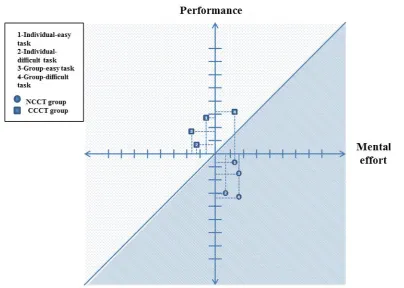
www.mojet.net load and performance scores obtained from the students were first converted to standardized Z scores and four instructional efficiency scores were calculated for each task for four tasks according to the instructional efficiency formula. The mean scores of the experimental groups can be shown in Figure 2 in the teaching efficiency coordinate system. When the figure is examined, it is seen that the instructional efficiency scores of the group using CCCT in the instructional efficiency coordinate system are high and the instructional efficiency scores of the group using NCCT remain low.
Figure 2: Instructional Efficiency Scores of Experimental Groups
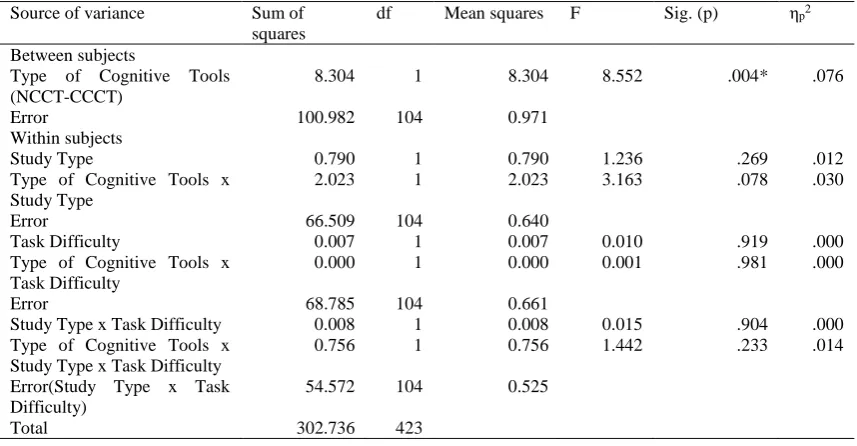
Three-way mixed design ANOVA was used to examine the effect of cognitive tool type (NCCT- CCCT), study type (individual - group) and task difficulty (easy - difficult) on the calculated teaching efficiency scores. In Table 5, the mean instructional efficiency scores of the students in the experimental groups are given according to the type of cognitive tool (NCCT- CCCT), study type (individual - group) and task difficulty (easy - difficult).
Table 5: Type of Cognitive Tools, Study Type, Task Difficulty and Instructional Efficiency
Type of Cognitive
Tools (Grup) Study Type Task Difficulty
Sd Sd Sd
NCCT
Individual Easy -0.167 0.117 -0.211 0.091
-0.098 0.040 Difficult -0.254 0.112
Group Easy -0.036 0.115 0.014 0.088 Difficult 0.064 0.129
CCCT
Individual Easy 0.165 0.111 0.208 0.086
0.182 0.312 Difficult 0.251 0.106
Group Easy 0.189 0.108 0.156 0.083 Difficult 0.123 0.122
Results of three-way mixed ANOVA are presented on Table 6. According to results of analyze there have been found significant difference only with type of cognitive tools [F(1-104) =8.552, p=.004, ηp2=.076].
X X X
www.mojet.net Effect size shows a moderate effect (.06<ηp2<.14). Instructional efficiency scores of students used CCCT (
=0.182) are significantly higher than instructional efficiency scores of students used NCCT ( =-0.098).
Table 6: Results of three-factor mixed ANOVA for Type of Cognitive Tools, Study Type, Task Difficulty and Instructional Efficiency
Source of variance Sum of squares
df Mean squares F Sig. (p) ηp2
Between subjects
Type of Cognitive Tools (NCCT-CCCT)
8.304 1 8.304 8.552 .004* .076
Error 100.982 104 0.971
Within subjects
Study Type 0.790 1 0.790 1.236 .269 .012
Type of Cognitive Tools x Study Type
2.023 1 2.023 3.163 .078 .030
Error 66.509 104 0.640
Task Difficulty 0.007 1 0.007 0.010 .919 .000
Type of Cognitive Tools x Task Difficulty
0.000 1 0.000 0.001 .981 .000
Error 68.785 104 0.661
Study Type x Task Difficulty 0.008 1 0.008 0.015 .904 .000
Type of Cognitive Tools x Study Type x Task Difficulty
0.756 1 0.756 1.442 .233 .014
Error(Study Type x Task Difficulty)
54.572 104 0.525
Total 302.736 423
*p<,05
DISCUSSION AND CONCLUSION
Students’ task performance, cognitive load and instructional efficiency scores are examined with type of cognitive tools; there are significant differences on task performance and instructional efficiency. The students used collaborative cloud computing tools have significantly higher scores, but there was no significant difference on cognitive load. Within the limitations of this study, it was concluded that students' learning performance and instructional efficiency in the group using cloud computing was better than learning by students using non collaborative cognitive tools.
As a result of the analysis, the effect of cloud computing on the cognitive load was not significant. In the literature, it is possible to find studies indicating that the use of cognitive tools reduces cognitive load (Li, 2005; Greenfield, 2013). In the current study cognitive tools were used in both experimental groups. Non collaborative cognitive tools were used in one group and collaborative cloud computing tools was used in the other group. The use of network technologies as a cognitive tool allows users to create communities and work collaboratively (Kirschner and Wopereis, 2003). In this way, users can perform transactions that cannot be done by themselves and can produce better products. Collaborative tools make it easier for students to collaborate and achieve their learning goals (Agcaoili, 2012). Hsiao, Brouns and Sloep, (2013) examined the effect of different support tools (forum, peer teaching) on cognitive load in the network learning environments. Similarly, Bernal (2014) stated in his study that different environments that present of information have no effect on cognitive load. In this study, it has been shown that different types of cognitive tools used in experimental groups have the same effect on reducing cognitive load.
One of the independent variables discussed in the study is the study type. In this study, the students performed two tasks individually and two tasks in group work. The effect of the study type (individual - group) variable on cognitive load, performance and instructional efficiency of the students was examined. As a result X
X
www.mojet.net of analyzes, a significant difference was observed on cognitive load and performance scores according to the type of study (individual - group), but no significant difference was observed on the instructional efficiency scores. When the cognitive load scores of the students were examined according to the type of study, it was seen that the cognitive load scores in the group tasks were higher than the cognitive load scores in the individual tasks. This finding differs from the studies in the literature. In collaborative group work, the cognitive load is divided between the working memory of the group members (Kirschner, Paas and Kirschner, 2009a). Thus, more complex tasks can be easily accomplished by sharing the cognitive load among people. Since the cognitive load is shared on the employee memory of group members, group or cooperative studies are offered as an alternative to reduce cognitive load, especially in complex tasks (Kirschner, Paas and Kirschner, 2008a, 2008b). In this case, working memory with more than one limited capacity comes together to form a joint workspace (van Mierlo, Jarodzka, Kirschner and Kirschner, 2012). similarly, Kirschner, Paas and Kirschner, (2008b) compared the cognitive load of students working individually and as a group in the same complex cognitive task and stated that students working as a group had lower cognitive load than the students working in the same cognitive task. Zhang, Ayres and Chan (2011) found that the cognitive load of the students working with the group was lower than the cognitive load of the individual working students. It can be said that the findings obtained in this study are different from the literature because individual and group tasks have different intrinsic cognitive loadings.
In the studies comparing the student performances in the individual and group studies, it was found that the performances of the students working as a group were higher than the performances of the students working individually (Kirschner, Paas and Kirschner, 2009b; Zhang, Ayres and Chan, 2011). In this study, the effect of individual and group work on performance supports the literature. Students' performances in group tasks are higher than those performed individually. In other words, working with the group improves the performance of the students. The effect of study type (individual - group) on teaching efficiency was not significant. The reason for this finding is that the effect of study type on cognitive load is in favor of individual work and the effect on performance is in favor of working with group.
The last variable examined in the research on the effect of dependent variables is task difficulty (easy - difficult). As a result of the analyzes conducted to examine the effect of task difficulty on cognitive load, performance and instructional efficiency, the effect of task difficulty on cognitive load and performance was found to be significant, but not on teaching efficiency. Findings related to task difficulty and cognitive load support the studies in the literature. As complex cognitive tasks require more and interrelated skills, the actual cognitive load level is higher than easy tasks (Sweller, Van Merrienboer and Paas, 1998; van Merriënboer and Sweller, 2005; Artino, 2008; Kirschner, Kester and Corbalan, 2011; Hsiao, Brouns, Kester and Sloep, 2011). In the literature, it is possible to find many studies indicating that the amount of cognitive load in easy tasks is lower than the cognitive load in difficult tasks (Gevins, Smith, McEvoy and Yu, 1997; Kılıç, 2006; Hsiao, Brouns and Sloep, 2013; Milenković, Segedinac, Hrin and Cvjetićanin, 2014). This shows that as the task difficulty increases, the cognitive burden increases. Contrary to the cognitive load, the studies in the literature show that performance decreases with increasing task difficulty and performance decreases with increasing cognitive load (Van Merriënboer, Schuurman, de Croock nd Paas, 2002; Kılıç 2006; Milenković, Segedinac, Hrin and Cvjetićanin, 2014). In this study, students' performance in easy tasks was found to be higher than their performance in difficult tasks. Instructional efficiency is expected to be higher in easy tasks because the performance of easy tasks increases and cognitive load decreases. In their study, Hsiao, Brouns and Sloep (2013) found that students' productivity scores in difficult tasks were lower than productivity scores in easy tasks. However, in this study, no significant difference was found between teaching efficiency scores in difficult and easy tasks.
www.mojet.net
Suggestions
Within the scope of this research, the following suggestions were presented regarding the results of the research.
As the difficulty of tasks increases, students' cognitive load increases and their performance decreases. Since group work reduces students' cognitive burden and improves performance, group work can be organized especially for difficult tasks.
Using cloud computing and group work improves students' performance. Therefore, it may be preferable to use cloud computing when doing group work.
Group work improves students' performance in both easy and difficult tasks. Group activities could be organized in learning environments for students to perform better.
Finally, similar studies that investigating the effects of different cloud computing technologies on different variables with different participants could be designed.
REFERENCES
Agcaoili, K. (2012). Google Apps: An Opportunity To Collaborate. Unpublished doctoral dissertation. University Of Southern California.
Armbrust, M., Fox, A., Griffith, R., Joseph, A. D., Katz, R., Konwinski, A., ... & Zaharia, M. (2010). A view of cloud computing. Communications of the ACM, 53(4), 50-58.
Armutlu, H. & Akçay, M. (2013). Bulut Bilişimin Bireysel Kullanımı İçin Örnek Bir Uygulama. Akademik Bilişim
Konferansı-2013, 23-25.
Bayrakçeken, S. (2011). Test Geliştirme. Ölçme ve Değerlendirme. E. Karip (Editör). (Dördüncü Baskı), s. 294-325. Ankara:PegemA Yayıncılık.
Bernal, A. M. E. (2014). Effects Of Text, Audio And Learner Control On Text-Sound Association And Cognitive
Load Of Efl Learners. Unpublished doctoral dissertation. Arizona State University.
Büyüköztürk, Ş. (1998). Kovaryans Analizi: Varyans Analizi İle Karşılaştırmalı Bir İnceleme. Ankara Üniversitesi
Eğitim Bilimleri Fakültesi Dergisi, 31(1), 91-105.
Büyüköztürk, Ş. (1999). İlköğretim Okulu Öğretmenlerinin Araştırma Yeterlikleri. Kuram ve Uygulamada
Eğitim Yönetimi Dergisi, 5(2), 257-269.
Büyüköztürk, Ş. (2011). Deneysel Desenler Öntest-Sontest Kontrol Grubu Desen ve Veri Analizi. 3. Baskı. Pegem Akademi, Ankara.
Can, A. (2013). SPSS İle Bilimsel Araştırma Sürecinde Nicel Veri Analizi. Ankara: Pegem Akademi.
Dekeyser, S. & Watson, R. (2006). Extending Google Docs to Collaborate on Research Papers. Toowoomba,
Queensland, AU: The University of Southern Queensland, Australia, 23, 1-11.
DeLeeuw, K. E., & Mayer, R. E. (2008). A comparison of three measures of cognitive load: evidence for separable measures of intrinsic, extraneous, and germane load. Journal of Educational Psychology, 100 (1), 223–234. DOI: 10.1037/0022-0663.100.1.223
Foster, I., Zhao, Y., Raicu, I., & Lu, S. (2008). Cloud Computing and Grid Computing 360-degree Compared.
Grid Computing Environments Workshop, 2008. GCE'08 (pp. 1-10). Ieee.
Gevins, A., Smith, M. E., McEvoy, L. & Yu, D. (1997). High-resolution EEG Mapping of Cortical Activation Related to Working Memory: Effects Of Task Difficulty, Type Of Processing, and Practice. Cerebral
cortex, 7(4), 374-385.
www.mojet.net Godwin-Jones, R. (2008). Emerging Technologies Web-Writing 2.0: Enabling, Documenting, and Assessing
Writing Online. Language Learning & Technology, 12(2), 7-13.
Greenfield, W. C. (2013). E-Readers In Middle Schools: An Analysis Of The Impact On Cognitive Load,
Knowledge Acquisitıon And Perceived Mental Effort. Unpublished doctoral dissertation. Capella
University School of Education.
Höfer, C. N. & Karagiannis, G. (2011). Cloud Computing Services: Taxonomy and Comparison. Journal of
Internet Services and Applications, 2(2), 81-94.
Horzum, M. B., Kıyıcı, M. ve Akgün, Ö. E. (2015). Bulut Bilişim Tabanlı Öğrenme-Öğretme Yaklaşımı. Etkinlik
Örnekleriyle Güncel Öğrenme-Öğretme Yaklaşımları – II. Ekici, G. (Editör). s. 1-47. Ankara: Pegem
Akademi.
Hsiao, Y. P., Brouns, F., Kester, L., & Sloep, P. (2013). Cognitive Load and Knowledge Sharing in Learning Networks. Interactive Learning Environments, 21(1), 89-100.
Kılıç, E. (2006). Çoklu Ortamlara Dayalı Öğretimde Paralel Tasarım ve Görev Zorluğunun Üniversite
Öğrencilerinin Başarılarına ve Bilişsel Yüklenmelerine Etkisi. Unpublished doctoral dissertation.
Ankara Üniversitesi Eğitim Bilimleri Enstitüsü.
Kirschner, F., Kester, L. & Corbalan, G. (2011). Cognitive Load Theory and Multimedia Learning, Task Characteristics and Learning Engagement: The Current State of The Art. Computers in Human
Behavior, 27(1), 1-4.
Kirschner, F., Paas, F., & Kirschner, P. A. (2008a). Individual Versus Group Learning as A Function of Task
Complexity: An Exploration into The Measurement of Group Cognitive Load (pp. 21-28). Springer
Netherlands.
Kirschner, F., Paas, F., & Kirschner, P. A. (2008b). Learning from Complex Cognitive Tasks: Comparing Groups to Individuals. In Proceedings of the 8th international conference on International conference for
the learning sciences-Volume 1 (pp. 446-452). International Society of the Learning Sciences.
Kirschner, F., Paas, F., & Kirschner, P. A. (2009a). A Cognitive Load Approach to collaborative Learning: United Brains for Complex Tasks. Educational Psychology Review, 21(1), 31-42.
Kirschner, P. & Wopereis, I. G. (2003). Mindtools for Teacher Communities: A European Perspective. Technology, Pedagogy and Education, 12(1), 105-124.
Kittle, P. & Hicks, T. (2009). Transforming The Group Paper With Collaborative Online Writing. Pedagogy,
9(3), 525-538.
Li, R. (2005). The Effects of Databases as Cognitive Tools in A Multimedia Problem-Based Learning
Environment. Unpublished doctoral dissertation. The University of Texas.
Milenković, D., Segedinac, M., Hrin, T. & Cvjetićanin, S. (2014). Cognitive Load at Different Levels of Chemistry Representations. Hrvatski časopis za odgoj i obrazovanje, 16(3), 699-722.
Oxnevad, S. (2012). Google Presentation for Collaborative Learning . Apps & Mobile, Blog Series, Edtech, Smart Teachers. Retrieved on 3rd June 2014 from http://gettingsmart.com/2012/11/google-presentation-for-collaborative-learning adresinden erişilmiştir.
Özçelik, D. A. (2010). Ölçme ve Değerlendirme. Ankara: PegemA Yayıncılık. Özgüven, İ. E. (2003). Psikolojik Testler. PDREM Yayınları.
Paas, F. G. (1992). Training Strategies for Attaining Transfer of Problem-Solving Skill in Statistics: A Cognitive-Load Approach. Journal of educational psychology, 84(4), 429.
Paas, F. G., & Van Merriënboer, J. J. (1993). The Efficiency of Instructional Conditions: An Approach to Combine Mental Effort and Performance Measures. Human Factors: The Journal of the Human
Factors and Ergonomics Society, 35(4), 737-743.
Sevli, O. (2011). Bulut Bilişim ve Eğitim Alanında Örnek Bir Uygulama. Yayımlanmamış yüksek lisans tezi.
www.mojet.net Süleyman Demirel Üniversitesi, Fen Bilimleri Enstitüsü.
Stevens, H. & Pettey, C. (2008). Gartner Says Cloud Computing Will Be as İnfluential as E-Business. Gartner
Newsroom, Online Ed.
Sultan, N. (2010). Cloud Computing for Education: A New Dawn?. International Journal of Information
Management, 30 (2), 109-116.
Sweller, J., Van Merrienboer, J. J. & Paas, F. G. (1998). Cognitive Architecture and Instructional Design.
Educational psychology review, 10(3), 251-296.
Thompson, J. (2008). Don't Be Afraid to Explore Web 2.0. Phi Delta Kappan, 89(10), 711.
Turan, S. (2011). Bulut Bilişimi (Cloud Computing) Teknolojisi ve Hukuki Problemler.
http://www.bulutbilisimi.com/bulut-bilisimi-cloud-computing-teknolojisi-ve-hukuki-problemler.html#more-73 adresinden 15 Ocak 2015 tarihinde erişilmiştir.
UNESCO Institute for Information Technologies in Education. (2010). Cloud Computing in Education. IITE
Policy Brief, September 2010.
Van Merrienboer, J. J. & Sweller, J. (2005). Cognitive Load Theory and Complex Learning: Recent Developments and Future Directions. Educational psychology review, 17(2), 147-177.
Van Merriënboer, J. J. G., Schuurman, J. G., De Croock, M. B. M. & Paas, F. G. W. C. (2002). Redirecting Learners' Attention During Training: Effects on Cognitive Load, Transfer Test Performance and Training Efficiency. Learning and Instruction, 12(1), 11-37.
Van Mierlo, C. M., Jarodzka, H., Kirschner, F. & Kirschner, P. A. (2012).Cognitive Load Theory in E-Learning.
Encyclopedia of Cyber Behavior. Z. Yan (Ed). s. 1178-1211. USA: IGI Global.
World Economic Forum. (2010). Exploring the Future of Cloud Computing: Riding the Next Wave of Technology-Driven Transformation. Retrieved on 15th January 2015 from
http://www.weforum.org/reports/exploring-future-cloud-computing-riding-next-wave-technology-driven-transformation
Yang, C. C. R. (2010). Using Google Docs to Facilitate Collaborative Writing in an English Language Classroom Practice. The Electronic Journal for English as a Second Language. December 2010 –Volume 14,
Number 3. Retrieved on 20th May 2014 from
http://www.tesl-ej.org/wordpress/issues/volume14/ej55/ej55m1/
Yıldız, Ö. R. (2009). Bilişim Dünyasının Yeni Modeli: Bulut Bilişim ve Denetim. Sayıştay Dergisi, 74-75, 5-23. Zhang, L., Ayres, P. & Chan, K. (2011). Examining Different Types of Collaborative Learning in A Complex
Computer-Based Environment: A Cognitive Load Approach. Computers in Human Behavior, 27(1), 94-98.