R. Geetha et al, International Journal of Computer Science and Mobile Applications,
Vol.4 Issue. 4, April- 2016, pg. 01-05
ISSN: 2321-8363
Impact Factor: 4.123
©2016, IJCSMA All Rights Reserved, www.ijcsma.com 1
EFFICIENT MULTIKEYWORD RANKED
SEARCH OVER ENCRYPTED CLOUD
DATA WITH RANK INTEGRITY
R. Geetha
*1, M. Padma
#21
M.E (Mobile and Pervasive Computing), Anna University, BIT-Campus, Trichy
2
Teaching Fellow, Department of CSE/IT, Anna University, BIT-Campus, Trichy
ABSTRACT
:
Due to the high popularity of cloud computing, more data owners are motivated to outsource the data to the cloud server. In that sensitive data will be encrypted before outsourcing to the cloud server for security purpose. In this paper, we introduce a secure multi-keyword ranked search over encrypted cloud data, which performs dynamic update operations like deletion and insertion of documents. By combining the vector space model and widely used TFxIDF model for the index construction and query generation. By constructing a special tree-based index structure and introduce “Greedy Depth First Search” algorithm that gives effective multi-keyword ranked search. Secure KNN algorithm is used to encrypt the index and query vectors, and also gives accurate relevance score calculation between encrypted index and query vectors. Due to the special tree-based index structure, it can achieve sub-linear search time and perform deletion and insertion of documents flexibly. Using multi-keyword ranked search over encrypted cloud data the files can be retrieved based on ranking. Thus, the ranking provides similar files from the cloud server it cannot assure that retrieved files are same or not. In this paper ranking is tested to the correctness of its order. The Rank test method is used to check the integrity of the rank order of the search results. Since the rank is fixed by the cloud server is tested and the user can get accurate results and so privacy can be improved.Keywords: Multi-keyword, rank integrity, index, query, dynamic update, encryption
I. INTRODUCTION
R. Geetha et al, International Journal of Computer Science and Mobile Applications,
Vol.4 Issue. 4, April- 2016, pg. 01-05
ISSN: 2321-8363
Impact Factor: 4.123
©2016, IJCSMA All Rights Reserved, www.ijcsma.com 2
But few of the dynamic schemes support efficient multi-keyword ranked search our contributions are summarized as follows:
1) We design a searchable encryption scheme that supports both the accurate multi-keyword ranked search and flexible dynamic operation on document collection.
2) Due to the special structure of tree-based index, the search complexity of the proposed scheme is fundamentally kept to logarithmic.
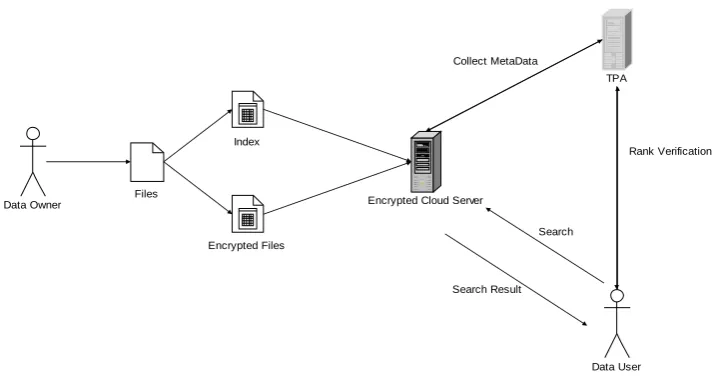
And in practice, the proposed scheme can do higher search efficiency by executing our “Greedy Depth-first Search” algorithm. Moreover, the parallel search can be flexibly performed to further reduce the time cost of the search process. An effective and flexible Audit scheme support to reduce the computation overheads. To ensure the correctness of similar data rank over the cloud that allowing a third party auditor (TPA), on behalf of the cloud client, to checking the integrity of the rank order in the search result assuming the cloud server is untrusted.
II. RELATED WORK
R. Geetha et al, International Journal of Computer Science and Mobile Applications,
Vol.4 Issue. 4, April- 2016, pg. 01-05
ISSN: 2321-8363
Impact Factor: 4.123
©2016, IJCSMA All Rights Reserved, www.ijcsma.com 3
III. SYSTEM MODEL
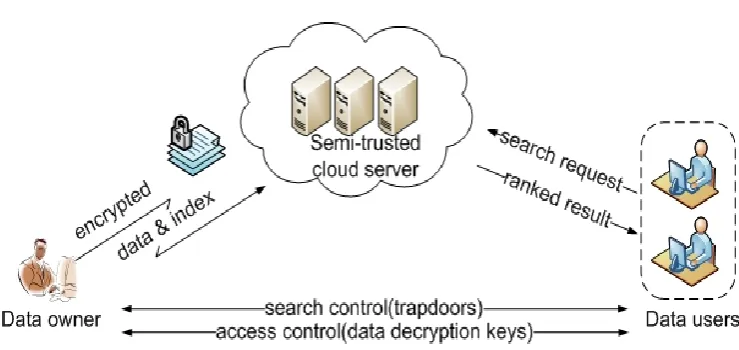
The system model can be divided into three entities, as shown:
Data owner:
Data owner collects the N number of important documents and outsources them to the cloud server. Before outsourcing them the documents are encrypted and uploaded to the cloud server for privacy requirements and securely distribute the key information by trapdoor to the authorized users.
Data user:
They are the authorized ones to access the documents uploaded by the data owner. Using the keyword the authorized user can send a trapdoor according to the search to get the encrypted documents from the cloud server. Then the user can decrypt the documents using a key.
Cloud server:
Cloud server stores the encrypted document and the encrypted tree index for data owner. Upon receiving the trapdoor TD from the data user, the cloud server executes the search over the index tree, and finally returns the corresponding collection of top- k ranked encrypted documents. Besides, upon receiving the update information from the data owner, the server needs to update the index and document collection C according to the received information.
IV. EXISTING SYSTEM
Existing searchable encryption schemes provide efficiency, functionality, and security. This scheme enable the client to store the encrypted data to the cloud and retrieve them using keyword search over cipher text domain. Abundant works have been done under different threat models to various search functionality such as single keyword search, similarity search, multi-keyword search, multi-keyword Boolean search, ranked search, multi-keyword search, etc. Among them, multi-keyword ranked search achieves more attention of document retrieval. This paper propose a secure tree based index structure and propose a “Greedy Depth First Search” algorithm to provide efficient multi-keyword ranked search. Secure kNN algorithm is used to encrypt the index and query vector and provide accurate relevance score calculation between encrypted index and query vectors.
V. SYSTEM ARCHITECTURE
R. Geetha et al, International Journal of Computer Science and Mobile Applications,
Vol.4 Issue. 4, April- 2016, pg. 01-05
ISSN: 2321-8363
Impact Factor: 4.123
©2016, IJCSMA All Rights Reserved, www.ijcsma.com 4
VI. PROPOSED SYSTEM
The enormous number of on-demand data users an enormous amount of outsourced data documents are present in the cloud, so this problem is challenging as it is really difficult to meet the requirements of scalability, performance and system usability. Ranked search will only send back the most relevant data hence it can also eliminate unnecessary network traffic, in “pay-as-you-use” cloud paradigm which is highly desirable. There are chances of attacking the rank order sent by cloud server hence it is required to check the integrity of rank. To enhance the accuracy of the search result as well as to improve the user searching experience, it is necessary to support multiple keywords search with the integrated ranking system.
Setup – here by taking the security parameters as an input from data owners generating symmetric keys for security is an output to data owners.
Build Index – here by taking all the documents from the data owners building an index for each and every document by considering unique keywords from the Documents. After index construction, all the keywords and the documents are encrypted before outsourcing into the cloud server.
Trapdoor – here with the keywords of interest as input, this has to generate trapdoor keys for searching the encrypted cloud data.
Query – here data user sends the search query to a cloud server which consists of multiple keywords and trapdoor. It performs keywords to search on the Encrypted cloud for the ranked order of the searchable index.
Integrated Rank – here it checks the integrity of the rank by using hash mapping technique for the integrated ranked ordered search .The sha-1 algorithm is used for checking the integrity of rank. Preserving the integrity of rank is important because when the data user searches for top-k retrieval from the cloud server and when the cloud server returns back the top-k retrieval to the data user there are possibilities of getting attacked by the intruder, so the data user may get the inaccurate rank order. Hence to overcome this problem checking the integrity of rank is required of both cloud and data user. When cloud server sending the top-k retrieval rank order, using rank order it performs a hash mapping technique to generate the signature. Then it sends both rank order and signature to the data user. Now the data user by using the rank order generates signature by using same hash mapping technique. Now the data user verifies the signature which is generated by itself and sent by cloud server if they both matches then the received rank order is accurate else it is inaccurate. If the rank order is accurate user download the document or else discard them.
VII. SYSTEM ARCHITECTURE
Figure 7.1 system architecture Encrypted Cloud Server Data Owner
Files
Index
Encrypted Files
Data User Search
Search Result
TPA
R. Geetha et al, International Journal of Computer Science and Mobile Applications,
Vol.4 Issue. 4, April- 2016, pg. 01-05
ISSN: 2321-8363
Impact Factor: 4.123
©2016, IJCSMA All Rights Reserved, www.ijcsma.com 5
VIII. CONCLUSION
In this paper, we define and solve the problem of checking the security of the cloud server and data user so that the data user retrieves the correct result from the cloud server by using integrated rank ordered multiple keyword searches over encrypted cloud data. We preserve the privacy of the data and the integrity of rank. By using Hash Mapping technique it solves the challenge of checking the integrity of rank on both cloud server and data user. We can achieve low communication and computation overhead by using an integrated rank order search for effective data retrieval in multiple keyword queries over an encrypted cloud data. As a result of this proposed methodology, we can achieve high security while retrieving the data as well as while outsourcing the data.
REFERENCES
[1] R. Curtmola, J.A. Garay, S. Kamara, and R. Ostrovsky, “Searchable Symmetric Encryption: Improved Definitions and Efficient Constructions,” Proc. ACM 13th Conf. Computer and Comm. Security (CCS), 2006.
[2] D. Song, D. Wagner, and A. Perrig, “Practical Techniques for Searches on Encrypted Data,” Proc. IEEE Symp. Security and Privacy, 2000.
[3] D. Boneh, G. Crescenzo, R. Ostrovsky, and G. Persiano, “Public- Key Encryption with Keyword Search,” Proc. Int’l Conf. Theory and Applications of Cryptographic Techniques (Eurocrypt), 2004.
[4] C. Wang, N. Cao, J. Li, K. Ren, and W. Lou, “Secure Ranked Keyword Search over Encrypted Cloud Data,” Proc. IEEE 30th Int’l Conf. Distributed Computing Systems (ICDCS), 2010.
[5] P. Golle, J. Staddon, and B. Waters, “Secure Conjunctive Keyword Search over Encrypted Data,” in Proc. of ACNS, 2004, pp. 31-45.
[6] N. Cao, C. Wang, M. Li, K. Ren, and W. Lou, “Privacy-Preserving Multi keyword Ranked Search over Encrypted Cloud Data,” Proc. IEEE INFOCOM, 2011