An Efficient Explanation of Individual Classifications
using Game Theory
Erik ˇStrumbelj [email protected]
Igor Kononenko [email protected]
Faculty of Computer and Information Science University of Ljubljana
Trˇzaska 25, 1000 Ljubljana, Slovenia
Editor: Stefan Wrobel
Abstract
We present a general method for explaining individual predictions of classification models. The method is based on fundamental concepts from coalitional game theory and predictions are ex-plained with contributions of individual feature values. We overcome the method’s initial exponen-tial time complexity with a sampling-based approximation. In the experimental part of the paper we use the developed method on models generated by several well-known machine learning algorithms on both synthetic and real-world data sets. The results demonstrate that the method is efficient and that the explanations are intuitive and useful.
Keywords: data postprocessing, classification, explanation, visualization
1. Introduction
Acquisition of knowledge from data is the quintessential task of machine learning. The data are often noisy, inconsistent, and incomplete, so various preprocessing methods are used before the appropriate machine learning algorithm is applied. The knowledge we extract this way might not be suitable for immediate use and one or more data postprocessing methods could be applied as well. Data postprocessing includes the integration, filtering, evaluation, and explanation of acquired knowledge. The latter is the topic of this paper.
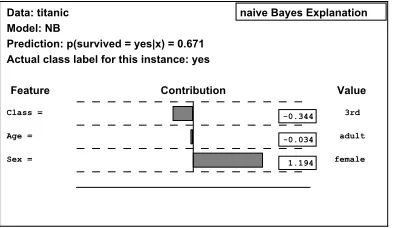
To introduce the reader with some of the concepts used in this paper, we start with a simple illustrative example of an explanation for a model’s prediction (see Fig. 1). We use Naive Bayes because its prediction can, due to the assumption of conditional independence, easily be transformed into contributions of individual feature values - a vector of numbers, one for each feature value, which indicates how much each feature value contributed to the Naive Bayes model’s prediction. This can be done by simply applying the logarithm to the model’s equation (see, for example, Kononenko and Kukar, 2007; Becker et al., 1997).
where important and sensitive decisions are made. One such example is medicine, where medical practitioners are known to be reluctant to use machine learning models, despite their often superior performance (Kononenko, 2001). The inherent ability of explaining its decisions is one of the main reasons for the frequent use of the Naive Bayes classifier in medical diagnosis and prognosis (Kononenko, 2001). The approach used to explain the decision in Fig. 1 is specific to Naive Bayes, but can we design an explanation method which works for any type of classifier? In this paper we address this question and propose a method for explaining the predictions of classification models, which can be applied to any classifier in a uniform way.
Figure 1: An instance from the well-known Titanic data set with the Naive Bayes model’s predic-tion and an explanapredic-tion in the form of contribupredic-tions of individual feature values. A copy of the Titanic data set can be found at http://www.ailab.si/orange/datasets.psp.
1.1 Related Work
Before addressing general explanation methods, we list a few model-specific methods to emphasize two things. First, most models have model-specific explanation methods. And second, providing an explanation in the form of contributions of feature values is a common approach. Note that many more model-specific explanation methods exist and this is far from being a complete reference. Similar to Naive Bayes, other machine learning models also have an inherent explanation. For example, a decision tree’s prediction is made by following a decision rule from the root to the leaf, which contains the instance. Decision rules and Bayesian networks are also examples of transparent classifiers. Nomograms are a way of visualizing contributions of feature values and were applied to Naive Bayes (Moˇzina et al., 2004) and, in a limited way (linear kernel functions), to SVM (Jakulin et al., 2005). Other related work focusses on explaining the SVM model, most recently in the form of visualization (Poulet, 2004; Hamel, 2006) and rule-extraction (Martens et al., 2007). The ExplainD framework (Szafron et al., 2006) provides explanations for additive classifiers in the form of contributions. Breiman provided additional tools for showing how individual features contribute to the predictions of his Random Forests (Breiman, 2001). The explanation and interpretation of artificial neural networks, which are arguably one of the least transparent models, has also received a lot of attention, especially in the form of rule extraction (Towell and Shavlik, 1993; Andrews et al., 1995; Nayak, 2009).
ex-planation method also has to be modified or replaced. The user then has to invest time and effort into adapting to the new explanation method. This can be avoided by using a general explanation method. Overall, a good general explanation method reduces the dependence between the user-end and the underlying machine learning methods, which makes work with machine learning models more user-friendly. This is especially desirable in commercial applications and applications of ma-chine learning in fields outside of mama-chine learning, such as medicine, marketing, etc. An effective and efficient general explanation method would also be a useful tool for comparing how a model predicts different instances and how different models predict the same instance.
As far as the authors are aware, there exist two other general explanation methods for explaining a model’s prediction: the work by Robnik- ˇSikonja and Kononenko (2008) and the work by Lemaire et al. (2008). While there are several differences between the two methods, both explain a prediction with contributions of feature values and both use the same basic approach. A feature value’s contri-bution is defined as the difference between the model’s initial prediction and its average prediction across perturbations of the corresponding feature. In other words, we look at how the prediction would change if we ”ignore” the feature value. This myopic approach can lead to serious errors if the feature values are conditionally dependent, which is especially evident when a disjunctive concept (or any other form of redundancy) is present. We can use a simple example to illustrate how these methods work. Imagine we ask someone who is knowledgeable in boolean logic What
will the result of (1 OR 1) be?. It will be one, of course. Now we mask the first value and ask
again What will the result of (something OR 1) be?. It will still be one. So, it does not matter if the person knows or does not know the first value - the result does not change. Hence, we conclude that the first value is irrelevant for that persons decision regarding whether the result will be 1 or 0. Symmetrically, we can conclude that the second value is also irrelevant for the persons decision making process. Therefore, both values are irrelevant. This is, of course, an incorrect explanation of how these two values contribute to the persons decision.
Further details and examples of where existing methods would fail can be found in our previous work ( ˇStrumbelj et al., 2009), where we suggest observing the changes across all possible subsets of features values. While this effectively deals with the shortcomings of previous methods, it suffers from an exponential time complexity.
To summarize, we have existing general explanation methods, which sacrifice a part of their effectiveness for efficiency, and we know that generating effective contributions requires observing the power set of all features, which is far from efficient. The contribution of this paper and its im-provement over our previous work is twofold. First, we provide a rigorous theoretical analysis of our explanation method and link it with known concepts from game theory, thus formalizing some of its desirable properties. And second, we propose an efficient sampling-based approximation method, which overcomes the exponential time complexity and does not require retraining the classifier.
The remainder of this paper is organized as follows. Section 2 introduces some basic concepts from classification and coalitional game theory. In Section 3 we provide the theoretical foundations, the approximation method, and a simple illustrative example. Section 4 covers the experimental part of our work. With Section 5 we conclude the paper and provide ideas for future work.
2. Preliminaries
2.1 Classification
In machine learning classification is a form of supervised learning where the objective is to predict the class label for unlabelled input instances, each described by feature values from a feature space. Predictions are based on background knowledge and knowledge extracted (that is, learned) from a sample of labelled instances (usually in the form of a training set).
Definition 1 The feature space
A
is the cartesian product of n features (represented with the setN={1,2, ...,n}):
A
=A1×A2×...×An, where each feature Aiis a finite set of feature values.Remark 1 With this definition of a feature space we limit ourselves to finite (that is, discrete) fea-tures. However, we later show that this restriction does not apply to the approximation method, which can handle both discrete and continuous features.
To formally describe situations where feature values are ignored, we define a subspace
A
S=A′1×A′2×...×A′n, where Ai′=Aiif i∈S and A′i={ε}otherwise. Therefore, given a set S⊂N,
A
Sis a feature subspace, where features not in S are ”ignored” (
A
N=A
). Instances from a subspacehave one or more components unknown as indicated byε. Now we define a classifier.
Definition 2 A classifier, f , is a mapping from a feature space to a normalized |C|-dimensional space f :
A
→[0,1]|C|, where C is a finite set of labels.Remark 2 We use a more general definition of a classifier to include classifiers which assign a rank or score to each class label. However, in practice, we mostly deal with two special cases: classifiers in the traditional sense (for each vector, one of the components is 1 and the rest are 0) and probabilistic classifiers (for each vector, the vector components always add up to 1 and are therefore a probability distribution over the class label state space).
2.2 Coalitional Game Theory
The following concepts from coalitional game theory are used in the formalization of our method, starting with the definition of a coalitional game.
Definition 3 A coalitional form game is a tuplehN,vi, where N ={1,2, ...,n} is a finite set of n players, and v : 2N→ℜis a characteristic function such that v(∅) =0.
Subsets of N are coalitions and N is referred to as the grand coalition of all players. Function v describes the worth of each coalition. We usually assume that the grand coalition forms and the goal
is to split its worth v(N)among the players in a ”fair” way. Therefore, the value (that is, solution)
is an operatorφwhich assigns tohN,via vector of payoffsφ(v) = (φ1, ...,φn)∈ℜn. For each game
with at least one player there are infinitely many solutions, some of which are more ”fair” than others. The following four statements are attempts at axiomatizing the notion of ”fairness” of a
solutionφand are key for the axiomatic characterization of the Shapley value.
Axiom 1
∑
i∈Nφi(v) =v(N). (efficiency axiom)
Axiom 3 If v(S∪ {i}) =v(S)holds for every S, where S⊂N and i∈/ S, thenφi(v) =0. (dummy axiom)
Axiom 4 For any pair of games v,w :φ(v+w) =φ(v) +φ(w), where(v+w)(S) =v(S) +w(S)for all S. (additivity axiom)
Theorem 1 For the gamehN,vithere exists a unique solutionφ, which satisfies axioms 1 to 4 and it is the Shapley value:
Shi(v) =
∑
S⊆N\{i},s=|S|(n−s−1)!s!
n! (v(S∪ {i})−v(S)), i=1, ...,n.
Proof For a detailed proof of this theorem refer to Shapley’s paper (1953).
The Shapley value has a wide range of applicability as illustrated in a recent survey paper by Moretti and Patrone (2008), which is dedicated entirely to this unique solution concept and its applications. From the few applications of the Shapley value in machine learning, we would like to bring to the readers attention the work of Keinan et al. (2004), who apply the Shapley value to function localization in biological and artificial networks. Their MSA framework is later used and adapted into a method for feature selection (Cohen et al., 2007).
3. Explaining Individual Predictions
In this section we provide the theoretical background. We start with a description of the intuition behind the method and then link it with coalitional game theory.
3.1 Definition of the Explanation Method
Let N={1,2, ...,n}be a set representing n features, f a classifier, and x= (x1,x2, ...,xn)∈
A
aninstance from the feature space. First, we choose a class label. We usually chose the predicted class label, but we may choose any other class label that is of interest to us and explain the prediction from that perspective (for example, in the introductory example in Fig. 1 we could have chosen
”survival = no” instead). Let c be the chosen class label and let fc(x)be the prediction component
which corresponds to c. Our goal is to explain how the given feature values contribute to the
prediction difference between the classifiers prediction for this instance and the expected prediction
if no feature values are given (that is, if all feature values are ”ignored”). The prediction difference
can be generalized to an arbitrary subset of features S⊆N.
Definition 4 The prediction difference ∆(S) when only values of features represented in S are known, is defined as follows:
∆(S) = 1
|
A
N\S|∑
y∈AN\S
fc(τ(x,y,S))−
1
|
A
N|∑
y∈AN
fc(y), (1)
τ(x,y,S) = (z1,z2, ...,zn), zi=
Remark 3 In our previous work ( ˇStrumbelj et al., 2009) we used a different definition: ∆(S) =
fc∗(S)−fc∗(∅), where f∗(W) is obtained by retraining the classifier only on features in W and re-classifying the instance (similar to the wrappers approach in feature selection Kohavi and John 1997). With this retraining approach we avoid the combinatorial explosion of going through all possible perturbations of ”ignored” feature’s values, but introduce other issues. However, the ex-ponential complexity of going through all subsets of N still remains.
The expression∆(S)is the difference between the expected prediction when we know only those
values of x, whose features are in S, and the expected prediction when no feature values are known. Note that we assume uniform distribution of feature values. Therefore, we make no assumption about the prior relevance of individual feature values. In other words, we are equally interested in each feature value’s contribution. The main shortcoming of existing general explanation methods is that they do not take into account all the potential dependencies and interactions between feature values. To avoid this issue, we implicitly define interactions by defining that each prediction
dif-ference∆(S)is composed of 2N contributions of interactions (that is, each subset of feature values
might contribute something):
∆(S) =
∑
W⊆SI
(W), S⊆N. (2)Assuming
I
(∅) =0 (that is, an interaction of nothing always contributes 0) yields a recursivedefinition. Therefore, function
I
, which describes the interactions, always exists and is uniquelydefined for a given N and function∆:
I
(S) =∆(S)−∑
W⊂S
I
(W), S⊆N. (3)Now we distribute the interaction contributions among the n feature values. For each interaction the involved feature values can be treated as equally responsible for the interaction as the interaction
would otherwise not exist. Therefore, we define a feature value’s contributionϕiby assigning it an
equal share of each interaction it is involved in
ϕi(∆) =
∑
W⊆N\{i}I
(W∪ {i})|W∪ {i}| , i=1,2, ...,n. (4)
It is not surprising that we manage in some way to uniquely quantify all the possible interactions, because we explore the entire power set of the involved feature values. So, two questions arise: Can
we make this approach computationally feasible? and What are the advantages of this approach over other possible divisions of contributions?. We now address both of these issues, starting with
the latter.
Theorem 2 hN ={1,2, ...,n},∆i is a coalitional form game and ϕ(∆) = (ϕ1,ϕ2, ...,ϕn) corre-sponds to the game’s Shapley value Sh(∆).
Proof Following the definition of∆ we get that∆(∅) =0, so the explanation of the classifier’s
prediction can be treated as a coalitional form gamehN,∆i. Now we provide an elementary proof
hN,∆i. The recursive definition of
I
given in Eq. (3) can be transformed into its non-recursive form:I
(S) =∑
W⊆S
((−1)|S|−|W|∆(W)). (5)
Eq. (5) can be proven by induction. We combine Eq. (4) and Eq. (5) into the following non-recursive formulation of the contribution of a feature value:
ϕi(∆) =
∑
W⊆N\{i}∑
Q⊆(W∪{i})
((−1)|W∪{i}|−|Q|∆(Q))
|W∪ {i}| . (6)
Let us examine the number of times∆(S∪ {i}), S⊆N,i∈/S , appears on the right-hand side of
Eq. (6). Let M∆(S∪{i})be the number of all such appearances and k=n−|S|−1. The term∆(S∪{i})
appears when S⊆W and only once for each such W . For W , where S⊆W and |W|=|S|+a,
∆(S∪ {i})appears with an alternating sign, depending on the parity of a, and there are exactly ka such W in the sum in Eq. (6), because we can use any combination of a additional elements from
the remaining k elements that are not already in the set S. If we write all such terms up to W =N
and take into account that each interaction
I
(W)is divided by|W|, we get the following series:The treatment is similar for∆(S), i∈/S where we get M∆(S)=−V(n,k). The series V(n,k)can
be expressed with the beta function:
(1−x)k=
k 0 − k 1 x+ k 2
x2−...±
k k xk Z 1 0
xn−k−1(1−x)kdx=Z 1 0 ( k 0
xn−k−1−
k
1
xn−k+...±
k n−1
xn−1)dx
B(n−k,k+1) = k 0
n−k− k 1
n−k+1+...±
k k
n =V(n,k).
Using B(p,q) =Γ(Γ(pp)Γ(+qq)), we get V(n,k) =(n−kn!−1)!k!. Therefore:
ϕi(∆) =
∑
S⊆N\{i}V(n,n−s−1)·∆(S∪ {i})−
∑
S⊆N\{i}V(n,n−s−1)·∆(S) =
=
∑
S⊆N\{i}
(n−s−1)!s!
n! ·(∆(S∪ {i})−∆(S)).
sum of all n contributions in an instance’s explanation is equal to the difference in prediction∆(N). Therefore, the contributions are implicitly normalized, which makes them easier to compare across different instances and different models. According to the 2nd axiom, if two features values have an identical influence on the prediction they are assigned contributions of equal size. The 3rd axiom says that if a feature has no influence on the prediction it is assigned a contribution of 0. When viewed together, these properties ensure that any effect the features might have on the classifiers output will be reflected in the generated contributions, which effectively deals with the issues of previous general explanation methods.
3.1.1 ANILLUSTRATIVEEXAMPLE
In the introduction we used a simple boolean logic example to illustrate the shortcomings of ex-isting general explanation methods. We concluded that in the expression (1 OR 1) both values are irrelevant and contribute nothing to the result being 1. This error results from not observing all the possible subsets of features. With the same example we illustrate how our explanation method
works. We write N={1,2},
A
={0,1} × {0,1}, and x= (1,1). In other words, we are explainingthe classifier’s prediction for the expression(1 OR 1). Following the steps described in Section 3,
we use Eq. (1) to calculate the∆−terms. Intuitively,∆(S)is the difference between the classifiers
expected prediction if only values of features in S are known and the expected prediction if no values are known. If the value of at least one of the two features is known, we can predict, with certainty, that the result is 1. If both values are unknown (that is, masked) one can predict that the probability
of the result being 1 is 34. Therefore,∆(1) =∆(2) =∆(1,2) =1−34 = 14 and∆(∅) = 3
4− 3 4 =0.
Now we can calculate the interactions.
I
(1) =∆(1) = 14 and
I
(2) =∆(2) = 14. When observed
together, the two features contribute less than their individual contributions would suggest, which
results in a negative interaction:
I
(1,2) =∆(1,2)−(I
(1) +I
(2)) =−14. Finally, we divide the
interactions to get the final contributions: ϕ1=
I
(1) +I(1,2)2 =
1
8 andϕ2=
I
(2) +I(1,2)
2 =
1
8. The
generated contributions reveal that both features contribute the same amount towards the prediction being 1 and the contributions sum up to the initial difference between the prediction for this instance and the prior belief.
3.2 An Approximation
We have shown that the generated contributions, ϕi, are effective in relating how individual
fea-ture values influence the classifier’s prediction. Now we provide an efficient approximation. The approximation method is based on a well known alternative formulation of the Shapley value. Let
π(N)be the set of all ordered permutations of N. Let Prei(
O
)be the set of players which arepre-decessors of player i in the order
O
∈π(N). A feature value’s contribution can now be expressedas:
ϕi(∆) =
1
n!O∈
∑
π(N) ∆(Prei(
O
)∪ {i})−∆(Prei(O
)), i=1, ...,n. (7)
Eq. (7) is the a well-known alternative formulation of the Shapley value. An algorithm for the computation of the Shapley value, which is based on Eq. (7), was presented by Castro et al. (2008).
However, in our case, the exponential time complexity is still hidden in our definition of ∆ (see
Eq. (1)). If we use the alternative definition used in our previous work (see Remark 3), we can
a polynomial time complexity). However, this requires retraining the classifier for each S⊆N, so
the method would no longer be independent of the learning algorithm and we would also require the training set that the original classifier was trained on. To avoid this and still achieve an efficient explanation method, we extend the sampling algorithm in the following way. We use a different, but equivalent formulation of Eq. (1). While the sum in this equation redundantly counts each
f(τ(x,y,S)) term |
A
S| times (instead of just once) it is equivalent to Eq. (1) and simplifies thesampling procedure:
∆(S) = 1
|
A
|∑
y∈A
(f(τ(x,y,S))−f(y)). (8)
We replace occurrences of∆in Eq. (7) with Eq. (8):
ϕi(∆) =
1
n!· |
A
|∑
O∈π(N)y
∑
∈Af(τ(x,y,Prei(
O
)∪ {i}))−f(τ(x,y,Prei(O
))).We use the following sampling procedure. Our sampling population is π(N)×
A
and eachorder/instance pair defines one sample XO,y∈A = f(τ(x,y,Prei(
O
)∪ {i}))−f(τ(x,y,Prei(O
))). Ifsome features are continuous, we have an infinite population, but the properties of the sampling procedure do not change. If we draw a sample completely at random then all samples have an
equal probability of being drawn (n!·|1A|) and E[XO,y∈A] =ϕi. Now consider the case where m such
samples are drawn (with replacement) and observe the random variable ˆϕi=m1∑mj=1Xj, where Xjis
the j−th sample. According to the central limit theorem, ˆϕi is approximately normally distributed
with meanϕi and variance σ
2
i
m, whereσ2i is the population variance for the i−th feature. Therefore,
ˆ
ϕiis an unbiased and consistent estimator ofϕi. The computation is summarized in Algorithm 1.
Algorithm 1 Approximating the contribution of the i-th feature’s value,ϕi, for instance x∈
A
.determine m, the desired number of samples
ϕi←0
for j=1 to m do
choose a random permutation of features
O
∈π(N)choose a random instance y∈
A
v1← f(τ(x,y,Prei(
O
)∪ {i})) v2← f(τ(x,y,Prei(O
)))ϕi←ϕi+ (v1−v2) end for
ϕi← ϕmi
{v1 and v2 are the classifier’s predictions for two instances, which are constructed by taking
instance y and then changing the value of each feature which appears before the i-th feature in
order
O
(for v1 this includes the i−th feature) to that feature’s value in x. Therefore, these two3.2.1 ERROR/SPEEDTRADEOFF
We have established an unbiased estimator of the contribution. Now we investigate the relationship
between the number of samples we draw and the approximation error. For each ϕi, the number
of samples we need to draw to achieve the desired error, depends only on the population variance
σ2
i. In practice,σ2i is usually unknown, but has an upper bound, which is reached if the population
is uniformly distributed among its two extreme values. According to Eq. (1), the maximum and
minimum value of a single sample are 1 and−1, respectively, soσ2i ≤1. Let the tupleh1−α,ei
be a description of the desired error restriction and P(|ϕi−ϕˆi|<e) =1−α the condition, which
has to be fulfilled to satisfy the restriction. For any givenh1−α,ei, there is a constant number
of samples we need to satisfy the restriction: mi(h1−α,ei) =
Z2 1−α·σ2
e2 , where Z1−2 αis the Z-score,
which corresponds to the 1−αconfidence interval. For example, we want 99% of the approximated
contributions to be less than 0.01 away from their actual values and we assume worst-case variance
σ2
i =1, for each i∈N. Therefore, we have to draw approximately 65000 samples per feature,
regardless of how large the feature space is. The variances are much lower in practice, as we show in the next section.
For each feature value, the number of samples mi(h1−α,ei)is a linear function of the sample
varianceσ2i. The key to minimizing the number of samples is to estimate the sample varianceσ2i and
draw the appropriate number of samples. This estimation can be done during the sampling process, by providing confidence intervals for the required number of samples, based on our estimation of variance on the samples we already took. While this will improve running times, it will not have any effect on the time complexity of the method, so we delegate this to further work. The optimal
(minimal) number of samples we need for the entire explanation is: mmin(h1−α,ei) =n·
Z12−α·σ2 e2 ,
whereσ2=1
n∑ n
i=1σ2i. Therefore, the number n·σ2, whereσ2is estimated across several instances,
gives a complete description of how complex a model’s prediction is to explain (that is, proportional to how many samples we need).
A note on the method’s time complexity. When explaining an instance, the sampling process has to be repeated for each of the n feature values. Therefore, for a given error and confidence level,
the time complexity of the explanation is O(n·T(
A
)), where function T(A
)describes the instanceclassification time of the model on
A
. For most machine learning models T(A
)≤n.4. Empirical Results
The evaluation of the approximation method is straightforward as we focus only on approximation errors and running times. We use a variety of different classifiers both to illustrate that it is indeed a general explanation method and to investigate how the method behaves with different types of classification models. The following models are used: a decision tree (DT), a Naive Bayes (NB), a SVM with polynomial kernel (SVM), a multi-layer perceptron artificial neural network (ANN), Breiman’s random forests algorithm (RF), logistic regression (logREG), and ADABoost boosting with either Naive Bayes (bstNB) or a decision tree (bstDT) as the weak learner. All experiments were done on an off-the-shelf laptop computer (2GHz dual core CPU, 2GB RAM), the explanation method is a straightforward Java implementation of the equations presented in this paper, and the
classifiers were imported from the Weka machine learning software (http://www.cs.waikato.
model # instances # features (n) max(σ2
i) max(σ2) n·max(σ2)
CondInd 2000 8 0.25 0.06 0.48
Xor 2000 6 0.32 0.16 0.96
Group 2000 4 0.30 0.16 0.64
Cross 2000 4 0.43 0.14 0.92
Chess 2000 4 0.44 0.22 0.88
Sphere 2000 5 0.21 0.13 0.65
Disjunct 2000 5 0.10 0.06 0.30
Random 2000 4 0.19 0.12 0.48
Oncology 849 13 0.16 0.08 1.04
Annealing 798 38 0.08 0.02 0.76
Arrhythymia 452 279 0.03 10−3 0.28
Breast cancer 286 9 0.22 0.10 0.90
Hepatitis 155 19 0.20 0.05 0.95
Ionosphere 351 34 0.20 0.04 1.36
Iris 150 4 0.23 0.10 0.40
Monks1 432 6 0.29 0.12 0.72
Monks2 432 6 0.31 0.27 1.62
Monks3 432 6 0.20 0.07 0.42
Mushroom 8124 22 0.24 0.05 1.10
Nursery 12960 8 0.22 0.03 0.24
Soybean 307 35 0.20 0.01 0.35
Thyroid 7200 21 0.18 0.02 0.42
Zoo 101 17 0.25 0.02 0.14
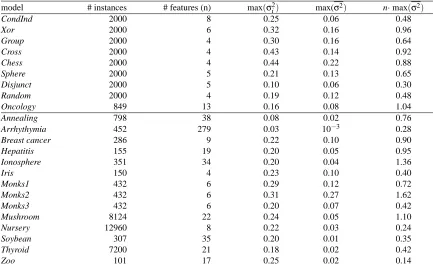
Table 1: List of data sets used in our experiments. The variance of the most complex feature value and the variance of most complex model to explain are included.
The list of data sets used in our experiments can be found in Table 1. The first 8 data sets are synthetic data sets, designed specifically for testing explanation methods (see Robnik- ˇSikonja and Kononenko, 2008; ˇStrumbelj et al., 2009). The synthetic data sets contain the following concepts: conditionally independent features (CondInd), the xor problem (Xor, Cross, Chess), irrelevant fea-tures only (Random), disjunction (Disjunct, Sphere), and spatially clustered class values (Group). The Oncology data set is a real-world oncology data set provided by the Institute of Oncology, Ljubljana. To conserve space, we do not provide all the details about this data set, but we do use an instance from it as an illustrative example. Those interested in a more detailed description of this data set and how our previous explanation method is successfully applied in practice can refer to our previous work ( ˇStrumbelj et al., 2009). The remaining 14 data sets are from the UCI machine learning repository (Asuncion and Newman, 2009).
log10(samples per feature)
absolute error
0.05 0.10
1 2 3 4
condInd NB group NB
1 2 3 4
monks2 ANN monks2 DT
random ANN
1 2 3 4
random logREG sphere bstDT
1 2 3 4
0.05 0.10
sphere DT
99% max mean
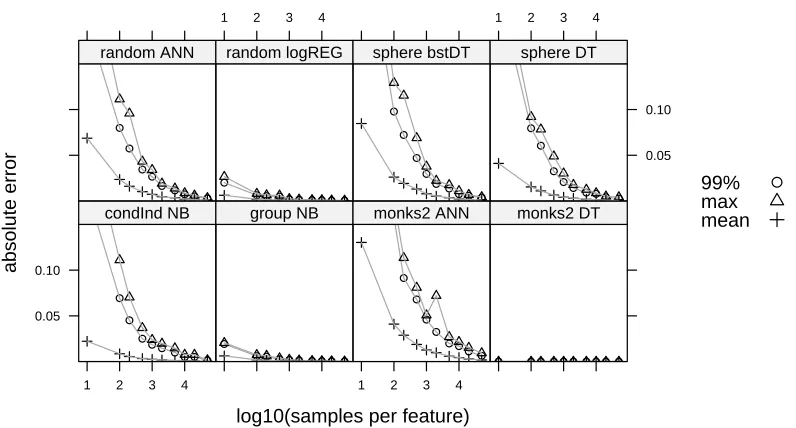
Figure 2: Mean, 99th-percentile, and maximum errors for several data set/classifier pairs and across different settings of how many samples are drawn per feature. Note that the error is the absolute difference between the approximated and actual contribution of a feature’s value. The maximum error is the largest such observed difference across all instances.
Some of the results of this experiment are shown in Fig. 2. We can see that it only takes about a thousand of samples per feature to achieve a reasonably low approximation error. When over 10000 samples are drawn, all the contributions across all features and all test instances are very close to the actual contributions. From the discussion of the approximation error, we can see that the number of samples depends on the variance in the model’s output, which in turn directly depends on how much the model has learned. Therefore, it takes only a few samples for a good approximation when explaining a model which has acquired little or no knowledge. This might be either due to the model not being able to learn the concepts behind the data set or because there are no concepts to learn.
A few such examples are the Naive Bayes model on the Group data set (model’s accuracy: 0.32,
relative freq. of majority class: 0.33), the Decision Tree on Monks2 (acc. 0.65 , rel. freq. 0.67), and
Logistic Regression on the Random data set (acc. 0.5 , rel. freq. 0.5). On the other hand, if a model successfully learns from the data set, it requires more samples to explain. For example, Naive Bayes on CondInd (acc. 0.92 , rel. freq. 0.50) and a Decision Tree on Sphere (acc. 0.80 , rel. freq. 0.50). In some cases a model acquires incorrect knowledge or over-fits the data set. One such example is the ANN model, which was allowed to over-fit the Random data set (acc. 0.5 , rel. freq. 0.5). In this case the method explains what the model has learned, regardless of whether the knowledge is correct or not. And although the explanations would not tell us much about the concepts behind the data set (we conclude from the model’s performance, that it’s knowledge is useless), they would reveal what the model has learned, which is the purpose of an explanation method.
logREG NB DT RF SVM bstDT bstNB ANN
iris (4)
random (4) monks2 (6)
group (4)
disjunct (5)
cross (4) chess (4)
xor (6)
monks3 (6) monks1 (6)
breast cancer (9)
condInd (8) sphere (5) nursery (8)
zoo (17)
hepatitis (19) oncology (13) thyroid (21) mushroom (22) annealing (38)
soybean (35)
ionosphere (34) arrhythmia (279)
<1sec <5sec <10sec <1min <5min >5min
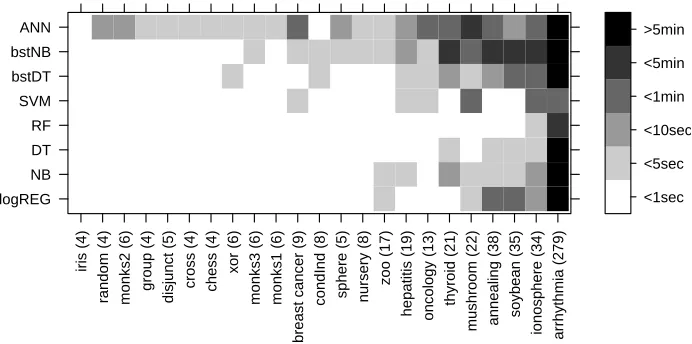
Figure 3: Visualization of explanation running times across all data set/classifier pairs.
the number of test instances, which is sufficient for a good estimate of classification times and
variances. The maximumσ2i in Table 1 reveal that the crisp features of synthetic data sets have
higher variance and are more difficult to explain than features from real-world data sets. Explaining the prediction of the ANN model for an instance Monks2 is the most complex explanation (that is, requires the most samples - see Fig. 2), which is understandable given the complexity of the Monks2 concept (class label = 1 iff exactly two feature values are 1). Note that most maximum values are achieved when explaining ANN.
From the data gathered in our second experiment, we generate Fig. 3, which shows the time
needed to provide an explanation with the desired errorh99%,0.01i. For smaller data sets (smaller in
the number of features) the explanation is generated almost instantly. For larger data sets, generating an explanation takes less than a minute, with the exception of bstNB on a few data sets and the ANN model on the Mushroom data set. These two models require more time for a single classification.
The Arrhythmia data set, with its 279 features, is an example of a data set, where the explanation can not be generated in some sensible time. For example, it takes more than an hour to generate an explanation for a prediction of the bstNB model. The explanation method is therefore less ap-propriate for explaining models which are built on several hundred features or more. Arguably, providing a comprehensible explanation involving a hundred or more features is a problem in its own right and even inherently transparend models become less comprehensible with such a large number of features. However, the focus of this paper is on providing an effective and general expla-nation method, which is computationally feasible on the majority of data sets we encounter. Also note that large data sets are often reduced to a smaller number of features in the preprocessing step of data acquisition before a learning algorithm is applied. Therefore, when considering the number of features the explanation method can still handle, we need not count irrelevant features, which are not included in the final model.
4.1 Example Explanation
(a) NB model (b) bstDT model
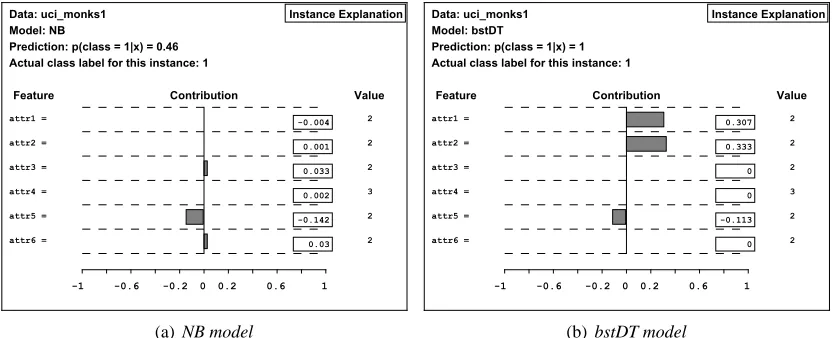
Figure 4: The boosting model correctly learns the concepts of the Monks1 data set, while Naive Bayes does not and misclassifies this instance.
method’s explanations with several examples. When interpreting the explanations, we take into account both the magnitude and the sign of the contribution. If a feature-value has a larger contribu-tion than another it has a larger influence on the model’s prediccontribu-tion. If a feature-value’s contribucontribu-tion has a positive sign, it contributes towards increasing the model’s output (probability, score, rank, ...). A negative sign, on the other hand, means that the feature-value contributes towards decreas-ing the model’s output. An additional advantage of the generated contributions is that they sum up to the difference between the model’s output prediction and the model’s expected output, given no information about the values of the features. Therefore, we can discern how much the model’s output moves when given the feature values for the instance, which features are responsible for this change, and the magnitude of an individual feature-value’s influence. These examples show how the explanations can be interpreted. They were generated for various classification models and data sets, to show the advantage of having a general explanation method.
The first pair of examples (see Fig. 4) are explanations for an instance from the first of the well-known Monks data sets. For this data set the class label is 1 iff attr1 and attr2 are equal or attr5 equals 1. The other 3 features are irrelevant. The NB model, due to its assumption of conditional independence, does not learn the importance of equality between the first two features and misclassifies the instance. However, both NB and bstDT learn the importance of the fifth feature and explanations reveal that value 2 for the fifth feature speaks against class 1.
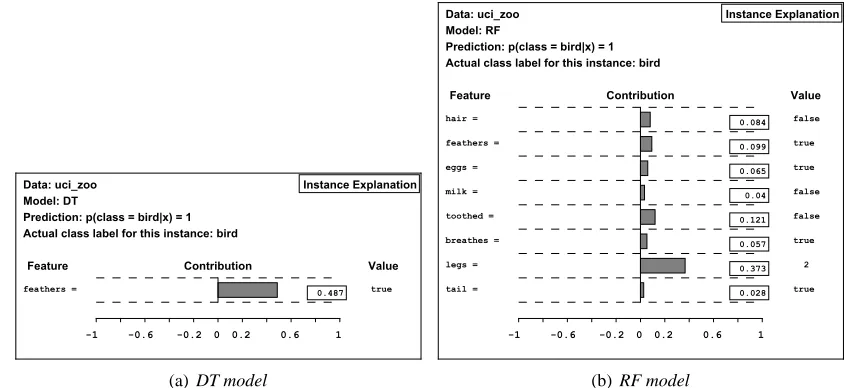
The second pair of examples (see Fig. 5) is from the Zoo data set. Both models predict that the instance represents a bird. Why? The explanations reveal that DT predicts this animal is a bird, because it has feathers. The more complex RF model predicts its a bird, because it has two legs, but also because the animal is toothless, with feathers, without hair, etc... These first two pairs of examples illustrate how the explanations reflect what the model has learnt and how we can compare explanations from different classifiers.
exclusive-(a) DT model (b) RF model
Figure 5: Explanations for an instance from the Zoo data set. The DT model uses a single feature, while several feature values influence the RT model. Feature values with contributions
≤0.01 have been removed for clarity.
or concept of this data set (for this data set the class label is the odd parity bit for the first three feature values) and the explanation is appropriate. On the other hand, SVM manages to overfit the Random data set and finds concepts where there are none (see Fig. 6(b)).
Fig. 7(a) is an explanation for ANN’s prediction for the introductory instance from the Titanic data set (see Fig. 1). Our explanation for the NB model’s prediction (Fig. 7(b)) is very similar to the inherent explanation (taking into account that a logarithm is applied in the inherent explanation). The ANN model, on the other hand, predicts a lower chance of survival, because being a passenger from the 3rd class has a much higher negative contribution for ANN.
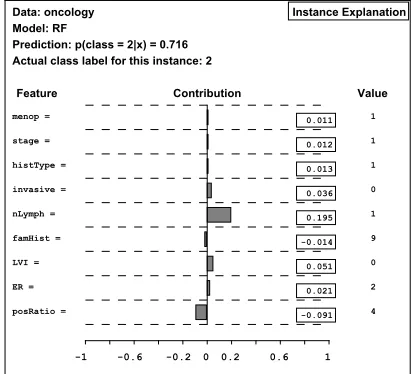
Our final example illustrates how the method can be used in real-world situations. Fig. 8 is an explanation for RT’s prediction regarding whether breast cancer will (class = 1) or will not (class = 2) recur for this patient. According to RF it is more likely that cancer will not recur and the explanation indicates that this is mostly due to a low number of positive lymph nodes (nLymph). The lack of lymphovascular invasion (LVI) or tissue invasion (invasive) also contributes positively. A high ratio of removed lymph nodes was positive (posRatio) has the only significant negative contribution. Oncologists found this type of explanation very useful.
5. Conclusion
(a) logREG model (b) SVM model
Figure 6: The left hand side explanation indicates that the feature values have no significant influ-ence on the logREG model on the Xor data set. The right hand side explanation shows how SVM overfits the Random data set.
(a) ANN model (b) NB model
Figure 7: Two explanations for the Titanic instance from the introduction. The left hand side ex-planation is for the ANN model. The right hand side exex-planation is for the NB model.
on several examples, the method can be used to visually inspect models’ predictions and compare the predictions of different models.
The proposed approximation method successfully deals with the initial exponential time com-plexity, makes the method efficient, and feasible for practical use. As part of further work we intend to research whether we can efficiently not only compute the contributions, which already reflect the interactions, but also highlight (at least) the most important individual interactions as well. A minor issue left to further work is extending the approximation with an algorithm for optimizing the number of samples we take. It would also be interesting to explore the possibility of applying the same principles to the explanation of regression models.
References
Robert Andrews, Joachim Diederich, and Alan B. Tickle. Survey and critique of techniques for extracting rules from trained artificial neural networks. Knowledge-Based Systems, 8:373–389, 1995.
Artur Asuncion and David J. Newman. UCI Machine Learning Repository,http://www.ics.uci.
edu/˜mlearn/MLRepository.html, 2009.
Barry Becker, Ron Kohavi, and Dan Sommerfield. Visualizing the simple bayesian classier. In KDD
Workshop on Issues in the Integration of Data Mining and Data Visualization, 1997.
Leo Breiman. Random forests. Machine Learning Journal, 45:5–32, 2001.
Javier Castro, Daniel G´omez, and Juan Tejada. Polynomial calculation of the shapley value based on sampling. Computers and Operations Research, 2008. (in print, doi: 10.1016/j.cor.2008.04.004).
Shay Cohen, Gideon Dror, and Eytan Ruppin. Feature selection via coalitional game theory. Neural
Computation, 19(7):1939–1961, 2007.
Lutz Hamel. Visualization of support vector machines with unsupervised learning. In
Computa-tional Intelligence in Bioinformatics and ComputaComputa-tional Biology, pages 1–8. IEEE, 2006.
Aleks Jakulin, Martin Moˇzina, Janez Demˇsar, Ivan Bratko, and Blaˇz Zupan. Nomograms for vi-sualizing support vector machines. In KDD ’05: Proceeding of the Eleventh ACM SIGKDD
International Conference on Knowledge Discovery in Data Mining, pages 108–117, New York,
NY, USA, 2005. ACM. ISBN 1-59593-135-X.
Alon Keinan, Ben Sandbank, Claus C. Hilgetag, Isaac Meilijson, and Eytan Ruppin. Fair attribution of functional contribution in artificial and biological networks. Neural Computation, 16(9):1887– 1915, 2004.
Ron Kohavi and George H. John. Wrappers for feature subset selection. Artificial Intelligence
journal, 97(1–2):273–324, 1997.
Igor Kononenko. Machine learning for medical diagnosis: history, state of the art and perspective.
Artificial Intelligence in Medicine, 23:89–109, 2001.
Igor Kononenko and Matjaz Kukar. Machine Learning and Data Mining: Introduction to Principles
Vincent Lemaire, Rapha¨el Fraud, and Nicolas Voisine. Contact personalization using a score under-standing method. In International Joint Conference on Neural Networks (IJCNN), 2008.
David Martens, Bart Baesens, Tony Van Gestel, and Jan Vanthienen. Comprehensible credit scoring models using rule extraction from support vector machines. European Journal of Operational
Research, 183(3):1466–1476, 2007.
Stefano Moretti and Fioravante Patrone. Transversality of the shapley value. TOP, 16(1):1–41, 2008.
Martin Moˇzina, Janez Demˇsar, Michael Kattan, and Blaˇz Zupan. Nomograms for visualization of naive bayesian classifier. In PKDD ’04: Proceedings of the 8th European Conference on
Principles and Practice of Knowledge Discovery in Databases, pages 337–348, New York, NY,
USA, 2004. Springer-Verlag New York, Inc. ISBN 3-540-23108-0.
Richi Nayak. Generating rules with predicates, terms and variables from the pruned neural net-works. Neural Networks, 22(4):405–414, 2009.
Francois Poulet. Svm and graphical algorithms: A cooperative approach. In Proceedings of Fourth
IEEE International Conference on Data Mining, pages 499–502, 2004.
Marko Robnik- ˇSikonja and Igor Kononenko. Explaining classifications for individual instances.
IEEE Transactions on Knowledge and Data Engineering, 20:589–600, 2008.
Lloyd S. Shapley. A Value for n-person Games, volume II of Contributions to the Theory of Games. Princeton University Press, 1953.
Duane Szafron, Brett Poulin, Roman Eisner, Paul Lu, Russ Greiner, David Wishart, Alona Fyshe, Brandon Pearcy, Cam Macdonell, and John Anvik. Visual explanation of evidence in additive classifiers. In Proceedings of Innovative Applications of Artificial Intelligence, 2006.
Geoffrey Towell and Jude W. Shavlik. Extracting refined rules from knowledge-based neural net-works, machine learning. Machine Learning, 13:71–101, 1993.