Renu Jangra et al, International Journal of Computer Science and Mobile Applications, Vol.5 Issue. 8, August- 2017, pg. 24-29 ISSN: 2321-8363 Impact Factor: 4.123
©2017, IJCSMA All Rights Reserved, www.ijcsma.com 24
ACO Parameters Analysis of TSP Problem
Renu Jangra
Ph.D., Research Scholar, Department of Computer Science & Applications, Kurukshetra University, Kurukshetra, India
Dr. Ramesh Kait
Assistant Professor, Department of Computer Science & Applications, Kurukshetra University, Kurukshetra, India
Abstract- A recently proposed algorithm named Ant colony optimization algorithm (ACO) is simple to merge with additional methods. The application of Ant Colony Optimization is much wider and it is always the key algorithm. A meta-heuristic algorithm Ant Colony optimization which is applied on the combinatorial optimized problems to get the optimal solution. Among common combinatorial problems one is Travelling-Salesman Problem (TSP). In this paper, we analyze the ACO algorithm with different parameters values using MATLAB tool. The analysis is shown in form of graph showing the optimal solution corresponding to the values set for the parameters.
Keywords: ACO-Ant colony optimization; Traveling Salesman Problem
I. INTRODUCTION
Ant Colony Optimization is a meta-heuristic technique that is adapted by many researchers for their research work and successfully implemented in many applications. Initially, the planning of ACO is done by the scholar of Italian M.Dorigo .et.al. in 1991 [1]. The concept that inspired the scholars to propose the ACO is the exploring conduct of the real ants. The main concept behind ACO algorithm is the communication among the ants done indirectly through the pheromone trails. A pheromone is like a chemical substance discharge by the ants during their search for foodstuff. ACO algorithm helps in evaluating the shortest path from home to food. More concentration of pheromone on any path attract more ants follow that path and this will give the probability of getting the shortest path. Initially, ACO algorithm famous with its three variations: Ant Cycle; Ant-Density; and Ant Quantity. The major difference among them depends on the update in pheromone value. In Ant-Cycle, after the completion of each and every ant‟s tour, the pheromone (the sum of pheromone is in inverse proportion of length of tour) is deposited on the paths traversed during the ant‟s route. The edges traversed by the ants during the tour are remembered by ant‟s memory. In Ant-Density and Ant-Quantity, the value of pheromone is reset at every city before the movement of ants to the next city. The Ant-cycle algorithm worked superior than the other two algorithms on a number of analysis problems [2].
II. LITERATURE SURVEY
Renu Jangra et al, International Journal of Computer Science and Mobile Applications, Vol.5 Issue. 8, August- 2017, pg. 24-29 ISSN: 2321-8363 Impact Factor: 4.123
©2017, IJCSMA All Rights Reserved, www.ijcsma.com 25
that ASrank gives the preeminent solutions for the entire specified target due to its capability to travel around and utilize the solution space successfully. They also compare the other meta-heuristics such as GRASP, Tabu Search, Genetic Algorithms and Simulated Annealing with the performance of ACO algorithms on the TSP problem. Ping Guo, et.al. [8] examine and evaluate several ACO algorithms that use different improving methods, and then wrap up two sorts of strategies (an improvement on the construction of solutions and on the update of pheromone trails ) from them. Based on experiments, they examine and prove the effectiveness of performance and usage of the two strategies. These two strategies possess their own features and offer a clear guideline for designing new ACO algorithms.Thomas St¨utzle et.al. [9] done the experiment on computation time, by taking different parameters values, can boost the performance of an algorithm in two ways - in prescheduled ways and based on the search progress. Evolutionary algorithms have two frequent themes - Parameter control; and parameter. Mahesh Mulani et.al [10] presents the fundamental plan that works on the concept of the analytical behavioral study to mutually help in designing the algorithm with the parameter settings and problem instance characteristics. This paper is considered as the remarks on algorithm design criterion TSP and its analytical outcome. Shigang Cui et.al [11] describes the base of the ant colony algorithm using TSP problem its model, benefits and shortcomings. The existing understanding process of ant colony algorithm is used in solving traveling salesman problem and the execute simulation results shows that ant colony algorithm works better than others with benefits of fast and high precision of convergence speed; strong robustness and many others. But, randomly possible in case when the number of ants is small and the search time will be more when there is more ants.
Ant Colony Optimization: A Metaheuristic
Metaheuristic implies higher level search. The new heuristic have the below desirable features:
Versatile: It adapt the changes occur in some event. This can be applicable when type of problem is same; for example, asymmetric traveling salesman problem (ATSP) produced from the traveling salesman problem (TSP).
Robust: With the small change, it can be applicable to other optimized combinatorial problems such as the graph coloring problem (GCP) and the sequential ordering problem (SOP).
Population-based approach: This is popular because it uses positive feedback as a search mechanism. It also allows the system available for parallel implementations.
The Concept of Ant Colony Optimization:
Fig 1: Asymmetric Bridge
Renu Jangra et al, International Journal of Computer Science and Mobile Applications, Vol.5 Issue. 8, August- 2017, pg. 24-29 ISSN: 2321-8363 Impact Factor: 4.123
©2017, IJCSMA All Rights Reserved, www.ijcsma.com 26
pheromones in creation of new paths. If only positive reaction is taken into consideration, this creates a problem called stagnation in which all ants follow a single sub-optimal path. To stay away from the negative reaction, pheromone evaporation is taken into consideration. The rate at which evaporation of pheromone takes place should not be very high or not too fast. If too high, the search area will contract. If too fast, then situation occurs in which the colony forgets too early its knowledge that the ants achieve in the past (loss of memory) which spoils the supportive activities of ants [4].
Currently, ant k is in city/node i and wants to go to city/node j with probability formula given by
pi,jk = [τi,j]α [ηi,j]β
, if j ∈ Nik
(1)
∑l∈Nik [τi,j]α [ηi,j]β
Where ηi,j=1/di,j and α,β ≥0
di,j = distance between cities/nodes i and j
τi,j = intensity of pheromone trail between cities/nodes i and j
ηi,j = representing the heuristic information to travel to the city j from the city i : the closer the city, stronger the wish to visit it.
α = parameter that decides the relative control or weight of the pheromone trail. β = parameter to show visibility when selecting the route.
When value of α=0, ant selects the nearest city to move on and when value of β=0, the only the value of pheromone is taken into consideration that show that all ants will follow one sub-optimal path. For superior optimization, dynamics β ≥α. Equation (1) represents the probability of choosing a next particular city. The choice rule is based on “roulette-wheel” principle in which each city that it contains has its own sector with the area proportional to probability (1). The selection of next city is same as throwing a roulette ball, i.e. to know the sector position of where it stops, it generates a random number. The pheromone release by kth ant on edge (i, j), when tour is completed, is given by
Q , if (i, j) ∈ Tk(t)
Lk (t)
∆τi,j,k(t) =
0 , if (i, j) ∉ Tk (t)
where Q>0 is a adjustable parameter, Tk(t) is assumes to be the route of ant k at „t‟ iteration, Lk(t) is assume as the length of the route
Tk(t)
Pheromone update rule with evaporation rate coefficient ρ is given by: m
τi ,j (t+1) = (1- p) τi,j (t) + ∑ ∆τi,j,k(t)
k=1
Travelling Salesman Problem (TSP):
Renu Jangra et al, International Journal of Computer Science and Mobile Applications, Vol.5 Issue. 8, August- 2017, pg. 24-29 ISSN: 2321-8363 Impact Factor: 4.123
©2017, IJCSMA All Rights Reserved, www.ijcsma.com 27
In our experiment, the shortest route follows by ants is shown in Figure1. The parameters taken are as follows. Number of iteration=300, Number of ants=40, α = β = 1, ρ=0.05
Fig. 1: Optimal path follow by ants
III. EXPERIMENT ANALYSIS
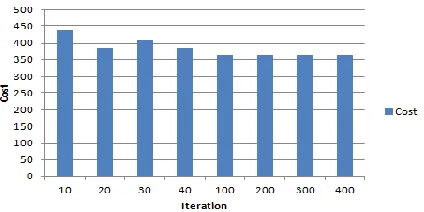
With the help of Matlab Tool, we execute the ACO code with TSP problem taken from TSPLIB [5] and analyze the results. The parameters are set to values α = 1; β = 1; ρ = 0.05; Q = 1; m (no. of ants) = 40. In Fig. 2, when we increase the number of iterations, initially cost varies but after 100 iterations onward cost is fixed and minimum.
Fig. 2: Graph between Iteration and Cost of Route
In Fig.3, when the number of iterations=100, the effect of a number of ants on the cost of the route followed by the ants is shown. As number of ants going to increase, cost going to decrease and after m=50 onwards remains constant.
Renu Jangra et al, International Journal of Computer Science and Mobile Applications, Vol.5 Issue. 8, August- 2017, pg. 24-29 ISSN: 2321-8363 Impact Factor: 4.123
©2017, IJCSMA All Rights Reserved, www.ijcsma.com 28
When number of ants (m) is 50 and number of iteration is 100 our experimental analysis shows the optimal solution in terms of cost and length of tour in Fig 4.
Fig4: Graph between Cost and Tour Length versus the Number of Ants.
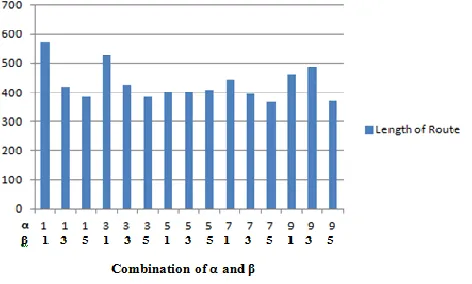
Fig 5: Length of route based on combination of α and β
When number of iterations = 100, α = 7 and β = 5, the cost is minimum among the other combination, the solution is optimal according to our experiment.
Renu Jangra et al, International Journal of Computer Science and Mobile Applications, Vol.5 Issue. 8, August- 2017, pg. 24-29 ISSN: 2321-8363 Impact Factor: 4.123
©2017, IJCSMA All Rights Reserved, www.ijcsma.com 29
IV. CONCLUSION
This paper shows the optimal solution of the algorithm based on the parameters values. At α = 1; β = 1; ρ = 0.05; Q = 1; m (no. of ants) = 40, when we increase the number of iterations, initially cost varies but after 100 iterations onward cost is fixed and minimum. When a number of ants going to increase, the cost going to decrease and after m=50 onwards remains constant. With our analysis m=50 shown the best possible solution in terms of cost and length of the tour. The choice of the value of α, β, m and ρ are taken on the base of experiment and the literature survey. The experimental results show the performance of ant colony algorithms when solving TSP problems. The evaluation of the performance of the algorithm is also analyzed on the basis of other properties like the number of iterations, the iteration time, etc.
REFERENCES
[1] M. Dorigo, V. Maniezzo and A Colorni, “Positive feedback as a search strategy”, Politecnico di Milano,Italy, Technical Reportno, vol. 91,no. 16,(1991).
[2] Daniel C. Asmar, Ahmad Elshamli, Shawki Areibi,” A Comparative Assessment of ACO Algorithms Within a TSP Environment”, International Conference on Engineering Applications and Computational Algorithms.
[3] Xianmin Wei,” Parameters Analysis for Basic Ant Colony Optimization Algorithm in TSP”, International Journal of u-and e-Service, Science and Technology Vol.7, No.4 (2014), pp.159-170.
[4]S. D. Shtovba,” Ant Algorithms: Theory and Applications”, Programming and Computer Software, Vol. 31, No. 4, 2005, pp. 167–178.
[5] Zar Chi Su Su Hlaing and May Aye Khine,” Solving Traveling Salesman Problem by Using Improved Ant Colony Optimization Algorithm”, International Journal of Information and Education Technology, Vol. 1, No. 5, December 2011. [6] http://www.iwr.uniheidelberg.de/groups/comopt/software/TSPLIB95/tsp/
[7] Zar Chi Su Su Hlaing, May Aye Khine,”An Ant Colony Optimization Algorithm for Solving TravelingSalesman Problem,” International Conference on Information Communication and Management 2011.
[8] Ping Guo, Zhujin Liu, and Lin Zhu,”Improved Strategies of Ant Colony Optimization Algorithms”, Springer-Verlag Berlin Heidelberg, pp. 396–403, 2012.
[9] Thomas St¨utzle, Manuel L´opez-Ib´a˜nez, Paola Pellegrini, Michael Maur,Marco Montes de Oca, Mauro Birattari, and Marco Dorigo,”Parameter Adaptation in Ant Colony Optimization”© Springer-Verlag Berlin Heidelberg 2011.
[10] Mahesh Mulani and Vinod L. Desai ,” Computational Performance Analysis of Ant Colony Optimization Algorithms for Travelling Sales Person Problem”, Springer Science Business Media Singapore 2016.