Published online June 30, 2014 (http://www.sciencepublishinggroup.com/j/ajss) doi: 10.11648/j.ajss.20140204.11
Effect of different practice schedules on learning and
performance in handball task
Vahid Rouhollahi, Mansoorehossadat Rozan, Akhil Mehrotra
Department of Physical Education, Banaras Hindu University, Varanasi, India
Email address:
[email protected] (V. Rouhollahi), [email protected] (M. Rozan), [email protected](A. Mehrotra)
To cite this article:
Vahid Rouhollahi, Mansoorehossadat Rozan, Akhil Mehrotra. Effect of Different Practice Schedules on Learning and Performance in Handball Task. American Journal of Sports Science. Vol. 2, No. 4, 2014, pp. 71-76. doi: 10.11648/j.ajss.20140204.11
Abstract:
The purpose of this study was to investigate different effects of various practice schedules in handball task. 30 participants have been divided into three equal practice groups randomly. Participants have performed a task under blocked, random and serial practice schedules and they were tested in acquisition phase conducted on five consecutive sessions with knowledge of results (KR). Delayed retention test and transfer test had been done on the next day without KR. On the basis of results of this study, there were not significant differences between various practice schedules in acquisition phase, retention and transfer tests. These findings were consistent with Magill and Hall (1990) hypothesis that the learning benefits of contextual interference are more likely to occur, when skill variations are from different classes of movement.Keywords:
Contextual Interference, Performance, Learning1. Introduction
Motor learning has been described as a problem-solving process in which the goal of an action represents a problem and the development of an appropriate movement pattern represents the solution (Guadagnoli & Lee, 2004). Shea and Morgan (1979) are credited with being the first to demonstrate the contextual interference (CI) effect for motor skill learning (Heather Wilde et al., 2012). Contextual interference effect is "the effect on learning of the degree of functional interference found in a practice situation when several tasks must be learned and are practiced together (Magill et al., 1990). Skill acquisition researchers are interested in understanding which practice variables serve to optimize this process and consequently to understand the mechanisms that sub serve these variables. The scheduling of practice trials is one variable that has been shown to influence the efficacy of motor learning. Randomly sequencing practice trials throughout a training session (high contextual interference) has been shown to result in successful performance on tests of retention and transfer, despite poor performance during acquisition. The learner practices more than one skill is interspersed between the skills, i.e. one skill is practiced for a set number of trails, followed by practices on another skill, followed by practice on a third skill and back to beginning , then the cycle is repeated. In contrast, repeating all practice
moderate CI schedule actually performed best during both the acquisition stage as well as during retention. The researchers argued that moderate levels of contextual interference may be superior because it combines the best features of both high CI and low CI. Moderate CI allows the learner to make adjustments on the task because of the 3 trials in a row but also still offers the benefits of high CI by requiring each subject to perform several different tasks per practice session. There are various viewpoints on the contextual interference and its processes. Shea and Morgan (1979) and Shea and Zimny (1983 & 1988) proposed that when practice is performed in a random order, it has some advantages to learn via interaction between the working memories of two or more similar tasks. An increase in the interference in working memory during practice results in an increase in a distinctive and vast processing and ultimately facilitates retention (Al-Ameer, H. et al.1993).
During the last three decades, many motor learning studies have focused on dissociating between temporary performance effects and relatively permanent learning effects. These studies have demonstrated some paradoxical phenomena whereby practice schedules that hinder acquisition performance actually facilitate as assessed by retention and transfer test.
Since Shea & Morgan’s (1979) study, many studies have found and explain the CI effect in motor learning. Some of these studies directly focus on investigating why the CI effect occurs; for example Shea and Morgan (1979) explained the CI effect from a viewpoint of level of elaboration imposed on learners. This explanation has some empirical support (e.g. Limon & Shea, 1998; Shea & Zimny, 1983; Wright, 1991; Wright, Li, &Whitacre, 1992). The Elaboration hypothesis has explained that when individuals shift from one skill to another during a random practice session, they are forced to become aware of the distinctiveness among the skills, making each one more meaningful in their long-term memory. More meaningful or distinctive memories are presumably more durable and therefore, more easily retrieved for use at a later time, resulting in more effective performance in retention tests (Richard A. Schmidt et al., 1999).
Lee and Magill (1985) from a view point of reconstruction of action plans explained that under high level of CI, an action plan for a particular task needs to be reconstructed every time that task is performed because the action plan is completely or partially forgotten from the working memory by intervening other tasks. Although this reconstruction process hinders acquisition performance, retention and transfer are enhanced because the reconstruction process is required during retention and transfer tests.
Other groups of studies investigated the generalizability of the effect in variety of setting. One of these groups included studies that investigated the influence of task characteristics on the CI effect. The CI effect was found with real world motor skill such as volleyball (Bortoli, Robazza Durigon & Carra, 1992), badminton serves
(Goode&Magil, 1986; Wrisberg, 1991) and baseball batting (Hall, Dominguez & Cavazos, 1994).These studies provided evidence that the CI effect can occurred outside a laboratory.
Carnahan, Van Eerd, and Allard (1990) proposed that the CI effects occurs only when tasks require generation of overt movement, suggesting that different levels of CI are attributed to the process of learning motor components of a task, Similarity of task variation is another task characteristics that has recently intrigued many researchers following the Magill and Hall (1990) hypothesis. Similarity has been defined in terms of characteristics of generalized motor program (GMP) in their hypothesis and controversial finding have been reported by (Hall & Magill,1995; Lee, Wulf, & Schmidt,1992; Sekiya, Magill, & Anderson,1996; Sekiya, Magill, Sidaway, & Anderson, 1994; Wood and Ging,1991;Wulf ,1992;Lee,1993;& etc.).
Magill and Hall hypothesis proposed a limitation to the generalizability of the CI effect with respect to underlying GMP structures of task variation to be learned.
Magill and Hall (1990) hypothesis indicating that the CI effect would be found when task variations to be learned are governed by different Generalized Motor Programs(GMPs), but should not be found when task variation are governed by the same GMP. The GMP is a hypothetical notion for a memory representation that governs a class of movements (Schmidt, 1988).The GMP has invariant features such as relative timing and relative force and variant features such as overall duration and overall force. The variant features are parameters added to the fundamental GMP. Under this conceptualization, task variation with different invariant and variant feature belong to different movement classes and are controlled by different GMPs. On the other hand, when task variation share the same invariant features but differ along in variant features, the task variation belong to the same movement class and are controlled by the same GMPs. According to this hypothesis, the CI effect is unlikely to occur when task variations from the same GMP are learned. Some investigations that support the Magill and Hall (1990) hypothesis implies to this point that no CI effect with task variation controlled by the same GMP (Heitman & Gilley, 1989; Whitehurst & Del Rey, 1983; Wulf, 1992; Wulf & Lee,1993 and etc.), but some recent studies found the CI effect with task variations that are considered to be controlled by the same GMP (Carnahan et al.1990; Shea et al.1990; Young chon & Husak,1993;Hall et al.1994; Sekiya et al.,1994; etc.).
2. Method
2.1. Participants
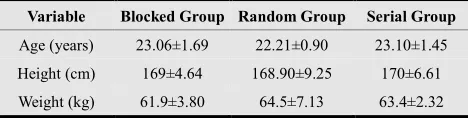
Thirty male Physical Education students (Mage = 22.6 years, SD = 1.3 years) from Banaras Hindu University which divided into three equal blocked, random and serial practice groups has been selected randomly (see table 1). The participants had no prior experience with the task (Handball Center Shot) and were not aware of the specific purpose of the study. All participants were right-hand dominant as determined by self-report prior to the experiment. The participants read and signed an informed consent prior to participation.
Table 1. Participant Characteristics
Variable Blocked Group Random Group Serial Group
Age (years) 23.06±1.69 22.21±0.90 23.10±1.45
Height (cm) 169±4.64 168.90±9.25 170±6.61
Weight (kg) 61.9±3.80 64.5±7.13 63.4±2.32
2.2. Materials and Procedure
Cornish Handball Test has been constructed with an objective to measure the power of handball drive and is frequently used for testing handball skill (Devinder k.Kansal, 2008).The field was marked with a restraining line at a distance of 18 feet from a 22feet wide hard wall. This line at a distance of a 5feet behind it, made the service zone. Four additional horizontal lines at a distance of 5.75 feet were drawn behind the service zone. The subject was required to throw the ball against the front wall on which a horizontal line was marked at the height of 6 feet. Each subject was informed that he has to hit the ball up to the height marked by the horizontal line on the wall and also he was instructed clearly that he has to stroke the ball from behind the front service line. In case, the ball hits the front wall above the 6 feet line or the subject makes the foot fault that is he hits the ball in front of the service line, he was asked to restart the test. For scoring, service zone is marked as one score zone and each of 5.75 feet board zone behind the service zone was labeled as zone scoring 5, 10, 15, 20&25 respectively.
In first session, explanation and illustration of the Handball Center Shot skill was taught by coach; then subjects continued to their training with the use of Cornish test with consideration of their practice schedule. The study consisted of pre-test, acquisition phase, delayed retention test and delayed transfer test which will be explained as follows:
Pre-test: After viewing the skill, the participants performed a blocked schedule pre-test of the task that included 15 trials from 34.5 feet distance.
Acquisition phase: Prior to the first acquisition session, participants were assigned to one of three groups, which differed in the practice schedule used: blocked (n = 10), random (n = 10) and serial (n=10). The acquisition phase
consisted of 225 practice trials of task for per participant in total. Participants had been trained for 5 sessions (consecutive days), in every session participants completed 45 trails according to Cornish test, and subjects have been received knowledge of their result after each block. Within each session, the blocked learners practiced all trials in blocked order. For the random group, participants practiced each task in a random order during each session and the random schedule was different for each practice session, but the same for each participant and serial schedules performed in a serial order. The task order was counterbalanced across participants.
Delayed retention test: The delayed retention test was conducted 24 hours after the last Acquisition phase session in one day. All participants completing 15 trails from 34.5 feet distance, same as pre-test performance.
Delayed transfer test: After 5min rest, each subject performed transfer test which include 15 trails on one new task, which was Handball Center Shot with 45 ̊ from center point of target with 34.5 feet distance. During delayed retention test and delayed transfer test, trials were done without KR.
3. Results
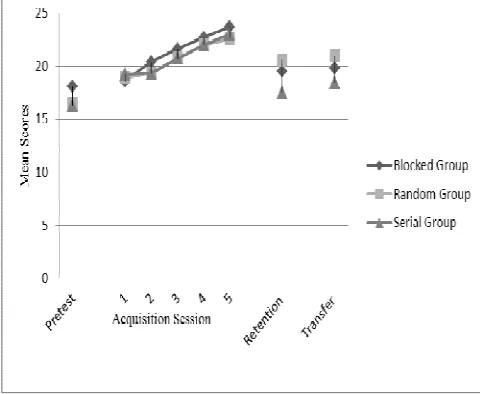
Pre-test: The pre-test confirm that there were no significant performance differences between the groups for task, F (2, 27) = 1.11, p = .345, (see figure1).
Acquisition phase results: During the acquisition period, we were evaluated with separate Learning Group × Acquisition Session (3 × 5) analyses of variance (ANOVAs) with repeated measures on the acquisition session factor. There was a significant improvement in performance across the acquisition sessions (F (4, 135) =14.50, p < .05, partial η2 = .300) .However, there was no significant main effect for learning group F (2, 54) = 1.094, p = .338. There were also no significant learning group by acquisition session interaction effects, F (4, 135) = .219, p = .987(see figure 1). Delayed retention test results: We expected that relative to blocked practice and serial practice, random practice would result in superior performance on tests of delayed retention, to test this hypothesis, performance during the pretest and the delayed retention test were analyzed with three separate Learning Group × Test Occasion (3 × 2) ANOVAs with repeated measures on the test occasion factor. There was a significant main effect for test occasion (F (2, 54) = 6.68, p < .001, partial η2 = .012), such that the level of performance for all groups improved from the pre-test to the retention test (see Figure1). There was neither a significant main effect for learning group (F (2, 54) = 1.90, p = 159), nor a significant interaction effect (F (2, 54) 1.17, p = .316).
improvement in performance from the pre-test to the retention test (t (9) = – 6.16, p < .001).
Delayed transfer test results: The results of transfer test showed that, there were no difference in performance between groups in this period (F (2, 27) = .809, p = .456), it means that effect of CI was not apparent in delayed transfer test (see Figure 1).
Figure 1. Mean scores for the blocked, random and serial groups during
pre-test, acquisition phase, delayed retention and delayed transfer tests
4. Discussion
The purpose of present experiment was to investigate the effect of various practice schedules on performance and learning of a task with different distance parameters. In line with previous researches showing that random learners experience high levels of cognitive effort (e.g. Brady, 1998; Lee et al., 1994; Li & Wright, 2000; Young et al., 1993), we expected that, relative to blocked practice, random practice and serial practice would result in poor performance during acquisition phase. The results delivered mixed findings regarding this hypothesis. We found that there were no differences between the level of performance of the blocked, random and serial learners during acquisition phase. These findings contradict the traditional contextual interference effect; but support research suggesting that high contextual interference schedules are less likely to adversely affect performance during acquisition of applied tasks than laboratory based tasks. For example, Goode and Magill (1986) did not observe CI between different groups during acquisition in their applied study of blocked, random and serial practice of badminton serves (despite finding significant differences between the learning groups on both the retention and transfer tests).
With reference to retention, in the retention test, which was the critical test of learning, there were no retention benefits for the random and serial practice schedule compared to the blocked schedule, it means that effect of CI no appear in delayed retention test.
Magill and Hall (1990) suggested that including skills from different motor programs is likely to increase the amount of interference caused during the learning process (this is based on Schmidt’s [1975, 1988] view of a motor program). Magill and Hall suggested that when tasks were consistent on aspects such as relative timing, sequence of events, and spatial configurations, then the tasks were unlikely to introduce a sufficient level of interference to produce the traditional interaction effect. Also according to Lee (1990) and Herbert (1996), due to the inherent attractiveness of applied task, to appear the effect of CI in this type of task, we need a lot of practice compared to laboratory tasks; thus, the significant difference between the fifth session scores with scores of previous sessions implies that further efforts are needed.
In the transfer test, there were no difference in performance between groups; it means that effect of CI was not apparent in transfer test. Our results in transfer test was consistent with the some applied studies like Chamberlin et al. (1990) in basketball jump shot but it was inconsistent with such studies Piggott & Shapiro(1984), Hall & Boyle(1993), Guadagnoli et al.(1996) and Pollock et al.(1997). Therefore, considering to lack of effect of CI in acquisition, delayed retention and transfer tests, by supporting Magill and Hall hypothesis (1990), we conclude that for the appearance of CI effect, variability of motor program parameters is not enough. Also, its seem that results of this study should await for applied investigations about effect of CI with other variables such as number of sessions and efforts, subject ˈs experience and reliability of scoring system.
Reference
[1] Al-Ameer, H. and T. Toole, (1993). Combinations of blocked and random practice orders: Benefits to acquisition and retention. J. Human Movement
[2] Bortoli, Robazza Durigon & Carra. (1992). Effects of contextual interference on learning technical sports skills. Perceptual and Motor Skills, 75,552-56.
[3] Brady, F. (1998). A theoretical and empirical review of the contextual interference effect and the learning of motor skills. Journal of Research Quarterly for Exercise and Sports, 50, 266–293.
[4] Brady, F. (2008). The contextual interference effect and sport skills. Perceptual and Motor Skills, 106, 461–472.
[5] Carnahan, H.,Van Eerd, D.l., & Allard, F. (1990). A note on the relationship between task requirement and contextual interference. Journal of Motor Behavior, 22, 159-169.
[6] Chamberlin, C.J. et al. (1990). The ecological validity of contextual interference effect: A practical application to learning the jump shot in basketball. Paper presented at the annual meeting of North American Society for the Psychology of Sport and Physical Activity, Houston, T X.
[8] Gregory C. Snider (2009).The effect of random, blocked, and transition practice schedules on children’s performance of a barrier knockdown test,p.g.6-7
[9] Goode, S., & Magill, R. A. (1986). Investigation of the contextual interference effect in the manipulation of the motor parameter of over-all force. Perceptual and Motor Skills, 83, 735–743.
[10] Guadagnoli,M.A & Holcomb,W.R. (1996). The effect of variable and constant practice on the skill of putting. Science of Golf ш. Human Kinetics, campaign, IL.
[11] Hall, K.G. & Boyle, M. (1993). The effects of contextual interference on shuffleboard skill in children. Research Quarterly for Exercise and Sports, 64, 74-78.
[12] Hall, K.G., Dominquez, D.A., & Cavazos, R. (1994). Contextual interference effects with skilled baseball players. Perceptual and Motor Skills, 78, 835- 841.
[13] Hall, K.G., & Magill, R.A. (1995).Variability of practice and contextual interference in motor skill learning. Journal of Motor Behavior, 27,299-309.
[14] Heather Wilde, Curt Magnuson, & Charles H. Shea (2012). Random and Blocked Practice of Movement Sequences: Differential Effects on Response Structure and Movement Speed. Research Quarterly for Exercise and Sports,76,416-425.
[15] Heitman, R.J., & Gilley, W.F. (1989). Effects of blocked versus random practice by mentally retarded subjects on learning a novel skill. Perceptual and Motor Skills, 69, 443-447.
[16] Herbert, E.P. et al. (1996). Practice schedules effects on the performance and learning of low and high skilled studies: An applied study. Research Quarterly for Exercise and Sports, 67, 52-58.
[17] Landin, D., & Hebert, E.P. (1997). A comparison of three practice schedule along the contextual interference continuum. Research Quarterly for Exercise and Sport,68, 357-361.
[18] Lee,T.D., & CARNAHAM,H.(1990). When to provide knowledge of results during motor learning: Scheduling effects. Human performance, 3, 87-105.
[19] Lee, T.D. & Magill, R.A. (1985). Can forgetting facilitate skill actuation? In D. Goodman, R.B. Wilberg, & I.M. Frank (Eds), Differing perspectives in motor learning memory, and control (pp.3-22). Amsterdam: North-Holland.
[20] Lee, T. D., Swinnen, S. P., & Serrien, D. J. (1994). Cognitive effort and motor learning. Research Quarterly for Exercise and Sport, 46, 328–344.
[21] Lee, T. D., & Simon, D. A. (2004). Contextual interference. In A.M. Williams & N. J. Hodges (Eds.), Skill Acquisition in sport: Research, theory, and practice (pp. 29–44). London, England: Routledge.
[22] Lee, T.D. & Weeks, D.J. (1987).The beneficial influence of forgetting on short-term retention of movement information. Human movement science, 6,233-245.
[23] Li, Y., & Wright, D. L. (2000). An assessment of the attention demands during random- and blocked-practice schedules. Quarterly Journal of Experimental Psychology, 53A, 591–606.
[24] Limons, E., & Shea , J.B. (1988). Deficient processing in learning and performance. In A.M. Colley & J.R.Beech (Eds.), Cognition and action in skilled behavior, (pp.333-347).
[25] Magill, R. A., & Hall, K. G. (1990). A review of the contextual interference effect in motor skill acquisition. Journal of Human Movement Science, 9, 241–289.
[26] Megan A. Rendell1, Rich S. W. Masters, Damian Farrow & Tony Morris, (2011). An Implicit Basis for the Retention Benefits of Random Practice. Journal of Motor Behavior, Vol. 43, No. 1.
[27] Pigott, R.E. & Shapiro,D.C (1984). Motor schema: The structure of the variability session. Research Quarterly for Exercise and Sports, 55, 41-45.
[28] Keating, D.P. (1980). Four faces of creativity: The continuing plight of the intellectually under served. Gifted Child Quarterly, 24: 56-61.
[29] Pigott, R.E., & Shapiro, D.C. (1984). Motor Schema: The structure of the variability session. Research Quarterly for Exercise and Sport, 55, 41-45.
[30] Pollock, B.J. & Lee, T.D. (1997). Dissociate contextual interference in children and adults. Perceptual and Motor Skills, 84,851-858.
[31] Richard A. Schmidt, Craig A. Wrisberg (1999). A situation based learning approach, p.g.259.
[32] Schmidt, R. A. (1975). A schema theory of discrete motor skill learning. Psychological Review, 82, 225–260.
[33] Schmidt, R. A. (1988). Motor control and learning: A behavioral emphasis (2nd Ed.). Champaign, IL: Human Kinetics.
[34] Sekiya,H.(1997). Interactive influence of task characteristics and amount of practice on the contextual interference effect in motor learning. Mem,Fac.Integrad Arts and Sci., Hiroshima Uni.,23,87-105.
[35] Sekiya, H., Magill R.A. & Anderson, D.I. (1996). The contextual interference effect in parameter modifications of the same generalized motor program. Research Quarterly for Exercise and Sport, 67, 59-68.
[36] Sekiya, H., Magill, R.A., Sidaway, B., & Anderson, D.I. (1994). The contextual interference effects for skill variations from the same and different generalized motor programs. Research Quarterly for Exercise and Sports, 65, 330-338.
[37] Shea, C. H., Kohl, R., & Indermill, C. (1990). Contextual interference: Contributions of practice. Acta Psychological, 73, 145-157.
[38] Shea, J. B., & Morgan, R. L. (1979). Contextual interference effects on the acquisition, retention and transfer of a motor skill. Journal of Experimental Psychology, Human Learning and Memory, 5, 179–187.
[39] Shea,J.B., & Zimny, S.T. (1983). Context effects in memory and learning movement information. In R.K. Magill (Ed.), Memory and control of action, (pp.345-366).
[41] Wood, C.A., & Ging, C.A. (1991). The role of interference and task similarity on the acquisition, retention and transfer of simple motor skill. Research Quarterly for Exercise and Sport, 62, 18-26.
[42] Wright, D. L. (1991). The role of inter task and intra task processing in acquisition and retention of motor skills. Journal of Motor Behavior, 23, 139–145.
[43] Wright, D. L., Li, Y., & Whitacre, C. (1992). The contribution of elaborative processing to the contextual interference effect. Research Quarterly for Exercise and Sport, 58, 369–374.
[44] Wrisberg, C.A. (1991). A field test of effect of contextual variety during skill acquisition. Journal of Teaching in Physical Education, 11, 21-33.
[45] Wulf, G. (1992). Reducing knowledge of results can produce context effects in movements of the same class. Journal of Human Movement Studies, 22, 71-84.
[46] Wulf, G. & Lee,T.D. (1993). Contextual interference effects in movements of the same class: Differential effects on program and parameter learning. Journal of Motor Behavior, 25,263.