The Thirty-Third AAAI Conference on Artificial Intelligence (AAAI-19)
Convolutional Spatial Attention Model for
Reading Comprehension with Multiple-Choice Questions
Zhipeng Chen,
†Yiming Cui,
‡†∗Wentao Ma,
†Shijin Wang,
†Guoping Hu
† †Joint Laboratory of HIT and iFLYTEK (HFL), iFLYTEK Research, Beijing, China‡Research Center for Social Computing and Information Retrieval (SCIR),
Harbin Institute of Technology, Harbin, China {zpchen,ymcui,wtma,sjwang3,gphu}@iflytek.com
Abstract
Machine Reading Comprehension (MRC) with multiple-choice questions requires the machine to read given passage and select the correct answer among several candidates. In this paper, we propose a novel approach called Convolutional Spatial Attention (CSA) model which can better handle the MRC with multiple-choice questions. The proposed model could fully extract the mutual information among the passage, question, and the candidates, to form the enriched representa-tions. Furthermore, to merge various attention results, we pro-pose to use convolutional operation to dynamically summa-rize the attention values within the different size of regions. Experimental results show that the proposed model could give substantial improvements over various state-of- the-art systems on both RACE and SemEval-2018 Task11 datasets.
Introduction
Owing to the rapid release of various large-scale datasets, Machine Reading Comprehension (MRC) has become enor-mously popular in Natural Language Processing. For ex-ample, cloze-style MRC (such as CNN/DailyMail (Her-mann et al. 2015), Children’s Book Test (CBT) (Hill et al. 2015)), span-extraction MRC (such as SQuAD (Rajpurkar et al. 2016)), and multiple-choice MRC (such as MCTest (Richardson, Burges, and Renshaw 2013), RACE (Lai et al. 2017), SemEval-2018 Task11 (Ostermann et al. 2018)).
In this paper, we mainly focus on solving the reading comprehension with multiple-choice questions. At the be-ginning of the reading comprehension study, this type of reading comprehension task was not that popular because there is no large-scale dataset available and thus we cannot apply neural network approaches to solve them. To bring more challenges to reading comprehension task and miti-gate the absence of large-scale multi-choice reading com-prehension dataset, Lai et al.(2017) propose a new dataset called RACE. Compared to the earlier MCTest (Richard-son, Burges, and Renshaw 2013), the RACE dataset is made from the English examinations for Chinese middle and high school students, consisting near 100,000 questions gener-ated by human experts, and is far more challenging than the MCTest.
∗
Corresponding author
Copyright c2019, Association for the Advancement of Artificial Intelligence (www.aaai.org). All rights reserved.
In this paper, we propose a novel model called Convo-lutional Spatial Attention (CSA) to fully utilize the hierar-chical attention information for reading comprehension with multiple-choice questions. The proposed model first encode the passage, question, and candidates into word represen-tations which are enhanced by the additional POS-tag and matching features. Then we concentrate on enriching the representation of the candidates by incorporating the pas-sage, question information, and further calculate the atten-tions between the passage, question, and candidates, form-ing the spatial attentions. To further extract the represen-tative features in the spatial attentions, we propose to use convolutional neural network to dynamically conclude adja-cent regions with different window size. We mainly test our CSA model on two multiple-choice reading comprehension datasets: RACE and SemEval-2018 Task11, and our model achieves state-of-the-art performances on both of them. The examples of each dataset are given in Figure 1. The main contributions of our paper can be summarized as follows. • We focus on modeling different semantic aspects of the
candidates, by integrating the passage and question infor-mation, forming the 3D spatial attention among the pas-sage, question, and candidates.
• We propose a Convolutional Spatial Attention (CSA) mechanism to dynamically extract representative features from the spatial attentions.
• The proposed model gives substantial improvements over various state-of-the-art systems on both RACE and SemEval-2018 Task11 datasets, showing its generaliza-tion and extensibility to other NLP tasks.
Related Works
RACE SemEval-2018 Task11
Passage Passage
Is it important to have breakfast every day? A short time ago, a test was given in the United States. People of differ-ent ages, from 12 to 83, were asked to have a test. During the test, these people were given all kinds of breakfast, and sometimes they got no breakfast at all. ...
I was thirsty so I decided to make a cup of tea. I looked through my box of teas and rifled through the assorted fla-vors. I settled on Earl Gray, which is a black tea flavored with bergamot orange. I filled the kettle with water and placed it on the stove, turning on the burner so that it would heat up and begin boiling. ...
Question Question
What do the results show? Why did they use a kettle?
Candidates Candidates
AThey show that breakfast has affected on work and study. Ato drink from
BBreakfast has little to do with a person’s work. Bto boil water
CA person will work better if he only has fruit and milk.
DThey show that girl students should have less for break-fast.
Figure 1: Example of RACE and SemEval-2018 Task11 dataset. The correct answer is depicted in bold face.
generate a span in the passage to answer the questions. With rapid progress on designing effective neural network models (Xiong, Zhong, and Socher 2016; Seo et al. 2016; Wang et al. 2017; Hu, Peng, and Qiu 2017), recent works on this datasets have surpassed the average human perfor-mance, such as QANet (Yu et al. 2018) etc.
However, current machine reading comprehension mod-els are still struggling with solving the questions that need reasoning over multiple sentences or even passage. To solve the reading comprehension with multiple-choice questions, various approaches have been proposed, and most of them are focusing on designing effective attentions or persuing enriched representations for prediction. When releasing the RACE dataset, Lai et al.(2017) also adopted and modified two models of the cloze-style reading comprehension: Gated Attention Reader (Dhingra et al. 2017) and Stanford Atten-tive Reader (Chen, Bolton, and Manning 2016). However, experimental results show that these models are not capable of this task. Parikh et al.(2018) introduced ElimiNet which use a combination of elimination and selection to get refined representation of the candidates. Xu et al.(2017) proposed the Dynamic Fusion Networks (DFN), which uses multi-hop reasoning mechanism for this task. Zhu et al.(2018) pro-posed the Hierarchical Attention Flow model, which lever-age candidate options to model the interactions among pas-sage, questions, and candidates.
Though various efforts have been made, we believe there is still a large room for designing effective neural networks for better characterizing the relations between the passage, questions, and candidates. To this end, we summarize the main differences between our model and existing models for this task into three aspects. First, we calculate various representations of the candidate to better characterize it for prediction. Second, when calculating attention, we apply ad-ditional trainable weights to dynamically adjust the atten-tion values, which is more flexible. Third, unlike the previ-ous works only utilize the final-level hierarchical attentions,
we propose to use every attention in each hierarchy, and use convolutional neural network to capture features for predict-ing the answer.
Convolutional Spatial Attention Model
Task Definition
The RACE dataset (Lai et al. 2017) for reading comprehen-sion with multiple-choice questions was proposed, which consists of 28,000+ passages and near 100,000 questions generated by human experts for the English examinations of Chinese middle and high school students. Different from the earlier MCTest dataset (Richardson, Burges, and Ren-shaw 2013), the RACE dataset is significantly larger, and thus we can apply deep learning approaches for this task. As all the questions and choices are generated by human ex-perts, RACE dataset provides more comprehensive and re-alistic evaluation on machine reading comprehension than the other popular datasets such as CNN/DailyMail, SQuAD datasets, whose answer should appear in context. Also ac-cording to the analysis by Lai et al.(2017), a large portion of the questions in RACE need reasoning over various clues, which makes it more challenging and suitable to evaluate the ability of the reading comprehension systems. SemEval-2018 Task11 is closely the same with the RACE dataset but with two candidates and small size. The examples of each dataset are given in Figure 1.
The Model
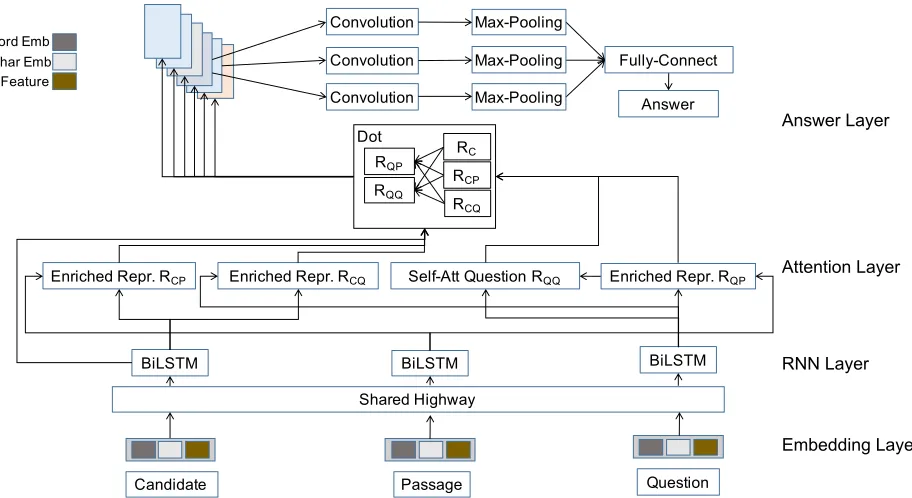
In this section, we will give a detailed description on the pro-posed model. The main neural architecture of our model is depicted in Figure 2. Throughout this section, we will useP
`````````````` ```
Passage Question
Candidate
Embedding Layer RNN Layer Attention Layer Answer Layer
Shared Highway
BiLSTM BiLSTM
BiLSTM
Enriched Repr. RQP
Self-Att Question RQQ
Enriched Repr. RCP Enriched Repr. RCQ
Answer Convolution
Convolution Convolution
Fully-Connect Max-Pooling
Max-Pooling
Max-Pooling
RC
RCP
RCQ
RQP
RQQ
Dot
Word Emb Char Emb Feature
Figure 2: Main neural architecture of the Convolutional Spatial Attention (CSA) model.
Word Representation
We transform each word in the passage, question, and can-didates into continuous representations. In this paper, there are three components in the embedding layer, which can be listed as follows.
• Word EmbeddingEword: We use traditional pre-trained GloVe embedding for initialization (Pennington, Socher, and Manning 2014) and keep fixed during the training process.
• ELMo Embedding Eelmo: For this part, we use pre-trained ELMo (Peters et al. 2018) embedding.
• Feature EmbeddingEf eat: We also utilize three addi-tional features to enhance the word representations. 1. POS-tag EmbeddingEpos: We use NLTK (Bird and
Loper 2004) for part-of-speech tagging for each word. Similar to traditional word embeddings, we assign dif-ferent trainable vectors for each part-of-speech tag. 2. Word MatchingFmatch: Take the text as an example,
if the word in text also appears in question or candidate, we set the value as one, otherwise set it as zero. In this way, we can also add this feature to the question and candidate.
3. Fuzzy Word Matching Ff uzzy: Similar to the word matching feature, but we loosen the matching criteria as partial matching. For example, we regard ‘teacher’ and ‘teach’ as fuzzy matching, because the string ‘teacher’ is partially matched by ‘teach’.
We concatenate three embedding components to form the final word representations for the textEP ∈R|P|×e, ques-tion EQ ∈ R|Q|×e, and candidates EC ∈ R|C|×e, where
|P|,|Q|,|C|are the length of the passage, question, and can-didates, e is the final embedding size (including all three components).
E = [Eword;Eelmo;Ef eat] (1) Ef eat= [Epos;Fmatch;Ff uzzy] (2) After obtaining embedding representations, we further feed each word embedding into a shared highway network (Srivastava, Greff, and Schmidhuber 2015) withtanhoutput activation (denoted asσ). In this paper, we apply two con-secutive highway networks with shared weights. Then we use Bi-Directional LSTM (Graves and Schmidhuber 2005) to model the contextual information, formingHP ∈R|P|×h, HQ ∈R|Q|×h, andHC ∈ R|C|×h(his hidden size of Bi-LSTM). Note that, we use different Bi-LSTMs for the pas-sage, question, and candidates.
e
H=σ(2-Highway(E)) (3)
H =Bi-LSTM(He) (4)
Enriched Representation
Calculating attention and generating enriched representation play very important roles in machine reading comprehsion. In our model, we will calculate various types of en-riched representations for better characterizing the candidate and question, which are the essential components in this task. The procedure for generating enriched representation is illustrated in Algorithm 1.
Algorithm 1Enriched Representation.
Input:
Time-Distributed representationX1 Time-Distributed representationX2
Initialize:
Random weight matrixW1∈Rh×hatt
Random weight matrixW2∈Rh×hatt Diagonal weight matrixD∈Rhatt×hatt
All-one weight matrixW ∈R|X1|×|X2|
Output: X2-awareX1representationY
1: Calculate attention matrixM0∈R|X1|×|X2|: M0=f(W
1X1)T ·D·f(W2X2)
2: Apply element-wise weight:M =M0W
3: Apply softmax function to the last dimension of M:
Matt=sof tmax(M)
4: Calculate raw representationY0∈R|X2|×h: Y0 =MattT ·X1
5: Concatenate raw representationY0 and raw input X1, then apply Bi-LSTM:
Y =Bi-LSTM([X1;Y0])
6: return Y
representationRCP. According to Algorithm 1,RCP can be generated as follows.
• [Line 1]Given the Bi-LSTM representations of passage
HPand candidateHC, we first calculate the attention ma-trix where each element indicate the matching informa-tion between them. In this paper, we adopt the atteninforma-tion mechanism used in FusionNet (Huang et al. 2017). where two representations are transformed by individual fully-connected layer with an output activationf. Also, a train-able diagonal weight matrixD is applied. The activation functionf is defined as RELU throughout this paper. • [Line 2]Then we apply an element-wise weight matrix
W to the attention matrixM0. This is designed to let the model flexibly adjust the attention values.
• [Line 3]We applysoftmaxto the weighted attention ma-trixM to the last dimension of it, which calculates the passage-level attention vector w.r.t. each candidate word. • [Line 4]After obtaining the normalized attention matrix
Matt, we make a dot product between theMattand the passageHPto extract candidate-related passage.
• [Line 5] Finally, we concatenate candidate-related pas-sage YCP0 and Bi-LSTM candidate representation HC, and feed them to a Bi-LSTM to fully integrate passage information into the candidate representations.
By applying the proposed algorithmg(X1, X2), we can calculate the passage-aware and question-aware candidate representationRCP andRCQ. Besides, as the question in-formation is also important, we also calculate passage-aware question representationRQPand self-attended question rep-resentationRself-Q. Note that, we use Bi-LSTM outputBQ and passage-aware question representation RQP to obtain the (almost-)self-attended question representation, which
combines different levels of representations.
RCQ=g(BC, BQ) (5) RCP =g(BC, BP) (6) RQP =g(BQ, BP) (7) Rself-Q=g(BQ, RQP) (8)
Convolutional Spatial Attention
With previously generated representations, we can calcu-late the matching matrix to measure the similarity between them. In this paper, we adopt simple dot product to obtain the matching matrix. As the candidate information is impor-tant to answer the question, firstly we calculate the matching matrix using various candidate representations to the self-attended question representation Rself-Q. The motivation is to use the question information as the key to extracting candidate information in different levels. We use question-aware candidate representationRCQ, passage-aware candi-date representationRCP, and candidate Bi-LSTM represen-tationHC, as shown below.
M11=RCQ·Rself-Q (9) M12=RCP·Rself-Q (10) M13=HC·Rself-Q (11) In a similar way, we can also replace the self-attended question representation Rself-Q with passage-aware ques-tion representaques-tion RQP in Equation 9, 10, 11, to obtain M21, M22, M23. Then we concatenate all matrices on the channel dimension to form a Spatial Attention CubeM ∈
R6×|C|×|Q|, which is similar to an ‘image’ with 6 channels. M = [M11;M12;M13;M21;M22;M23] (12) In order to extract high-level features inside the spatial at-tention cube, we use CNN-MaxPooling operation to dynam-ically conclude adjacent attention information, which is sim-ilar to the traditional operation on the image. Formally, we first apply convolutional operation on theM to summarize different length of adjacent elements We adopt three convo-lutional kernels: 5, 10, and 15, along with the dimension of the question length.
After convolution operation, we could get three features maps w.r.t. different convolutional kernels. The procedure can be illustrated as the following equations.
O1=Max-Pooling1×3{CN N1×5(M)} (13)
O2=Max-Pooling1×2{CN N1×10(M)} (14)
O3=Max-Pooling1×1{CN N1×15(M)} (15) In this way, we used CNN-MaxPooling operation to ob-tain three feature vectorsO1, O2, O3by using different con-volutional kernels and max-pooling intervals.
Final Prediction
Model RACE-M RACE-H RACE
Sliding Window (Lai et al. 2017) 37.3 30.4 32.2
Stanford AR (Lai et al. 2017) 44.2 43.0 43.3
GA Reader (Lai et al. 2017) 43.7 44.2 44.1
ElimiNet (Parikh et al. 2018) N/A N/A 44.5
Hierarchical Attention Flow (Zhu et al. 2018) 45.0 46.4 46.0 Dynamic Fusion Network (Xu et al. 2017) 51.5 45.7 47.4
CSA Model (single model) 51.0 47.3 48.4
CSA Model + ELMo (single model) 52.2 50.3 50.9
GA Reader (6-ensemble) - - 45.9
ElimiNet (6-ensemble) - - 46.5
GA + ElimiNet (12-ensemble) - - 47.2
Dynamic Fusion Network (9-ensemble) 55.6 49.4 51.2
CSA Model (7-ensemble) 55.2 52.4 53.2
CSA Model + ELMo (9-ensemble) 56.8 54.8 55.0
Table 1: Experimental results on RACE. The best previous results are in italics, and overall best results are in bold face.
question, so we will getN candidate scores in this stage. We apply softmax function to these scores to obtain the final probability distributions over the candidates.
si=wT·[O1;O2;O3] (16)
P r(A|P, Q, C) =sof tmax([s1;...;sN]) (17) To train our model, we use traditional cross entropy loss to minimize the gap between the prediction and the ground truth.
Experiments
Experimental Setups
To evaluate our system, we carried out experiments on the following two public datasets.
• RACE: English examinations for Chinese middle and high school students. The questions are generated by hu-man experts, which has four candidates for each question. The test set consists of 4,934 instances, where RACE-M (middle school) has 1,436 instances, and RACE-H (high school) for 3,498 instances.
• SemEval-2018 Task11: The dataset provided by the SemEval-2018 Task11 organizer, which mainly focus on solving commonsense reading comprehension. Each question has two candidates to choose from.
The data are tokenized and lower-cased by using Natu-ral Language Toolkit (NLTK) (Bird and Loper 2004), and all punctuations are removed. The main hyper-parameters of our model are listed in Table 2. Note that, except for the candidate numbers, all hyper-parameters are identical among two datasets. The word embeddings are initialized by the pre-trained GloVe word vectors (Common Crawl, 6B tokens, 100-dimension) (Pennington, Socher, and Manning 2014), and keep fixed during training. The words that do not appear in the pre-trained word vectors are set to the unk
token and initialized accordingly. We use Adam (Kingma
Symbol Descriptions Size
|P| Passage max length 300 |Q| Question max length 20 |C| Candidate max length 10
e Word embedding 200
h Bi-LSTM hidden size 250
hatt Attention hidden size 80 es ELMo embedding size 1024
p POS-tag embedding 16
Table 2: Hyper-parameter settings.
and Ba 2014) for weight optimizations with an initial learn-ing rate of 0.001. In order to prevent overfittlearn-ing, we apply dropout of 0.35 to all the representation layers. The models are built on Keras platform (Chollet and others 2015) with Tensorflow backend (Abadi et al. 2016).
Overall Results
RACE.The experimental results are shown in Table 1. As we can see that, our CSA model shows significant improve-ments over various state-of-the-art systems by a large mar-gin. We also compared our model to the recent unpublished work DFN, while our model gives an absolute gain of 1.0% in the overall test set, and further gains can be obtained by incorporating ELMo, demonstrating the effectiveness of our proposed model. Also, when compared to the Hierarchical Attention Flow model (Zhu et al. 2018), our CSA model show substantial improvements, indicating that utilizing the attentions in each hierarchy and using convolutional neural network to extract the most representative features from the spatial attentions are useful in this task.
Model Dev Test
HMA (Chen et al. 2018) 84.48 80.94 TriAN (Wang 2018) 83.84 81.94
CSA Model (single model) 83.63 82.20 CSA Model + ELMo (single model) 83.84 83.27
TriAN (ensemble) 85.27 83.95 HMA (ensemble) 86.46 84.13
CSA Model (ensemble) 84.05 84.34 CSA Model + ELMo (ensemble) 85.05 85.23
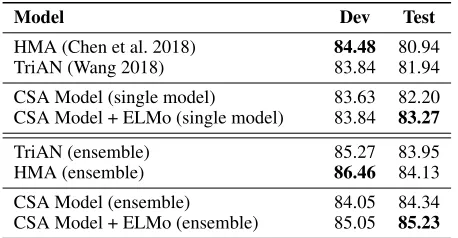
Table 3: Experimental results on SemEval-2018 Task11. The two top-ranked systems are listed as baselines.
our model shows slightly worse result in RACE-M but sig-nificantly better in RACE-H regardless of single model or ensemble. These results indicate that our model is more ca-pable of solving difficult question (high school). While on the contrary, it may hurt the performance on the relatively easier question (middle school). We will give a detailed anal-ysis for illustrating this phenomenon in the next section.
SemEval-2018 Task11.The distributions of question type is quite different between the RACE and SemEval-2018 Task11 datasets. To test if our model could generalize to other reading comprehension dataset, we also carried out ex-periments on the very recent SemEval-2018 Task11 dataset. The results are shown in Table 3. As we can see that, our CSA model could give moderate improvements over the top-ranked SemEval systems in both single model and en-semble, and set up new state-of-the-art performance on this task, demonstrating the proposed model is powerful and showing its potential possibility to generalize to other NLP tasks. Note that, we directly train the model using the hyper-parameter settings of the RACE experiments without finding other hyper-parameter combinations, indicating further im-provements may be obtained through fine-tuning.
Ablation Study
We also carried out model ablations to further demonstrate the effectiveness of the proposed approaches. The results are shown in Table 4.
Model RACE
CSA Model 48.52
w/o attention weight 48.18
w/o enriched representation 47.52 w/o convolutional spatial attention 47.30
CSA Model + ELMo 50.89
w/o attention weight 49.49
w/o enriched representation 49.78 w/o convolutional spatial attention 48.47
Table 4: Ablations on several model components.
As shown in the model description, we adopt the atten-tion mechanism used in FusionNet (Huang et al. 2017), and
applied an element-wise weight to the attention matrix. By applying additional trainable weights to the attention ma-trix could give moderate improvements suggesting that these weights are useful in dynamically adjusting the attention val-ues. When we remove all the enriched candidate representa-tions, there is an absolute drop of 1.0%. This suggests that it is necessary to incorporate various information (such as the passage and question) into the candidate representation. We also removed our convolutional spatial attention mech-anism in the model. The results show a significant drop in performance by 1.22%, indicating that the proposed convo-lutional spatial attention is effective in extracting most rep-resentative values among the various attention matrices. The same results drop is shown by incorporating ELMo. Further more, whether we use ELMo or not, our convolutional spa-tial attention has improved significantly. That also proved that our model can get father improvement after some big data trained toolkit like ELMo or some other transformer.
The detailed settings of the ablation experiments are shown below.
• w/o attention weight: We changeM =M0W( in Alg 1 line 2) toM =M0, whereW is the attention weight. • w/o enriched representation: We remove interaction of
candidate-to-question (RCQin Figure 2 ) and candidate-to-passage (RCP in Figure 2) and only use candidate’s LSTM outputRC.
• w/o convolutional spatial attention: We use two fully-connected layer to transform the matching matrix to a score. The first fully-connected layer squeeze the match-ing matrix to a vector along the question length dimen-sion. The second fully-connected layer squeeze the vec-tor to a scalar score. As every candidate has six matching matrices, so we can get six scores. Finally, we add the six scores as the final prediction.
Analysis and Discussion
Quantitative Analysis
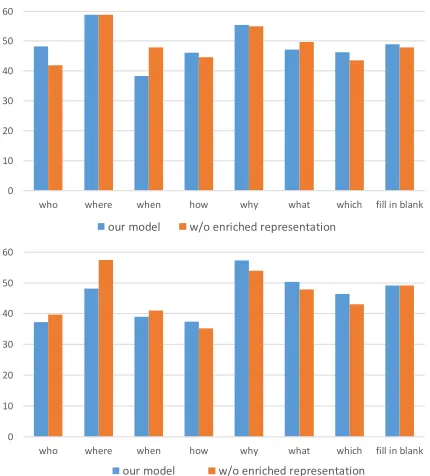
In our CSA model, we adopt various enriched representa-tions for better characterizing candidate information in dif-ferent semantic aspects. To better understand our model, we compare the performance between the original CSA model and without enriched candidate representations, as shown in Figure 3.
0 10 20 30 40 50 60
who where when how why what which fill in blank
our model w/o enriched representation
0 10 20 30 40 50 60
who where when how why what which fill in blank
our model w/o enriched representation
Figure 3: Quantitative analysis on different type of questions in RACE development and test set.
These results also explain why our CSA model shows significant improvements on RACE-H (high school) subset while giving a relatively inferior performance on RACE-M (middle school) subset. As the sample number of RACE-H subset is three times the size of RACE-M, the overall per-formance of our model still shows significant improvements over various state-of-the-art systems.
Case Study
We also randomly sampled one hundred question from RACE test set, and classified them into three categories ac-cording to its difficulty. The results are shown in Table 5. • The first level is the question that can be answered by
matching a few words in the passage. If the model finds the right place in the text, the answer is easy to find. With the attention mechanism, the neural model is especially good at solving this kind of question.
• The second level is the question that can be answered by using a few sentences without reasoning, which is rela-tively difficult than the first level.
• The third level is the question that needed to comprehen-sive reasoning via multiple clues in the passage. This kind of question is more complicated. To answer this question, the intention of the questioner must be captured.
As we can see that the current model shows relatively good performance on the first and second level questions than the third one, indicating that more investigation should be made on solving those questions that need reasoning.
An interesting example is shown in Figure 4, where our model chooses the right answer “C”. The reason why our model could pick out the right answer is that the candidate
State Total # Right # Accuracy
All 100 56 56.0%
First level 30 18 60%
Second level 30 20 66.7%
Third level 40 18 45.0%
Table 5: Case analysis on RACE dataset.
RACE Dataset
Passage
As is known to all, in dailyconversationpeople often use simple words and simple sentences, especially elliptical
sentences. Here is an interesting conversation between Mr Green and his good friend Mr Smith, a fisherman. Do you know what they are talking about?
Question
Thetextis mainly about .
Candidates
Ahow to catch fish. Bhow to spend a Sunday
Cellipsis in conversations Djoy in fishing
Figure 4: An example of RACE dataset. The correct answer is depicted in bold face.
“C” has the biggest semantic overlap with passage. If we change the candidate “C” to“ellipsis in talking”or change the question to“The conversation is mainly about .”, the model could still pick out the candidate “C” with a high probability as the correct answer. Through this experiment, we can see that our model could handle part of the high level semantic matching which suggest that the proposed CSA model is effective and robust on modeling text with similar meanings.
Conclusion
We propose the Convolutional Spatial Attention (CSA) model to tackle the machine reading comprehension with multiple-choice questions. The proposed model could fully extract the mutual information among the passage, question, and candidates, to form the enriched representations using the modified attention mechanism that has trainable weights. To summarize attention matrices from various sources, we propose to use convolutional operation to dynamically sum-marize the attention values within the different size of re-gions, which is beneficial to capture diverse features. Ex-perimental results show that the proposed CSA model could give substantial improvements over various state-of-the-art systems on both RACE and SemEval 2018 Task11 datasets. Also, the ablation studies verify the effectiveness of several proposed components in our model, and case analysis also shows that the CSA model is superior in solving relatively sophisticated questions (such as ‘why’ or ‘how’ questions).
Acknowledgments
We would like to thank all three anonymous reviewers for their constructive comments to improve our paper. This work was supported by the National Key R&D Program of China via grant No. 2016YFC0800806.
References
Abadi, M.; Barham, P.; Chen, J.; Chen, Z.; Davis, A.; Dean, J.; Devin, M.; Ghemawat, S.; Irving, G.; Isard, M.; et al. 2016. Tensorflow: a system for large-scale machine learn-ing. InOSDI, volume 16, 265–283.
Bird, S., and Loper, E. 2004. Nltk: the natural language toolkit. InACL 2004 on Interactive Poster and Demonstra-tion Sessions, 31.
Chen, Z.; Cui, Y.; Ma, W.; Wang, S.; Liu, T.; and Hu, G. 2018. Hfl-rc system at semeval-2018 task 11: Hybrid multi-aspects model for commonsense reading comprehension.
arXiv preprint arXiv:1803.05655.
Chen, D.; Bolton, J.; and Manning, C. D. 2016. A thorough examination of the cnn/daily mail reading comprehension task. InProceedings of ACL 2016, 2358–2367. Association for Computational Linguistics.
Chollet, F., et al. 2015. Keras.
https://github.com/fchollet/keras.
Cui, Y.; Chen, Z.; Wei, S.; Wang, S.; Liu, T.; and Hu, G. 2017. Attention-over-attention neural networks for reading comprehension. InProceedings of ACL 2017, 593–602. As-sociation for Computational Linguistics.
Dhingra, B.; Liu, H.; Yang, Z.; Cohen, W.; and Salakhutdi-nov, R. 2017. Gated-attention readers for text comprehen-sion. InProceedings of ACL 2017, 1832–1846. Association for Computational Linguistics.
Graves, A., and Schmidhuber, J. 2005. Framewise phoneme classification with bidirectional lstm and other neural net-work architectures. Neural Networks18(5-6):602–610. Hermann, K. M.; Koˇcisk´y, T.; Grefenstette, E.; Espeholt, L.; Kay, W.; Suleyman, M.; and Blunsom, P. 2015. Teaching machines to read and comprehend. In International Con-ference on Neural Information Processing Systems, 1693– 1701.
Hill, F.; Bordes, A.; Chopra, S.; and Weston, J. 2015. The goldilocks principle: Reading children’s books with explicit memory representations.arXiv preprint arXiv:1511.02301. Hu, M.; Peng, Y.; and Qiu, X. 2017. Reinforced mnemonic reader for machine comprehension.CoRR, abs/1705.02798. Huang, H.-Y.; Zhu, C.; Shen, Y.; and Chen, W. 2017. Fu-sionnet: Fusing via fully-aware attention with application to machine comprehension. arXiv preprint arXiv:1711.07341. Kadlec, R.; Schmid, M.; Bajgar, O.; and Kleindienst, J. 2016. Text understanding with the attention sum reader net-work. InProceedings of ACL 2016, 908–918. Association for Computational Linguistics.
Kingma, D. P., and Ba, J. 2014. Adam: A method for stochastic optimization.CoRRabs/1412.6980.
Lai, G.; Xie, Q.; Liu, H.; Yang, Y.; and Hovy, E. 2017. Race: Large-scale reading comprehension dataset from examina-tions. InProceedings of EMNLP 2017, 785–794. Associa-tion for ComputaAssocia-tional Linguistics.
Ostermann, S.; Roth, M.; Modi, A.; Thater, S.; and Pinkal, M. 2018. Semeval-2018 task 11: Machine comprehension using commonsense knowledge.
Parikh, S.; Sai, A.; Nema, P.; and Khapra, M. M. 2018. Eliminet: A model for eliminating options for reading comprehension with multiple choice questions. https://openreview.net/forum?id=B1bgpzZAZ.
Pennington, J.; Socher, R.; and Manning, C. 2014. Glove: Global vectors for word representation. InProceedings of EMNLP 2014, 1532–1543. Association for Computational Linguistics.
Peters, M.; Neumann, M.; Iyyer, M.; Gardner, M.; Clark, C.; Lee, K.; and Zettlemoyer, L. 2018. Deep contextual-ized word representations. InProceedings of NAACL 2018, 2227–2237. Association for Computational Linguistics. Rajpurkar, P.; Zhang, J.; Lopyrev, K.; and Liang, P. 2016. Squad: 100,000+ questions for machine comprehension of text. InProceedings of EMNLP 2016, 2383–2392. Associa-tion for ComputaAssocia-tional Linguistics.
Richardson, M.; Burges, C. J.; and Renshaw, E. 2013. Mctest: A challenge dataset for the open-domain machine comprehension of text. In Proceedings of EMNLP 2013, 193–203.
Seo, M.; Kembhavi, A.; Farhadi, A.; and Hajishirzi, H. 2016. Bidirectional attention flow for machine comprehen-sion.arXiv preprint arXiv:1611.01603.
Srivastava, R. K.; Greff, K.; and Schmidhuber, J. 2015. Highway networks.arXiv preprint arXiv:1505.00387. Wang, W.; Yang, N.; Wei, F.; Chang, B.; and Zhou, M. 2017. Gated self-matching networks for reading comprehension and question answering. InProceedings of ACL 2017, 189– 198. Association for Computational Linguistics.
Wang, L. 2018. Yuanfudao at semeval-2018 task 11: Three-way attention and relational knowledge for commonsense machine comprehension. CoRRabs/1803.00191.
Xiong, C.; Zhong, V.; and Socher, R. 2016. Dynamic coat-tention networks for question answering. arXiv preprint arXiv:1611.01604.
Xu, Y.; Liu, J.; Gao, J.; Shen, Y.; and Liu, X. 2017. To-wards human-level machine reading comprehension: Rea-soning and inference with multiple strategies.arXiv preprint arXiv:1711.04964.
Yu, A. W.; Dohan, D.; Luong, M.-T.; Zhao, R.; Chen, K.; Norouzi, M.; and Le, Q. V. 2018. Qanet: Combining local convolution with global self-attention for reading compre-hension. arXiv preprint arXiv:1804.09541.