Volume 3, Issue 3, March 2014
Page 313
Abstract
There are many optimization technique used for optimization such as Linear Programming Method, Non Linear Programming Method and Dynamic Programming Method. These methods having some drawbacks. So the result was there are developing new optimization methods such as heuristic optimization approaches. All the heuristic optimization algorithms work based on natural or artificial phenomena. One of these algorithm the harmony search algorithm works based on the improvisation of music. The performance of algorithm is illustrated with optimization of helical spring using as front suspension spring of Maruti Suzuki 800 for minimum weight. Helical spring is used in many applications so the requirement of minimum weight reduce the cost of the spring and fulfill the purpose of the spring without affecting the performance.
Keywords: Optimization, Harmony Search Algorithm, Weight Optimization of Helical Spring, Mathematical Model of Helical Spring.
1. Introduction
Now a day all the people required maximum benefits with minimum cost. To achieved this goal we usually depend on optimization technique. Many problems in engineering field solved by different optimization techniques such as design of aircraft and aerospace structure for minimum weight, design of frame structure, design of bridge, minimum weight design of structure for earthquake, wind and other types of load, parametric optimization of machine to reduce the production cost, design of pumps, turbines and heat transfer equipment for maximum efficiency, optimum design of electric network. All are the above problems are solved by different optimization methods. Now a day the heuristic algorithms such as genetic algorithm, practical swarm algorithm, ant bee colony algorithm, tabu search method, simulated annealing algorithm are used for solving optimization problems. All the heuristic algorithm work based on natural as well as artificial phenomena, such as in 1983 Kirkpatrick et al. [1] proposed simulated annealing algorithm work based on the annealing process of the metal, ant bee colony algorithm works based on the way of ant and bee in their life, Holland [2] proposed genetic algorithm works based on natural selection and the mechanisms of population genetics. Zong Woo Geem and Joong Hoon Kim et al. [3] presented harmony search algorithm works based on artificial phenomena music improvisation process from jaaz music.
2. Harmony Search Algorithm
Harmony Search Algorithm is give the better result than other heuristic algorithm. An Artificial phenomenon, musical harmony can used for developing harmony search algorithm. In music the process of searching better harmony is the base of the algorithm. In musical performance seek a best state as the optimization algorithm seek a best state. Compression between musical harmony and harmony search algorithm is given below.
Basic Steps of harmony search algorithm: 1. Initialize a Harmony Memory (HM). 2. Improvise a new harmony from HM.
3. If the new harmony is better than minimum harmony in HM, include the new harmony in HM, and exclude the minimum harmony from HM.
4. If stopping criteria are not satisfied, go to step 2.
Table – 1. Compression between Musical Performance and Optimization Process
COMPRESSION FACTOR MUSICAL PERFORMANCE PROCESS OPTIMIZATION PROCESS
Best State Fantastic Harmony Global Optimum
Estimated By Aesthetic Standard Objective Function
Estimated With Pitches of Instruments Values of Variables
Process Unit Each Practice Each Iteration
3. Detail Steps of Harmony Search Algorithm
3.1 Problem FormulationHS algorithm apply then problem should be formulated in the optimization environment, having objective function and constraint.
Optimization of Helical Spring for Minimum
Weight by Using Harmony Search Algorithm
Mr. Avakash P Patel1 and Mr. V.A.Patel2
1
ME (CAD/CAM) Student
Volume 3, Issue 3, March 2014
Page 314
3.2 Algorithm Parameter SettingOnce the problem formulation is ready, algorithm parameters should be set with certain values. HS contains algorithm parameters including harmony memory size (HMS), harmony memory considering rate (HMCR), pitch adjusting rate (PAR), and number of iteration (NI).
HMS is the number of solution vectors simultaneously handled in the algorithm; HMCR is the rate (0<HMCR<1) where HS picks one value randomly from musician’s memory. Thus, (1-HMCR) is the rate where HS picks one value randomly from total value range; PAR (0< PAR <1) is the rate where HS tweaks the value which was originally picked from memory. Thus, (1-PAR) is the rate where HS keeps the original value obtained from memory; MI is the number of iterations. HS improvises one harmony (= vector) each iteration.
3.3 Random Tuning for Memory Initialization
After problem is formulated and the parameter values were set properly, random tuning process is performed. In an orchestra concert, after oboe plays the note A (usually A440), other instruments randomly play any pitches out of playable ranges. Likewise, the HS algorithm initially improvises many random harmonies. The number of random harmonies should be at least HMS. However, the number can be more than HMS, such as twice or three times as many as HMS. Then, top-HMS harmonies are selected as starting vectors.
3.4 Harmony Improvisation
In Jazz improvisation, a musician plays a note by randomly selecting it from total playable range, from musician’s memory, or by tweaking the note obtained from musician’s memory. Likewise, the HS algorithm improvises a value by choosing it from total value range or from HM, or tweaking the value which was originally chosen from HM.
Random Selection: When HS determines the value (xi)newfor the new harmony (xi)new = ((x1)new,……,(xn)new) it randomly picks any value from total value range with probability of (1-HMCR). Random selection is also used for previous memory initialization.
Memory Consideration: When HS determines the value (xi)new it randomly picks any value xi j
from HM = {xi
1 ,……,xi
HMS
} with probability of HMCR.
Pitch Adjustment: After the value (xi)new is randomly picked from HM in the above memory consideration process, it can be further adjusted into neighbouring values by adding certain amount to the value, with probability of PAR. For discrete variable, if xi(k) = (xi)new the pitch-adjusted value becomes xi (k m) where m{1, 1} normally.
3.5 Harmony Improvisation
If the new harmony xnewis better, in terms of objective function value, than the worst harmony in HM, the new harmony is included in HM and the worst harmony is excluded from HM:
xnew HM xworst HM
If the new harmony xnewis the best one when compared with every harmony in HM.
3.6 Performing Termination
If HS satisfies termination criteria (for example, reaching NI), the computation is terminated. Otherwise, HS improvises another new harmony again.
4. Computational Procedure for HAS
The computational procedure of the basic HS algorithm can be summarized as follows Step 1: Set the parameters HMS, HMCR, PAR, BW and NI.
Step 2: Initialize the HM and calculate the objective function value of each harmony vector. Step 3: Improvise a new harmony Xnew as follows:
for (j = 1 to n) do
if (r1 < HMCR) then
xnew(j) = xa(j) where a (1, 2, . . . ,HMS) if (r2 < PAR) then
xnew(j) = xnew(j) ± r3× BW where r1, r2, r3 (0, 1) endif
else
xnew(j) = LBj + r × (UBj - LBj), where r (0, 1) endif
endfor
Step 4: Update the HM as XW= Xnew if f(Xnew) < f(XW)
Step 5: If NI is completed, return the best harmony vector XB in the HM; otherwise go back to step 3.
5. Problem Formulation
Volume 3, Issue 3, March 2014
Page 315
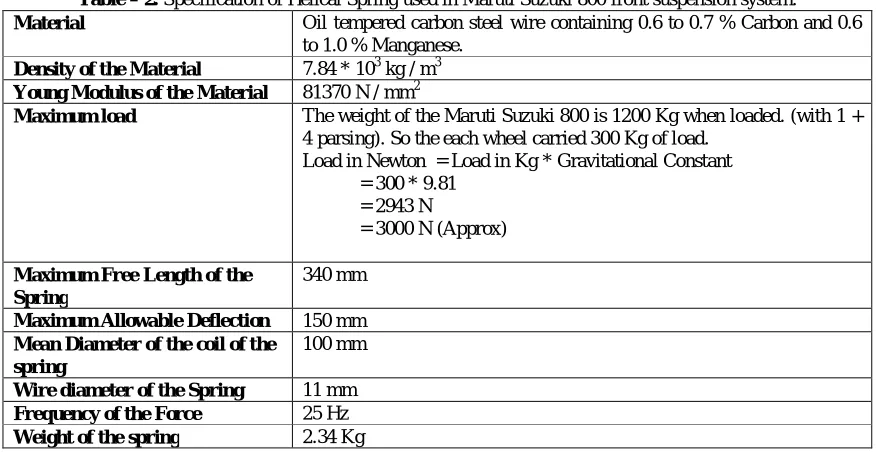
Table – 2. Specification of Helical Spring used in Maruti Suzuki 800 front suspension system.Material Oil tempered carbon steel wire containing 0.6 to 0.7 % Carbon and 0.6
to 1.0 % Manganese.
Density of the Material 7.84 * 103 kg / m3
Young Modulus of the Material 81370 N / mm2
Maximum load The weight of the Maruti Suzuki 800 is 1200 Kg when loaded. (with 1 +
4 parsing). So the each wheel carried 300 Kg of load. Load in Newton = Load in Kg * Gravitational Constant = 300 * 9.81
= 2943 N
= 3000 N (Approx)
Maximum Free Length of the Spring
340 mm
Maximum Allowable Deflection 150 mm
Mean Diameter of the coil of the spring
100 mm
Wire diameter of the Spring 11 mm
Frequency of the Force 25 Hz
Weight of the spring 2.34 Kg
The weight of a helical spring is an important measure of quality. Optimization of spring for minimum weight, so weight function of the spring is the objective function of the spring. The weight of the spring is obtained from,[4]
Where, W = Weight of helical spring, d = Wire diameter,
D = Spring coil diameter
n = Number of active coil in spring,
The material used for made helical spring is oil tempered carbon steel wire containing 0.6 to 0.7 % Carbon and 0.6 to 1.0 % Manganese which density is 7.84*10-6 kg/m3.
So the weight of the spring,
As seen above equation the weight of the helical spring is determined by d, D and n.So the d (Diameter of wire), D (Diameter of spring coil) and n (Number of active coil) are the design variable.
So the design vector is
So the objective function can be defined as,
When helical spring is loaded by axial force shear stress is exerted in the spring wire. We know the shear stress produce in helical spring, By using superposition, the shear stress in the inside fiber of the spring may be computed using the equation
Volume 3, Issue 3, March 2014
Page 316
Take,
So the above equation can be written as,
Where, Ks = Shear multiplication factor.
For most springs, C will range from about 6 to 12.
The above equation is quite general and applied for both static and dynamic load so the equation can be written as,
Where K = Wahl correction factor.
This factor includes the direction shear, together with another effect due to curvature. Curvature of the wire increases the stress on the inside of the spring but decreases it only slightly on the outside.
The value of K may be obtained from equation,
The maximum shear stress should not larger than allowable shear stress.
Where Fmax = Maximum axial load.
So the condition for shear stress can be expressed by equation,
When a helical spring is loaded by the axial force F, deflection is also exerted in spring. To obtain the equation for the deflection of a helical spring, we shall consider an element of wire formed by two adjacent cross sections. An element, the length of it is dx, cut from wire of diameter d. This element is on the surface of wire which is parallel to the spring axis. When loaded by force F and after deformation it will rotate through the angle and occupy the new position. From the expression of Hooke’s law for torsion, we have equation
We know that the maximum axial deflection of the helical spring can be expressed by the equation,
Where G = Young modulus of the material. G = 81370 N/mm2.
For safe design axial deflection is smaller than the maximum deflection.
Maximum working load provide maximum deflection, which load is larger than the working load.
So, .
So the condition for maximum axial deflection can be expressed as equation,
The natural frequency in radians per seconds is expressed by equation,
Volume 3, Issue 3, March 2014
Page 317
m = Mass of spring
Insert the value of k and m in above equation we get,
The fundamental critical frequency fb should be from 15 to 20 time the frequency of the force to avoid resonance with the harmonics.
The force frequency in helical spring used in suspension of Maruti Suzuki 800 is taken as 25 Hz. So the condition for maximum critical frequency can be expressed as,
6. Result & Discussion
Solving Above problem by using Harmony Search Algorithm we get the result as discussed bellow. As we seen that the result by using harmony search algorithm is better than genetic algorithm. Also I found that the time taken to solve the problem is less than the genetic algorithm. When I increase the number of iteration then I got the optimum result then previous and after 10000 iteration there are no more change in the given result.
No. of Iteration Wire Diameter (d)
Mean Coil Diameter (D)
No. of Active Coil (n)
Weight of Spring (W)
1000 12.0000 98.6395 5.4015 2.029039
2000 12.0000 101.2735 5.0000 1.970215
3000 11.0000 89.4730 5.1102 1.48565
4000 11.0000 90.4113 5.0000 1.477963
5000 10.0000 76.0165 5.6914 1.128419
10000 10.0000 79.3700 5.0000 1.072289
References
[1] Kirkpatrick S., Gelatt C,. and Vecchi M., “Optimization of simulated annealing,” Science, vol. 220, No. 4598, pp. 671-680, 1983.
[2] Holland J H , “Adaptation in Natural and Artificial System” Umiversity of Michigan Press, Ann Arbor, 1975.
[3] Zong Woo Geem and Joong Hoon Kim, “A New Heuristic Optimization Algorithm: Harmony Search,” Simulation 76, Vol. 2, pp. 60-68, 2001.
[4] K.S. Lee, Z.W. Geem, A new meta-heuristic algorithm for continuous engineering optimization, harmony search theory and practice, Comput. Methods Appl. Mech. Eng. 194 (2005) 3902–3933.
[5] Liang shangming, Yin guofu. Modern Mechanical Design Optimization, Chemical Industry Press, Beijing, 2005.
AUTHOR
Avakash Patel received the B.E degrees in Mechanical Engineering from Government Engineering College Modasa in 2009. During 2011 to till I am studying Master Engineering in CAD/CAM from Sakalchand Patel College of Engineering , Visnagar. Under the guidance of Professor Vikram A Patel (Advanced Manufacturing Technology.