198 Copyright © 2011-15. Vandana Publications. All Rights Reserved.
Volume-5, Issue-1, February-2015
International Journal of Engineering and Management Research
Page Number: 198-
202A Comparative Study of Mobile Ad-Hoc Network Protocols
Honey1, Sonia Sachdeva2 1
Assistant Professor, M.M. Modi College, Patiala, Punjab, INDIA 2
Assistant Professor, Gopichand Arya Mahila College, Abohar, INDIA
ABSTRACT
Mobile Ad hoc networks are wireless network that use multi-hop routing instead of static networks infrastructure to provide network connectivity. The network topology in MANETs usually changes with time. Therefore, these are new changes for routing protocol in MANETs since traditional routing protocols may not be suitable for MANETs. In mobile Ad-hoc network, the reactive and proactive routing protocols face many challenges like frequently changing topologies increases random number of nodes, connection brakes etc. For facing these types of challenges, this paper evaluates a lot of reactive and proactive routing protocols. This work is an attempt towards a comprehensive performance evaluation of five commonly used Mobile Ad hoc routing protocols . In this paper, we studied and compared the performance of various routing protocols like Ad hoc (AODV), (DSR), (TORA), (DSDV), (OLSR). In this paper few of the on demand ad hoc protocols are introduced and compared in order to find out for which kind of networks protocol is most suitable.
Keywords--- Ad hoc On-Demand Vector routing,
Destination-Sequenced Distance-vector Routing, Dynamic Source Routing, MANET, On-demand , Optimized Link State Routing Protocol , Temporally Ordered Routing Algorithm.
I.
INTRODUCTION
A mobile ad hoc network is a collection of wireless nodes that can dynamically be set up anywhere and anytime without using any pre-existing network infrastructure. It is an autonomous system in which mobile hosts connected by wireless links are free to move randomly and often act as routers at the same time. Unlike cellular wireless networks, no static or fixed infrastructure exists in MANET, and no centralized control can be available. The network can be formed anywhere, at any time, as long as two or more nodes are connected and
communicate with one another either directly when they are in radio range of each other or via intermediate mobile nodes because of flexibility that a MANET offers[1,2]. The mobile nodes can perform the roles of both hosts and routers. The presence of mobility makes a MANET challenging for designing and implementation in real life. It is a huge challenge to design topology control, routing, quality-of services (QOS) and resources management, services discovery, network operations and management, security services, and services offerings for MANET as traditional schemes are no longer applicable. A mobile (ad hoc network MANET) sometimes called a wireless ad hoc network or a mobile mesh network is a wireless network, comprised of mobile computing devices (nodes) that use wireless transmission for communication, without the aid of any established infrastructure or centralized administration such as a base station or an access point[2]. The traffic types in ad hoc networks are quite different from those in an infrastructure wireless network, including: [3]
1.1 Peer-to-Peer Communication between two nodes
which are within one hop. Network traffic (Bps) is usually consistent.
1.2 Remote-to-Remote Communication between two
nodes beyond a single hop but which maintains a stable route between them. This may be the result of several nodes staying within communication range of each other in a single area or possibly moving as a group. The traffic is similar to standard network traffic.
1.3 Dynamic Traffic This occurs when nodes are dynamic
199 Copyright © 2011-15. Vandana Publications. All Rights Reserved.
II.
MANET FEATURES
MANET has the following features: [4][3]
2.1 Autonomous terminal. In MANET, each mobile
terminal is an autonomous node, which may function as both a host and a router. In other words, besides the basic processing ability as a host, the mobile nodes can also perform switching functions as a router. So usually endpoints and switches are indistinguishable in MANET.
2.2 Distributed operation. Since there is no background
network for the central control of the network operations, the control and management of the network is distributed among the terminals. The nodes involved in a MANET should collaborate amongst themselves and each node acts as a relay as needed, to implement functions e.g. security and routing.
2.3 Multi hop routing. Basic types of ad hoc routing
algorithms can be single-hop and multihop, based on different link layer attributes and routing protocols. Single-hop MANET is simpler than multiSingle-hop in terms of structure and implementation, with the cost of lesser functionality and applicability. When delivering data packets from a source to its destination out of the direct wireless transmission range, the packets should be forwarded via one or more intermediate nodes.
2.4 Dynamic network topology. Since the nodes are
mobile, the network topology may change rapidly and unpredictably and the connectivity among the terminals may vary with time. MANET should adapt to the traffic and propagation conditions as well as the mobility patterns of the mobile network nodes. The mobile nodes in the network dynamically establish routing among themselves as they move about, forming their own network on the fly. Moreover, a user in the MANET may not only operate within the ad hoc network, but may require access to a public fixed network
2.5 Light-weight terminals. In most cases, the MANET
nodes are mobile devices with less CPU processing capability, small memory size, and low power storage. Such devices need optimized algorithms and mechanisms that implement the computing and communicating functions.
III.
CLASSIFICATION OF AD-HOC
ROUTING PROTOCOLS
These are generally categorized as table-driven or proactive, on-demand or reactive and hybrid routing protocols.
Fig.1Classification of various Routing Protocols
3.1 Table-Driven Routing Protocols (Proactive)
Table driven routing protocols attempt to maintain consistent, up-to-date routing information from each node to every other node in the network. These protocols require each node to maintain one or more tables to store routing information, and they respond to changes in network topology by propagating updates throughout the network in order to maintain a consistent network view.
200 Copyright © 2011-15. Vandana Publications. All Rights Reserved.
3.1.1 The Destination Sequence Distance Vector Protocol (DSDV) [5]:
The Destination Sequence Distance Vector (DSDV) is a proactive routing protocol which adds a new attribute, sequence number, to each route table entry at each node. Routing table maintained at each node and with this table; node transmits the packets to other nodes in the network. This protocol was motivated for the use of data exchange along changing arbitrary path of interconnection which may not be close to any base station. The data broadcast by each node will contain its new sequence number and the following information for each node will contain its new sequence number and the following information for each new route:-
• The destination address
• The number of hops required to reach the destination and
• The new sequence number, originally stamped by the destination.
Advantage of DSDV:
• DSDV protocol guarantees loop free paths.
• Count to infinity problem is reduced in DSDV.
• We can avoid traffic with incremental updates instead of full dump updates.
Limitation of DSDV:
• Wastage of bandwidth due to unnecessary advertising of routing information even if there is no change in the network topology.
• DSDV doesn’t support multi path routing.
3.1.2 OLSR—The Optimized Link State Routing Protocol
The Optimized Link State Routing Protocol is a Proactive link state protocol .OLSR employs three mechanism for routing (1)Hello message for neighbor sensing message (2)Control packet using multi-point rely(MPR).(3)Path selection using shortest path first algorithm.[6] Each nodes using its two-hops by selecting MPR’s such that all its two-hop neighbors are accessible .Basically the hello and topology control (TC) messages to discover and then broadcast link state information throughout the particularly suited for large and dense networks, as the optimization is done by using MPRs which work well in this context. The larger and more dense a network, the more optimization can be achieved as compared to the classic link state algorithm.
3.3 Source-Initiated On-Demand Routing (Reactive Routing Protocols)
A different approach from table-driven routing is source-initiated on-demand routing. This type of routing creates routes only when desired by the source node. When a node requires a route to a destination, it initiates a route discovery process within the network. This process is completed once a route is found or all possible route permutations have been examined.
Once a route has been established, it is maintained by a route maintenance procedure until either
the destination becomes inaccessible along every path from the source or until the route is no longer desired.
3.2.1 Ad Hoc On-Demand Distance Vector Routing:
The Ad Hoc On-Demand Distance Vector (AODV) routing protocol described on the DSDV algorithm. AODV is an improvement on DSDV because it typically minimizes the number of required broadcasts by creating routes on a demand basis, as opposed to maintaining a complete list of routes as in the DSDV algorithm. The AODV classify it as a pure on-demand route acquisition system, since nodes that are not on a selected path do not maintain routing information or participate in routing table exchanges When a source node desires to send a message to some destination node and does not already have a valid route to that destination, it initiates a path discovery process to locate the other node. [7]
3.2.2 Dynamic Source Routing
The Dynamic Source Routing (DSR) protocol presented is an on-demand routing protocol that is based on the concept of source routing. Mobile nodes are required to maintain route caches that contain the source routes of which the mobile is aware. Entries in the route cache are continually updated as new routes are learned. The protocol consists of two major phases: route discovery and route maintenance. When a mobile node has a packet to send to some destination, it first consults its route cache to determine whether it already has a route to the destination. If it has an unexpired route to the destination, it will use this route to send the packet. On the other hand, if the node does not have such a route, it initiates route discovery by broadcasting a route request packet.
3.2.3 Temporally Ordered Routing Algorithm
The Temporally Ordered Routing Algorithm (TORA) is a highly adaptive loop-free distributed routing algorithm based on the concept of link reversal. TORA is proposed to operate in a highly dynamic mobile networking environment. It is source-initiated and provides multiple routes for any desired source/destination pair. The key design concept of TORA is the localization of control messages to a very small set of nodes near the occurrence of a topological change. To accomplish this, nodes need to maintain routing information about adjacent (one-hop) nodes. The protocol performs three basic functions: • Route creation
• Route maintenance • Route erasure
IV.
COMPARATIVE STUDY
201 Copyright © 2011-15. Vandana Publications. All Rights Reserved.
operation [10], [17]. Also, the values for these metrics represent the worstcase behaviour. Control traffic overhead and loop-free properties are two important issues with proactive routing protocols in MANETs. The proactive routing used for wired networks normally have predictable control traffic overhead because topology changes rarely and most routing updates are periodically propagated. As stated earlier, DSDV is essentially a modification of the basic Bellman-Ford routing algorithm. The modification includes the guarantee of loop-free routing and a simple route update protocol. DSDV selects the shortest path by using number of hops required to reach the destination as the routing metric. It utilizes destination sequence number to avoid route loops. Both periodic and triggered updates are utilized in DSDV. However, DSDV is inefficient because of the requirement of periodic update transmission, regardless of the number of changes in the network topology. Reactive routing protocols were proposed to reduce the traffic control overhead and improve scalability. The DSR algorithm is intended for networks in which the mobiles move at moderate speed
with respect to packet transmission latency [2]. As compared to the other reactive protocols, DSR does not make use of periodic routing advertisements, thus saving bandwidth and reducing power consumption. However, because of the small diameter assumption and the source routing requirement, DSR is not scalable to large networks. Similar to DSR, AODV employs a route discovery procedure, but the DSR overhead is potentially larger than that of AODV since AODV packet only contain the destination address instead of the complete routing information. Another advantage of AODV is that it supports multicasting [7]. AODV exploits both the distance vector used in DSDV and source routing from DSR. Among the three protocols, AODV has less traffic control overhead and is most scalable (because of the smaller size of data packets as compared to DSR and no periodic route updates as compared to DSDV). However, AODV does require hello messages exchanges periodically with their neighbours to monitor link disconnections.
V.
METHODOLOGY
In this paper performance comparison is based on the simulation results. The implementation is done by using NS-2. In this paper we describe the simulation of various ad-hoc routing protocols.
5.1 Packet Delivery Ratio:
Packet Delivery Ratio is the ratio between the numbers of packets sent by the sources and the number of packets received at destination. It also describes the loss rate that of the packets, which in turn affects the maximum throughput that the network can support.
Packet Delivery Ratio In RWP
0 20 40 60 80 100
Number of Nodes
PD
R
AODV DSDV TORA OLSR DSR
AODV 97.71 86.42 73.85 64.43
DSDV 81.91 47.82 47.72 14.73
TORA 79.92 34.81 27.87 10.77
OLSR 98.84 30.48 28.38 7.75
DSR 85.76 48.99 19.89 18.45
25 50 75 100
Fig 2. Packet Delivery Ratio
5.2 Average End To End Delay:
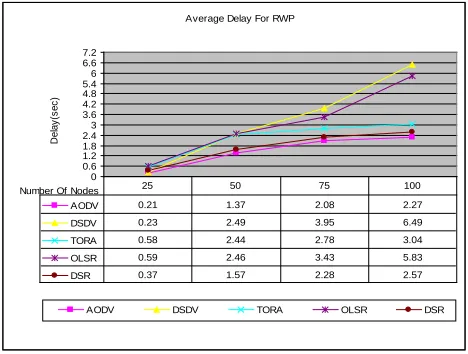
The end-to-end delay is the time needed to traverse from the source node to the destination node in a network.
Average Delay For RWP
0 0.6 1.2 1.8 2.4 3 3.6 4.2 4.8 5.4 6 6.6 7.2
Number Of Nodes
D
el
ay
(s
ec
)
AODV DSDV TORA OLSR DSR AODV 0.21 1.37 2.08 2.27 DSDV 0.23 2.49 3.95 6.49 TORA 0.58 2.44 2.78 3.04 OLSR 0.59 2.46 3.43 5.83 DSR 0.37 1.57 2.28 2.57 25 50 75 100
Fig.3 Average Delay Values for protocols
5.3 Throughput:
202 Copyright © 2011-15. Vandana Publications. All Rights Reserved.
Throughput For RWP
0 20 40 60 80 100
Number of Node
T
hr
oughput
AODV DSDV TORA OLSR DSR AODV 75.16 68.04 57.69 51.95 DSDV 52.84 51.24 34.83 8.82 TORA 41.41 19.01 12.17 4.62 OLSR 76.03 24.01 22.34 6.25 DSR 54.97 33.78 14.51 10.91
25 50 75 100
Fig 4. Throughput for protocols
VI.
CONCLUSION
The different basic working mechanisms of these protocols lead to the differences in the performance. For DSDV, OLSR, AODV, DSR and TORA packet delivery ratio is independent of offered traffic load, with all protocols delivering are different of the packets in all cases.
Our simulation results show that Reactive protocols is much better than proactive in the manners of packet delivery ,throughput at the same time delay is minimal in compare to proactive protocol. The delay of OLSR is less and in the DSR is worst. Throughput is high in case of AODV. In DSR delay is greater than the AODV and OLSR. On the other hand DSR perform better when the numbers of nodes are less but it will fails when the numbers of nodes increase but DSR showed high end to end delay due to formation of temporary loops within the network .TORA is very poor and not reliable for the MANETs but TORA works better in the WSNs compare to MANET.
However it is currently impossible to quantitatively compare and contrast most ad hoc routing protocols.
REFERENCE
[1 ]Zhao Sun “Mobile Ad Hoc Networking: An Essential Technology for Pervasive Computing”, Proc. International Conferences on Info-tech & Info-net, Beijing, China, C:316 - 321,2001.
[2] Imrich Chlamtac, Marco Conti, Jennifer J.-N. Liu, “Mobile Ad Hoc Networking: Imperatives and Challenges”, I. Chlamtac et al. / Ad Hoc Networks 1, 2003, Page 13–64I. S. Jacobs and C. P. Bean, “Fine particles, thin films and exchange anisotropy,” in Magnetism, vol. III, G. T. Rado and H. Suhl, Eds. New York: Academic, 1963, pp. 271–350.
[3] Mobile ad hoc network described in wi
[4] Jun-Zhao Sun “Mobile Ad Hoc Networking: An Essential Technology for Pervasive Computing “Proceedings. ICII 2001 - Beijing. 2001 International Conferences on Volume 3, Issue, 2001 Page(s):316 - 321 vol.3.
[5] Jian Liu and Suresh Singh, “ATCP: TCP for Mobile Ad Hoc Networks”, IEEE Journal on Selected Areas in Communications, Vol. 19, No. 7, July 2001.
[6] C. E. Perkins and E.M. Royer. “Ad hoc on demand Distance Vector routing, mobile computing systems and applications”, 1999. Proceedings. WMCSA ’99. Second IEEE Workshop on, 1999, pp. 90-100.