Volume 3, Issue 5, May 2014
Page 346
Abstract
In this paper Bit Error Rate performance of OFDM, 4-PSK, 16-QAM, 64-QAM System over AWGN channel is analyzed by using convolutional coding and BCH coding. In this paper, we have considered only adaptive modulation. First we have investigated the OFDM system performance of uncoded adaptive modulation using quadrature amplitude modulation (QAM) and phase shift keying (PSK). To further enhance the system, we employ convolutional coding to OFDM system. In OFDM system, the Signal to noise ratio is estimated at receiver and then transmitted to the transmitter through feedback channel, the transmitter according to the estimated SNR select appropriate modulation scheme and coding rate which maintain constant bit error rate lower than the requested BER. The obtained results show that a significant improvements in terms of bit error rate (BER) and throughput can be achieved demonstrating the Superiority of the adaptive modulation schemes compared to fixed transmission schemes.
Keywords: Adaptive Modulation, Orthogonal frequency division multiplexing, AWGN channel coding, Bit error rate, throughput, Convolutional coding, BCH coding
1.
I
NTRODUCTIONOrthogonal frequency-division multiplexing (OFDM) is a method of encoding digital data on multiple carrier frequencies. OFDM is used in digital television and audio broadcasting, DSL Internet access, wireless networks, power line networks, and 4G mobile communications. OFDM is essentially identical to coded OFDM (COFDM) and discrete multi-tone modulation (DMT), and is a frequency-division multiplexing (FDM) scheme used as a digital multi-carrier modulation method. A large number of closely spaced orthogonal sub-carrier signals are used to carry data on several parallel data streams or channels. Each sub-carrier is modulated with a Quadrature amplitude modulation or phase-shift keying at a low symbol rate, and also maintaining total data rates similar to conventional single-carrier modulation schemes in the same bandwidth.
In an OFDM transmission system, each subcarrier is attenuated individually under the frequency-selective and fast fading channel. The channel performance may be highly fluctuating across the subcarriers and varies from symbol to symbol, In case of frequency selective fading the increasing average signal to noise ratio with error probability decreases very slowly. This problem can be mitigated if different modulation schemes are employed for the individual OFDM subcarriers. This will substantially improve the performance and data throughput of an OFDM system. However the potential loss of throughput due to seclusion of faded subcarriers can be mitigated by employing higher order modulation modes on the subcarriers exhibiting high SNR values [2].
The primary advantage of OFDM over single-carrier schemes is its ability to cope with severe channel conditions (for example, attenuation of high frequencies in a long copper wire, narrowband interference and frequency-selective fading due to multipath) without complex equalization filters. The low symbol rate makes the use of a guard interval between symbols affordable, making it possible to eliminate inter symbol interference (ISI) and utilize echoes and time-spreading (on analogue TV these are visible as ghosting and blurring, respectively) to achieve a diversity gain, i.e. a signal-to-noise ratio improvement.
2.
SYSTEM
MODELS
In this paper, sub band adaptive transmission schemes are employed to reduce the complexity. In this simulation the instantaneous SNR of the subcarrier is measured at the receiver. The channels quality varies across the different subcarriers for frequency selective channels. The received signal at any subcarrier can be expressed as [1].
= + (1)
Where the channel coefficient at any subcarrier is, is the transmitted symbol and is the Gaussian noise sample. So the instantaneous SNR can be calculated using
SN = (2)
To Improve Performance of OFDM System
Using Optimize Adaptive Coding Technique
with Convolutional and BCH Coding
Irfan Y. Khan1, Sunil U. Nyati2 and Umesh S. Bhadade3
Volume 3, Issue 5, May 2014
Page 347
The conservative approach in threshold based adaptation is by using the lowest quality subcarrier. It means that the lowest value of SNR will be used in mode selection. By using this method, the overall BER in one sub band is normally lower than the BER target. Figure (1) shows the adaptation procedure.
Figure 1 Adaptation Procedure [2]
3.
BLOCK
DIAGRAM
OF
OFDM
SYSTEM
The block diagram of this system is shown in Figure 2. The channel estimation and mode selection are done at the receiver side and the information is sent to the transmitter using a feedback channel. In this model the adaptation is done frame by frame. The channel estimator is used to estimate the instantaneous SNR of the received signal. Based on the instantaneous SNR calculated, the best mode will be chosen for the next transmission frame. This task is done by the mode selector block. At the transmitter the adaptive modulator block consists of different modulators which are used to provide different modulation modes. The switching between these modulators will depend on the instantaneous SNR. This block diagram is used to describe two types of adaptive modulation schemes which is based on MQAM and MPSK scheme. The goal of adaptive modulation is to choose the appropriate modulation mode for transmission in each sub band, given the local SNR, in order to achieve good trade-off between spectral efficiency and overall BER [2].
Figure 2 Block diagram of OFDM system[2]
4.
SIMULATION
RESULT
4.1 Convolutional Coding with AWGN PSK
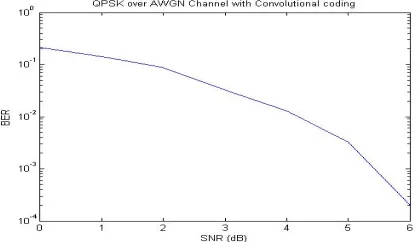
Figure (3) shows the BER performance of QPSK over AWGN channel with convolutional coding. BPSK requires 3 dB less of signal to noise ratio than QPSK to achieve the same BER. This outcome will hold true only if we consider BER in terms of SNR per carrier. The results are displayed in figure (3). In AWGN channel, the signal is more prone to errors and for example, at a bit error rate of 10
-3
we need 20 dB more of signal to noise ratio than for AWGN to achieve the same bit error rate. The probability of error is identical for BPSK and QPSK because the BER has been measured in terms of signal to noise ratio per bit.
Volume 3, Issue 5, May 2014
Page 348
4.2 Convolutional Coding with AWGN QAM
Figure (4) shows the 64-QAM over AWGN Channel with convolutional coding. It represent result of the signal to noise ratio verses Bit error rate performance. In 64-QAM over AWGN Channel with convolutional coding of signal to noise ratio is increases the bit error rate is decreases. Fig (5) shows 16-QAM over AWGN channel with Convolutional coding.
Figure 4 64-QAM over AWGN Channel with Figure 5 16-QAM over AWGN Channel with Convolutional coding. convolutional coding.
Figure (6) Show M-ary PSK & QAM over AWGN Channel with convolutional coding. This figure shows the combination of M-ary 4-PSK, M-ary 16-QAM and M-ary 64-QAM.
Figure 6 M-ary PSK & QAM over AWGN Channel with convolutional coding.
4.3 Convolutional Adaptive Coding with AWGN Channels
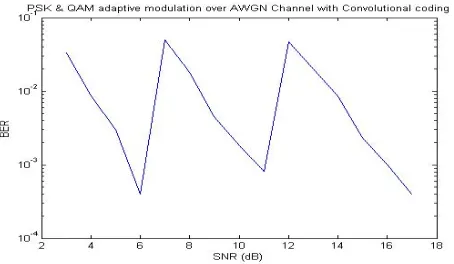
Figure (7) shows the result of PSK & QAM adaptive modulation over AWGN Channel with Convolutional coding. In PSK and QAM signal are adaptive by using adaptive modulation and display the result as shown in figure (7).
Figure 7 PSK & QAM adaptive modulation over AWGN Channel.
4.4 Convolutional Coding Result
Volume 3, Issue 5, May 2014
Page 349
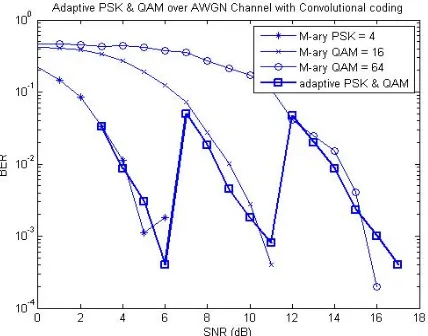
efficiency but result in poor BER. So to achieve good trade-off between spectral efficiency and overall BER adaptive modulation is used. Figure (8) shows the simulated BER performance of M-ary PSK, 16-QAM, 64-QAM and adaptive modulation scheme for an OFDM system over AWGN channel.
Figure 8 Adaptive PSK & QAM over AWGN Channel with Convolutional coding.
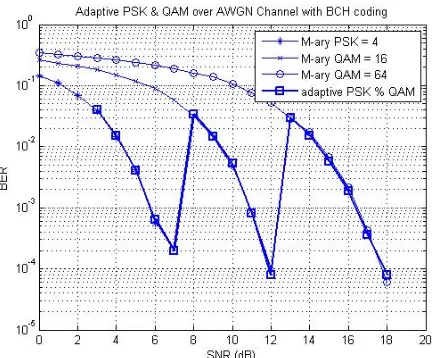
The BER performance of adaptive modulation has a ripple phenomenon. This is because the BER of adaptive modulation scheme will rise up when the constellation is switched to one with larger constellation size as SNR increases and falls in the next SNR region. The BER will decrease when the SNR keeps increasing within the region boundaries. As the value of SNR increases, the BER decreases and the system will switch to the next higher modulation scheme and again the BER increases but it decreases for the chosen modulation scheme interval. But the adaptive modulation scheme keeps the value of the BER below the target BER.
4.5 BCH Coding with AWGN PSK
Figure (9) shows the BER performance of QPSK over AWGN channel with BCH coding. In this figure the SNR increase the Bit error rate is decreases. BPSK requires 3 dB less of signal to noise ratio than QPSK to achieve the same BER. This outcome will hold true only if we consider BER in terms of SNR per carrier. The effects of AWGN channel simulated. The results are displayed in figure. In AWGN channel, the signal is more prone to errors and for example, at a bit error rate of 10
-3
we need 20 dB more of signal to noise ratio than for AWGN to achieve the same bit error rate. The probability of error is identical for BPSK and QPSK because the BER has been measured in terms of signal to noise ratio per bit.
Figure 9 QPSK over AWGN Channel with BCH coding
4.6 BCH Coding with AWGN QAM
Volume 3, Issue 5, May 2014
Page 350
Figure 10 16-QAM over AWGN Channel BCH coding Figure 11 64-QAM over AWGN Channel with BCH coding
Figure (12) Show ary PSK & QAM over AWGN Channel with BCH coding. This figure shows the combination of M-ary 4-PSK, M-M-ary 32-QAM and M-M-ary 64-QAM.
Figure 12 M-ary PSK & QAM over AWGN Channel with BCH Coding
4.7 BCH Adaptive Coding with AWGN Channels
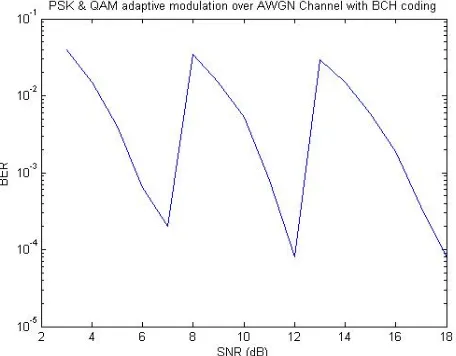
Figure (13) shows the result of PSK & QAM adaptive modulation over AWGN Channel with BCH coding. In PSK and QAM signal are adaptive by using adaptive modulation and display the result as shown in figure (13).
Volume 3, Issue 5, May 2014
Page 351
4.8 BCH Coding Result
Figure (14) shows the result of Adaptive PSK & QAM over AWGN Channel with BCH Coding. In PSK and QAM signal are adaptive by using adaptive modulation and gives this result are as shown in figure (14). This figure indicates the Adaptive combination of Adaptive PSK and QAM.
Figure 14 Adaptive PSK & QAM over AWGN Channel with BCH Coding.
5. CONCLUSION
The detail knowledge of a current key issue in the field of communications named Orthogonal Frequency Division Multiplexing (OFDM). We elaborated on the performance theory of the codes. First we developed an OFDM system model then try to improve the performance by applying forward error correcting codes to our uncoded system. From the study of the system, it can be concluded that we are able to improve the performance of uncoded OFDM by convolution coding scheme. In this paper, the performances of adaptive transmission scheme for OFDM have been investigated. The advantage of employing adaptive transmission scheme is described by comparing their performance with fixed transmission system. A better adaptation algorithm is used to improve the throughput performance. This algorithm utilizes the average value of the instantaneous SNR of the subcarriers in the sub band as the switching parameter. The results show an improved throughput performance with considerable BER performance.
References
[1] Dr. Serkout N. Abdullah, Zainab Mageed Abid, “Adaptive Coded Modulation for OFDM System”, Volume 2, February 2012 Journal of Engineering.
[2] J. Faezah and K. Sabira, “Adaptive Modulation for OFDM Systems”, International journal of communication networks and information security Vol. 1, No. 2, August 2009.
[3] Rajeshree Raut, Priti Subramanium & Kavita Bramahankar, “Adaptive Coding Techniques to Improve BER in OFDM System”, International Conference on Computer Science and Information Technology (CSIT-2012), May 19th, 2012, Bangalore, ISBN: 978-93-81693-28-5 298.
[4] T.S.Harivikram, Dr. R.Harikumar, Dr. C.Ganesh Babu, P.Murugamanickam, “Adaptive Modulation and Coding Rate for OFDM Systems”, International Journal of Emerging Technology and Advanced Engineering, (ISSN 2250-2459, ISO 9001:2008 Certified Journal, Volume 3, Issue 2, February 2013).
[5] Srabani Mohapatra, “A new approach for performance improvement of OFDM system using pulse shaping”, Department of Electrical Engineering National Institute of Technology Rourkela Rourkela-769 008, Orissa, India 2009.
[6] Abebe Tsegaye, “Adaptive Modulation-based OFDM System in Doubly Selective Channel”, Addis Ababa University. Addis Ababa Institute of Technology Electrical and Computer Engineering Department, September, 2012.
[7] Eric Phillip LAWREY, “Adaptive Techniques for Multiuser OFDM”, the degree of Doctor of Philosophy in Electrical and Computer Engineering School of Engineering James Cook University in December 2001.
[8] D. Sreenivasa Rao, M. Kanti Kiran & K. Sri Ramakrishna, “Algorithm to Improve the Performance of OFDM based WLAN Systems”, International Journal of Computer Science & Communication. Vol. 1, No. 2, July-December 2010, pp. 27-31.
Volume 3, Issue 5, May 2014
Page 352
QAM Modulation Technique”, Journal of Engineering Research and Applications (IJERA), ISSN: 2248-9622, Vol. 1, Issue 3, pp.1005-1011.[10]Piyush Vyas, Surendra K. Bohra, “ Improved performance of digital techniques companded OFDM system using non linear symmetric approach under sufficient bandwidth”, International Journal of Advanced Technology & Engineering Research (IJATER), ISSN No: 2250-3536 Volume 2, Issue 5, Sept 2012.
[11]Pallavi Dhok, Mrs S.V. Rathkantiwar, “Performance Improvement in BER and PAPR Reduction in OFDM System Using Companding Technique”, International Journal of Application or Innovation in Engineering & Management, Volume 2, Issue 1, January 2013.
[12]Suverna Sengar, Partha Pratim Bhattacharya, “Performance improvement in OFDM system by PAPR reduction”, Signal & Image Processing, an International Journal (SIPIJ) Vol.3, No.2, April 2012.
[13]Mohit Pant, Dr.Dhiiraj Nitnawwre, “Performance Improvement of OFDM System Using PAPR Reduction”, International Journal of Advanced Research in Computer Science and Software Engineering, Volume 2, Issue 5, May 2012 ISSN: 2277 128X.
[14]Susmita Das, Srabani Mohapatra and KalaPraveen Bagadi, “Performance improvement of OFDM system by peak to average power reduction through pulse shaping technique, ISSN: 2229– 6948 ICTACT journal on communication technology, December 2010, Vol 1. Issue 04.
[15]Mrs.C.Geetha Priya, Dr. Mrs. M. Sunganthi, M. Madhana Prabha, “Improving the Data Rate of OFDM System in Rayleigh Fading Channel Using Spatial Multiplexing with Different Modulation Techniques”, 2009 International Symposium on Computing, Communication, and Control (ISCCC 2009) Proc .of CSIT vol.1 (2011) © (2011) IACSIT Press, Singapore.
[16]Priya hariharan, “Adaptive schemes for multicarrier transmission system with MB-OFDM modulation”, Communications Laboratory Faculty of Electrical Engineering and Computer Science University of Kassel, March 2007.
AUTHOR
Irfan Khan Yousuf Khan received his BE (E&C) Degree from G. H .Raisoni College of Engineering and management Jalgaon, North Maharashtra University in 2011. He is a final year student of M.E in Digital Electronics (E&Tc), SSBT’s COET Bambhori Jalgaon Maharashtra, India. He published two papers in international journals and also published two papers in international conference.
Sunil U. Nyati received his BE ( E&Tc) degree from Govt. Engineering College, Aurangabad in 1996. He obtained his ME in E&Tc degree from Govt. COE, A’bd.. He has 12 years of teaching experience. He worked as a Associate Professor in E&Tc Department at SSBT’s COET bambhori Jalgaon. He has published 4 papers in international and national journals and also published around 14 papers in international and national conferences conducted in india.