The Thirty-Third AAAI Conference on Artificial Intelligence (AAAI-19)
Exploring Knowledge Graphs in an
Interpretable Composite Approach for Text Entailment
Vivian S. Silva,
1Andr´e Freitas,
2Siegfried Handschuh
1,31Department of Computer Science and Mathematics, University of Passau, Innstraße 43, 94032, Passau, Germany 2School of Computer Science, University of Manchester, Kilburn Building, Oxford Road, M13 9PL, UK 3Institute of Computer Science, University of St. Gallen, M¨uller-Friedberg-Strasse 8, 9000, St. Gallen, Switzerland
[email protected], [email protected], [email protected]
Abstract
Recognizing textual entailment is a key task for many seman-tic applications, such as Question Answering, Text Summa-rization, and Information Extraction, among others. Entail-ment scenarios can range from a simple syntactic variation to more complex semantic relationships between pieces of text, but most approaches try a one-size-fits-all solution that usually favors some scenario to the detriment of another. We propose a composite approach for recognizing text entailment which analyzes the entailment pair to decide whether it must be resolved syntactically or semantically. We also make the answer interpretable: whenever an entailment is solved se-mantically, we explore a knowledge base composed of struc-tured lexical definitions to generate natural language human-like justifications, explaining the semantic relationship hold-ing between the pieces of text. Besides outperformhold-ing well-established entailment algorithms, our composite approach gives an important step towards Explainable AI, using world knowledge to make the semantic reasoning process explicit and understandable.
Introduction
Text entailment is formally defined as a directional relation-ship between a pair of text expressions, denoted byT – the entailing text, andH– the entailed hypothesis. We say that T entails H if, typically, a human reading T would infer that H is most likely true (Dagan, Glickman, and Magnini 2006). It is an important input for a number of other natural lan-guage processing (NLP) tasks, such as Question Answering, Text Summarization, Information Retrieval, Machine Trans-lation, etc., which need to deal with natural language vari-ability to determine whether inputs and/or outputs expressed in different forms are equivalent.
Text entailment encompasses three different scenarios: (1) T and H are equivalent statements but expressed in slightly different ways; (2) H generalizes information from T; and (3) H present new information derived from T. While (1) can usually be resolved syntactically, given that only the sen-tence structure is altered, and (2) requires only shallow se-mantic information, such as synonyms and hypernyms, (3) requires knowledge that goes beyond what is expressed in T
Copyright c2019, Association for the Advancement of Artificial Intelligence (www.aaai.org). All rights reserved.
and H, demanding the use of external world knowledge to solve the entailment.
Some approaches focus on exploring the syntactic struc-tures of T and H to determine whether they are equivalent and confirm the entailment, but can fall short of identify-ing more complex semantic variations. On the other hand, techniques concentrating purely on finding semantic rela-tions between T and H will struggle to deal with pairs where only a syntactic variation holds. To overcome these issues, we propose the use of different methods to tackle different entailment scenarios, integrated as components into a com-posite approach that performs arouting, that is, it analyzes the entailment pair and sends it to the most suitable compo-nent to solve it.
For solving syntactic entailments, we use a tree edit dis-tance algorithm over a dependency tree representation of T and H. For identifying semantic relationships, we employ a distributional (word embedding-based) navigation algorithm over graph knowledge bases composed of natural language dictionary definitions. By finding paths is these graphs link-ing T and H, we can provide human-readable justifications that shows explicitly what is the semantic relationship hold-ing between them. Our contribution is twofold: besides pro-viding a more flexible way to deal with different entailment phenomena, we also analyze different knowledge sources, showing how they compare quantitatively and qualitatively, especially from the interpretability point of view.
Related Work
et al. (2018b) proposed an approach that focuses on seman-tic entailments, also exploring structured knowledge bases to find semantic relationships that confirm and explain the entailment.
Recently, new techniques have been introduced for Nat-ural Language Inference (NLI), a subtask of text entail-ment aimed at classifying a pair of pieces of text as entail-ment,neutralorcontradiction(text entailment is originally a binary classification task, returning yes or no as an an-swer). With the introduction of machine learning-oriented datasets (Bowman et al. 2015; Williams, Nangia, and Bow-man 2018), Bow-many inference models are now based on deep neural networks (Chen et al. 2017; Gong, Luo, and Zhang 2018), frequently using attention models (Parikh et al. 2016; Im and Cho 2017). Despite the great improvement in the quantitative results, those models are purely accuracy-driven and have increasingly more complex architectures, which leads to poor interpretability, magnifying the problem of lack of transparency and explanation already observed in most entailment systems.
Although tree edit distance has already been used in text entailment (Kouylekov and Magnini 2005), graph traversal approaches are more commonly associated with informa-tion retrieval (Frisse and others 1988; Gudivada et al. 1997), text mining (Aggarwal and Wang 2011), text summariza-tion (Ganesan, Zhai, and Han 2010), and semantic similarity (Paul et al. 2016). Graphs are also used in text entailment (Kotlerman et al. 2015) as a set of potential entailment rules extracted from text, but the use of graph traversal methods for exploring independent, external resources for injecting world knowledge in the entailment recognition process is still an emerging field.
Syntactic-Semantic Composite Text
Entailment
Our proposed text entailment approach is based on the no-tion that syntactic and semantic phenomena require different approaches to be solved. While in the first case an analysis of the structure of the sentences may suffice, in the second it is necessary to look for the semantic relationship holding be-tween the text and hypothesis, often requiring external world knowledge. To decide what is the best approach, we employ a routing mechanism that relies on the notion of overlap, which will indicate whether there are terms that could be semantically related or not. We assume that a semantic re-lationship holds between two entitiese1 and e2, e1 6= e2,
both referring to a third entity, which we call thereferent. For example, consider the entailment pair 2.4 from the BPI1
dataset:
2.4 T: North Korea launched a test missile Wednesday. 2.4 H: The missile was launched on Wednesday.
Apart from stop words, all concepts in T are also contained in H. Now consider the pair 43.1 from the same dataset:
43.1 T: A worker cleans up the streets. 43.1 H: The streets are tidy.
1
http://www.cs.utexas.edu/users/pclark/bpi-test-suite/
Here, some concepts differ from T to H. Furthermore, the entities “clean up” and “tidy” are semantically related, and both are referring to the entity “the streets”.
The overlapOis computed over the bag-of-words repre-sentation of T and H, denoted byT0 = {t1, t2, ..., tn}and
H0 ={h
1, h2, ..., hm}, wheretiandhi are tokens in T and
H, respectively, and nandm are the sizes of T0 andH0, respectively. Therefore,O = T0 ∩H0 = {w1, w2, ..., wk},
wherekis the size ofO. Three scenarios may occur:
(1)total overlap, where all the tokens ofH0are contained in
T0or (less commonly) vice-versa, that is,k=mork=n; (2)partial overlap, where some but not all of the of tokens ofT0are contained inH0, sok < nandk < m; and (3)null overlap, that is, no tokens ofT0are contained inH0,
soO=∅andk= 0
After a preprocessing stage that generates T0 and H0, the router computesOand decides the entailment model the pair will be sent to: if there is a partial overlap, it sends the pair to the Graph Navigation model to be solved semantically, be-cause there are entitiese1 ∈ T0 ande2 ∈H0not contained
inO(soe16=e2) for which a semantic relationship can hold
and is likely that the referent is contained inO. For the other two scenarios, the router sends the pair to be solved syntac-tically by the Tree Edit Distance model, because if there is a total overlap it means that only the sentence structures of T and H are different, and if there is a null overlap, even if there are some potential candidatese1 ande2that could be
semantically related, it is more likely (although not certain) that they are referring to completely different entities, since there is no common referent inO.
After the entailment is solved by the suitable model, re-turning yesor noas the output, an interpretability module uses the evidence produced by the entailment algorithm to generate a justification aimed at explaining the algorithm’s decision. The general architecture of the interpretable com-posite entailment approach is shown in Figure 1.
Figure 1: General architecture of the proposed interpretable composite text entailment approach
Figure 2: Dependency graph (left) and the resulting dependency tree (right) which is sent to the tree edit distance algorithm
Since we represent dependencies as nodes in the tree, our tree edit distance model penalizes node replacement more than insertion and deletion, because replacing a nodex be-tween nodes aand b in T by a nodey between the same nodesaandbin H means changing the dependency between them, or changing one of the arguments of a dependency, if the replacement comes before or after a sequence of two nodeaandbwhich are identical in T and H. This is done by aweighted cost modelwith higher weight for replacements than for insertions and deletions, and by the calculation of the relative edit distancerelDist, which is the edit distance
distrelative to the differencediff between the sizes of the two trees, given byrelDist =dist/dif f. If the two trees are roughly the same size, but many edit operations are per-formed, they are probably replacements, which means many dependencies and/or arguments are being changed, sodiffis low andrelDistincreases. If approximately the same num-ber of operations are performed for trees having different sizes (usually, T larger than H), there will be more inser-tions and/or deleinser-tions. In this case,diffis higher andrelDist
decreases, which favors scenarios where the tree for H is a subtree of the tree for T, and, therefore, insertions/deletions will occur more often and affect the validity of the entail-ment less than replaceentail-ments. TherelDistis then compared against a thresholdt, and the pair is classified as an entail-ment ifrelDist < t, and as a non-entailment otherwise.
For dealing with entailments involving semantic phenom-ena, we use the Graph Navigation model introduced by Silva et al. (2018b). This model is based on a distributional navigation algorithm (DNA) (Freitas et al. 2014), which uses Distributional Semantic Models (DSMs) to perform a selec-tive reasoning in a knowledge graph. Given a pair of terms, namely asourceand atarget, and a thresholdη, the DNA finds all paths from source to target, with lengthl, formed by concepts semantically related to the target wrtη(Freitas et al. 2014). In our approach, the source is an entityei ∈T0
and the target is another entityej ∈ H0, botheiandej not
contained in the overlap setOgenerated in the routing stage, soei6=ej.
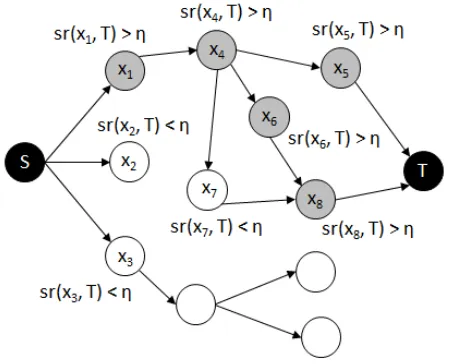
As in (Silva, Freitas, and Handschuh 2018b), we use an external knowledge graph over which we perform a depth first search algorithm, exploring first the paths whose next node to be visited has the highest semantic similarity value wrt the target. Starting from the source node, the algo-rithm retrieves all its neighbors {x1, x2, ..., xn} and
com-putes the similarity relatednesssr(xi, target). All the nodes
distributional graph navigation algorithm is schematized in Figure 3.
Figure 3: The distributional navigation algorithm. Gray nodes, for whichsr(xi, T) > η, make up valid paths
be-tween the source node S and the target node T. The path
{S, x1, x4, x5, T}is the shortest one
Differently from Silva et al. (2018b), who uses syntactic rules to identify source-target pairs and nodes’ head words, we select all the inputs for the graph navigation algorithm se-mantically, also using DSMs. The source-target pairs are the pairs of terms formed by the aforementioned entitiesei∈T0
andej ∈ H0, and the head words are the main words in a
node of the knowledge graph that contains a multi-word ex-pression (see next Section), and which will define the next nodes to be visited. For defining the source-target pairs, we compute the semantic similarity measures betweenT00and
H00, whereT00=T0−OandH00=H0−O, as the Cartesian productP =T00×H00. The results are then sorted and the highest scoring pairs - the setP0- are sent as the inputs for the Graph Navigation algorithm. It is done similarly for the head words, but is this case, the similarity measure is com-puted between each word/phrase that constitutes a node and the target node. In both cases, we remove stop words, and, to get the head words, we also remove words with lowinverse document frequency(IDF), since they are too frequent (for example, verbs such as “get”, “put”, “cause” or “make”) and can be reached from almost any node in the graph, leading to diverting paths. IDF is calculated using as the corpus the same linguistic resource that gave origin to the knowledge graph being explored by the algorithm (see next Section).
Word sense disambiguation comes as a natural conse-quence of the distributional navigation mechanism while choosing the next nodes to be visited in the graph: by look-ing for the word/phrases that are more semantically related to the target, the algorithm naturally selects the correct (or at least the closest) word senses, since unrelated word
mean-ings will have lower similarity scores wrt the target, and the paths containing them will be excluded by the algorithm.
The Graph Navigation algorithm finds all paths between
ei andej, for each{ei, ej} ∈ P0. The shortest path is then
chosen as the solution, since it provides the shortest dis-tance between the source and the target, showing that, se-mantically, they are more closely related. The contents of the nodes composing this path are then used to generate the justification that explains the entailment decision. If no path is found at all, the entailment is rejected.
Exploring Lexical Knowledge for Semantic
Interpretability
The ability to explain how decisions are reached is becom-ing a key requirement for AI systems (Gunnbecom-ing 2017). Al-though a model may produce accurate results, if it lacks transparency, not showing clearly how it is using the data, it can become harder for users to trust its predictions.
Generating natural language justifications is an important feature for increasing a system’s interpretability, and the use of external sources of world knowledge can provide a both semantically rich and interpretable resource, which can sup-port the generation of explanations. Dictionary-style defi-nitions are a rich source of such knowledge and, different from formal structured resources like ontologies, they are domain-independent and largely available. Many NLP sys-tems, including text entailment systems (Clark, Fellbaum, and Hobbs 2008; Herrera, Penas, and Verdejo 2006), al-ready explore lexicons, notably WordNet (Fellbaum 1998), but they usually look only at the structured information, that is, links such as synonyms, hypernyms, etc. The natural lan-guage definition is left aside, although it contains the largest amount of relevant information about an entity: its type, es-sential attributes, primary functions, and often many non-essential, but very informative, attributes as well.
We rely on the knowledge provided by lexical dictionary definitions for looking for relationships between the text and the hypothesis whenever the entailment is solved semanti-cally. These relationships not only confirm the entailment but also explain why the entailment is true. To make use of natural language definitions in our approach, we structure them, converting a whole dictionary into a knowledge graph following the methodology proposed by Silva et al. (2018a). In this model, definitions are split into entity-centered se-mantic roles(Silva, Handschuh, and Freitas 2016) and each of these roles become a node in the graph (therole nodes), meaning that each node encloses a self-contained amount of information regarding the entity being defined, which is also a node (theentity nodes). Figure 4 depicts the graph repre-sentation for one of the definitions of the concept “planet” (“any of the nine large celestial bodies in the solar system that revolve around the sun and shine by reflected light”) ac-cording to this model.
Figure 4: The graph representation of a lexical definition. The node labeled “planet” is an entity node (the entity being defined), and all the other ones are role nodes.Supertype, ac-cessory determiner,differentia qualityanddifferentia event
are some of the semantic roles for definitions introduced in (Silva, Handschuh, and Freitas 2016)
linked to them. This path is sent to the interpretability mod-ule, which formats them into a human-readable justification, which shows what the relationship between the source (and therefore, the text T), and the target (the hypothesis H) is, and makes clear what was the reasoning followed by the al-gorithm. As an example, consider the entailment pair 15.6 from the BPI dataset:
15.6 T: Baghdad has seen a spike in violence since the sum-mer.
15.6 H: Baghdad has seen an increase in violence. 15.6 A: YES
Here, the best source-target pair ise1= “spike” ande2=
“in-crease”, while thereferent is “violence”, since bothe1 and
e2refer to this concept. A possible path between the source
and the target in a DKG is shown in Figure 5.
Figure 5: A path, indicated by the gray nodes, between source node “spike” and target node “increase” in a DKG
In this path, nodes are linked by the “has supertype” property, which defines thekindof an entity, so the justifi-cation derived from this sequence of nodes is:
Aspikeis a kind of rise A rise is a kind ofincrease
In order to evaluate how different resources influence the entailment results, including the justifications generated, we built three DKGs, using the definitions from WordNet, Wiki-tionary, and the set of definitions extracted from Wikipedia pages provided by Faralli and Navigli (2013). All defini-tions were filtered so potential invalid definidefini-tions could be removed (for example, verb definitions not beginning with a verb or an adverbial phrase followed by a verb, noun definitions beginning with verbs or prepositions, etc.), and, for Wikipedia, definitions for named entities were also ex-cluded with the aid of the Stanford Named Entity Recog-nizer (NER), so the final content could be closer to a regular dictionary. Due to the natural limitations of the NER, many named entity definitions remained in the final set, but even so, this filter helped in setting a manageable size for the final graph, without leaving out potentially relevant information. Each set of definitions was then labeled and finally converted to an RDF graph. Table 1 shows the dimensions of the result-ing graphs.
Table 1: Final dimensions of the definition knowledge graphs used in the composite text entailment approach
Resource Noun Defs Verb Defs Total WordNet 79,939 13,760 93,699 Wikitionary 390,417 73,826 464,243 Wikipedia 859,087 - 859,087
Evaluation
We evaluated our approach on two datasets: the Princeton-Boeing-ISI (BPI) and the Guardian Headlines Sample2 (GHS). BPI has a good mix of syntactic and semantic exam-ples, and GHS is fully composed of real-world data (head-lines and sentences from The Guardian newspaper stories), without artificially assembled hypotheses. Both datasets are balanced, with half positive and half negative examples, and have 250 and 800 entailment pairs, respectively.
We compare our results with a purely syntactic entail-ment algorithm, theEdit Distance(Kouylekov and Magnini 2005) implementation provided by EOP (Magnini et al. 2014), a state-of-the-art text entailment framework; a syn-tactic approach that employs linguistic resources from where shallow semantic information is extracted, the Maximum Entropy Classifier (Base+WN+TP+TPPos+TS EN) (Wang and Neumann 2008) using WordNet and VerbOcean, also made available by EOP; and a purely semantic approach, the Graph Navigation algorithm using WordNet definition graph, as reported by Silva et al. (2018b).
All similarity measures were computed through the In-dra (Sales et al. 2018) service, using word2vector as the DSM. Table 2 shows the precision, recall and F-measure ob-tained by each of the Composite Entailment approach con-figurations, which are given by the definition graph used by the Graph Navigation component, that is, the knowledge
2
Table 2: Evaluation results. The upper part shows the baselines, and at the bottom are the proposed composite entailment approach’s results.
BPI GHS
Precision Recall F-measure Precision Recall F-measure
EditDistance 0.44 0.65 0.53 0.96 0.30 0.45
MaxEntClassifier 0.46 0.57 0.51 0.50 1.00 0.66
GraphNavigation 0.65 0.54 0.59 0.56 0.50 0.53
CompositeEntailment (WN) 0.57 0.79 0.66 0.52 0.70 0.60 CompositeEntailment (WKT) 0.53 0.70 0.60 0.50 0.70 0.58 CompositeEntailment (WKP) 0.41 0.26 0.32 0.42 0.11 0.17
bases derived from WordNet (WN), Wikitionary (WKT), and Wikipedia (WKP), as well as the baselines results.
Among the three Composite Entailment configurations, the one that employs WordNet as the knowledge base per-forms better than the other ones. For the BPI dataset, the Composite Entailment present much better results than both syntactic approaches (EditDistance and MaxEntClassifier). The semantic-only GraphNavigation approach still presents better precision, but, due to the better handling of syntac-tic pairs and also the improved, semansyntac-tic-based selection of source-target pairs and head words for multi-word ex-pression nodes, the Composite Entailment delivers a much higher recall, leading to an overall higher F-measure.
For the GHS dataset, the EditDistance algorithm shows the highest precision but very low recall. Here again the Composite Entailment presents much higher recall and, con-sequently, better F-measure than both syntactic-only Edit-Distance and semantic-only GraphNavigation. The MaxEnt-Classifier shows higher F-measure, but it classifies all but two of the 800 pairs as entailment, hence the 100% recall and 50% precision, since the dataset is balanced. Given that positive pairs are structurally very different from negative ones in this dataset (in positive pairs, H is a news story short headline and T is the first, usually long, story’s sentence, and in negative pairs both T and H are random, often long sen-tences from the same story) it is somewhat hard to grasp the MaxEntClassifier’s rationale behind those decisions.
Comparing Lexical Knowledge Bases
More important than the quantitative improvements, the in-terpretable characteristic of the Composite Entailment ap-proach represents a concrete gain for the final user, provid-ing them with human-like explanations for the entailment decisions whenever a more complex semantic relationship is involved. The justifications, though, depends heavily on the knowledge base (KB) employed in the entailment recog-nition. To evaluate the impact of the type and quality of the KB contents in our approach, we chose three resources with different characteristics: WordNet is a lexicon built by lexi-cographers under a relatively controlled environment, Wiki-tionary is a dicWiki-tionary built collaboratively by lay users, and Wikipedia is also built collaboratively but more focused on encyclopedic than lexical knowledge.
The best measure for comparing the performance of the KBs is the recall: the more useful information the graph contains, the more paths (meaning semantic relationships
between source and target words) can be found and, conse-quently, more entailments can be recognized. As can be seen in Table 2, WordNet graph offers the best quantitative re-sults, while Wikipedia shows notably bad outcomes. Despite the negligible results, it is worth listing Wikipedia numbers to highlight that, for the entailment task, the content type is more relevant than the amount of information in the graph. WordNet graph is roughly only 10% of the Wikipedia graph, but the first contains far more common nouns denoting ba-sic language concepts, while the second, besides not defin-ing verbs, privileges the definitions of people, places, arts and entertainment artifacts (films, books, songs, etc.) and other entities expressed by proper nouns. In fact, Wikipedia lacks definitions for many concepts present in the datasets for which relationships are sought: “violence” and “dam-age”, “signatory” and “agreement”, “decontamination” and “contaminants”, or “bet” and “gamble”, to name a few.
As for the Wikitionary graph, different from the Wikipedia one, which fails to provide the information to start most of the paths, most of the relevant concepts are there as much as for the WordNet graph, but the issue here refers more to the definition’s completeness: if not enough information is contained in the definition, that is, the defi-nition of an entity does not mention other entities it is es-sentially related to, paths will start but won’t reach the tar-get. Being built by experts, WordNet definitions tend to fol-low some patterns and are more prone to cover essential at-tributes. On the other hand, in a collaborative environment, despite the larger volume of information that can be gener-ated, high-quality standards can’t always be ensured. This is the reason why, in spite of its much larger dimensions, Wiki-tionary graph yields lower recall for the BPI dataset than the WordNet one. Again, the coverage and regularity of the KB contents prove to be more important than its size. An ex-ample from the BPI dataset that can be solved and justified through the WordNet graph, but not when Wikitionary or Wikipedia ones are used:
11.2 T: The UN Security Council demands that North Korea stop making nuclear weapons.
11.2 H: The Security Council wants North Korea to stop making nuclear weapons.
11.2 A: YES Justification:
From the GHS dataset:
16089 T: Frank Quattrone, a star investment banker of the dotcom era, was sentenced yesterday to 18 months in prison for obstruction of justice.
16089 H: Quattrone jailed for obstruction 16089 A: YES
Justification:
Tosentenceis to pronounce a sentence on in a court of law A sentence is a period a prisoner is imprisoned
To imprison is synonym of tojail
As mentioned before, Wikipedia does not include defini-tions for verbs, so “to demand” and “to sentence” (the source nodes in both examples) can’t be found as nodes in its graph. Wikitionary does have definitions for both “to demand” and “to sentence”, but they fail to establish a (direct or indirect) link with “to want” in the first case and with “to jail” in the second example, so, while traversing its graph, no paths starting at those nodes will reach the target.
Regarding the quality of the justifications generated by each graph, we observe that WordNet and Wikipedia expla-nations are usually more informative than Wikitionary ones. To illustrate this pattern, consider the entailment pair 57.1 from the BPI dataset:
57.1 T: Many soldiers were killed in the ambush. 57.1 H: The soldiers were attacked by surprise. 57.1 A: YES
The justifications given by each of the graphs are as follows:
By WordNet graph: “An ambush is an act of concealing yourself and lying in wait toattackby surprise”.
By Wikitionary graph: “Anambushis a kind ofattack”. By Wikipedia graph: “Anambushis a military tactic to at-tackan unsuspecting enemy from concealed positions such as among dense underbrush or behind hilltops”.
Considering the goal of finding the relation between “am-bush” and “attack”, all the graphs succeed, but WordNet seems to find the best balance between being not too short nor overly detailed.
In summary, Wikipedia graph provides good quality jus-tifications, if too detailed (which is understandable given its encyclopedic nature) but yields very low recall for lacking many basic concepts. Wikitionary graph has a good cover-age of relevant concepts, but recall and justification qual-ity may be impaired by incompleteness resulting from the amateur nature of the definitions creation process. WordNet graph, despite being the smallest KB, provides the highest recall and often the most concise justifications, thanks to the focus on the description of basic language concepts and a more professional creation process which leads to better quality definitions.
Conclusion
We presented an interpretable composite approach for rec-ognizing textual entailments that employs a routing mecha-nism to decide whether entailment pairs should be dealt with syntactically or semantically. For pairs predominantly show-ing structural differences, we use a Relative Tree Edit
Dis-tance model over dependency parse trees, and for pairs con-taining semantic relationships we employ a Distributional Graph Navigation model over knowledge bases composed of structured dictionary definitions. The paths found in those graph KBs are used to render the entailment interpretable, providing natural language, human-like justifications for the entailment decision.
We generated knowledge graphs from WordNet, Wiki-tionary and Wikipedia definition sets to assess how each of them could leverage our approach’s interpretability. Given that text entailment deals with language variability, we con-cluded that knowledge graphs covering the most basic, ev-eryday language concepts yield the best results, so regular dictionaries are more useful than encyclopedic KBs for this task. We also found that definitions created by lexicogra-phers under a controlled environment tend to be more com-plete and, consequently, generate higher quality justifica-tions than those created in collaborative environments by lay users. All in all, our analysis shows that the use of exter-nal world knowledge bases is a valuable feature for increas-ing intelligent systems’ interpretability, and recent accuracy-driven advancements, such as new NLI techniques, could benefit from these resources to also stay in line with Ex-plainable AI requirements.
Acknowledgments
This work was supported in part by a grant from the Eu-ropean Union Horizons 2020 – the Framework Programme for Research and Innovation (2014–2020) under grant agree-ment 740723 Project CSAWARE, and by the Chair of Data Science, University of St. Gallen. Vivian S. Silva is a CNPq Fellow – Brazil.
References
Aggarwal, C. C., and Wang, H. 2011. Text mining in social networks. InSocial network data analytics. Springer. 353– 378.
Bowman, S. R.; Angeli, G.; Potts, C.; and Manning, C. D. 2015. A large annotated corpus for learning natural language inference. InConference on Empirical Methods in Natural Language Processing (EMNLP). Association for Computa-tional Linguistics (ACL).
Chen, D., and Manning, C. 2014. A fast and accurate depen-dency parser using neural networks. InProceedings of the 2014 conference on empirical methods in natural language processing (EMNLP), 740–750.
Chen, Q.; Zhu, X.; Ling, Z.-H.; Wei, S.; Jiang, H.; and Inkpen, D. 2017. Enhanced LSTM for natural language inference. InProceedings of the 55th Annual Meeting of the Association for Computational Linguistics (Volume 1: Long Papers), volume 1, 1657–1668.
learning challenges: evaluating predictive uncertainty, vi-sual object classification, and recognising textual entail-ment. Springer. 177–190.
Faralli, S., and Navigli, R. 2013. A java framework for mul-tilingual definition and hypernym extraction. InProceedings of the 51st Annual Meeting of the Association for Computa-tional Linguistics: System Demonstrations, 103–108. Fellbaum, C. 1998.WordNet. Wiley Online Library. Freitas, A.; da Silva, J. C. P.; Curry, E.; and Buitelaar, P. 2014. A distributional semantics approach for selective rea-soning on commonsense graph knowledge bases. In Inter-national Conference on Applications of Natural Language to Data Bases/Information Systems, 21–32. Springer. Frisse, M., et al. 1988. Searching for information in a hy-pertext medical handbook. Communications of the ACM
31(7):880–886.
Ganesan, K.; Zhai, C.; and Han, J. 2010. Opinosis: a graph-based approach to abstractive summarization of highly re-dundant opinions. InProceedings of the 23rd international conference on computational linguistics, 340–348. Associ-ation for ComputAssoci-ational Linguistics.
Glickman, O., and Dagan, I. 2005. A probabilistic setting and lexical cooccurrence model for textual entailment. In
Proceedings of the ACL Workshop on Empirical Modeling of Semantic Equivalence and Entailment, 43–48. Association for Computational Linguistics.
Gong, Y.; Luo, H.; and Zhang, J. 2018. Natural language inference over interaction space. InProceedings of the Sixth International Conference on Learning Representations. Gudivada, V. N.; Raghavan, V. V.; Grosky, W. I.; and Kasanagottu, R. 1997. Information retrieval on the world wide web.IEEE Internet Computing1(5):58–68.
Gunning, D. 2017. Explainable artificial intelligence (XAI).
Defense Advanced Research Projects Agency (DARPA). Herrera, J.; Penas, A.; and Verdejo, F. 2006. Textual entail-ment recognition based on dependency analysis and Word-Net. InMachine Learning Challenges. Evaluating Predic-tive Uncertainty, Visual Object Classification, and Recog-nising Textual Entailment. Springer. 231–239.
Im, J., and Cho, S. 2017. Distance-based self-attention network for natural language inference. arXiv preprint arXiv:1712.02047.
Kotlerman, L.; Dagan, I.; Magnini, B.; and Bentivogli, L. 2015. Textual entailment graphs. Natural Language Engi-neering21(5):699–724.
Kouylekov, M., and Magnini, B. 2005. Recognizing textual entailment with tree edit distance algorithms. In Proceed-ings of the First Challenge Workshop Recognising Textual Entailment, 17–20.
Magnini, B.; Zanoli, R.; Dagan, I.; Eichler, K.; Neumann, G.; Noh, T.-G.; Pado, S.; Stern, A.; and Levy, O. 2014. The Excitement Open Platform for textual inferences. In ACL (System Demonstrations), 43–48.
Newman, E.; Stokes, N.; Dunnion, J.; and Carthy, J. 2005. UCD IIRG approach to the textual entailment challenge.
In Proceedings of the PASCAL Challenges Workshop on Recognising Textual Entailment, 53–56.
Parikh, A.; T¨ackstr¨om, O.; Das, D.; and Uszkoreit, J. 2016. A decomposable attention model for natural language infer-ence. InProceedings of the 2016 Conference on Empirical Methods in Natural Language Processing, 2249–2255. Paul, C.; Rettinger, A.; Mogadala, A.; Knoblock, C. A.; and Szekely, P. 2016. Efficient graph-based document similar-ity. InInternational Semantic Web Conference, 334–349. Springer.
Pawlik, M., and Augsten, N. 2016. Tree edit distance: Ro-bust and memory-efficient. Information Systems 56:157– 173.
P´erez, D., and Alfonseca, E. 2005. Application of the Bleu algorithm for recognising textual entailments. In Proceed-ings of the First Challenge Workshop Recognising Textual Entailment, 9–12.
Sales, J. E.; Souza, L.; Barzegar, S.; Davis, B.; Freitas, A.; and Handschuh, S. 2018. Indra: A word embedding and semantic relatedness server. InProceedings of the Eleventh International Conference on Language Resources and Eval-uation (LREC 2018).
Silva, V. S.; Freitas, A.; and Handschuh, S. 2018a. Build-ing a knowledge graph from natural language definitions for interpretable text entailment recognition. In Proceedings of the Eleventh International Conference on Language Re-sources and Evaluation (LREC 2018).
Silva, V. S.; Freitas, A.; and Handschuh, S. 2018b. Recog-nizing and justifying text entailment through distributional navigation on definition graphs. InAAAI.
Silva, V. S.; Handschuh, S.; and Freitas, A. 2016. Cate-gorization of semantic roles for dictionary definitions. In
Cognitive Aspects of the Lexicon (CogALex-V), Workshop at COLING 2016, 176–184.
Wang, R., and Neumann, G. 2008. An divide-and-conquer strategy for recognizing textual entailment. InProceedings of the Text Analysis Conference, Gaithersburg, MD. Williams, A.; Nangia, N.; and Bowman, S. 2018. A broad-coverage challenge corpus for sentence understand-ing through inference. InProceedings of the 2018 Confer-ence of the North American Chapter of the Association for Computational Linguistics: Human Language Technologies, Volume 1 (Long Papers), volume 1, 1112–1122.
Zanoli, R., and Colombo, S. 2016. A transformation-driven approach for recognizing textual entailment. Natural Lan-guage Engineering1–28.
Zhang, K., and Shasha, D. 1989. Simple fast algorithms for the editing distance between trees and related problems.
SIAM journal on computing18(6):1245–1262.