* Corresponding author.
E-mail addresses: [email protected] (Arazi Idrus), [email protected] (Moamin A. Mahmoud), sharif@uniten. edu.my (Mohd Sharifuddin Ahmad), [email protected] (Azani Yahya), [email protected] (Hapsa Husen).
DOI: 10.9781/ijimai.2017.03.010
I. Introduction
L
In build engineering and construction domains, deciding on a new project depends upon a company’s strategy. If the strategy is based on a decision by a stakeholder, then it takes a shorter time to decide. However, such decision has no significance in terms of value management, because the decision-making process does not include other experienced stakeholders that have different backgrounds.A project manager usually cares more about the cost and schedule of a project than the function while a design manager is more concerned about the function than the cost. Thus, for any decision to be made regarding a new project, stakeholders must propose an optimal solution. However, a problem may arise when stakeholders propose many solutions. In such a situation, stakeholders need to negotiate on the proposed solutions and agree on an optimal solution. But the negotiation may not be easy and smooth because when stakeholders possess different backgrounds, often their views about an optimal solution for a particular project are different. Such differences cause conflicts in arriving at a decision. In addition, stakeholders may work at different branches throughout the country or other parts of the world which make a meeting for decision more difficult and costly. While applying Value Management on decision making in the construction domain is useful, it faces communication difficulties between stockholders and conflicting issues that require negotiation.
We attempt to overcome these difficulties by developing a framework for automated multi-agent negotiation for decision making based on value management in the construction domain. This paper is an extension to our work in the concepts of automated multi-agent negotiation [1, 2, 29].
The framework in [1, 2, 29] enables software agents to conduct negotiations and autonomously make value-based decisions. The framework consists of three main components which are, solution generator algorithm, negotiation algorithm, and finally conflict resolution algorithm. This paper focuses and extends the discussion on the solution generator algorithm that enables software agents to generate solutions and rank them from 1st to nth solution for the next
stage of the negotiation operation. The solution generator algorithm consists of three steps which are, review solutions, rank solutions, and form ranked solutions. For validation purpose, we present a scenario that utilizes the proposed algorithm to rank solutions. The validation shows that the algorithm is promising, however, it also highlights the conflict between different parties that needs further negotiation action. While this work is inspired by the work of Utomo [3], his study is only in conceptual level and lacks a complete negotiation process that aids an agent to interact and negotiate with other agents and respond to its environment and eventually influences its autonomy level in decision making.
II. Related Work
In this section, we discuss two prominent topics of this research which are value management and application of negotiation in multi-agent systems.
Keywords
Intelligent Software Agent, Multi-agent Systems, Agent and Negotiation, Automated Negotiation, Value Management.Abstract
In this paper, we present our work-in-progress of a proposed framework for automated negotiation in the construction domain. The proposed framework enables software agents to conduct negotiations and autonomously make value-based decisions. The framework consists of three main components which are, solution generator algorithm, negotiation algorithm, and conflict resolution algorithm. This paper extends the discussion on the solution generator algorithm that enables software agents to generate solutions and rank them from 1st to nth solution for the negotiation stage of the operation. The solution generator algorithm consists of three steps which are, review solutions, rank solutions, and form ranked solutions. For validation purpose, we present a scenario that utilizes the proposed algorithm to rank solutions. The validation shows that the algorithm is promising, however, it also highlights the conflict between different parties that needs further negotiation action.
A Solution Generator Algorithm for Decision Making
based Automated Negotiation in the Construction
Domain
Arazi Idrus
1, Moamin A. Mahmoud
2, Mohd Sharifuddin Ahmad
2, Azani Yahya
1, Hapsa Husen
1*
1
National Defence University of Malaysia, Kuala Lumpur (Malaysia)
2Universiti Tenaga Nasional, Selangor (Malaysia)
Value Management (VM) is defined as “a structured, organized team approach to identify the functions of a project, product, or service that will recognize techniques and provide the necessary functions to meet the required performance at the lowest overall cost” [4]. Utomo et al. [3] defined VM as one of the decision methodologies that include a multi-disciplinary, team-oriented approach to problem solving [5]. Therefore, negotiation plays an important role on VM using a value-based group decision [3]. VM is based on a data collection method from reliable resources and functional requirements to fulfill the needs, wants and desires of customers [3].
The application of VM in decision making has been reported by many researchers [3, 6, 7]. One of the techniques that is relevant to VM is weighting and scoring in which a decision needs to be made in selecting an option from a number of competing options, and the best option is not immediately identifiable [3, 8, 9].
Intelligent software agents have been widely used in distributed artificial intelligence and due to their autonomous, self-interested, rational abilities [11, 12, 13, 14, 15, 16], and social abilities [17, 18, 19, 20], agents are well-suited for automated negotiation on behalf of humans [10]. According to Kexing [10], automated negotiation is a system that applies artificial intelligence and information and communication technology to negotiation strategies, utilizing agents and decision theories.
Numerous research have discussed negotiation on multi-agent systems in various domains [21, 22, 23, 24, 25]. Coutinho et al. [26]
proposed a negotiation framework to serve collaboration in enterprise networks to improve the sustainability of interoperability within enterprise information systems. Utomo [3] presented a conceptual model of automated negotiation that consists of a negotiation methodology and an agent-based negotiation. Dzeng and Lin [27] presented an agent-based system to support a negotiation between constructors and suppliers via the Internet. Anumba et al. [28] proposed a collaborative design of light industrial buildings based on multi-agent systems to automate the interaction and negotiation between the design members. Ren et al. [22]
developed a multi-agent system representing participants, who negotiate with each other to resolve construction claims.
III. A Conceptual Framework for Value Decision Making
based Automated Negotiation
A decision made by an agent goes through several processes. These processes work by gradually reducing candidate solutions of a project until a single solution is reached. Consequently, in this work, the process of nominating a single solution from a set of solutions is called decision-making.
There are three main processes in decision-making for a specific project, which are propose solutions, negotiate solutions and handling conflicting outcomes (conflict resolution).
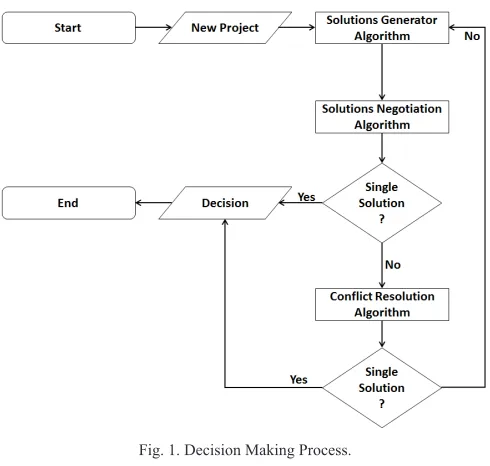
Figure 1 shows the flowchart of the decision-making process as described above. The process starts when agents receive a new project. The agents first propose solutions in ranked order. They then negotiate these solutions. If they agree upon a single solution, then the decision is made, otherwise, the conflict resolution process takes over to drop the weak and risky solutions. If the outcome of the conflict resolution process is a single solution then the decision is made. Otherwise, the agents negotiate the outcome of the conflict resolution process. Ultimately, one coalition’s solution is accepted.
Fig. 1. Decision Making Process.
IV. Solutions Generator
A. Overview and Definitions
In this section, we discuss the preliminary issues in proposing an algorithm for software agents to generate solutions and rank them from 1st to nth solution for the negotiation stage of the operation.
The proposed solution generator algorithm (ASG) is based on two parameters, which are Cost and Function. In real situations, various stakeholders have different level of interest about the cost and function parameters based on their positions and values they uphold. Thus, those stakeholders appraise their solutions based on their interest level on these parameters. For example, in the construction domain, a Design Manager cares more about the function in contrast with a Project Manager who cares more about the cost, while a Facility Manager’s interest is in between the Design and Project Managers’ interests. Therefore, the Design Manager normally attempts to find a solution that provides high function, whereas the Project Manager normally attempts to find a solution that provides low cost. The Facility Manager attempts to find a moderate solution that provides acceptable cost and function.
Definition 1: A Stakeholder, S, is a person that has an ability and authority to propose solutions for a particular issue and contribute in the decision for that issue’s solution. In this work, a software agent represents a stakeholder. If aS is a stakeholder agent, D is a decision, L is a solution, then,
which means that for all stakeholder agents and for all decisions, there exist solutions, which stakeholder agents generate and contribute in the decision.
Definition 2: A Single Solution, LS, is a result of agents’ negotiation to solve a particular problem. Initially, each agent ranks the proposed solutions from 1st to nth solution, where n is any natural number. After
negotiation, the agents produce a single solution. The agents rank the solutions based on the parameters of cost and function.
(highest) cost, CMIN is the minimum (lowest) cost, n is any natural number, then,
C
MINMAX=
C
MIN MIN n+ MIN+2n,
...,
MAX(1)
Definition 4: A Function, F, is the measure of usefulness of an entity in fulfilling its purpose. It is a solution’s quality measurement for a specific project. A Function is ranked from high to low based on its useful effect on a solution. The maximum function contributes highly to the solution rank and vice versa. If FMAX is the maximum function, FMIN is the minimum function, then,
F
MAXMIN=
F
MAX,
MAX n−,
MAX−2n,
...,
MIN(2)
B. Solution Routes Method (SRM)
We identify three routes to generate ranked solutions, as follows:
• Cost Route (RC): This route is preferred by agents (stakeholders) who
care more about the cost, e.g. Project Manager. From Eq. 1 and 2 since this route emphasizes more on the cost, then the first rank solution starts with the minimum cost, CMIN, and maximum function, FMAX, as an optimal solution. However, the optimal solution (CMIN, FMAX) is the same for all agents’ types e.g. Design Manager, Project Manager and so on, but it depends if such solution exists. If this solution does not exists, then the next optimal solution attempts to keep the cost low with reduced function (CMIN, FMAX-n). This route progresses with decreasing function until the minimum acceptable function is found (CMIN, FMIN). An alternative cost route increases cost to CMIN+N while maintaining the maximum function FMAX, (CMIN+N, FMAX). If no optimal solution is found, the cost cycle is repeated with reduced function. The completed track of cost route is as shown in Figure 2.
• Function Route (RF): This route is preferred by agents that care more about the function, e.g. Design Manager. Since this route emphasizes more on the function, then the first rank solution starts with the maximum function, FMAX, and minimum cost, CMIN as an optimal solution. If the optimal solution is not found, the next optimal solution attempts to maintain the maximum function with increased cost (FMAX, CMIN+n). This route progressively increases the cost until an optimal solution is found or the maximum acceptable cost (FMAX, CMAX) is reached. An alternative function route progressively decreases function to FMAX-n while maintaining the minimum cost CMIN, (CMIN+n , FMAX). If no solution is found, the function cycle is repeated with reduced cost. The complete track of the function route is as shown in Figure 3.
• Mixed Route (RM): This route is preferred by agents that moderately care about both the cost and function, e.g. Facility Manager. This route accepts both earlier mentioned routes’ solutions. For example, the two solutions (CMIN, FMAX-N; FMAX, CMIN+N) are acceptable, an agent from this type selects the highest weightage solution (see (3)), which we shall discuss in the next section.
R
M=
(
R
C∨
�
R
F)
(3)
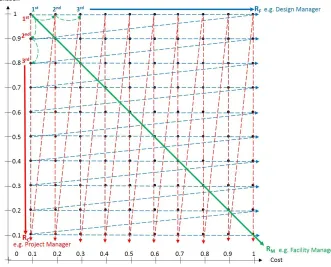
Figure 5 shows the solution routes where the blue line represents the function route, red line represents the cost route, and green line represents the mixed route. The function route takes the horizontal direction, the solutions’ rank of which is represented by 1st, 2nd, 3rd in
blue color. The cost route takes the vertical direction, the solutions’ rank of which is represented by 1st, 2nd, 3rd in red color. The mixed route
takes the oblique direction, the solutions’ rank of which is represented by 1st, 2nd, 3rd in red and blue colors.
1
st(Optimal)
2
nd3
rd4
thC
���
, F
���
C
���
, F
���
-nC
���
, F
���
-2n...
C
���
, F
���
5
th6
th7
th8
thC
���
+n, F
���
C
���
+n, F
���
-nC
���
+n, F
���
-2n...
C
���
+n, F
���
9
th10
th11
thn
thC
���
, F
���
C
���
, F
���
-nC
���
, F
���
-2n...
C
���
, F
���
. . .
Fig 2. Complete track of cost route.
1
st(Optimal)
2
nd3
rd4
thF
���
, C
���
F
���
, C
���
+nF
���
, C
���
+2n...
F
���
, C
���
5
th6
th7
th8
thF
���
-n, C
���
F
���
-n, C
���
+nF
���
-n, C
���
+2n...
F
���
-n, C
���
9
th10
th11
thn
thF
���
, C
���
F
���
, C
���
+nF
���
, C
���
+2n...
F
���
, C
���
. . .
C. The Solutions Generator Algorithm (A
SG)
The ASG algorithm consists of three steps as shown in Figure 4. We present these steps as follows:
Fig. 4. The Solutions Generator Algorithm (ASG) Process.
Step1: Review Solutions, agents first review solutions.
Step 2: Rank Solutions, each agent selects a suitable route by using the Solution Route Method (SRM) to rank solutions from 1st to nth.
Step 3: Form Ranked Solutions, after each agent has selected the suitable route according to its type and has ranked them, it forms the outcome as follows:
agentName (solutionNumber, solutionRank) Algorithm 1 shows the process of Solution Generator Algorithm.
V. Scenario Validation
In this section, we present a scenario to clarify and validate the proposed Solution Generator algorithm. As the proposed algorithm is for the construction domain, we assume the task is building the Roof System. From the literature [3, 4], there are five possible solutions
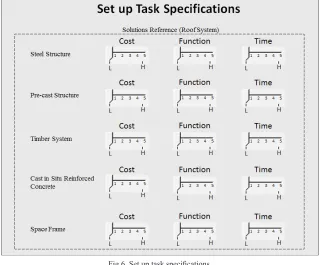
which are, Steel Structure, Pre-cast Structure, Timber System, Cast in Situ Reinforced Concrete, and Space Frame. In addition, the three characteristics, as defined in this paper, are Cost, Function, and Time and each characteristic has a value from low to high, 1 to 5. Three types of agents are simulated in this scenario, which are Design Manager, Facility Manager, and Project Manager. Figure 6 shows the set up specifications of the scenario.
Table 1 shows the assumed values of cost, function, and time for each solution,
Fig. 5. Grid for Solution Algorithm. 1. Begin
2. ∃ a contributes in Decision Do 3. exploit(a,ASG),
4. begin
5. review(a, solutions)
6. returns (∃ Solution, (C, F, T)) 7. rank(a, solutions)
8. if care (a, C) 9. grade (RC ,LN
1),
10. else 11. if care (a, F) 12. grade (RF ,LN
1),
13. else
14. if care (a, (C,F)) 15. grade (RM ,LN
1),
16. end if
17. form(a, ranked solutions)
18. agentName (solutionNumber, solutionRank) 19. end
20. End
TABLE I. The Assumed Values of Cost, Function, and Time for each Solution, the Scale from 1 represents Very Low to scale 5 represents
Very High.
No Solution Cost Function Time
1 Steel Structure 4 5 5
2 Pre-cast Structure 3 2 4
3 Timber System 3 2 3
4 Cast in Situ Reinforced Concrete 5 3 4
5 Space Frame 4 4 3
According to [3, 4], a Project Manager cares more about the cost, and time, then function. While a Design Manager cares more about the Function then the cost and time. Facility manager has no conflict and can adapt with both Project and Design Managers. According to algorithm 1 and assumed values in Table 1, Table 2 shows the solutions ranking of each stockholder (agent).
Table 2 shows that the algorithm is able to rank the solutions according to each stakeholder/agent characteristic/ position. It also highlights a clear conflict between different stakeholders that needs further action.
VI. Conclusion and Future Work
This paper presents a solution generator algorithm to enable software agents to generate solutions and rank them from 1st to nth solution as preparation for the subsequent negotiation process. The developed algorithm consists of three steps which are, review solutions, rank solutions, and form ranked solutions. The algorithm works on ranking through three identified factors which are, the cost, function, and time and a stakeholder characteristic that inspired by the position e.g. Design Manager, Facility Manager, and Project Manager. We also present a validation scenario that deploys the developed algorithm to rank solutions. The validation shows that the algorithm is able to rank solutions according to each stakeholder/agent characteristic/position.
However, the scenario also highlights a clear conflict between different stakeholders/agents. Consequently, in our future work, we
shall develop a negotiation algorithm and conflict resolution algorithm for agents to negotiate solutions and solve the conflict if any.
References
[1] Mahmoud, M. A., Ahmad, M. S., Yuso, M. Z. M., & Idrus, A. (2015). An Automated Negotiation-based Framework via Multi-Agent System for the Construction Domain. International Journal of Artificial Intelligence and Interactive Multimedia, 3(5), 23-27.
[2] Mahmoud, M. A., Ahmad, M. S., Yusoff, M. Z. M., & Idrus, A. (2015). Automated Multi-agent Negotiation Framework for the Construction Domain. In Distributed Computing and Artificial Intelligence, 12th International Conference (pp. 203-210). Springer International Publishing.
[3] Utomo C., Development of a negotiation Support Model for Value Management in Construction, PhD Thesis, University Teknologi PETRONAS, December 2009.
[4] SAVE International, value methodology standards, 2001.
[5] Kelly J. and Male S., Value Management in Decision and Construction, The Economic Management of Projects. Spon Press, London.
[6] Jaapar, A., Endut, I.R., Bari, N.A.A. and Takim, R. The impact of value management implementation in Malaysia. Journal of Sustainable Development 2 (2), 2009.
[7] Shen, Q., Chung, J.K.H., Li, H. and Shen, L.. A Group Support System for improving value management studies in construction. Automation in Construction, 13 (2004): 209–224, 2004.
[8] Cariaga, I, El-Diraby, T and Osman, H., Integrating Value Analysis and Quality Function Deployment for Evaluating Design Alternatives. Construction Engineering and Management, 133(10), 761-770, 2007.
[9] Qing Y. and Wanhua Q., 2007, Value Engineering Analysis and Evaluation. For the Second Beijing Capital Airport. Value World, Spring, SAVE International.
[10] Kexing L.. A survey of agent based automated negotiation. In Network Computing and Information Security (NCIS), 2011 International Conference on, vol. 2, pp. 24–27 (IEEE, 2011).
[11] Ahmed M., Ahmad M S, Yusoff M Z M, Modeling Agent-based Collaborative Process , The 2nd International Conference on Computational Collective Intelligence Technology and Applications (ICCCI 2010), pp. 296-305, ISBN:3-642-16692-X 978-3-642-16692-1, 10-12 November, 2010 Taiwan.
AGENT SYSTEM. Journal of Theoretical and Applied Information Technology, 89(1), 155.
[13] Itaiwi A. K., Ahmad M. S., Hamid N. H. A., Jaafar N. H., Mahmoud M. A., A Framework for Resolving Task Overload Problems Using Intelligent Software Agents, 2011 IEEE International Conference on Control System, Computing and Engineering, ICCSCE11,2011.
[14] Ahmed M., Ahmad M. S., and Yusoff M. Z. M., “A Collaborative Framework for Multiagent Systems.” International Journal of Agent Technologies and Systems (IJATS), 3(4):1-18, 2011.
[15] Ahmed M., Ahmad M. S., and Yusoff M. Z. M., Mitigating Human-Human Collaboration Problems using Software Agents, The 4th International KES Symposium on Agents and Multi-Agent Systems – Technologies and Application (AMSTA 2010), pp. 203-212, ISBN:3-642-13479-3 978-3-642-13479-1, Gdynia, Poland, 23 – 25 June 2010.
[16] Itaiwi, A. M. K., Ahmad, M. S., Hamid, N. H. A., Jaafar, N. H., & Mahmoud, M. A. (2012, June). A multi-agent framework for dynamic task assignment and delegation in task distribution. In Computer & Information Science (ICCIS), 2012 International Conference on (Vol. 1, pp. 318-323). IEEE.
[17] Mahmoud, M. A., Ahmad, M. S., Mohd Yusoff, M. Z., & Mustapha, A. (2014). A Review of Norms and Normative Multiagent Systems. The Scientific World Journal, 2014.
[18] Mahmoud, M. A., Ahmad, M. S., Ahmad, A., Yusoff, M. Z. M., Mustapha, A., & Hamid, N. H. A. (2013, May). Obligation and Prohibition Norms Mining Algorithm for Normative Multi-agent Systems. In KES-AMSTA (pp. 115-124).
[19] Mahmoud, M. A., Ahmad, M. S., Ahmad, A., Yusoff, M. Z. M., & Mustapha, A. (2012). Norms Detection and Assimilation in Multi-agent Systems: A Conceptual Approach. In Knowledge Technology (pp. 226-233). Springer Berlin Heidelberg.
[20] Mahmoud, M. A., Ahmad, M. S., Ahmad, A., Mohd Yusoff, M. Z., & Mustapha, A. (2012, June). A norms mining approach to norms detection in multi-agent systems. In Computer & Information Science (ICCIS), 2012 International Conference on (Vol. 1, pp. 458-463). IEEE.
[21] Beer M., d’Inverno M., Jennings R.N., Luck M., Preist C., Schroeder M., Negotiation in multi-agent systems Knowledge Engineering Review, 14 (3) (1999), pp. 285–289.
[22] Z. Ren, C.J. Anumba, Multi-agent systems in construction—state of the art and prospects, Automation in Construction, 13 (2004), pp. 421–434
[23] M. Wang, H. Wang, D. Vogel, K. Kumar, D.K.W. Chiu Agent-based negotiation and decision making for dynamic supply chain formation Engineering Applications of Artificial Intelligence, 22 (7) (2009), pp. 1046–1055.
[24] Utomo C., Idrus A., A Concept toward Negotiation Support for Value Management on Sustainable Construction, Journal of Sustainable Development Vol 4, No 6 (2011).
[25] Victor Sanchez-Anguix , Vicente Julian , Vicente Botti , Ana García-Fornes, Tasks for agent-based negotiation teams: Analysis, review, and challenges, Engineering Applications of Artificial Intelligence, v.26 n.10, p.2480-2494, November, 2013.
[26] Coutinho, C., Cretant, A., Ferreira da Silva, C., Ghodous, P., & Jardim-Goncalves, R. (2014). Service-based negotiation for advanced collaboration in enterprise networks. Journal of Intelligent Manufacturing. doi:10.1007/s10845-013-0857-4.
[27] Dzeng, R. J., & Lin, Y. C. (2004). Intelligent agents for supporting construction procurement negotiation. Expert Systems with Applications, 27(1), 107-119.
[28] C.J. Anumba, Z. Ren, A. Thorpe, O.O. Ugwu, L. Newnham, Negotiation within a multi-agent system for the collaborative design of light industrial buildings Adv Eng Software, 34 (7) (2003), pp. 389–401.
[29] Mahmoud, M. A., Ahmad, M. S., & Yusoff, M. Z. M. (2016). A Conceptual Automated Negotiation Model for Decision Making in the Construction Domain. In Distributed Computing and Artificial Intelligence, 13th International Conference (pp. 13-21). Springer International Publishing.
Arazi Idrus
B Eng.(Hons) in Civil and Structural Engineering (Sheffield University, UK), M.Sc. (Cranfield University, UK), Ph.D (Imperial College, University of London, UK). Field of Specialization: Project Management, Construction It, Construction Productivity, Value Management; PPP/PFI, IBS Construction, Building Maintenance Management, Risk-Based Assessment, Concrete Repairs,Blast Design, and Load Resistance Factor Design of Offshore Structures.
Mohd Sharifuddin Ahmad
Mohd Sharifuddin Ahmad received his B.Sc. in Electrical and Electronic Engineering from Brighton Polytechnic, UK in 1980. He started his career as a power plant engineer specializing in Process Instrumentation and Control in 1980. After completing his MSc in Artificial Intelligence from Cranfield University, UK in 1995, he joined UNITEN as a Principal Lecturer and Head of Dept. of Computer Science and Information Technology. He obtained his PhD from Imperial College, London, UK in 2005. He has been an associate professor at UNITEN since 2006. His research interests include applying constraints to develop collaborative frameworks in multi-agent systems, collaborative interactions in multi-agent systems and tacit knowledge management using AI techniques.
Moamin A. Mahmoud
Moamin A. Mahmoud obtained his Bachelor in Mathematics from the College of Mathematics and Computer Science, University of Mosul, Iraq in 2007. He obtained his Master of Information Technology at the College of Graduate Studies, Universiti Tenaga Nasional (UNITEN), Malaysia in 2010, and PhD of Information and Communication Technology from Universiti Tenaga Nasional (UNITEN), Malaysia in 2013. His research interests are in the area of software agents, agent behavior in open societies, and social sciences simulation.
Azani Yahya
Field of Specialization Construction and Construction Materials - Construction Technology.
Hapsa Husen