*Corresponding author
Received July 22, 2013
1 Available online at http://scik.org
Mathematical Finance Letters, 2013, 2013:5 ISSN 2051-2929
DRIFT TERM AND VERTEX POINT IN SINGLE FACTOR
INTEREST RATE MODEL
SURESH RAMANATHAN*, KIAN-TENG KWEK
Department of Economics, University of Malaya, Kuala Lumpur, 50910, Malaysia
Abstract: By using a stochastic differential equation in the form of the Ornstein-Uhlenbeck process, the drift term that is obtained plays a crucial role in determining the vertex point of monetary policy. The drift term, essentially is the same in its structural form for both single factor interest rate models of Vasicek and Cox Ingersoll Ross. Both single factor interest rate models are useful when it comes to measuring the vertex point and vertex point gap of monetary policy transmission.
Keywords: Vasicek, Cox Ingersoll Ross Interest Rate Models, Stochastic Differential Equation, Ornstein-Uhlenbeck process, Drift Term, Vertex Point, Vertex Point Gap, Speed of Monetary Policy Transmission.
2000 AMS Subject Classification: 91G30
1. Introduction
interest rate instruments. Shocks in financial markets in the form of sharply reduced interest rates elevate financial market volatility and this in turn widens the dispersion of modelled interest rates from policy interest rates. In enhancing the capability of single factor interest rate models that incorporate the behavioral economics tool, Zoubi (2009) identified the drift function for mean reversion of interest rates as beneficial. The function captures expected instantaneous change in interest rate at time t. The drift function and instantaneous volatility parameters complement each other in designing optimal financial market strategies to hedge against interest rate risk. Findings by Nautz and Scheithauer (2011) indicate when the gap between modelled interest rates and policy interest rates reduce, it is due to appropriate monetary policy communication in a transparent and efficient manner. The reduction in the gap between modelled interest rates and policy interest rates allows equilibrium in money markets to occur in a rapid manner and reduces friction in interest rates markets, therefore increasing the speed of interest rates mean reversion capability.
This research paper uses two single factor interest rate models, the Vasicek and Cox Ingersoll Ross models to capture the vertex point gap of monetary policy. It essentially measures the speed of monetary policy transmission using a stochastic differential differential equation in the framework of Ornstein-Uhlenbeck process to identify the drift term. The objective, to be able to measure the vertex point of monetary policy and to show as the vertex point gap distance increases, the speed of monetary policy transmission slows down while as the vertex point gap distance reduces the speed of monetary policy transmission increases.
2. Preliminaries
The Vasicek model is represented as
drt = α(β−rt)dt+σdwt (1)
and the Cox Ingersoll Ross model is represented as
Where α is speed of mean reversion, β is the long term mean of short term interest rates, σdwt is the instantaneous volatility with a Weiner process, r is the short term
interest rate and α(β - rt)dt is the drift term. The coefficients in the Cox Ingersoll
Ross model are the same as with the Vasicek model with the exception of the instantaneous volatility which is σ√rtdwt .In calibrating the single factor mean
reversion interest rate models for estimation of coefficients, this exercise uses a stochastic differential equation in the framework of Ornstein-Uhlenbeck process. The process involves computing the following equation,
𝑟𝑡+1= 𝑟𝑡𝑒−𝛼𝛼+𝛽�1− 𝑒−𝛼𝛼�+𝜎√1−𝑒 −2𝛼𝛼
2𝛼 (3)
Where in equation (3) it shows that the short term interest rates in the period ahead
𝑟𝑡+1 is determined by actual short term interest rates at period rt with respect to a
mathematical constant of e approximately equal to 2.71828. This is adjusted to the speed of mean reversion parameter and the fixed time step of δ. The fixed time step is measured as a single financial trading day divided by the 252 financial trading days in a year. The long term mean of short term interest rates 𝛽, is adjusted by the difference against the mathematical constant of 2.71828 that is powered to the mean reversion coefficient and the time step. The stochastic differential equation takes into account of instantaneous volatility in the framework of the mathematical constant, the speed of mean reversion and the fixed time step. The relationship between 𝑟𝑡 and 𝑟𝑡+1 is linear with a normal random error of ᶓ with a constant ḃ. The coefficient ά reflects the relationship between current short term interest rates 𝑟𝑡 and short term interest rates at period 𝑟𝑡+1, therefore allowing for the estimation of the following equation
2.1 Calibration Process
The identified coefficients from equation (4) are calibrated into the Ornstein-Uhlenbeck process in the following form,
ά = 𝑒−𝛼𝛼 (5)
ᶓ = 𝜎√1−𝑒2𝛼−2𝛼𝛼 (7)
Rewriting in the form of a quantifiable method to find the values of α, β and σ for both the single factor mean reversion interest rate models of Vasicek and Cox Ingersoll Ross, shows,
α = −𝑙𝑙𝛼ά (8)
β = 1−ḃά (9) and
σ = std.dev (ᶓ) √ −2𝑙𝑙ά
𝛼(1−ά2) (10)
2.2 Drift Term
The framework for Vasicek and Cox Ingersoll Ross single factor mean reversion of short term interest rates indicate the drift term is a function of short term interest rates in the form of
α(β - rt)dt = f (drt) (11)
Equation (11) is integrated into a second order polynomial regression with a quadratic function1, where the coefficient of φ2 is obtained to reflect the inverse or positive
relationship against the drift term, where
α(β - rt)dt =φ0+ φ1drt+ φ2dr2t+ Єt (12)
and setting the intercept φ0 = 0 the equation is transformed to
α(β − rt)dt = φ1drt+ φ2dr2t+ Єt (13)
The drift term captures the behavior of short term interest rates to either move up or down towards equilibrium. A negative coefficient φ2 of the drift term generates the
tendency for short term interest rates to move downwards towards equilibrium while a
positive coefficient φ2 of the drift term generates the tendency for short term interest
rates to move upwards towards equilibrium.
2.3 Speed of Monetary Policy Transmission
The drift coefficient of φ2 < 0 from equation (13) indicates the curve in the
polynomial regression is reflective of a downward parabola while φ2 > 0 indicates the
curve in the polynomial regression is reflective of an upward parabola. The coefficient
φ2 of the drift term α(β − rt)dt controls the speed of decrease or increase in the
polynomial function from the vertex. The larger the negative or positive coefficient φ2,
the function will decrease rapidly. The vertex of the parabola is the turning point of financial market expectations of interest rate behavior. It is the maximum point when coefficient of the drift term is φ2 < 0 and is the minimum point when coefficient of the
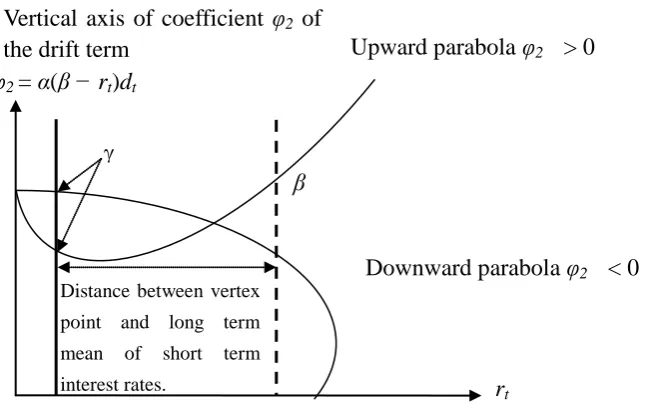
drift term is φ2 > 0. The vertex point is measured as the vertical line that passes
through the vertex point and is computed as
γ = − 𝜑1
2𝜑2 (14)
The horizontal axis of the symmetry of the parabola is identified as γ which is measured based on the coefficient φ1 and φ2 from equation (13) and is substituted into
Figure 1 –Vertex Point Gap – Speed of Monetary Policy Transmission
Source: Authors compilation.
Where γ is the vertex point with, φ2 > 0 as an upward parabola and φ2 < 0 as an
downward parabola. The distance between γ and β , reflects the distance from vertex to long term mean of short term interest rates, also known as the vertex point gap of speed of monetary policy transmission.
3. Main results
Important aspects identified from this exercise, by using a stochastic differential equation in the form of the Ornstein-Uhlenbeck process, the drift term that is obtained plays a crucial role in determining the vertex point of monetary policy. The drift term, essentially is the same in its structural form for both single factor interest rate models of Vasicek and Cox Ingersoll Ross. Both single factor interest rate models are useful when it comes to measuring the vertex point and vertex point gap of monetary policy transmission. This essentially provides central banks and financial regulators an added tool in deliberating short term policy interest rates within the framework of monetary policy.
γ
β
rt
φ2 = α(β − rt)dt
Distance between vertex point and long term mean of short term interest rates.
Horizontal axis of the symmetry of the parabola which is the short term interest rates Vertical axis of coefficient φ2 of
the drift term Upward parabola φ2 > 0
REFERENCES
[1] Al-Zoubi, H.A.,‘Short-term spot rate models with nonparametric deterministic drift’, The Quarterly Review of Economics and Finance, 49, (2009),731-747.
[2] Cox, J.C., Ingersoll, J.E. and Ross, S.,‘A theory of the term structure of interest rates’, Econometrica, (1985), 385-407.
[3] Janczura, Orzeł and Wyłomańska,‘Subordinated α-stable Ornstein–Uhlenbeck process as a tool for financial data description’, Physica A 390,(2011),4379 – 4387.
[4] Nautz, D. and J. Scheithauer.,’Monetary policy implementation and overnight rate persistence’, Journal of International Money and Finance 30,( 011), 375 – 1386.