2014 April, Volume 3 Number 1, 13-42
The reverse DTML-conversion model with its
mathematical formulas
Kumassah, Eliot Kosi
Jasikan College of Education, Ghana ([email protected])
Received: 1 April 2013 Revised: 4 January 2014 Accepted: 14 February 2014 Available Online: 15 March 2014 DOI: 10.5861/ijrsc.2014.419
ISSN: 2243-772X Online ISSN: 2243-7797
OPEN ACCESS
Abstract
Conversion within quantities of same units and between quantities of different units is a
thorny subject to students of Jasikan College of Education (Butterfield, Sutherland, &
Molyneux-Hodgson, 2000) and its treatment by tutors sometimes becomes very difficult such
that most tutors resort to handling the subject theoretically/ abstractly. When this happens
most students seemed not to comprehend the subject. In view of this, the Reverse
DTML-Conversion model (i.e. The Reverse D-Conversion model, The Reverse T-Conversion
model, The Reverse M-Conversion model and The Reverse L-Conversion model) was
designed. The Reverse DTML-Conversion Model is a model that has been designed by the
researcher to make the teaching of conversion in measurement very easy to tutors and
meaningful to students.
Keywords:
The Reverse D-Conversion model; The Reverse T-Conversion model; The Reverse
Kumassah, E. K.
The reverse DTML-conversion model with its mathematical formulas
1. Introduction
The Reverse DTML-Conversion Model is a model that has been designed by the researcher to make the teaching of conversion in measurement very easy to tutors and meaningful to students. This employs the use of a straight line divided into equal sections/parts depending on the physical quantity of concern. The three fundamental/basic physical quantities which are used in this model are distance, time and mass. Conversion within quantities of same units and between quantities of different units is a thorny subject to students (Butterfield, Sutherland & Molyneux-Hodgson, 2000) and its treatment by tutors sometimes becomes very difficult such that tutors resort to handling the subject theoretically/abstractly. When this happens most students seemed not to comprehend the subject.
In view of this, Trimpe studies in 2000 and 2008 and http://www.bayhicoach.com designed a metric mania and metric conversion: stair-step method to enable students understands conversion of distance, litre (volume) and grams (mass). Trimpe metric mania and the stair-step method even though very similar were good; however, it concentrated on only one dimension distance (i.e. considering distance) and just one aspect of the three dimension distance i.e. litre, while the Reverse DTML-Conversion extends from one distance dimension to two distance dimension and three distance dimension (i.e. considering distance) and also each step in the metric mania is in multiples of decimals (i.e. 0.1) when dealing with smaller units of the basic unit and in multiples of ten (i.e. 10) when dealing with higher units also of the basic unit (Appendix A and Appendix B) and also from
http://www.bayhicoach.com that steps in metric system are all in multiples of ten (10) and decimal (0.1). However, with the Reverse DTML-Conversion model, all steps with respect to length (i.e. one dimension distance) , mass and litre S.I units are in multiples of ten (10). All steps with respect to Area (i.e. two dimension distance) are in multiples of hundreds (100), all steps with respect to volume (i.e. three dimension distance) are in multiples of thousands (i.e. 1000), and all steps with respect to time are in multiples of sixty (60). All units on the number line started with zero mark through ten steps, hundred steps, thousand step and sixty steps each, and also in place of the basic unit for both higher units and smaller as in metric mania and the stair-step have been replaced with the smallest unit and the highest unit on a straight line in ten steps, hundred steps, thousand step and sixty steps.
The Reverse DTML-Conversion model was designed by the researcher from the premise that learning to convert between units of measurement is critical to learners development in the realm of science and other courses and that having access to a general method would support students' efficiency in conversion (Butterfield, Sutherland, & Molyneux-Hodgson, 2000). The focus for designing the Reverse DTML-Conversion model was on the role of a general rule for converting and this arose out of a detailed observational study of first year diploma in basic education students of Jasikan College of Education working through their integrated science course on measurement (Institute of Education, 2010).
The reverse DTML-conversion model with its mathematical formulas measurement was part of their Integrated Science Syllabus.
The Reverse DTML-Conversion Model is made up of three most basic fundamental physical quantities i.e. Distance, Time and Mass. This version instead of presenting the research aspect of the reverse DTML-Conversion models rather presents only the conceptual framework and practical aspects of the Reverse DTML-Conversion model.
1.1 Research hypothesis
The following research hypothesis guided the researcher in transforming the DTML-Conversion model (Kumassah, 2012) into the Reverse DTML-Conversion model.
There is no significant statistical deference between the conversion-factor on length (one dimension distance) and the L-Conversion model on length (one dimension distance)
There is no significant statistical deference between the conversion-factor on area (two dimension distance) and the A-Conversion model on area (two dimension distance)
There is no significant statistical deference between the conversion-factor on volume (three dimension distance) and the V-Conversion model on volume (three dimension distance)
There is no significant statistical deference between the conversion-factor on mass and the M-Conversion model on mass
There is no significant statistical deference between the conversion factor on time and the T-Conversion model on time.
There is no significant statistical deference between the conversion factor on litre and the L-Conversion model on litre.
2. Conceptual framework
2.1 The reverse distance-conversion model
The reverse distance-Conversion Model (the reverse D-Conversion Model) has three parts, which are in three distance dimensions (the reverse Length-Conversion Model i.e. D1/L-Conversion model) which is a one dimension distance, two dimension distance (the Area-Conversion Model i.e. D2/A-Conversion model) and three dimension distance (the Volume-Conversion Model i.e. D3/V-Conversion model).
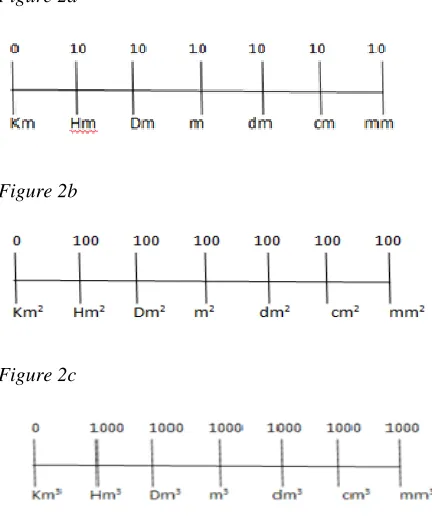
A straight line is divided into six equal parts. The distance between each part is ten (10), hundred (100), and thousand (1000) depending on one’s dimension.
Figure 1. The division of the straight line into equal parts of 10, 100, and 1000
Kumassah, E. K. Figure 1b
Figure 1c
The straight lines are labelled (mm, mm2, mm3), (cm, cm2, cm3), (dm, dm2, dm3), (m, m2, m3), (Dm, Dm2, Dm3), (Hm, Hm2, Hm3), and (Km, Km2, Km3).
mm = millimetre mm2 = square millimetre mm3 = cubic millimetre cm = centimetre cm2 = square centimetre cm3 = cubic centimetre dm = decimetre dm2 = square decimetre dm3 = cubic decimetre m = metre m2 = square metre m = cubic metre Dm = decametre Dm2 = square decametre Dm3 = cubic decametre Hm = hectometre Hm2 = square hectometre Hm3 = cubic hectometre Km = kilometre Km2 = square kilometre Km3 = cubic kilometer
Figure 2. The transformation of figure-1 into complete One, Two and Three dimensions reverse distance-conversion model
Figure 2a
Figure 2b
Figure 2c
The reverse DTML-conversion model with its mathematical formulas Dm, Dm to m, m to dm, dm to cm and cm to mm. from figure 1, the straight line has been divided into 10 equal distances starting from Km to mm. This meant that 1 step of Km will give 10 steps of Hm and it follows through to mm.
NB: when dealing with conversion, then one must be in the realms of multiplication (i.e. movement from the maximum unit to the least unit) and division (i.e. movement from the least unit to the maximum unit). With this straight line on distance, the least unit is the millimetre (mm) and the maximum unit is the kilometre (Km). Figure 2d
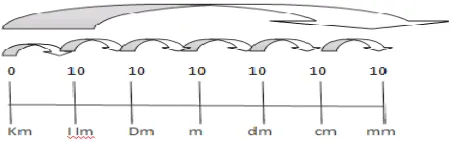
Figure 3: Complete labeled one dimension reverse distance-conversion model
Figure 3a: One Step/ Movement
In figure 3a, one step was made starting from Km to the right i.e. the step from Km to Hm, it then implies that the first movement from Km to Hm is 10 and the second movement from Hm to Dm is also 10, thus 10=101=10 (i.e. 1Km=10Hm)
Step One / Movement One 1Km=10(1×101) Hm 1Hm=10(1×101) Dm 1Dm=10(1×101) m 1m=10(1×101) dm 1dm=10(1×101) cm 1cm=10(1×101) mm
Figure 3b: Two Steps/ Movements
Kumassah, E. K.
Step Two/ Movement Two 1Km= 100(1×10²) Dm 1Hm= 100(1×10²) m 1Dm= 100(1×10²) dm 1m= 100(1×10²) cm 1dm= 100(1×10²) mm
Figure 3c: Three Steps/ Movements
In figure 3c, three steps were made starting from Km to the right i.e. the first step from Km to Hm, Hm to Dm and from Dm to m, it then implies that the first movement from Km to Hm is 10, the second movement from Hm to Dm is 10 and the last step from Dm to m is also 10, thus 10×10×10=103=1000 (i.e. 1Km=1000m). Step Three/ Movement Three
1Km=1000(1×10³) m 1Hm=1000(1×10³) dm 1Dm=1000(1×10³) cm 1m=1000(1×10³) mm
Figure 3d: Four Steps/ Movements
In figure 3d, four steps were made starting from Km to the right i.e. the first step from Km to Hm, Hm to Dm, Dm to m and from m to dm, it then implies that the first movement from Km to Hm is 10, the second movement from Hm to Dm is 10, the third movement from Dm to m is 10 and the last step from m to dm is also 10, thus 10×10×10×10=104=10000 (i.e. 1Km=10000dm).
Step Four/ Movement Four 1Km=10000(1×10⁴) dm 1Hm=10000(1×10⁴) cm 1Dm=10000(1×10⁴) mm
The reverse DTML-conversion model with its mathematical formulas In figure 3e, five steps were made starting from Km to the right i.e. the first step from Km to Hm, Hm to Dm, Dm to m, m to dm and from dm to cm, it then implies that the first movement from Km to Hm is 10, the second movement from Hm to Dm is 10, the third movement from Dm to m is 10, the fourth movement from m to dm is 10 and the last step from dm to cm is also 10, thus 10×10×10×10×10=105=100000 (i.e. 1Km =100000cm).
Step Five/ Movement Five 1Km =100000(1×10⁵) cm 1Hm =100000(1×10⁵) mm
Figure 3f: Six Steps/ Movements
In figure 3f, six steps were made starting from Km right i.e. the first step from Km to Hm, Hm to Dm, Dm to m, m to dm, dm to cm and from cm to mm, it then implies that the first movement from Km to Hm is 10, the second movement from Hm to Dm is 10, the third movement from Dm to m is 10, the fourth movement from m to dm is 10, the fifth movement from dm to cm is 10 and the last step from cm to mm is also 10, thus 10×10×10×10×10×10=106=1000000 (i.e. 1Km =1000000mm).
Step Six/ Movement Six 1Km =1000000(1×10⁶) mm
Table 1
One Dimension reverse Distance Summary
Step 1 Step 2 Step 3 Step 4 Step 5 Step 6
1Km=10(1×101) Hm 1Km= 100(1×10²) Dm
1Km=1000(1×10³) m 1Km=10000(1×10⁴)dm 1Km =100000(1×10⁵) cm
1Km =1000000(1× 10⁶) mm
1Hm=10(1×101) Dm 1Hm= 100(1×10²) m
1Hm=1000(1×10³) dm 1Hm=10000(1×10⁴)cm 1Hm =100000(1×10⁵) mm
1Dm=10(1×101) m 1Dm= 100(1×10²) dm
1Dm=1000(1×10³) cm 1Dm=10000(1×10⁴) mm
1m=10(1×101) dm 1m= 100(1×10²) cm 1m=1000(1×10³) mm
Table 1 continued
Step 1 Step 2 Step 3 Step 4 Step 5 Step 6
1dm=10(1×101) cm 1dm= 100(1×10²) mm
1cm=10(1×101) mm
2.2 The Reverse Two Dimension Distance model (Area (A)-Conversion Model)
Kumassah, E. K.
The number line is labelled Km2, Hm2, Dm2, m2, dm2, cm2 and mm2. Km2 = square kilometre
Hm2 = square hectometre Dm2 = square decametre m2 = square metre dm2 = square decimetre cm2 = square centimetre mm2 = square millimeter
Figure 4.1: the Complete Labelled Two Dimension reverse Distance-Conversion Model (A-Conversion Model)
The two dimension of distance looks at two spaces ( ) with a common meeting point between two objects (Asiedu & Baah-Yeboah, 2004; Brown, 1999; Serway & Jewett, 2004; Awe & Okunola, 1992; http://www.bayhicoach.com) i.e. Km2 to Hm2, Hm2 to Dm2, Dm2 to m2, m2 to dm2, dm2 to cm2 and cm2 to mm2. From figure 13, a straight line has been divided into 100 equal distances starting from Km2 to mm2. This meant that 1 step of Km2 will give 100 steps of Hm2 and it follows through to mm2.
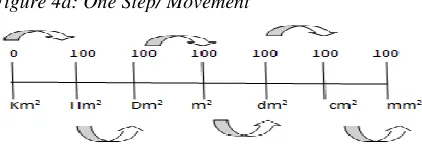
Figure 4a: One Step/ Movement
In figure 4a, one step was made starting from Km2 right i.e. the step from Km2 to Hm2, it then implies that the first movement from Km2 to Hm2 is 100 and the second movement from Hm2 to Dm2 is also 100, thus 100=102=100 (i.e. 1Km2=100Hm2).
The Mathematical proof: Area= length*length=L2 1Km2 = 1Km×1Km But 1Km = 10Hm
1Km2 = 1Km×1Km= 10 Hm ×10 Hm = 10×10(Hm × Hm) = 102 Hm2=100 Hm2
Step One / Movement One
The reverse DTML-conversion model with its mathematical formulas 2.3 1cm2=100(1×10²) mm2
Figure 4b: Two Step/ Movement
In figure 4b, two steps were made starting from Km2 right i.e. the first step from Km2 to Hm2 and from Hm2 to Dm2. It then implies that the first movement from Km2 to Hm2 is 100 and the second movement from Hm2 to Dm2 is also 100, thus 100×100=104=10000 (i.e. 1Km2=10000Dm2).
Step Two/ Movement Two 1Km2=10000(1×10⁴) Dm2 1Hm2=10000(1×10⁴) m2 1Dm2=10000(1×10⁴) dm2 1m2=10000(1×10⁴) cm2 1dm2=10000(1×10⁴) mm2
Figure 4c: Three Steps/ Movements
In figure 4c, three steps were made starting from Km2 to the right i.e. the first step from Km2 to Hm2, Hm2 to Dm2 and from Dm2 to m2, it then implies that the first movement from Km2 to Hm2 is 100, the second movement from Hm2 to Dm2 is 100 and the last step from Dm2 to m2 is also 100, thus 100×100×100=106=1000000 (i.e. 1km2=1000000m2).
Step Three/ Movement Three
1Km2=1000000(1×10⁶) m2 1Hm2=1000000(1×10⁶) dm2 1Dm2=1000000(1×10⁶) cm2 1m2=1000000(1×10⁶) mm2
Kumassah, E. K.
In figure 4d, four steps were made starting from Km2 to the right i.e. the first step from Km2 to Hm2, Hm2 to Dm2, Dm2 to m2 and from m2 to dm2, it then implies that the first movement from Km2 to Hm2 is 100, the second movement from Hm2 to Dm2 is 100, Dm2 to m2 is 100 and the last step from m2 to dm2 is also 100, thus 100×100×100×100=108=100000000 (i.e. 1Km2=100000000dm2)
Step Four/ Movement Four
1Km2=100000000(1×10⁸) dm2 1Hm2=100000000(1×10⁸) cm2 1Dm2=100000000(1×10⁸) mm2
Figure 4e: Five Steps/ Movements
In figure 4e, five steps were made starting from Km2 to the right i.e. the first step from Km2 to Hm2, Hm2 to Dm2, Dm2 to m2, m2 to dm2 and from dm2 to cm2, it then implies that the first movement from Km2 to Hm2 is 100, the second movement from Hm2 to Dm2 is 100, Dm2 to m2 is 100, m2 to dm2 and the last step from dm2 to cm2 is also 100, thus 100×100×100×100×100=1010=10000000000 (i.e. 1Km2=10000000000cm2).
Step Five/ Movement Five
1Km2=10000000000(1×10¹⁰) cm2 1Hm2=10000000000(1×10¹⁰) mm2
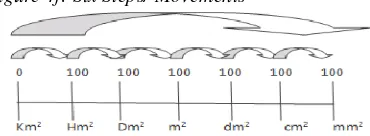
Figure 4f: Six Steps/ Movements
In figure 4f, six steps were made starting from Km2 to the right i.e. the first step from Km2 to Hm2, Hm2 to Dm2, Dm2 to m2, m2 to dm2, dm2 to cm2 and from cm2 to mm2, it then implies that the first movement from Km2 to Hm2 is 100, the second movement from Hm2 to Dm2 is 100, Dm2 to m2 is 100, m2 to dm2, dm2 to cm2 and the last step from cm2 to mm2 is also 100, thus 100×100×100×100×100×100=1012=1000000000000 (i.e. 1Km2=10000000000mm2).
Step Six/ Movement Six
The reverse DTML-conversion model with its mathematical formulas
Table 2
Two Dimension Distance Summary
Step 1 Step 2 Step 3 Step 4 Step 5 Step 6
1Km2=100(1×10²)Hm2 1Km2=10000(1×1 04) Dm2
1Km2=1000000(1×1 06) m2
1Km2=100000000(1×1 08) dm2
1Km2=10000000000 (1×10¹⁰) cm2
1Km2=10000000000 (1×10¹²) mm2 1Hm2=100(1×10²)Dm2 1Hm2=10000(1×1
04) m2
1Hm2=1000000(1×1 06) dm2
1Hm2=100000000(1×1 08) cm2
1Hm2=10000000000 (1×10¹⁰) mm2 1Dm2=100(1×10²)m2 1Dm2=10000(1×1
04) dm2
1Dm2=1000000(1×1 06) cm2
1Dm2=100000000(1×1 08) mm2
1m2=100(1×10²)dm2 1m2=10000(1×10 4) cm2
1m2=1000000(1×10⁶ ) mm2
1dm2=100(1×10²)cm2 1dm2=10000(1×1 04) mm2 1cm2=100(1×10²)mm2
2.4 Reverse Three Dimension Distance (Volume (V)-Conversion Model)
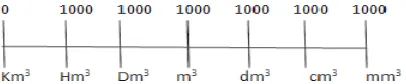
Figure 5: A straight line is divided into seven equal parts. The distance between each part is one thousand (1000)
The number line is labelled Km3, Hm3, Dm3, m3, dm3, cm3 and mm3. Km3 = cubic kilometre
Hm3 = cubic hectometre Dm3 = cubic decametre m3 = cubic metre dm3 = cubic decimetre cm3 = cubic centimetre mm3 = cubic millimeter
Figure 5.1: The Complete Labelled Three Dimension Reverse Distance-Conversion Model (V-Conversion Model)
Kumassah, E. K.
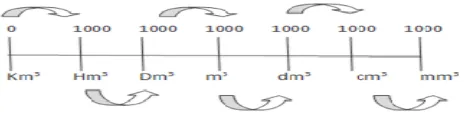
Figure 5a: One Step/ Movement
In figure 5a, one step was made starting from Km3 to the right i.e. the step from Km3 to Hm3 is 1000, and the movement from Hm3 to Dm3 is also 1000, thus 1km3=1000(103) Hm3. The Mathematical proof:
Volume = length × length × Length=L3 1Km3 = 1Km×1Km×1Km
But 1Km = 10Hm
1Km3 = 1Km×1Km×1Km≡ 10Hm ×10Hm ×10Hm = (10)3(Hm)3 = 1000Hm3
Step One/ Movement One 1Km3=1000(103) Hm3 1Hm3=1000(103) Dm3 1Dm3=1000(103) m3 1m3=1000(103) dm3 1dm3=1000(103) cm3 1cm3=1000(103) mm3
Figure 5b: Two Step/ Movement
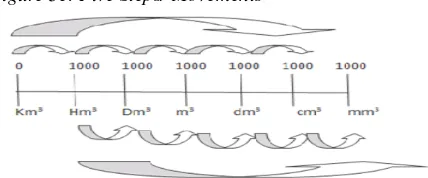
In figure 5b, two steps were made starting from Km3 to the right i.e. the first step from Km3 to Hm3 and from Hm3 to Dm3. It then implies that one movement from Km3 to Hm3 is 1000 and the second movement from Hm3 to Dm3 is also 1000, thus 1000×1000=106=1000000 (i.e. 1Km3=1000000Dm3).
The reverse DTML-conversion model with its mathematical formulas
Figure 5c: Three Steps/ Movements
In figure 5c, three steps were made starting from Km3 to the right i.e. the first step from Km3 to Hm3, Hm3 to Dm3 and from Dm3 to m3, it then implies that the first movement from Km3 to Hm3 is 1000, the second movement from Hm3 to Dm3 is 1000 and the last step from Dm3 to m3 is also 1000, thus 1000×1000×1000=109=1000000000 (i.e. 1Km3=1000000000m3).
Step Three/ Movement Three
1Km3=1000000000(1×10⁹) m3 1Hm3=1000000000(1×10⁹) dm3 1Dm3=1000000000(1×10⁹) cm3 1m3=1000000000(1×10⁹) mm3
Figure 5d: Four Steps/ Movements
In figure 5d, four steps were made starting from Km3 to the right i.e. the first step from Km3 to Hm3, Hm3 to Dm3, Dm3 to m3 and from m3 to dm3, it then implies that the first movement from Km3 to Hm3 is 1000, the second movement from Hm3 to Dm3 is 1000, Dm3 to m3 is 1000 and the last step from m3 to dm3 is 1000, thus 1000×1000×1000×1000=1012=1000000000000 (i.e. 1Km3 =1000000000000dm3).
Step Four/ Movement Four
1Km3 =1000000000000(1×10¹²) dm3 1Hm3 =1000000000000(1×10¹²) cm3 1Dm3 =1000000000000(1×10¹²) mm3
Figure 5e: Five Steps/ Movements
Kumassah, E. K.
Step Five/ Movement Five
1Km3 =1000000000000000(1×10¹⁵) cm3 1Hm3 =1000000000000000(1×10¹⁵) mm3
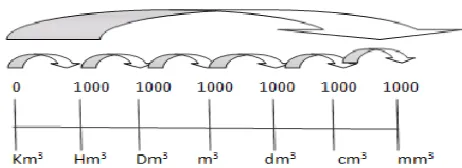
Figure 5f: Six Steps/ Movements
In figure 5f, six steps were made starting from Km3 to the right. The i.e. the steps are Km3 to mm3, Hm3 to Dm3, Dm3 to m3, m3 to dm3, dm3 to cm3 and from cm3 to mm3, it then implies that the first movement from Km3 to Hm3 is 1000, the second movement from Hm3 to Dm3 is 1000, Dm3 to m3 is 1000, m3 to dm3 is 1000, dm3 to cm3 is 1000 and the last step from cm3 to mm3 is also 1000, thus 1000×1000×1000×1000×1000×1000=1018=1000000000000000000(i.e.1Km3=10000000000000000mm3). Step Six/ Movement Six
1Km3= 10000000000000000mm3
Table 3
reverse Three Dimension Distance Summary
Step 1 Step 2 Step 3 Step 4 Step 5 Step 6
1Km3=1000 (103) Hm3
1Km3=1000000(1×1 06)Dm3
1Km3=1000000000 (1×10⁹)m3
1Km3=10000000000 00 (1×10¹²) dm3
1Km3=10000000000 00000 (1×10¹⁵) cm3
1Km3=10000000000 000000(1×10¹⁸) mm3 1Hm3=1000(103)
Dm3
1Hm3=1000000(1×1 06)m3
1Hm3=1000000000( 1×10⁹)dm3
1Hm3=10000000000 00(1×10¹²) cm3
1Hm3=10000000000 00000(1×10¹⁵) mm3 1Dm3=1000(103) m3 1Dm3=1000000(1×1
06)dm3
1Dm3=1000000000( 1×10⁹)cm3
1Dm3=10000000000 00 (1×10¹²) mm3 1m3=1000 (103) dm3 1m3=1000000(1×10
6) cm3
1m3=1000000000(1× 10⁹)mm3
1dm3=1000(103) cm3 1Km3=1000000(1×1 06)Dm3
1cm3=1000(103) mm3
2.5 The Reverse Time (T)-Conversion Model
The reverse DTML-conversion model with its mathematical formulas min = minute
Hr = hour
Figure 6.1: The Complete Labelled Reverse T-Conversion Model
The time-conversion model has two steps (i.e. Step One, and Step Two). Figure 6a: One Step/ Movement
In figure 6a, one step was made starting from Hr to the right i.e. the step from Hr to min, it then implies that the first movement from Hr to min is 60 and the second movement from min to s is also 60, thus 60=6×101=6×10 (i.e. 1Hr = 60min).
Step One / Movement One 1 Hr = 60min
1 min = 60 s
Figure 6b: Two Steps/ Movements
In figure 6b, two steps were made starting from Hr to the right i.e. the first step from Hr to min and from min to s, it then implies that the first movement from Hr to min is 60 and the second movement from min to s is also 60, thus 60×60=62×102=36×100 (i.e. 1Hr = 3600s).
Step Two/ Movement Two 1Hr = 3600s
Table 4
The Reverse Time-Conversion Model Summary
Step 1 Step 2
Kumassah, E. K.
2.6 The Reverse Mass (M)-Conversion Model
Figure 7: A straight line is divided into six equal parts. The distance between each part is ten (10)
The number line is labelled Kg, Hg, Dg, g, dg, cg and mg. Kg = kilogram
Hg = hectogram Dg = dekagram g = gram dg = decigram cg = centigram mg = milligram
Figure 7.1: The Complete Labelled Reverse M-Conversion Model
Figure 7a: One Step/ Movement
In figure 7a, one step was made starting from Kg to the right i.e. the step from Kg to Hg, Hg to Dg, Dg to g, g to dg, dg to cg, and cg to mg. This then implies that one movement from Kg to Hg is 10 thus 10=1×101 (i.e. 1Kg = 10Hg).
Step One / Movement One 1Kg = 10Hg
1Hg = 10Dg 1Dg = 10g 1g = 1dg 1dg = 10cg 1cg = 10mg
The reverse DTML-conversion model with its mathematical formulas In figure 7b, two steps were made starting from Kg to the right i.e. the step from Kg to Dg, Hg to g, Dg to dg, g to cg, and dg to mg. This then implies that one movement from Kg to Dg is 100 thus 10×10=1×10² (i.e. 1Kg = 100Dg).
Step Two / Movement Two 1Kg = 100Dg
1Hg = 100g 1Dg = 100dg 1g = 100cg 1dg = 100mg
Figure 7c: Three Step/ Movement
In figure 7c, three steps were made starting from Kg to the right i.e. the step from Kg to g, Hg to dg, Dg to cg, and g to mg. This then implies that one movement from Kg to g is 1000 thus 10×10×10=1×10³ (i.e. 1Kg = 1000g).
Step Three / Movement Three 1Kg = 1000g
1Hg = 1000dg 1Dg = 1000cg 1g = 1000mg
Figure 7d: Four Step/ Movement
In figure 7d, four steps were made starting from Kg to the right i.e. the step from Kg to dg, Hg to cg, and Dg to mg. This then implies that one movement from Kg to dg is 10000 thus 10×10×10×10=1×10⁴ (i.e. 1Kg = 10000dg).
Step Four / Movement Four 1Kg = 10000 dg
Kumassah, E. K.
Figure 7e: Five Step/ Movement
In figure 7e, five steps were made starting from Kg to the right i.e. the step from Kg to cg, and Hg to mg. This then implies that one movement from Kg to cg is 100000 thus 10×10×10×10×10=1×10⁵ (i.e. 1Kg = 100000 cg).
Step Five / Movement Four
1Kg = 100000 cg 1Hg = 100000 mg
Figure 7f: Six Step/ Movement
In figure 7f, six steps were made starting from Kg to the right i.e. the step from Kg to mg. This then implies that one movement from Kg to mg is 1000000 thus 10×10×10×10×10×10=1×10⁶ (i.e. 1Kg = 1000000 mg). Step Six / Movement Four
1Kg = 1000000mg
Table 5
Reverse Mass-Conversion Model Summary
Step 1 Step 2 Step 3 Step 4 Step 5 Step 6
1Kg=10 Hg 1Kg=100 Dg 1Kg =1000 g 1Kg=10000 dg 1Kg= 100000cg 1Kg=1000000mg
1Hg=10 Dg 1Hg=100 g 1Hg=1000 dg 1Hg=10000 cg 1Hg=100000 mg
1Dg= 10 g 1Dg=100 dg 1Dg=1000 cg 1Dg=10000 mg
1g = 1 dg 1g =100 cg 1g=1000 mg
1dg=10 cg 1dg=100 mg
1cg=10 mg
1dg=10 cg
The reverse DTML-conversion model with its mathematical formulas 2.7 The Reverse Liter (L)-Conversion Model
Figure 8: A straight line is divided into six equal parts. The distance between each part is ten (10)
The number line is labelled KL, HL, DL, L, dL, cL and mL. KL = kiloliter
HL = hectoliter DL = dekaliter L = liter dL = deciliter cL = centiliter mL = milliliter
Figure 8.1: The Complete Labelled reverse L-Conversion Model
Figure 8a: One Step/ Movement
In figure 8a, one step was made starting from KL to the right i.e. the step from KL to HL, HL to DL, DL to L, L to dL, dL to cL, and cL to mL. This then implies that one movement from KL to HL is 10 thus 10=1×101 (i.e. 1KL = 10HL).
Step One / Movement One 1KL = 10HL
1HL = 10DL 1DL = 1L 1L = 10dL 1dL = 10cL 1cL = 10mL
Figure 8b: Two Step/ Movement
Kumassah, E. K.
Step Two / Movement Two 1KL = 100DL
1HL = 100L 1DL = 100dL 1L = 1cL 100dL = 1mL
Figure 8c: Three Step/ Movement
In figure 8c, three steps were made starting from KL to the right i.e. the step from KL to L, HL to dL, DL to cL, and L to mL. This then implies that one movement from KL to L is 1000 thus 10×10×10=1×10³ (i.e. 1KL = 1000L).
Step Three / Movement Three 1KL = 1000L
1HL = 1000dL 1DL = 1000cL 1L = 1000mL
Figure 8d: Four Step/ Movement
In figure 8d, four steps were made starting from KL to the right i.e. the step from KL to dL, HL to cL, and DL to mL. This then implies that one movement from KL to dL is 10000 thus 10×10×10×10=1×10⁴ (i.e. 1KL = 10000dL).
Step Four / Movement Four 1KL = 10000dL
1HL = 10000cL 1DL = 10000mL
The reverse DTML-conversion model with its mathematical formulas
In figure 8e, five steps were made starting from KL to the right i.e. the step from KL to cL, and HL to mL. This then implies that one movement from KL to cL is 100000 thus 10×10×10×10×10=1×10⁵ (i.e. 1KL = 100000cL).
Step Five / Movement Four
1KL = 100000cL 1HL = 100000mL
Figure 8f: Six Step/ Movement
In figure 8f, six steps were made starting from KL to the right i.e. the step from KL to mL. This then implies that one movement from KL to mL is 1000000 thus 10×10×10×10×10×10=1×10⁶ (i.e. 1KL = 1000000mL). Step Six / Movement Four
1KL = 1000000mL
Table 5
Liter-Conversion Model Summary
Step 1 Step 2 Step 3 Step 4 Step 5 Step 6
1KL= 10HL 1KL=100DL 1KL = 1000L 1KL= 10000dL 1KL= 100000cL 1KL= 1000000mL 1HL= 10DL 1HL = 100L 1HL=1000dL 1HL= 10000cL 1HL=100000mL
1DL = 1L 1DL=100dL 1DL=1000cL 1DL=10000mL 1L = 10dL 1L = 1cL 1L =1000mL
1dL= 10cL 100dL=1mL 1cL= 10mL
3. Mathematical proof of the number of step/movements on the DTML-CONVERSION model
3.1 Movement in one dimension
Kumassah, E. K.
Figure 2: the Mass (M)-Conversion Model
Figure 3: the Liter-Conversion Model
Figure 4: the Time (T)-Conversion Model
Figure 1, 2 and 3 will be considered now and after the proving, will be applied to figure 4. Figure 5: the proved Diagram for Reverse One Dimension-Conversion Model
Where A = Km = Kg = KL (figure 1, 2 and 3) and G = mm = mg = mL (figure 1, 2 and 3) Let y = equal distance/space between alphabets (figure 5)
n = the number of steps / movements from the starting point, A h = the index of the spaces between the alphabets i.e. yh
From figure 5, n depends on y.
Mathematically, n ∝y
Hence, n = ky, k= constant of proportionality Let y be raised to an index h
nh = kyh, k ≠ 0, if k = 1 = (n/yh ) = (n/10h ) nh = yh, but y = 10 (figure 5)
The reverse DTML-conversion model with its mathematical formulas
To determine the first movement/ step to the right of the starting point A, then h = 1
From n = 10h, n1 = 101 = 10 units, so the first movement from the starting point A (figure 5) is a distance of 10 units
To determine the second movement/ step to the right of the starting point A, then h = 2
From nh = 10h, n2 = 102 = 10×10 = 100 units, so the second movement from the starting point A (figure 5) is a distance of 100 units
To determine the third movement/ step to the right of the starting point A, then h = 3 From nh = 10
h, n3 = 10
3
= 10×10×10 = 1000 units, so the third movement from the starting point A (figure 5) is a distance of 1000 units
To determine the fourth movement/ step to the right of the starting point A, then h = 4
From nh = 10h, n4 = 104 = 10×10×10×10 = 10000 units, so the fourth movement from the starting point A (figure 5) is a distance of 10000 units
To determine the fifth movement/ step to the right of the starting point A, then h = 5
From nh = 10h, n5 = 105 = 10×10×10×10×10 = 100000 units, so the fifth movement from the starting point A (figure 5) is a distance of 100000 units
To determine the sixth movement/ step to the right of the starting point A, then h = 6 From nh = 10
h, n6 = 10
6
= 10×10×10×10×10×10 = 1000000 units, so the sixth movement from the starting point A (figure 5) is a distance of 1000000 units
Figure 4: The Reverse Time (T)-Conversion Model
Now a very closer look at figure 4 reveals that, instead of n = 10h as in figures 1, 2 and 3, n now rather becomes nh = 60h in figure 4.
To determine the starting point to the steps/movements, then h = 0 From nh = 60h, n0 = 600 = 1 unit, so the starting point Hr (figure 4) is 1 unit
To determine the first movement/ step to the right of the starting point Hr, then h = 1
From nh = 60h, n1 = 601 = 60 units, so the first movement from the starting point Hr (figure 4) is a distance of 60 units
To determine the second movement/ step to the right of the starting point Hr, then h = 2
From nh = 60h, n2 = 602 = 60×60 = 3600 units, so the second movement from the starting point s (figure 4) is a distance of 3600 units
3.2 Movement in two dimensions
Kumassah, E. K.
Figure 6: the reverse Area (A)-Conversion Model
Figure 7: the Proved Diagram for reverse Two Dimension-Conversion Model
Let y = equal distance/space between alphabets (figure 7)
n = the number of steps / movements from the starting point Km2 h = the index of the spaces between the alphabets i.e. yh
From figure 7, n depends on y.
Mathematically, n ∝y
Hence, n = ky, k= constant of proportionality Let y be raised to an index h
nh = ky h
, k ≠ 0 if k = 1 nh = yh, but y = 100 (figure 7) nh = yh = 100h
nh = 100 h
Application of n = 100h to reverse Two Dimension i.e. Area-Conversion Model
To determine the starting point to the steps/movements, then h = 0
From nh = 100h, n0 = 1000 = 1 unit, so the starting point Km2 (figure 7) is 1 unit. To determine the first movement/ step to the right of the starting point Km2, then h = 1
From nh = 100h, n1 = 1001 = 100 units, so the first movement from the starting point Km2 (figure 7) is a distance of 100 units.
To determine the second movement/ step to the right of the starting point Km2, then h = 2 From nh = 100
h,
n2 = 100 2
= 100×100 = 10000 units, so the second movement from the starting point Km2 (figure 7) is a distance of 10000 units.
To determine the third movement/ step to the right of the starting pointKm2, then h = 3
The reverse DTML-conversion model with its mathematical formulas To determine the fifth movement/ step to the right of the starting point Km2, then h = 5
From nh = 100 h,
n5 = 100 5
= 100×100×100×100×100 = 10000000000 units, so the fifth movement from the starting point Km2 (figure 7) is a distance of 10000000000 units.
To determine the sixth movement/ step to the right of the starting point Km2, then h = 6
From nh = 100h, n6 = 1006 = 100×100×100×100×100×100 = 1000000000000 units, so the sixth movement from the starting point Km2 (figure 7) is a distance of 1000000000000 units.
3.3 Movement in three dimensions
The three dimensions of units in the DTML-Conversion model is Volume. Figure 8: the Volume (V)-Conversion Model
Figure 9: the Proved Diagram for reverse Three Dimension-Conversion Model
Let y = equal distance/space between alphabets (figure 9)
n = the number of steps / movements from the starting point, Km3 h = the index of the spaces between the alphabets i.e. yh
From figure 9, n depends on y. Mathematically,
n ∝ y
Hence, n = ky, k= constant of proportionality Let y be raised to an index h
nh = ky h
, k ≠ 0, if k = 1 nh = yh, but y = 1000 (figure 9) nh = yh = 1000h
nh = 1000 h
3.4 Application of n = 1000h to Three Dimension i.e. Volume-Conversion Model
To determine the starting point to the steps/movements, then h = 0
From nh = 1000h, n0 = 10000 = 1 unit, so the starting point Km3 (figure 9) is 1 unit. To determine the first movement/ step to the right of the starting point Km3, then h = 1
Kumassah, E. K.
To determine the second movement/ step to the right of the starting point Km3, then h = 2
From nh = 1000h, n2 = 10002 = 1000×1000 = 1000000 units, so the second movement from the starting point Km3 (figure 9) is a distance of 1000000 units.
To determine the third movement/ step to the right of the starting point Km3, then h = 3
From nh = 1000h, n3 = 10003 = 1000×1000×1000 = 1000000000 units, so the third movement from the starting point Km3 (figure 9) is a distance of 1000000000 units.
To determine the fourth movement/ step to the right of the starting point Km3, then h = 4
From nh = 1000h, n4 = 10004 = 1000×1000×1000×1000 = 1000000000000 units, so the fourth movement from the starting point Km3 (figure 9) is a distance of 1000000000000 units.
To determine the fifth movement/ step to the right of the starting point Km3, then h = 5
From nh = 1000h, n5 = 10005 = 1000×1000×1000×1000×1000 = 1000000000000000 units, so the fifth movement from the starting point Km3 (figure 9) is a distance of 1000000000000000 units.
To determine the sixth movement/ step to the right of the starting point Km3, then h = 6
From nh = 1000h, n6 = 1006 = 1000×1000×1000×1000×1000×1000 = 1000000000000000000 units, so the sixth movement from the starting point Km3 (figure ) is a distance of 1000000000000000000 units.
4. Mathematical proof of converting within units with the reverse DTML-CONVERSION MODEL
Let y = the given unit
c = the unit in which the given unit is to be converted n = the number of steps / movements from the starting point d = the dimension of a quantity
If, y depends on n. Mathematically, y ∝ n
Hence, y = cn, c= constant of proportionality Let y be raised to an index d
y = cnd; c≠0, if for one dimension d = 1, for two dimension d =2, and for three dimension d = 3 y = cnd, if d = 1(one dimension)
y = cnd = cn1= cn (one dimension)
y = cnd, if d = 2, then y = cn2 (two dimension; n is the number of steps/movement in the one dimension-conversion model)
y = cnd = cn2 = cn (two dimension; n is the actual number of steps in the two dimension-conversion model) y = cnd, if d = 3, then y = cn3 (three dimension; n is the number of steps/movement in the one dimension-conversion model)
y = cnd = cn3 = cn (three dimension; n is the actual number of steps in the three dimension-conversion model)
The reverse DTML-conversion model with its mathematical formulas Example 1
Convert 2cm to m.
Data: y = the given unit (i.e. 2cm), n = number of steps (two steps, n2 = 100 i.e. converting from cm to m is a two step/movement i.e. n2 = 100), c = the unit in which the given unit is to be converted.
Solution y = cn
2cm = c×100cm/m 2cm/100cm×1m = c 0.02m = c
Example 2
Change 0.001g to dg Data:
y = 0.001g, n = 1÷10 (moving from g to dg is one movement but it is the reverse of dg to g, hence instead of n= 10, the reverse is n = (1÷10), c =?
Solution y = cn
0.001g = c× 1/10g/dg 0.001g/ (1/10g) ×1dg = c 0.001×10dg = c
0.01dg = c
Example 3
Convert 534kL to mL Data:
y = 534kL, n = 1÷1000000 (moving from kL to mL is six steps/movement but it is the reverse of mL to kL, hence instead of n = 1000000, the reverse is n = (1÷1000000), c =?
Solution y = cn
534kL = c× 1/1000000kL/mL 534kL/ (1/1000000kL/mL) = c 534×1000000mL = c
534000000mL = c
Example 4
Change 200s to hr. Data:
y = 200s, n = 3600 (moving from s to hr is two steps/movements), c =? Solution
y = cn
Kumassah, E. K.
4.2 Application of y = cn2 to Two Dimension i.e. Area (A) - Conversion Model
Example 1
Convert 2cm2 to m2 Data:
y = the given unit (i.e. 2cm2), n = number of steps (two steps, n2 = 10000 = n2#2 = 1002 i.e. n2# is the two step / movement in the one dimension-conversion model, also converting from cm2 to m2 is a two step/movement i.e. n2 = 10000), c = the unit in which the given unit is to be converted.
Solution
By using n2# = 100 (two step / movement in the one dimension-conversion model) y = cnd, for two dimension, d =2
y = cnd = cn2
2cm2 = c× n2#2 = c×1002cm2/m2 2cm2 = c×10000cm2/m2 (2/10000cm2/cm2)×1m2 = c 2/10000m2 = c
0.0002m2 = c
By using n2 = 10000 (actual two step / movement in the two dimension-conversion model) y = cn2
2cm2 = c×10000cm2/m2 (2/10000cm2/cm2)×1m2 = c 0.0002m2 = c
Example 2
Convert 2m2 to cm2 Data:
y = the given unit (i.e. 2m2), n = number of steps (two steps in a reverse direction i.e. from m2 to cm2, n2 = 1÷10000 = n2#
2
= (1÷100)2 i.e. n2# is the two step / movement in the one dimension-conversion model, also converting from m2 to cm2 is a two step/movement but in a reversed direction i.e. n2 = 1÷10000, c = the unit in which the given unit is to be converted.
Solution
By using n2# = 2/100 (two step / movement in the one dimension-conversion model) y = cnd, for two dimension, d =2
y = cnd = cn2 2m2 = c× n2#
2
The reverse DTML-conversion model with its mathematical formulas By using n2 = 1/1000 (actual two step / movement in the two dimension-conversion model)
y = cn2
2m2 = c× (1/1000) m2/cm2 (2m2 ×10000m2)×1cm2 = c 20000cm2 = c
4.3 Application of y = cn3 to Three Dimension i.e. Volume (V)- Conversion Model
Example 1
Convert 2cm3 to m3 Data:
y = the given unit (i.e. 2cm3), n = number of steps (two steps, n2 = 1000000 i.e. 1000×1000 = n2# 3
= 1003 i.e. n2# is the two step / movement in the one dimension-conversion model, also converting from cm3 to m3 is a two step/movement i.e. n2 = 1000000, c = the unit in which the given unit is to be converted.
Solution
By using n2# = 100 (two step / movement in the one dimension-conversion model) y = cnd, for three dimension, d =3
y = cnd = cn3 2cm3 = c× n2#
3
= c×1003cm3/m3 2cm3 = c×1000000cm3/m3 (2/1000000cm3/cm3)×1m3 = c 2/1000000m3 = c
0.000002m3 = c
By using n2 = 1000000 (actual two step / movement in the three dimension-conversion model) y = cn2
2cm3 = c×1000000cm3/m3 (2/1000000cm3/cm3)×1m3 = c 0.000002m3 = c
Example 2
Convert 2m3 to cm3 Data:
y = the given unit (i.e. 2m3), n = number of steps (two steps but in a reversed movement, n2 = 1÷1000000 i.e. = n2#
3
= 1÷1003 i.e. n2# is the reversed two step / movement in the one dimension-conversion model, also converting from m3 to cm3 is a reversed two step/movement i.e. n2 = 1000000, c = the unit in which the given unit is to be converted.
Kumassah, E. K. y = cnd = cn3
2m3 = c× n2#3 = c× (1÷1003) m3/cm3 2m3 = c×1/1000000cm3/m3
(2m3×1000000m3)×1cm3 = c 2×1000000cm3 = c
2000000cm3 = c
By using n2 = 1/1000000 (actual two step / movement in the three dimension-conversion model) y = cn2
2m3 = c×1/1000000m3/cm3 (2m3 ×1000000m3)×1cm3 = c 2000000cm3 = c
5. References
Asiedu, P., & Baah-Yeboah, A.H. (2004). Aki-ola series: Physics for senior high schools in West Africa (3rd ed.). Accra: Aki-Ola Publications.
Awe, O., & Okunola, O. O. (1992). Comprehensive certificate physics. Ibadan: University Press. Brown, M. (1999). Schaum’s outlines: Physics for engineering and science. New York: McGraw-Hill.
Butterfield, A., Sutherland, R., & Molyneux-Hodgson, S. (2000). Learning conversions in science: The case of vocational students in the UK. ALT-J, 8(3), 89-104. http://dx.doi.org/10.1080/0968776000080310 Institute of Education. (2010). Integrated science syllabus for first year diploma in basic education programme.
Cape Coast: Author.
Molyneux, S., & Sutherland, R. (1996). Mathematical competencies of gnvq science students: The role of computers. In the 2010 Report to the Leverhulme Trust, the University of Bristol, School of Education. Institute of Education.
Kumassah, E. K. (2012). The dtml-conversion model with its mathematical formulas. Elixir Edu. Tech. 47, 8846-8860.
Serway, R. A., & Jewett, J. W, Jr. (2004). Physics for scientists and engineers (6 ed.). California: Thomson Learning.
Trimpe, T. (2000). Metric mania. http://sciencespot.net/
Trimpe, T. (2008). Metric mania: Metric conversions ladder method. http://sciencespot.net/ Willis, R. (2011). Introduction to conceptual physics: Metric conversion; stair-step method.