International Journal of
www.Ijoit.org pg. 19
Practical Aspects for the Module Selection of Modern Wireless
Infotainment Systems
Raghvendra Kumar Rai
Bharat Electronics Limited, Banglore, India
Mritunjay Rai JRE Group of Institutions,
Greater Noida, India [email protected]
R.K.Yadav
JRE Group of Institutions,
Greater Noida, India [email protected]
Abstract - This Paper discusses about the selection of modules for a typical wireless infotainment system that supports applications like Bluetooth, WLAN, and Mobile TV for entertainment, education and information. Section 1 brief about the trends and approach for the selection of wireless modules. Section 2 outlines the important parameters to be considered for module selection. Section 3 gives a practical understanding for vendor selection criterion. Section 4 outlines best module selection for particular application on the basis of trade-off analysis and evaluation of reference designs. Section 5 concludes this paper.
Index Terms
—
Wireless infotainment, Bluetooth, WLAN, Mobile TV1. Introduction
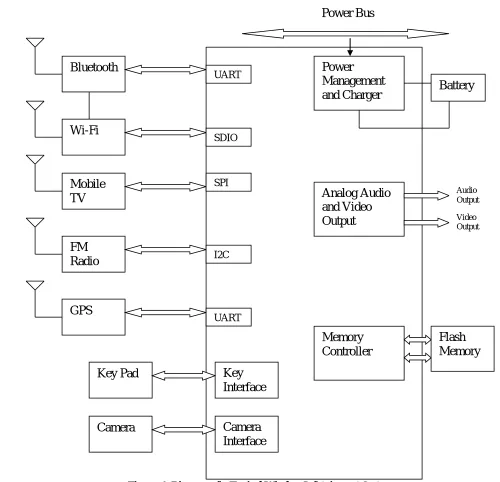
The Infotainment Devices are being conceptualized as convergent devices that combine navigation and infotainment requirements on a single “portable” platform. Today innovation and technology convergence are driving the changes in the auto market. Consumers are now demanding advanced infotainment systems and solutions for their vehicles. New services such as GPS live mobile TV, terrestrial TV, FM radio, Bluetooth, and access to the Wi-Fi network for internet access, emails, and chats etc. are getting implemented in vehicles. This paper discusses about the practical aspects for the module selection for GPS, Bluetooth, WLAN, Mobile TV, Terrestrial TV and FM Radio for a typical wireless infotainment system. Different available modules are compared on the basis of capabilities of the modules for the different wireless applications and best suitable modules are selected.
2. Fundamental Parameters to Understand for Module Selection
www.Ijoit.org pg. 20 Figure. 1. Diagram of a Typical Wireless Infotainment System
Wireless infotainment industry is looking for every possibility to trim the size of the components of their products and increase more functionalities, then the best approach is to use integrated RF modules readily available in the market rather than using individual components (such as PA, duplexer, transceivers etc.,) with out any compromise in their performance. Integrated modules lowers the time to market and design efforts, they come preassembled and tested with optimized internal interfaces reducing the chance for design errors with optimum performance. To Gain competitive advantages to develop system quickly and cost efficiently, one should use readily available modules from third party vendors. Selection of modules or components for any wireless device requires knowledge of some fundamental parameters. Nonetheless, although the availability of off-the-shelf components, modules and reference designs has made wireless infotainment system design a little easier, the designer still needs to acquire some fundamental knowledge about the parameters that influence in the selection of modules.
2.1 Important Parameters for GPS Module Selection
In this section we will discuss about the aspects of important parameters to be considered for GPS module selection
TABLE 1. Important parameters for GPS module selection
Type Parameters Unit
Receiver Receiver Channels
Acquisition Sensitivity Tracking Sensitivity
Time to first fix Positioning accuracy
NMEA support
NA dBm dBm seconds
meter NA
DC Power Consumption mW
General Dimensions
Driver support Cost
mm2 NA NA
As per requirement specifications module selection for GPS receiver is aimed for selecting best performance characteristics such as lower power consumption, tracking of weak satellites, faster acquisition times and more accurate position fixes. GPS receivers specify two sensitivity values, acquisition sensitivity and tracking sensitivity.
Bluetooth
Wi-Fi
Mobile
TV
FM
Radio
I2CUART
SDIO
SPI
Power
Management
and Charger
Key
Interface
Camera
Interface
Analog Audio
and Video
Output
Memory
Controller
Key Pad
Camera
Flash
Memory
Battery
Power Bus
Audio Output
Video Output
GPS
UART
www.Ijoit.org pg. 21
Acquisition sensitivity represents the lowest power level at which a receiver will be able to achieve a position fix. Tracking sensitivity is the lowest power level at which a receiver will be able to track an individual satellite and is measured by measuring the C/N ratio of a receiver for a known input power level. For a typical GPS receiver minimum C/N ratio is 28 to 32 dB-Hz to achieve a position fixes. A receiver requires at least four satellites to obtain a 3D position fix and Time to first fix gives the details regarding time required for a GPS receiver to acquire satellite signals and navigation data, and calculate a position fix. TTFF requirement for this typical GPS receiver is < 1 Sec. positioning accuracy of a GPS receiver is expressed in a specific coordinate system such as latitude and longitude and gives the ability of a receiver to accurately locate your position. Positioning accuracy requirement for this typical GPS receiver is <5m.One should also consider other parameters such as NMEA support is a standard used by the GPS receiver to transmit data, receiver channels, power consumption, Dimensions and price for selection of modules for this typical GPS receiver.
2.2 Important Parameters for Bluetooth and WLAN Module Selection
In this section we will discuss about the aspects of important parameters to be considered for Bluetooth and WLAN module selection
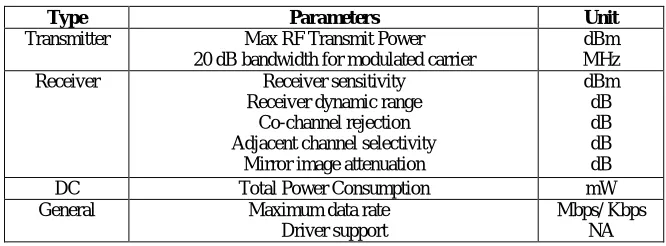
TABLE 2. Important parameters for Bluetooth and WLAN module selection
Type Parameters Unit
Transmitter Max RF Transmit Power
20 dB bandwidth for modulated carrier
dBm MHz
Receiver Receiver sensitivity
Receiver dynamic range Co-channel rejection Adjacent channel selectivity
Mirror image attenuation
dBm dB dB dB dB
DC Total Power Consumption mW
General Maximum data rate Driver support
Mbps/ Kbps NA
The Maximum Transmitter Power and Sensitivity are critical parameters to consider for bluetooth and WLAN module selection .They directly play role in transmission budget analysis, do have an affect on transmission reliability, especially when two transmitters like Bluetooth and WLAN are working in the same free license band and are in close proximity. Maximum transmit power determines the range for bluetooth and WLAN devices [1] as an example approximate range of an Bluetooth device with respect to the maximum transmit is listed below in table3:
TABLE. 3. Table for bluetooth device range with respect to the maximum output power
Class Maximum Transmitted Power Range(Approximate)
Class1 20 dBm ~100 meters
Class2 4 dBm ~10 meters
Class3 1 dBm ~1 meters
One has to ensure that the radio can operate over its stated range in number of different operating conditions, at stated output power and sensitivity and in different environmental conditions such as air humidity, obstacles such as people and furniture etc. and one should also ensure that the sensitivity stated in the datasheet is at maximum data rate as sensitivity degrades as data rate increases. The DC Power consumption is important parameter especially when one is selecting components for handheld products. The need for the low DC power consumption is to improve the battery life of the system, lower will be the DC power consumption better will be battery life.
www.Ijoit.org pg.22 Figure. 2. Basic setup for WLAN data rate and range testing
The first step is to have the Client associate with the Access Point. Next the IPERF utility is invoked on both the Client and the server side of the connection. The DOS based IPERF utility is used to initiate data transfers between the Client and the server. On the Client side the IPERF utility is invoked to run in Client mode using the command .Once the Client and the server have associated, and the IPERF utility is running on both of them, it continuously outputs the measured data rate and by changing the distance between client and server one can calculate the range for DUT. The other receiver as well as transmitter parameters are not directly part of the transmission link budget analysis but they have an effect on transmission performance and one should also consider that parameters for module selection.
2.3 Important Parameters for Mobile TV Module Selection
In this section we will discuss about the aspects of important parameters to be considered for Mobile TV module selection
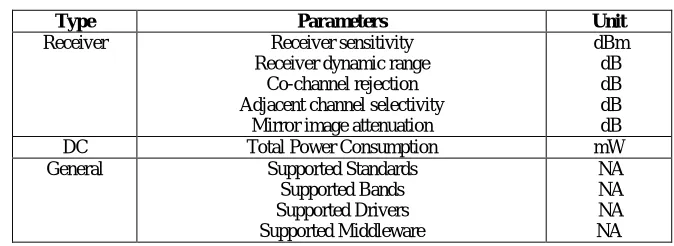
TABLE 4. Important parameters for mobile TV module selection
Type Parameters Unit
Receiver Receiver sensitivity
Receiver dynamic range Co-channel rejection Adjacent channel selectivity
Mirror image attenuation
dBm dB dB dB dB
DC Total Power Consumption mW
General Supported Standards
Supported Bands Supported Drivers Supported Middleware
NA NA NA NA
As we have already discussed most of the receiver, DC parameter aspects in the previous section 2.1.In this section we will discuss about the aspects of general parameters of Mobile TV application The mobile TV industry is fragmented with different markets supporting different standards and different bands such as DVB-H has a strong hold in Europe and is also to be the dominant standard in south east Asia –Taiwan, Singapore, Vietnam, Malaysia-and the Pacific Rim, Media Flo seems to be the winner in North America, ISDB-T will dominate in Japan, Brazil and couple other south American countries, south Korea is dominated by T- DMB and in china home grown standard known as CMMB(S-TIMI) will be the main platform for Mobile TV .Being the picture so unclear one should select the mobile TV component that could be able to support multi standards and multiband solution so, that migration effort and time from one standard to other standards will reduce i.e. a very few hardware changes is needed , a single module can be used to support multiple standards. The drivers are used to initialize the chip, tune to given channel and to handle mobility aspects like band scan and handover and the Middleware includes upper layer functionality like IP stack, Electronic Service Guide extraction, parsing and decompression, multi channel support for Picture in Picture and Watch/Record, conditional access, clip casting, file delivery, and A/V decoder interface. One should ensure from the respective vendor regarding the availability of drivers and middleware features while selecting components.
2.4 Important Parameters for Analog TV Module Selection
In this section we will discuss about the aspects of important parameters to be considered for Analog TV module selection
TABLE 5. Important parameters for Analog TV module selection
Type Parameters Unit
Receiver Receiver sensitivity
Adjacent channel selectivity
dBm dB
DC Total Power Consumption mW
General Supported Standards
Supported Bands Supported Drivers
Dimensions Price
NA NA NA mm3 NA
Laptop
with Driver
Support
DUT
Access
Point
Laptop
with Driver
Support
Linksys
Router
Laptop Running
IPERF in Server Mode
www.Ijoit.org pg.23
Sensitivity is the ability of a tuner to pick up weak analog TV signals. The higher the sensitivity, the better the tuner's ability to bring in weaker stations clearly. Adjacent channel selectivity is the ability of the receiver to select the wanted signal and to reject the unwanted signal such as another broadcast in adjacent frequency channels. Supported bands for analog TV is NTSC, PAL and SECAM. NTSC standard is used in most of the America, Japan, South Korea, Taiwan, the Philippines, Burma and some pacific island nations. PAL standard is used in Europe, Ireland, Hong Kong, Macau, Mainland of China, India, Australia, Brazil and Argentina. SECAM standard is used in for global coverage Russia, Ukraine and portions of Middle East & Africa. Based on the coverage of standards, NTSC and PAL are considered as a primary standard for module selection.
2.5 Important Parameters for FM Radio Module Selection
In this section we will discuss about the aspects of important parameters to be considered for FM module selection
TABLE 6. Important parameters for FM radio module selection
Type Parameters Unit
Receiver RDS Support
Sensitivity RDS Sensitivity Total Harmonic Distortion Maximum signal to noise ratio
NA dBm dBm dB dB
DC Total Power Consumption mW
General Supported Bands
Supported Drivers Dimensions
Cost
NA NA NA NA
RDS and RBDS is a communication protocol for European broadcast union and US broadcast respectively for sending digital information using conventional FM radio broadcast such as time, track / artist information and station identification. Sensitivity is the ability of a tuner to pick up FM radio transmitters. The higher the sensitivity, the better the tuner's ability to bring in weaker stations clearly. The sensitivity figure indicates the tuner's ability to pull in a moderately distant station mostly noise-free and in stereo. The lower the number, the better the reception of the FM
radio. The total harmonic distortion (THD) of a signal is a measurement of the harmonic distortion present, that is, any deviation of the actual output signal with respect to the ideal transfer function. Signal to noise ratio (SNR) is a measurement indicating the difference in dB between the level of the background noise and the level of the signal. The higher the number, the better the signal to noise ratio and the lesser the background noise from the tuner.
3. Vendor Selection Criterion
A general criterion of selection of vendors in modern wireless infotainment area is listed below:
Vendors Experience: There are branded vendors who are more experienced and established in wireless infotainment components with a decent technical support. Depending on experience base and availability of resources to support wireless infotainment projects, one should select the type of vendor. Second most important consideration is whether the vendor has knowledge of business processes in the specific domain e.g. Bluetooth, Wi-Fi, Mobile TV, etc. Each industry has unique requirements and vendors should have figured out how their product or service handles these industry-specific issues.
Track Record of vendors in Wireless infotainment Services: In an emerging industry, it is extremely important to take into account the track record of the vendor in servicing its clients. There are many vendors in wireless infotainment industry who have large, experienced and lots of customers but are just entering this industry. On the other hand, there may be an experienced, small vendor who has the right product and service.
Avoid Risk for selecting a new component and startup Vendor: There are risks and corresponding rewards in working with a new component and startup vendors such as the problem of stability of the components parameters in the rigorous conditions. One should ensure the stability of the components from technical datasheets, application notes and evaluating reference designs for particular components and as a reward one can negotiate component and source code at lower price. It is a matter of tradeoffs.
Price:This obviously plays an important role when making a decision on what products to purchase. A wireless component with a higher price, though, could be the best one to choose. As a result, a careful consideration is to be made for the installation and support tools which a higher priced component might include’. It could be worth the extra money if the higher priced component saves considerable time when integrating this component with the system.
www.Ijoit.org pg.24 4. Module Selection
One can use the above mentioned criterion and fundamental parameters stated in datasheets of particular vendors. A list of the top wireless vendors is considered and selected a preferred vendor who satisfies all our requirements. Also evaluate several products are evaluated before making a final decision. For example, one could install a small test setup in a lab to compare the performance of top three vendors. There's nothing better than a live comparison, but one has to be sure to judge them equally using common test conditions and criteria. In this section we will discuss about GPS, Bluetooth, WLAN, Mobile TV, Analog TV and FM radio module selection and for that a Comparison with respect to different vendors / Modules are done and a comparison table is prepared .This table consists of all important parameters illustrated in section 2 and 3 for respective applications.
4.1 GPS Module Selection
TABLE 7. Comparison Table for GPS module selection
Type
Parameters Wi2Wi Fastrax Micro module
W2SG0004 IT321 MN5010HS
Receiver Frequency Band
Receiver Type Acquisition Sensitivity
Tracking Sensitivity Time to First Fix Positioning Accuracy NMEA Support 1.575 GHz 20 Channels -141 dBm -157 dBm 0.6Sec 3 m Yes 1.575 GHz 20 Channels NM -159 dBm
< 1 Sec NM Yes 1.575 GHz 20 Channels -142 dBm -159dBm
< 1 Sec < 2.5 m Yes
DC Power Consumption 3. 3 V ; 50 mA 3. 3 V ; 45 mA 3. 3V ; 46 mA
General Interface Support
Dimensions ROHS Compliant Price UART 11.2mm×12mm×2.5mm Yes
100K pcs : $13.06
UART 10.4mm×14mm×2.3
mm NM 100K pcs : $14.9
UART 10mmx10mmx1.8mm
Yes 100K pcs : $16.0
As per datasheet Parameters such as tracking sensitivity, acquisition sensitivity, and positioning accuracy are approximately equal for all the three vendors. Time to first fix is lowest for the W2SG004 module .Size and Pricing are also lowest for the W2SG004 module. Also all the three vendors are evaluated before making a final decision and it is found that performance wise all the three are approximately equal. Based on remaining parameters like Price and Size and considering other parameters such as availability of modules and evaluation boards W2SG004 module is selected for the GPS application.
4.2 Bluetooth and WLAN Module Selection
Blue tooth and WLAN operating in same frequency range of 2.4GHz. So it will create interference problems between both of these. But, some vendors provides solution which supports simultaneous functionality of Bluetooth and WLAN and this solution is called ‘coexistence’ technique; in this technique software monitors WLAN and Bluetooth traffic patterns and, when both 802.11 and Bluetooth require bandwidth, it uses multiplexing techniques to allocate the bandwidth for simultaneous functions. In this way, RF interference between 802.11 and Bluetooth is eliminated, packet collisions are avoided and high throughput rates are maintained without requiring antenna isolation. Then, better approach is to use single modules which support coexistence of Bluetooth and WLAN.
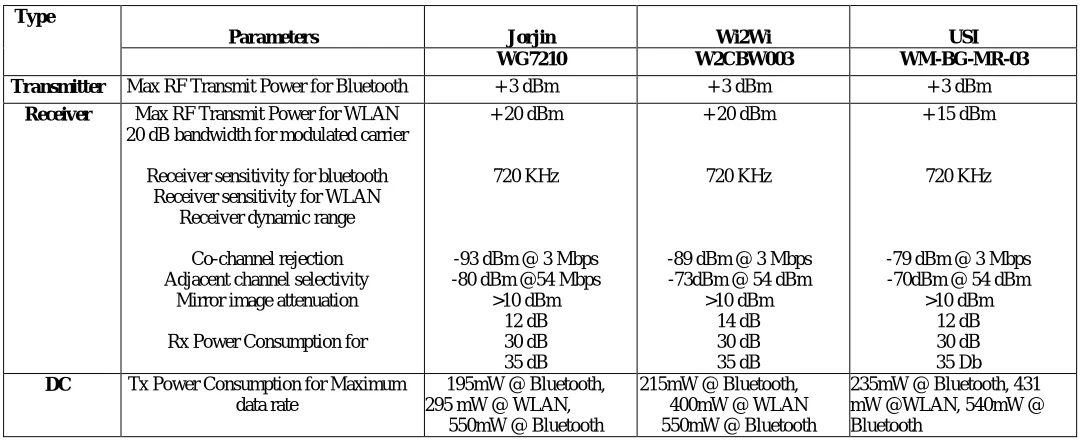
TABLE 8. Comparison Table for Bluetooth and WLAN module selection
Type
Parameters Jorjin Wi2Wi USI
WG7210 W2CBW003 WM-BG-MR-03
Transmitter Max RF Transmit Power for Bluetooth + 3 dBm + 3 dBm + 3 dBm
Receiver Max RF Transmit Power for WLAN
20 dB bandwidth for modulated carrier
Receiver sensitivity for bluetooth Receiver sensitivity for WLAN
Receiver dynamic range
Co-channel rejection Adjacent channel selectivity
Mirror image attenuation
Rx Power Consumption for
+ 20 dBm
720 KHz
-93 dBm @ 3 Mbps -80 dBm @54 Mbps
>10 dBm 12 dB 30 dB 35 dB
+ 20 dBm
720 KHz
-89 dBm @ 3 Mbps -73dBm @ 54 dBm
>10 dBm 14 dB 30 dB 35 dB
+ 15 dBm
720 KHz
-79 dBm @ 3 Mbps -70dBm @ 54 dBm
>10 dBm 12 dB 30 dB 35 Db
DC Tx Power Consumption for Maximum
data rate
195mW @ Bluetooth, 295 mW @ WLAN,
550mW @ Bluetooth
215mW @ Bluetooth, 400mW @ WLAN 550mW @ Bluetooth
235mW @ Bluetooth, 431 mW @WLAN, 540mW @ Bluetooth
www.Ijoit.org pg. 25
General Driver support
Price Dimensions
1.4 Mbps @ Bluetooth, 18.6 Mbps @ WLAN
UART,SDIO
$ 11.3@10 K 12mm×13mm×1.65mm
1.3 Mbps @ Bluetooth, 16.2 Mbps @ WLAN
UART,SDIO
$ 14.25@10 K 12mm×12mm×1.4mm
1.0 Mbps @ Bluetooth. 15.4 Mbps @ WLAN
UART,SDIO
$18.0@10K 12.5mm×12.5mm×1.3mm
As shown in table 8, the top three vendors that support single modules with coexistence technique for Bluetooth and WLAN has been considered for comparison and among all, Vendor 1 is selected because of best pricing, receiver sensitivity and data rate for both Bluetooth and WLAN .
4.3
Mobile TV Module Selection
TABLE 9. Comparison Table for Mobile TV Component selection
Type
Parameters Siano New Port Media DIBcom
SMS1130 NMI310 / NMI700 / NMI320 DIB9080H /
DIB8076M
Receiver Receiver sensitivity
Receiver dynamic range Co-channel rejection Adjacent channel selectivity
Mirror image attenuation
-98 dBm >2dBm 12 dB 35dB 39dB -97 dBm >3dBm 12dB 32 dB 35dB -98 dBm >3dBm 12dB 34dB 36dB
DC Total Power Consumption 200mW 195 mW 200mW
General Supported Standards
Supported Bands Supported Drivers Supported Middleware Features
Price DVB-H/T,ISDB-T,T-DMB VHF/UHF/L SPI ESG/EPG,PIP,PVR
$ 8.73 @ 10 K
DVB-H/T VHF/UHF/L
SPI ESG/EPG,PIP,PVR
$8.0 @ 10 K
ISDB-T VHF/UHF/L
SPI ESG/EPG,PIP,PVR
$8.0@10K
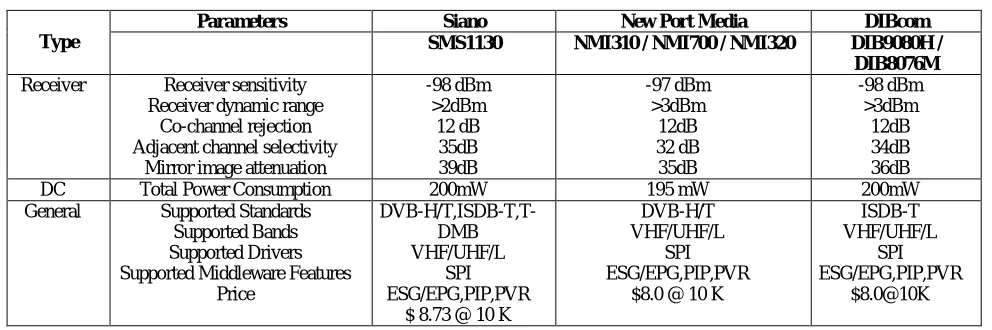
The greatest challenge for Mobile TV module selection is to get a single module that should support multiple standards so, that migration effort and time from one standard to other standards will reduce i.e., a very few hardware changes is needed , a single module can be used to support multiple standards. As shown in table 5 Siano SMS1130 price is high than other two vendors and other RF parameters are approximately same even though vendor 1 got selected for this application because it supports multi- standards.
4.4
Analog TV Module Selection
TABLE 10. Comparison Table for Analog TV Component selection
Type Parameters Telegent Systems Telegent Systems Telegent Systems
TLG1130 TLG1120 TLG1100
Receiver Frequency Band
Receiver sensitivity Adjacent channel selectivity
48 – 862 MHz -100 dBm
75dBc
48 – 862 MHz -102dBm
80dBc
48 – 862 MHz -102dBm
80dBc
DC Total Power Consumption 250mW 250mW 250mW
General Supported Standards
Supported Drivers ROHS Compliant Dimensions Price DVB-H/DVB-T/NTSC/PAL/FM
SDIO / SPI Yes 10×10 mm $ 9.0 @ 100 K Pcs
NTSC/PAL/SECAM/FM
I2C Yes 7×7 mm $ 8.89 @ 100 K Pcs
NTSC/PAL/FM
I2C Yes 8×8 mm $ 8.89 @ 100 K Pcs
For handheld wireless infotainment system size and height of the module is one of the important parameter for the selection of modules. For Analog TV application only Telegent Systems is found suitable for providing required size of the module, other vendor modules are found bulky and bigger in size and suitable for consumer electronics products such as DVD players etc. As shown in Table 10 form factor for TLG1120 is lowest among all the three modules, SECAM addition for global coverage Russia, Ukraine and portions of Middle East & Africa. TLG1100 are not having this Feature.TLG1120 share the same antenna for both Analog TV and FM radio eliminating the need for a more involved FM input match design based upon the variable load of a headphone cable. Additionally, if the FM stereo function shares the TV antenna than a more expensive headphone cable with grounding/shielding is eliminated. Sharing the antenna between TV and FM also benefits the end-consumer as usage case studies have shown that consumers often do not carry the headphone cable with them, forget it, or lose it thus invalidating the ability to use the FM stereo feature. Based on the above discussed parameters TLG1120 is selected for Analog TV application.
www.Ijoit.org pg. 26
4.5 FM Radio Module Selection
TABLE 11. Comparison Table for FM Radio Module selection
Type Parameters Philips Silicon Labs Sigmatel (Free
scale)
TEA5990HN/UK Si4703 STFM1000
Receiver Frequency Band
RDS / RBDS Demodulation Sensitivity RDS Sensitivity
TH
70 – 108 MHz Yes -106 dBm -86.16dBm
0.5%
76 – 108 MHz Yes -100dBm -83.5dBm 0.5%
76 – 108 MHz Yes 104.7dBm
NM 0.06%
DC Power Consumption 40.5mW NM 35 mW
General Supported Bands
Supported Drivers Dimensions
Price
European / US / Japanese / China Band
I2C 4×4×1.0 mm $1.2 @ 10 K Pcs
European / US / Japanese
I2C 3×3×0.5 mm $ 2.07 @ 10K Pcs
European / US / Japanese
I2C 5×5×1.0 mm
--
As shown in Table 11 Sigmatel STFM1000 power consumption and Total harmonic distortion is lowest among all the vendors but this module is not compatible with TI OMAP3430 processor though it got rejected. Receiver sensitivity and RDS demodulator sensitivity for Philips TEA5660HN/UK is better than Silicon labs Si47403 and pricing is also less .So Philips TEA5990HN/UK got selected for FM radio application.
5. Conclusion
Understanding how different components parameters influence a wireless performance link is essential in building a perfect wireless infotainment system. By knowing the operation and aspects of the fundamental wireless parameters such as maximum RF transmit power, receiver sensitivity, power consumption, pricing and availability, the comparison is done and on the basis comparison results the best solution for the Bluetooth ,WLAN and Mobile TV is selected for wireless infotainment system. Not to forget here, component and module selection trade-off is one of the key aspects in the whole product development phase which is linked to the performance of the product.
References
[1]. Masamitsu T, Ichikawa K, “Radiated radio frequency electromagnetic interference test method for Bluetooth using opened parallel wired cell,” radio science conference, 2004.
[2]. M. Kitora and M. Tokuda: Electromagnetic
field immunity measurement method for wireless communication system by opened parallel wired cell, The 2003 IEEE International Symposium on EMC, Session TH-P-R1, No.5, 2003.
[3]. Besser, Gilmore, Rowan Gilmore, Les Besser., “Practical RF Circuit Design for Modern Wireless Systems,” Volume1, Passive Circuits and Systems , Artech House, 2003 [4]. N. Fujita: Home Network and EMC, Chapter
3 Wireless LAN/Bluetooth and EMC�The Institute of Electrical Engineers of Japan, Home Network and EMC examination specialty committee (Chairperson: M. Tokuda), Ohmsha Co., Ltd. pp. 51–141, 2006.
[5]. ] S. Korte and H. Garbe: Susceptibility of electronic devices to variable transient spectra, 2007 IEEE International Symposium on EMC, Hawaii, Session WE-PM-4, No. 5, 2007.
[6]. W. Radasky: Overview of the threat of intentional electromagnetic interference (IEMI), 2003 IEEE International Symposium on EMC, Istanbul, Session TH-A-I1, No. 1, 2003.
[7]. M. Tokuda, M. Kitora, Y. Honma, and K. Ichikawa: Radiated electromagnetic field
immunity test method for wireless LAN using opened parallel wired cell, IEICE Trans. Commun., Vol. E88-B, No. 8, pp. 3229–3234, 2005.
[8]. M. Tokuda, K. Ichikawa, Y. Honma, and M. Kitora: Radio wave interference test method for wireless communication system by opened parallel wired cell, IEICE Trans. Commun., Vol. E88-B, No. 8, pp. 3242–3248, 2005.
[9]. H. Kamiya, M. Yamada, S. Ishigami, K. Gotoh, Y. Matsumoto and M. Tokuda: Evaluation of Interference between MBOFDM UWB and Wireless LAN Systems using a GTEM Cell, 2008 IEEE EMC International Symposium, Detroit, THUPM- 2-5, 2008. [10].M. Yamada, M. Tokuda, S. Ishigami, K.
Gotoh and Y. Matsumoto: Evaluation of electromagnetic interference between UWB system and wireless LAN using a GTEM cell, 2007 IEEE EMC International Symposium, Honolulu, TUAM44, 2007.
[11]. International Electrotechnical Commission
(IEC) standard IEC 61000- 4-3:
“Electromagnetic Compatibility (EMC), Part 4: Testing and measurement techniques, Section 3: Radiated, radio frequency, electromagnetic field immunity test,” Edition 3.1, 2008.