372
Research Note Note
Simple and quick method of DNA extraction from different parts of plant
for PCR amplification
Kiruthika. S and Padmanabha. B. V
Department of Research and Development, OrrisLife Sciences Pvt. Ltd, Bangalore, Karnataka, India.
E-mail : [email protected]
(Received: 14 Feb 2018; Revised: 19 Mar 2018; Accepted:19 Mar 2018)
Abstract
Various protocols are usually used for extracting genomic DNA from plants for genetic analysis. Majority of currently used DNA extraction methods and commercially available kits are multi-stepped, time consuming, expensive especially when dealing with large number of samples. In the present study, we have developed a universal method for extracting DNA from various parts of different plants which is inexpensive, quick and easy. In this method, to extract the DNA, 0.5% SDS, 0.5 M NaCl, 0.5% PVP and 100mM Tris HCl (pH 8.0) were used in the buffer. Leaf samples were ground with 50µL of buffer in 1.5 ml tube and was stabilised with 1000µL of 100mM Tris-HCl buffer. 2µL of lysate from this extract was used for setting PCR. The method doesn’t require hazardous chemicals or purification procedures. The DNA extracted was found to be sufficient and suitable for PCR amplification with high reproducibility.
Keywords
DNA extraction, SDS (Sodium dodecyl sulphate), PCR (Polymerase chain Reaction), high reproducibility Polymerase chain reaction (PCR) for its efficacy
and high throughput has been indispensable technique in the DNA molecular marker based genetic analysis. Isolation of suitable quality and quantity of genomic DNA is the prerequisite for molecular biology research. An efficient DNA extraction method should be simple, rapid and affordable to provide moderate quality and quantity of DNA, particularly when large number of samples needs to be analysed. Currently CTAB method (Murray and Thompson, 1980) and its modified methods are widely used for extraction and
isolation of genomic DNA (Allen et al., 2006).
Although several protocols are available for this purpose, all involve multiple steps and incur high cost. Since PCR requires only a minimal quantity of template DNA for considerable amplification, the DNA present even in the crude cell lysate could be sufficient. So, it might be possible to extract sufficient DNA from the tissue in an appropriate buffer and use directly for PCR. The major criteria for such buffer should be, it extracts sufficient DNA and does not inhibit the amplification at the same time. Most of the plants contain secondary
metabolites like mucilage (Singh et al., 2012),
polysaccharides and polyphenolic compounds (Kasem et al., 2008), etc. at various concentrations in different parts of the plant. These compounds not only make the DNA Extraction difficult but also hinder the PCR reaction. Hence the composition of the buffer system should be appropriate that could minimize inhibiting factors and extracts required quantity of DNA for proper amplification.
The main aim of the present study was to develop a simple, rapid and cost effective genomic DNA extraction method from different parts of the plant such as cotyledonary leaf, true leaf, hypocotyl and root. The quality and quantity of the genomic DNA obtained from this method has been sufficient enough for the PCR based genetic analysis.
All plant materials used in this study were collected from 15 to 20 days old healthy plantlets of five different crops (Table 1). Various parts of plantlets such as cotyledonary leaf (CL), leaf (L), hypocotyl (H) and root (R) were used in this study to validate the method.
Extraction buffer comprised of a mixture of two
solutions viz. Solution A with 0.5% SDS, 0.5 M
NaCl, 0.5% PVP and Solution B with 100mM Tris-HCl (adjusted to pH 8.0 or above) prepared in double distilled autoclaved water.
Approximately 2mm2 of plant material was taken in
373 The total volume of PCR mixture was set to 20 µl
which comprised of 10 µl Ampliqon RED master mix (2X Taq DNA Polymerase Master mix), 2 µl template DNA (crude DNA extract), 1 µl of each primer (Forward and Reverse) at 10 pmol concentration and 6 µl of autoclaved HPLC grade water.
The PCR was carried out in a 2720 Thermal Cycler (Applied Bio systems, Life Technologies) with an initial denaturing step at 95°C for 4 min followed by 35 cycles at 95°C for 30 sec, annealing at 52°C for 30 sec, extension at 72°C for 30 sec and a final extension at 72°C for 5 min.
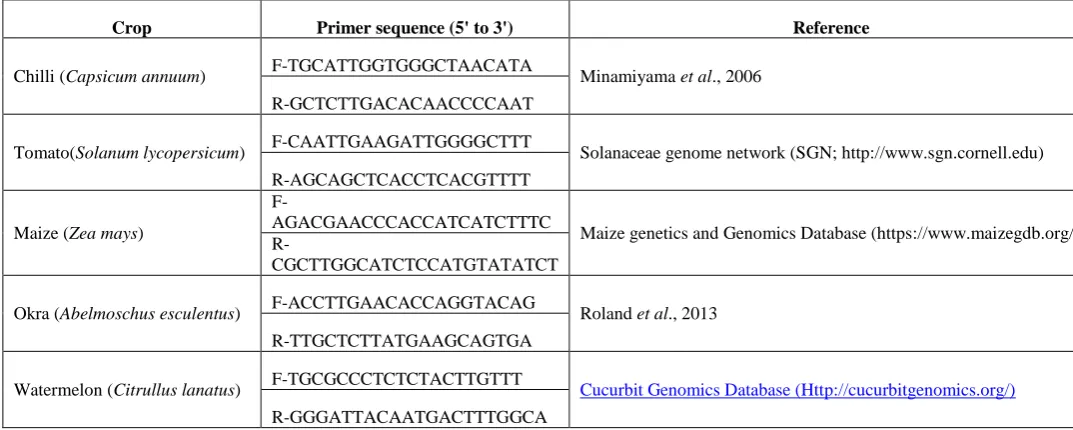
The sequence of SSR primers used to amplify the DNA fragment for each crop is mentioned in table 2. PCR amplified products were run on 3.5% agarose gel at 150 V in 1X Sodium Borate buffer by electrophoresis and stained with ethidium bromide for gel documentation.
In the present study, a simple, quick, reproducible and cost-effective protocol for genomic DNA extraction from various plant materials of different crops was established. At present, other DNA extraction protocols are very expensive and laborious involving multiple reagents, solvents and equipments. Sometimes, the protocol may not be suitable for extracting good quality DNA from different parts of the plant due to the presence of secondary metabolites at varied concentrations. Even though renowned CTAB method (Murray and Thompson, 1980) and commercially available extraction kits provide successful extraction of high quality DNA, they are either time consuming or expensive respectively.
In this method, the successful extraction of DNA is probably due to breaking the plant cell wall using mechanical force in the presence of the extraction buffer. Sodium dodecyl sulfate (SDS) in the extraction buffer liberated DNA by lysing cell and nuclei (Manak, 1993). Further addition of Tris HCl solution followed by centrifugation co-precipitated cell debris with protein and polysaccharide complexes that affect quality of extracted DNA. The presence of PVP in extraction buffer helps in effectively binding to polyphenol compounds, if present, that can also be separated from DNA by centrifugation.
To test the quality of genomic DNA extracted by
this method, samples from different parts of chilli, tomato, maize, watermelon and okra were collected and subjected to DNA extraction. The extracted DNA was used for PCR amplification using
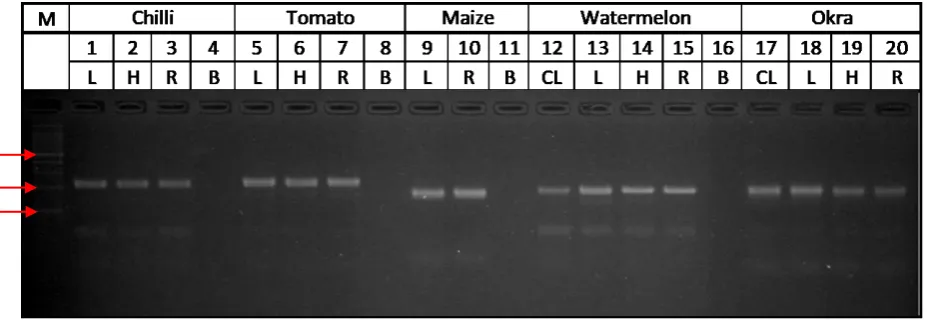
microsatellite (SSR) markers. Distinct DNA fragments were clearly observed from amplified products when separated on 3.5 % agarose gel (Fig. 1). This clearly indicates that DNA extracted by this method was free from plant secondary metabolites, which interfere with yield and quality of DNA (Porebski et al., 1997).
Since only a little amount of plant material is used for extraction, this method enables us for quick and early stage genetic analysis or screening of plant growth. This simple “crush and use” method does not require any organic solvents or other treatments like incubating at specific temperature, proteinase and RNase treatment, purification etc. Minimal use
of chemicals considerably reduced cross
contamination problems and eventually reduced time also. This proposed method will be useful in screening large numbers of plant samples where genetic purity tests are performed regularly.
Major advantages of this method are ease and speed of extraction, reduced costs, minimal chemical usage and high quality DNA obtained, which make this method ideal for extracting DNA from different plants for PCR based genetic analysis.
In this study, a simple, rapid and cost effective method for genomic DNA extraction from various parts of the different crops was developed and validated in different crops. The quality and quantity of DNA obtained by this method was sufficient for PCR based genetic analysis using microsatellite markers. This study provides a promising method for extracting DNA from large number of samples in short duration with no much labour, chemicals and equipments. In future studies, this method needs to be modified for efficient DNA extraction from various plant species of different age, types and concentrations of secondary metabolites.
References
Allen, G. C., Flores-vergara, M. A., Krasnyanksi, S., Kumar, S. and Thompson, W. F., 2006. A modification protocol for rapid DNA isolation
from plant tissues using
cetyltrimethylammoniumbromide. Nat. Protoc.,
1 (5) : 2320-2325.
Hong Wang, Meiqing Qi and Adrian J. Cutler. 1993. A Simple method of preparing plant samples for PCR. Nucleic Acids Research.,21(17) : 4153-4154.
374 Manak, M. M. 1993. Sample preparation. In: Keller, G.
H., Mamak, M. M. (Eds.), DNA Probes. Stockton Press, New York.
Minamiyama, Y. and Masato, Æ. T. 2006. An SSR-based linkage map of Capsicum annuum. Mol. Breeding., 18 : 157-169.
Murray, H. G. and Thompson, W. F. 1980. Rapid isolation of high molecular weight DNA.
Nucleic Acids Res., 8 : 4321-4325.
Porebski, S., Bailey, L. G. and Baum, B. R., 1997. Modification of a CTAB DNA extraction
protocol for plants containing high polysaccharide and polyphenol components.
Plant Mol. Biol. Report., 15 : 8-15.
Roland, S., Sanjeet Kumar, Chen-Yu Lin, Satish, G. H. and Andreas Ebert. 2013. The okra (Abelmoschusesculentus) transcriptome as a source for gene sequence information and molecular markers for diversity analysis. Gene.,
517: 27-36.
375
Table 1. List of crops and various plant materials used for this study
S. No. Crop Parts used in the study
1 Chilli (Capsicum annuum) Leaf, hypocotyl, root 2 Tomato (Solanum lycopersicum) Leaf, hypocotyl, root
3 Maize (Zea mays) Leaf, root
4 Okra (Abelmoschus esculentus) Cotyledonary leaf, leaf, hypocotyl, root 5 Watermelon (Citrullus lanatus) Cotyledonary leaf, leaf, hypocotyl, root
Table 2. Sequence of SSR markers of different crops used in this study for PCR amplification
Crop Primer sequence (5' to 3') Reference
Chilli (Capsicum annuum) F-TGCATTGGTGGGCTAACATA Minamiyama et al., 2006 R-GCTCTTGACACAACCCCAAT
Tomato(Solanum lycopersicum) F-CAATTGAAGATTGGGGCTTT Solanaceae genome network (SGN; http://www.sgn.cornell.edu) R-AGCAGCTCACCTCACGTTTT
Maize (Zea mays)
F-AGACGAACCCACCATCATCTTTC
Maize genetics and Genomics Database (https://www.maizegdb.org/)
R-CGCTTGGCATCTCCATGTATATCT
Okra (Abelmoschus esculentus) F-ACCTTGAACACCAGGTACAG Roland et al., 2013 R-TTGCTCTTATGAAGCAGTGA
Watermelon (Citrullus lanatus) F-TGCGCCCTCTCTACTTGTTT Cucurbit Genomics Database (Http://cucurbitgenomics.org/)
376
Fig. 1. Agarose gel electrophoresis showing distinct DNA banding pattern of various plant materials from different crops.
Lane M - 100 bp DNA ladder (GeneDirex), Lane B - Blank (No sample), Amplification profile of chilli
(Capsicum annuum) - Lane (1-3), Tomato (Solanum lycopersicum) - Lane (5-7), Maize (Zea mays) - Lane
(9-10), Watermelon (Citrullus lanatus) - Lane (12-15) and Okra (Abelmoschus esculentus) - Lane (17-20). : CL - Cotyledonary leaf, L - Leaf, H - Hypocotyl and R - Root.
500 bp
200 bp