TRANS Asian Research Journals
http://www.tarj.in 50
P u b l i s h e d b y : T R A N S A s i a n R e s e a r c h J o u r n a l s
TAJMMR:
T R A N S
A s i a n J o u r n a l o f
M a r k e t i n g & M a n a g e m e n t
R e s e a r c h
( A D o u b l e B l i n d R e f e r e e d & R e v i e we d I n t e r n a t i o n a l J o u r n a l )
LAPTOPS V/S HAND-HELD DEVICES IN B-SCHOOLS- STUDIES ON
USAGE, PREFERENCE AND BEHAVIOR PATTERNS
Neeraj Kumar*; Rekha Makhija**;
Prashant Iyer***; Mohamed Sheriff Ameer****
*S P Jain School of Global Management. **S P Jain School of Global Management. ***S P Jain School of Global Management. ****S P Jain School of Global Management.
ABSTRACT
Today’s market has so many gadgets that consumers are almost spoilt for choice. Also a bulk of the consumers who are students have difficulty in choosing between laptops or handheld devices like smart phones and tablets for their day to day activities. In this paper attempt has been made to highlight how education and technology have evolved hand in hand over the years. We also have conducted an exhaustive research on the usage patterns of laptops and handheld devices among students to find their preferences and behavior patterns. We have restricted our research to Business school students because they are widely exposed to various gadgets as part of their academic learning and daily activities. This study helps us to gauge, compare and to an extent even predict the future of different gadgets in the higher education sector. The survey showed that though the current usage of laptops is highest for academic and leisure activities, their preference are more towards tablets. There are various business schools that have already adapted tablets as a substitute for laptops and books. With the rapidly increasing advancement in technology, the usage of tablets for education is expected to become more widespread across various educational institutions.
KEYWORDS: Business schools, Education, Hand-held devices, Laptops, Mobiles, Technology.
TRANS Asian Research Journals
http://www.tarj.in 51
INTRODUCTION
Technology is the source of some of the most significant and radical changes in the methods of imparting learning in the education industry. It has significantly altered the way teachers, students and educational institutions operate [5]. In earlier times, school education made use of simple tools, such as blackboards and chalks,which were the primary teaching devices.Students relied heavily on books and papers for their learning process. For students who would work on a project, say on Antarctica, there were limited tools available at their disposal. Libraries were the main source of information, where students would go and read about Antarctica [1]. Thomas Edison said in 1925 that “books will soon be obsolete in schools. Scholars will soon be instructed through the eye.”
We are now living in digital age [2]. There has been a paradigm shift in the learning experience. Time has changed and tools available for imparting knowledge have evolved, and so have the teaching methods. Today, classrooms have evolved from being centered on blackboards and books to becoming multimedia centers with video screens, computers and IPads. Today, when a student works on a project on Antarctica, students need not leave the classrooms to do so [1]. The most significant development that the education industry has seen since the invention of the printing press is the computer and related technological innovations [4].
Text books are being replaced by digital readers and the traditional technology is moving online. In 2011, South Korea announced that by the year 2015, all text books will be replaced by e-books [2].There are diverse and innumerable resources available to students because of the technological developments within the class room scenario.Students can do a virtual visit to Antarctica through a video screen in the class room.Thus, education has become more customer oriented, with the class room being more learner oriented rather than lecture oriented[1].
The role of teachers has also changed because of the evolution in technology over time.This evolution has led to the reinvention, reorganization and rebuilding of the teaching pedagogies [5]. Earlier, teachers were one of the most important sources of knowledge, with the focus being more on one-sided knowledge sharing. Whereas, in today’s world, teachers act more as education facilitators, with students have diverse sources of knowledge available. Teaching methods have evolved because of the technology evolution within the classroom. Teachers, unlike earlier who mainly disseminated information to students, today challenge students to search for and uncover information themselves[1]. Given the information age that we are currently in, educational institutions all over the world are increasingly budgeting for technology
tools to be used in their institutions [1]. In 1996, the first fully online university was launched,
thus enabling students to undertake distance learning [3]. Online education has helped evolve the education ecosystem. Students now have the option to choose from various different sources of the same information. They can choose between different lecturers teaching the same subject through different sources [4].
TRANS Asian Research Journals
http://www.tarj.in 52
have the opportunity to apply their learnings in real business life like virtual scenarios through simulations [4].
Laptops and tablets have revolutionized the education system due to the numerous advantages that they have over traditional forms of learning. One advantage that stands out is the increased interaction with content that it allows students to have. Some of the major advantages that technological innovations have on education and learning are as explained below:
REDUCED LEARNING TIME: Laptops and tablets can be used not only for calculations, but also for knowledge surfing, having reduced the time required to learn a particular concept. In the traditional method of learning, the only major resource to gather information was books, whereas currently, portable devices provide quick access to huge database of reference materials, e-books, video resources and presentations. This has significantly reduced the learning time for students.
PORTABILITY: One major advantage that technological advancements such as handheld devices have brought about is their portability. Now the learning experience is not confined to classrooms, laboratories, libraries or rooms. Because of increased battery life, laptops and tablets can accompany a student while travelling too.
INTERACTION: Portable devices have enhanced the learning experience by providing a platform for a student to interact with other students, professors or industry experts at any place and time. Technology also helps students to study in a group because it enables better interaction.
SIZE: Because of their small size, laptops and tablets are not confined to laboratories or rooms. Data can be stored on the systems and carried from one place to another.
COST: With the evolution of technology, the price of devices, such as laptops and tablets has reduced by a noticeable margin. Now a days, students can buy devices that are easily available at affordable prices.
WIRELESS: Data can be easily transferred using Bluetooth or other wireless techniques, which adds to the portability and advancement in use.
SIMPLICITY AND SUPPORT: Handheld devices are easy to use and have readily available technical support, applications and upgraded software’s. [10]
Though portable devices have numerous advantages, they have some noticeable and significant disadvantages. Educational system will have to strike a balance to utilize the portable devices in the best way. Some of the major disadvantages of portable devices are:
TRANS Asian Research Journals
http://www.tarj.in 53
LACK OF CONCENTRATION: Portable devices are not only used for learning or calculation but for entertainment as well. Entertainment can hamper one’s concentration if one becomes addicted to it. Many of the social networking applications like Whatsapp and Facebook distract the students a lot.
STORAGE: Laptops and tablets have limited storage capacity. At least Laptops can be upgraded, but Smartphones and tablets have fixed configurations.
READING ABILITY: Portable devices specially tablets have a smaller screen size then desktops. This makes reading tough on them. As portable devices in education are mainly used for reading and calculations, this comes as a strong shortcoming.
UNETHICAL USE DURING EXAMINATIONS: If portable devices are allowed in colleges they can be used during examinations for unethical practices, such as cheating. Even if a tablet is not able to store large information, internet can easily be accessed through it and provides source to large information for cheating.
HEALTH CONCERNS: Handheld devices can be a health hazard for students if used regularly. They can not only affect eyes but other parts of the body as well. Thus, the increased use of technological devices can have a detrimental impact on the health of students. [9].
TECHNOLOGICAL DIFFERENCES IN LAPTOPS, TABLETS AND SMARTPHONES
LAPTOPS
TRANS Asian Research Journals
http://www.tarj.in 54
TABLETS
Tablets are currently the trendiest gadgets in the mobile technology space. They are extremely compact and portable. They are very useful in multitasking. Most of the tablets have very good graphics and fabulous interfaces which makes them attractive. These interfaces provide unmatched usability and comfort.A majority of them today are equipped with dual cameras to capture and record videos or photos and also make video calls. They have inbuilt 3G connectivity which helps to stay connected on the go.However, it is difficult to perform complicated tasks which involves lots of typing, and calculations. Also the battery life is not much and lasts for only a few hours. The Wi-Fi and 3G connectivity also contribute significantly in draining the battery life. Software upgradation for tablets has become extremely convenient and fast,but the hardware upgradation and expansion options which are limited is still a challenge. They have limited options to store data externally. But it could be transferred to a computer or uploaded on cloud.
SMARTPHONES
Smartphones are the most portable and most widely used multi-tasking gadget in today’s world. Smart phones can easily be connected to 3G and Wi-Fi which makes it one of the best “In your pocket” gadgets providing internet access round the clock.They do have very good processing speeds and internal memory but cannot be compared to laptops or tablets in this regard. They have comparatively very small screen size when compared to tablets or Laptops. These hardware limitations restrict their usage to limited functionalities. They cannot be used for data entry, presentation, and complex calculations. The hardware upgradation and customizability remains a challenge.
BUSINESS SCHOOLS
Business schools have been most receptive to new technologies. This is mainly because the learning involves a dynamic curriculum which keeps continually changing with the business world. Also, there is a lot of unstructured materials like case studies, videos etc. from different sources that are used in business schools.
An MBA, over the years, has always been linked to innovative thinking and has evolved as a reaction to management approaches. Hence, B-schools have resorted to new teaching methods and embraced new technologies
TRANS Asian Research Journals
http://www.tarj.in 55
CURRENT SCENARIO OF LAPTOPS, TABLETS AND SMART PHONES IN BUSINESS SCHOOLS
With the availability and access to various electronic gadgets to students in the B-schools they are able to:
• Gain experience with technology that they would be using when they are in the business world in the future.
• Understand how Information technology can be maximized to create innovation and drive business growth.
• Have access to emails and notifications all the time. Universities like to keep the students engaged and busy inside and outside the class by giving the students assignments and other tasks.
• Keep track of calendar events and make changes as and when required.
• Organize notes, materials, tasks, assignments etc. at one place. This eventually helps manage time and increases productivity.
• Share information with others. With the availability of intra networks and internet, it becomes easy for students to share data with each other and also helps faculty to share information with the students. Traditional practices of sharing hard copies which will have to be photocopied and distributed to all students have become redundant.
• Replay lectures. Now a days, many universities/schools have the facility to video record the lectures and make it available to the students in case they want to listen to it again or also if they were unable to attend the lecture.
• Record data from field (text, pictures, audio, video etc.) and send it to teacher in classroom.
• Apply their learning through simulations and quizzes.
SURVEY
METHOD AND SCOPE
TRANS Asian Research Journals
http://www.tarj.in 56
SURVEY RESULTS AND ANALYSIS
DEVICE OWNERSHIP
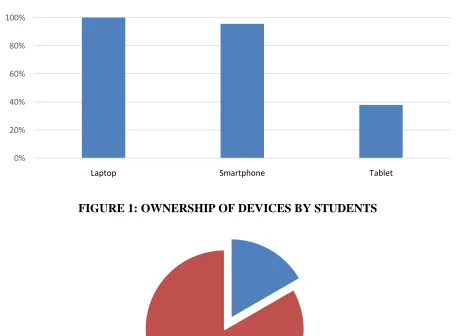
Descriptive analysis on the usage of devices by students showed that all students owned a laptop, and more than 95% students owned a smart phone device. In comparison, only 38% of the students owned a tablet (such as IPad, Kindle, or Android tablet). The usage of tablets in class room is very limited, with less than 40% of the students using a tablet in the classroom. See below for a graphical presentation of this analysis.
FIGURE 1: OWNERSHIP OF DEVICES BY STUDENTS
FIGURE 2:USAGE OF TABLETS IN CLASSROOM
0% 20% 40% 60% 80% 100% 120%
Laptop Smartphone Tablet
TRANS Asian Research Journals
http://www.tarj.in 57
BEHAVIORAL PATTERN
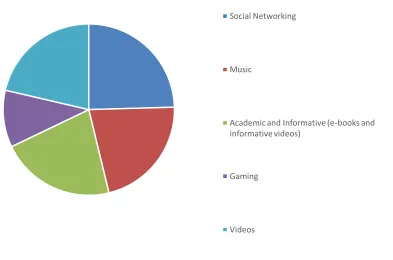
It is important to obtain an understanding of the behavior of students in terms of time spent on major activities. This will help us to identify the specific needs of students, and to etter analyze the current and preferred usage patterns for devices.
FIGURE 3: BEHAVIOURAL PATTERN OF STUDENTS
The results indicate that students spend maximum amount of time on social networking (such as Facebook, social connectivity, etc.), followed by a slightly lesser amount of time on academic work, which includes reading and carrying out academic work, and music. This is followed closely by time spent on videos. Not surprisingly, the least amount of time is spent by the students on gaming.
CURRENT USAGE COMPARED TO PREFERENCE
The survey results of the current usage versus preference of laptops, tablets and smartphone’s for academic activities presented in below graph indicates that currently 65% of the student population are using laptops, 15% of the students are using tablets and 20% of the students are using smart phones. Preference for tablets is 20% higher than the current usage, while that of laptopsis lesser by the same percentage. It is observable that the preference for smart phones usage remains more or less the same. This change can be attributed to the various advantages that tablets have above laptops.
Social Networking
Music
Academic and Informative (e-books and informative videos)
Gaming
TRANS Asian Research Journals
http://www.tarj.in 58
FIGURE 4: CURRENT USAGE V/S PREFERENCE IN USAGE OF LAPTOPS, TABLETS AND SMARTPHONE’S FOR ACADEMIC ACTIVITIES
The survey results for the current usage versus preference of laptops, tablets and smart phone’s for leisure activities shown in below graph indicates that the current usage of laptops is 67%, that of tables is 8% and that of smart phones is 25%. Preference for laptops is decreasing by a small margin of 7%, while that of tablet is increasing by 12% and that of smart phone is decreasing by 5%. The usage preference is not changing as drastically for leisure activities as for academic. This diverse response can be attributed to the fact that students have not adjusted to the smaller screen of tablets for activities like gaming and watching movies.
FIGURE 5: CURRENT USAGE VERSUS PREFERENCE IN USAGE OF LAPTOPS, TABLETS AND SMARTPHONE’S FOR LEISURE
Survey result for the current usage versus preference of laptops, tablets and smart phone’s for communication indicates that the current usage of laptops is 38%, that of tablets is 7% and that of smart phones is 55%. Preference for future is decreasing for laptops by 8%, while increasing for tablets by 17% and decreasing for smart phones by 9%. This change can be attributed to the fact that most of the tablets perform dual function, that of a laptop as well as of a smart phone.
0% 20% 40% 60% 80%
Laptop Tablet Smartphone
Current Usage
Preference
0% 20% 40% 60% 80%
Laptop Tablet Smartphone
Current Usage
TRANS Asian Research Journals
http://www.tarj.in 59
FIGURE 6: CURRENT USAGE VS PREFERENCE IN USAGE OF LAPTOPS, TABLETS AND SMARTPHONE’S FOR COMMUNICATION
CONCLUSION
In this study we focused on studying the student’s current usage versus preference towards usage laptops, tablets and smart phones. Student’s use laptops, tables and smart phones majorly for three broad activities, academic, leisure and communication.
The survey showed that though the current usage of laptops is highest for academic and leisure activities, their preference is more towards tablets. This difference in usage and preferences of customers may be because of the difficulty in using tablets for academic purposes, such as to perform calculations. Further, the user interface, such as lack of keyboard makes the device more difficult to use. In order to use tablets and other mobile devices in academics, students need support regarding usage of mobile technology in the sphere of learning. Students should also be provided access to mobile devices for learning.
There are various business schools that have already adapted tablets as a substitute for laptops and books. With the rapidly increasing advancement in technology, the usage of tablets for education is expected to become more widespread across various educational institutions. However, tablets will be phased out completely. Their usage is more likely to become more in line with a desktop computer, with tablets taking the center stage in the learning experience.
REFERENCES
1.
http://web.b.ebscohost.com/ehost/detail?sid=51037476-c340-4153-a747-cf2d594db2d3%40sessionmgr
112&vid=1&hid=124&bdata=JnNpdGU9ZWhvc3QtbGl2ZQ%3d%3d#db=buh&AN=11195 98
2.
http://www.onlineschools.com/in-focus/educational-technology?WT.qs_osrc=gensynd-edtech 0% 10% 20% 30% 40% 50% 60%
Laptop Tablet Smartphone
Current Usage
TRANS Asian Research Journals
http://www.tarj.in 60
3. http://www.teachthought.com/trends/the-evolution-of-classroom-technology/
4. http://harvardmagazine.com/2013/09/harvard-past-president-endorses-online-education
5.
http://web.b.ebscohost.com/ehost/detail?sid=752f2fad-cc08-4cf4-82ef-141af834380f%40sessionmgr112&vid=1&
hid=124&bdata=JnNpdGU9ZWhvc3QtbGl2ZQ%3d%3d#db=buh&AN=4922113 See pdf- Article 6
6. http://www.jite.org/documents/Vol11/JITEv11IIPp301-317Mang1138.pdf
7. http://ianwylie.co.uk/wp-content/uploads/2012/01/easyJetSocialMedia.pdf
8. http://www.edudemic.com/10-big-concerns-about-tablets-in-the-classroom/
9. http://new-technology-in-education.wikispaces.com /Advantages+and+Disadvantages