University of Windsor University of Windsor
Scholarship at UWindsor
Scholarship at UWindsor
Electronic Theses and Dissertations Theses, Dissertations, and Major Papers
2015
CFD Simulation of Impinging Jet Flows and Boiling Heat Transfer
CFD Simulation of Impinging Jet Flows and Boiling Heat Transfer
Mehrdad Shademan
University of Windsor
Follow this and additional works at: https://scholar.uwindsor.ca/etd
Part of the Mechanical Engineering Commons
Recommended Citation Recommended Citation
Shademan, Mehrdad, "CFD Simulation of Impinging Jet Flows and Boiling Heat Transfer" (2015). Electronic Theses and Dissertations. 5700.
https://scholar.uwindsor.ca/etd/5700
This online database contains the full-text of PhD dissertations and Masters’ theses of University of Windsor students from 1954 forward. These documents are made available for personal study and research purposes only, in accordance with the Canadian Copyright Act and the Creative Commons license—CC BY-NC-ND (Attribution, Non-Commercial, No Derivative Works). Under this license, works must always be attributed to the copyright holder (original author), cannot be used for any commercial purposes, and may not be altered. Any other use would require the permission of the copyright holder. Students may inquire about withdrawing their dissertation and/or thesis from this database. For additional inquiries, please contact the repository administrator via email
i CFD Simulation of Impinging Jet Flows and Boiling Heat Transfer
By
Mehrdad Shademan
A Dissertation
Submitted to the Faculty of Graduate Studies
through the Department of Mechanical, Automotive & Materials Engineering
in Partial Fulfillment of the Requirements for
the Degree of Doctor of Philosophy
at the University of Windsor
Windsor, Ontario, Canada
2015
ii CFD Simulation of Impinging Jet Flows and Boiling Heat Transfer
By
Mehrdad Shademan
APPROVED BY:
__________________________________________________
Dr. B.-C. Wang, External Examiner
University of Manitoba, Winnipeg, MB
__________________________________________________
Dr. V.T. Roussinova
Department of Civil & Environmental Engineering
__________________________________________________
Dr. G.W. Rankin
Department of Mechanical, Automotive & Materials Engineering
__________________________________________________
Dr. A. Fartaj
Department of Mechanical, Automotive & Materials Engineering
__________________________________________________
Dr. R. Balachandar (Co-Advisor)
Department of Mechanical, Automotive & Materials Engineering
__________________________________________________
Dr. R.M. Barron (Co-Advisor)
Department of Mechanical, Automotive & Materials Engineering
iii DECLARATION OF CO-AUTHORSHIP/PREVIOUS PUBLICATION
I. Co-authorship Declaration
I hereby declare that this dissertation contains original material that is the result of joint research. R. Barron and R. Balachandar contributed to all chapters by providing the opportunities and facilities necessary to complete the research along with intellectual guidance. V. Roussinova also contributed to Chapter 3 by providing experimental results and constructive guidance, detailed comments and helpful direction. In all chapters, the ideas, data interpretation, and writing of all manuscripts and dissertation were performed by the author, Mehrdad Shademan.
I am aware of the University of Windsor Senate Policy on Authorship and I certify that I have properly acknowledged the contribution of other researchers to my thesis. I certify that, with the above qualification, this dissertation, and the research to which it refers, is the product of my own work.
II. Declaration of Previous Publications
This dissertation includes three original papers that have been previously published in peer-reviewed journals and conferences, as follows:
Dissertation Chapter
Publication tile/full citation Publication
status
Chapter 2 Shademan, M., Balachandar, R., Barron,
R.M., 2013. CFD analysis of the effect of nozzle stand-off distance on turbulent impinging jets. Canadian Journal of Civil Engineering 40(7): 603-612
published
Chapter 3 Shademan, M., Roussinova, V., Barron,
R.M., Balachandar, R., 2014. Large eddy simulation of round impinging jets with large stand-off distance. ASME Congress, Montreal, Canada
published
Chapter 4 Shademan, M., Balachandar, R., Barron,
R.M., 2014. CFD simulation of boiling heat transfer using OpenFOAM. ASME
Congress, Montreal, Canada
iv I certify that I have obtained written permission from the copyright owner(s) to include the above published material(s) in my dissertation. A copy of these written permissions is included in the Appendix. I certify that the above material describes work completed during my registration as a graduate student at the University of Windsor.
I certify that, to the best of my knowledge, my dissertation does not infringe upon anyone’s copyright nor violate any proprietary rights and that any ideas, techniques, quotations, or any other material from the work of other people included in my dissertation, published or otherwise, are fully acknowledged in accordance with the standard referencing practices. Furthermore, to the extent that I have included copyrighted material that surpasses the bounds of fair dealing within the meaning of the Canada Copyright Act, I certify that I have obtained written permission from the copyright owner(s) to include such material(s) in my dissertation.
v ABSTRACT
Circular jets impinging vertically on flat surfaces have many practical
applications in industry. Nozzle height-to-diameter ratio plays an important role in
the performance of this type of jet.
In this thesis a step by step approach has been followed to cover different
aspects of impinging jets. In the first step, a steady Reynolds-Averaged
Navier-Stokes simulation has been carried out on impinging jets with different nozzle
stand-off distances. A strong dependency of the jet characteristics on the nozzle
height-to-diameter ratio was observed. The simulations show that an increase in
this ratio results in larger shear stress and more distributed pressure on the wall.
In the second step, an unsteady simulation using Large Eddy Simulation
has been performed on an impinging jet with large stand-off distance. Good
agreement was observed between the mean value results obtained from the
current simulations and experiments. Unlike impinging jets with small stand-off
distance, where the ring-like vortices keep their interconnected shape upon
reaching the plate, no sign of interconnection was observed on the plate for the
large stand-off distance case. A large deflection of the jet stagnation streamline
was observed in comparison to the cases with small nozzle height-to-diameter
ratios. Large fluctuations of the unsteady wall shear stresses were also captured.
A boiling model was developed for impinging jets with heat transfer. An
Eulerian-Eulerian two-phase flow model was implemented using an open source
code for the simulation (OpenFOAM). Initially, an adiabatic two-phase model was
vi account for non-adiabatic and boiling conditions. The simulation predictions were
found to be in reasonable agreement with the experimental data and show
significant improvement over previous numerical results. Finally, the model was
upgraded for an impinging jet flow by implementing new correlations. The results
obtained from the current model show reasonable agreement with the
experimental results. The model can be confidently used for the evaluation of
vii DEDICATION
To my parents and my wife, Sara.
viii ACKNOWLEDGEMENTS
I would like to express my sincere gratitude to my supervisors Dr. Ron
Barron, and Dr. Ram Balachandar for their endless support and guidance
throughout my Ph.D. studies. I appreciate their encouragement and support
which assisted me with my work and gave me self-confidence. I would also like
to thank my graduate committee members for their ideas and comments during
my research. I am thankful to Dr. Vesselina Roussinova for providing me
valuable information. I would like to thank Drs. Amir Fartaj and Gary Rankin, for
their support along the way.
It was not possible to complete this project without help from many people.
My thanks to Kohei Fukuda, Sudharsan Annur Balasubramanian, Vimaldoss
Jesudhas, Mehdi Heidari and Mohammadali Esmaeilzadeh for encouraging and
commenting on my work. My thanks tothe staff at the Shared Hierarchical
Academic Research Computing Network (SHARCNET) for their endless support
during the simulations. Many thanks to Doug Roberts, Terry McKay, Alexei
Razoumov, Mark Hah, Kaizaad Bilimory, Tyson Whitehead, Gary Molenkamp,
Isaac Ye and Fraser McCrossan for their guidance and maintenance support for
SHARCNET facilities. I am also thankful to the nice friends and staff at FDRI.
This research was financially supported by NSERC through the Vanier
ix TABLE OF CONTENTS
DECLARATION OF CO-AUTHORSHIP/PREVIOUS PUBLICATION... iii
ABSTRACT...……….………... v
DEDICATION....………... vii
ACKNOWLEDGEMENTS...….………..…... viii
LIST OF FIGURES...………... xiii
LIST OF TABLES... xvii
NOMENCLATURE……….. xviii
CHAPTER 1 ... 1
INTRODUCTION AND LITERATURE REVIEW 1.1. Background and motivation ... 2
1.1.1. Adiabatic round impinging jets ... 3
1.1.2. Round impinging jets with boiling heat transfer ... 8
1.1.3. Objectives and outline of the dissertation ... 14
CHAPTER 2 ... 16
RANS ANALYSIS OF THE EFFECT OF NOZZLE STAND-OFF DISTANCE ON TURBULENT IMPINGING JETS 2.1. Introduction ... 17
2.2. Numerical method ... 20
2.2.1. Geometry modelling and boundary conditions ... 20
2.2.2. Governing equations ... 23
x
2.3.1. Centreline velocity ... 25
2.3.1.1. H/D = 2 ... 27
2.3.1.2. H/D = 6 ... 27
2.3.1.3. H/D = 18.5 ... 28
2.3.2. Radial distribution of velocity ... 29
2.3.3. Radial distribution of shear stress ... 32
2.3.3.1. Shear stress in regions I, II and III ... 32
2.3.3.2. Wall shear stress ... 35
2.3.4. Static pressure along the plate ... 37
2.3.5. Wall jet region ... 38
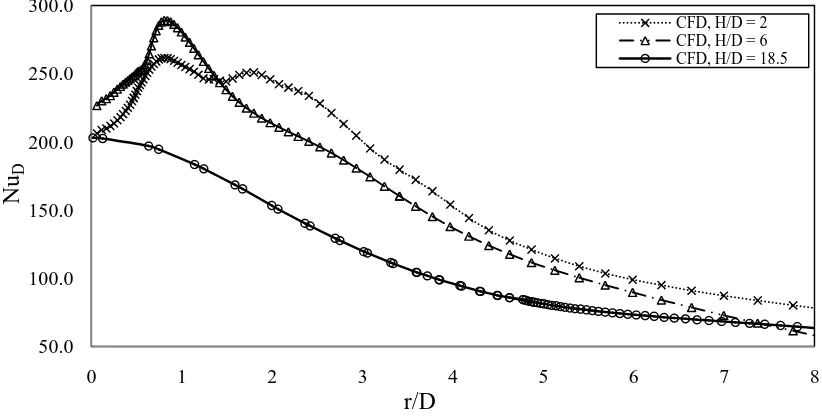
2.3.6. Wall heat transfer ... 41
2.4. Conclusions ... 44
CHAPTER 3 ... 46
LARGE EDDY SIMULATION OF ROUND IMPINGING JETS WITH LARGE STAND-OFF DISTANCE 3.1. Introduction ... 47
3.2. Numerical method ... 51
3.2.1. Geometry and boundary conditions ... 51
3.2.1.1. Nozzle flow modelling ... 52
3.2.1.2. Tank flow modelling ... 53
xi
3.3. Time averaged results ... 60
3.4. Unsteady results ... 68
3.4.1. Free jet region ... 69
3.4.2. Stagnation zone and wall jet region ... 75
3.4.3. Wall shear stress... 82
3.5. Conclusions ... 85
CHAPTER 4 ... 88
CFD SIMULATION OF BOILING HEAT TRANSFER IN AN IMPINGING JET USING OPENFOAM 4.1. General remarks ... 89
4.2. Introduction ... 89
4.3. Governing equations ... 92
4.3.1. Interfacial forces ... 93
4.3.1.1. Drag force ... 94
4.3.1.2. Lift force ... 95
4.3.1.3. Wall lubrication force ... 96
4.3.1.4. Turbulent dispersion force ... 96
4.3.1.5. Virtual mass force ... 97
4.3.2. Boiling model ... 97
4.3.2.1. Phase change rates ... 100
xii
4.3.4. Turbulence modelling ... 105
4.3.4.1. Bubble induced turbulence ... 105
4.4. Results ... 107
4.4.1. Evaluation of adiabatic case ... 107
4.4.2. Evaluation of boiling model ... 112
4.4.3. Boiling simulation in an impinging jet ... 115
4.4.3.1. Lift force ... 116
4.4.3.2. Wall lubrication force ... 116
4.4.3.3. Validation of the boiling model for impinging jet ... 117
4.4.3.4. Results ... 119
4.5. Concluding remarks ... 121
CHAPTER 5 ... 123
CONCLUSIONS AND RECOMMENDATIONS REFERENCES ... 130
APPENDIX A- REPRINT PERMISSIONS ... 141
xiii LIST OF FIGURES
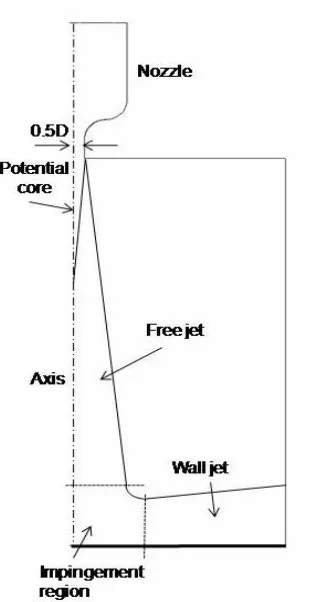
Fig. 1.1 Definition schematic of an axisymmetric impinging jet ... 2
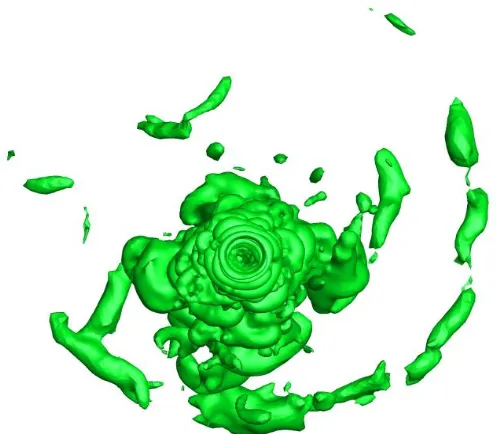
Fig. 1.2 Iso-surfaces of λ2 criterion colored with velocity magnitude contours close to the nozzle exit ... 4
Fig. 1.3 Iso-surface of pressure contours (-20 pa) (top view) ... 4
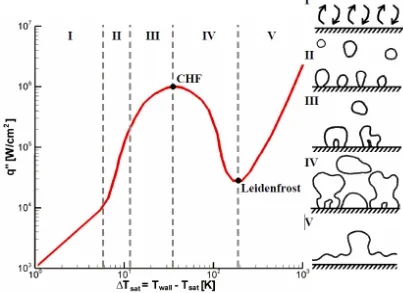
Fig. 1.4 Typical boiling curve and associated boiling regimes (Coursey, 2007) . 10 Fig. 2.1 Definition schematic of an impinging circular jet with large height-to-diameter ratio (adapted from Rajaratnam et al. (2010)) ... 18
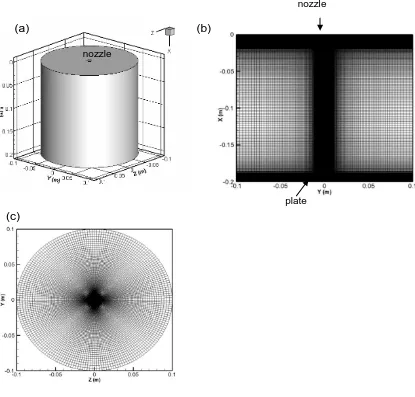
Fig. 2.2 (a) Full 3D geometry, (b) cross-section of the computational domain and mesh, and (c) domain dimensions and boundary conditions ... 21
Fig. 2.3 Comparison between computational and experimental centreline velocity ... 26
Fig. 2.4 Mean velocity distribution at different x/H stations, comparing experimental data and CFD results; (a) H/D = 2, (b) H/D = 6, (c) H/D = 18.5 ... 31
Fig. 2.5 Comparison of experiments and CFD for the shear stress profiles uv /Uj2 at different x/H stations and H/D ratios ... 33
Fig. 2.6 Wall shear stress along the impingement plate ... 36
Fig. 2.7 Static pressure along the impingement plate ... 37
Fig. 2.8 Radial velocity V/Vm at different r/D stations in the wall jet ... 39
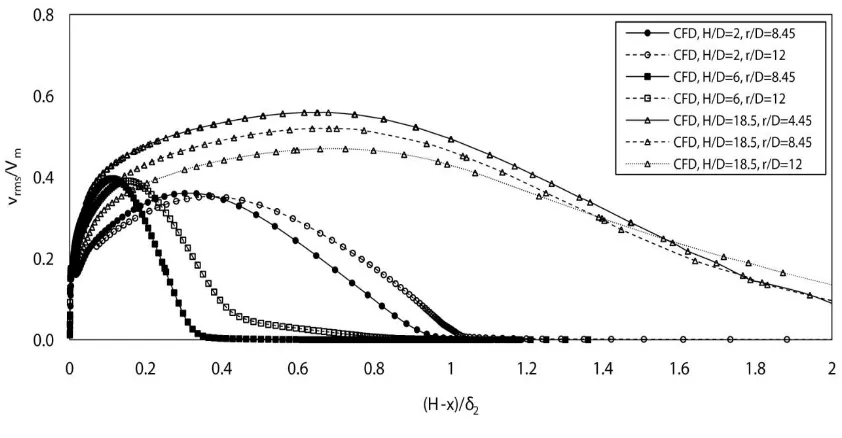
Fig. 2.9 Comparison of vrms/Vm for different nozzle heights, at different r/D stations in the wall jet region (fully developed) ... 40
Fig. 2.10 Comparison of uv /Vm2 for different nozzle heights, at different r/D stations in the wall jet region (fully developed) ... 41
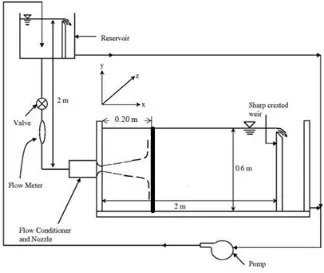
xiv Fig. 3.1 Impinging jet experimental setup (Roussinova and Balachandar, 2012) 51
Fig. 3.2 Cross-section of the mesh in the nozzle ... 52
Fig. 3.3(a) Virtual tank dimensions, (b) cross-section of the mesh inside the tank,
(c) cross-section of the mesh on the plate ... 54
Fig. 3.4 Mesh requirement analysis ... 56
Fig. 3.5 Comparison of mesh cell size with the Kolmogorov length scale at r/D=0
... 57
Fig. 3.6 Comparison of (a) mean axial velocity, (b) turbulent axial velocity,
obtained from LES and PIV experiments (Tandalam et al. 2010) at x/D = 1 ... 60
Fig. 3.7 Mean centreline velocity obtained from LES, RANS and experiments .. 62
Fig. 3.8(a) Mean static pressure along the wall, (b) mean wall shear stress ... 63
Fig. 3.9 Turbulence intensities obtained from LES and experiments ... 64
Fig. 3.10(a) Mean radial velocity profiles (V/Uj), (b) turbulent velocity profiles
(vrms/Uj) in wall region, at different r/D stations ... 65
Fig. 3.11 Contours of (a,b) mean velocity magnitude superimposed with sectional
streamlines, (c,d) streamwise turbulent velocity fluctuations and (e,f) shear stress
in the whole domain and close to the plate ... 67
Fig.3.12 Iso-surfaces of a) λ2 criterion colored with velocity magnitude contours,
b) static pressure (-20 Pa) colored with vorticity magnitude contours ... 70
Fig. 3.13 Deformation of shear layer in y-z plane visualized by the instantaneous
vorticity magnitude contours at (a) x/D = 1, (b) x/D = 1.25, (c) x/D = 1.5, (d) x/D
=1.75, (e) x/D = 2, (f) x/D = 4, (g) x/D = 7, (h) x/D = 15, (i) x/D = 20 ... 72
Fig. 3.14 (a) History of static pressure, (b) power spectra at x/D = 2 and r/D = 0.5
xv Fig. 3.15(a) History of static pressure, (b) power spectra at x/D = 18 and r/D = 5
... 75
Fig. 3.16 Instantaneous velocity magnitude (y-z plane) and static pressure
contours (x-y and x-z planes) with sectional streamlines over the characteristic
period (T2), (a) t/T2 = 0, (b) t/T2 = 1/5, (c) t/T2 = 2/5, (d) t/T2 = 3/5, (e) t/T2 = 4/5 and
(f) t/T2 = 5/5 (the red circle in y-z plane shows the nozzle) ... 78
Fig. 3.17 Generation of secondary vortices in the wall region ... 81
Fig. 3.18 Instantaneous sectional streamlines and (black) and mean (red) wall
shear stress in x-y plan over the characteristic period (T2), (a,b) t/T2 = 0, (c,d) t/T2
= 1/5, (e,f) t/T2 = 2/5, (g,h) t/T2 = 3/5, (i,j) t/T2 = 4/5 and (k,l) t/T2 = 5/5 ... 83
Fig. 4.1 Boiling model algorithm ... 102
Fig. 4.2 Implementation of breakup, coalescence and IAC equation in
OpenFOAM ... 104
Fig. 4.3 k − ε turbulence model, modified to account for gas bubbles ... 106
Fig. 4.4 a) Schematic of a two-phase pipe flow (not to scale), b) 2D axisymmetric
mesh ... 108
Fig. 4.5 Radial distribution of a) interfacial area concentration, b) void fraction, c)
liquid velocity, d) bubble diameter ... 111
Fig. 4.6 Sketch of the DEBORA test setup (Garnier et al. 2001) ... 113
Fig. 4.7 Radial distribution of a) liquid temperature, b) interfacial area
concentration, c) void fraction, d) bubble diameter ... 115
Fig. 4.8 a) Computational domain, b) mesh for the impinging jet ... 117
Fig. 4.9 Boiling curve obtained from current CFD analysis, simulation of
Narumanchi et al. (2008) and experiment of Katto and Kunihiro (1973) ... 119
xvi Fig. 4.11 Profiles at different radial stations; a) IAC, b) void fraction, c) liquid
xvii LIST OF TABLES
Table 3.1 Grid data (virtual tank) ... 55
xviii NOMENCLATURE
Ab Area covered by nucleation bubbles
As Surface area of the wall per unit volume
A w Contact area with the wall per unit volume
CD Drag force coefficient
CL Lift force coefficient
Chl Liquid Stanton number
Cpl Specific heat of liquid
Cf Fanning friction number
CWL Wall lubrication force coefficient
dB Bubble detachment diameter
dref Reference diameter of bubbles
D Nozzle diameter
f Bubble detachment frequency
F Force
F gL Lift force
F gWL Wall lubrication force
F gTD Turbulent dispersion force
F gVM Virtual mass force
F gD Drag force
g Gravity acceleration
hC Convection heat transfer coefficient
hsat Saturation enthalpy of liquid
hg Enthalpy of gas phase
hk Specific enthalpy of phase k
hl Enthalpy of liquid
H Nozzle height
IAC Interfacial area concentration
Nw Site density of bubbles
p Pressure
Ps Stagnation point pressure
qtk Turbulent heat flux
q w Wall heat flux density
qW Total heat flux from the wall
QE Evaporative heat flux
QC Convective heat flux
Qk Heat flux
QQ Quenching heat flux
r1/2 Jet half width
Rk Diffusion of phase k
xix
Re Reynolds number
t Time
tw Bubble waiting time
T1 Time period for roll up vortices close to the nozzle
T2 Time period for large scale structures hitting the plate
Tw Wall temperature
Tl Liquid temperature
Tsat ,l Saturation temperature of liquid
uτ Shear velocity
uu
Normal stress in x direction
vv
Normal stress in y direction
uu
Normal stress in z direction
uv
Shear stress in x-y plane
uw
Shear stress in x-z plane
vw
Shear stress in y-z plane
Uj Jet exit velocity
Uc Jet centreline velocity
Um Jet radial maximum velocity
U
k Velocity of phase k
Greek symbols
δ2 Distance above the plate at which V = 0.5Vm
ρk Density of phase k
k Turbulent kinetic energy
ε Turbulent dissipation rate
ν Kinematic viscosity
ω Specific turbulent dissipation rate
θ Circumferential direction
η Kolmogorov length scale
Δ Grid size
τij Subgrid-scale stresses
αk Void fraction of phase k
Γki Phase change from phase k to i
Γik Phase change from phase i to k
kl Heat conductivity of liquid
ΔTsub Subcooling temperature
ΔTsup Superheat temperature
∅C Source term for bubble coalescence
∅B Source term for bubble breakup
∅nuc Source term for bubble nucleation
μmol Molecular viscosity
μbubble Bubble induced viscosity
1 CHAPTER 1
2 1.1. Background and motivation
Turbulent jets impinging on a flat surface are commonly used in many
industrial applications where enhancement of heat and mass transfer is required.
Examples of such applications include cooling, heating, cleaning and drying. In
this type of flow, the flow field is a combination of several distinct features, such
as a free jet, a stagnation flow, and a radial wall jet (see Fig. 1.1). Each of these
flows has its own particular characteristics which have gained the attention of
many researchers.
3
1.1.1. Adiabatic round impinging jets
The characteristics of round impinging jets strongly depend upon several
parameters such as Reynolds number, distance between the nozzle and the
plate, nozzle geometry and the rate of turbulence introduced at the inlet to the
domain (Manceau et al. 2014).
The core of the free jet is surrounded by a growing shear layer. In this
shear layer the development of the Kelvin-Helmholtz instabilities results in the
formation of ring vortices. Yule (1978) defined the term ―vortex‖ as a part of a
flow field accompanying a concentrated, continuous, coherent distribution of
vorticity which is uniform in the direction of the vorticity vector. With increasing
downstream distance the ring vortices change into large eddies. An eddy may be
described as a vorticity containing region of fluid which can be identified as a
moving coherent structure in the flow (Yule, 1978). These eddies are significant
features of the turbulent region of the jet. However, features like
three-dimensionality and irregularity of the vorticity field restrict us fromdenoting them
as a ring vortex.
The ring vortices which change into large eddies (see Figs. 1.2 and 1.3)
have a three-dimensional shape and have lost their axisymmetric behaviour.
These eddies influence the flow field and cause pressure fluctuations on the
plate (Hadziabdic and Hanjalic, 2008). This phenomenon causes an unsteady
behaviour in the radial distributions ofwall shear stress and wall pressure and will
eventually influence the rate of the heat transfer from the plate (Hall and Ewing,
4 unsteady structures impinging on the plate. These impinging unsteady structures
cause separation and reattachment of the flow in the wall region which are
associated with variations in the wall shear stress (El Hassan et al. 2013).
Fig. 1.2 Iso-surfaces of λ2 criterion colored with velocity magnitude contours
close to the nozzle exit
5 The jet exit mean velocity remains constant inside the core part of the free
jet region, where the turbulence intensity is very low. Once the core reaches its
maximum penetration, which is associated with an increase in turbulence
intensity, a sharp decay in the jet centreline velocity occurs. Basically,
penetration of the turbulence from the shear layer to the core part of the jet
destroys the jet and results in a large decay in jet streamwise velocity. In the
impinging zone, the flow loses its axial velocity and changes direction due to the
presence of the plate. A wall jet is formed on the plate and attains a fully
developed behaviour as it travels towards the downstream.
There are many numerical and experimental studies in the literature on
different aspects of impinging jets. These analyses include investigations on the
steady and unsteady flow parameters, effect of nozzle stand-off distance,
behaviour of wall shear stress, pressure distribution and also separation and
reattachment of flow along the wall jet zone.
On the experimental side, the work carried out by Yule (1978) has been of
particular interest to researchers because of its fundamental overview on the
physics of impinging jets. Yule (1978) showed that for impinging jets with large
distance between the nozzle and the plate, large eddies have a wide range of
sizes and trajectories with no symmetry between them. This phenomenon results
in an unsteady three-dimensional behaviour of large scale structures causing
pressure fluctuation in the impinging zone.
The effect of nozzle stand-off distance on flow parameters has been
6 classified impinging jets with H/D > 8.3 into three sub-regions including free jet,
impinging region and wall jet zone as shown in Fig. 1.1. Following this, Giralt et
al. (1977) conducted experiments on axisymmetric turbulent impinging jets for 3
< H/D < 25. They developed an experimental correlation between flow
parameters and different H/D ratios. Although their study covered different H/D
cases, it was limited to a mean value analysis and did not present any time
history of the data.
Another aspect of impinging jetswhich has been investigated by different
researchers is the behaviour of wall shear stress and static pressure in different
flow configuration. Bradshaw and Love (1961) measured velocity, wall static
pressure and skin friction for a case with H/D = 2. They observed that the high
pressure region on the plate is slightly larger than the diameter of the jet. The
peak of the wall skin friction magnitude occurred at a radius equal to that of the
jet. A study carried out by Deshpande and Vaishnav (1982) showed a decreasing
trend for the wall shear stress as the nozzle stand-off distance increases. Recent
unsteady analysis of El Hassan et al. (2013) on the wall shear stress using
particle image velocimetry showed significant influence of large-scale vortical
structures on the wall shear stress (Re = 1260, H/D = 2). The influences of the
vortex ring, the secondary and the tertiary vortices were reported to be the main
mechanisms involved in the wall shear stress variation.
On the numerical side, there are different Reynolds-Averaged
Navier-Stokes (RANS) analyses as well as Large Eddy Simulations (LES) and Direct
7 of the studies are focused on the challenges associated with the turbulence
modeling of impinging jets.
The research of Craft et al. (1993) is one of the fundamental RANS
studies on impinging jets which investigates the issues with the turbulence
modeling for this type of flow. The benchmarking of the simulations was
performed using the experimental results of Cooper et al. (1993). Their study
suggested the higher performance of the Reynolds Stress Model with the wall
reflection models compared to other turbulence models.
Due to the limitations associated with LES and DNS computations, most
of these studies deal with small H/D ratios. Olsson and Fuchs (1998) performed
large eddy simulations for a case with H/D = 4. The purpose of their simulations
was to study the turbulence parameters and the dynamic behaviour of impinging
jets. They noticed generation of secondary vortices in the wall jet region which
was found to be a result of primary vortices generated at the jet exit shear layer.
They also observed that the primary vortices do not have an axisymmetric shape
when approaching the plate.
Hadziabdic and Hanjalic (2008) used LES to analyze a circular impinging
jet at Re = 20,000 and H/D = 2. The case that they analyzed showed that due to
the small distance between the nozzle and the plate, the generated vortices are
short-lived and undergo a faster stretching breakdown than in a free jet due to
the radial deflection. They also noticed that because of the jet flapping, the
stagnation point meanders in time around the jet geometrical centre. They
8 was due to the reattachment of the recirculation bubble and associated
turbulence production.
Uddin et al. (2013) used LES to model impinging jets at two Reynolds
numbers of 13,000 and 23,000 at H/D = 2, in order to extract the reason for the
second peak observed in the radial distribution of the Nusselt number profile.
They found that the flow acceleration in the developing region of the boundary
layer is closely related to the secondary peak in the radial distribution of Nusselt
number.
Wu and Piomelli (2014) performed LES to study the roughness effects on
the evolution of azimuthal vortices in impinging jets with H/D = 1 and Re =
66,000. They modeled one case with laminar inflow and another one with
turbulent inflow conditions. They observed a wider and weaker wall jet for the
rough surface compared to the smooth surface for the turbulent case. They
noticed that the peak of the velocity profile on the wall jet was shifted away from
the plate. They concluded that roughness results in transition to the turbulence
regime even if the inlet jet is laminar.
1.1.2. Round impinging jets with boiling heat transfer
One of the important applications of impinging jets in industry is their
usage in removal ofalarge amount of heat from a surface. For example,
impinging jets are used to cool electronic components in the computer industry
and to dissipate the heat in pistons in the automotive industry. Boiling heat
9 reduces the heat transfer, which could allow the wall temperature to increase to
the burnout point. Boiling heat transfer is characterized by a curve with different
regimes, as shown in Fig. 1.4. In Regime I, due to the small temperature
difference between the wall and liquid (wall superheat), the heat transfer
mechanism is only through free convection. This single-phase heat transfer
problem can be treated using common analytical solutions for free convection.
The nucleate boiling regime, which is characterized by two sub-regimes (II and
III), begins once bubbles are generated on the surface. Regime II refers to the
condition when the isolated bubbles are formed at their own nucleation sites
without interacting with each other when departing the surface. At higher wall
superheat (Regime III), bubbles coalesce at different directionsas a consequence
of higher nucleation frequency. Further increase of the wall superheat causes the
boiling curve to rise to the local maximum heat flux point, called the critical heat
flux (CHF). At this stage the high generation of vapor compared to previous
stages results in a blockage between the surface and liquid. Therefore, heat
must be transported through the vapor layer which is less efficient and results in
a reduction in the heat flux. In the design of appliances working with boiling heat
transfer, the CHF point is defined as a thermal limit in which further increase of
10 Fig. 1.4 Typical boiling curve and associated boiling regimes (Coursey, 2007)
The transition boiling regime (Regime IV) occurs after the CHF point,
characterized by increasing wall temperature while the heat flux removal
decreases. This is due to the increase of bubbles generated on the surface (dry
area). Therefore, this regime is not known to present any practical applications.
Finally, following the transition regime, the boiling curve reaches a local minimum
point denoted as the Leidenfrost point. At this point, the surface enters the
film-boiling regime (V). In this regime, in order to transfer heat to the liquid, it must be
conducted across a continuous vapor film. This regime of heat transfer is an
inefficient processand is not recommended for cooling purposes. It results in high
11 There are a number of studies in literature on the numerical modeling of
subcooled boiling. Basically, most of these studies deal with the challenges of
numerically modeling the boiling phenomenon and correlating it with the
experimental results.In this regard, the model developed at Rensselaer
Polytechnic Institute (RPI) by Kurul and Podowski (1990, 1991) has gained
significant attention. According to the RPI model, the boiling heat transfer is
divided into three components; convective, quenching and evaporative heat
fluxes. The convective part provides for single-phase convection, quenching
refers to liquid filling the wall vicinity after bubble detachment due to vaporization
and the evaporative component is for the fluid that evaporates.
The numerical simulation of boiling heat transfer is performed by
employing different two-phase flow methods. The Eulerian-Eulerian and Volume
of Fluid (VOF) approaches are widely used for this purpose. The
Eulerian-Eulerian method is more accurate because it solves the balance equations of
mass, momentum and energy for both phases separately. However, it is
computationally more expensive. The coupling of two phases is carried out by
introducing source/sink terms such as interfacial forces and heat flux in these
equations.
Krepper and Rzehak (2011) used the Eulerian-Eulerian approach in CFX
software for modeling the boiling heat transfer in a pipe flow. Most of their results
showed good agreement with the experimental results, except for the bubble size
radial distribution. Evaluation of their model shows that there is no interfacial area
12 changes in the bubble size and takes into account the effect of bubble break-up
and coalescence in the model. In their recent study, Krepper et al. (2013)
updated their model by implementing a population balance method which takes
into account the variation of bubble size due to bubble breakup/coalescence and
condensation/evaporation processes. The quality of their results was significantly
improved, especially for the bubble size distribution.
Michta (2011) and Michta et al. (2012) used OpenFOAM to model the
boiling heat transfer in a pipe flow and considered the IAC equation as well as
different interfacial forces in the model. The choice of OpenFOAM was based on
the fact that it is an open source code and gives permission to the user to modify
the code and to incorporate the appropriate experimental correlations. They
found reasonable results in the adiabatic part of their code, however, for the
boiling part the results were not in a good agreement with the experiments.
Kunkelmann and Stephan (2010) simulated the nucleate boiling heat
transfer using the Volume of Fluid (VOF) method in OpenFOAM. The boiling of a
single bubble was simulated by modifying the OpenFOAM default solver. Their
model captured the growth, departure and movement of the bubble. Good
agreement with the experimental results was observed for the bubble size as well
as the mean wall superheat.
There are several different interfacial forces acting on both the continuum
and dispersed phases in two-phase flows. They include, drag, lift, wall
lubrication, turbulent dispersion and added mass forces. In order to properly
13 the bubbles in two-phase flow simulations, different correlations have been
suggested by different researchers. Drag is one of the primary interfacial forces
which is generated by the continuous phase on the dispersed phase due to the
movement of the dispersed phase. The correlation developed by Ishii and Zuber
(1979) has been widely used for modelling the effect of the drag force. Tomiyama
et al. (2002) measured trajectories of single air bubbles in simple shear flow to
determine the transverse lift force acting on single bubbles. Their correlation has
gained a lot of attention in the literature for modelling the lift force in two-phase
flows. Antal et al. (1991) was the first to develop an analytical expression for the
wall lubrication force. This is a repulsive force generated by the wall which
pushes the bubbles away from it. Later, Tomiyama (1988) improved this model to
pipe geometries. Frank (2005) upgraded the Tomiyama (1998) wall lubrication
force coefficient and made it independent of the geometry. The virtual mass force
which is generated due to the relative acceleration of one phase to the other is
another important interfacial force. The correlation developed by Zuber (1964)
has been widely used for the virtual mass force by many researchers.
Narumanchi et al. (2008) developed a numerical model for boiling heat
transfer in an impinging jet. The application of their study was in the cooling of
power electronic components. They employed the Eulerian-Eulerian approach in
Fluent software and found reasonable results for the prediction of wall superheat
in the stagnation point region. However, no information was provided about the
14 Abishek et al. (2013) numerically studied the effect of heater-nozzle ratio
on the boiling phenomenon in an impinging jet. The jet Reynolds number was
2,500 with a subcooling of 20°C. They used the RPI model for decomposing the
heat flux on the impingement plate and RNG k-ε to model the turbulence. The
Eulerian-Eulerian two-phase flow model was used for the simulation. They found
that irrespective of the heater-nozzle size ratio, at high superheat temperatures
the quenching heat flux contributes to the major part of the heat flux. They also
developed a correlation for the heat flux as a function of wall superheat and the
size of the heater.
1.1.3. Objectives and outline of the dissertation
As the literature shows, there are many numerical and experimental
simulations to study the various aspects of impinging jets. On the experimental
side, detailed unsteady analysis of flow structures seem to be limited. On the
numerical side, most of the unsteady studies are either RANS based or only
cover small stand-off distances (H/D < 4).
In the first phase of this dissertation (Chapter 2), the mean value analysis
is carried out on impinging jets to evaluate the effect of nozzle stand-off distance
on different mean flow parameters. In this regard, Reynolds-Averaged
Navier-Stokes simulations are carried out using different turbulence models at three
nozzle height-to-diameter (H/D) ratios.
In the second phase (Chapter 3), due to the limited reporting of unsteady
15 flow features at large nozzle height-to-diameter ratios. The objective is to answer
critical questions raised by the steady analysis in Chapter 2. In this regard, an
unsteady simulation using Large Eddy Simulation (LES) is carried out on an
impinging jet with H/D = 20.
Commercial software has limitations in implementing the appropriate
experimental correlations for every simulation, Furthermore, due to the
inaccuracy observed in the previous numerical simulations of boiling heat
transfer, it is of interest to develop a CFD code to simulate the boiling heat
transfer for an impinging jet. As the literature shows, previous CFD approaches
for boiling simulation in impinging jets do not take into account all aspects of
two-phase flow phenomenon, particularly in the boiling part of the model. In this
regard, adetailed Eulerian-Eulerian two-phase flow model was developed using
the open source codeOpenFOAM, which takes into account the effects of
interfacial forces, breakup/coalescence of the bubbles as well as the interfacial
area concentration (IAC) equation (chapter 4). It is expected that the model
developed in this dissertation presents more accurate results than previous
investigations and advances the state-of-the-art research on boiling simulation
16 CHAPTER 2
RANS ANALYSIS OF THE EFFECT OF NOZZLE STAND-OFF DISTANCE
17 2.1. Introduction
Reynolds-Averaged Navier-Stokes (RANS) simulations have been carried
out on turbulent impinging jets to evaluate the effect of nozzle height-to-diameter
ratio on different flow parameters. In this regard, three cases with different H/D
ratios have been selected for the simulations, corresponding to short (H/D = 2),
intermediate (H/D = 6) and long (H/D = 18.5) jets.
Circular jets impinging vertically on flat surfaces have many practical
applications such as in heating, cooling, metal cutting, fabric weaving and
cleaning. Most of the experiments on impinging jets have been performed for
short stand-off distances, i.e., with an impingement height (H) to nozzle diameter
(D) ratio of less than six. Cooper et al. (1993) carried out experiments on a jet
impinging on a large plane surface and measured mean and turbulence
quantities in different regions of the jet. They considered two Reynolds numbers,
23,000 and 70,000, while the H/D ratio varied from two to ten, with particular
focus between two and six. For H/D < 6, researchers have found that the core of
the jet is still developing when reaching the plate surface (Nishino et al. 1996;
Hadziabdic and Hanjalic 2008, Shademan et al. 2013).
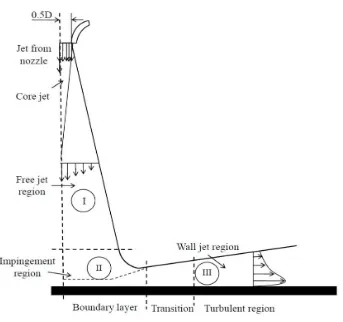
For larger impingement heights (H/D > 8.3), Beltaos and Rajaratnam
(1974, 1977) classified the flow into three different regions: the free jet portion
(region I), the impingement zone (region II) and the axisymmetric wall jet portion
(region III), as illustrated in Fig. 2.1.Giralt et al. (1977) conducted experiments on
18 34,000 up to 80,000. Based on their experimental data, they developed a
conceptual model for submerged, axisymmetric, turbulent impinging jets, which
can be used to analyze the effect of increasing the nozzle distance from the
plate. Recently, Rajaratnam et al. (2010) performed measurements on an
impinging jet with a large H/D ratio of 18.5 at Re = 100,000 using a standard
constant temperature hot-wire anemometer and evaluated the mean and
turbulence characteristics in regions I and II. They noticed self-similarity in the
radial distribution of mean velocity profiles up to regions close to the
impingement zone.
Fig. 2.1 Definition schematic of an impinging circular jet with large
19 Numerical simulation of a round jet impinging on a flat surface using
Reynolds-Averaged Navier-Stokes (RANS) turbulence models have been the
subject of considerable research, forming part of the 2nd ERCOFTAC-IAHR
Workshop on Refined Flow Modelling in 1993. Subsequently, Craft et al. (1993)
published their research using different turbulence models to analyze the heat
transfer in the impingement region of the jet, i.e., region II. They observed that
the results were not in good agreement with experimental data and attributed this
to the weakness associated with the eddy viscosity stress-strain relationship in
the turbulence models used. They also implemented second-moment closure
models. Due to the incorrect response of the wall reflection process, the eddy
viscosity model (k - ε) and the basic Reynolds Stress Model (RSM) failed to
produce reasonable results. However, an improved RSM which takes into
account the wall reflection effects generated satisfactory results.
Most of the previous analyses of impinging jets deal with a specific nozzle
stand-off distance. As mentioned earlier, the experiments by Giralt et al. (1977)
were carried out to study the effect of stand-off distance, but the evaluation is
limited to the quantities inside the jet, the variation of turbulence intensity along
the jet axis and presentation of a numerical model for determining the wall shear
stress. There is a lack of information regarding the effect of impingement
distance on the mean and turbulence quantities in different regions of the
impinging jet, including the free jet portion, impinging zone and the wall jet
region. The focus of the current study is to investigate the mean and turbulence
20 values. In addition, it is also of practical interest to evaluate the mean and
turbulence quantities in regions very close to the wall because of the
uncertainties associated with the experimental techniques in this region.
In this chapter, three-dimensional RANS simulations have been carried
out for H/D = 2, 6 and 18.5 at Re = 100,000. H/D = 2 represents a jet with
impingement occurring in the potential core region. Jets with H/D = 6 are in a
transitional state and the core of the jet is almost fully penetrated by the external
flow. At H/D = 18.5, the jet can be considered as fully developed with distinct
regions of flow including potential core, free jet and impingement zone. The
experiments performed by Rajaratnam et al. (2010) have been used as the
primary benchmark to validate the numerical model. However, other
experimental data from Bradshaw and Love (1961) and Giralt et al. (1977) are
also used to assess the accuracy of the computational results.
2.2. Numerical method
2.2.1. Geometry modelling and boundary conditions
In this research, a high velocity air jet exiting from a circular nozzle
impinges vertically on a flat plate and spreads out as a radial wall jet. The nozzle
has an exit diameter of D = 23.4 mm. The stand-off distances between the nozzle
exit plane and the plate are H = 46.8 mm (H/D = 2), 140.4 mm (H/D = 6) and 432
mm (H/D = 18.5). The value H/D = 18.5 is specifically chosen to match the
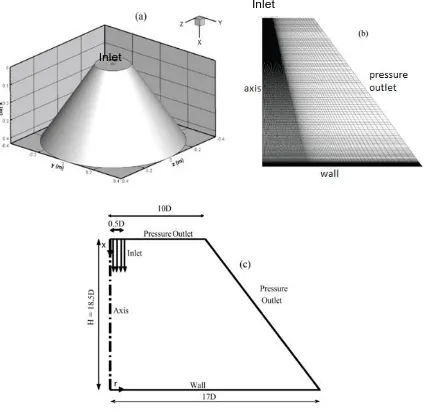
21 normal to the plate. Details of the computational domain and mesh generated for
the current simulations are shown in Fig. 2.2.
Fig. 2.2 (a) Full 3D geometry, (b) cross-section of the computational domain and
mesh, and (c) domain dimensions and boundary conditions
The full 3D geometry for the H/D = 18.5 case is illustrated in Fig. 2.2a and the
structured mesh system and half cross-section of the domain with the boundary Inlet
22 conditions applied in the numerical model are shown in Figs. 2.2b and 2.2c,
respectively. In Fig. 2.2c, the jet is aligned with the x-axis and r is the radial
distance from the x-axis. To ensure that the location of the outlet boundary has
negligible influence on the pressure and velocity fields, the computational domain
is taken to have a radius of 0.4 m (17D) along the plate. Shorter distances
between the pressure outlet boundary and the jet axis were taken for the H/D = 2
and 6 cases, but sufficiently long enough to minimize the influence of this
boundary on the flow field.
A constant velocity of 61m/s is imposed at the inlet, corresponding to a
Reynolds number of 100,000 based on the nozzle exit velocity and diameter.
Since the air escapes to the atmosphere through the side and top boundaries of
the computational domain, they are set as pressure outlets. The plate is
considered to be a no-slip boundary. The Low Reynolds Number Modelling
(LRNM) method (Launder and Spalding, 1974) is used as a numerical model to
accurately capture the wall effect.
In order to provide a fine mesh with minimal skewness in the boundary
layer near the impinging wall, the mesh system is constructed of hexahedral
elements. A high-density mesh, as shown in Fig. 2.2b, is used to capture the high
shear stresses within the jet, as well as those generated near the plate,
particularly in the impingement zone. For the rest of the domain, where the wall
effect is smaller, a coarser mesh is used. Different mesh schemes, including fully
structured, fully unstructured and hybrid meshes with different numbers of cells
23 results, the fully structured mesh was chosen for all subsequent simulations. Grid
independence tests were also performed, the grid size being increased in 20%
increments until no noticeable variance in the drag force exerted on the plate was
observed. The total number of cells required to ensure a grid independent
solution from the current simulations was approximately 1.1 x 10⁶ for H/D = 2,
1.38 x 10⁶ for H/D = 6 and 1.84 x 10⁶ for H/D = 18.5.
2.2.2. Governing equations
The impinging jet flow is modeled by the steady 3D incompressible RANS
equations, representing conservation of mass and momentum balance. These
equations, in tensor form, are:
∂u i
∂xj = 0 (2.1)
∂
∂xj u iu j = ∂ ∂xj ν(
∂u i
∂xj + ∂u j
∂xi) − 1 ρ
∂p ∂xi−
∂uiuj
∂xj (2.2)
where
x
i, u
i, u
i′, p, ρ
andν
denote the coordinate directions, velocity, the velocityfluctuations, pressure, density and kinematic viscosity, respectively, and the
over-bar indicates a time-averaged quantity (Hoffmann and Chiang, 2000).
Cooper et al. (1993) has reported that for the simulation of impinging jets,
the k - ε model over-predicts the turbulent kinetic energy near the stagnation
point. In order to reduce this effect, different turbulence models, which take into
24
The Realizable k – ε model (Shih et al. 1995), the k - ω SST (Shear Stress
Transport) model (Menter, 1994) and the Reynolds Stress Model (RSM)
(Launder et al. 1975) have been implemented in the current simulations. For the
Realizable k - ε model, the LRNM is used.The k - ω SST turbulence model takes
into account the low-Re effects in the flow. In the SST version of the model, the
standard k – ω model is used for the near-wall region, combined with a standard
k – ε model in the fully turbulent zone (Menter, 1994). The Reynolds Stress
Model (RSM), which is also used in this study, takes into consideration
multi-scale and anisotropic effects of turbulence. In RSM, a transport equation is
solved for each of the unknown stresses in the Reynolds stress tensor. A wall
reflection scheme and pressure gradient terms are included in the model
(Launder et al.1975). The details of these models can be found in FLUENT
6.3.26 User’s Guide.
The finite volume method is used to discretize the governing equations,
with the QUICK scheme for discretization of the convective terms. The Standard
scheme for the pressure interpolation is used. For the pressure-velocity coupling,
the SIMPLE algorithm developed by Patankar and Spalding (1972) has been
applied. FLUENT 6.3.26 is used to solve the discretized governing equations.
During the simulations the drag force exerted on the plate was monitored, and
the solution was considered converged when no significant change in drag was
observed (changes less than the order of 10-3). For all results presented in this
chapter, the residuals of the continuity, momentum and turbulence equations are
25 2.3. Results
To understand the effect of the nozzle height on the behaviour of
impinging jets, different mean and turbulent flow parameters have been analyzed
at various H/D ratios. These quantities include the decay of centreline velocity,
radial distribution of axial velocity, pressure and shear stress distribution along
the plate, and mean and root mean square (rms) velocities in the wall jet region.
2.3.1. Centreline velocity
To validate the current CFD simulations, the results are compared with the
available experimental data of Giralt et al. (1977) and Rajaratnam et al. (2010).
Although there are three distinct cases in the current simulations (H/D = 2, 6 and
18.5), for the purpose of identifying the best RANS turbulence model to use for
subsequent analysis, only the H/D =18.5 case was selected for a detailed
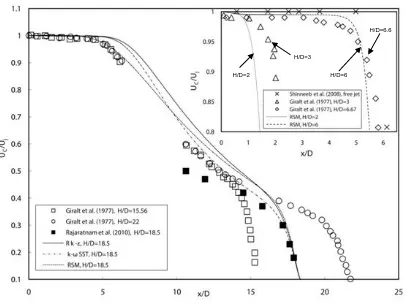
comparison. According to the results shown in Fig. 2.3, the Realizable k - ε and
RSM models show some over-prediction of the centreline velocity entering the
impingement zone, but recover to provide a close match to the data of
Rajaratnam et al. (2010) near the plate surface. On the other hand, the k - ω SST
model provides a good agreement with the data of Rajaratnam et al. (2010)
through the impingement zone and very close to the plate. Note that k - ω SST
26 Fig. 2.3 Comparison between computational and experimental centreline velocity
All three models show good agreement with the H/D = 18.5 experimental
data of Rajaratnam et al. (2010) as the flow approaches the plate (region II), but
Fig. 2.3 also shows that RSM yields more accurate centreline velocity in the free
jet (region I). Based on this comparison, and also considering that RSM is a
non-isotropic turbulence model, the RSM was selected as the main turbulence model
for further simulations in all H/D cases. The following sections investigate the
variation of the centreline velocity as the H/D ratio increases from 2 to 18.5.
H/D=2
H/D=3
H/D=6
27
2.3.1.1. H/D = 2
The case of H/D < 6 represents an impinging jet where the core of the jet
reaches the plate and has not yet been fully penetrated by the ambient flow. No
fully developed free jet region exists for this type of impinging jet and different
regimes of the jet are not distinguishable. To obtain a better understanding of this
kind of impinging jet, H/D = 2 was chosen for the current CFD study and the
results are compared with the available experimental data of Giralt et al. (1977)
at H/D = 3 (see inset in Fig. 2.3). This comparison confirms that the current
results follow the expected trend. For H/D = 2, no significant decay in the
centreline velocity between the nozzle and the plate is observed, except in the
impinging zone which starts around x/D = 1 and extends to the stagnation point.
2.3.1.2. H/D = 6
As previously discussed, H/D = 6 represents an intermediate regime of an
impinging jet in which the core of the jet has reached the maximum penetration
(Beltaos and Rajaratnam, 1977). Therefore, the current CFD analysis was
carried out at H/D = 6 and the results are compared with the experimental data of
Giralt et al. (1977) at H/D = 6.67 and the free jet results of Shinneeb et al. (2008)
(see inset in Fig. 2.3). Similar to H/D = 2, at H/D = 6 no decay in the centreline
velocity is observed up to the impinging zone (i.e., 0 <x/D < 5), which confirms
that the core of the jet is still developing up to a location very close to the plate.
28 is influenced by the impingement wallfor x/D > 5. Results for the radial
distribution of the axial velocity are discussed in Section 2.3.2.
2.3.1.3. H/D = 18.5
According to the literature discussed above and also based on the results
shown in Fig. 2.3, H/D = 18.5 represents an impinging jet in which all three
sub-regions of an impinging jet co-exist, namely the free jet region, impingement zone
and wall jet region. Figure 2.3 shows that for H/D = 18.5, the core of the jet is still
developing up to about x/D = 6and no decay in the centreline velocity can be
observed. For x/D > 6, the free jet region starts to develop and a large decay in
centreline velocity occurs up to about x/D = 15 as the ambient flow is entrained
with the jet. For x/D > 15, the flow senses the plate and a much sharper decay in
the centreline velocity can be seen compared to the decay in the region 6 < x/D <
15. This is due to the transfer of the momentum from the axial to the radial
direction.
One can note from Fig. 2.3 that the results of Rajaratnam et al. (2010)
deviate significantly from the results of the present simulations and the
experimental results of Giralt et al. (1977) for x/D < 14. It is important to recall
that the design of the nozzle has an impact on the downstream evolution of the
jet (Xu and Antonia, 2002). The shape of the nozzle affects the behaviour of the
shear layer at the jet exit, influencing flow characteristics such as jet expansion in
29 impingement zone. This could be the reason for this discrepancy. Nevertheless,
for x/D > 17, where the flow approaches the impingement point, the mean values
of the streamwisecentreline velocity obtained from the CFD calculations (H/D =
18.5) match very well with the measurements of Rajaratnam et al. (2010), and
fall between the results of Giralt et al. (1977) corresponding to H/D = 15.6 and
H/D = 22.
2.3.2. Radial distribution of velocity
Figure 2.4 illustrates the effect of H/D on the radial distribution of the
streamwise mean velocity, normalized by the local maximum value Um, for
locations near the impingement plate (0.785 < x/H < 0.99). The radial distance is
normalized by the jet half-width δ1, defined as the radial location where U =
0.5Um.
For H/D = 2, Fig. 2.4a shows that there is a slight shift in the peak of the
streamwise velocity profiles towards the axis when moving from x/H = 0.785 to
0.93. This phenomenon confirms that the flow is still accelerating and results in a
transfer of momentum from the axial to radial direction in the region 0.785 < x/H
<0.93. For the rest of the axial stations x/H = 0.97, 0.98 and 0.99, the streamwise
velocity profiles collapse on each other.
In Fig. 2.4b the streamwise velocity profiles at several axial stations are
plotted for H/D = 6. The flat shape of the profile (no decay in the centreline
30 minor losses) has retained its top-hat shape up to this station. The peak
observed in the other profiles is located off the centreline, which confirms that the
flow has started to change direction from axial to radial. Comparison of the jet
diameter at similar axial stations for H/D = 2 and H/D = 6 (Figs. 2.4a and 2.4b)
shows a decrease in this value as the H/D ratio increases.
The velocity profiles at stations very close to the plate (x/H = 0.98 and
0.99) bring out another important difference between the H/D = 2 and 6 cases.
Note that due to limitations in experimental techniques, measurements in regions
very close to the plate are susceptible to large uncertainties. Figure 2.4a
illustrates that there is a collapse in the velocity profiles at these stations for H/D
= 2, which suggests that the flow has changed direction before these stations.
However, for the same stations with H/D = 6, some changes in the peak of the
profiles can be observed in Fig. 2.4b, indicating that momentum transfer occurs
from the axial to the radial direction even at these stations very close to the plate.
Figure 2.4c shows that the velocity profiles at all x/H stations have the same
peak region along the centreline. This implies that the core of the jet is not
developing anymore and the flow has reached an almost fully developed
condition. The simulation results presented in Fig. 2.4c are consistent with the
classification of impinging jets based on the H/D ratio presented by Beltaos and
31 Fig. 2.4 Mean velocity distribution at different x/H stations, comparing
32
2.3.3. Radial distribution of shear stress
2.3.3.1. Shear stress in regions I, II and III
Figure 2.5 shows the comparison between radial distribution of shear
stress for three H/D ratios. The results show that there is a local maximum and
minimum in the radial distribution of the shear stress (Figs. 2.5a, 2.5c and 2.5e).
The first peak (maximum) occurs due to the entrainment of the ambient air into
the exiting flow from the nozzle. As the flow expands in the radial direction the
peak loses its magnitude. The second peak (minimum) is located in the region
very close to the wall. It can be seen that as the flow gets closer to the wall the
magnitude of the peak shear stress starts to increase, and at a specific station it
starts to exhibit a decreasing behaviour. A good representation of this
phenomenon can be seen in the inset (Figs. 2.5b, 2.5d, 2.5f) where the contours
of uv /Uj2 in the impingement zone of the computational domain have been
illustrated. In this figure, the positive peak shear stress is observed at x/H
stations between the nozzle and the impingement zone. In the region where the
flow changes direction from axial to radial, both positive and negative values of
shear stress can be seen, and for the region very close to the plate, only the
negative values of shear stress remain. Comparison of the shear stress profiles
at different H/D shows that the magnitude of the peak value of the shear stress in
the region close to the wall (x/H = 0.97 ~ 0.98) increases when H/D increases
33
Fig. 2.5 Comparison of experiments and CFD for the shear stress profiles uv /Uj2
at different x/H stations and H/D ratios (continued)
(b)
(c)
34 Fig. 2.5 (continued) Comparison of experiments and CFD for the shear stress
profiles uv /Uj2 at different x/H stations and H/D ratios
Figure 2.5e compares the predicted shear stress with those of Rajaratnam et al.
(2010) at H/D = 18.5. At most x/H stations, except very close to the plate at x/H =
0.955 and 0.97, the CFD results match well with the experiments. Measurements
at locations very close to the wall are associated with higher uncertainties. The
well-known difficulties of experimental techniques in accurately capturing the
large variation of shear stress in regions very close to the wall (x/H = 0.97 ~ 0.99)
further support the contributions of CFD analysis in these regions.
(e)
35
2.3.3.2. Wall shear stress
Figure 2.6 displays the wall shear stress distribution from the current
simulations and the impinging jet measurements carried out by Alekseenko and
Markovich (1994) at Re = 41,600 and H/D = 2. Also shown are the experimental
results of Bradshaw and Love (1961) at Re = 150,000 and H/D = 18. In this
figure, the radial direction is non-dimensionalized by the jet height, while the
shear stress is normalized by 𝜌Uj2. The quantity plotted along the vertical axis is
chosen to be consistent with other studies.
According to this figure, the peak wall shear stress is increased when the
distance between the nozzle and the plate is increased, which is similar to the
trend predicted by the numerical model of Giralt et al. (1977). As noted by
Giraltet al. (1977) for small nozzle heights, the jet entering the impingement zone
has a uniform velocity profile, causing lower flow acceleration near the stagnation
point and therefore smaller shear stress values. By increasing the H/D ratio, the
peak of the velocity profile shifts towards the centreline, resulting in maximum
36 Fig. 2.6 Wall shear stress along the impingement plate
Both the experimental results and the present simulations indicate the
presence of two peaks in the wall shear stress distribution when H/D = 2. With
increasing H/D, a single peak is located closer to the jet axis. Kataoka and
Mizushina (1974) and Alekseenko and Markovich (1994) noticed that for small
H/D values the transition from a laminar to turbulent boundary layer within the
impingement zone is accompanied by a sudden increase in the wall shear stress.
Consistent with their experiments, this phenomenon can be observed for H/D = 2
in Fig. 2.6, where the wall shear stress experiences a sudden increase near r/H =
1. For small H/D ratios, the transition from laminar to turbulent boundary layer in
the wall jet part of the flow occurs slightly later compared to jets with large H/D
ratios. This is due to the fact that in small H/D impinging jets, the potential core of
the jet reaches the impingement region, whereas for large H/D cases the flow is
37
2.3.4. Static pressure along the plate
Figure 2.7 compares the static pressure distribution along the plate for
different stand-off distances. The static pressure values are normalized by the
static pressure at the stagnation point, Ps. The radial direction is normalized by
r½, which is the radial position at which P = 0.5Ps.The numerical predictions
obtained at all H/D ratios are consistent with the measurements by Bradshaw
and Love (1961) and by Giralt et al. (1977) at large H/D.
Fig. 2.7 Static pressure along the impingement plate
For small stand-off distance (H/D = 2), the initial shape of the velocity
profile is nearly uniform, as illustrated in Fig. 2.3 (inset) and Fig. 2.4a. Therefore,
the pressure distribution in this case is wide and the region where higher
pressure exists is larger. As the value of H/D increases, the jet velocity profile