The effect of social media on pre- and post purchasing
behavior: Evidence from Turkey
Tuncay Taşkın, Cemal Yükselen
Beykent University Beykent University
ABSTRACT: The aim of this study is to determine the role and effect of social media in the purchasing behavior of consumers. The purchasing behavior is taken into analysis as pre and post purchasing. The data was gathered from university students who are intensive users of the Internet and social media that identified as the sample of the research. The sample was chosen by convenience sampling and 306 university students were reached. Descriptive method was used in the research and the scale was used in the framework of pre-purchasing and post-pre-purchasing behavior. The research findings show that the social media marketing strategies has a meaningful impact and that there is a meaningful but not strong relationship between the social media frequency of use and its effect on purchasing behavior. This means that the firms should try to understand the social media users’ reasons and expectations in social media and react according to their needs and taking care of users’s expectations.
Keywords: Social media, social media marketing, consumer behavior before purchasing, consumer behavior after purchasing
I. Literature Review
Recently, by spreading internet social media has become popular and an effective media in communication not only between people but also between consumers and firms. Social media can be appreciated as an important communication platform for marketing by means of easy creation of the content, easy sharing of the content created, and also users' opportunity to share the interesting contents which have an impact on the target audience.
Businesses, brands, executives, advertisers, bloggers, press member, politicians and people from almost all sectors actively use the social media. Observing that their consumers are in social media, businesses deliver their products and services to the customers using social media accounts. Social media which is shaped in this way has become the communication tool of brands. The use of social media in marketing activities constitutes a much lower cost compared to traditional mass media. This is very important in terms of the effective use of the budget allocated to marketing activities. A high return can be achieved by low cost with the use of social media in marketing activities.
new but very fast developing media. Social platforms such as Facebook and Twitter have become receiving a greater share from advertising budgets with each passing day.
(*)This article was written within the scope of Tuncay Taşkın’s master's thesis under the supervision of Prof. Dr. Cemal Yükselen.
Social media can be appreciated as a benefactor for marketing by means of easy creation of the content, easy sharing of the content created, and also users' opportunity to share the interesting contents which have an impact on the target audience (Albayraket al., 2011:45).The use of social media in marketing activities constitutes a much lower cost compared to traditional mass media. This is very important in terms of the effective use of the budget allocated to marketing activities. A high return can be achieved by low cost with the use of social media in marketing activities.
The development of social media with each passing day and the increased number of users pave the way for companies to perform their marketing, and especially promotional activities. The fact that social media marketing activities create warm atmospheres through which consumers can easily be accessed andthrough which it is possible to contact and talk with consumers has led to the common use of the social media and marketing concepts. Social media is a golden benefaction for companies; companies that are aware of this diversify their marketing departments by investing in this field. They announce their campaigns and products to the consumers through social media.
Users provide an opportunity to combine active/accessible and non-active communication policies through socialization provided by the digital environments in which simultaneous information transfer is performed, which is achieved by user-friendliness and instant communication offered by a new generation of web applications, and users can generate contents (Tuncer, 2013, 9).Although heavy Internet users, especially individuals spending time in digital environments in which simultaneous information transfer is performed, which is achieved by user-friendliness and instant communication offered by a new generation of web applications, and users can generate contents, are further exposed to active and accessible promotional activities, social media in terms of marketing has a very important place regarding opportunity and accessibility (Vural et al., 2010, 3350).
Marketing activities should be planned according to the mass media to be used, and appropriate content should be created in accordance with the selected mass medium. Social media marketing activities should also be target audience oriented as well as marketing activities implemented in mass media. The digital environment in which simultaneous information transfer is performed, which is achieved by user-friendliness and instant communication offered by a new generation of web applications, and users can generate contents has led marketers to accept wide marketing opportunities as a part of the promotional mix with each passing day. Social media closes an important gap for the purpose of catching especially individuals between 18 and 34 years whom it is quite difficult to reach via classical mass media (Ada et al., 2014:319).
Stephen (2016:17) noted that “Marketers have responded to this fundamental shift by increasing their use of digital arketing channels. In fact, by 2017 approximately one-third of global advertising spending is forecast to be in digital channels”. Zhu andChen (2015:335), noted by referring to Gallup report that consumers are highly adept at tuning out brand-related Facebook and Twitter content. Zhu andChen (2015:340), also point out that referring to Forrester Research (2012) revealed that only 15% of consumers trust social media marketing in the U.S., leading to dismal social marketing campaign outcomes.
approach it‟s said that marketers should focus on this voice. The other approach called Active Approach suggests soial media as tools of communication, direct sales, customer acquisition and customer retention (Constantinides 2014: 45).
Trusov, Bucklin, and Pauwels (2009).noted that social mediais a platform for interacting with one another for consumers and it has direct impact on brand communities and it achieves focusing only on firm-consumer relationship more than in traditional marketing methodologies. Wang and Kim (2017) point out that social media usage plays a moderating role by amplifying the positive impact of social CRM capabilities on firm performance. Godey et. al. (2016), point out that social media marketing efforts have a significant positive effect on brand equity and on the two main dimensions of brand equity: brand awareness and brand image.
The first step in social media activities is to create a page. All marketing and communication activities are carried out through this page created. An attempt to catch the attention of users is made by this page created, and the information included on the page. The basic principle in terms of marketing and marketing communication activities is to start the process of interaction. The quality of the contents created, suitability for the target audience and notice ability of the contents are vital for marketing and marketing communication activities. These pages created for the execution of marketing and marketing communication activities are brought to the forefront for a certain sum of money to be given. In this context, the similar aspect with other media is the payment of a certain sum of money in return for a place, the aspect distinguishing from other media is the opportunity to reach more people.
Briefly, social media accounts should be used effectively and efficiently while executing marketing activities in social media accounts. Facebook, Twitter, LinkedIn, YouTube and parallelly Vimeo, Instagram, Pinterest, SlideShare and Google+ channels should be opened as social media channels. The account should be opened in all other social media channels even if they are not used. URL must be customized in all of these channels that give permission. This URL must bear the brand name. Blog infrastructure should be created, which is integrated with related web page. The appropriate infrastructure will have been prepared for the promotion and sale of the product or brand in social media accounts managed by this system.
Social media is a double-sided media system in which people communicate with each other and share their ideas, thoughts and feelings. The number of users is also increasing assuming that social media renews itself with each passing day. According to the data from the research carried out by We Are Social in January 2015, Turkey is on the 11th rank with 2.9 hours among 30 countries in the ranking of time spent in social media. When the data on time spent in social media are analyzed, social media usage in Turkey is quite high. 37.7 million of our country‟s 76.7 million population are active internet users. It is stated that there are 40 million social media accounts and 32 million active mobile social media accounts in our country. The ratio of users who access social media through mobile was reported to be 69.6 million people. Moreover, according to the data from the research carried out by We Are Social in January 2015, it was determined that the ratio of those searching on the Internet via PC is 35%, the ratio of those who shop on the Internet via PC is 33%, the ratio of those searching on the Internet for shopping via mobile is 24%, and the ratio of those who shop on the Internet via mobile devices is 19%. As a result of the research, according to these figures, consumers take purchasing decisions by using the Internet and doing various researches.
The effective and intensive presence of consumers in social media has led to the emergence of various differences in consumers' purchasing behavior. In this context, brands create their social media communications on the communication and interaction between brands and consumers within the scope of changing consumer behaviors (Evans, 2010:40).
Consumers do research in social media for the products or services they want to purchase. Consumers pay attention to articles and comments written by users regarding the product/service they are interested in or want to purchase. They do this kind of research using blogs, tweets, forums, dictionaries and various groups. Consumers control all the contents shared in regard to the product/service using social media before taking a purchasing decision. The opinions of other users who use and express opinions about the product they want to purchase affect purchasing decisions. While consumers give positive opinions on the product and service with which they are satisfied using social media, they share their dissatisfactions in regard to the product and service with which they are dissatisfied. Thus, sharings made provide information for other consumers related to products and services. (İşlek, 2012:101)
II. Method and Data
The literature review related to the research scale was performed by Yiğit, H. B., (2011). İşlek, M. S.,(2012). Questions related to the effect of social media on consumer behaviors before purchasing and the effect of social media on consumer behaviors after purchasing were included in the third section of the research. The questionnaire form consisted of 80 questions. Questions were structured according to 5-pointLikert scale. The questionnaire application of the research was performed by face-to-face interviews with the respondents, and the data were obtained in this way. The convenience sampling method was used in the selection of the research sample.
The hypotheses of the research were determined as follows:
H1: Social media has a positive effect on consumers' pre-purchasing behavior.
H2: Social media has a positive effect on consumer‟s post purchasing behavior.
H3: There is a meaningful positive relationship between the social media frequency of use and the effect
of social media in pre-purchasing behavior
H4: There is a meaningful positive relationship between the social media frequency of use and the effect
of social media in post purchasing.
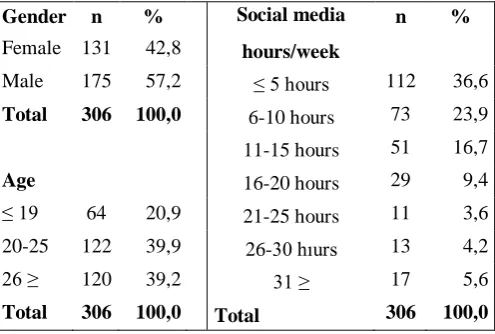
Research Findings Respondents’ Profile
Table 1. Profile of Respondents Gender n % Social media
usage
n %
Female 131 42,8 hours/week
Male 175 57,2 ≤ 5 hours 112 36,6
Total 306 100,0 6-10 hours 73 23,9
11-15 hours 51 16,7
Age 16-20 hours 29 9,4
≤ 19 64 20,9 21-25 hours 11 3,6
20-25 122 39,9 26-30 hıurs 13 4,2
26 ≥ 120 39,2 31 ≥ 17 5,6
Total 306 100,0 Total 306 100,0
Effect of Use of Social Media on Purchasing Behavior
Table 2 shows the test results regarding the effect of social media on behaviors pre-purchasing and the significance test of the averages. The analysis was performed as a one-way arithmetic average test and accepted with all judgments except for 3 judgments, the participation levels of which were not greater than 3. Namely, respondents disagree with the opinion that the campaigns of the companies in social media, company information, and popular people affect them in pre-purchasing.
The significance test was performed by analyzing the total values of the judgments to represent all behavior patterns as the social media average effect score, and H1 hypothesis was accepted according to the
results in Table 2 and Table 3.The analysis results regarding the effect of the use of social media on behavior post purchasing are presented in Table 4.Respondents agree with the judgments except for three judgments according to the analysis results. According to the results, respondents are not in favor of sharing on a company page and do not want to recommend in social media even though they are satisfied with the product. The significance test was performed by analyzing the total values of the judgments to represent all behavior patterns as the social media average effect score, and H2 hypothesis was accepted according to the results in Table 5.
Table2. Significance Test Results of the Effect of Using Social Media Tools on Behaviors before Purchasing
Behavior before Purchasing t sd p
Arithmetic Average Difference
95% Security Level Difference Lower
Limit
Upper Limit
1. I do research in social media in regard to
a product/service before purchasing it. 22,051 305 0,000 1,209 1,1 1,32
2. I believe I can get reliable information in social media in regard to a product/service I will purchase.
10,474 305 0,000 0,569 0,46 0,68
3. If the information in social media concerning a product/service I will purchase is created by the consumer, I rely on that information.
4. If the information in social media concerning a product/service I will purchase is created by the seller, I rely on that information.
-3,427 305 0,001 -0,216 -0,34 -0,09
5. I just pay attention to the advice of people I have known previously in social media concerning a product/service I will purchase.
9,051 305 0,000 0,608 0,48 0,74
6. I pay attention to the advice of popular users in social media concerning a product/service I will purchase.
-0,919 299 0,359 -0,063 -0,2 0,07
7. I prefer to purchase the products of companies/brands that I like and follow on social media tools.
7,063 305 0,000 0,444 0,32 0,57
8. When a company/brand gets in contact with me in social media, this positively affects me for purchasing.
6,014 305 0,000 0,405 0,27 0,54
9. Social media sites are suitable places for consumers get in contact with
companies/brands.
11,709 305 0,000 0,66 0,55 0,77
10. I join the campaigns organized by
companies in social media. -2,343 305 0,020 -0,163 -0,3 -0,03
Table3.Significance Test Results of the Effect of Using Social Media Tools on Behaviors Pre-Purchasing as a Whole
n
Arithmetic Average
Standard Deviation
Standard Error
t= 10,277 p= 0,000
PREEFFECT 30
0 3,4097
,6904 6
,039 86
Table4.Significance Test Results of the Effect of Using Social Media Tools on Behaviors Post Purchasing
Behavior after Purchasing t sd p
Arithmetic Average Difference
95% Security Level Difference Lower
Limit
Upper Limit
1. If I am satisfied with the product/service I
have purchased, I will share it in social media. -0,415 304 0,678 -0,03 -0,17 0,11
2. If I am satisfied with the product/service I have purchased, I will share it on company pages in social media.
I have purchased, I will share it in social media.
4. If I am dissatisfied with the product/service I have purchased, I will share it on company pages in social media.
3,953 298 0,000 0,284 0,14 0,43
5. If I am satisfied with the product/service I have purchased, I will recommend other users to purchase that product in social media.
0,56 304 0,576 0,036 -0,09 0,16
6. If I am dissatisfied with the product/service I have purchased, I will recommend other users not to purchase that product in social media.
5,846 304 0,000 0,397 0,26 0,53
7. When the company/brand, the
product/service of which is satisfactory for me, has recognized me in social media, this increases my satisfaction.
6,206 304 0,000 0,433 0,3 0,57
8. The fact that the company/brand, the product/service of which is not satisfactory for me, has got in contact with me in social media may change my opinion.
3,121 304 0,002 0,203 0,08 0,33
9. The fact that the company/brand, the product/service of which is not satisfactory for me, has not recognized me and has not got in contact with me in social media increases my dissatisfaction.
7,66 304 0,000 0,551 0,41 0,69
Table5. Significance Test Results of the Effect of Using Social Media Tools on Behaviors after Purchasing as a Whole
n
Arithmetic Average
Standard Deviation
Standard Error
t= 4,871 p= 0,000 POSTEFFECT
29
9 3,2482
,881 16
,0509 6
Relationship between Social Media Frequency of Use and Purchasing Behavior
Table6. Correlation Matrix of the Relationship between Social Media Frequency of Use and the Effect on Behavior Pre and Post Purchasing
SMUSAGE PREEFFECT
POST EFFECT
SMUSAGE Pearson
Correlation 1 0,243 0,371
Sig.
(2-tailed) ,000 ,000
n 280 274 279
PREEFFECT
Pearson
Correlation 0,243 1 0,5
Sig.
(2-tailed) ,000 ,000
n 274 300 293
PSTEFFECT
Pearson
Correlation 0,371 0,5 1
Sig.
(2-tailed) ,000 ,000
n 279 293 299
CONCLUSION
Social media is a platform that brings individuals together every moment and being in communication. At this platform they talk, share everything they are interested in. Purchasing behavior and experiences are a part of their sharing in social media. Firms should take care of their interests, talks and experiences and develop social media marketing strategy to make awareness for their messages. First, they should try to understand what consumers talk, need and interested in. Then they should create a message which can create attention and interest of them and after presentation the message they should follow them and interact with consumers.
According to the results of this study, social media has a positive effect on consumers' behaviors pre- and post purchasing. In other words, consumers are affected by social media in their behaviors in pre- and post purchasing. It can be said that there is a meaningful but not strong relationship between the social media frequency of use and the effect of social media in pre- and post purchasing. This result shows that social media frequency of use positively affects the behavior of consumers both in pre and post purchasing.
Consequently, it can be said that mutual communication made by social media, which is expressed as participatory media, is effective for consumers and companies while traditional media communication is going on.
REFERENCES
[2.] Adecco (2014). “İş Pazarı Bünyesinde Arz ve Talebin Eşleşmesinde Sosyal Medya Kullanımı İş Arayanların Türkiye‟deki Algısı”, [Use of Social Media in Matching of Supply and Demand within Business Market Perceptions of Job-Seekers in Turkey] Adecco Türkiye Sosyal Medya KullanımıRaporu
[3.] Albayrak, E. Albayrak, Ş. and Küçük yılmaz, M. M. (2011). “Toplumun, Kültür Politikaları Ve Medyanın Kültürel Süreçlere Etki Algısı Araştırması” [Research on Impact Perception of Society, Culture Policies and Media on Cultural Processes], T.C. Kültür ve Turizm Bakanlığı, SETA Yayınları, I. Baskı,Ankara
[4.] Constantinides,Efthymios, (2014), “Foundations of Social Media Marketing”, Procedia - Social and Behavioral Sciences 148, pp.40 – 57
[5.] Evans, D., and McKee, J. (2010). Social Media Marketing: The Next Generation of Business Engagement. Indianapolis: Wiley Publishing.
[6.] Evans, D. (2008). Social Media Marketing: An Hour A Day. Indianapolis: Wiley
[7.] Godey, Bruno, AikateriniManthiou,, Daniele Pederzoli, Joonas Rokka, Gaetano Aiello, Raffaele Donvito , Rahul Singh, (2016), “Social media marketing efforts of luxury brands: Influence on brand equity and consumer behavior”, Journal of Business Research 69, pp.5833–5841.
[8.] İşlek, M.S (2012) „‟Sosyal Medyanın Tüketici Davranışlarına Etkileri: Türkiye‟deki Sosyal Medya Kullanıcıları Üzerine Bir Araştırma‟‟ [Social Media's Effects on Consumer Behaviors: A Research on Social Media Users in Turkey] Karamanoğlu Mehmetbey Üniversitesi Sosyal Bilimler Enstitüsü İşletme Anabilim Dalı Yüksek Lisans Tezi, Karaman
[9.] Parise S., Guinan P.J., (2008): Marketing using Web 2.0, in: Proceedings of the 41st Hawaii International Conference on System Sciences”
[10.] Stephen, Andrew T, (2016), “The role of digital and social media marketing in consumer behavior”, Current Opinion in Psychology 2016, 10, pp.17–21
[11.] Tuncer, S. A. (2013). “Sosyal Medyanın Gelişimi” [Development of Social Media], T.C. Anadolu Üniversitesi Yayınları, I. Baskı,Eskişehir
[12.] Trusov, Michael, Randolph E. Bucklin, and Koen Pauwels (2009), “Effects of Word-of-Mouth Versus
Traditional Marketing: Findings from an Internet Social Networking Site,” Journal of Marketing, 73, 5, 90–102.
[13.] Vural, Z. B. ve ve Bat, M. (2010). “Yeni Bir İletişim Ortamı Olarak Sosyal Medya: Ege Üniversitesi İletişim Fakültesine Yönelik Bir Araştırma” [Social Media as a New Communication Environment: A Research for Aegean University Faculty of Communication], Journal of Yasar University 20(5),ss.3348‐3382
[14.] Wang Zhan, and Hyun Gon Kim, (2017), “Can Social Media Marketing Improve Customer Relationship Capabilities and Firm Performance? Dynamic Capability Perspective”, Journal of Interactive Marketing 39 (2017) 15–26
[15.] Yiğit H.B (2011). „‟Sosyal Medyada marka farkındalığı oluşturma‟‟ [Creating Brand Awareness in Social Media] Marmara Üniversitesi Sosyal bilimler enstitüsü, İstanbul