The Role of Self-Affirmation in an Online Physical Activity Intervention.
Rose A Walker Newcastle University
Abstract
Obesity is a rising issue worldwide which is linked with the development of
Non-Communicable Diseases (Scully, 2014). There is a wide evidence base for the use of physical
activity to improve health (Warbuton, Nicole & Bredin, 2006). This research is utilising the
Internet to deliver a physical activity intervention using self-affirmation to increase message
acceptance. The self-affirmation theory (Steele, 1988) states that reflection of a person’s
positive traits may reduce defensiveness about a threatening message. Epton and Harris
(2008), and Fielden (2012) have shown self-affirming to lead to reduced defensiveness about
health messages and also behaviour change. This research is a progression and is aiming to
show similar findings with physical activity. Participants completed a series of questionnaires
to determine their physical activity levels before being randomly allocated to either an
affirmation or control group. Participants completed a manipulation check before completing
a log of physical activity (n=34). The same questionnaires were then asked at 7 days (n=26)
and 14 days (n=23). Results demonstrated no significant increase in physical activity. Self-affirmation has shown to work best on those who are most ‘at-risk’ and participants already
showed to be participating in physical activity. Limitations and suggestions for further research, such as the use of an ‘at risk’ population are discussed.
Keywords: self-affirmation, physical activity, on-line intervention
Overweight and Obesity
Being overweight is defined as having a body mass index (BMI) of between 25kg/m²
to 29.9kg/m². Obesity is more severe, classified as having a BMI of > 30kg/m² (Wolin &
Petrelli, 2009; Health and Social Care Information Centre, 2014), and has become a problem
worldwide (Scully, 2014). Obesity is on the rise with figures suggesting that in 2012 in the
UK, 24% of men and 25% of women were obese, and 42% of men and 32% of women were
overweight. This is an issue in itself but combined with health issues accompanying obesity,
it is imperative to intervene (Health and Social Care Information Centre, 2014).
Non-communicable disease
Non-communicable diseases (NCD) are those which are not passed from person to
person but are enduring, with slow progression. The majority are caused by lifestyle choices
such as drinking, smoking, eating habits, and sedentary behaviour. NCD include Type II
diabetes, cardiovascular disease, stroke and chronic respiratory disease. All of these have severe costs to a person’s quality of life (QoL), financing, and mental health (Beaglehole et
al., 2011). The financial strain on the health care system is also crippling. In the UK alone,
between 2006-2007, obesity cost the NHS £5.1 billion. A breakdown of costs saw that
physical inactivity cost the NHS £0.9 billion and poor-diet related ill health cost a further
£5.6 billion (Scarbrough et al., 2011) which is staggering, especially when such factors are
preventable.
It is established that NCD are the biggest cause of mortality on earth with an
estimated 56 million deaths a year, which equates to 60% of all deaths (World Health
Organisation, WHO; 2002). It’s also been demonstrated that when obesity was reduced
marginally at population level, the incidence of Type II diabetes and cardiovascular disease
significantly lowered (Kilpi et al., 2014). The large percentage of the population who are now
overweight or obese is critical and the associations between obesity and NCD demonstrate
the necessity to intervene.
The relationship between obesity and NCD is accurately portrayed by Litwin (2006),
who demonstrated that for every unit of mass increase once overweight (BMI > 29.9kg/m²),
the risk of developing coronary heart disease (CHD) increases by 5-7%. To put this in
from that of the general population to 50-70%. As a BMI of 30 is the lower scale of obesity,
this demonstrates the significant risk of obesity.
Contributing factors to Non-Communicable Diseases
The link between obesity and NCD is well established, so it is essential to determine
the causes of obesity in order to develop an intervention that will tackle these issues.
Research demonstrates there are many factors that interplay such as genetics, environment,
physiological, and social (Wright & Aronne, 2012), although the biggest contributing factor
is an unhealthy diet and sedentary lifestyle (Ebrahim et al., 2011). As these are seen as
lifestyle choices, it emphasises the capacity to intervene and make changes. Much research
has been designed to investigate the efforts of interventions, with those that target
self-behavioural change of lifestyle choice to be most effective, especially over other
interventions such as surgery, or pharmacological (Berkel, Poston, Reeves & Foreyt, 2005).
Of these interventions, those specifically looking at altering sedentary lifestyle and improving
physical activity (PA) are most effective, although meta-analyses have revealed that further
research is needed to determine the optimum length of intervention for the obese population
(e.g. Goulan, Trouilloud & Sarrazin, 2011).
Physical Activity
There is a wide evidence base for the use of PA as an intervention and as a
preventative measure (Warbuton, Nicole & Bredin, 2006; Keim, Blanton & Krestch, 2004).
Research has specifically demonstrated the benefits of exercise against all-cause mortality
(Crespo et al., 2002). Their research looked at 9136 men in Puerto Rico, and adjusted for
socio-cultural factors such as age, smoking status, and family history. The results indicated
the significance of the smallest amounts of PA to a person’s health. Results suggested that for
two morbidly obese people, where one takes part in PA and the other does not, even the
smallest amount of PA, showed drastic increases in health status compared to the sedentary
counterpart (Crespo et al., 2002).
Furthermore, the role that PA plays in the regulation of mental health is also
becoming established (Kim et al., 2012). More specifically, Paluska and Schwenk (2000)
found those who took part in regular PA were less likely to suffer from depression or anxiety.
Also, for those who already suffered from depression or anxiety, they made considerable
long term benefits of PA that provide rationale to increase baseline levels of PA in the
general population. A report in The Journal of the American Medical Association (JAMA,
2000) outlined the benefits of PA. Results indicated that PA in the short term helped a
healthier heart, muscles, bones, better ability to cope with stress, better sleep and mental
wellbeing. In the long term, the benefits indicate that PA prevents premature death, NCD
development and prevention of obesity (JAMA, 2000).
Research has indicated that there is an extreme deficit in adherence to PA. The UK
government recommends that people should partake in at least 30 minutes of moderate
intensity exercise at least 5 times per week (Department of Health, 2004). Moderate intensity
defines that the heart rate is raised and a shortness of breath, and includes brisk walking,
dancing, and carrying moderate loads (<20kg; WHO, 2014). Bergman, Grjibovski,
Hagstromer, Bauman and Sjostrom (2008) investigated adherence to these guidelines in
Swedish adults and results indicated that less than two thirds adhered even though guidelines
and benefits were widely advertised. Furthermore, Schoenborn and Strommel (2011)
investigated the health risks associated with non-adherence to guidelines by comparing health
of those who had adhered to those who had not. Results verified that adhering to the
recommendations was significantly associated with health benefits. The effects were more
noticeable in those who demonstrated a chronic condition of any type. This emphasises the
notion that increases in PA need to be made in order to nationally increase health, and aid
those suffering from conditions (Schoenborn & Stommel, 2011).
Further research by Lee et al. (2012) aimed to specifically assess the effect of
inactivity on NCD and estimate how much disease could be averted if people engaged in PA.
Their research assessed the world wide burden of disease based on physical inactivity and
how increases of PA would affect health and life expectancy. Results displayed that 1.3
million deaths could be prevented each year if PA were to be increased by just 25% and that
life expectancy would also greatly increase if physical inactivity were reduced by the same
25% (Lee et al., 2012).
Jolly et al. (2011) aimed to assess overall effectiveness of interventions aiming to
increase PA for the obese population. The results revealed that those who received primary
care treatment demonstrated the least increases in PA and least amount of weight loss
compared with outside agencies, such as Weight Watchers, which had the most significant
effective and could be developed into primary health care. To develop an effective
intervention, the Medical Research Council (MRC) guidelines suggested that the use of
appropriate theory needs to be established (Craig et al., 2008). Therefore the theory of
self-affirmation will be tailored into the intervention.
Self-affirmation
Research into the ‘self’ has suggested that people have a ‘psychological immune system’ where there is a need to maintain psychological balance – or positive global
self-evaluation (Sherman & Cohen, 2006), also known as self-affirmation theory (Steele, 1988).
When an event occurs that attacks a person’s global self-worth, they engage in ‘defensive’
behaviour where previous positive events are remembered as this confirms the person is ‘good’, and psychological balance is restored. It is this process of regaining self-concept that
is self-affirmation (Steele, 1988). When a threat is perceived, people are instantly motivated
to reduce the psychological discomfort (McQueen & Klein, 2006).
Sherman and Hartson (2011) suggested the term ‘system’ to describe
self-affirmation. Components of the self-system such as values, beliefs, relationships, health,
goals and identities all contribute towards the key component; global self-worth. As soon as a
threat is perceived in one component, it will be rationalised using another. For instance, a
person may justify that although they never take part in exercise, they are healthy because
they eat healthily. With global self-worth being flexible, it means that affirmation in one area
can maintain global self-worth when another is under threat.
It was proposed by Steele (1988) that methods to overcome ‘psychological discomfort’ will require either modification to one’s behaviours or biased processing of
information to take place. A person may receive a health message that is a threat to them; the
information could be purposely misinterpreted in order for it to fit their self-concept and to
reduce psychological discomfort. Steele (1988) suggested that as an alternate method, people could develop a ‘coping resource’ or ‘buffer’ where they observe other aspects of the self that
are of importance to them and focus on these which results in the threat being more likely to
be accepted (Steele, Spencer & Lynch, 1993). It is this method that this research is aiming to
replicate in order to affirm participants in other core values before demonstrating a message
about health that may undermine their global self-concept. The theory states that as these
participants will have other core values affirmed, the health message will be accepted which
behaviour change in a variety of domains including relationships (Jaremka, Bunyan, Collins
& Sherman, 2011), reducing stigma (Cohen, Garcia, Apfel & Master, 2006), reducing
defensiveness in individuals (Crocker, Niiya & Mischkowski, 2008), and more importantly to
the current research, health behaviours (Epton & Harris, 2008).
Self-Affirmation Research
The use of self-affirmation appears to be used most in a health context with
interventions aiming to increase or decrease certain behaviours using self-affirmation prior to
giving information of the behaviour (Epton & Harris, 2008). It has been noted, to be
effective, participants are required to be blinded to the task (Sherman, Cohen, Nelson,
Nussbaum, Bunyan & Garcia, 2009). However, there are a number of ethical considerations when conducting a ‘blind’ intervention. Some ethical concerns regard participants not
receiving treatment or being treated favourably if they are then not offered the actual
intervention (Sarker, 2014). However, within the research discussed here, the same information was provided to participants and the ‘blind’ came in during the affirmation
process. Therefore, all information was given to all groups, but it is how they perceived the
information that differs.
Research by Jessop, Simmonds and Sparks (2009) investigated self-affirmation and
sunscreen use in women. Their manipulation of self-affirmation included three groups and a
control group. The self-affirmation groups all affirmed in separate aspects. Group 1 affirmed in ‘values’, Group 2 in ‘kindness’ and Group 3 in ‘positive traits’. This allowed for different
aspects of self-affirmation to be tested against no affirmation. Results were positive,
indicating self-affirmation to reduce defensiveness compared with controls. It was also found that those in the ‘positive traits’ category significantly increased their requests for a free
sunscreen sample compared to the others. This research demonstrated the use of
self-affirmation in reducing defensiveness and increasing acceptance of a health message. It
demonstrates the need to further assess how self-affirmation can be used to introduce a health
message in other domains, including PA.
Sherman, Nelson and Steele (2000) assessed the use of self-affirmation in two health
behaviours; caffeine consumption and condom use. Participants in each condition were split
of the health message. In the condom usage condition, it was also noted that participants who
were affirmed were found to purchase more condoms than those who were not. More in
depth, results showed how those who were considered most high risk demonstrated the most
psychological discomfort but then showed greatest difference in intention to change. These
results demonstrate how self-affirming overcame psychological discomfort which positively
led to behaviour change in a health inducing behaviour (condom use), whereas although
message acceptance is high and intent is high for behaviour to be reduced (caffeine
consumption) the actual behaviour did not mimic this.
A meta-analysis by Epton, Harris, Kane and van Koningsbruggen (2014) assessed the
use of self-affirmation on health behaviour and specifically, how self-affirmation affects
message acceptance, intention to change, and behaviour modification. The selection criteria
for the analysis were strict and from the initial 592 studies, only 41 met the inclusion criteria.
Testing demonstrated the efficacy of self-affirmation. However, the effect was small, and the
individual components of self-affirmation were not assessed, therefore further research is
needed to distinguish how useful self-affirming is and which aspects cause the most
significant changes, providing rationale for this research.
Further to the use of self-affirmation in relation to this project, it is imperative that
research aiming to increase healthy lifestyle and decrease the instances of obesity and NCD
be assessed. Epton and Harris (2008) aimed to improve fruit and vegetable consumption in
women who were randomly allocated to either self-affirmation or a control group before
being shown a health message about fruit and vegetable consumption. Participants recorded
their fruit and vegetable consumption for seven days and results indicated that there were
drastic differences in measures of response efficacy (RE), self-efficacy (SE) and intent (INT)
in those whom affirmed. This is significant as it has been shown that these variables are
closely linked with behaviour, and INT has been shown to be one of the most essential
factors for closing the intention-behaviour gap (Rhodes & Dickau, 2013). Similarly, Fielden
(2012) aimed to conduct an online self-affirmation intervention to increase fruit and
vegetable consumption in students and low socio-economic status mothers. Research aimed
to develop an effective intervention by exploring all of the barriers and then developing a
website dependent on the preferences and views of the participant group. Once these barriers
had been addressed and the health message website designed accordingly, the final research
was conducted which used an online technique to affirm participants before being shown the
questionnaires of SE, RE and IN before filling in a day-to-day fruit and vegetable diary for
seven days. Results demonstrated that those in both groups who had been affirmed
demonstrated significantly more fruit and vegetable consumption than those in control
conditions.
The current research is aiming to utilise the findings from Fielden (2012) about the
barriers and website development in order to assimilate the findings in PA. It aimed to
change behaviour that is one of the highest contributing factors to obesity with results
indicating a large change of 5.5 pieces of fruit and vegetable consumption in the following
seven days for affirmed participants. This is a large increase, and the current research is
aiming to produce similar results in the area of PA.
Online interventions
Many theorists are implementing interventions using the Internet (Bennett &
Glasgow, 2009). Cohen and Adams (2011) demonstrated that people do not often see
someone they trust (GP, nutritionist, personal trainer) to find out information about how to
live a healthy lifestyle due to time, costs and embarrassment. There are a large proportion of
people who fit this category and in the U.S. alone, in 2009, 74% of all adults used the Internet
and 61% had used it for health information as well as 49% looking specifically about a
condition they already had (Cohen & Adams, 2011). This demonstration of the widespread
use justifies the use of online interventions.
To ensure an effective intervention, research has demonstrated the credibility of
information is essential. Brouwer, Oenema, Crutzen, de Nooijer, de Vries and Brug (2009) assessed adults’ cognitions when deciding on Internet interventions. Results validated
credibility of information, regular updates, and motivational information are of importance. It
has further been demonstrated that although there are many sources which are not credible,
that overall the Internet is a valuable tool to promote healthcare (Korp, 2006). Fielden (2012),
aimed to address the issues surrounding online health information. The target audience for
this research was low socio-economic status mothers and students. As the current research is
expecting the majority of participants to be students, the results of this were integrated into
the development of the health information webpage. Fielden (2012) found that there were
dislikes for too much information, preference for bullet pointed information, motivational
Ammann, Vandelanotte, de Vries, and Mummery (2013) assessed the use of internet
in regards to PA interventions. They developed an online PA intervention for older people to
assess the acceptability, usability and effectiveness of the intervention. They compared three
age groups, <44, 45-59 and >60 years of age. Results indicated there were significant positive
changes for all age groups, but the largest was in the oldest age group. Although the results
were small, they were effective and demonstrated the use of the Internet. A meta-analysis
carried out by Davies, Spence, Vandelanotte, Caperchione, & Mummery (2012), assessed 34
studies that met the research criteria of being online, increasing PA, with other aspects
including age, sample size, email as communication, experimental design, and English
language. Through meta-analysis, results demonstrated online PA interventions to be
significantly effective and that their use should be promoted.
Aims of the Study
The problem of obesity and the development of NCD are widespread and requires
intervention (Scully, 2014; Kilpi et al., 2014; Lee et al., 2012). Self-affirmation has shown to
be effective (Epton & Harris, 2008; Fielden, 2013) although research looking at
self-affirmation and PA is limited. The Internet is an effective way of reaching out to many in a
low-cost, timely manner and that demonstrates effectiveness in PA (Davies, Spence,
Vandelanotte, Caperchione, & Mummery, 2012) but needs further study to be conclusive.
Therefore, the current research is aiming to utilise the versatility of the Internet to deliver an
effective, low-cost intervention that aims to increase PA amongst participants using
self-affirmation.
It is hypothesised that participants will show an increase in their levels of
participation in PA with those that affirmed demonstrating higher changes in levels of
participation. It is also hypothesised that participants who have been affirmed will show
increases in SE, RE and IN most drastically directly post manipulation, but also across the
Method
Design
This study comprises a Randomised Controlled Trial (RCT) in that participants were
randomly allocated using Qualtrics (www.qualtrics.com) to either the experimental
self-affirmation condition or to the control condition. The experimental self-self-affirmation condition
required participants to answer questions about themselves that would demonstrate that they
are a good person, thus enabling them to be more responsive to a negative health message.
The control group was to conduct a similar cognitive task that did not make them think of
their values but their opinions, thus not affecting their response to the health message.
Baseline measures were taken before participants were shown a health website
(www.whatisphysicalactivity.weebly.com). Participants were then directed back to the
questionnaire where they completed the same questionnaires as baseline measures. From
here, the design followed a weekly procedure where participants were to log into the survey
and complete questionnaires in 7 day and 14 day intervals. RE, SE, IN and PA were
measured at each stage following a manipulation check to ensure those in the experimental
condition had been affirmed.
Participants
Due to this research being the first of its type, an a priori power calculation was not possible.
Due to similarities between this research and that of Epton and Harris (2008) and Fielden
(2012), the sample size aimed to be similar (N=80). Of the initial 61 respondents, 37.7% (n=23) completed each time point correctly and had no missing data; 11 in the self-
affirmation condition (SA) and 12 in the non-affirmed condition (NA). There was a high
dropout rate progressively across the time points with a 32.8% initial drop between baseline
(n=61) and post-test point (n=41), with 83% of these being included for analysis (n=34; SA
n=16, NA n=18) as they included no missing data, and did not complete all time point data in
one sitting. Between the post-test data (n=41) and the 7 day data (n=36) there was a dropout
rate of 12.2% with 72.2% of these qualifying for analysis (n=26; SA n=12, NA n=14). At the
14 day time point (n=27) there was a drop out of 25% from the 7 day time point (n=36) with
Table 1
Distribution of participants included for analysis across the various time-point.
Participants Baseline – Post Test Baseline – 7 Day Baseline – 14 Days SA
NA Total
16 18 34
12 14 26
11 12 23
Of the original 34 participants who were included for analysis, 10 were male and 24 were
female. By the 14 day analysis, of the 23 participants included for analysis, 7 were male and
16 were female. Participants mostly consisted of university students (72%) and were
recruited through the Newcastle University Psychology Research Participant Programme, or
social media. Participants who completed the whole survey were placed into a prize draw for
a £50 Amazon voucher. The ages of participants varied from 18-59 years with an average of
24.6 years (SD= 7.86 years).
Materials
A series of online questionnaires were distributed to participants using Qualtircs
(www.Qualtrics.com). The questionnaires were developed from Epton and Harris (2008) as
the questions were developed specifically for their intervention of which this is a progression.
These are discussed below in relation to each category measures were taken from.
Self-Efficacy. Questions concerning SE would ask ‘I know for sure that I could
adhere to doing 30 minutes of moderate exercise each day’ with answers for participants on a
spectrum from ‘1- not true at all’, to ‘4- exactly true’.
Response Efficacy. Questions assessing RE read ‘My chances of experiencing heart
disease and some cancers in the future if I do not do 30 minutes of moderate exercise each day are...?’ with answers for participants on a scale of ‘1- very low’, to ‘7- extremely high’.
Intent. Questions assessing IN would ask ‘I intend to do 30 minutes of moderate
exercise each day, in the next seven days’ with answers on a spectrum between ‘1-strongly disagree’ to ‘7-strongly agree’.
Health Information Website. The online website containing the health message
(www.whatisphysicalactivity.weebly.com) was made in line with government
recommendations using The Department of Health
(http://www.nhs.uk/Livewell/fitness/Pages/physical-activity-guidelines-for-adults.aspx), and
also Change4Life (http://www.nhs.uk/change4life/Pages/change-for-life.aspx). A pilot test
was conducted to assess whether the information was appropriate for participants, whereby
people from different domains (work colleagues and fellow university students) assessed the
website and gave feedback to the researchers in terms of ease to follow, aesthetics, content
and appropriateness. Minor adjustments, such as decreased use of technical terminology,
were made based on feedback which was implemented into the final website design.
Condition Specific Questions. The self-affirmation questions used and the control
condition cognitive task were developed from Reed and Aspinwall (1998). The self-affirmation questions asked questions such as: ‘Have you ever been considerate of another
person’s feeling?’ or ‘Have you ever looked for another person’s interest before your own?’ If participants answered ‘Yes’ to a questions, they were asked to give an example, thus
affirming their values (Reed & Aspinwall, 1998: Steele, 1988). Questions from the control condition were asked opinion questions such as ‘I think the colour blue looks great on most people’. If participants were to click ‘Yes’, then they were asked to give an example in order
to keep it similar to the experimental condition.
Manipulation Check. A manipulation check was conducted as developed by Napper et al. (2009) to assess participants’ engagement with the experimental condition and ensure participants were affirmed. Questions from this were such as ‘What I wrote earlier made me
think about...?’, with answers on a scale of ‘Things I don’t like about myself’ to ‘Things I like about myself’ and participants were to click on the spectrum in the appropriate place.
The assumption is that those affirmed would have thought more about things they liked about
themselves making them more open to the health message.
Procedure and Measures
Participants were informed that the research was aiming to assess attitudes and
behaviours towards PA. Information for participants and a consent form were given through
the online questionnaire system (Qualtrics), prior to any questions being asked. Once
consented, participants received an email with a unique participant code that they would use
Measures of response efficacy (RE), self-efficacy (SE), and intent (IN) were taken.
RE is the extent to which people believe the response (PA) will alleviate the health threat,
obesity (Witte, 1992). These measures will be taken at baseline, before being directed to the
health (www.whatisphysicalactivity.weebly.com) website. Participants worked through the website by clicking ‘Continue’, which led to a link that directed them back to the survey
where they completed the distracter word recall task. A manipulation check (Napper et al., 2009) was then completed to assess participant’s levels of affirmation. An analysis of
Cronbach’s alpha of the manipulation check revealed a high score, α = .93. Participants were
then sent an email thanking them for their participation and that they would be contacted in
seven days to complete the second phase. At 7 days and 14 days post manipulation,
participants were emailed reminding them to complete the second and final phases which
asked the same questionnaires as previously.
Results
The results will be displayed starting with the baseline and post-test measures.
Analysis will then primarily focus on the 14 day time-point to assess the longevity of
self-affirmation. Regarding the manipulation check and differences in baseline measures between
conditions to ensure effectiveness of the self-affirmation task, analysis consisted of 34
participants (n=34) as this was the number of participants who completed the post-test
time-point without any missing data. Analysis revealed a large difference between the mean scores
of the manipulation check for the conditions (Table 2).
Table 2
Mean scores of the manipulation check for participants in each condition.
Participants Manipulation Check Score
SA (n=16) NA (n=18)
4.84 3.98
An ANOVA revealed that the differences in scores was not significant, F(1,32) = 3.76, p = .061.
Analysis then focused on baseline measures of participation in PA between conditions
which revealed that participants were already participating in more than recommended (Table
Table 3
Differences between Physical Activity scores from both conditions using complete baseline data compared with the baseline government's recommendations.
Participants PA Baseline Governments
Recommendation
Difference
SA (n=16) NA (n= 18)
40.94
49.06
30
30
10.94
19.06
A one-way ANOVA once again revealed that the differences were not significant F(1, 32)= 0.63, p= .432.
Analysis of 14 Day Time-Point
The main aim of this research was to distinguish the effects of self-affirmation over a
prolonged period of time, as most research has focused on the following seven days
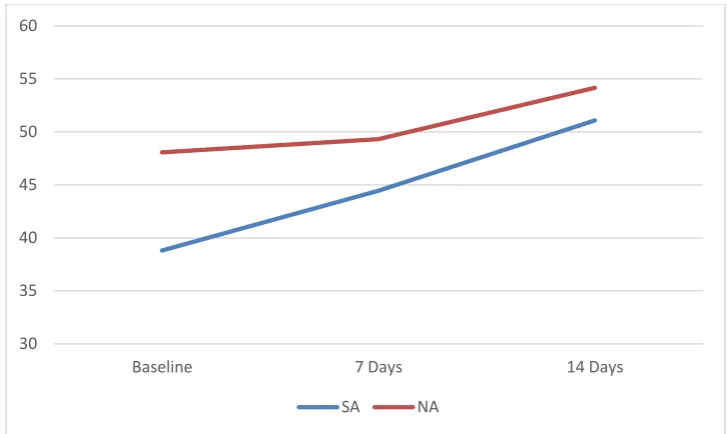
(Armitage, Harris & Arden, 2011). Analysis revealed that participants did increase their
levels of PA throughout the intervention (Table 4).
Table 4
Mean score of PA across each time-point for the complete data at the 14 day analysis.
Participants Baseline PA Mean
Score
7 Day Mean
Score
14 Day Mean
Score
SA (n=11) NA (n= 12)
38.82
48.08
44.46
49.33
51.09
Figure 1. Graphical data revealing the participation in physical activity across the two conditions increasing, although not significant.
A 2 x 2 mixed design factorial ANCOVA revealed the main effect of condition on PA
was not significant F(1,20) = .12, p=.770, ηp2= .006.
Results were further broken down to assess PA at all time-points of the 14 day data. A
One-Way ANOVA revealed that the differences in PA between the conditions across the
time-points was not significant F(1,22 )= .10, p = .751 for the 7 day interval and F(1,22) = .04, p = .836 for the 14 day interval.
Analysis of SE, RE and INT.
Analysis was conducted on the 14 day time-point in order to assess whether
self-affirmation had an effect on RE, INT, and SE, as scores of RE increased in both conditions
throughout the intervention, INT having an initial increase before decreasing again and SE
having an initial increase post-test before decreasing throughout the intervention (Table 5).
30 35 40 45 50 55 60
Baseline 7 Days 14 Days
Table 5
Descriptive data for the measures of response-efficacy, intent and self-efficacy for Self-Affirmed participants [Non-Self-Affirmed comparisons].
Measure Baseline Post Test 7 Day 14 Day
RE 4.96[5.69] 5.61[5.88] 5.64[5.82] 5.73[5.94]
INT 3.77[3.17] 4.18[3.81] 4.24[3.86] 4.12[3.75]
SE 2.36[2.33] 2.48[3.52] 2.75[2.51] 2.75[2.58]
A 2x2 mixed factorial ANCOVA was conducted controlling for the baseline scores.
Analysis revealed the main effect of condition on each of these measures was not significant
F(1,20)= .56, p = .462, ηp2= .023, for RE; F(1,20)= .06, p = .815, ηp2= .003, for INT; and
F(1,20)= .78, p = .388, ηp2= .04 for SE.
Researchers then assessed SE, RE and INT at the post-test stage as this is straight
after manipulation and it was hypothesised that those in SA would score higher due to their
affirmation. Results showed similar results across the conditions (Table 6).
Table 6
Mean scores of self-efficacy, response-efficacy and intent at 0 days post manipulation.
Participants SE 0 Day Score RE 0 Day Score INT 0 Day Score
SA (n=16) NA (n=18)
2.52 (SD= .83) 2.67 (SD= .91)
5.43 (SD= .69) 5.67 (SD= 1.08)
5 (SD= 1.7) 4.7 (SD= 2.01)
One-Way ANOVAs were conducted with the independent variable as condition and
the dependent variable as values of SE, RE and INT at post-test (n=34; SA n=16, NA n=18). The ANOVAs revealed that the scores of SE, RE, and INT were not significant when varied
for condition F(1,32)= .478, p = .494 for SE; F(1,32)= .668, p = .420 for RE; and F(1,32)= .356, p = .555 for INT.
Further Analysis of the 7 Day Time-Point.
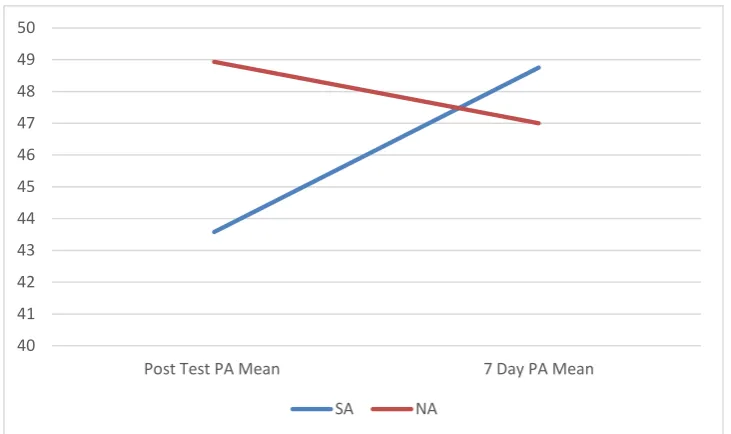
As was shown, levels of PA had a larger increase in the SA group compared with the
NA group over a 14 day period. This trend was further assessed at the 7 day interval as there
Researchers assessed this as self-affirmation has previously shown to be effective in
behaviour change up to 7 days post manipulation (Table 7).
Table 7
Differences in means of Physical Activity scores at baseline compared with seven days for all complete data at the 7-day time-point for both conditions.
Participants Post Test PA Mean 7 Day PA Mean Difference
SA (n=12) NA (n=14)
43.58
48.93
48.75
47
5.17
-1.93
Figure 2. Graphical data of Physical Activity scores at baseline and after seven days post manipulation for both control and experimental condition.
A 2 x 2 mixed factorial ANCOVA was conducted controlling for baseline PA which
revealed the differences in PA, were not significant F(1,24) = .510, p = .482, ηp2= .16. As all measures were demonstrated to not be statistically significant, this research
cannot confirm the effective use of self-affirmation theory when conducting an online PA
intervention. This is the first type of intervention like it, and so further analysis needs to be
conducted before these results can be taken conclusively. Findings will be discussed below
along with limitations of the research.
40 41 42 43 44 45 46 47 48 49 50
Post Test PA Mean 7 Day PA Mean
Discussion
The aim of this research was to develop an online PA intervention using
self-affirmation. The results demonstrated few significant changes. The first aim was to
demonstrate that those who were self-affirmed would show an increase in participation in PA.
However, the results showed this not to be the case. What should be noted was that after
comparison of the means, it became apparent that participants were already completing
higher amounts of PA than governmental recommendations. Previous research has
demonstrated that self-affirming works best for those who are most ‘at risk’ (Armitage et al., 2008). The concept of those most ‘at risk’ showing the most dramatic increases was
demonstrated by Fielden (2012) who broke down conditions to separate those most ‘at risk’
from those who were not. This suggests that for the current research, the health message may still have been accepted but due to participants being ‘low risk’, there was no significant
behaviour change.
Most of the participants were students and research has demonstrated links between
educational attainment and increased participation in PA. Reasons for this increase have been
discussed as a more comprehensive understanding of health messages, or an overall increase
in self-efficacy and social support which is associated with higher participation in PA (Cerin
& Leslie, 2008). This is a point that should be explored further as in the current research, it is
possible that the ceiling effects noticed may have been due to participants attaining a higher level of education which affects participation in PA, making participants ‘low risk’, but
conclusions cannot be drawn as it was not accounted for.
It was also hypothesised that initial increases in PA are to level out in accordance with
recommendations; due to the concept of self-affirming which suggests people will alter
behaviour in accordance with risk (Sherman & Hartson, 2011; Steele, 1988). In conjunction
to the present research, the baseline means demonstrated participants were already
participating in beyond recommended amounts of PA, which would not compromise their
global self-concept or result in behaviour change. In relation to previous findings, research by Fielden (2012) aimed to increase fruit and vegetable intake. The methodology of this research
was carried out online and results revealed that self-affirmation led to positive behaviour
change which levelled out in accordance with time and recommendations. Also
demonstrated, was those furthest from the target behaviours were the ones who increased
the amount of participants also used ‘at risk’ participants. As discussed, there may be reasons
that the student population are not ‘at risk’ and separate research should be conducted to explore participation in PA by an ‘at risk’ population or to further research mediators of
participation in PA by different population groups, including the student population.
Finally, it was predicted that those participants who were affirmed would show
increases in measure of SE, RE and INT; however this was established to be not significant.
As participants were already partaking in PA, it would be assumed that there would be no differences. By having already reached the recommended levels, participants’ IN towards
physical activity would not be expected to increase. Similarly, for SE and RE in that if
participants already felt that they were doing enough, there would be no change needed.
Previously, Harris and Epton (2008) assessed self-affirmation in a computer setting and
levels of IN and RE towards fruit and vegetable intake post manipulation. The results verified
that those affirmed had higher levels of message acceptance, intent to change and subsequent
behaviour in the following seven days compared with controls. It is important to note the
implication of these results as it establishes the use of self-affirmation in a computer setting
which is of high applicability to the current research. As Epton and Harris (2008) found significant results of behaviour change and response measures in a population who were ‘at risk’, it reveals that the findings of the current research cannot discredit previous findings.
The current research had half the number of participants not ‘at risk’. Therefore, this
intervention needs to be carried out on a population of a larger sample and those who represent the ‘at risk’ population.
Complexities of PA.
The largest gaps in health behaviour are usually associated with those who are
furthest from the target behaviours and who display denial and defensiveness to overcome the
psychological upset (Berry, 2004). As self-affirmation has been shown to increase acceptance and even increase behaviour in those who are most ‘at risk’, it needs to be researched further
into the area of PA as there is governmental need and rationalisation to do so, as deliberated previously. The complexities of PA are imperative to consider as people who are motivated
often do not demonstrate positive behaviour (Marcus et al., 2006). The Theory of Planned
Behaviour demonstrates this as many factors interplay in relation to behaviour and expected
behaviour. Certain aspects such as intention and perceived behavioural control are big
experiences also interplay to affect actual behaviour outcome (Armitage & Conner, 2001). As
this current research was the first that examined self-affirmation in a PA setting, when PA has
been shown to be so complex, it is important to advocate the need for future research. The
intricacies of PA can be further researched and modalities of self-affirmation implemented in
order to overcome these complexities.
To overcome the complexities of PA, suggestions for future research include the identification of a specific group considered to be ‘at risk’, which is similar to the
methodology of Fielden (2012), and results validated that tailoring the message to a particular
group facilitated to identify contributors to the intention-behaviour gap (Godin & Kok, 1996).
Therefore, for self-affirmation and PA literature, it is proposed that the focus is on particular
sub-groups and that interventions are specifically designed towards the requirements of the
sub-group.
The use of online PA interventions
This research is the first time self-affirmation as a means of increasing PA has been
explored, and the concept of it being delivered in an online setting is still novel to literature
and further work needs to be piloted before any inferences can be drawn. This study
demonstrated an increase in PA that although not significant, provides justification for
additional research. Previous research by Epton and Harris (2008) and Fielden (2012) has
demonstrated self-affirming can lead to positive increase in health inducing behaviours.
Research should focus on this, as there have been mixed results shown in behaviour change
when looking at cessation of behaviour (Sherman et al., 2000; Armitage et al., 2008).
The use of the Internet was previously discussed as a tool to be used for effective
interventions due to time, cost, and a wide audience base. As Brouwer et al., (2009) noted, to
be effective, health messages online need to be credible and tailored toward the target
population (Fielden 2012). Although there was not a target population for this research, the
majority of participants were students. Therefore, once the website had been published,
researchers used the assistance of students to evaluate the website in depth to ensure that the
message was regarded as credible. A few points were given as feedback which included the
use of complex terms and as a result, researchers altered these points and supplementary
Implications
This research has demonstrated that for a concept as complex as PA where increased
amounts are ever beneficial, once recommendations of baseline participation are met,
self-affirmation does not aid to increase amounts further (Sherman & Hartson, 2011). What needs
to be assessed is this use of methodology on a group who specifically underachieve baseline
measures of PA as it is this population who are most at need of intervention. Further
replication of this methodology is needed in more extensive research, in order for this online
methodology to be developed into an effective intervention for PA as it will be low cost, have
the ability to reach out to many, reduce stigma, and in turn, aim to reduce the worldwide
obesity epidemic. However, this does require the person to go onto the site but once an
effective intervention is developed, further research can go into detail about how to address
adherence.
As the world of technology is ever growing, it opens up doors for health
interventionists. Mobile phones could be explored as it would allow people to keep up to date
with information whilst they are on the go which emphasises their individuality and comfort
throughout interventions. The use of technology is prominent in everyday life and to address
issues by utilising the Internet could be of extreme value to both users and health care
professionals and due to the points mentioned above, it is therefore vital that there is further
research conducted. Furthermore, affirmation may be able to work over a period of time. If
research can demonstrate that affirming can be effective more than once throughout an
intervention; the low cost, longitudinal effects of self-affirmation have the potential to
develop long term, effective interventions at a low cost and with the ease of online delivery.
Limitations
The first limitation to note was the use of self-report measures. As the research was
specifically looking at PA, there is the possibility that some participants were portraying ‘demand characteristics’. The use of an accelerometer was discussed; however due to time
constraints, this was unavailable. It is suggested that such a measure is used in any further
research to gauge the accuracy of self-report. Secondly, is that as a measure of PA, what is ‘moderate exercise’ for one person may be ‘vigorous’ to another. Researchers did read participants’ description of their physical activity and matched it with their interpretation of
The sample size and the population are also limitations of this research. The sample
size was small with limited diversity with the majority representing the student population. It
has already been discussed as to why the student population is not representative of the wider
population in regards to PA behaviour and future research should aim to expand beyond this
population in order for findings to be developed into an intervention that can be widely used.
Issues encountered by participants gave insight to researchers about potential
problems with the methodology. For instance, as the research used long term follow up,
participants received an email saying to log back in seven days. However, a few did not see the ‘seven days’ and completed all stages. In other cases, after the baseline measure,
participants were to click to view the health website. Some however did not do this straight
away and were sent a reminder but the effects of self-affirmation may have been lost.
Therefore in future, greater consideration should be given to clarity, and potentially making a pop up screen saying ‘STOP’ is suggested. Regarding long term follow up, it is necessary to
assess the longitudinal effects of self-affirmation. However, a simplified approach or data
collection at longer intervals is recommended due to the repetition of the research over short
time periods resulting in a loss of participants. There was a high dropout rate of participants,
of which the design of the research being over separate time points can account for part. This
limited the research to a reduced number of participants being counted in the analysis at the
14 day time point.
Future Research
The need for further research into the area of self-affirmation, PA and the use of the
Internet is essential in order to add to the health literature, and potentially develop a low cost,
time effective intervention. In order to effectively test self-affirmation, the use of baseline
measures and post manipulation measures of RE, IN and SE are suggested to make
comparisons. Most research in self-affirmation has used these measures post manipulation
but have not at baseline making it problematic to calculate differences (Fielden, 2012;
Armitage, Harris, Hepton & Napper, 2008).
Rather than just assessing response, message acceptance and self-efficacy, Fielden
(2012) reported the first instance of improved behaviour change in an online setting. Future
research should build upon this and measure the effects on behaviour post manipulation.
Intent is especially important to assess as although not consequentially, intent is one of the
discrepancies between intention and behaviour, research can then gauge means of bridging
this gap using self-affirmation.
If research is aiming to look at PA, it is suggested that groups who are deficient in PA
are assessed as it is believed that self-affirmation works best on those most at risk, and as this
research has demonstrated, there were no significant effects with participants who were
already hitting baseline levels of PA. What should be explored further are the details of this
group, so the health message can be customised towards them. As the effects of
self-affirmation behaviour change have only been shown in a small amount of studies, research
needs to assess the longitudinal effects. For truly effective behaviour change, it would be
expected that behaviour would maintain over time but this as of yet, has not been explored.
Conclusion
The main aims of this research were to assess self-affirmation on behaviour in an
online setting. Although having shown to lack significant changes, reasons such as
participation size and ceiling effects have been suggested with recommendations for future
research. Self-affirmation has previously shown to be effective in health behaviour (Fielden,
2012; Shermanet al., 2000). In respect to PA, it is novel and further advancements have been
suggested. As the problem of obesity and NCD is growing faster than can be tackled, it is
imperative that effective interventions are constructed in order to minimise the problems
using the versatility of the tools available such as the internet.
References
Ammann, R., Vandelanotte, C., de Vries, H., & Mummery, K. W. (2013). Can a
website-delivered computer-tailored physical activity intervention be acceptable, useable, and
effective for older people?. Health Education and Behaviour, 40(2), 160-170. doi: 10.1177/1090198112461791
Armitage, C. J. & Connor, M. (2001). Efficacy of the theory of planned behaviour: A
Armitage, C. J., Harris, P. R., & Arden, M. A. (2011). Evidence that self-affirmation reduces
alcohol consumption: Randomized exploratory trial with a new, brief means of
self-affirming. Health Psychology, 30(5), 633-641. doi: 10.1037/a0023738
Armitage, C. J., Harris, P. R., Hepton, G. & Napper, L. (2008). Self-affirmation increased
acceptance of health-risk information among UK adult smokers with low
socioeconomic status. Psychology of Addictive Behaviours, 22(1), 88-95. doi: 10.1037/0893-164X.22.1.88
Bandura, A. (1997). Self-efficacy: The exercise of control. Worth Publishers, New York. Beaglehole, R., Bonita, R., Horton, R., Adams, C., Alleyn, G., Asaria, P., ... & Keling, A.
(2011). Priority actions for the non-communicable disease crisis. The Lancet, 377(9775), 23-29. doi: 10.1016/S0140-6736(11)60393-0
Bennett, G. G., & Glasgow, R. E. (2009). The delivery of public health interventions via the
internet: Actualising their potential. Annual Review of Public Health, 30, 273-292. doi: 10.1146/annurev.pubhealth.031308.100235
Bergman, P., Grjibovski, A. M., Hagstromer, M., Bauman, A., & Sjostrom, M. (2008).
Adherence to physical activity recommendations and the influence of
socio-demographic correlates – a population-based cross-sectional study. BMC Public Health, 8, 367-375. doi: 10.1186/1471-2458/8/367
Berkel, L. A., Poston, W. S. C., Reeves, R., & Foreyt, J. (2005). Behavioural interventions
for obesity. Journal of the American Dietetic Association, 105(5S1), 35-43. doi: 10.1016/j.jada.2005.02.031
Berry, D. (2004). Risk, communication and health psychology. Open University Press, New York.
Brouwer, W., Oenema, A., Crutzen, R., de Nooijer, J., de Vries, N. K., & Brug, J. (2009).
What makes people decide to visit and use an internet-delivered behaviour-change
Cerin, E., & Leslie, E. (2008). How socio-economic status contributes to participation in
leisure-time physical activity. Social Sciences & Medicine, 66(12), 2596-2609. doi: 10.1016/j.socscimed.2008.02.012
Cohen, G., & Adams, P. F. (2011). Use of the internet for health information: United States,
2009. NCHS Data Brief, 66. Retrieved from:
http://www.cdc.gov/nchs/data/databriefs/db66.pdf
Cohen, G., Garcia, J., Apfel, N., & Master, A. (2006). Reducing the racial achievement gap:
A social psychological intervention. Science, 313, 1307. doi: 10.1126/science.1128317
Craig, P., Dieppe, P., Macintyre, S., Michie, S., Nazareth, I., &Petticrew, M. (2008).
Developing and evaluating complex interventions: the new Medical Research Council
guidance. Biomedical Journal, 337, 1655.doi: 10.1136/bmj.a1655
Crespo, C. J., Garcia – Palmieri, M. R., Perdomo, R. P., McGee, D. L., Smit, E., Sempos, C. T. & … Sorlie, P. D. (2002). The relationship of physical activity and body weight
with all-cause mortality: Results from the Puerto Rico Heart Health program. Annals of Epidemiology, 12(8), 543-552. doi: 10.1016/S1047-2797(01)00296-4
Crocker, J., Niiya, Y.,, & Mischowski, D. (2008). Why does writing about important values
reduce defensiveness? Self-affirmation and the role of positive other-directed feelings.
Psychological Science, 19(7), 740-747. doi: 10.1111/j.1467-9280.2008.02150 Davies, C. A., Spence, J. C., Vandelanotte, C., Caperchione, C. M., & Mummery, K. W.
(2012). Meta- analysis of internet-delivered interventions to increase physical activity
levels. International Journal of Behavioural Nutrition and Physical Activity, 9, 52-66. doi:10.1186/1479.5868.9.52
Department of Health, Physical Activity, Health Improvement and Prevention. (2004). At
least five times a week: Evidence on the impact of physical activity and its
relationship to health. A report from the Chief Medical Officer. HM Government,
London.
Ebrahim, S., Taylor, F., Ward, K., Beswick, A., Burke, M., & Smith, G. D. (2011). Multiple
risk factor interventions for primary prevention of coronary heart disease. Cochrane Database of Systematic Reviews, 1, 1-97. doi: 10.1002/14651858.CD001561.pub3 Epton, T., & Harris, P. R. (2008). Self-affirmation promotes health behaviour change. Health
Psychology, 27(6), 746-752. doi: 10.1037/0278-6133.27.6.746
Epton, T., Harris, P. R., Kane, R., & van Koningsbruggen, G. M. (2014). The impact of
self-affirmation on health behaviour change: a meta-analysis. Health Psychology.34(3), 187 http://dx.doi.org/10.1037/ hea0000116
Fielden, A. (2012). Increasing the Acceptance of Online Health Information: Understanding
Barriers, Tailoring Messages and Self-Affirmation. Northumbria University:
Available at: http://nrl.northumbria.ac.uk/14687/1/fielden.amy_phd.pdf.
Godin, G., & Kok, G. (1996). The theory of planned behaviour: a review of its applications to
health related behaviours. American Journal of Health Promotion, 11(2), 87-98. doi: 10.4278/0890-1171-11.2.87
Gourlan, M. J., Trouilloud, D. O., & Sarrazin, P. G. (2011). Interventions promoting physical
activity amongst obese populations: a meta-analysis considering global effect, long
term maintenance, physical activity indicators and dose characteristics. Obesity Reviews, 12(7), 633-645. doi:10.1111/j.1467-789X.2011.0084
Han, J. C., Lawlor, D. A., & Kimm, S. Y. (2010). Childhood obesity. The Lancet, 375(9727), 15-21. doi:10.1016/S0140-6736(1)60171-7
Health and Social Care Information Centre. (2014). Statistics on Obesity, Physical Activity
and Diet: England 2014. Retrieved from: http://www.hscic.gov.uk/catalogue/
PUB13648/Obes-phys-acti-diet-eng-2014-rep.pdf
JAMA. (2000). The benefits of regular physical activity. The Journal of the American Medical Association, 283(22), 3030. doi: 10.1001/jama.283.22.3030
Jaremka, L. M., Bunyan, D. P., Collins, N. L., & Sherman, D. K. (2011). Reducing defensive
distancing: Self-affirmation and risk regulation in response to relationship threats.
Jessop, D. C., Simmonds, L. V., & Sparks, P. (2009). Motivational and behavioural
consequences of self-affirmation interventions: A study of sunscreen use among
women. Psychology and Health, 24(5), 529-544. doi: 10.1080/08870440801930320 Jolly, K., Lewis, A., Beach, J., Danley, J., Adab, P., Deeks, J. J., Daley, A., & Aveyard, P.
(2011). Comparison of range of commercial or primary care led weight reduction
programmes with minimal intervention control for weight loss in obesity: Lighten Up
randomised controlled trial. BMC Public Health, 439(10), 1-8. doi: 10.1186/1471- 2458-10-439
Keim, N. L., Blanton, A. C., Kretsch, M.J. (2004). America’s obesity epidemic: Measuring
physical activity to promote an active lifestyle. Journal of the American Dietetic Association, 104, 1398-1409. doi: 10.1016/j.jada.2004.06.005
Kilpi, F., Webber, L., Musaigner, A., Aitsi-Selmi, A., Marsh, T., Rtveladze, K., ... & Brown,
M. (2014). Alarming predictions for obesity and non-communicable diseases in the
Middle East. Public Health Nutrition, 17(5), 1078-1086. doi: 10.1017/S136898001 3000840
Kim, Y. S., Park, Y. S., Allegrante, J. P., Marks, R., Ok, H., Cho, K. O., & Garber, C. E.
(2012). Relationship between physical activity and general mental health.
Preventative Medicine, 55(5), 458-463. doi: 10.1016/j.ypmed.2012.08.021
Korp, P. (2006). Health on the internet: Implications for health promotion. Health Education Research: Theory and Practice, 21(1), 78–86. doi: 10.1093/her/cyh043
Lee, I. M., Shiroma, E. J., Lobelo, F., Puska, P., Blair, S. N., & Katzmarzyk, P. T. (2012).
Effects of physical inactivity on major non-communicable diseases worldwide: an
analysis of burden of disease and life expectancy. The Lancet, 380(9838), 219-229. doi: 10.1016/S0140-6736(12)61031-9
Litwin, S. E. (2006). The growing problem of obesity and the heart: The plot thickens.
Journal of American College of Cardiology, 47(3), 617-619. doi:10.1016 /j.jacc.2005.11.014
Marcus, B. H., Williams, D. M., Dubbert, P. M., Sallis, J. F., King, A. C., Yancey, A. K., ...
& Claytor, R. P. (2006). What We Know and What We Need to Know: A Scientific
Activity, and Metabolism (Sub-Committee on Physical Activity); Council on
Cardiovascular Disease in the Young; and the Interdisciplinary Working Group on
Quality of Care and Outcome Research. Circulation, 114, 2739-2752. doi:10.1161/ circulationaha.106.179683
McQueen, A. & Klein, W. M. P. (2006) Experimental manipulations of self- affirmation: A
systematic review. Self and Identity, 5(4), 289-354. doi.org/10.1080/ 15298860600805325
Napper. L., Harris, P. R. & Epton, T. (2009) Developing and testing a self- affirmation
manipulation. Self and Identity, 8(1), 45-62. doi:10.1080/15298860802079786 Paluska, S. A., & Schwenk, T. L. (2000). Physical activity and mental health. Sports
Medicine, 29(3), 167-180. doi: 10.2165/00007256-200029030-00003
Reed, M. B., & Aspinwall, L. G. (1998). Self-affirmation Reduces Biased Processing of
Health-Risk Information. Motivation and Emotion, 22(2), 99-132. doi:10.1023/A:102146322181
Rhodes, R. E., & Dickau, L. (2013). Moderators of the intention-behaviour relationship in the
physical activity domain: a systematic review. British Journal of Sports Medicine, 47, 215-225. doi:10.1136/bjsports.2011.0904.11
Sarker, J. (2014). Ethical issues of randomized controlled trials. Journal of Bioethics, 5(1), 1-4. doi: 10.3329/bioethics.v5i1.18441
Schoenborn, C., & Stommel, M. (2011). Adherence to the 2008 adult physical activity
guidelines and mortality risk. American Journal of Preventative Medicine, 40(5), 514-521. doi:10.1016/j.amepre.2010.12.029
Scarborough, P., Bhatnagar, P., Wickramasinghe, K. K., Allender, S., Foster, C., & Rayner,
M. (2011). The economic burden of ill health due to diet, physical inactivity,
smoking, alcohol and obesity in the UK: an update to 2006-07 NHS costs. The Journal of Public Health, 33(1), 1-9. doi: 10.1093/pubmed/fdr033
Scully, T. (2014). The increasing prevalence of obesity is a worldwide phenomenon,
Sherman, D. K., & Cohen, G. L. (2006). The Psychology of Self-Defence: Self-Affirmation
Theory. Advances in Experimental Social Psychology, 38, 183-242. doi: 10.1016/S0065-2601(06)38004-5
Sherman, D. K., Cohen, G. L., Nelson, L. D., Nussbaum, A. D., Bunyan, D. P., & Garcia, J.
(2009). Affirmed yet unaware: exploring the role of awareness in the process of
self-affirmation. The Journal of Personality and Social Psychology, 97(5), 745-764. doi: 10.1037/a0015451
Sherman, D. K. & Hartson, K. A. (2011) Reconciling self-protection with self- improvement:
Self-affirmation theory. In M. Alicke & C. Sedikides (Eds.), The Handbook of Self- Enhancement and Self-Protection, 128–143. New York, Guilford Press.
Sherman, D. A. K., Nelson, L. D., & Steele, C. M. (2000). Do Messages About Health Risks
Threaten the Self? Increasing the Acceptance of Threatening Health Messages Via
self-Affirmation. Personality and Social Psychology Bulletin, 26, 1046-1058. doi:0.1177/01461672002611003
Steele, C. M. (1988). The Psychology of Self-Affirmation: Sustaining the Integrity of the
Self. Advances in Experimental Social Psychology, 21, 261-302. doi:10.1016S0065-2601(08)60229-4
Steele, C. M., Spencer, S. J., & Lynch, M. (1993). Self-image resilience and dissonance: The
role of affirmational resources. Journal of Personality and Social Psychology, 64,
885-89. doi.org/10.1037/0022-3514.64.6.885
Stewart, L. (2011). Childhood Obesity. Medicine, 39(1), 42-44. doi: 10.1016/j.mpmed .2010.10.004
Warburton, D. E. R., Nicol, C. W., & Bredin, S. S. D. (2006). Health benefits of physical
activity: the evidence. Canadian Medical Association Journal, 174(6), 801-809. doi: 10.1503/cmaj.051351
Witte, K. (1992). Putting the fear back into fear appeals: The extended parallel process
model. Communications Monographs, 59, 329-349. doi:10.1080/0363775920937 6276
World Health Organisation (WHO). (2014). Global Strategy on diet, physical activity and
health. Retrieved from: http://www.who.int/dietphysicalactivity/physical_activity_
intensity/en/
World Health Organisation (WHO). (2002). The world health report 2002 – Reducing risks,
promoting healthy life. Retrieved from: http://www.who.int/whr/2002/en/