www.biogeosciences.net/13/989/2016/ doi:10.5194/bg-13-989-2016
© Author(s) 2016. CC Attribution 3.0 License.
The organic sea-surface microlayer in the upwelling region off
the coast of Peru and potential implications for air–sea
exchange processes
Anja Engel and Luisa Galgani
GEOMAR – Helmholtz Centre for Ocean Research Kiel, Düsternbrooker Weg 20, 24105 Kiel, Germany Correspondence to: Anja Engel ([email protected])
Received: 29 May 2015 – Published in Biogeosciences Discuss.: 9 July 2015
Revised: 23 December 2015 – Accepted: 27 January 2016 – Published: 22 February 2016
Abstract. The sea-surface microlayer (SML) is at the upper-most surface of the ocean, linking the hydrosphere with the atmosphere. The presence and enrichment of organic com-pounds in the SML have been suggested to influence air– sea gas exchange processes as well as the emission of pri-mary organic aerosols. Here, we report on organic matter components collected from an approximately 50 µm thick SML and from the underlying water (ULW), ∼20 cm be-low the SML, in December 2012 during the SOPRAN ME-TEOR 91 cruise to the highly productive, coastal upwelling regime off the coast of Peru. Samples were collected at 37 stations including coastal upwelling sites and off-shore sta-tions with less organic matter and were analyzed for total and dissolved high molecular weight (> 1 kDa) combined carbo-hydrates (TCCHO, DCCHO), free amino acids (FAA), total and dissolved hydrolyzable amino acids (THAA, DHAA), transparent exopolymer particles (TEP), Coomassie stainable particles (CSPs), total and dissolved organic carbon (TOC, DOC), total and dissolved nitrogen (TN, TDN), as well as bacterial and phytoplankton abundance. Our results showed a close coupling between organic matter concentrations in the water column and in the SML for almost all components ex-cept for FAA and DHAA that showed highest enrichment in the SML on average. Accumulation of gel particles (i.e., TEP and CSP) in the SML differed spatially. While CSP dance in the SML was not related to wind speed, TEP abun-dance decreased with wind speed, leading to a depletion of TEP in the SML at about 5 m s−1. Our study provides in-sight to the physical and biological control of organic matter enrichment in the SML, and discusses the potential role of organic matter in the SML for air–sea exchange processes.
1 Introduction
Accumulation of organic matter in the SML may be tightly coupled to phytoplankton abundance in the water column (Bigg et al., 2004; Galgani et al., 2014; Gao et al., 2012; Matrai et al., 2008). Thus, organic matter accumulation and composition in the SML may also reflect the sensitivity of marine microorganisms in the surface ocean to environmen-tal changes, which was shown during previous mesocosms studies (Engel et al., 2013; Riebesell et al., 2009; Schulz et al., 2013). Distinct from the SML and on top of it lies the nanolayer, a monomolecular film, which, like the SML, shows seasonality features with carbohydrate-rich polymeric material being most abundant during the summer months and possibly related to a combination of primary produc-tion (phytoplankton abundance) and photochemical and/or microbial reworking of organic matter (Laß et al., 2013).
In our study we focused on the upper micrometers of the water–air interface that we operationally define as SML, whose compositional changes and accumulation of organic matter may influence two air–sea interface processes nec-essary to understand oceanic feedbacks on the atmosphere: sea-spray aerosol (SSA) emission and air–sea gas exchange (Cunliffe et al., 2013). During biologically productive peri-ods, a high amount of SSA with a predominant organic com-position is emitted from the ocean’s surface (O’Dowd et al., 2004). These compounds primarily reveal a polysaccharidic, gel-like composition, suggesting that the abundance and size of dissolved polysaccharides and marine gels in the sea sur-face may influence the organic fraction of SSA (Orellana et al., 2011; Russell et al., 2010). It has also been shown that the presence of biogenic surface active substances (surfac-tants) in the SML leads to capillary wave damping, alters the molecular diffusion of gases (Frew et al., 1990; Liss and Duce, 2005) and thereby affects gas exchange rates particu-larly at lower wind speed (Jähne and Haußecker, 1998). In this respect, the understanding of sources, composition and fate of biological components in the SML becomes of partic-ular relevance for environments, where biological productiv-ity is high like in coastal upwelling regimes.
Off the coast of Peru, the coastal upwelling region extends between approximately 4 and 40◦S. In this area, upwelling processes are sustained by winds throughout the year but fea-ture high inter-annual variability induced by the El Niño– Southern Oscillation (ENSO) cycle (Tarazona and Arntz, 2001). Eastern boundary upwelling systems (EBUSs) like the system off the coast of Peru are characterized by high biological productivity supported by deep upwelling of nutri-ents and often associated with subsurface oxygen minimum zones (OMZs). The supply of oxygen to the OMZ is largely controlled by physical (i.e., diffusive and advective) mecha-nisms, whereas biological processes (i.e., respiration of or-ganic matter) provide sinks (Lachkar and Gruber, 2011).
OMZs are significant source regions for major climate-relevant gases such as carbon dioxide, methane, hydrogen sulfide and nitrous oxide (Paulmier et al., 2008, 2011). Pro-cesses affecting gas exchange in these regions need to be
un-derstood in order to accurately estimate trace gas fluxes from the ocean to the atmosphere and consequences on climate. In 2008, the VAMOS Ocean-Cloud-Atmosphere-Land Study Regional Experiment (VOCALS-REx) and the Chilean Up-welling Experiment (VOCALS-CUpEx) conducted between Southern Peru and Northern Chile focused on the link be-tween aerosols, clouds and precipitation as well as on physi-cal and chemiphysi-cal couplings between the upper ocean and the lower atmosphere (Garreaud et al., 2011; Wood et al., 2011). During the SOPRAN cruise METEOR91 (M91), we stud-ied organic matter components at the very sea surface since properties of the SML may represent a major uncertainty for gas, heat and aerosol fluxes in this specific region and in other oceanic environments. During our cruise, organic matter con-centration and composition of the SML and the underlying seawater were studied on 37 different stations, providing the first SML data set for the upwelling system off the coast of Peru, including the first data set on gel particles in EBUSs so far.
2 Material and methods
2.1 Field information and sampling
The R/V METEOR cruise M91 studied the upwelling region off the coast of Peru (Bange, 2013). Samples were collected between 4.59◦S and 82.0◦W, and 15.4◦S and 77.5◦W from 3 to 23 December in 2012. The overall goal of M91 was to conduct an integrated biogeochemical study on the upwelling region off the coast of Peru in order to assess the importance of OMZs for the sea-air exchange of various climate-relevant trace gases and for tropospheric chemistry. Salinity and tem-perature were measured with a CTD at each station. Global and UV radiation and wind speed data were retrieved from the DShip database for the time of sampling based on the sensors installed on board.
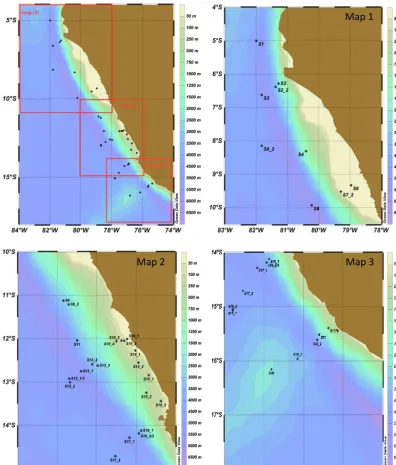
Map 1
[image:3.612.102.499.65.530.2]Map 2
Map 3
Figure 1. Maps of stations where sampling for the sea-surface microlayer (SML) and underlying seawater (ULW) was conducted during the
SOPRAN Meteor 91 cruise along the coastal upwelling area off the coast of Peru in 2012.
(width)×5 mm (thickness) was made of borosilicate glass and had an effective sampling surface area of 2000 cm2 (con-sidering both sides). For each sample, the glass plate was in-serted into the water perpendicular to the surface and with-drawn slowly at a rate of approximately 20 cm s−1. The sam-ple, retained on the glass because of surface tension, was re-moved with the help of a Teflon wiper. Samples were col-lected as far upwind of the ship as possible and away from the path taken by the ship to avoid contamination. For each sample the glass plate was dipped and wiped about 20 times. The exact number of dips and the total volume collected
The apparent thickness (d) of the layer sampled with the glass plate was determined as follows:
d=V /(A×n), (1)
whereV is the SML volume collected (i.e., 60–140 mL)Ais the sampling area of the glass plate (A=2000 cm2) andnis the number of dips (Cunliffe and Wurl, 2014). We will used (µm) as an operational estimate for the thickness of the SML. At the same stations, after sampling the SML, about 500 mL samples were collected from the underlying seawa-ter (ULW) at∼20 cm depth by holding an acid-cleaned (HCl 10 %) and Milli-Q-rinsed borosilicate glass bottle. The bot-tle was open and closed underwater to avoid simultaneous sampling of SML water. For safety reasons, sampling for the SML from a rubber boat could be made only during daylight hours.
2.2 Chemical and biological analyses
2.2.1 Total organic carbon (TOC) and dissolved organic carbon (DOC)
Samples for TOC and DOC (20 mL) were collected in busted glass ampoules, DOC after filtration through com-busted GF/F filters (8 h, 500◦C). Samples were acidified with 80 µL of 85 % phosphoric acid, heat sealed immediately, and stored at 4◦C in the dark until analysis. DOC and TOC sam-ples were analyzed by applying the high-temperature cat-alytic oxidation method (TOC-VCSH, Shimadzu) modified from Sugimura and Suzuki (1988). The instrument was cal-ibrated every 8–10 days by measuring standard solutions of 0, 500, 1000, 1500, 2500 and 5000 µg C L−1, prepared from a potassium hydrogen phthalate standard (Merck 109017). Every measurement day, ultrapure (MilliQ) water was used to determine the instrument blank, which was accepted for values < 1 µmol C L−1. TOC analysis was validated on every measurement day with deep seawater reference (DSR) mate-rial provided by the Consensus Reference Matemate-rials Project of RSMAS (University of Miami) yielding values within the certified range of 42–45 µmol C L−1. Additionally, two inter-nal standards with DOC within the range of those in samples were prepared each measurement day using a potassium hy-drogen phthalate (Merck 109017). DOC and TOC concen-tration was determined in each sample from 5 to 8 injections. The precision was < 4 % estimated as the standard deviation of replicate measurements divided by the mean. Particulate organic carbon (POC) was determined as the difference be-tween TOC and DOC.
2.2.2 Total nitrogen (TN) and total dissolved nitrogen (TDN)
TN and TDN were determined simultaneously with TOC and DOC, respectively, using the TNM-1 detector on the Shi-madzu analyzer. Nitrogen in the samples is combusted and
converted to NOx, which chemiluminesces when mixed with ozone and can be detected using a photomultiplier (Dick-son et al., 2007). Calibration of the instrument was done ev-ery 8–10 days by measuring standard solutions of 0, 100, 250, 500 and 800 µg N L−1, prepared with potassium nitrate Suprapur® (Merck 105065). Particulate nitrogen (PN) was determined as the difference between TN and TDN. Deep seawater reference (DSR) material provided by the Consen-sus Reference Materials Project of RSMAS (University of Miami) was used on every measurement day and yielded val-ues within the certified range of 31–33 µmol N L−1. The pre-cision was < 2 % estimated as the standard deviation of 5–8 measurements divided by the mean.
2.2.3 Total, dissolved and free amino acids
For total hydrolysable amino acids (THAA), 5 mL of sam-ple were filled into pre-combusted glass vials (8 h, 500◦C)
and stored at−20◦C until analysis. Samples for dissolved hydrolysable (DHAA) and free amino acids (FAA) were additionally filtered through 0.45 µm Millipore Acrodisc® syringe filters and then stored in the same way as sam-ples for THAA. Analysis was performed according to Lin-droth and Mopper (1979) and Dittmar et al. (2009) with some modifications. Duplicate samples were hydrolyzed for 20 h at 100◦C with hydrochloric acid (suprapur, Merck) and neutralized by acid evaporation under vacuum in a mi-crowave at 60◦C. Samples were washed with water to re-move remaining acid. Analysis was performed on a 1260 HPLC system (Agilent). Thirteen different amino acids were separated with a C18 column (Phenomenex Kinetex, 2.6 µm, 150×4.6 mm) after in-line derivatization with o-phthaldialdehyde and mercaptoethanol. The following stan-dard amino acids were used: aspartic acid (AsX), glutamic acid (GlX), serine (Ser), arginine (Arg), glycine (Gly), threo-nine (Thr), alathreo-nine (Ala), tyrosine (Tyr), valine (Val), pheny-lalanine (Phe), isoleucine (Ileu), leucine (Leu),γ- amino bu-tyric acid (GABA).α- amino butyric acid was used as an in-ternal standard to account for losses during handling. Solvent A was 5 % acetonitrile (LiChrosolv, Merck, HPLC gradient grade) in sodium-di-hydrogen-phosphate (Merck, suprapur) buffer (PH 7.0). Solvent B was acetonitrile. A gradient was run from 100 % solvent A to 78 % solvent A in 50 min. FAA were determined from DHAA samples without prior hy-drolysis in separate analyses. Particulate hydrolysable amino acids (PHAA) were determined by subtracting DHAA from THAA. The detection limit for individual amino acids was 2 nmol monomer L−1. The precision was < 5 %, estimated as the standard deviation of replicate measurements divided by the mean.
pre-combusted glass vials (8 h, 500◦C) and kept frozen at −20◦C until analysis. Samples for DCCHO were
addition-ally filtered through 0.45 µm Pall Acrodisc®syringe filters. The analysis was conducted according to Engel and Hän-del (2011) applying high performance anion exchange chro-matography coupled with pulsed amperometric detection (HPAEC-PAD) on a Dionex ICS 3000. Samples were desali-nated by membrane dialysis (1 kDa MWCO, Spectra Por) for 5 h at 1◦C, hydrolyzed for 20 h at 100◦C with 0.4 M HCl fi-nal concentration, and neutralized through acid evaporation under vacuum and nitrogen atmosphere (1 h, 60◦C). Two replicate samples were analyzed. The retention of carbohy-drates on exchange columns, and thus the reproducibility of results are highly sensitive to changes in temperature (Pana-giotopoulos et al., 2001; Yu and Mou, 2006). For our system, best resolution of sugars was obtained at 25◦C and
there-fore applied constantly during all analyses. In order to min-imize degradation of samples before analysis, the tempera-ture in the auto-sampler was kept at 4◦C. The system was calibrated with a mixed sugar standard solution including (a) the neutral sugars: fucose (4.6 µM, Fuc), rhamnose (3.1 µM, Rha), arabinose (2.0 µM, Ara), galactose (2.4 µM, Gal), xy-lose/ mannose (3.1 µM, Xyl/ Man), glucose (2.4 µM, Glc), (b) the amino sugars: galactosamine (2.0 µM, GalN), glu-cosamine (2.8 µM, GlcN), and (c) the acidic sugars: galac-turonic acid (2.8 µM, Gal-URA), gluconic acid (5.1 µM, Glu-Ac), glucuronic acid (3.0 µM, Glc-URA) and muramic acid (1.9 µM, Mur-Ac). Regular calibration was performed by in-jecting 12.5, 15.0, 17.5 and 20 µL of mixed standard solution. Linearity of the calibration curves of individual sugar stan-dards was verified in the concentration range 10 nM–10 µM. Therefore, the standard mixture was diluted 10, 20, 50, and 100 fold with Milli-Q water. Injection volume for samples and for the blank was 17.5 µL. To check the performance of carbohydrate analysis and stability of the HPLC-PAD sys-tem, a 17.5 µL standard solution was analyzed after every second sample. The detection limit was 10 nM for each sugar with a standard deviation between replicate runs of < 2 %. Milli-Q water was used as blank to account for potential contamination during sample handling. Blanks were treated and analyzed in the same way as the samples. Blank concen-tration was subtracted from sample concenconcen-tration if above the detection limit. Particulate combined carbohydrates (PC-CHO) were determined as the difference between TCCHO and DCCHO.
2.2.5 Gel particles
Total area, particle numbers and equivalent spherical diam-eter (dp) of gel particles were determined by microscopy after Engel (2009). Therefore, 20 to 30 mL were fil-tered onto 0.4 µm Nuclepore membranes (Whatmann) and stained with 1 mL Alcian Blue solution for polysaccha-ridic gels (i.e., transparent exopolymer particles (TEP)) and 1 mL Coomassie Brilliant Blue G (CBBG) working
solu-tion for proteinaceous gels (i.e., Coomassie stainable par-ticles (CSP)). Filters were mounted onto Cytoclear©slides and stored at−20◦C until microscopy analysis. The size–
frequency distribution of gel particles was described by the following:
dN d dp
=kd δ
p, (2)
where dN is the number of particles per unit water volume in the size rangedpto (dp+d(dp); Mari and Kiørboe, 1996). The factork is a constant that depends on the total number of particles per volume, andδ (δ< 0) describes the spectral slope of the size distribution. The valueδ is related to the slope of the cumulative size distribution N=adpβ by δ= β+1, whereNis the total number of particles per unit water volume. The less negative isδ, the greater is the fraction of larger gels. Bothδ andkwere derived from regressions of log(dN/d(dp))vs. log(dp)over the size range 1.05–14.14 µm ESD.
Formation of exopolymeric gel particles (e.g., TEP) can be described in terms of coagulation kinetics (Engel et al., 2004; Mari and Burd, 1998). Aggregates can be described using a fractal scaling relationship (e.g.,M∼LD), whereM is the mass of the aggregate,Lthe size andDis the fractal dimen-sion, which is controlled by the size of particles that form the aggregate as well as by the processes of particle collision, e.g Brownian motion, shear, or differential settlement (Meakin, 1991). Assuming that TEP are formed by shear-induced co-agulationDcan be estimated fromδ(Mari and Burd, 1998): D=(64−∂)
26.2 . (3)
2.2.6 Heterotrophic bacteria
For bacterial cell numbers, 4 mL samples were fixed with 200 µL glutaraldehyde (25 % final concentration) and stored at −20◦C until enumeration. Samples were stained with
SYBR Green I (molecular probes). Heterotrophic bacteria were enumerated using a flow cytometer (Becton & Dickin-son FACSCalibur) equipped with a laser emitting at 488 nm and detected by their signature in a plot of side scatter (SSC) vs. green fluorescence (FL1). Heterotrophic bacteria were distinguished from photosynthetic prokaryotes (e.g., Prochlorococcus) by their signature in a plot of red fluores-cence (FL2) vs. green fluoresfluores-cence (FL 1). Yellow-green la-tex beads (Polysciences, 0.5 µm) were used as internal stan-dard. Sampling bacterioneuston with a glass plate does not bias cell abundance measurements (Stolle et al., 2009). 2.2.7 Phytoplankton
Temperature (°C)
Wind speed (m/ s)
Figure 2. (a) Surface water (1 m depth) temperature (◦C) and wind speed (m s−1)(b) during M91.
laser providing 15 mW at 488 nm and with a standard fil-ter set-up. The cells were analyzed at high flow rate (∼39– 41 µL min−1) with the addition of 1 µm-fluorescent beads (Trucount, BD). Autotrophic groups were discriminated on the basis of their forward or right angle light scatter (FALS, RALS) as well as from chlorophyll and phycoery-thrin (characteristic for cyanobacterial, mainly Synechococ-cus populations) fluorescence. Cell counts were analyzed using BD CellQuest Pro-Software. Two groups were dis-tinguished: non-cyanobacterial-type phytoplankton (NCPL) and cyanobacterial-type phytoplankton (CPL).
2.3 Data analysis
The relative concentration of a substance A in the SML was compared to the underlying water (ULW) by the enrichment
factor (EF), defined by the following:
EF=(A)SML/(A)ULW, (4)
where (A) is the concentration of a given parameter in the SML or ULW, respectively (GESAMP, 1995). Because the concentration of a component is normalized to its values in the underlying water, EFs for different components can be readily compared. Enrichment of a component is indicated by EF > 1, depletion by EF < 1.
Differences in data as revealed by statistical tests (t test) were accepted as significant forp< 0.05. Average values for total concentrations are given by their arithmetic mean, av-erages for ratios by their geometric mean. Average values are reported with±1 standard deviation (SD). Calculations, statistical tests and illustration of the data were performed with the software packages Microsoft Office Excel 2010, Sigma Plot 12.0 (Systat) and Ocean Data View (Schlitzer, 2013). Weighted-average gridding was used in ODV to dis-play data in the SML according to data coverage with auto-matic scale lengths (53 permillex scale length, 40 permille yscale length).
3 Results
3.1 The physical environment
[image:6.612.51.286.64.458.2]Table 1. Hydrographic conditions encountered during SML sampling off the coast of Peru in 2012 (M91). Data on air temperature, wind
speed, global and UV radiation were obtained from the ship’s DShip database for the time of sampling.
Temperature Salinity Air temperature Wind speed Global radiation UV radiation (◦C) (◦C) (m s−1) (W m−2) (W m−2)
Average 19.25 34.87 19.67 5.66 570 37 935
SD 1.70 0.50 0.89 2.14 366 23 384
Min 15.91 32.02 17.30 0.60 10 0.812 Max 21.90 35.32 21.50 9.00 1103 71.10
Figure 3. Direct relationship between surface water temperature
and wind speed during M91 SML sampling, p< 0.001, r=0.58,
n=37. Data between 16 and 18◦were selected for analysis of wind speed effects at similar temperatures, see Fig. 7.
3.2 SML properties and organic matter accumulation Estimates for SML thickness are depending on the method applied to sample the SML (Carlson, 1982; Zhang et al., 1998). For the glass plate technique, Zhang et al. (1998) showed that SML thickness decreases with increasing with-drawal rates; i.e., from 50–60 µm for a withwith-drawal rate of 20 cm s−1, to 10–20 µm at rate of 5–6 cm s−1. Their re-sults confirmed earlier studies that generally revealed thin-ner SML layers at slower withdrawal rates (Carlson, 1982; Harvey and Burzell, 1972; Hatcher and Parker, 1974). Dur-ing this study, the SML was sampled with the glass plate at ∼20 cm s−1, yielding a thickness between 45 and 60 µm, with an overall mean value of 49±8.89 µm (n=39). This value is in good accordance with the proposed apparent sam-pling thickness of 50±10 µm (Zhang et al., 1998) and fits well to previous observations for the SML sampled with a glass plate at the same withdrawal rate (Cunliffe et al., 2011;
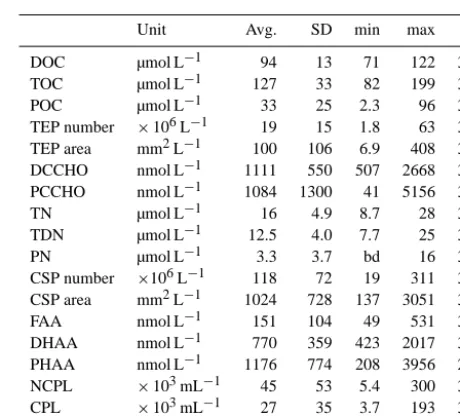
Table 2. Concentration of various organic components in the SML
during M91, given as average (avg.) and standard deviation (SD), as well as minimum (min) and maximum (max);n=number of observations. For abbreviations see text.
Unit Avg. SD min max n
DOC µmol L−1 94 13 71 122 39
TOC µmol L−1 127 33 82 199 39
POC µmol L−1 33 25 2.3 96 39
TEP number ×106L−1 19 15 1.8 63 39 TEP area mm2L−1 100 106 6.9 408 39 DCCHO nmol L−1 1111 550 507 2668 39 PCCHO nmol L−1 1084 1300 41 5156 34
TN µmol L−1 16 4.9 8.7 28 39
TDN µmol L−1 12.5 4.0 7.7 25 39
PN µmol L−1 3.3 3.7 bd 16 39
CSP number ×106L−1 118 72 19 311 39 CSP area mm2L−1 1024 728 137 3051 39
FAA nmol L−1 151 104 49 531 37
DHAA nmol L−1 770 359 423 2017 30
PHAA nmol L−1 1176 774 208 3956 29
NCPL ×103mL−1 45 53 5.4 300 35
CPL ×103mL−1 27 35 3.7 193 35
Het. bacteria ×104mL−1 195 206 3 854 36
Galgani and Engel, 2013; Galgani et al., 2014; Zhang et al., 1998; Zhang, 2003). Using direct pH microelectrode mea-surements, Zhang (2003) later confirmed an in situ thickness of∼60 µm for the SML, which they defined as the layer of sudden change of physico-chemical properties.
We therefore assume that samples obtained from the SML during this study well represented the SML, as defined by Zhang (2003). Thickness of the SML as determined dur-ing this study increased significantly with amount of organic substances in the SML, determined as TOC concentration (p< 0.005;n=39). This corroborates earlier findings from experimental studies showing that organic matter produced by phytoplankton increases the thickness of SML sampled with a glass plate (Galgani and Engel, 2013). No correla-tion instead was observed between SML thickness and wind speed (r= −0.11, n=39) or between SML thickness and temperature (r= −0.06;n=39).
[image:7.612.313.543.251.460.2]or-Table 3. Correlation coefficients (r)between concentrations of var-ious organic components in the SML and their concentration in the underlying seawater (ULW), temperature (T,◦C), and wind speed (U, m s−1)at the time of sampling. Correlations yielding a signifi-cance level ofp< 0.01 are marked bold. For abbreviations see text.
SML rULW rT rU n
DOC 0.75 −0.04 0.06 39 TOC 0.79 −0.53 −0.35 39 POC 0.68 −0.67 −0.48 39 TEP number 0.51 −0.58 −0.69 39
TEP area 0.58 −0.65 −0.69 39
DCCHO 0.94 −0.44 −0.29 39 PCCHO 0.77 -0.59 −0.38 34 TDN 0.24 −0.18 −0.05 39 PN 0.59 −0.55 −0.43 39
CSP number 0.53 −0.04 0.15 39 CSP area 0.68 −0.36 −0.31 39 FAA 0.34 −0.34 0.19 37 DHAA 0.30 −0.47 −0.37 30 PHAA 0.56 −0.64 −0.53 29
NCPL 0.70∗ −0.24 −0.21 35 CPL 0.90∗ −0.21 −0.31 35 Het. bacteria 0.92 −0.33 −0.37 36
∗Only 30 samples were analyzed for NCPL and CPL from the
ULW.
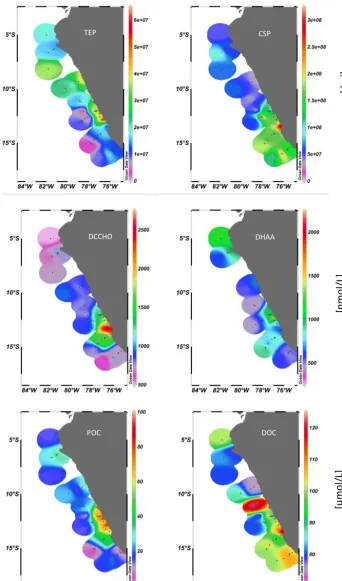
ganic components in the SML showed spatial distribution patterns resembling those of temperature and wind speed (Figs. 3, 4, 5). Highest concentration values for nearly all organic components were observed at the upwelling stations 10_1 to 10_4, 14_1 and 14_2 and 15_1 to 15_3 (Fig. 1) in ac-cordance with high estimated primary production rates (Ste-infeldt et al., 2015) and high Chlaconcentrations (Hu et al., 2015) determined in surface waters at these sites during M91. Phytoneuston abundances (< 20 µm) varied between 3.7×10³and 1.9,×105mL−1for cyanobacterial-type phy-toplankton (CPL; mainly Synechococcus spp.) and between 5.4×10³and 3.0×10⁵mL−1for other non-cyanobacterial-type phytoplankton (NCPL). Generally, highest abundance was determined on and close to the upwelling stations (Fig. 4). On all other stations, cell abundance of CPL and NCPL differed spatially, with higher abundance of NCPL at the southern stations and higher numbers of CPL at the north-ern stations (Fig. 4). NCPL and CPL were closely related to cell abundance in the ULW (Table 3).
Heterotrophic bacteria were determined in abundances between 3.0×10⁴ and 8.5×10⁶mL−1 with the highest numbers observed at the upwelling stations and southeast of the upwelling (Fig. 4). Heterotrophic bacteria in the SML were highly positively correlated to abundances in the ULW (r=0.94;n=36;p< 0.001) and negatively influenced by wind speed, although less clearly (r= −0.37; n=36; p=0.01). No significant influence on heterotrophic
bacte-ria abundance was detected with respect to global radiation or UV radiation.
TOC concentration ranged between 82 and 199 µmol L−1, and was clearly higher than DOC concentration on all sta-tions. Particulate Organic Carbon (POC) concentration was calculated as the difference between TOC and DOC and ranged from 2.3 to 96 µmol L−1. Highest POC concentra-tion was observed at the upwelling staconcentra-tions (Fig. 5). In general, POC concentration was highly correlated to tem-perature (r= −0.67, n=39 p< 0.001) and to wind speed (r= −0.48,n=39p< 0.001; Table 3). DOC concentration ranged between 71 and 122 µmol L−1(Table 2) and, in con-trast to POC, was not significantly related to temperature or wind speed (Table 3). Relatively high DOC concentra-tions of about 100 µmol L−1were observed at stations 9 and 9_2 (Fig. 5), but excluding these stations from analysis did not reveal a correlation to temperature or wind speed ei-ther. DOC is a bulk measure and is quantitatively dominated by refractory compounds that are independent from recent biological productivity. More closely linked to productivity and likely stimulated by the upwelling of nutrients along the Peruvian coast are labile and semi-labile compounds such as dissolved combined carbohydrates and amino acids. In-deed, both DCCHO and DHAA reached highest concen-trations at the upwelling stations (Fig. 5). Thereby, max-imum concentration of DCCHO of 2670 nmol L−1 (mean: 1110±550 nmol L−1)was observed at station 15_2, slightly south of the station 14_1 exhibiting highest DHAA concen-trations of 2020 nmol L−1(mean: 770 ±360 nmol L−1; Ta-ble 2). In general high DCCHO concentration was more fo-cused to the upwelling, and exhibited strong horizontal gra-dients to the northern and southern stations.
DHAA concentration was on average lower than DC-CHO concentration (Table 2) and horizontal differences were less pronounced than for DCCHO. Both components of semi-labile DOC were inversely correlated to temperature (DCCHOr= −0.44,n=39,p< 0.001; DHAA:r= −0.47, n=30,p< 0.001), linking their accumulation in the SML to productivity in the cold upwelling waters.
Concentrations of carbohydrates and amino acid in parti-cles, and in gels (i.e., TEP, CSP) in particular, were highest at the coastal upwelling stations also. Particulate carbohydrates and amino acids (PCCHO, PHAA) were highly correlated to POC concentrations (PCCHO:r=0.70, n=39,p< 0.001; PHAA:r=0.81,n=30,p< 0.001).
[image:8.612.76.257.131.359.2]Figure 4. Phyto- and bacterioneuston (< 20 µm) abundance (number mL−1)in the SML off the coast of Peru during M93: NCPL: “Non-cyanobacterial-type” phytoplankton; CPL: ““Non-cyanobacterial-type” phytoplankton; HPL: heterotrophic bacterioplankton.
CSP abundance was more pronounced at the southern sta-tions. Moreover, stations of highest and lowest concentration of CSP were different from those of TEP. Lowest value of CSP total area of 137 mm2L−1was observed at station 11_1 and highest values of 3051 mm2L−1at station 14_1.
3.3 Accumulation patterns in the SML
For almost all components investigated during this study, concentration in the SML was significantly related to the re-spective concentration in the ULW (Table 3). Thereby, cor-relations between SML and ULW were strongest for com-bined carbohydrates, particularly for DCCHO. Close cor-relations were also observed for bulk organic carbon mea-surements, i.e., TOC and DOC, and POC is a combination thereof. For dissolved nitrogenous compounds (i.e., TDN, FAA and DHAA), no relationship between SML and ULW concentrations was observed, suggesting that loss or gain of these compounds in the SML were faster than exchange pro-cesses with the ULW. Temperature had an effect on most or-ganic compounds in the SML, with generally higher concen-trations at lower temperature (Table 3). This can largely be attributed to the higher production of organic matter at the colder upwelling sites. Concentrations of particulate compo-nents POC, TEP, PHCCHO, PHAA and particulate nitrogen (PN) were also inversely related to wind speed, whereas DC-CHO and DHAA were inversely related to temperature but not to wind speed. Clear differences were observed for the two different gel particle types determined in this study. In contrast to TEP, neither abundance nor total area of CSP were related to wind speed, nor to seawater temperature. Instead abundance of CSP in the SML was mostly related to their abundance in ULW. However, with the exception of CSP, par-ticulate components in the SML were affected by changes in wind speed more than concentration of dissolved compounds (Table 3).
Enrichment factors indicated a general accumulation of or-ganic matter in the SML with respect to the ULW (Fig. 6), which happened at most stations. Thereby, clear differences were observed between EF values of different components. The highest enrichment was observed for FAA that were en-riched more than 10-fold at some stations. Moreover, FAA were consistently enriched in the SML, except for one sta-tion where the lowest FAA concentrasta-tion was determined (49 nmol L−1). The largest variability of EF was observed for abundance and total area of gel particles. For TEP total area, values of EF ranged between 0.2–12, with highest EF ob-served at the coastal upwelling station 14_1, where the wind speed recorded was 0.6 m s−1. In proximity of this station, the lowest EF of TEP was determined (station 15_3) indi-cating a clear depletion at wind speed of 7 m s−1. The EFs of CSP total area ranged between 0.4 and 4.8. Thus highest EF of CSP was clearly lower than for TEP, and in contrast to TEP it was observed at the more offshore station 18_2 at a higher wind speed rate of 9.2 m s−1. Total and dissolved hydrolysable amino acids (THAA, DHAA) were enriched in the SML at almost all stations (Fig. 6), with EFs in the range 0.8–4.6 (DHAA) and 0.4–3.4 (THAA). Median EFs were 1.7 and 1.4 for DHAA and THAA, respectively.
Concentration of TCCHO and DCCHO in the SML were often similar to the ULW, with EF values ranging between 0.6 and 1.4 (DCCHO) and between 0.3 and 1.7 (TCCHO), respectively.
In general, variability of EFs was smaller for dissolved than for particulate organic compounds, suggesting differ-ences in the accumulation dynamics.
DCCHO TEP
DHAA CSP
POC DOC
[/m
l]
[
n
m
o
l/
L]
[
µ
mol
/L
[image:10.612.129.471.66.647.2]]
Figure 5. Surface distribution patterns of organic matter concentrations in the SML during M91 showing particulate organic carbon (POC,
E
n
ric
h
e
m
e
n
t
fa
c
to
rs
(
E
F
)
[image:11.612.327.523.65.440.2]0,1 1 10
Figure 6. Box and whisker plot of enrichment factors (EFs)
calcu-lated for various particulate and dissolved components during M91. Each box encloses 50 % of the data with the median value of the variable displayed as a line. The bottom of the box marks the 25 %, and the top the 75 % limit, of data. The lines extending from the top and bottom of each box marks the 10 and 90 % percentiles within the data set and the filled circles indicate the data outside of this range. For abbreviations, see text.
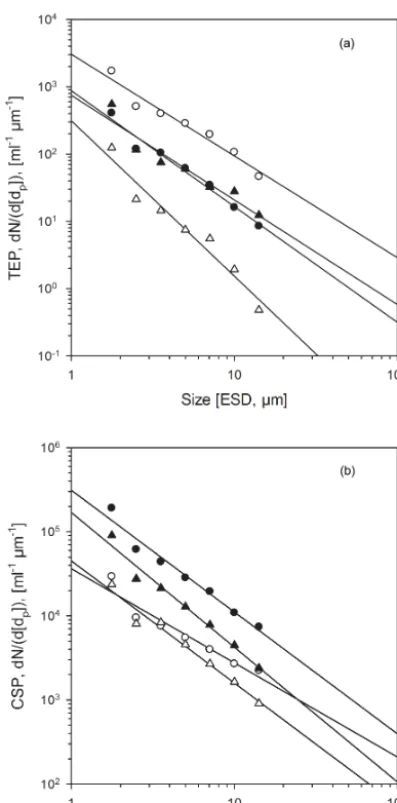
3.4 Size distribution of gel particles within the SML
Abundance of gel particles in the SML and ULW decreased with increasing particle size according to the power law func-tion given in Eq. 2 (Fig. 8). The parameter δ describes the slope of the particles size spectrum. Lower values of δ in-dicate relatively higher abundance of smaller particles. Data fits to the function were very well described for each sam-ple withr2> 0.90, yielding a standard error forδ of < 20 %. For TEP, δ varied between−2.63 and−1.38 (mean value: −1.86, SD: 0.27) for particles in the SML and between −2.25 and−1.25 (mean value:−1.70, SD: 0.30) for parti-cles in the ULW. To compare the size distribution of TEP in the SML and the ULW, we calculated the slope ratio (δ∗=δSML/ δULW; Fig. 9). Size distributions of TEP in the SML and ULW were generally quite similar yieldingδ∗TEPin the range of 0.78–1.42, with a median value of 1.1. Never-theless, spatial differences were observed, with δTEP∗ < 0.95 at the more coastal northern stations and δ∗TEP> 1.1 more offshore at the southern stations (Fig. 9). At the upwelling stations with high TEP abundance slopes of SML and ULW were very similar, yieldingδTEP∗ in the range 0.95–1.1. This showed a relatively higher abundance of smaller TEP in the SML at the offshore stations, whereas relatively more, larger-sized TEP were present close to the coast in the north-ern part of the study region. This comparison also showed that sampling of TEP from the SML with a glass plate does not bias TEP size distribution, e.g., by inducing
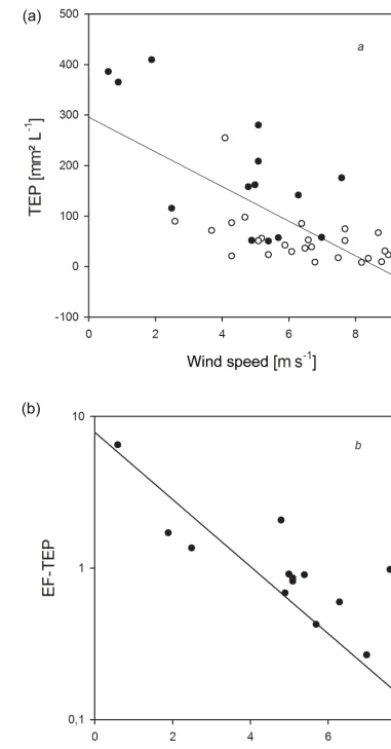
parti-Figure 7. Influence of wind speed (m s−1)on the total area con-centration of TEP (mm2L−1) in the SML at all stations (a) and relationship between TEP enrichment factors (EFs) and wind speed (m s−1)for only those stations that showed similar sea surface tem-perature as indicated in Fig. 3. Filled dots indicated data from sta-tions of similar sea surface temperature. Data in plot (b) were fitted by a power law function.
[image:11.612.50.285.65.256.2]Figure 8. Size–frequency distribution of TEP (a) and CSP (b)
ob-served during the M91 cruise for samples collected from the SML (open symbols) and in the ULW (filled symbols) at the stations with lowest wind speed of 0.6 m s−1 (circles) and highest wind speed of 9.0 m s−1(triangles). Linear regression of log(dN/d(dp))
vs. log(dp) was fitted to the particles in the size range of 1.05–
14.14 µm ESD.
and included on average 61±5.2 % of all TEP. For CSP, variability of abundance in the 1.25–1.77 µm size class was much smaller and ranged between 1.46×10⁴ and 2.33×10⁵mL−1. Although CSP thus represented the largest fraction of small gel particles, the relative abundance of CSP in the smallest size fraction was lower, yielding an average contribution of 52±6.0 % of all CSP. Similar to TEP, size distribution of CSP followed the power law relationship of Eq. (2), yieldingδ values between−1.12 and−2.01 (mean value:−1.44, SD: 0.20) for particles in the SML and between −1.11 and−1.88 (mean value:−1.39, SD: 0.17) for particles in the ULW. WithD=2.50±0.008, the fractal dimension of
CSP was almost identical to that of TEP, suggesting that sim-ilar processes, i.e., shear-induced aggregation, are responsi-ble for CSP formation. The slope ratio,δ∗, for CSP varied between 0.77 and 1.32, with a median value of 1.0. No spa-tial pattern was observed for the distribution ofδ∗CSP. Slopes of the size distribution of CSP in the SML and ULW were not significantly different (p=0.176, n=39, pairedt test), in-dicating that CSP size distribution, similarly to TEP, is not biased by the sampling approach of the glass plate.
No overall relationship was established between the slope of the size distribution of TEP and wind velocity (δTEP vs. wind speed: r= −0.19, n=37,p=0.20). However, TEP size distribution was much steeper at the station with high-est wind speed compared to the one with lowhigh-est wind ve-locity (δTEP at 0.6 m s−1= −1.51,r2=0.95,n=7;δTEP at 9.0 m s−1= −2.31,r2=0.95,n=7; Fig. 8a). In particular, at the high wind speed a loss of larger TEP, i.e., > 7 µm was observed in the SML compared to the ULW and relative to the low wind speed station.
For CSP a significant inverse relationship was observed between the slopeδ and wind speed (δCSP vs. wind speed: r= −0.61,n=37,p< 0.001). A loss of larger CSP was also observed by direct comparison between low and high wind speed stations (δCSP at 0.6 m s−1= −1.12,r2=0.92,n=7; δTEPat 9.0 m s−1= −1.45,r2=0.97,n=7; Fig. 8b).
4 Discussion
It has been suggested that the presence of organic matter in the SML influences a series of processes relevant to air– sea exchange of gases, dissolved and particulate components. EBUSs are characterized by high biological productivity and strong across shelf gradients of organic matter concentration (Capone and Hutchins, 2013). Therefore EBUSs are ideal model systems to study the linkages of biological produc-tivity and SML properties, with respect to characteristics of organic matter composition and factors controlling organic matter enrichment in the SML.
4.1 Organic matter characteristics of the SML in the upwelling region off the coast of Peru
meso-d
* TEPFigure 9. Spatial distribution of the slope ratio,δ∗, for TEP in the upwelling region off the coast of Peru during M91.
cosm study, indicating that ecosystem changes impact SML organic matter composition and concentration (Galgani et al., 2014). Despite this finding that relates to a more general char-acteristic of the SML, clear differences in the accumulation behavior of different organic matter components were deter-mined during this study and are in good accordance with previous observations. A generally higher SML accumula-tion was observed for amino acids compared to carbohy-drates. Significant enrichment of amino acids in the SML has been determined previously for coastal as well as open ocean sites, and higher accumulation of FAA compared to DHAA and THAA, as also observed during this study, appears to be a consistent SML feature (Carlucci et al., 1992; Hen-richs and Williams, 1985; Kuznetsova and Lee, 2002, 2001; Kuznetsova et al., 2004; Reinthaler et al., 2008). As for this study, wind velocity and temperature have not been identified as physical factors responsible for amino acid enrichment in the past (Kuznetsova et al., 2004). FAA and DHAA are la-bile to semi-lala-bile substrates and taken-up by heterotrophic microorganisms (Keil and Kirchman, 1992). Turnover times of these components in the water column are usually in the range of minutes to days (Benner, 2002; Fuhrman and
Fergu-son, 1986). The observed accumulation of FAA and DHAA in the SML may therefore be related to a reduced activity of bacteria. For different coastal Baltic Sea sites, Stolle et al. (2009) determined a lowered bacterial biomass produc-tion in the SML, despite bacterial cell numbers being simi-lar to those in the ULW. During M91 bacteria were mostly depleted in the SML compared to the ULW supporting the idea of the SML being an “extreme environment” for bacte-ria. Earlier studies showed that some bacteria may be adapted to UV radiation in the SML as well as in the ULW (Agogué et al., 2005; Carlucci et al., 1985). Amino acid consump-tion by bacterioneuston under UV-B stress may be reduced (Santos et al., 2012), which may give an explanation for the higher concentrations of FAA and DHAA in the SML dur-ing M91. However, no significant correlation between bac-terial abundance and UV radiation or between UV radiation and amino acid concentrations in the different pools was ob-served during this study, suggesting that at most stations his-tory rather than instantaneous UV radiation, if at all, respon-sible for controlling bacteria and organic matter components in the SML.
SML thickness during this study was significantly related to TOC concentration, but not to wind speed. A thickening of the SML with increasing wind speed up to 8 m s−1has been observed by Falkowska (1999) from samples collected in the Baltic Sea and explained by increased advective transport of organic matter to the SML (e.g., through bubble adsorption) at higher turbulence. During M91, accumulation of organic matter in the SML was higher at the upwelling stations where wind speed often was quite low. Hence, a higher source of organic matter in the ULW may have counterbalanced the wind speed effect.
of Wurl and colleagues (Wurl et al., 2009, 2011). However, in contrast to earlier observations showing EF values > 1 for TEP in the SML also at higher wind speed, we found the SML to be depleted of TEP at wind speed of∼5 m s−1and above. It has been suggested that TEP aggregation rates in the SML are higher than in the ULW, due to enhance collision rates by shear or bubble bursting. TEP have been shown to control coagulation efficiencies of solid particles, such as di-atoms and coccolithophores (Chow et al., 2015; Engel, 2000; Logan et al., 1995). At higher wind speed, increased aggrega-tion rates of TEP with solid particles, eventually containing mineral ballast, may thus favor the formation of aggregates that become negatively buoyant and sink out of the SML. This, may explain the observed loss of larger TEP (> 7 µm) from the SML relative to the ULW and to the SML at low wind speed. Enhanced aggregation rates could then also ex-plain the inverse relationship between POC and wind speed, observed during this study.
In contrast to TEP, no impact of wind speed was deter-mined for CSP accumulation, or for CSP enrichment in the SML. Moreover, clear spatial differences were observed for the distribution of TEP and CSP in the SML. Although both TEP and CSP are gel particles that form from dissolved or-ganic precursors released by microorganisms, their spatial and temporal occurrence in marine systems can be quite dif-ferent (e.g., TEP accumulate towards the end of phytoplank-ton blooms, while CSP rather co-occur with maximum phy-toplankton abundance (Cisternas-Novoa et al., 2015; Engel et al., 2015). Moreover, the depth distribution of TEP and CSP was shown to be different for open ocean sites (Cisternas-Novoa et al., 2015). These spatial and temporal differences in the occurrence of TEP and CSP in the water column may explain the spatial separation of both types of marine gels in the SML observed during this study. However, the observed differences in relation to wind speed suggest that additional factors control the enrichment of TEP and CSP in the SML. It has been shown that CSP are less prone to aggregation than TEP (Engel et al., 2015; Prieto et al., 2002). Similarly, CSP may be less involved in aggregation formation and sinking out of the SML at higher wind speed. Yet, similarly to TEP, larger CSP were observed in the SML at low wind speed sug-gesting that both kind of gels may be involved in slick for-mation that becomes disrupted when wind speed increases. 4.2 Implications of organic matter accumulation in
EBUSs
4.2.1 Air–sea gas exchange
Although the SML and surface active substances (surfac-tants) within are widely believed affecting the exchange of gases and heat at the air–sea interface (Davies, 1966; Frew, 1997; Salter et al., 2011), particularly at lower wind speed (Liss, 1983), we still have little quantitative knowl-edge on how natural organic components at the immediate
sea-surface alter the gas transfer velocity in water (kw). Our data showed a depletion of the SML with respect to TEP and POC at wind speeds > 5 m s−1, suggesting that an effect of these “insoluble” components on gas exchange is, if any, op-erating only at low wind speed. Due to their fractal scaling, gel particles have a relatively large surface to volume ratio and may act as a cover, reducing molecular diffusion rates at the interface between air and sea.
Accumulation of dissolved organic components in the SML during M91 was not related to wind speed. DCCHO and DHAA concentration representing fresh DOM were highest at the upwelling sites and therefore negatively related to seawater temperature. DOM, such as DCCHO and chro-mophoric dissolved organic matter (CDOM), have demon-strated surfactant properties and reduced gas transfer veloc-ity in water (kw) at low wind speed in laboratory and field experiments (Frew et al., 2004, 1990). The reduction of kw is thereby believed to be related to a dampening of small, capillary waves. Salter et al. (2011) recently showed that ar-tificial surfactants can suppress gas transfer velocity by up to 55 % at sea. Suppression of k666 (i.e., kw normalized to a Schmidt number of 666) during their field study was de-pendent on wind speed, but was detected up to 11 m s−1, en-compassing the full range of wind speed determined during M91. Thus, accumulation of natural DOM particularly in up-welling regimes with high biological production and coastal wind shelter as observed during this study may have an in-fluence on gas exchanges rates as well.
Across the SML, the diffusivity of climate-relevant gases such as methane (CH4), has been proposed being mediated by SML bacteria, as possible sink (Upstill-Goddard et al., 2003) or source of this compound (Cunliffe et al., 2013). About ∼30 % of the atmospheric concentration of nitrous oxide (N2O), one of the strongest greenhouse gases and responsible for ozone depletion, is supported by oceanic sources (Solomon et al., 2007). Of total oceanic N2O pro-duction, oxygen minimum zones (OMZs) contribute about 25–75 % (Bange et al., 2001). In EBUSs, high primary pro-duction and induced high aerobic remineralization associated with large-scale circulation maintain the presence of OMZs (Gutknecht et al., 2013; Paulmier and Ruiz-Pino, 2009), which, in the last decades, have been expanding and intensi-fying due to enhanced stratification and reduced ventilation (Keeling et al., 2010; Stramma et al., 2008). During M91, N2O concentration in surface waters was highly supersatu-rated at the upwelling sites and in particular at station 14_1 (Arevalo-Martinez et al., 2015). Although a direct influence of organic matter in the SML on gas-exchange was not in-vestigated during M91, it can be assumed that the high en-richment of organic components in the SML observed the upwelling sites was one factor contributing to N2O supersat-uration.
regions like OMZs affected by a changing climate. A re-cent laboratory study reported π non-covalent interactions of N2O with phenols, suggesting a possible important role of N2O in biological processes by specifically binding to phe-nolic groups as those of the amino acids tyrosine and pheny-lalanine (Cao et al., 2014). Tyrosine and phenypheny-lalanine in the SML of our study represented a small molar percentage of to-tal amino acids pool (data not shown), but were present. As we found evidence of overall accumulation of amino acids in the SML during our cruise, for those amino acids in par-ticular the median EF both in the total (THAA) and in the dissolved (DHAA) fraction was > 1, suggesting a possible interaction of specific SML organics with N2O in the coastal upwelling region off the coast of Peru. Although the exper-iment conducted by Cao and colleagues cannot be directly translated to our setting, it provides interesting ideas for the interaction of N2O with biological macromolecules worth further investigation.
Overall, our results showed that accumulation of organic substances occurs in EBUSs and is related to the increased biological production. Hence, the organic SML may play a particularly important role for exchange of climate-relevant gases that are associated to high organic matter production and resulting anoxia in upwelling systems like the one off the coast of Peru.
4.2.2 Organic aerosol production
The structure of sea-spray aerosols (SSA), originating by bubble bursting at the sea surface, is a function of biologi-cal, chemical and physical properties of the SML, which may comprise a vast array of organic surface-active compounds, microorganisms and exopolymer gels (Leck and Bigg, 2005; Quinn and Bates, 2011; Wilson et al., 2015). Despite recent evidences showing that high levels of chlorophylla are not directly related to the organic carbon content of SSA (Quinn et al., 2014), still organic SSA largely derive from the oceanic surface layer and therefore are also subject to the effects of climate change on marine systems (Andreae and Crutzen, 1997). Polysaccharides and polysaccharidic nanogels (Orel-lana et al., 2011; Russell et al., 2010) as well as particulate amino acids and proteinaceous compounds (Kuznetsova et al., 2005) are present in organic SSA particles. During M91, we found a different accumulation behavior of TEP and CSP in the SML. TEP showed a close inverse relationship to wind speed, being depleted in the SML above 5 m s−1, while par-ticulate proteinaceous compounds (CSP) accumulated inde-pendently of wind speed. Submicron gels embedded in sea spray may represent an important source for primary organic aerosols in the more offshore wind exposed regions. TEP as well as dissolved polysaccharides include sugars with car-boxylic groups such as uronic acids and may contribute to the relatively high fraction of carboxylic acid that was ob-served in the organic matter component of marine aerosols (Hawkins et al., 2010). In the upwelling region off the coast
of Peru the wind-driven export of polysaccharidic compo-nents to the atmosphere thus might represent a loss-pathway of these organic compounds from the SML that would then contribute to a larger extent to the organic SSA mass. Pro-teinaceous compounds, including CSP, are probably more stable at the sea surface and may contribute to organic mass in aerosols even at higher wind speed.
However, future studies that investigate gel particles within the SML and in SSA are needed to clarify if the ob-served loss of TEP from the SML at higher wind speeds is indeed related to a transport of TEP to the atmosphere, or if CSP contribute to organic aerosol mass.
The accumulation of organic matter in the SML, and the distinct behavior of certain compounds at the water–air inter-face is certainly an important issue for all exchange processes between the ocean and the atmosphere that needs to be fur-ther exploited.
Acknowledgements. We thank the captain and crew of R/V ME-TEOR during cruise leg M91 for logistic support during sampling,
especially help related to the rubber boat operation, as well as H. Bange as chief scientist and all the scientific crew. A great acknowledgement goes to J. Roa for helping with SML sampling on board and for TOC/TN and carbohydrates analysis, respectively. Further technical help was provided by R. Flerus, S. Manandhar and N. Bijma for amino acids and microscopy analysis, as well as T. Klüver for flow-cytometry counts. This work was supported by BMBF project SOPRAN II and III (Surface Ocean Processes in the Anthropocene, 03F0611C-TP01 and 03F0662A-TP2.2) and is a contribution to the international SOLAS program.
Edited by: B. Ward
References
Agogué, H., Casamayor, E. O., Bourrain, M., Obernosterer, I., Joux, F., Herndl, G. J., and Lebaron, P.: A survey on bacteria inhabiting the sea surface microlayer of coastal ecosystems, FEMS Micro-biol. Ecol., 54, 269–280, 2005.
Andreae, M. O. and Crutzen, P. J.: Atmospheric Aerosols: Biogeo-chemical Sources and Role in Atmospheric Chemistry, Science, 276, 1052–1058, 1997.
Arevalo-Martinez, D. L., Kock, A., Loscher, C. R., Schmitz, R. A., and Bange, H. W.: Massive nitrous oxide emissions from the tropical South Pacific Ocean, Nat. Geosci., 8, 530–533, 2015. Azetsu-Scott, K. and Passow, U.: Ascending marine particles:
sig-nificance of transparent exopolymer particles (TEP) in the upper ocean, Limnol. Oceanogr., 49, 741–748, 2004.
Bange, H. W.: Surface Ocean – Lower Atmosphere Study (SOLAS) in the upwelling region off the coast of Peru, Cruise No. M91, 1– 26 December, 2012, Callao (Peru), Bremen, 69 pp., 2013. Bange, H. W., Rapsomanikis, S., and Andreae, M. O.: Nitrous oxide
cycling in the Arabian Sea, J. Geophys. Res-Oceans, 106, 1053– 1065, 2001.
micro-gel transparent exopolymer particles, P. Natl. Acad. Sci. USA, 109, 9119–9124, 2012.
Benner, R.: Chemical composition and reactivity. In: Biogeochem-istry of marine dissolved organic matter, edited by: Hansell, D. A. and Carlson, D. J., Academic Press – Elsevier, 2002. Bigg, K. E., Leck, C., and Tranvik, L.: Particulates of the surface
microlayer of open water in the central Arctic Ocean in summer, Mar. Chem., 91, 131–141, 2004.
Cao, Q., Gor, G. Y., Krogh-Jespersen, K., and Khriachtchev, L.: Non-covalent interactions of nitrous oxide with aromatic com-pounds: Spectroscopic and computational evidence for the for-mation of 1:1 complexes, J. Chem. Phys., 140, 144–304, 2014. Capone, D. G. and Hutchins, D. A.: Microbial biogeochemistry of coastal upwelling regimes in a changing ocean, Nat. Geosci., 6, 711–717, 2013.
Carlson, D.: The Early Diagenesis of Organic Matter: Reaction at the Air-Sea Interface, in: Organic Geochemistry, edited by: En-gel, M. and Macko, S., Topics in Geobiology, Springer US, 1993. Carlson, D. J.: A field evaluation of plate and screen microlayer
sampling techniques, Mar. Chem., 11, 189–208, 1982.
Carlucci, A. F., Craven, D. B., and Henrichs, S. M.: Surface-film microheterotrophs: amino acid metabolism and solar radiation effects on their activities, Mar. Biol., 85, 13–22, 1985.
Carlucci, A. F., Wolgast, D. M., and Craven, D. B.: Microbial Pop-ulations in Surface Films: Amino Acid Dynamics in Nearshore and Offshore Waters off Southern California, J. Geophys. Res., 97, 5271–5280, 1992.
Carr, M.-E. and Kearns, E. J.: Production regimes in four Eastern Boundary Current systems, Deep–Sea Res. Pt. II, 50, 3199-3221, 2003.
Chin, W.-C., Orellana, M. V., and Verdugo, P.: Spontaneous assem-bly of marine dissolved organic matter into polymer gels, Nature, 391, 568–572, 1998.
Chow, J. S., Lee, C., and Engel, A.: The influence of extracellular polysaccharides, growth rate, and free coccoliths on the coagu-lation efficiency of Emiliania huxleyi, Mar. Chem., 175, 5–17, doi:10.1016/j.marchem.2015.04.010, 2015.
Cisternas-Novoa, C., Lee, C., and Engel, A.: Transparent ex-opolymer particles (TEP) and Coomassie stainable parti-cles (CSP): Differences between their origin and verti-cal distributions in the ocean, Mar. Chem., 175, 56–71, doi:10.1016/j.marchem.2015.03.009, 2015.
Cunliffe, M. and Murrell, J. C.: The sea-surface microlayer is a gelatinous biofilm, ISME J., 3, 1001–1003, 2009.
Cunliffe, M. and Wurl, O.: Guide to best practices to study the ocean’s surface, Plymouth, UK, 2014.
Cunliffe, M., Upstill-Goddard, R. C., and Murrell, J. C.: Microbiol-ogy of aquatic surface microlayers, FEMS Microbiol. Rev., 35, 233–246, 2011.
Cunliffe, M., Engel, A., Frka, S., Gašparovi´c , B., Guitart, C., Mur-rell, J. C., Salter, M., Stolle, C., Upstill-Goddard, R., and Wurl, O.: Sea surface microlayers: A unified physicochemical and bi-ological perspective of the air-ocean interface, Progr. Oceanogr., 109, 104–116, 2013.
Davies, J. T.: The Effects of Surface Films in Damping Eddies at a Free Surface of a Turbulent Liquid, 1966.
Dickson, A. G., Sabine, C. L., and Christian, J. R.: Guide to best practices for ocean CO2measurements, PICES, 2007.
Dittmar, T., Cherrier, J., and Ludwichowski, K.-U.: The Analysis of Amino Acids in Seawater. In: Practical Guidelines for the Anal-ysis of Seawater, CRC Press, 2009.
Engel, A.: The role of transparent exopolymer particles (TEP) in the increase in apparent particle stickiness (α)during the decline of a diatom bloom, J. Plankton Res., 22, 485–497, 2000.
Engel, A.: Determination of Marine Gel Particles, in: Practical Guidelines for the Analysis of Seawater, CRC Press, 2009. Engel, A. and Händel, N.: A novel protocol for determining the
con-centration and composition of sugars in particulate and in high molecular weight dissolved organic matter (HMW-DOM) in sea-water, Mar. Chem., 127, 180–191, 2011.
Engel, A. and Schartau, M.: Influence of transparent exopolymer particles (TEP) on sinking velocity of Nitzschia closterium ag-gregates, Mar. Ecol.-Prog. Ser., 182, 69–76, 1999.
Engel, A., Thoms, S., Riebesell, U., Rochelle-Newall, E., and Zon-dervan, I.: Polysaccharide aggregation as a potential sink of ma-rine dissolved organic carbon, Nature, 428, 929–932, 2004. Engel, A., Borchard, C., Piontek, J., Schulz, K. G., Riebesell, U.,
and Bellerby, R.: CO2increases14C primary production in an
Arctic plankton community, Biogeosciences, 10, 1291–1308, doi:10.5194/bg-10-1291-2013, 2013.
Engel, A., Borchard, C., Loginova, A., Meyer, J., Hauss, H., and Kiko, R.: Effects of varied nitrate and phosphate supply on polysaccharidic and proteinaceous gel particle production dur-ing tropical phytoplankton bloom experiments, Biogeosciences, 12, 5647–5665, doi:10.5194/bg-12-5647-2015, 2015.
Falkowska, L.: Sea surface microlayer: a field evaluation of teflon plate, glass plate and screen sampling techniques, Part 1, Thickness of microlayer samples and relation to wind speed, Oceanologia, 41, 211–221, 1999.
Frew, N. M.: The role of organic films in air-sea gas exchange, n: The Sea Surface and Global Change, edited by: Liss, P. S. and Duce, R. A., Cambridge University Press, UK, 1997.
Frew, N. M., Goldman, J. C., Dennett, M. R., and Johnson, A. S.: Impact of phytoplankton-generated surfactants on air-sea gas ex-change, J. Geophys. Res.-Oceans, 95, 3337–3352, 1990. Frew, N. M., Bock, E. J., Schimpf, U., Hara, T., Haußecker, H.,
Edson, J. B., McGillis, W. R., Nelson, R. K., McKenna, S. P., Uz, B. M., and Jähne, B.: Air-sea gas transfer: Its dependence on wind stress, small-scale roughness, and surface films, J. Geo-phys. Res.-Oceans, 109, doi:10.1029/2003JC002131, 2004. Fuhrman, J. A. and Ferguson, R. L.: Nanomolar concentrations and
rapid turnover of dissolved free amino acids in seawater: agree-ment between chemical and microbiological measureagree-ments, Mar. Ecol.-Prog. Ser., 33, 237–242, 1986.
Galgani, L. and Engel, A.: Accumulation of Gel Particles in the Sea-Surface Microlayer during an Experimental Study with the Di-atom Thalassiosira weissflogii, Int. J. Geosci., 4, 129–145, 2013. Galgani, L., Stolle, C., Endres, S., Schulz, K. G., and Engel, A.: Effects of ocean acidification on the biogenic composition of the sea-surface microlayer: Results from a mesocosm study, J. Geo-phys. Res-Oceans, 119, 7911–7924, 2014.
Gao, Q., Leck, C., Rauschenberg, C., and Matrai, P. A.: On the chemical dynamics of extracellular polysaccharides in the high Arctic surface microlayer, Ocean Sci., 8, 401–418, 2012. Garreaud, R. D., Rutllant, J. A., Muñoz, R. C., Rahn, D. A.,
Upwelling Experiment, Atmos. Chem. Phys., 11, 2015–2029, doi:10.5194/acp-11-2015-2011, 2011.
GESAMP: The Sea-Surface Microlayer and its Role in Global Change. Reports and Studies, WMO, 1995.
Gutknecht, E., Dadou, I., Marchesiello, P., Cambon, G., Le Vu, B., Sudre, J., Garçon, V., Machu, E., Rixen, T., Kock, A., Flohr, A., Paulmier, A., and Lavik, G.: Nitrogen transfers off Walvis Bay: a 3-D coupled physical/biogeochemical modeling approach in the Namibian upwelling system, Biogeosciences, 10, 4117– 4135, doi:10.5194/bg-10-4117-2013, 2013.
Harvey, G. W. and Burzell, L. A.: A simple microlayer method for small samples, Limnol. Oceanogr., 11, 608–614, 1972.
Hatcher, R. F. and Parker, B. C.: Laboratory comparisons of four surface microlayer samplers1, Limnol. Oceanogr., 19, 162–165, 1974.
Hawkins, L. N., Russell, L. M., Covert, D. S., Quinn, P. K., and Bates, T. S.: Carboxylic acids, sulfates, and organosulfates in processed continental organic aerosol over the southeast Pacific Ocean during VOCALS-REx 2008, J. Geophys. Res.-Atmos., 115, doi:10.1029/2009JD013276, 2010.
Henrichs, S. M. and Williams, P. M.: Dissolved and particulate amino acids and carbohydrates in the sea surface microlayer, Mar. Chem., 17, 141–163, 1985.
Hu, H., Bourbonnais, A., Larkum, J., Bange, H. W., and Altabet, M. A.: Nitrogen cycling in shallow low oxygen coastal waters off Peru from nitrite and nitrate nitrogen and oxygen isotopes, Bio-geosciences Discuss., 12, 7257–7299, doi:10.5194/bgd-12-7257-2015, 2015.
Jähne, B. and Haußecker, H.: AIR-WATER GAS EXCHANGE, Annu. Rev. Fluid Mech., 30, 443–468, 1998.
Keeling, R. F., Körtzinger, A., and Gruber, N.: Ocean Deoxygena-tion in a Warming World, Annu. Rev. Mar. Sci., 2, 199–229, 2010.
Keil, R. G. and Kirchman, D. L.: Bacterial Hydrolysis of Protein and Methylated Protein and Its Implications for Studies of Pro-tein Degradation in Aquatic Systems, Appl. Environ. Microbiol., 58, 1374–1375, 1992.
Kuznetsova, M. and Lee, C.: Enhanced extracellular enzymatic pep-tide hydrolysis in the sea-surface microlayer, Mar. Chem., 73, 319–332, 2001.
Kuznetsova, M. and Lee, C.: Dissolved free and combined amino acids in nearshore seawater, sea surface microlayers and foams: Influence of extracellular hydrolysis, Aquatic Sciences – Re-search Across Boundaries, 64, 252–268, 2002.
Kuznetsova, M., Lee, C., and Aller, J.: Enrichment of amino acids in the sea surface microlayer at coastal and open ocean sites in the North Atlantic Ocean, Limnol. Oceanogr., 49, 1605–1619, 2004. Kuznetsova, M., Lee, C., and Aller, J.: Characterization of the pro-teinaceous matter in marine aerosols, Mar. Chem., 96, 359–377, 2005.
Lachkar, Z. and Gruber, N.: What controls biological production in coastal upwelling systems? Insights from a comparative mod-eling study, Biogeosciences, 8, 2961–2976, doi:10.5194/bg-8-2961-2011, 2011.
Laß, K., Bange, H. W., and Friedrichs, G.: Seasonal signatures in SFG vibrational spectra of the sea surface nanolayer at Boknis Eck Time Series Station (SW Baltic Sea), Biogeosciences, 10, 5325–5334, doi:10.5194/bg-10-5325-2013, 2013.
Leck, C. and Bigg, E. K.: Source and evolution of the marine aerosol – A new perspective, Geophys. Res. Lett., 32, L19803, doi:10.1029/2005GL023651, 2005.
Lindroth, P. and Mopper, K.: High performance liquid chro-matographic determination of subpicomole amounts of amino acids by precolumn fluorescence derivatization with o-phthaldialdehyde, Anal. Chem., 51, 1667–1674, 1979.
Liss, P. S.: Gas Transfer: Experiments and Geochemical Implica-tions, in: Air-Sea Exchange of Gases and Particles, edited by: Liss, P. and Slinn, W. G., NATO ASI Series, Springer Nether-lands, 1983.
Liss, P. S. and Duce, R. A.: The Sea Surface and Global Change, Cambridge University Press, 2005.
Logan, B. E., Passow, U., Alldredge, A. L., Grossartt, H.-P., and Si-mont, M.: Rapid formation and sedimentation of large aggregates is predictable from coagulation rates (half-lives) of transparent exopolymer particles (TEP), Deep-Sea Res. Pt. II, 42, 203–214, 1995.
Long, R. A. and Azam, F.: Abundant protein-containing particles in the sea, Aquat. Microb. Ecol., 10, 213–221, 1996.
Mari, X. and Burd, A.: Seasonal size spectra of transparent exopoly-meric particles (TEP) in a coastal sea and comparison with those predicted using coagulation theory, Mar. Ecol.-Prog. Ser., 163, 63–76, 1998.
Mari, X. and Kiørboe, T.: Abundance, size distribution and bacterial colonization of transparent exopolymeric particles (TEP) during spring in the Kattegat, J. Plankton Res., 18, 969–986, 1996. Matrai, P. A., Tranvik, L., Leck, C., and Knulst, J. C.: Are high
Arctic surface microlayers a potential source of aerosol organic precursors?, Mar. Chem., 108, 109–122, 2008.
Meakin, P.: Fractal aggregates in geophysics, Rev. Geophys., 29, 317–354, 1991.
O’Dowd, C. D., Facchini, M. C., Cavalli, F., Ceburnis, D., Mircea, M., Decesari, S., Fuzzi, S., Yoon, Y. J., and Putaud, J.-P.: Bio-genically driven organic contribution to marine aerosol, Nature, 431, 676–680, 2004.
Orellana, M. V., Matrai, P. A., Leck, C., Rauschenberg, C. D., Lee, A. M., and Coz, E.: Marine microgels as a source of cloud con-densation nuclei in the high Arctic, P. Natl. Acad. Sci. USA, 108, 13612–13617, 2011.
Panagiotopoulos, C., Sempéré, R., Lafont, R., and Kerhervé, P.: Sub-ambient temperature effects on the separation of monosac-charides by high-performance anion-exchange chromatography with pulse amperometric detection: Application to marine chem-istry, J. Chromatogr. A, 920, 13–22, 2001.
Passow, U.: Transparent exopolymer particles (TEP) in aquatic en-vironments, Prog. Oceanogr., 55, 287–333, 2002.
Paulmier, A. and Ruiz-Pino, D.: Oxygen minimum zones (OMZs) in the modern ocean, Progr. Oceanogr., 80, 113–128, 2009. Paulmier, A., Ruiz-Pino, D., and Garcon, V.: The oxygen minimum
zone (OMZ) off Chile as intense source of CO2and N2O, Cont. Shelf Res., 28, 2746–2756, 2008.
Paulmier, A., Ruiz-Pino, D., and Garçon, V.: CO2 maximum in
the oxygen minimum zone (OMZ), Biogeosciences, 8, 239–252, doi:10.5194/bg-8-239-2011, 2011.
wide size range records in a mesocosm study, Deep-Sea Res. Pt. I, 49, 1233–1253, 2002.
Quinn, P. K. and Bates, T. S.: The case against climate regulation via oceanic phytoplankton sulphur emissions, Nature, 480, 51– 56, 2011.
Quinn, P. K., Bates, T. S., Schulz, K. S., Coffman, D. J., Frossard, A. A., Russell, L. M., Keene, W. C., and Kieber, D. J.: Contribution of sea surface carbon pool to organic matter enrichment in sea spray aerosol, Nat. Geosci., 7, 228–232, 2014.
Reinthaler, T., Sintes, E., and Herndl, G. J.: Dissolved organic mat-ter and bacmat-terial production and respiration in the sea-surface mi-crolayer of the open Atlantic and the western Mediterranean Sea, Limnol. Oceanogr., 53, 122–136, 2008.
Riebesell, U., Kortzinger, A., and Oschlies, A.: Tipping Elements in Earth Systems Special Feature: Sensitivities of marine carbon fluxes to ocean change, P. Natl. Acad. Sci. USA, 106, 20602– 20609, 2009.
Russell, L. M., Hawkins, L. N., Frossard, A. A., Quinn, P. K., and Bates, T. S.: Carbohydrate-like composition of submicron atmo-spheric particles and their production from ocean bubble burst-ing, P. Natl. Acad. Sci. USA, 107, 6652–6657, 2010.
Salter, M. E., Upstill-Goddard, R. C., Nightingale, P. D., Archer, S. D., Blomquist, B., Ho, D. T., Huebert, B., Schlosser, P., and Yang, M.: Impact of an artificial surfactant release on air-sea gas fluxes during Deep Ocean Gas Exchange Experiment II, J. Geo-phys. Res.-Oceans, 116, C11016, doi:10.1029/2011JC007023, 2011.
Santos, A. L., Oliveira, V., Baptista, I., Henriques, I., Gomes, N. C., Almeida, A., Correia, A., and Cunha, A.: Effects of UV-B radiation on the structural and physiological diversity of bacte-rioneuston and bacterioplankton, Appl. Environ. Microbiol., 78, 2066–2069, 2012.
Schlitzer, R.: Ocean Data View, odv.awi.de, 2013.
Schulz, K. G., Bellerby, R. G. J., Brussaard, C. P. D., Büdenbender, J., Czerny, J., Engel, A., Fischer, M., Koch-Klavsen, S., Krug, S. A., Lischka, S., Ludwig, A., Meyerhöfer, M., Nondal, G., Silyakova, A., Stuhr, A., and Riebesell, U.: Temporal biomass dynamics of an Arctic plankton bloom in response to increasing levels of atmospheric carbon dioxide, Biogeosciences, 10, 161– 180, doi:10.5194/bg-10-161-2013, 2013.
Sieburth, J. M.: Microbiological and organic-chemical processes in the surface and mixed layers – Air-Sea exchange of Gases and Particles, D. Reidel Publishing Company, 1983.
Solomon, S., Qin, D., Manning, M., Chen, Z., Marquis, M., Av-eryt, K. B., Tignor, M., and Miller, H. L.: Climate Change 2007: The Physical Science Basis. Contribution of Working Group I to the Fourth Assessment Report of the Intergovernmental Panel on Climate Change, Cambridge, United Kingdom and New York, NY, USA, Cambridge University Press, 2007.
Steinfeldt, R., Sültenfuß, J., Dengler, M., Fischer, T., and Rhein, M.: Coastal upwelling off Peru and Mauritania inferred from helium isotope disequilibrium, Biogeosciences, 12, 7519–7533, doi:10.5194/bg-12-7519-2015, 2015.
Stolle, C., Nagel, K., Labrenz, M., and Jürgens, K.: Bacterial ac-tivity in the sea-surface microlayer: in situ investigations in the Baltic Sea and the influence of sampling devices, Aquat. Microb. Ecol., 58, 67–78, 2009.
Stramma, L., Johnson, G. C., Sprintall, J., and Mohrholz, V.: Ex-panding Oxygen-Minimum Zones in the Tropical Oceans, Sci-ence, 320, 655–658, 2008.
Sugimura, Y. and Suzuki, Y.: A high-temperature catalytic oxidation method for the determination of non-volatile dissolved organic carbon in seawater by direct injection of a liquid sample, Mar. Chem., 24, 105–131, 1988.
Tarazona, J. and Arntz, W.: The Peruvian Coastal Upwelling Sys-tem, in: Coastal Marine Ecosystems of Latin America, edited by: Seeliger, U. and Kjerfve, B., Ecological Studies, Springer Berlin Heidelberg, 2001.
Upstill-Goddard, R. C., Frost, T., Henry, G. R., Franklin, M., Murrell, J. C., and Owens, N. J. P.: Bacterioneuston con-trol of air-water methane exchange determined with a labo-ratory gas exchange tank, Global Biogeochem. Cy., 17, 1108 doi:10.1029/2003gb002043, 2003.
Verdugo, P., Alldredge, A. L., Azam, F., Kirchman, D. L., Passow, U., and Santschi, P. H.: The oceanic gel phase: a bridge in the DOM–POM continuum, Mar. Chem., 92, 67–85, 2004. Wallace, G. T. and Duce, R. A.: Transport of particulate organic
matter by bubbles in marine waters 1, Limnol. Oceanogr., 23, 1155–1167, 1978.
Wilson, T. W., Ladino, L. A., Alpert, P. A., Breckels, M. N., Brooks, I. M., Browse, J., Burrows, S. M., Carslaw, K. S., Huffman, J. A., Judd, C., Kilthau, W. P., Mason, R. H., McFiggans, G., Miller, L. A., Najera, J. J., Polishchuk, E., Rae, S., Schiller, C. L., Si, M., Temprado, J. V., Whale, T. F., Wong, J. P. S., Wurl, O., Yakobi-Hancock, J. D., Abbatt, J. P. D., Aller, J. Y., Bertram, A. K., Knopf, D. A., and Murray, B. J.: A marine biogenic source of at-mospheric ice-nucleating particles, Nature, 525, 234–238, 2015. Wood, R., Mechoso, C. R., Bretherton, C. S., Weller, R. A., Huebert, B., Straneo, F., Albrecht, B. A., Coe, H., Allen, G., Vaughan, G., Daum, P., Fairall, C., Chand, D., Gallardo Klenner, L., Garreaud, R., Grados, C., Covert, D. S., Bates, T. S., Krejci, R., Russell, L. M., de Szoeke, S., Brewer, A., Yuter, S. E., Springston, S. R., Chaigneau, A., Toniazzo, T., Minnis, P., Palikonda, R., Abel, S. J., Brown, W. O. J., Williams, S., Fochesatto, J., Brioude, J., and Bower, K. N.: The VAMOS Ocean-Cloud-Atmosphere-Land Study Regional Experiment (VOCALS-REx): goals, plat-forms, and field operations, Atmos. Chem. Phys., 11, 627–654, doi:10.5194/acp-11-627-2011, 2011.
Wurl, O., Miller, L., Röttgers, R., and Vagle, S.: The distribution and fate of surface-active substances in the sea-surface microlayer and water column, Mar. Chem., 115, 1–9, 2009.
Wurl, O., Miller, L., and Vagle, S.: Production and fate of trans-parent exopolymer particles in the ocean, J. Geophys. Res., 116, C00H13, doi:10.1029/2011JC007342, 2011.
Yu, H. and Mou, S.-F.: Effect of temperature on the retention of amino acids and carbohydrates in high-performance anion-exchange chromatography, J. Chromatogr. A, 1118, 118–124, 2006.
Zhang, Z., Liu, L., Wu, Z., Li, J., and Ding, H.: Physicochemical Studies of the Sea Surface Microlayer: I. Thickness of the Sea Surface Microlayer and Its Experimental Determination, J. Col-loid Interface Sci., 204, 294–299, 1998.