www.ann-geophys.net/28/223/2010/
© Author(s) 2010. This work is distributed under the Creative Commons Attribution 3.0 License.
Annales
Geophysicae
Solid charged-core model of ball lightning
D. B. Muldrew
16 Elmsley Crescent, Ottawa, K2H 6V2, Canada
Received: 4 May 2009 – Revised: 5 November 2009 – Accepted: 23 November 2009 – Published: 22 January 2010
Abstract. In this study, ball lightning (BL) is assumed to have a solid, positively-charged core. According to this un-derlying assumption, the core is surrounded by a thin elec-tron layer with a charge nearly equal in magnitude to that of the core. A vacuum exists between the core and the elec-tron layer containing an intense electromagnetic (EM) field which is reflected and guided by the electron layer. The mi-crowave EM field applies a ponderomotive force (radiation pressure) to the electrons preventing them from falling into the core. The energetic electrons ionize the air next to the electron layer forming a neutral plasma layer. The electric-field distributions and their associated frequencies in the ball are determined by applying boundary conditions to a differ-ential equation given by Stratton (1941). It is then shown that the electron and plasma layers are sufficiently thick and dense to completely trap and guide the EM field. This model of BL is exceptional in that it can explain all or nearly all of the peculiar characteristics of BL. The ES energy associ-ated with the core charge can be extremely large which can explain the observations that occasionally BL contains enor-mous energy. The mass of the core prevents the BL from rising like a helium-filled balloon – a problem with most plasma and burning-gas models. The positively charged core keeps the negatively charged electron layer from diffusing away, i.e. it holds the ball together; other models do not have a mechanism to do this. The high electrical charges on the core and in the electron layer explains why some people have been electrocuted by BL. Experiments indicate that BL radi-ates microwaves upon exploding and this is consistent with the model. The fact that this novel model of BL can ex-plain these and other observations is strong evidence that the model should be taken seriously.
Keywords. Electromagnetics (Electromagnetic theory; Guided waves) – Meteorology and atmospheric dynamics (Lightning)
Correspondence to: D. B. Muldrew
1 Introduction
The characteristics, properties, and observations of ball light-ning (BL) are given in books by Singer (1971) and by Barry (1980). A statistical study of data from several data banks on BL is given by Smirnov (1992).
Although high energy BL is rare, there are several exam-ples in the literature of BL with enormous energy content. Goodlet (1937) estimated that a BL that boiled about 17 liters of water had an energy content of about 107J. Another BL that exploded and destroyed a mud house (Singer, 1971) had an energy content estimated at 4×10⁹J. A BL (Altschuler et al., 1970) that dug a trench 100 m long and 1.3 m deep and tore away 25 m of stream bank had a conservatively es-timated energy greater than 107J and a lifetime of 20 min. A large BL (Dmitriev et al., 1981) about 1.5 m in diameter ex-ploded over the ground producing charred and molten earth over an area 1.5 m in diameter to a depth of 20 to 25 cm and evaporated about 175 kg of water; the energy was estimated to be more than 109J. Koslov (1978) calculated the BL en-ergy liberated by log (trees, posts, etc.) destruction to be in the range 10 to 200 MJ. According to the virial theorem (Schmidt, 1960), the sum of the kinetic, electric and mag-netic energies of a finite plasma cannot exceed 3pV where
V is the plasma volume andpis the surface pressure confin-ing it. If atmospheric pressure is solely responsible, then the maximum energy density cannot exceed 3×10⁵J/m3.
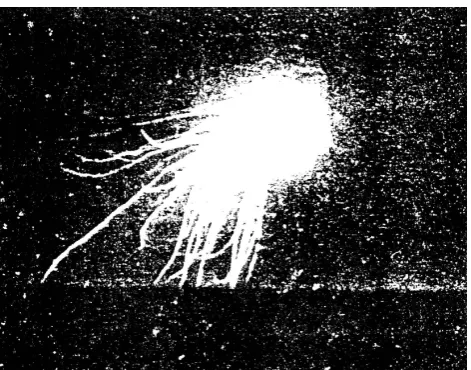
Fig. 1
Fig. 1. A photograph of ball lightning spouting sparks. After Kuhn
(1951). Singer (1971), reporting Kuhn’s observation, states: “The ball, with an estimated diameter of 50 cm . . . fell directly down and flew apart a few meters above the ground. The photographer reported that he saw the luminous body clearly at the 200-m dis-tance and that there were no other light sources in the field of view”. Ground level is about two thirds of the way down from the top of the figure.
have an outward force on the current channel and this out-ward force must be confined by atmospheric pressure.
Dmitriev et al. (1981) carried out some interesting experi-ments to determine how the earth beneath the exploding ball lightning could consist of more than a thousand pieces of slag 5 to 6 cm in diameter and pieces of glass with a fluid-like structure. The original soil consisted of water-saturated sand with quartz grains. They found no changes in the ele-ment composition of the soil. Various tests were performed on the original soil to see how the soil was heated. They used irradiative energy, high-frequency electrical discharge, low voltage power sources, high-frequency electromagnetic fields, gasoline, diesel oil, alcohol and thermite. Only the high-frequency electromagnetic field was able to reproduce the observed slag-like material. The frequency used was 13.56 MHz; this frequency penetrated the soil to a greater depth than observed. Consequently they added 30% cop-per powder to the soil to give the correct penetration depth. They estimated that the frequency required without the cop-per would be 108−109Hz. As will be seen below, this is very convincing evidence that the model presented here is close to the correct model.
[image:2.595.50.286.61.246.2]Another interesting characteristic of the high-energy ball of Dmitriev et al. is that it spouted sparks. This is a fairly common BL characteristic. These sparks probably corre-spond to small pieces of the core breaking off due to the in-tense repulsive force of the charge on the core. These would accelerate radially outward. A photograph (Kuhn, 1951) showing sparks and streamers coming from BL is shown in Fig. 1.
Recent experiments and theories of BL suggest that BL is composed of burning nanopartcles (Abrahamson and Den-niss, 2000; Abrahamson, 20002; Dikhtyar and Jerby, 2006; Paiva et al., 2007) or of burning vapor or molten metal-lic spheres (Stephan and Massey, 2008). If the particles or molten spheres have sufficient weight they could counteract the buoyancy force. However there is nothing to keep the BL from expanding or dispersing. BL is known to obtain electri-cal charge and the charge on the particles would cause them to be repelled from each other and from the ball.
There are several models that consider BL to be a plasmoid (Silberg, 1962) or EM radiation trapped in a plasma sheath (Dawson and Jones, 1969; Endean, 1976). One objection to these models is that these BL should rise like a helium filled balloon. Another objection is that there is nothing contain-ing the plasma. The model presented here has similarities to these models but there is a major difference and that is that BL has a highly charged solid core at its center. This keeps the BL from dispersing into its surroundings and from float-ing.
The processes involved in BL evolving from a highly charged piece of material to its long-lived quasi steady state is obviously very complicated and the author does not wish to speculate about this. It is thought that an understanding of the quasi steady state should be obtained first and then con-sideration can be given to the generation mechanism. This is the approach taken here and the generating mechanism is not considered in detail.
2 Model
BL is formed by high-energy events such as lightning, vol-canoes, tornados, earthquakes and meteors (Singer, 1971). The high energy is capable of generating EM energy and of somehow separating electrons from a small solid body (core) which could be, for example, hail, a stone, or a piece of metal. Electrons separated from the core and those gen-erated by the initiating source, produce an electron layer and highly ionized plasma layer surrounding the positively charged core. These trap the EM energy. If the plasma elec-tron energy is sufficiently high, the elecelec-tron-ion collision fre-quency, and hence the absorption of the trapped EM energy by the plasma, is low enough (discussed below) that the ball lifetime could be seconds or more.
than about 1 cm. The trapped EM energy energizes the elec-trons to the keV or tens of keV level. These completely strip orbital electrons from atmospheric atoms that they come in contact with to produce a neutral plasma layer. For sim-plicity, the plasma layer is assumed to consist only of en-ergetic electrons and ions of nitrogen N+7. As the plasma layer varies from fully ionized to non-ionized is obviously of extreme complexity and even an approximate descrip-tion will not be attempted here. It should be noted that Dmitriev (1969) found large concentrations of ozone and ni-trogen dioxide in air samples capture from the “bluish mist” trail of a BL.
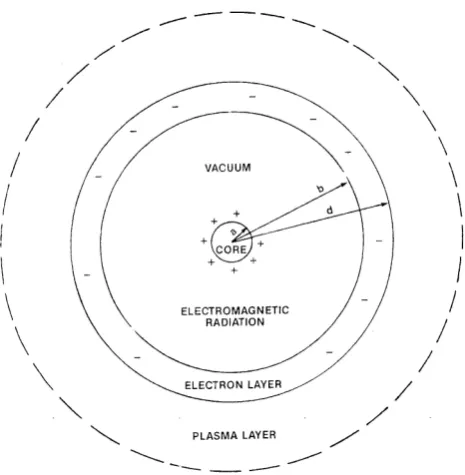
In a mathematical description of this model given by Mul-drew (1990), referred to as Paper 1 below, both a first-order theory and second-order theory are presented. In the first order theory it is assumed that the electron density is zero for a < r < b wherer is distance measured from the cen-ter of the ball (see Fig. 2). Forr > bit is assumed that the electron density is constant and is determined by equating the plasma pressure where the EM field is small, to atmo-spheric pressurep0. In the second-order theory, three differ-ential equations are obtained for the self-consistent electron density, ion density, and EM electric field distributions as a function ofr. These are solved numerically for a particular case. In Eq. (2.3) of Paper 1 the plasma pressure is given by the sum of the electron and ion pressures. Equating this to atmospheric pressurep0gives
p0=N KTe+NiKTi=KN (Te+Ti/Z) (1) whereN andTe are the electron density and temperature,
Ni andTi are the ion density and temperature, K is Boltz-mann’s constant andNi=N/Z. Equation (1) is valid if the mean free path is small compared to the distance over which the macroscopic properties of the plasma vary or if there is a magnetic field for which the cyclotron radius is small com-pared to this distance (Spitzer, 1962). The electron mean free path is extremely large (Paper 1) and a magnetic field, which may be present due to currents, is not considered. If the plasma pressure is only due to the ions, then
p0=NiKTi=N KTi/Z (2)
In reality, the electron densityN would be between that de-termined from Eq. (1) and that dede-termined from Eq. (2). The effect of this on the BL model presented in Paper 1 is that the electron density in the electron and plasma layers is no longer limited by the electron temperature. The ball energy and the electric field distribution inside the electron layer for the example shown in Fig. 2 of Paper 1 is not greatly affected but, due to the higher electron density, much higher EM fre-quencies can be trapped by the ball. This means that smaller balls can be obtained than predicted by the model of Paper 1. The minimum size, of about 1 cm, is then determined by the strength and size of the core and agrees fairly well with ob-servation. Calculations based on this modification indicate
Fig. 2
Fig. 2. A sketch of the ball lightning model. After Fig. 1 of
Mul-drew (1990).
that small-size BL can be described by the model (see be-low).
An error in Fig. 2 of Paper 1 should be pointed out here. The electron layer in Fig. 2 of Paper 1 should be about 0.34 cm thick, not about 0.12 cm thick, as shown in the fig-ure. The text and calculations are correct.
In the second-order theory of Paper 1, the first term on the left-hand side of Eq. (3.1) is the electron pressure-gradient term and, as discussed above, should be modified. The re-sults presented in Fig. 3 of Paper 1 would then be different.
3 Evidence for a solid core
The feasibility of the above model can be demonstrated by presenting the observational evidence that BL has a solid core.
[image:3.595.312.545.59.297.2]Strong steel has a tensile strength of about 3×10⁹N/m2. Tensile strength is determined by stretching a wire to the breaking point and then dividing by the cross sectional area. In this process, the cross sectional area decreases as the length of the wire increases. For a solid such as a sphere, with an outward radial force applied to the surface, this can-not happen since the dimensions normal to the applied force must also increase if the radial dimension is increased. It thus seems reasonable that the conventional tensile strength is not appropriate in this case. The bonding force between molecules of the material may determine the limiting force. This can be estimated from the amount of heat energy re-quired to raise the material to its boiling point and evaporate it. This would of course over-estimate the breaking strength because of flaws in the material. For iron the bonding en-ergy is about 7×10¹⁰J/m3and applying the virial theorem gives a bonding strength of about 2×10¹⁰N/m2. If a strength of 1010N/m2, say, is chosen for the strength of a spherical steel core, then a BL energy of 109J could be contained by a sphere about 17 cm in radius. It is quite possible that the energy of the most energetic BL was over estimated by, say, a factor of 10. For an energy of 108J, the spherical steel core would be about 7 cm in radius and would weigh about 11 kg. The buoyancy force on a 1 m3BL is only about 1 kg, and hence energetic BL would be considerably heavier than air. This is borne out by the observations: In the Goodlet (1937) example the BL fell from a house roof into a con-tainer of water. Obviously, in the Altschuler et al. (1970) example the BL must have had considerable weight to dig a trench 1.3 m deep. In the Dmitriev et al. (1981) example the BL appeared over a cinema and then descended to the earth’s surface through tree branches. Hence, even though the core is large it is not unlikely that the highest estimated levels of BL energy can be explained by the solid-core model.
BL is usually generated by lightning. Lightning striking an object on the ground could break off a piece of the object and electrically charge it due to the intense electric currents and/or electric fields associated with the lightning channel. This could form the core of BL. During thunderstorms BL is sometimes observed falling from clouds or observed from aircraft. In this case the core could be a piece of a meteor. An ionized meteor trail would form a good path for lightning and hence it is not that unlikely that a meteor would be hit by lightning during a storm. BL observed inside or just outside an aircraft could be caused by lightning striking or occur-ring near the aircraft and producing a large current or electric field in some material inside or outside the aircraft. A piece of this material could become the core. Clear air BL is also occasionally seen; in fact, the author has observed this type of BL and thinks the two balls observed resulted from meteor fragments. A large meteor was observed about the same time but the exact time relative to the ball lightning observations is uncertain due to fading memory. Material ejected from volcanoes, picked up from the ground by tornados and hurri-canes, or broken off of meteors would be subjected to severe
frictional forces resulting in electrostatic charging. Piezo-electric effects near the fault of an earthquake produce in-tense electric fields that could highly charge a piece of ma-terial. This material would form the core of BL. The core would normally have an irregular shape and if its size were an appreciable fraction of the ball diameter, it could produce a nonspherical ball. Nonspherical balls are observed in per-haps 15% of the reported observations (Singer, 1971).
Jones (1910), Potts (1910) and others give direct evidence of BL having a solid core. One of Jones’ students shorted an ordinary (for that period) 110 V circuit. Jones writes:
“I happened at the time to be a few meters from him and to be looking toward the terminals. At the instant of the short circuit I saw an incandescent ball which appeared to roll rather slowly from the terminals across the laboratory table and then disappeared. As I remembered it, I should say that the ball may have appeared to be about three cen-timeters in diameter. I think no one else in the room saw anything more than a flash of light – much as if a fuse had blown. On the table where the ball had rolled we found a line of scorched spots, as if the ball had bounced along the table and had scorched the wood wherever it touched. As I remember them, these scorched spots were rather close to-gether, perhaps not much more than one or two centimeters apart. In the top of the table was a crack perhaps a millimeter or two wide, and at this crack the scorched line ended. In a drawer immediately under the crack we found a tiny copper ball, perhaps a millimeter in diameter. Apparently the ball that rolled along the table was incandescent copper vapor, al-though my memory of it is rather like a yellow-white than a greenish light.”
The observations of Jones are discussed in more detail be-low. Potts writes of his observation during a heavy electrical storm:
“I observed what appeared to be a ball of fire between two and three feet in diameter rolling along the street. It was also accompanied by several others of smaller size. This appear-ance occurred just after a very heavy electrical discharge to a telephone pole some few squares away. The discharge along the telephone wire heated the wire to red heat. The wire broke on account of this heating and a section of some con-siderable length was hurled along the street with a whirling motion. The rapidity of the rolling motion gave the appear-ance of a ball, as it also gave a forward motion to the ball of fire. Subsequent investigation revealed the two ends of the wire dangling from adjacent poles with a considerable length of wire missing.”
a tree (Meunier, 1886). During a lightning storm, a tar-like substance was reported on the ground from a burning ball that exploded after half a minute (Webber, 1907). Witnesses observed a large ball of fire formed by lightning “vaporiz-ing” a 65-cm length of a 2-mm copper antenna wire (Tur-pain, 1911). Large objects have been seen to fall from en-ergetic ball lightning (Corliss, 1982). Sparks and streamers emanating from BL (Fig. 1) also indicate that BL has a solid core.
All of these observations are evidence that BL contains a solid core. In most cases a core is not observed but this does not mean that one didn’t exist. It could be too small to notice, it could blow apart during explosion (Fig. 1), it could vaporize, or it could be dispersed upon melting.
4 Theory
The first-order theory will be presented here with the appro-priate modification described above and with more detail and clarification. The second order-theory will not be presented here. It is, of course, interesting to know the detailed elec-tron density, ion density and EM field distributions in BL but it is not essential for an understanding of the model. In the second order theory it is only necessary to assume a positive core surrounded by an electron layer of equal but opposite charge. In the first order theory the electron densityN is as-sumed to be zero inside a radiusb and for all r > b, N is assumed constant. This is justified based on the second order theory. Fromr=btor=d, there is an electron layer that contains a total charge−Qassumed equal in magnitude to that of the core. Forr > dthere is a neutral plasma layer of fully ionized nitrogen ions N+7. The electrons in the electron layer have energies of order of tens of keV. It takes about 10 eV to ionize an air molecule and hence the air near the outer boundary of the electron layer would be ionized by the energetic electrons.
Equations (8) on page 556 of Stratton (1941) for the boundary conditions of the EM oscillations of a sphere, are now used to obtain the natural angular frequencyω of the trapped EM energy. Forr < bthe wave numberk1is that of free spaceω/cand forr > bthe wave number is (Budden, 1961b)
k2= ω c
"
1− e 2N
ε0mω2
#12
(3)
wherec,e,mandε0have their usual meaning. It is assumed Eq. (3) is valid even though due to the high electron temper-ature (see below), the electrons are slightly relativistic.
The tangential component of the EM electric field is con-tinuous atr=b. Hence, assuming the permeability of the
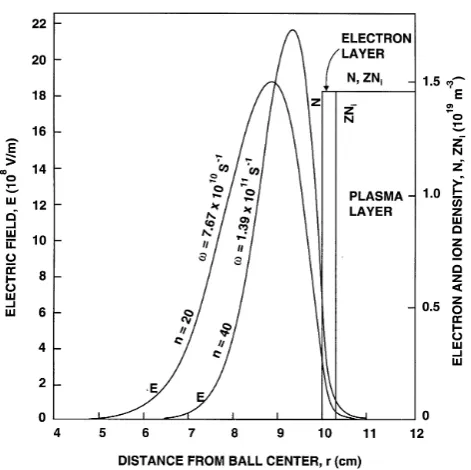
Fig. 3 Fig. 3. Electric-field distributions for the fundamentaln=20 and
n=40 modes assuming electron and plasma layers of constant
elec-tron density. After Fig. 2 of Muldrew (1990) with corrected elecelec-tron layer thickness.
plasma is that of free space, from Eq. (10), page 556, of Strat-ton
[k1bjn(k1b)]0
jn(k1b)
=[k2bh (1) n (k2b)]0
h(n1)(k2b)
(4)
where jn and h(n1) are spherical Bessel and Hankel func-tions. Forr < b, the electric field is proportional tojn(k1r) and forr > b, the electric field is proportional toh(n1)(k2r). The primes in Eq. (4) denote differentiation with respect tok1bandk2b. Numerical calculations involving spherical Bessel and Hankel functions are carried out using the formu-lae given on page 405 of Stratton. The electric field distribu-tion forn=20 and forn=40 are shown in Fig. 3. The plasma parameters used in the calculation are discussed below. The wave frequencies are determined by the boundary conditions. The assumed constant value ofN is found by equating the plasma pressure to atmospheric pressurep0. The minimum value ofN is given by Eq. (1) and the maximum value of
N by Eq. (2). Calculations have been carried out for various values between these two limits.
[image:5.595.311.547.58.293.2]between electrons and ions; consequently the ions have their own temperature. Preliminary calculations (not given here) using Banks and Kockarts (Part B, 1973) indicate that if the ion temperature is assumed constant, it cannot exceed a few thousand degrees since otherwise energy loss due to thermal conduction would be large;Ti is taken to be 5000 K.
The order n of the spherical functions determines the shape of the radial electric field. The greaternis, the smaller the field atr=a is. If the core is conductive, a strong field at the core surface could produce sufficient ohmic heating to melt the core. A small field at the core is achieved by choos-ingngreater than about 10. For the calculations presented here,n=20 andn=40. It also is assumed that the EM field depends only onr. The field is chosen to be independent of the azimuth angleφby choosing the indexm=0 (see Strat-ton, page 555). As a function of the latitudinal angleθ, how-ever, the electric field hasnnulls. Such a field could be set up, for example, by a single VLF transmitting source in the earth-ionosphere waveguide (Budden, 1961a). But suppose there were two separated VLF transmitting sources. In a lin-ear system, both would have their own system of modes with differently located nulls. The two fields would of course in-terfere producing a complicated pattern of electric field min-ima and maxmin-ima. However, in general, the minmin-ima would not be nulls. This corresponds in some way to the present prob-lem where there is no particular source or perhaps there is an extremely large number of small, evenly distributed sources. The average electric field due to all the different sources and all the different modes would tend to average out leaving no nulls but possibly leaving electric field minima. It therefore seems justifiable, to a first approximation, to take the electric field as a function ofronly. The EM field in the ball corre-sponds to what is commonly referred to as the ‘whispering-gallery’ mode of propagation (Budden, 1961a).
GivenN andb, Eq. (4) is solved numerically forωusing Eq. (3). Sinceωis multivalued, the smallest value is chosen. This value results in a solution for which there is only a single maximum in|E|betweenr=0 andr= ∞whereE is the electric field strength.
The constant of proportionality betweenEandjn(k1r)for r < b is determined from the charge on the core Q. One method of finding it is to use the virial theorem. The desired form of the virial theorem can be obtained from Eq. (13) of Schmidt (1960). For a steady state, the left-hand side of this equation is zero. Consider a sphere with a constant scalar gas pressurepoutside a radiusb. If the gas has no macro-scopic flow (T=0) and a vacuum exists forr < b (U=0), then the enclosed magnetic and electric electromagnetic en-ergyEM+EEis
SEM=EM+EE=bp
Z
dS=4π b3p=3V p (5) where SEM is the total enclosed EM energy of a ball of volumeV having a pressure p at the surface S. The en-closed energy does not include the electrostatic (ES) energy
of the charge on the core since this energy is confined by the strength of the core itself. Assuming the electron layer is very thin, Eq. (5) gives
SEM =2
∞
Z
a 1 2ε0E
24π r2dr
=3
4
3π b 3
"
p0+
Q2
8π ε0b2(4π b2)
#
(6)
where the second term in square brackets on the right is the ES pressure of the electron layer andp0is atmospheric pres-sure. The electric field energyEE is given by the integral; the energy density of the EM electric field is(1/2)ε0E2and 4π r2dr is a volume element. The 2 in front of the integral results sinceEE=EM. Let
E= E0
jn(k1b)
jn(k1r) (7)
ThenE0, the value of E atr=b, is determined from Eq. (6) numerically.
Equation (6) is of interest historically since much has been written in the literature regarding BL and the virial theorem. However, there is a better method to deter-mineE0. The ponderomotive force on a single electron is −e2/(2mω2)(dE2/dr) (Fejer, 1979). The ponderomotive force on the electron and plasma layers is balanced by the force of electrostatic attraction of the electron layer to the core plus the force of atmospheric pressure. Hence for a thin electron layer nearr=b,
−
∞
Z
b
e2
2mω2 dE2
dr (4π r
2N dr)=4π b2p 0+
Q2
8π ε0b2
(8)
where the quantity in brackets is the number of electrons in
dr. IfEfalls rapidly to zero forr > b, 4π r2can be set equal to 4π b2and from Eq. (7)
−
∞
Z
b
dE2 dr dr= −
0
Z
E02
dE2=E02 (9)
From Eqs. (8) and (9) 1
2ε0E 2 0=
ω2 ω2 p
"
p0+ Q2
2ε0(4π b2)2
#
(10)
chosen to show that the model is capable of explaining en-ergetic BL. Lower energy BL is much more common and would have a core charge about 3×10⁻⁶to 10−4C.
Suppose, hypothetically, that the core consists of a spher-ical steel ball of radius a and with strength sufficient to carry a charge densityρ=0.3 C/m2. Then, 4π a2=Q/ρor
a=0.016 m and the core mass is about 0.15 kg. The ES en-ergySESis
SES=
Q2
8π ε0
1
a−
1
b
(11)
or 2.36×10⁵J and an electron in the electron layer has an average potential energy of about 240 MeV. The EM energy can be obtained from Eq. (6).
SEM=
Q2
8π ε0b
+4π b3p0 (12)
or 4.6×10⁴J. Neglecting the thermal energy of the electrons and the vacuum energy, the total energy is from Eqs. (11) and (12)
ST=
Q2
8π ε0a
+4π b3p0 (13)
or about 2.8×10⁵J.
The outward pressure at the surface of the core is
ps=
Q2
8π ε0a2(4π a2)
(14)
or 5×10⁹N/m2. This is near the upper limit for the strength of steel (see above).
The electron-ion collision frequency and bremsstralung in the plasma layer are dependent on the electron temperature. Equating the electron energy corresponding to a temperature
Teto the electron energy in the EM field gives 3
2KTe= 1 2m
eE
mω
2
(15)
As an example, for an E of about 108V/m and ω about 1011s−1, a Te of about 109K (about 102keV) is obtained. The electron energy is lost by bremsstrahlung, ionization, dissociation and conduction in the plasma layer. Also, the most energetic electrons will escape from the ball. This will leave a small net positive charge on the ball which will con-strain the less energetic electrons to orbit the core. In any case the electron energy is so large that energy losses due to electron-ion collisions can probably be neglected in de-termining ball lifetime for medium and large-size BL, and allows lifetimes of about 1 s for BL of diameter down to about 1 cm. The energy loss means that we do not have a true steady state.
5 The observations of Jones
The first order theory of Paper 1 was applied to the observa-tion of Jones (1910). By trial and error a particular model ball was found which agrees quite well with the observa-tion of Jones. Using the same symbols as in Paper 1, the values are: Q=3×10⁻⁶C,b=1.7 cm,n=4,N=1020m−3, whereQis the core charge,b is the ball radius,nis the or-der of the spherical functions describing the trapped elec-tromagnetic field, andN is the electron density of the elec-tron and plasma layers. The tensile strength for copper is about 4×10⁸N/m2. As mentioned above, the strength on the surface of a sphere of copper would be greater than this. The molecular bonding strength (see above) yields a surface strength of about 1.5×10¹⁰N/m2. A strength midway be-tween these of 3×10⁹N/m2is chosen for the calculations. From this value andQa radius for the core is calculated to be 1.0 mm and the associated electrostatic energy 49 J. The an-gular frequency of the trapped EM radiation is 1.4×10¹¹s−1. If the core is spherical and located at the center of the ball then, for the above parameters, the EM field at the surface of the sphere is sufficiently small so that it will take several tens of seconds for the core to melt by ohmic heating.
In Paper 1 it was suggested that for a freely-moving ball the electrons in the electron layer would follow the motion of the core since they are to some extent in orbit about the core. In Jones’ example the ball motion is restricted by the table. Hence there must be forces acting on the core to keep it cen-tered. The ponderomotive force (radiation pressure) of the trapped EM field acting on the free electrons of the conduc-tor is certainly great enough to do this (Stratton, 1941). One problem is that if the ponderomotive force on the core were sufficient to, say, balance the gravitational force, the ohmic heating might be so great that the ball would melt. There is another force which is probably greater than the pondero-motive force and which would prevent the ball from melting. The EM field increases very rapidly with distance from the center of the ball ifnis not too close to 1. The surface of the core furthest from the center of the ball would encounter the largest EM field. If a portion of the surface moves into a high EM field it could be vaporized. The momentum of the escaping vapor would apply a force on the core and push it back toward the center. This would keep the core from melt-ing due to ohmic heatmelt-ing and would result in producmelt-ing an approximately spherical core as was observed by Jones and by Golka (see above).
6 Ball lightning motion
force due to this field. However, during storm conditions, when BL is usually observed, the electric field is reversed and about 10 000 V/m. There is thus an upward force on a positively charged BL. Within about 1 m of a surface the to-tal positive plus negative ion concentration in the atmosphere is reduced by about a factor of two due to collision of the ions with the surface. This decreases the conductivity and in-crease the vertical electric field by a factor of about two. This is called the electrode effect (Hopple, 1967). A BL falling to-ward the Earth’s surface during storm conditions will thus ex-perience an increasing upward force in about the last meter. The buoyancy, gravitational and electrostatic forces may then balance within about 1 m of the surface. Consider a 10-cm radius ball with a core mass of 10 g. The upward buoyancy force is about 4 g weight. The downward 6 g net weight is balanced by an upward electric field of, say, 15 000 V/m for a net positive charge on the ball of 4×10⁻⁶C, a reasonable net charge.
The distortion of the Earth’s electric field by the walls sur-rounding windows and doors of a building can also explain the tendency for BL to enter and leave buildings through open windows and doors. A particularly strange but common observation is that BL enters a building through the chimney. Smoke is more highly ionized than normal air. Hence, in a smoke trail from a chimney the conductivity is higher and the electric field is lower than in the background air. The trail could thus act as a duct and guide the ball into the chimney. Another peculiar observation is that BL has a tendency to follow aircraft. An aircraft would likely attain a high electro-static charge in its motion through the air, especially during electrical storms. Due to the shape of the aircraft and to in-terference with the Earth’s field, electric field minima would exist in the vicinity of the aircraft. These minima could trap a BL causing it to follow the aircraft.
7 Discussion
There are several examples of BL having electrical proper-ties similar to lightning. In fact, people have been injured or killed by electrical discharges from BL. The charged core model of BL can explain this; nearly all other proposed mod-els cannot.
The strong microwave radiation trapped in BL and escap-ing upon explosion can explain the experimental results of Dmitriev et al. (1981). They estimated the microwave fre-quency that heated the soil to be about 108−109Hz. The diameter of the observed BL the studied was about 1.5 m or 7.5 times the diameter of the BL of Fig. 2. The fre-quencies corresponding to then=20 andn=40 examples in Fig. 2 are about 1.2×10¹⁰ and 2.2×10¹⁰Hz. Scaling these frequencies down for the 1.5 m BL gives 1.6×10⁹and 2.9×10⁹Hz. These frequencies are higher than the range given by Dmitriev et al. but choosing a smaller value ofn
would bring the value into their range. This gives very strong support for the solid-charged core model of BL.
The electron temperatureTemust be sufficiently great that the electron energy loss due to EM damping in the BL life-time is considerably less than the total ball energy. From Eq. (3.42) of Budden (1961b), the power loss per unit vol-ume due to collisionsWc in a timet1/ωand forων, whereνis the momentum collision frequency, is
Wc=
N e2νE2
mω2 (16)
whereE is the root-mean-square value of the field and not the peak value used by Budden. For electron-ion collisions (Banks and Kockarts, Part A, 1973), using mks units
ν=3.8×10⁻⁵NiZ2T
−3/2
e (17)
Bank and Kockarts give the energy collision frequency which is twice the momentum collision frequency; their value must thus be divided by 2. An error was made in Eq. (4.1) of Paper 1. For reasonable values ofNiandTe, a value of ln(3) (Table 5.1, Spitzer, 1962) of 21 is more appropriate than the value 15 used by Banks and Kockarts. The total EM power lossPcis from Eqs. (16) and (17)
Pc=
3.8×10⁻⁵Z2e2 mω2T3/2
e
Z ∞
a
N NiE24π r2dr (18) Forn=20 andn=40, in the example of Fig. 3, numerical integration yields Pc=1.8×10³W and Pc=2.5×10³W, respectively for Te=5×10⁸. From an electron-ion colli-sion point of view the “half-life” of the ball,ST/Pc, is from Eqs. (12) and (18) then about 150 s forn=20 and 110 s for
n=40. Lower energy balls would have shorter electron-ion-collision lifetimes; but there are also other factors which de-termine lifetime. The BL model presented here explains one of the most puzzling characteristic of BL – its long lifetime.
Ignoring the relatively small atmospheric pressure term in Eq. (13), the total energyST is independent ofb. As the EM energy is converted to heat, the only way to decreaseST is to decreaseQ, sinceais unlikely to change significantly. Start-ing with a ball in equilibrium, after EM energy is lost, the ES and atmospheric pressures are greater than can be sup-ported by the trapped EM energy. Since observationally, the ball doesn’t collapse immediately, it appears that either small charged particles break off and are repelled from the core (“sparks” are often observed ejected from a ball) or electrons from the electron layer penetrate the EM barrier and partly neutralize the core. Electron penetration could result from small, local instabilities and/or from interference minima in the EM field. The EM field of BL probably consists of many interfering modes covering a fairly large frequency range, not one mode as considered here.
decreases. However, from Eq. (13) it can be seen that the size of the ballbdoes not change significantly as the total energy
ST changes since the second term on the right is small rela-tive to the first term.
BL often terminates in an explosion. This might be due to an uncontrolled instability and/or melting of the core ma-terial by a transfer of ES energy to heat. The ES energy of an electron penetrating the EM field would be dissipated by radiation (analogous to synchrotron radiation), mainly in the visible and ultraviolet, as the relativistic electron spirals into the core, and by subatomic particle generation in collision with the core.
Radiation (bremsstrahlung) is generated in the plasma layer. The radiated power per unit volume is obtained from Eq. (5-60) of Spitzer (1962). In mks units, withN=ZNi
WR=1.4×10−40ZN2Te1/2 (19) The thickness of the plasma layer1sis not known but pre-sumably is much less than b. Then, for Te=5×10⁸K,
b=0.1 m, Z=7, N =1.45×10¹⁹ the power loss PR=
WR4π b21s=6×1041sW. For1s <0.01 m,PR<600 W which is considerably less than the collisional loss of Eq. (18) for the chosenTe. Of this, a few milliwatts are radiated in the visible, about 1 W in the ultraviolet and the rest in X rays (Spitzer, 1962). An interesting observation noted by Dmitriev (1969) in a footnote is that gamma radiation may have been detected from the BL by a gamma radiation scin-tillation radiometer located close to the BL. There are, of course, other sources of visible light: mainly recombination but also the ‘synchrotron’ radiation mentioned above.
The BL model presented here has been kept simple (i.e. a single EM mode) to allow a mathematical description. A more elaborate model is not justified on the basis of the ob-servational data. In reality, BL would be more complicated. For example, the EM field could consist of many interfering modes covering a large frequency range. Interference min-ima could allow leakage of electrons through the EM barrier. Also, as mentioned above, the plasma layer would be of ex-treme complexity. Air molecules diffuse inward becoming dissociated and ionized. The inward flux of neutrals and con-sequent energy loss to the ball is reduced by an equal outward flux of ions (cf. a candle flame).
In spite of the complexity of this model, it is still thought that it is fundamentally correct but still incomplete. It ex-plains the large amount of energy associated with BL without violating the virial theorem or resorting to unusual forms of matter. The author knows of no other model that can do this. It also explains other unusual characteristics such as lifetime, electrical properties, and motion. A small net charge on a ball interacts with the earth’s natural electric field (which can be quite strong during thunderstorms) or other local electric fields (e.g. near aircraft) to produce erratic motion. Because of the weight of the core, there is no buoyancy problem as there is with gas or plasma models.
8 Conclusions
The following conclusions and predictions are based on this paper and Paper 1. The predictions could be tested if a tech-nique for artificially producing BL is found.
1. There is a minimum size for BL. The theoretical and ob-served values of about 1 cm are reasonably close. Using Eqs. (12) and (18) the half-life of a ball based on ab-sorption of the EM field due to electron-ion collisions can be calculated. For a BL equal to or less than 1 cm, it would be about 1 s or less.
2. Many types of ions, atoms and molecules would exist in the plasma layer and these would vary depending on conditions. Although the electrons are extremely ener-getic, the ions would remain relatively cool due to heat conduction outward to the atmosphere. Hence, it is not thought that fusion would be possible.
3. Many EM modes are possible – electric and magnetic, multiplen, and multiple electric-field maxima between the core and electron layer (see Stratton, 1941; Budden, 1961a). Hence, nulls in the electric field are unlikely; however, electric field minima could exist.
4. Once the modes are established, the ball diameter would remain almost constant since size is almost indepen-dent of the total energy. In Eq. (13) the second term is due to atmospheric pressure and is negligible com-pared the first term for ES energy which is independent ofb. Hence the ball radiusbis almost constant as the total energy decreases.
5. Mode interference might allow some of the electrons in the electron layer to pass through the EM barrier at electric-field minima. Their ES energy would be supplied continuously to the ball. Once through the EM barrier, these electrons would become relativistic as they spiral into the core. They would radiate light and ultra violet (cf. synchrotron radiation). Upon collision with the core, subatomic particles could be produced. Infra-red radiation would be negligible; hence, as has often been observed, no heat would be felt by a close observer.
6. The electron layer is attracted to the positive core. This holds the ball together and prevents it from diffusing away. In other models of BL, diffusion of the ball into its surroundings would occur rapidly.
Acknowledgements. Topical Editor F. D’Andrea thanks two
References
Abrahamson, J.: Ball lightning from atmospheric discharges via metal nanosphere oxidation: from soils wood or metal, Phil. Trans. R. Soc. Lond. A, 360, 61–88, 2002.
Abrahamson, J. and Dinniss, J.: Ball lightning caused by oxida-tion of nanoparticle networks from natural strikes on soil, Nature, 403, 519–521, 2000.
Altschuler, M. D., House, L. L., and Hildner, E.: Is ball lightning a nuclear phenomenon?, Nature, 228, 545–546, 1970.
Ashby, D. E. T. F. and Whitehead, C.: Is ball lightning caused by antimatter meteorites?, Nature, 230, 180–182, 1971.
Banks, P. M. and Kockarts, G.: Aeronomy, Academic, Orlando, Fla., 1973.
Barry, J. D.: Ball Lightning and Bead Lightning, Prenum Press, New York, 1980.
Budden, K. G.: The Wave-Guide Mode Theory of Wave Propaga-tion, Prentice-Hall Inc., Englewood Cliffs, N. J., 1961a. Budden, K. G.: Radio Waves in the Ionosphere, Cambridge Univ.
Press, New York, 1961b.
Charman, W. N.: Ball lightning, Phys. Rep., 54, 261–306, 1979. Corliss, W. R.: Lightning, Auroras, Nocturnal Lights, and Related
Luminous Phenomena, pp. 162–163, Published by the Source-book Project, P.O. Box 107, Glen Arm, Maryland, 1982. Dawson G. A. and Jones, R. C.: Ball lightning as a radiation bubble,
Pure Appl. Geophys., 75, 247–262, 1969.
Dikhtyar, V. and Jerby, E.: Fireball ejection from a molten hotspot to air by localized microwaves, Phys. Rev. Lett., 96, 045002-1– 045002-4, 2006.
Dmitriev, M. T.: Stability mechanism for ball lightning, Sov. Phys. Tech. Phys., 14, 284–289, 1969.
Dmitriev, M. T., Bakhtin, B. I., and Martynov, V. I.: Thermal effects of ball lightning, Sov. Phys. Tech. Phys., 26, 1518–1520, 1981. Endean, V. G.: Ball lightning as electromagnetic energy, Nature,
263, 753–754, 1976.
Fejer, J. A.: Ionospheric modification and parametric instabilities, Rev. Geophys., 17, 135–153, 1979.
Golka, R.: Laboratory-produced ball lightning, J. Geophys. Res., D99, 10679–10681, 1994.
Goodlet, B. L.: Ball and bead lightning, J. Inst. Elec. Eng., 81, 1–56 (see pp. 32 and 55), 1937.
Hopple, W. A.: Theory of the electrode effect, J. Atmos. Terr. Phys., 29, 709–721, 1967.
Jones, A. T.: A laboratory illustration of ball lightning, Science, 31, 144, 1910.
Koslov, B. N.: Maximum energy liberation by ball lightning, Sov. Phys. Dokl., 23, 41–42, 1978.
Kuhn, E.: Ein Kugelblitz auf einr Moment-Aufnahme?, Naturwiss., 38, 518–519, 1951.
Meunier, M. S.: Substance singuli`ere recueillie `a la suite d’un m´et´eore rapport´e `a la foudre, Comptes Rendus, 103, 837–840, 1886.
Muldrew, D. B.: The physical nature of ball lightning, Geophys. Res. Lett., 17, 2277–2280, 1990.
Paiva, G. S., Pav¨ao, A. C., de Vasconcelos, E. P., Mendes Jr., O., and da Silva Jr., E. F.: Production of ball-lightning-like lumi-nous balls by electric discharge in silicon, Phys. Rev. Lett., 98, 048501-1–04508-4, 2007.
Potts, L. M.: Ball lightning, Science, 31, 144, 1910.
Schmidt, G.: Virial theorem for plasmas, Phys. Fluids, 3, 481–482, 1960.
Silberg, P. A.: Ball lightning and plasmoids, J. Geophys. Res., 67, 4941–4942, 1962.
Singer, S.: The Nature of Ball Lightning, Plenum Press, New York, 1971.
Smirnov, B. M.: Observational properties of ball lightning, Sov. Phys. Usp., 35, 650–670, 1992.
Spitzer Jr., L.: Physics of Fully Ionized Gases, Interscience Pub-lishers, New York, p. 24–25, 1962.
Stephan, K. D. and Massey, N.: Burning molten metallic spheres: one class of ball lightning?, J. Atmos. Solar Terr. Phys., 70, 1589–1596, 2008.
Stratton, J. A.: Electromagnetic Theory, McGraw-Hill, London, 1941.
Turpain, M. A.: Curieux effets d’un coup de foudre sur une antenne r´eceptrice d’onde ´electriques, J. de Physique, 1, 372–382, 1911. Webber, H.: A case of globular lightning, J. Roy. Astron. Soc. Can.,