Annales
Geophysicae
Vertical motion of ionization induced by the linear interaction of
tides with planetary waves
M. Voiculescu1and M. Ignat2
1Physics Department, University “Dunarea de Jos”, Galati, Romania 2Faculty of Physics, University “Al. I Cuza”, Iasi, Romania
Received: 14 June 2002 – Revised: 4 December 2002 – Accepted: 6 December 2002
Abstract. Experimental findings have shown that
travel-ling planetary waves modulate the occurrence of midlatitude sporadic-E-layers. Using a simple quantitative model, we analyse the effects of the linear interaction between tides and planetary waves on ion motion. Besides an expected varia-tion of the dumping height, it is found that the boundaries of the oscillations induced by the descending semidiurnal tide are significantly modified by the presence of the planetary wave. The height variations of the ionisation cause plan-etary wave modulations of the metallic ion content in the background plasma density. This could explain the long-term variation found in the occurrence of strongEs layers.
The fact that the dumping height variations are strongly in-fluenced by the tidal phase velocity and amplitude, together with the variability of the metallic ion content, could con-tribute to the understanding of the sporadic nature of the E-layers.
Key words. Ionosphere (Ionosphere-atmosphere
interac-tions; Mid-latitude ionosphere)
1 Introduction
Evidence of a strong link between thermospheric dynamics and sporadic-E phenomena have been recently supplemented by the finding that planetary waves (PW) could play a role in the large period wave-like variations found to exist in the occurrence of coherent backscatter echoes (Tsunoda et al., 1998; Voiculescu et al., 1999) and strong sporadic-E occur-rence (Voiculescu et al., 1999). In their paper, Voiculescu et al. (2000) tested this postulation and found a fairly good agreement in the long-term periodicities of strong Es and
backscatter echo occurrence in conjunction with simultane-ously measured neutral wind. A physical explanation of the relationship between the large-scale neutral waves and the formation of intense sporadic-E was first proposed by
Correspondence to: M. Voiculescu
Shalimov et al. (1999) and developed by Shalimov and Hal-doupis (2002). They presented a model of ion accumula-tion in the centre of a cyclonic vortex, which, according to Holton (1982), accompanies a travelling planetary wave. In a very recent paper, Haldoupis and Pancheva (2002) proved without any doubt thatEs parameters are strongly related to
planetary waves. They found that the critical frequency of sporadic-E-layers, observed by a large number of ionosonde stations, exhibits a strong 7-days periodicity, occurring con-currently with a large amplitude 7 day westward propagating planetary wave.
The role played by these large-scale neutral waves in the ionospheric plasma was recognized by earlier studies, which related them to the measured long-term periodicities in the D,EandF electron density (Pancheva et al., 1994; Apos-tolov et al., 1995; Fraser, 1977; Zhou, 1998). In their study, Mathews et al. (1993) noticed a 2–5 day period variation ex-isting in the lower height reached by the ionisation layers at Arecibo and suggested that it might be associated with the ac-tion of multiday waves acting on the dumping height. The 2-day modulation found in the electron density by Zhou (1998) was attributed to the transportation of metallic ions under the action of the Lorentz force associated to the PW.
Along these lines, we propose in this paper that the PW modulation, found in the occurrence of denseEs (ftEs >
re-sults primarily in a layer descent almost at the phase velocity of the wind profile, while Mathews and Bekeny (1979) found that the ion trajectories are consistent with the vertical mo-tions of the layers experimentally observed. MacDougall et al. (2000) found that the lifetime of the metallic ions varies between 10 h at 100 km and 10 min at 90 km, depending also on the electron density. Consequently, a variation of several km of the dumping height should lead to important variations of the metallic ion density in this height range. For the dura-tion of a semidiurnal period, the PW can roughly be seen as a mean background wind which will either lift or pull down the metallic ions depending on its direction. Therefore, the mo-tion of the ions and the height where they would have been deposited solely by the tide will change. Using a simple theo-retical model, we investigate how significant is this variation and what are the implications of this effect on the metallic ion content. To find how the ions are affected by the PW we solve the equation of motion for the ions in the presence of both semidiurnal and planetary wave. The equations and the modelling issues are presented in Sects. 2 and 3, while the results are summarized in Sect. 4. The last two sections are devoted to the discussions and conclusions.
2 Equations
The wind shear theory (Whitehead, 1961; Axford, 1963) pre-dicts that a vertical gradient of the horizontal wind provided by a neutral tide leads to convergent vertical ion drifts. The ions gather and form thin layers of enhanced ionisation at the nodes of the wind profile.
The steady-state equation of motion for ions (where the gravitational term is ignored and where only one species of ion is assumed) gives for the velocity vector the well-known formula (e.g. Kelley, 1989):
Vi=
1 1+β2
(
Vn+β(Vn×b)+β2b·(Vn·b)
−kBTi mii
β ∇N
N +β ∇N
N ×b
+β2b· ∇N
N ·b
+ e
mii
β h
E+β(E×b)+β2b·(E·bi
)
, (1)
where β = i
vin,b = B/B is the geomagnetic unit vector,
Vnis the neutral wind, E is the total electric field
(polariza-tion plus external field), N is the plasma density andi,vin,
mi andTi are the ion gyrofrequency, the ion-neutral
colli-sion frequency, the ion mass and the ion temperature, respec-tively. In the following we consider only the combined ac-tion of the neutral waves, neglecting the effects of diffusion or electric fields. The diffusion contributes less to the vertical ion velocity and more to the width, peak and lifetime of the layer (Mathews and Bekeny, 1979), while a typical midlati-tude zonal electric field of 0.5 mV/m would modify the ion vertical velocity with less than 1 m/s.
In a geographical coordinate system, with thex-axis point-ing east,y-axis to north andzpositive vertically upwards, a
wind Vn will force the ions to move vertically with the
ve-locity: Viz=
1 1+β2
h
1+β2sin2IVnz+βVnEcosI−β2VnNsinIcosI
i , (2) whereVnEandVnNare the zonal and the meridional
compo-nent of the neutral velocity,Vnz the vertical component and
I the inclination of the geomagnetic field, considered to be 50◦in our calculations.
Sporadic-E layers are formed by a wind shear associated with the semidiurnal tide, while gravity waves with smaller periods contribute to the structuring of the layer (Whitehead, 1989; Mathews, 1998). Since our interest is confined to the influence of planetary waves on the formation of a layer, we will consider the case of a semidiurnal tide, U, of period Ts =12 h, whose components can be approximated with
si-nusoidal waves:
UE, N(z, t )=U0E, N(z)sin
2π z λz(z)
+2π t Ts
+ϕE, N
, (3) where the wavelengthλz and the amplitudesU0E, U0N of
the zonal and meridional components vary with the altitude (Forbes, 1994) and whereϕEandϕNare the initial phases of
the two tidal components. Experimental and theoretical in-vestigations show that the vertical component of the tide is at the most one order of magnitude smaller than the horizontal ones and is not considered in our model.
The other wave acting on the ions is the travelling PW. These waves are interpreted as corresponding to the evanes-cent solution of the tidal equation of Laplace. They propa-gate horizontally in a westward direction, but their vertical propagation is forbidden and there is nozvariation of am-plitude in the lower thermosphere (Forbes, 1994). For the one-dimensional (vertical) model that we use, the waves are seen as time dependent oscillations of the neutral velocity with the periodTW. The horizontal components of the PW,
whose amplitudes and phases areW0E, N andθE, N, are
de-scribed by:
WE, N(t )=W0E, Nsin
2π t TW
+θE, N
. (4)
The effect of the two waves acting simultaneously on the ions in the E-region will sum up to give:
Viz=VizU +VizW, (5)
whereVizU(z, t )andVizW(z, t )are respectively the tidal
in-duced and the PW contribution to the vertical ion velocity, obtained by replacingVnwithUandW, into Eq. (2). After
introducing Eqs. (3) and (4) in the Eq. (5), the vertical motion of the ionisation can be determined by solving the equation: Viz=
dz dt =
β(z)cosI 1+β2(z)
U0E(z)sin
2π z λz(z)
+2pit Ts
+ϕE
+W0Esin
2π t TW
+θE
+β
2(z)sinIcosI
1+β2(z)
U0N(z)sin
2π z λz(z)
+2pit Ts
+ϕN
+W0Nsin
2π t TW
+θN
.(6)
3 Modelling issues
Although Eq. (6) can be solved, several simplifying assump-tions are utilized, mostly to avoid computational instabilities. 3.1 The tide
To conserve the wave energy density,w = ρU2, the tidal amplitude must increase with altitude to compensate the de-creasing density (e.g. Kelley, 1989):
U0E, N(z)=U095E, N
r ρ
95
ρ(z), (7)
where U095E, N and ρ95 are the amplitude and the neutral
density at 95 km. Theoretically, this is important in the E-region, but several studies show that this variation is severely reduced by dissipation (Forbes, 1982; Zhou et al., 1997). Moreover, the height where the dumping occurs is relatively low so that the possible variations of the velocity should not affect the final result significantly. Therefore, the amplitude of the wave will be considered constant,U = 50 m/s. Ac-cording to the theory of tides, the wavelength is function of altitude (Forbes, 1994):
λz(z)=
2π H r
H h
γ−1
γ +
dH dz
−1
4
, (8)
where H is the scale height, H = kBT
Mg, h the equivalent
depth andγ is the adiabatic constant. The variation of the wavelength is relatively small in this altitude range if the temperature variation with the altitude is considered, and, for the same reasons outlined above, we will consider the wave-length to be constant.
Akchurin et al. (1998) found that theEs parameters are
mostly influenced by the (2, 6) and (2, 4) harmonics of the semidiurnal wave and to a lesser extent, by the (2, 2) tide. In the lower thermosphere the first two tides have wavelengths of 30 km and 50 km, while the (2, 2) harmonic has a value of more than 100 km (Williams, 1996, Forbes, 1994). A medium wavelength of 40 km will be used to model the ef-fect of both (2, 4) and (2, 6) modes and the value of 100 km is attributed to the third wave.
The zonal phase is chosen so that at the initial moment the wind has a node between 110–115 km altitude, where theEs
formation is more efficient. The most propitious structure of the wind for the vertical accumulation of ions has a south-eastward component below and a north-westward component above the location of the layer, which means that the zonal and meridional components are opposed in phase. Even if this were an ideal situation, the meridional component is not very effective at low altitudes so that any variation induced
by a different meridional phase would be very small. The values of the zonal and meridional phases for the slow de-scending tides are then:
ϕE = −2π/3 and ϕN=π/3,
while for the faster (2, 2) tide, they are: ϕE = −π and ϕN=0.
3.2 The PW
Strong and long lasting Es have been found to be present
in connection with the quasi two-day wave (QTDW) (Voiculescu et al., 1999, 2000). In addition, the maximum energy in the PW spectrum comes from the short period waves (Jacobi et al., 1998). For this reason the period of the PW is set to 48 h. The PW is elliptically polarized, with the meridional component larger than the zonal one, especially for low latitudes. As previously stated, when discussing the tide characteristics, any change in the meridional direction leads to negligible effects at altitudes below 110 km. The amplitudesWN and WE are considered equal. Given that
experimental measurements have found that usual velocities accompanying a QTDW are between 15 and 25 m/s (Clark et al., 1994), we selected the smallest value in order to show that even if the PW amplitude is not large, the mechanism still operates. As for the phase of the PW, the maximum of the zonal component is attained at the noon of odd days (Meek et al., 1996), which means thatθE, N =0.
3.3 The collision frequency
Finally, the ion-neutral collision frequency, which is the most important factor in the dumping mechanism, can be ex-pressed using the relation of Banks and Kockarts (1973): νin=
1.80 √
A(A+28)·nN2+ 1.83 √
A(A+32)·nO2 0.91 √
A(A+16)·n0
·10−14.(9) This relation can be approximated by an analytical expres-sion, considering the fact that neutral densities are exponen-tially decreasing with increasing altitude:
νin(z)=
3
X
j=1
ν0jexp
z
0−z
Hj(z)
, (10)
where Hj is the scale height of the each neutral species,
Hj = MkBT
jg, andν0j are the ion-neutral collision frequencies
of the ions with each neutral species at the reference height z0. A realistic approach should consider the altitude
depen-dence of the scale heights due to the important variation of the neutral temperature. As a matter of fact, it is not the colli-sion frequency that is the relevant quantity but its ratio to the ion gyrofrequency,β= i
νin. A simpler analytical description
of the altitude dependence of this coefficient is: β(z)=β0exp
−z0−z H
0 0.5 1 1.5 95
100 105 110 115 120 125
Altitude variation of β
β
Altitude [km]
[image:4.595.51.288.63.261.2]BK.73: circles, Exp.law, H = 6.4 km: line
Fig. 1. Altitude dependence ofβ = i/νi for two cases: 1. col-lision frequency given by Banks and Kockarts, 1973 (circles), with MSIS-90 (15 July) used for the neutral densities; 2. the same quan-tity expressed using an exponential law with a constantH (line).
where, for small altitude ranges like those associated with the E-region, thez-variableHhas been replaced with a fixed one and whereβ0 = ν0i, all the contributions of the neutral
species being summed up in the valueν0. Using a simple
interpolation program we found that the scale height value giving the best approximation for the altitude dependence of β is H = 6.4 km. This can be seen in Fig. 1 where, for Eq. (9), the neutral densities have been taken from the MSIS-90 (Hedin, 1991) atmospheric model, run for 15 July.
4 Results
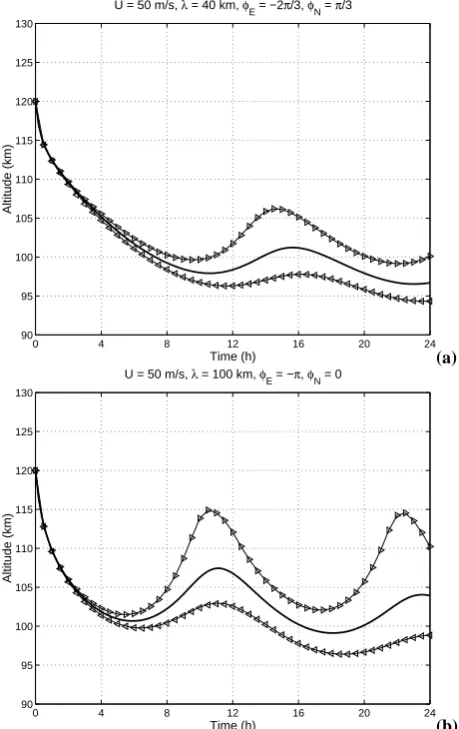
The ion trajectories obtained by solving Eq. (6), for an initial position at 120 km, are depicted in Fig. 2, for the duration of a half period of the PW (24 h). The plot in Fig. 2a illustrates the effect of the PW action when the tide descends slower, withVph ∼= 1 m/s, while Fig. 2b is the result for the faster
wave, whoseVph is 2.3 m/s. Both figures are produced in
the same manner, using the same values forW andU. The continuous line is the trajectory of the enhanced ionisation carried by the semidiurnal tide alone. The other two curves, marked with triangles, are the trajectories of the same ioni-sation points under the action of the same tide together with the longer-period wave, during the first half of a PW period (right triangles) and during the second half of a PW period (left triangles). We note, in the beginning, that the dumping heights are slightly higher than those found by Chimonas and Axford (1968). This result is a consequence of the fact that they used a vertical wavelength 3 times larger than the scale height, while this factor is, in our model, 6 and, respectively, 15. This implies a larger phase velocity for “our” tides.
A quick look at the two figures, where equal amplitudes of the tides were used, shows that the faster wave dumps its
0 4 8 12 16 20 24
90 95 100 105 110 115 120 125 130
U = 50 m/s, λ = 40 km, φE = −2π/3, φN = π/3
Time (h)
Altitude (km)
(a)
0 4 8 12 16 20 24
90 95 100 105 110 115 120 125 130
U = 50 m/s, λ = 100 km, φE = −π, φN = 0
Time (h)
Altitude (km)
(b)
Fig. 2. Ionization trajectories under the action of the tide (thick line), tide + eastward component of the PW (right triangles), tide + westward component (left triangles) forU = 50 m/s andW =
15 m/s. (a) Wavelength (λ) of 40 km; (b) wavelength (λ) of 100 km.
ionisation at higher heights than the slower one, no matter if the PW component is included or not. This is to be expected, since the ions remain trapped in the nodes of the tide for a longer time when they are carried by a slow moving wave, thus reaching lower heights (Whitehead, 1989; Mathews et al., 1993). It is visible, from all our plots, that the inclusion of the PW is seen mostly in the lower part of the E-region, where the zonal wind controls the motion of the ions. This is in accord with Voiculescu et al. (2000), who found that the long-term periodicities ofEs occurrence are associated with
those observed in the zonal component of simultaneous wind data.
[image:4.595.307.537.64.429.2]0 4 8 12 16 20 24 90
95 100 105 110 115 120 125 130
U = 100 m/s, λ = 40 km, φE = −2π/3, φN = π/3
Time (h)
Altitude (km)
(a)
0 4 8 12 16 20 24
90 95 100 105 110 115 120 125 130
U = 100 m/s, λ = 100 km, φE = −π, φN = 0
Time (h)
Altitude (km)
(b)
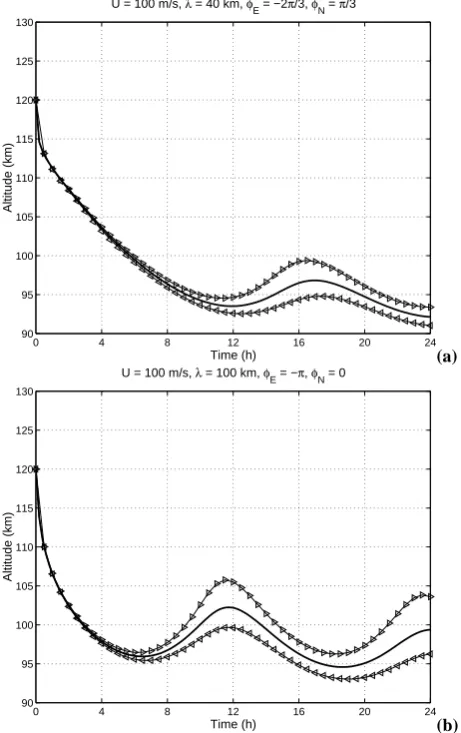
Fig. 3. The same as for Fig. 2 but for tidal amplitudes, U, of 100 m/s.
is larger, attaining 7 km, for the (2, 2) tide. The uppermost heights, where the eastward oriented PW velocity brings the ionisation, depends on the value of the wavelength, thus on the phase velocity. The faster the wave, the higher are the altitudes to which the ions are lifted.
The heights where the ions are carried by the tide de-pend also on the ratio of the amplitude to the phase velocity, U/Vph. When amplitudes of 100 m/s were used, the
pic-ture changed giving an overall lowering of the heights where the ions stop their vertical descending. This can be seen in Figs. 3a and b where, besides the tidal amplitude, all the other characteristics of the tidal and planetary wave are kept un-changed. An augmentation of the tidal amplitude lowers the dumping height and reduces the PW separation between the uppermost and the lowest altitude. In the case of the (2, 2) tide this effect is less dramatic, since the phase velocity of the wave is large when compared with the amplitude.
10−2 10−1 100 101 102 103 104
90 95 100 105 110
Lifetime of Fe+
Lifetime (h)
Altitude (km)
[e]=1010 m−3: stars [e]=1011 m−3: circles [e]=1012 m−3: squares
(a)
0 5 10 15 20 25 30
90 95 100 105 110
Lifetime of Fe+ (detail)
Lifetime (h)
Altitude (km)
[e]=1010 m−3 [e]=1011 m−3 [e]=1012 m−3
(b)
Fig. 4. (a) Lifetime of metallic ions function of altitude for three different electron densities. (b) Detail of plot (a), for lifetimes of 0–30 h.
5 Discussion
The modification of the dumping height resulting from the inclusion of other neutral waves was to be expected since, for short time intervals, the long-period wave acts upon the ionisation almost in the same way that a mean wind would do. The eastward component pushes the positive ions up, counteracting the corkscrew effect of the tidal wave, while the opposite one drives the ions to lower heights. It is not only the dumping height variation that is important but also the implications for the metallic ion content.
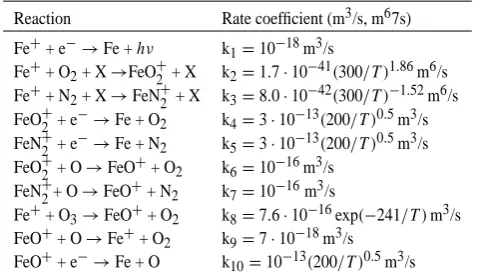
[image:5.595.306.538.61.432.2] [image:5.595.46.277.65.432.2]charac-Table 1. Rate coefficients of reactions leading to the neutralization of the Fe+ions
Reaction Rate coefficient (m3/s, m67s)
Fe++ e−→Fe +hν k1=10−18m3/s
Fe++ O2+ X→FeO+2 + X k2=1.7·10−41(300/T )1.86m6/s Fe++ N2+ X→FeN+2 + X k3=8.0·10−42(300/T )−1.52m6/s
FeO+2 + e−→Fe + O2 k4=3·10−13(200/T )0.5m3/s
FeN+2 + e−→Fe + N2 k5=3·10−13(200/T )0.5m3/s
FeO+2 + O→FeO++ O2 k6=10−16m3/s
FeN+2+ O→FeO++ N2 k7=10−16m3/s
Fe++ O3→FeO++ O2 k8=7.6·10−16exp(−241/T )m3/s
FeO++ O→Fe++ O2 k9=7·10−18m3/s
FeO++ e−→Fe + O k10=10−13(200/T )0.5m3/s
terize an very dense, a regular and a weakEs layer. The
neutral densities and temperature are given by the MSIS-90 model (Hedin, 1991) for 45◦N and 15 July.
We refer to the days when the zonal PW is eastward as “positive” and to the days when the zoanl PW is westward as “negative”. The lowest height where the ions are brought by the (2, 4) and (2, 6) tides during “positive” days is about 100 km where they have a lifetime of 1–10 h, depending on the electron densities characterizing the ionisation layer. The modelled trajectory shows that the sheet of enhanced ionisa-tion stops at this height for about 1 h after which it goes up, reaching an altitude of about 105 km after 4 h. For typical electron densities (less than 1012m−3), the lifetime of ions is large enough; hence, during this time interval, the metallic particles will be maintained in the ionised state. As a result, their uplift will increase the metallic ion density. The max-imum density of a stationary layer formed by a sinusoidal neutral wave with amplitudeUand wavelengthλ, at a height where the diffusion coefficient is D, is given by (Axford, 1968):
Nmax=N0
r
βU0λsinI
D . (12)
When the tide reaches the height where the PW has lifted the ions during “positive” days, it will act on a denser plasma generating denser layers. This is valid as long as the electron density is not extremely high so that the lifetime of ions in this height interval is longer than about 4 h. A density of more than 1012m−3, which does not often occur even during
times of highEs activity, will probably reduce the PW
in-fluence on the metallic ion content. The mean hourly values of the foEs series seen in Fig. 2 of Haldoupis and Pancheva
(2002) show that peak frequencies of more than 10 MHz are followed by significantly lower foEs, even at times when the
7 day-PW energy seems to be at its maximum. This means that a PW modulation is less likely to be observed in the long-term variation of the occurrence of very strong layers (foEs >10 MHz).
The faster semidiurnal wave will deposit the ionisation at higher levels for both eastward and westward directions of the PW although the difference between the two heights re-mains the same. The ions will be lifted at higher altitudes, where their lifetime increases to several days at 115 km, even for the greatest electron density that we considered. The in-crease of the metallic content of the plasma will be amplified and will occur over a larger volume than in the previous case. The ion motion is faster; the ions do not have enough time to undergo the neutralization process.
The westward wind associated with the QTDW lowers the dumping height to 95 km for both tides. There is a lift in this case too, but the height variation is very small (1–2.5 km). The altitude range where the ions reside is close to 95 km, where the ion lifetime varies over a large range and it is strongly influenced by the electron density. It is very diffi-cult to say how much time the recombination would take, but it is unlikely that the ion metallic density remains unchanged for more than 24 h (until the velocity associated with the PW changes again to east). Besides, at such low altitudes the collisions are so numerous that the ions cannot be lifted by the horizontal winds involved in our model. Further, at times when the PW is directed westward, the “second” tide will never reach the altitudes where the ions have been brought. Irrespective of whether these ions have been neutralized or not, the wind shear will act on a depleted plasma, providing poorer conditions for a strong layer to form. During these intervals, the ions are swept from the E-region by the com-bined action of the downward propagating neutral waves and the PW.
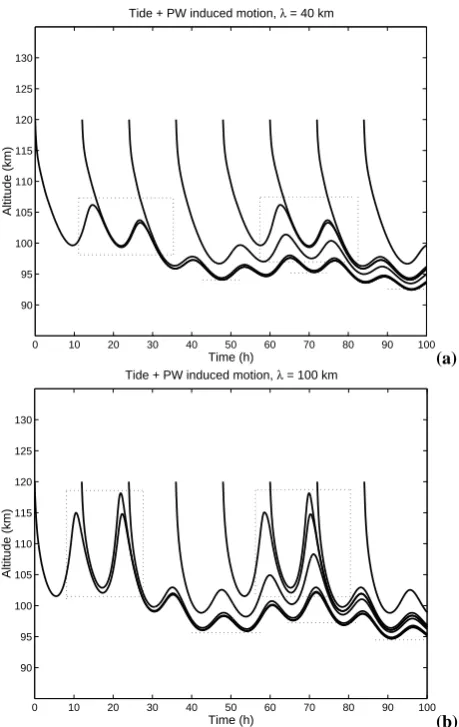
The 2-day modulation of the ionisation motion can be seen in Fig. 5, where the ionisation trajectories under the action of successive semidiurnal tides during a 4-day (2 cycles) pas-sage of a QTDW are depicted. The two plots summarize the results for the two selected tides havingU = 50 m/s. The dotted rectangles mark the altitude ranges and time intervals where the metallic ion density is enhanced. The density of Es layers generated by the (2, 4) and (2, 6) tides increases
below, approximately, 105 km in the afternoons of the “pos-itive days”. During the “negative” days theEs layer
activ-ity should be diminished. If the previous layers have been extremely dense, the increased neutralization rate significant reduces the amount of metallic ions to be lifted; hence the effect is less likely to be observed. Nevertheless, since the plasma density continues to decrease, the PW induced en-hancement of the metallic ion content should occur the next “positive” day. The effect seems to be more confined in time when the tide descends faster but the altitude range is larger, extending higher than 115 km. According to our results, the “positive” peak densities of the layers should be larger when formed by the latter tide because the dumping heights are higher and the collection of the ions is more effective than that formed by the former. Hence, the 2-day modulation in theEs parameters should be stronger when the semidiurnal
[image:6.595.48.287.97.236.2]experimentally observed. Mathews et al. (1993) noticed the existence of 3 km peak-to-peak wavelike variation with pe-riods of the order of days in the lowest heights where tidal ion layers can be observed. They attributed this effect to the multiday wave modulation of the dumping height or to tem-perature (and scale height) variation with similar periods.
The modulation of the metallic ion content and of the ion-isation motion could explain both the PW modulations of the occurrence ofEs layers with foEs > 5 MHz found by
Voiculescu et al. (1999, 2000) and the 7-day periodicity of theEs critical frequency seen by Haldoupis and Pancheva,
(2002). Assuming that all the other factors are constant, since the metallic ion density varies with a certain period, stronger layers will form with the same period. Concomitantly, the ionisation is “maintained” at higher altitudes, favouring an increased occurrence of theEs layers with, again, the same
period.
The drop of the dumping heights caused by the increase of the tidal amplitude, seen in Figs. 3a and b, has important ef-fects, especially for the slower 12-h tides. The separation in-duced by the opposite direction of the PW is still visible but it is smaller and confined by an altitude range where sporadic-E layer formation is not so common. The maximum height reached by the metallic ions is less than 100 km; therefore at higher altitudes the background plasma density is not modi-fied so that the planetary waves cannot cause any modulation of theEs activity. Nevertheless, the effect of the decrease of
the phase velocity relative to the tidal amplitude is less im-portant for the faster tide. At 105 km, strong layers could still form and the PW modulation should be observed but the in-crease of the background density induced by the PW occurs in a vertical region whose extent is smaller. On the other hand, smaller amplitudes, which actually are closer to mea-sured values for the semidiurnal tides, give way to the PW control.
It is known that the E-region is characterized by the joint presence of several tidal modes, with amplitudes and phases varying over a large range (Forbes, 1994; Akchurin et al., 1998). Our results show that both the ionisation motion and the dumping height are modified when tidal parameters are modified. Together with the variability of the metallic ion lifetime at low altitudes, these factors could contribute to the understanding of the sporadic nature of theEslayers.
In the present paper, we did not include other terms, like mean vertical wind or electric field; our intention was to point out the influence of the PW on the dynamics of the ions. When any of those terms is considered, the PW effect on the ion trajectories would presumably be altered. Neverthe-less, this modification is strongly dependent on the relative magnitude of the terms and a qualitative analysis cannot give too many indications. A more detailed model, including the altitude variation of the tidal parameters is the subject of a future effort.
0 10 20 30 40 50 60 70 80 90 100
90 95 100 105 110 115 120 125 130
Tide + PW induced motion, λ = 40 km
Time (h)
Altitude (km)
(a)
0 10 20 30 40 50 60 70 80 90 100
90 95 100 105 110 115 120 125 130
Tide + PW induced motion, λ = 100 km
Time (h)
Altitude (km)
[image:7.595.307.537.60.424.2](b)
Fig. 5. Ionization motion induced by the linear superposition of a tide with 50 m/s amplitude and a PW with 15 m/s amplitude during 2 cycles of the long-period wave for two tidal wavelengths: (a)L= 40 km; (b)L=100 km.
6 Conclusions
We showed that the variation of the trajectory of enhanced ionisation, induced by the alternating zonal component of a long-period wave, might explain the observed modulation of the strongEs occurrence with periods corresponding to
wave and the production of denseEslayers is hindered.
Con-sequently, successive 12 h waves will act on a plasma whose density is modulated with planetary wave periods which, in turn, will lead to a similar modulation of the density and oc-currence of theEs layers. This effect is highly dependent on
the ratio of the tidal amplitude to the phase velocity. The PW role in the E-region must be a very complicated phenomenon, requiring more experimental investigations. Theoretical models and experimental work show the pres-ence of non-linear interactions (Teitelbaum and Vial, 1991), which probably have an important contribution to the overall picture of the ionosphere–atmosphere system.
When the model was applied for different phase velocities and amplitudes of the tides, the numerical results showed that the dumping height is greatly influenced by these quantities and on their ratio. The linear interaction between different tides and PW has also different results on the ions motion. This means that in some cases the PW modulation can be stronger than in others depending on what is the dominant mode of the semidiurnal wave. Tides with large phase ve-locities dump their ionisation at altitudes where the ions sur-vive long enough to maintain the metallic content unchanged, favouring the occurrence of stronger layers. The tides that descend slowly will carry the ions at low altitudes, where, due to the important increase of the recombination rate, they will be rapidly transformed into neutral particles. The metal-lic percentage of the positive ions will be poorer andEs will
be, accordingly, weak.
Our simple model proved also that the ionisation be-haviour is significantly changed by any modification of the parameters characterizing the semidiurnal tide. This, to-gether with the large variability of the metallic ion lifetimes could contribute to the understanding the sporadic nature of the occurrence of E-region layers.
Acknowledgement. The authors acknowledge T. B¨osinger for valu-able comments on the paper. One author (M. V.) thanks the So-dankyl¨a Geophysical Observatory for supporting her visit to the University of Oulu through a Marie Curie research training fellow-ship granted by the European Community.
Topical Editor M. Lester thanks a referee for his help in evalu-ating this paper.
References
Akchurin, A. D., Zykov, E. Yu., Makarov. N. A., Minulin, R. G., Portnyagin, Yu. A., and Sherstyukov, O. N.: The influence of the semidiurnal tide on altitude variations of the sporadic-E layer, Int. J. of Geomagn. and Aeronomy, 1, 89–95, 1998.
Apostolov, E. M., Altadill, D., and Alberta, L.: Characteristics of the quasi-2 day oscillations in the foF2 at northern middle lati-tudes, J. Geophys. Res., 100, 12 163–12 171, 1995.
Axford, W. I.: The formation and vertical movement of dense ion-ized layers in the ionosphere due to vertical shears, J. Geophys. Res., 68, 769–779, 1963.
Banks, P. M. and Kockarts, G.: Aeronomy. Part A, Academic Press inc., New York, NY, 1973.
Chimonas, G. and Axford, W. I.: Vertical movement of temperate zone sporadic-E-layers, J. Geophys. Res., 73, 111–117, 1968. Clark, R. R., Current, A. C., Manson, A. H., Meek, C. E., Avery,
S. K., Palo, S. E., and Aso, T.: Hemispheric properties of the two-day wave from mesosphere-lower thermosphere radar ob-servations, J. Atmos. Terr. Phys., 56, 10, 1279–1288, 1994. Forbes, J. M.: Tidal and planetary waves, in: The upper
meso-sphere and lower thermomeso-sphere, a review of experiment and the-ory, (Eds) Johnson, R. M. and Killend, T. L., 1994.
Forbes, J. M.: Atmospheric tides 2. The solar and lunar semidiurnal components, J. Geophys. Res., 87, A7, 5241–5252, 1982. Fraser, G. J.: The 5-day wave and ionospheric absorption, J. Atmos.
Sci., 39, 121–124, 1977.
Haldoupis, C. and Pancheva, D.: Planetary waves and midlatitude sporadic-E-layers. Strong experimental evidence for a close rela-tionship, J. Geophys. Res., 107, in press, 2002.
Hedin, A. E.: Extension of the MSIS thermosphere model into the middle and lower atmosphere, J. Geophys. Res., 96, A2, 1159– 1172, 1991.
Holton, J. R.: An Introduction to Dynamic Meteorology, Academic Press, San Diego, California, 1982.
Kelley, M. C.: The Earth Ionosphere: Plasma Physics and Electro-dynamics, Academic Press, San Diego, California, 1989. Jacobi, C., Schminder, R., and K¨urschner, D.: Planetary wave
ac-tivity obtained from long long-period (2–18 days) variations of mesopause regions over central Europe (52◦N, 15◦E), J. Atmos. Sol.-Terr. Phys., 60, 81–93, 1998.
MacDougall, J. W., Plane, J. M. C., and Jayachandran, P. T.: Polar cap sporadic-E: part 2, modeling, J. Atm. Solar Terr. Phys., 62, 1169–1176, 2000.
Mathews, J. D. and Bekeny, F. S.: Upper atmosphere tides and the vertical motion of ionospheric sporadic layers at Arecibo, J. Geo-phys. Res., 84, A6, 2743–2750, 1979.
Mathews, J. D., Morton, Y. T., and Zhou, Q.: Observations of ion layer motions during the AIDA campaign, J. Atmos. Terr. Phys., 55, 3, 447–457, 1993.
Mathews, J. D.: Sporadic E: current views and recent progress, Journal of Atm. and Solar-Terr. Physics, 60, 413–435, 1998. Meek, C. E., Manson, A. H., Franke, S. J., Singer, W., Hoffmann,
P., Clark, R. R., Tsuda, T., Nakamura, T., Tsutsumi, M., Hagan, M., Fritts, D. C., Isler, J., and Portnyagin, Y. I.: Global study of Northern hemisphere quasi 2-day wave events in recent summers near 90 km altitude, J. Atmos. Terr. Phys., 58, 1401–1411, 1996. Pancheva, D., Alberta, L. F., and de la Morena, B. A.: Simultane-ous observations of the quasi-two-day variations in the lower and upper ionosphere over Europe, J. Atmos. Terr. Phys., 56, 43–50, 1994.
Shalimov, S., Haldoupis, C., Voiculescu, M., and Schlegel, K.: Mid-latitude E-region plasma accumulation driven by planetary wave horizontal wind shears, J. Geophys. Res., 104, 28 207–28 213, 1999.
Shalimov, S., and Haldoupis, C.: A model of midlatitude E-region plasma convergence inside a planetary wave cyclonic vortex, Ann. Geophysicae, 20, 1193–1201, 2002.
Teitelbaum, H., and Vial, F.: On tidal variability induced by non-linear interaction with planetary waves. J. Geophys. Res., 96, 14, 169-14, 178 1991.
Tsunoda, R., Yamamoto, M., Igarashi. K., Hocke, K., and Fukao, S.: Quasiperiodic radar echoes from midlatitude sporadic-E and role of the 5-day planetary wave, Geophys. Res. Lett., 25, 951– 954, 1998.
plan-etary wave effects on midlatitude backscatter and sporadic-E-layer occurrence, Geophys. Res. Lett., 26, 1105–1108, 1999. Voiculescu, M., Haldoupis, C., Pancheva, D., Ignat, M., Schlegel,
K., and Shalimov, S.: More evidence for a planetary wave link with midlatitude E-region coherent back scatter and sporadic-E-layers, Ann. Geophysicae, 18, 1182–1196, 2000.
Williams, P. J. S.: Tides, atmospheric gravity waves and traveling disturbances in the ionosphere, in Modern Ionospheric Science, eds. H. Kohl, R. R¨uster, K. Schlegel, EGS, 1996.
Whitehead, J. D.: The formation of the sporadic-E-layer in the
temperate zones, J. Atm. Terr. Phys., 20, 49–58, 1961.
Whitehead, J. D.: Recent work on mid-latitude and equatorial sporadic-E, J. Atm. Terr. Phys., 51, 401–424, 1989.
Zhou, Q. H.: Two-day oscillation of electron concentration in the lower ionosphere, J. Atm. Solar Terr. Phys., 60, 1669–1677, 1998.