A
pplied
R
esearch on
E
nglish Language
V. 8 N. 2 2019 pp: 165-186 http://uijs.ui.ac.ir/are
DOI: 10.22108/are.2018.112455.1342
___________________________________________
*
Corresponding Author.
The Effect of EQ and Gender on Oral Cloze Performance of Simultaneous
Interpreting Students
Gholam Reza Tajvidi
1, Sima Ferdowsi
2*1
Associate Professor Department of English Translation Studies, Faculty of Persian Literature and Foreign Languages, Allameh Tabataba'i University, Tehran, Iran
2
PhD Candidate Department of English Translation Studies, Faculty of Persian Literature and Foreign Languages, Allameh Tabataba'i University, Tehran, Iran
Received: 2018/08/09 Accepted: 2018/11/23
Abstract: This research sought to investigate the relationship between simultaneous interpreters‟ oral cloze performance, their emotional intelligence, and gender. In other words, the study tried to predict the variability in performance on simultaneous interpreting (SI) oral cloze test based on the variability in gender, emotional quotient (EQ) and its subscales. To this end, a number of seventy participants majoring in English Translation attending the course Oral Interpretation were selected. The Emotional Quotient Inventory (Bar-On, 1997) questionnaire was given to participants to gather the data. The students were also asked to take an oral cloze exam. The results of the study showed that no significant relationship was found between total EQ and oral cloze performance. However, two of the subscales of EQ, i.e. Flexibility and Stress Tolerance were found to be positive predictors of SI oral cloze score together. The results of the study indicated that the mere acquisition of oral cloze skill as one of the skills required for simultaneous interpreting, cannot guarantee students‟ achievement in interpreting. Rather the consideration of personality traits can have a facilitative effect. Moreover, with regard to gender no association was found between student interpreters‟ performance and their gender.
166 Applied Research on English Language, V. 8 N. 2 2019
AREL
Introduction
Interpreting as a kind of oral mode of transferring meaning between two languages was
defined as “presenting in the target language, the exact meaning of what is uttered in the
source language either simultaneously or consecutively, preserving the tone of the speaker”
(Mahmoodzadeh, 1992, p. 231).
Simultaneous interpreting (SI) is considered as one of the most difficult linguistic skills
by researchers investigating brain and language (Grosjean, 2011). Part of the difficulty of SI
can, according to Chernov (2004, p. 14), be attributed to the simultaneous nature of the task,
i.e. “the concurrent nature of SI speech perception and TL speech production and the need to
start the translation process before the SL utterance is completed.” [emphasis in original]. This is what Gonzalés, Vasquez and Mikkelson (2012) referred to as the non-linear feature of
SI since “the interpreter does not first grasp the meaning of the SL message and retrieve the
target language (TL) equivalent elsewhere in the brain” (p. 855). Rather, there is a kind of
overlap between the two processes of listening and speaking but “human brain is incapable of
performing two complicated tasks at the same time” (Viaggio, 1988, p. 399).
Another aspect of the extreme conditions of SI is time constraints or the external
control over the rate of SI. Unlike the translator who can freely determine his own rate of
information processing, “the amount of information processed by a simultaneous interpreter,
depending partly on the pace set by the speaker, is limited by human psychological factors
and the capacity limitations of the human brain” (Chernov, 2004, p. 16). The fact that in SI
the source text is always delivered at a faster rate than the interpreted target text can be
explained by the difference between improvised discourse versus recited texts. The point is
elaborated by Chernov (2004, p. 18):
In SI the interpreter always produces her communication spontaneously and on
the spur of the moment, “accessing” the sense (content, message) of her
communication from the SL discourse. Speakers, in contrast, very often do not
formulate their communication on the podium, but simply recite a pre-prepared
text.
This recited nature of ST creates additional difficulty in SI since a hesitancy pause
which is the result of searching for the intended word by the speaker is removed from recited
texts. Consequently, the text is uttered at a higher speech rate. Moreover, the lack of
redundancy in recited speech and the more elaborate syntactic structures of a prepared text
The Effect of EQ and Gender on Oral Cloze Performance of Simultaneous Interpreting Students 167
according to Chmiel (2008, p. 261) SI “is a challenging task in terms of cognitive processing” which “is performed under stress and time constraints, which leads to fatigue”. Therefore, to reduce the difficulties of this mentally challenging activity it is “necessary to ensure special working conditions for SI, with at least two interpreters present in the booth”
(Chmiel, 2008, p. 261). Based on the rule mentioned by The International Association of
Conference Interpreters (AIIC) “an interpreter shall not, as a general rule, work alone in a
simultaneous interpretation booth without the availability of a colleague to relieve her or him
should the need arise” (AIIC, 2015).
Another source of difficulty in SI can be probable comprehension problems as a result
of accented source speech. The empirical study conducted by Lin, Chang and Kuo (2013)
approved the decrease in accuracy with phonemic and prosodic deviations. Harris elaborated
the point in this way:
The interpreter, besides speaking his language, must learn to hear and understand
them as pronounced by others: by people talking various dialects of them and by
some who speaks them abnormally because of poor education or because they are
nervous or because languages are not native to them. (1981, p. 159)
The combinations of the above-mentioned specific features of SI are considered as
various sources of pressure on the interpreter which in turn give birth to another peculiarity of
SI, i.e., stressfulness.
The aforementioned complexities of simultaneous interpreting turn it into a frustrating
task for interpreting trainee students. Inasmuch as some students with acceptable proficiency
in English, cannot show the desired achievement in this course. Many students claim that
their inability to perform the task adequately is due to the stressful nature of simultaneous
interpreting which is amplified for some interpreting students. This group blames their
personal characteristics as the main reason for their lack of success in interpreting. This view
acts as an obstacle in the way of training interpreting students. But, achievement is the
outcome of instruction, and as mentioned by Osokoya (1998) it is the end product of a
learning experience. Accordingly, a great deal of attention should be devoted to the teaching
method and material. Put in other words, the individual differences should be the focus of
168 Applied Research on English Language, V. 8 N. 2 2019
AREL
Emotional Intelligence and Simultaneous Interpreting
The term emotional quotient (EQ) or emotional intelligence was introduced by Mayer and
Salovey (1997). It refers to the ability to monitor one‟s own and other‟s feelings and emotions, to differentiate among them and use this information to guide one‟s thinking and
actions. For Bar-On (1997), emotional intelligence is a collection of non-cognitive
capabilities, competencies, and skills that influence one‟s ability to succeed in order to
manage environmental demands and pressure.
The study of emotions is not a new field of inquiry. However, it has remained
under-researched in Interpreting Studies. Although it is known that individual differences between
interpreters is one of the possible reasons of their differing performance in terms of quality
(Schweda Nicholson, 2005). In the same vein, Hubscher-Davidson (2013) highlighted the
study of non-cognitive psychological processes in Translation and Interpreting Studies. She
stated that studying the emotional intelligence of translators and interpreters can help us to
have a better understanding of these two kinds of transforming activities. Hubscher-Davidson
(2013) claimed that “exploring the emotional intelligence of translators and interpreters could
add something to our understanding of their working process. In turn, this information could
have important repercussions on –and feed into- the ways translators and interpreters are
currently being trained” (p. 333).
This emphasis in literature for the importance of considering interpreters‟ EQ in
training was a source of inspiration for the researchers. Moreover, the association between SI
and EQ was created on the basis of various potential links and connections between the two.
First of all, literature abounds with various studies that revealed the impact of stress on
the quality of interpreting (Seleskovitch, 1978; Henderson, 1987; Moser-Mercer, 2008;
Timarova & Salaets, 2011) on the one hand. A large number of studies demonstrated that EQ
can significantly moderate responses to stress (Mikolajczak & Luminet 2008; Mikolajczak,
Roy, Luminet, Fillée, & de Timary, 2007) on the other hand. Hence, it seems plausible to
suppose interpreting trainees with higher levels of EQ can have a better performance in SI.
Secondly, a study conducted by Dewaele, Petrides, and Furnham (2008) showed that
people with high EQ have the lowest level of communicative anxiety. Since one of the
requirements of interpreting is the ability to speak publicly, here once again there seems to be
a link between high levels of EQ and better performance in SI interpreting.
Thirdly, research indicated that higher EQ individuals are more prone to use
The Effect of EQ and Gender on Oral Cloze Performance of Simultaneous Interpreting Students 169
logical to assume some kind of relation between EQ and the ability to interpret
simultaneously. There are some coping tactics in SI introduced by Gile (1995), which should
be used by interpreters to deal with problems the selections of which are not at random.
However, it seems that the ability of problem-solving can have an effect on the choice of the
appropriate tactic. Moreover, Mikolajczak et al. (2007) found that high EQ helps individuals
to appraise situations as challenging rather than threatening.
Furthermore, the effect of EQ on team performance and group cohesiveness was shown
by Quoidbach and Hansenne (2009). In simultaneous interpreting, there should be a kind of
cooperation between active and passive interpreters. Consequently, it seems those interpreter
pairs with higher level of EQ may be better candidates for SI, due to their better performance
in team work.
Generally speaking, among the various skills required for interpreting such as tact,
judgment, sense of humor, calm nerves, listed by the AIIC (2017), one can find the trace of
link with personality. Therefore, it sounds reasonable to suppose a kind of relationship
between EQ and the ability to interpret.
Simultaneous Interpreting Exercises
One of the debates with regard to interpreter aptitude is the issue of nature versus nurture (or
born vs. made). Most scholars believe in the role of training in interpreting (Mackintosh,
1999; Kalina, 2000; Timarová & Salaets, 2011). Lambert (1992, p. 264) clearly stated that
“there is no such a thing as a born interpreter”, rather there are some skills required for
success as an interpreter-trainee or working interpreter. These various skills highlight the
importance of thoughtfully designed interpreting programme which according to Lambert
(1992, p. 264) can “optimize chances for the growth of both the students and the profession itself”.
Lambert (1992) distinguished two types of interpreting exercises. The first group is
selection tests that “serve as eliminatory tests in that trainee-interpreters may be discouraged from moving on to the next stage if they are unable to master graded skills” (Lambert, 1992, p. 264). A stated by Lambert (1992), these kinds of tests are used to “determine which
candidates are most likely to become successful interpreters once they enroll in the training
170 Applied Research on English Language, V. 8 N. 2 2019
AREL
The second group is training tests that are used to develop interpreting skills of
candidates who have proven to be successful would-be interpreters. Lambert (1992, p. 264)
introduced twelve pedagogical techniques to be used in simultaneous training namely
“listening and recall; shadowing; dual-task training or parallel processing; paraphrasing;
abstracting or telescoping; clozing; sight translation; sight interpreting; lagging; anticipating;
processing digits, names, acronyms; ear preference and hemispheric processing”.
As can be seen, the exercises of shadowing, cloze, sight translation and sight
interpretation are common exercises in both groups. The inclusion of these exercises as both
selection exercises and training exercises can be indicative of the important role of these
exercises in training interpreters.
The cloze technique was chosen as an instrument in the present study to investigate the
plausible relation between EQ, gender and SI performance.
The Importance of Oral Cloze in SI
The cloze procedure is a method of test construction which consists of deleting words from
prose and asking students to fill in the blanks. As declared by Oller and Conrad (1971, p. 183):
The term „cloze‟ was used with the notion of Gestalt „closure‟ in mind, referring
to the natural human psychological tendency to fill in gaps in patterns. The
restoration of words deleted from a selection of prose in order for the passage to
make sense is a special use of this ability to complete broken patterns.
According to Lambert (1992), the cloze test is suitable for interpreting and can be used
both as a tool for selecting interpreters as well as an effective interpreter training technique,
since it “serves as a measure of integrative skills, namely the anticipatory processes involved
when native speakers of a language engage in normal conversation, including listening as
well as speaking” (p. 226). The idea of employing oral cloze for interpreter training was
introduced by John Long in a study to select conference interpreters (Gerver, Longley, Long,
& Lambert, 1984) on the “premise that interpreters normally work from spoken discourse and
because oral cloze effectively paces the listener in the same manner as a conference speaker
does” (Lambert, 1992, p. 226). Oral cloze technique as asserted by Anaya and Lopez (1990, p. 651) can be used to reinforce various kinds of interpreting skills such as “how to anticipate
word meaning, how to handle the syntaxes of any specific text, how to improvise vocabulary,
The Effect of EQ and Gender on Oral Cloze Performance of Simultaneous Interpreting Students 171
The cloze test, as stated by Lambert (1992, p. 226) can be devised in various forms.
The simplest way is choosing a passage in the students‟ mother-tongue and asking them to
fill in the blanks (visual/aural mode). This version of a cloze exercise is useful for developing
students‟ public speaking ability and reading ahead in anticipation. The second category of
mother tongue-to mother tongue cloze requires students to shadow the text in addition to fill
in the blanks.
Unlike the previous cases, the second group of cloze procedure is devised taking
translation factor into account. Students listen to a passage and are asked to write down the
deleted words either in the SL or in the TL (aural/written mode). Moreover, „language-switch cloze exercises‟ can be used where in addition to filling the missing words, a simultaneous
interpretation of the passage should be offered (aural/oral mode).
Another variation of cloze developed by Timarová and Ungoed-Thomas (2009, p. 230)
is called personalized cloze where students listen “to a short piece of text in which the
speaker provided some basic details about himself. Students repeated the text verbatim in the
foreign language and replaced all personal information-name, age, nationality, etc –with
information about themselves”. Hence, the combinations of the shadowing and paraphrasing
exercises are used in this kind of cloze. Pöchhacker (2011) also introduced another new form
of cloze. The SynCloze combines anticipation and vocabulary exercises. Students are
required to listen to an aural cloze and fill in the gaps by giving as many synonyms as
possible at the sound of the beep.
Purpose of the Study
The researchers of the present study set out to investigate the association between emotional
intelligence, gender, and oral cloze performance in SI.
To this end, the following research questions were posed and investigated in this study:
1- Does EQ (both total scores and subscales scores) predict the performance of
trainee students on oral cloze test significantly?
2- Are there any differences between males and females regarding their scores on
SI oral cloze test?
Methodology
Participants
For the purpose of this study, 70 participants majoring in English Translation from Shahid
172 Applied Research on English Language, V. 8 N. 2 2019
AREL
enrolled in the course „Oral Interpretation‟ taught by the researcher and had no experience of
interpreting before. All participants had Persian as their A-language and English as B-language.
They sat for the oral clause exam as one of the simultaneous interpreting aptitude tests. The
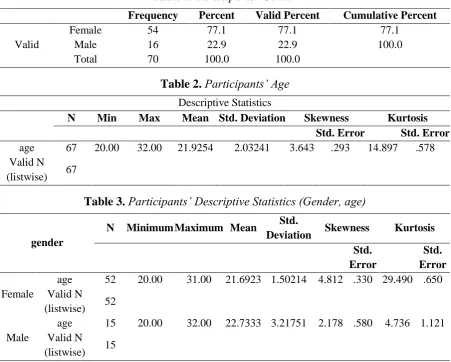
demographic information of the subjects (i.e. gender and age) is provided in Tables 1 to 3.
Table 1. Participants’ Gender
Frequency Percent Valid Percent Cumulative Percent
Valid
Female 54 77.1 77.1 77.1
Male 16 22.9 22.9 100.0
Total 70 100.0 100.0
Table 2. Participants’ Age
Descriptive Statistics
N Min Max Mean Std. Deviation Skewness Kurtosis
Std. Error Std. Error
age 67 20.00 32.00 21.9254 2.03241 3.643 .293 14.897 .578
Valid N (listwise) 67
Table 3. Participants’ Descriptive Statistics (Gender, age)
gender
N Minimum Maximum Mean Std.
Deviation Skewness Kurtosis
Std. Error
Std. Error
Female
age 52 20.00 31.00 21.6923 1.50214 4.812 .330 29.490 .650 Valid N
(listwise) 52
Male
age 15 20.00 32.00 22.7333 3.21751 2.178 .580 4.736 1.121 Valid N
(listwise) 15
Instruments
The study used the emotional intelligence questionnaire and an oral cloze test as its instruments
for data collection. In what follows, a detailed explanation of each instrument is offered.
Emotional Intelligence Test
To evaluate students‟ emotional intelligence, a Persian version of the emotional quotient
inventory (EQ-I) developed by Samouie (2003) was used. The original version of this
self-report instrument designed by Bar-On included 133 items with Likert-type responses, later
revisions applied to the test by Bar- On (1997) himself reduced its size to a considerable
degree, so that the modified version of the test comprised only 117 questions. Due to the fact
The Effect of EQ and Gender on Oral Cloze Performance of Simultaneous Interpreting Students 173
modified and translated version of the questionnaire which encompassed only 90 questions.
He found that this test did have sufficient reliability and validity indices in the Iranian
context. Based on her findings, the reported Cronbach‟s alpha gained for the questionnaire
was 0.93, and the reliability index gained through odd-even, split-half method was 0.88. In
another study, Dehshiri (2003) found the reliability index of 0.77 for the questionnaire. With
respect to its wide use in the Iranian context, this 90-item version of the questionnaire was
employed as the principal means of gathering data in the current study.
It's worth noting that each of the items on the questionnaire is related to one of the 5
composite scales that comprise 15 subscales of emotional intelligence. All the questions were
scored on a five-point Likert-type scale ranging from 'strongly agree' to 'strongly disagree'.
Reliability Analysis
The internal consistency reliability of the questionnaire employed in this study was
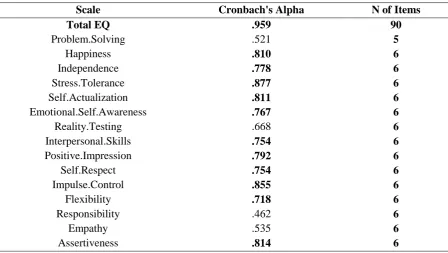
investigated running Cronbach alpha. Table 4 presents the total and subscales of alphas for
the EQ questionnaire. Evidently, all the great majority of alphas are above .7 which indicated
a high internal consistency in all the scales and their subscales. As regards the low alphas (i.e.
alphas for problem solving, reality testing, responsibility and empathy), the alphas could still
be considered acceptable since firstly the number of items in these subscales is just 6, and
secondly they are not that much different from the alphas reported in similar studies in which
the reliability of this instrument has been checked (Samouei, 2003).
Table 4. EQ Questionnaire’s Reliability Statistics
Scale Cronbach's Alpha N of Items
Total EQ .959 90
Problem.Solving .521 5
Happiness .810 6
Independence .778 6
Stress.Tolerance .877 6
Self.Actualization .811 6
Emotional.Self.Awareness .767 6
Reality.Testing .668 6
Interpersonal.Skills .754 6
Positive.Impression .792 6
Self.Respect .754 6
Impulse.Control .855 6
Flexibility .718 6
Responsibility .462 6
Empathy .535 6
174 Applied Research on English Language, V. 8 N. 2 2019
AREL
After computing alphas, item-total correlations as a measure of item discrimination
(ID) were computed for all the items of the questionnaires. The statistics indicated that most
of these values are above 0.3, showing a high correlation between the item score and total
scale score, hence high item discrimination. Regarding the few low IDs, the column titled
“alpha if item deleted” should be considered, which shows that when these low-ID items are
removed from the questionnaire, the alphas are not going to improve much (beyond the
current alphas). Therefore, it is concluded that all the items of the EQ questionnaire used in
this study are relatively functioning well, and the questionnaire is of acceptable items and
internal consistency reliability.
Oral Cloze Test
To devise the oral cloze passage, the research followed Gerver et al.‟s (1984) framework. An
oral passage of approximately 407 words in length was chosen from “VOA Special”. The
initial and final sections of the oral passage (about 45 words) were left intact to provide
context and warm-up for the trainees. Every 10th word was then deleted from the rest of the
passages. The Nuendo (5.0.1) software was used to create an oral cloze from the VOA
Special English passages chosen. The software helped to delete words from the oral passage
and create a beep instead. The students were asked to listen to the passage and write down, as
quickly as possible, the missing words signaled by a beep tone.
Data Collection Procedure
During the data collection phase, the emotional intelligence questionnaire was administered.
Students had their time to answer the questions. The oral cloze test was administered in a
separate session. To answer the cloze test, students had to write down 34 words signaled by a
beep. The exact word method was used to assess their performance in this test.
Data Analysis and Findings
RQ1: Do EQ scores (both total score and subscales scores) predict the performance of SI
trainee students on oral cloze test significantly?
Answering this question required employing multiple regression for EQ scores (both
total score and subscales scores) as the predictor variables and oral cloze scores as the
predicted variables. However, before running multiple regression, it is necessary to see which
The Effect of EQ and Gender on Oral Cloze Performance of Simultaneous Interpreting Students 175
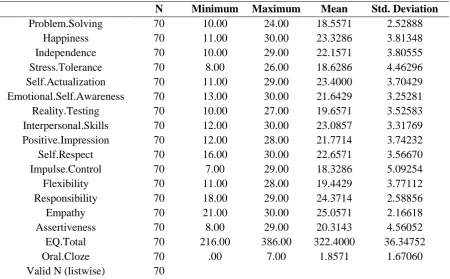
Table 5 presents the descriptive statistics of EQ (both total scale & subscales) and oral
cloze scores, and Table 6 presents the Kolmogorov-Smirnov (KS) test results on the
normality of the EQ (both total scale & subscales) and oral cloze scores.
Table 5. Descriptive Statistics of EQ & Oral Cloze Scores
N Minimum Maximum Mean Std. Deviation
Problem.Solving 70 10.00 24.00 18.5571 2.52888
Happiness 70 11.00 30.00 23.3286 3.81348
Independence 70 10.00 29.00 22.1571 3.80555
Stress.Tolerance 70 8.00 26.00 18.6286 4.46296
Self.Actualization 70 11.00 29.00 23.4000 3.70429
Emotional.Self.Awareness 70 13.00 30.00 21.6429 3.25281
Reality.Testing 70 10.00 27.00 19.6571 3.52583
Interpersonal.Skills 70 12.00 30.00 23.0857 3.31769
Positive.Impression 70 12.00 28.00 21.7714 3.74232
Self.Respect 70 16.00 30.00 22.6571 3.56670
Impulse.Control 70 7.00 29.00 18.3286 5.09254
Flexibility 70 11.00 28.00 19.4429 3.77112
Responsibility 70 18.00 29.00 24.3714 2.58856
Empathy 70 21.00 30.00 25.0571 2.16618
Assertiveness 70 8.00 29.00 20.3143 4.56052
EQ.Total 70 216.00 386.00 322.4000 36.34752
Oral.Cloze 70 .00 7.00 1.8571 1.67060
Valid N (listwise) 70
As the results of KS test in Table 6 show, only the self-actualization, and oral cloze
scores are not normally distributed (p < .05), but since the KS alpha is just a little below .05,
and the sample size is this study is large enough (n = 70), Pearson Product Moment
correlation (Pearson r) as a parametric test could be considered robust against this violation
of normality. All in all, it was decided that the data were normal enough to allow for running
Pearson r as a parametric test.
Table 6. One-Sample Kolmogorov-Smirnov Test
N
Normal
Parametersa,b Most Extreme Differences
Kolmogorov-Smirnov Z
Asymp. Sig.
(2-tailed)
Mean Std.
Deviation Absolute Positive Negative
176 Applied Research on English Language, V. 8 N. 2 2019
AREL
N
Normal
Parametersa,b Most Extreme Differences
Kolmogorov-Smirnov Z
Asymp. Sig.
(2-tailed)
Mean Std.
Deviation Absolute Positive Negative
Reality.Testing 70 19.6571 3.52583 0.112 0.066 -0.112 0.935 0.346 Interpersonal.Skills 70 23.0857 3.31769 0.075 0.057 -0.075 0.629 0.824 Positive.Impression 70 21.7714 3.74232 0.153 0.067 -0.153 1.279 0.076 Self.Respect 70 22.6571 3.5667 0.118 0.09 -0.118 0.989 0.282 Impulse.Control 70 18.3286 5.09254 0.083 0.083 -0.078 0.693 0.722 Flexibility 70 19.4429 3.77112 0.108 0.084 -0.108 0.905 0.386 Responsibility 70 24.3714 2.58856 0.11 0.102 -0.11 0.922 0.363
Empathy 70 25.0571 2.16618 0.159 0.159 -0.085 1.327 0.059
Assertiveness 70 20.3143 4.56052 0.101 0.049 -0.101 0.848 0.469
EQ.Total 70 322.4 36.3475 0.059 0.04 -0.059 0.493 0.968
Oral.Cloze 70 1.8571 1.6706 0.18 0.18 -0.133 1.508 0.021
Table 7 presents the Pearson r for the EQ (both total scale & subscales) and oral cloze
scores. Evidently, only Stress Tolerance and Flexibility are significantly and positively
correlated with oral cloze scores (p < .05). Therefore, only these variables were included in
multiple regression analysis, and the rest of the variables were excluded from the analysis.
Table 7. Correlations
Oral.Cloze
Problem.Solving
Pearson Correlation .074
Sig. (2-tailed) .543
N 70
Happiness
Pearson Correlation .119
Sig. (2-tailed) .327
N 70
Independence
Pearson Correlation .161
Sig. (2-tailed) .183
N 70
Stress.Tolerance
Pearson Correlation .345**
Sig. (2-tailed) .003
N 70
Self.Actualization
Pearson Correlation .115
Sig. (2-tailed) .344
N 70
Emotional.Self.Awareness
Pearson Correlation .070
Sig. (2-tailed) .562
N 70
Reality.Testing
Pearson Correlation -.097
Sig. (2-tailed) .424
N 70
The Effect of EQ and Gender on Oral Cloze Performance of Simultaneous Interpreting Students 177
Oral.Cloze
Sig. (2-tailed) .968
N 70
Positive.Impression
Pearson Correlation .159
Sig. (2-tailed) .188
N 70
Self.Respect
Pearson Correlation .228
Sig. (2-tailed) .058
N 70
Impulse.Control
Pearson Correlation -.076
Sig. (2-tailed) .531
N 70
Flexibility
Pearson Correlation .291*
Sig. (2-tailed) .015
N 70
Responsibility
Pearson Correlation -.182
Sig. (2-tailed) .132
N 70
Empathy
Pearson Correlation .006
Sig. (2-tailed) .959
N 70
Assertiveness
Pearson Correlation .050
Sig. (2-tailed) .683
N 70
EQ.Total
Pearson Correlation .138
Sig. (2-tailed) .256
N 70
To run multiple regression analysis, one assumption which needs to be met is the
normality of standard residuals which was checked by drawing the histogram. Evidently, the
histogram shows an almost normal bell-shaped distribution of standardized residuals.
Moreover, the Normal Probability Plot of the regression standardized residuals indicates that
the points have lain in a relatively straight diagonal line from bottom left to top right without
too many deviations; therefore, the assumption of normality of the regression standardized
residuals is met. Finally, the scatterplot of the standardized residuals indicates that there are
only a few negligible outliers which have lain outside the rectangular cluster of the data in the
center. Moreover, since there is a clear or systematic pattern to the residuals (e.g. curvilinear
or higher on one side than the other) with relatively few deviations from a centralized
rectangle, it is assumed that there is no violation of homoscedasticity.
Multiple regression also assumes no multicollinearity, which is investigated by
178 Applied Research on English Language, V. 8 N. 2 2019
AREL
that the correlations among the independent (i.e. predictor) variables are not above 0.7, which
demonstrates that the multicollinearity assumption is met. After examining the assumptions
of multiple regression, two multiple regressions were run: one with SI aptitude total score as
the predicted variable, and the other with oral cloze scores as the predicted variable.
After checking the assumptions of multiple regression, the actual regression tables are
investigated as follows. It should be first noted that since there was not any logic or
justification to specify an order for the inclusion of the predictor variables in the model,
simultaneous rather than hierarchical multiple regression analysis was run.
Table 8 presents the Adjusted R Squares for multiple regressions, which is .095 for oral
cloze scores as the predicted variable. This means that:
9% of the variance in oral cloze scores is explained by the 2 predictor variables (i.e.
Flexibility, Stress Tolerance), which could be considered as a small effect size according to
Cohen‟s guidelines for effect size.
Table 8. Model Summaryb
Model R R Square Adjusted R Square Std. Error of the Estimate
1 .348a .121 .095 1.58928
a. Predictors: (Constant), Flexibility, Stress.Tolerance b. Dependent Variable: Oral.Cloze
Table 9 indicates that the results are statistically significant (p < .05), suggesting that
the regression model overall (i.e. including all predictor variables) predicts oral cloze scores
significantly well.
Table 9. ANOVAa
Model Sum of Squares df Mean Square F Sig.
1
Regression 23.341 2 11.671 4.621 .013b
Residual 169.230 67 2.526
Total 192.571 69
a. Dependent Variable: Oral.Cloze
b. Predictors: (Constant), Flexibility, Stress.Tolerance
Table 10 presents the beta coefficients for the predictor variables. While we know from
the ANOVA results before that all predictor variables together can significantly predict oral
cloze scores, according to Table 10, the t-tests indicate whether each predictor variable
individually is making a significant contribution to the model or not. If the t-test associated
with a b-value is significant, then the predictor is making a significant contribution to the
The Effect of EQ and Gender on Oral Cloze Performance of Simultaneous Interpreting Students 179
Table 10, individually none of the predictor variables is making a significant contribution to
the model; therefore, it is concluded that:
Oral cloze scores are only predicted positively by the 2 predictor variables
together but not separately (i.e. Flexibility, Stress Tolerance) with small effect
size according to Cohen‟s guidelines for effect size (adjusted r square = .09).
Table 10. Beta Coefficientsa for the Predictor Variables
Model Unstandardized Coefficients
Standardized
Coefficients t Sig.
B Std. Error Beta
1
(Constant) -.799 1.009 -.792 .431
Stress.Tolerance .108 .065 .289 1.671 .099
Flexibility .033 .077 .075 .432 .667
a. Dependent Variable: Oral.Cloze
RQ2: Are there any differences between males and females regarding their scores on
oral cloze test?
Answering this question required dividing the participants into males and based on their
oral cloze scores. After doing so, the descriptive statistics of the males and females were
computed based on oral cloze scores (Table 11).
Table 11. Descriptive Statistics Based on Oral Cloze Scores
gender Mean Std. Deviation N
Oral.Cloze
Female 1.6667 1.62527 54
Male 2.5000 1.71270 16
Total 1.8571 1.67060 70
Table 12 presents the Levene test results on homogeneity of variances as an assumption
of MANOVA. As the results indicate, the test results are not significant (p > .05), hence
meeting the assumption.
Table 12. Levene's Test of Equality of Error Variancesa
F df1 df2 Sig.
Oral.Cloze .179 1 68 .674
Tests the null hypothesis that the error variance of the dependent variable is equal across groups. a. Design: Intercept + gender
Table 13 presents the multivariate tests results comparing the dependent variable - oral
cloze scores. Evidently, the results are not significant (p > .05) for oral cloze scores across
180 Applied Research on English Language, V. 8 N. 2 2019
AREL
Table 13. Multivariate Testsa
Effect Value F Hypothesis df Error df Sig. Partial Eta
Squared
Intercept
Pillai's Trace .720 86.298b 2.000 67.000 .000 .720
Wilks' Lambda .280 86.298b 2.000 67.000 .000 .720
Hotelling's Trace 2.576 86.298b 2.000 67.000 .000 .720 Roy's Largest Root 2.576 86.298b 2.000 67.000 .000 .720
gender
Pillai's Trace .047 1.668b 2.000 67.000 .196 .047
Wilks' Lambda .953 1.668b 2.000 67.000 .196 .047
Hotelling's Trace .050 1.668b 2.000 67.000 .196 .047
Roy's Largest Root .050 1.668b 2.000 67.000 .196 .047
a. Design: Intercept + gender b. Exact statistic
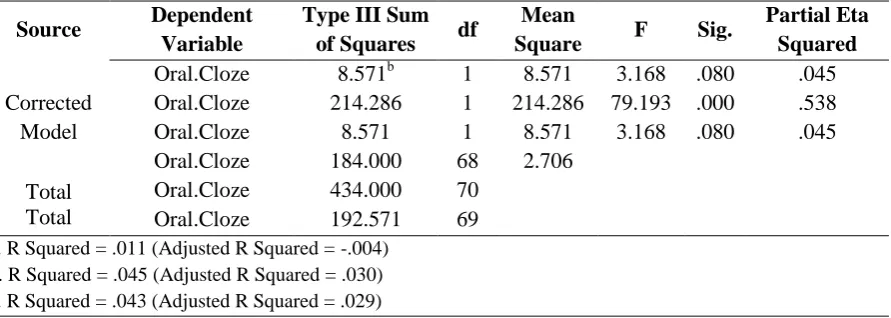
Table 14 presents the univariate tests results comparing males and females in terms of
the dependent variable - oral cloze scores. Again, the results are not significant (p > .05).
In sum, the multivariate and univariate results indicate that the null hypothesis to this
research question is supported. That is to say, there is no difference between males and
females regarding their scores on oral cloze test.
Table 14. Tests of Between-Subjects Effects
Source Dependent
Variable
Type III Sum
of Squares df
Mean
Square F Sig.
Partial Eta Squared
Corrected Model
Oral.Cloze 8.571b 1 8.571 3.168 .080 .045
Oral.Cloze 214.286 1 214.286 79.193 .000 .538
Oral.Cloze 8.571 1 8.571 3.168 .080 .045
Oral.Cloze 184.000 68 2.706
Total Total
Oral.Cloze 434.000 70
Oral.Cloze 192.571 69
a. R Squared = .011 (Adjusted R Squared = -.004) b. R Squared = .045 (Adjusted R Squared = .030) c. R Squared = .043 (Adjusted R Squared = .029)
Discussion and Conclusion
The present study aimed at finding the possible relationship between SI student trainees‟
performance on oral cloze test, their emotional intelligence and their gender.
The results of the first research question demonstrated that no significant relationship
was found between total EQ and students‟ performance on oral cloze test. However, the
findings revealed that 9 percent of the variation in students‟ performance can be explained by
taking the subscales of Flexibility and Stress Tolerance together into account. In other words,
The Effect of EQ and Gender on Oral Cloze Performance of Simultaneous Interpreting Students 181
minimal significant effect of the two predictor variables can have an important pedagogical
implication for interpreter training.
The importance of flexibility is due to the need to cope with different speakers, subject
matters, and situations in different interpreting settings, since as stated by AIIC (2017, para.
6) “not all meetings are the same, nor do they demand the same aptitudes from interpreters”.
Moreover, Roeseler (2017, p.74) believed that conference interpreting is an inconstant
activity by nature which demands interpreters to “think quickly and flexibly”. In addition, a study by Timarova and Salaets (2011, p. 31) proved that “self-selected interpreting students are cognitively more flexible and are less negatively affected by anxiety”. Accordingly, it
seems students with a higher sense of Flexibility would be better candidates for simultaneous
interpreting. Hence, paying attention to students feeling of flexibility and helping them to
develop it can facilitate interpreter training process.
Stress Tolerance has been found as another positive predictor. As has been
aforementioned in the literature, simultaneous interpreting is an inherently stressful activity
due to the existence of various stressors. Previous researches pointed out that individual
differences in coping with stress, are one of the influential factors that distinguish interpreters
based on their level of success. The study conducted by Jiménez and Pianzo (2001) revealed
that the ability to cope with stress is one of the important requirements for interpreters. In the
same vein, Kurz (2003, p. 55) showed that “conference interpreters have better
situation-dependent control over their feelings of anxiety and manage to label their anxiety in a
positive way”.
The second research question examined the effect of gender differences on oral cloze
score. The results indicated that there was no difference between males and females in their
performance on oral cloze test. In this line, previous research suggested no significant
difference between male and female student interpreters with regard to the quality of SI
(Hasanshahi & Shahrokhi, 2016). The pedagogical implication of this question is that both
male and female students have an equal chance of acquiring oral cloze ability as one of skills
required for interpreting. In other words, students‟ performance on oral cloze as one type of
SI aptitude test is not pre-determined by their gender. However, gender-differences have been
reported in interpreting from a different perspective by few studies. Research, for instance,
reported gender imbalance in conference interpreting with a preponderance of women in the
profession (Ryan, 2015). Another study revealed significant differences between female and
182 Applied Research on English Language, V. 8 N. 2 2019
AREL
found to have a longer EVS than men (Collard & Defrancq, 2016), women applied
self-correction as a strategy in SI more than men (Ziobro-Strzępek, 2014). The findings of these
studies do not seem to contradict the results of the present study; rather they may indicate
distinguishing professional interpreters from trainee interpreters while investigating the role
of gender. Put in other words, studies conducted on professional interpreters showed some
gender-bound differences, whereas studies concerning novice trainee interpreters did not
demonstrate such gender-related differences. This can be an interesting finding in interpreting
studies, which suggests that both male and female students have an equal chance of acquiring
the skills required for interpreting (in this case oral cloze skill). In other words, students‟
performance on oral cloze test is not pre-determined by their gender. But the gender-bound
differences found in professional interpreters can appear as a result of social conditions of the
profession, individual achievements developed through experience or other possible factors
that should be recognized.
As a general conclusion, the findings of the study suggested that interpreter training
programs should incorporate the development of personality traits such as EQ in their
curriculum. In other words, individual differences can be one of the influential ingredients for
a successful training of would-be- interpreters. Hence, acquiring interpreting skills alone may
not guarantee successful achievement in SI. Moreover, the role of these factors to reduce
trainees‟ stress can accelerate the process of interpreter training for both parties, i.e. trainers
The Effect of EQ and Gender on Oral Cloze Performance of Simultaneous Interpreting Students 183
References
AIIC. (2015). Basic texts: Professional standards. Retrieved from http://aiic.net/p/6746. AIIC. (2017). Basic texts: Selecting conference interpreters. Retrieved from
http://aiic-usa.com.
Anaya, G. D. G. & Lopez, J. I. (1990). Oral cloze: A backup exercise for interpreting. Meta, 35(3), 647-651.
Bar-On R. (1997). Emotional quotient inventory: Technical manual. Toronto: Multi-Health Systems.
Cecot, M. (2001). Pauses in simultaneous interpretation: A contrastive analysis of professional interpreters’ performances. Retrieved from http:
www.openstarts.units.it/dispace/bitsream.
Chernov, Gh. V. (2004). Inference and anticipation in simultaneous interpreting. Amsterdam/Philadelphia: John Benjamins Publishing Co.
Chmiel, A. (2008). Boothmates forever? On teamwork in a simultaneous interpreting booth.
Across languages and Cultures. 9 (2), 261-276.
Collard, C. & Defrancq, B. (2016). Sex differences in ear-voice span. Retrieved from
http://biblio.ugent.be/publication/851887.
Dehshiri, R. (2003). The reliability and validity of EQ-I in Iranian context. Unpublished
master‟s thesis, Allame Tabatabaee, Tehran, Iran.
Dewaele, J. M., Petrides, K. V., & Furnham, A. (2008). The effects of trait emotional
intelligence and sociobiographical variables on communicative anxiety and foreign
language anxiety among adult multilinguals: A review and empirical investigation. Language Learning, 58 (4), 911-960.
Gerver, D., Longley, P., Long, J. & Lambert, S. (1984). Selecting trainee conference
interpreters: A preliminary study. Journal of Occupational Psychology, 57 (1), 17-31. Gile, D. (1995). Basic concepts and models for interpreter and translator training.
Amsterdam/Philadelphia: John Benjamins.
Gonzalés, R.D., Vasques, V. F. & Mikkelson, H. (2012). Fundamentals of court interpreting: Theory, policy and practice. Durham, North Carolina: Carolina Academic Press. Grosjean, F. (2011). Those incredible interpreters. Life as a bilingual. Retrieved from
www.francoisgrosjean.ch/blog_en.
Harris, B. (1981). Prolegomenon to a study of the differences between teaching translation
184 Applied Research on English Language, V. 8 N. 2 2019
AREL
traduction: de la théorie à la pédagogie (pp. 153–162). Ottawa: University of Ottawa
Press.
Hasanshahi, P. & Shahrokhi, M. (2016). The relationship between simultaneous interpreters‟
speed of speaking in Persian and the quality of their interpreting: A gender perspective.
International journal of English Linguistics, 6(3), 11-20.
Henderson, A. (1987). The evidence continues to grow: Parent involvement improves student
achievement. Columbia, MD: National Committee for Citizens Education.
Hubscher-Davidson, S. (2013). Emotional intelligence and translation studies: A new bridge.
Meta, 58(2), 324-346.
Jimenez I. A. & Pinazo C. D. (2001). I failed because I got very nervous. Anxiety and
performance in interpreting trainees: An empirical study. The Interpreters’Newsletter,
9. 21–39.
Kalina, S. (2000). Interpreting competences as a basis and a goal for teaching. The Interpreters’ Newsletter, 10, 3-32.
Kurz, I. (2003). Physiological stress during simultaneous interpreting: A comparison of
experts and novices. The Interpreters’ Newsletter, 12, 51-67.
Lambert, S. (1991). Aptitude testing for simultaneous interpretation at the University of
Ottawa. Meta, 36 (4), 586-594.
Lambert, S. (1992). Shadowing. Meta, 37 (2), 263- 273.
Lin, I. I., Chang, F. A. & Kuo, F. (2013). The impact of non-native accented English on
rendition accuracy in simultaneous interpreting. The International journal of
Translation and Interpreting, Research, 5(2), 30-44.
Mackintosh, J. (1999). Interpreters are made not born. Interpreting, 4(11), 67-80.
Mahmoodzadeh, K. (1992). Consecutive interpreting: Its principles and techniques. In: C.
Dollerup and A. Loddegaard (Eds.), Teaching translation and interpretation: Training, talent and experience. (pp. 231-236).Amsterdam/Philadelphia: John Benjamins Publishing Co.
Mayer, J. D. & Salovey, P. (1997). What is emotional intelligence? In P. Salovey and D.
Sluyter (eds.), Emotional development and emotional intelligence: Implications for educators, (pp. 3-31). New York: Basic Books.
Mikolajczak, M., & Luminet, O. (2008). Trait emotional intelligence and the cognitive
The Effect of EQ and Gender on Oral Cloze Performance of Simultaneous Interpreting Students 185
Mikolajczak, M., Roy, E., Luminet, O., Fillée, C., & de Timary, P. (2007). The moderating
impact of emotional intelligence on the free cortisol responses to stress.
Psychoneuroendocrinology, 32, 1000–1012.
Moser-Mercer, B. (2008). Skill acquisition in interpreting: A human performance
perspective. The Interpreter and Translator Trainer. 2(1), 1-28.
Oller, J. W & Conrad, C.A. (1971). The cloze technique and ESL proficiency. Language Learning, 21. 183-196.
Osokoya, M. M. (1998). Some determinants of secondary school students’ academic
achievement in Chemistry in Oyo State. Unpublished PhD thesis, University of Ibadan, Ibadan: Nigeria.
Petrides, K. V., Pita, R., & Kokkinaki, F. (2007). The location of trait emotional intelligence
in personality factor space. British Journal of Psychology, 98, 273–289.
Pöchhacker, F. (2011). Assessing aptitude for interpreting: the SynCloze test. Interpreting, 13(1), 106-120
Quoidbach, J., & Hansenne, M. (2009). The impact of trait emotional intelligence on nursing
team performance and cohesiveness. Journal of Professional Nursing, 25(1), 23–29.
Roeseler, G. (2017). Beyond the interpretation contract. Retrieved from https://multilingual.com/all-issues.
Ryan, R. (2015). Why so few men? Gender imbalance in conference interpreting. Retrieved from <http://aiic.net/p/7347>.
Samouei R. (2003). Azmoune houshe hayajani (Bar-On's EQ-i). Tehran: Moasseseye Tahghighatie Olume Raftarie Sina.
Schweda Nicholson, N. (2005). Personality characteristics of interpreter trainees: The
Myers-Briggs Type Indicator (MBTI). The Interpreter’s Newsletter, 13, 109-142.
Seleskovitch, D. (1978). Interpreting for international conferences. Washington, D. C.: Pen and Booth.
Timarova, S. & Salaets, H. (2011). Learning styles, motivation and cognitive flexibility in
interpreter training: Self-selection and aptitude. Interpreting, 13(1), 31-52.
Timarová, Š. & Ungoed-Thomas, H. (2009). The predictive validity of admissions tests for
conference interpreting course in Europe: A case study. In C.V. Angelelli and H.E.
Jacobson (Eds.), Testing and assessment in translation and interpreting studies: A call
for dialogue between research and practice. (pp. 225-244). Amsterdam/Philadelphia:
186 Applied Research on English Language, V. 8 N. 2 2019
AREL
Viaggio, S. (1988). Teaching interpretation to beginners: Or, how not to scare them to death.
In D.L. Hammond (Ed.), Languages at Crossroads, Proceedings of the 29th ATA Annual Conference, (pp. 339-406). Medford, New Jersey.
Ziobro-Strzępek, J. (2014). Gender-bound differences in the application of self-correction
as a strategy in simultaneous interpreting. Retrieved from