Iranian Journal of Environmental Technology
1st Year, Vol. 1, No. 2, Autumn & Winter 2015
Received: February 16, 2015/ Accepted: October 19, 2015. Page: 53- 64
*Corresponding author
Copyright © 2015, University of Isfahan. This is an Open Access article distributed under the terms of the Creative Commons Attribution License (http://creativecommons.org/licenses/BY-NC-ND/4.0/), which permits others to download this work and share it with others as long as they credit it, but they cannot change it in any way or use it commercially.
Using Excess Biomass Sludge Acclimated in Side Stream Partial Nitrification to Evaluation Partial Nitrification and Abrupt Cold
Shock Effect in main stream
Ali Dehnavi
Ph.D. of Environmental engineering, Tarbiat Modares University, Tehran, Iran & Assistant Professor of Environmental Engineering, University of Isfahan, Iran, [email protected]
Hossein Ganjidoust *
Professor of Environmental engineering, Tarbiat Modares University, Tehran, Iran, h- [email protected]
Bita Ayati
Associate Professor of Environmental engineering, Tarbiat Modares University, Tehran, Iran, [email protected]
Giti Emtiazi
Professor of Microbiology, University of Isfahan, Iran, [email protected]
Abstract
In this study biomass acclimation in a side stream partial nitrification sequencing batch reactor (SBR) was performed under optimum conditions (T 30ºC, SRT 9± 1 days and hydraulic retention time (HRT) 1.2 day). Excess sludge for solids retention time (SRT) regulation was added to another batch reactor (main stream) which performed under different conditions for partial nitrification evaluation and calculating temperature dependency factor. The results of main stream reactor showed that temperature was an important factor that affected specific ammonia oxidation rate (sAOR) after cold shock by about 98.5%. It was demonstrated that abrupt cold shock caused a significant reduction in the sAOR; up to 25, 55 and 78% for temperature reduction from 30 to 25, 20 and 15ºC, respectively. Therefore, the temperature dependency factor was calculated about 1.0965 and 1.106 based on indirect and direct comparison, respectively. NO2/ NOx ratio analysis
showed that temperature, initial ammonia, MLVSS and time affected nitrite accumulation ratio by 49.7, 14.6, 3.7 and 30.7%, respectively. Results indicated that maximum NO2/
NOx ratio was about 94.9% and was reduced to 89.4% after 270 minutes.
Key words:AOB cultivation, Cold shock effect, Temperature dependency factor, Partial nitrification, Side stream reactor, Abrupt cold shock, Bio- augmentation
Highlights
Using of excess biomass acclimated in partial nitrification process for SRT regulation could be an effective way to partial nitrification in different conditions.
The effect of abrupt cold shock in partial nitrification process is much more than gradual shock.
Unlike previous studies on temperature dependency factor determination, in present study this coefficient was calculated on partial nitrification instead of nitrification. The temperature dependency coefficient for partial nitrification process was calculated
54 Iranian Journal of Environmental Technology, 1st Year,Vol. 1, No. 2, Autumn & Winter 2015
Introduction
Nitrogen removal from wastewater is gaining a lot of attention due to its potential threat to environment and especially in water. Therefore treatment of nitrogen in ammonia form has become a significant field of research during the last decade (1 & 2). However, from environmental and economical point of view, Biological Nitrogen Removal (BNR) could be more interesting for treating strong nitrogen wastewater (1, 3 & 4). The conventional
BNR involves two processes: (1)
ammonium oxidation to nitrite and
immediately to nitrate during the aerobic nitrification process and (2) the subsequent nitrate reduction to molecular nitrogen gas during anoxic denitrification (5). Needs of oxygen and organic matter in first and second processes, respectively, caused increase in the operational costs (5). Hence, to overcome these restrictions, some alternatives to the conventional BNR have been developed such as partial nitrification,
simultaneous nitrification and
denitrification, anaerobic ammonium
oxidation (Anammox), and completely auto- trophic nitrogen removal over nitrite (Cannon) (5 & 6)
Some researchers have pointed the beneficial effects of performing BNR process via nitrite as compared to the traditional nitrification- denitrification through nitrate with the following: (2, 7- 9):
1) Saving 25% of the oxygen consumption implies 60% energy savings;
2) Reduce 40% chemical oxygen demand (COD) requirement in the denitrification;
3) Enhance nitrite reduction rates 1.5- 2 times in the denitrification stage.
4) Reduce 20% carbon dioxide emission during the denitrification
To perform partial nitrification,
dissolved oxygen (DO), pH, ammonia concentration and temperature are most important. Some authors have reported that,
at reduced dissolved oxygen
concentrations, ammonia oxidizing biomass (AOB) is favoured over nitrite oxidizing biomass (NOB) (1, 7 & 9- 11). This is due to a greater oxygen affinity for the first step of nitrification. The critical values of DO recorded in previous studies were different and should be maintained about 0.8–1.5 mg/ L (3 & 9).
Moreover, temperature is one of the important and serious factors in biological
wastewater treatment especially in
Using Excess Biomass Sludge Acclimated in Side Stream Partial Nitrification to Evaluation Partial Nitrification … 55
equation (Equation 1) ; where, rT and rT0
are nitrification rate in T and T0 as the new
and pervious temperature, respectively. Each biomass including AOB and NOB has its own temperature dependency factor ( ) (13, 19 & 20). Different temperature dependency factor which was calculated in
granular or abrupt cold shock is
summarised in Table 1 for nitrification process.
(1)
Table 1- Temperature dependency factor in different study (19, 21)
Researchers dependency factor (/ ᵒ C) Downing and Hopwood 1.127 US environmental protection agency 1.103 Painter and Default 1.0756
Biowin Default 1.096
Jones 1.072
Head and Oleszkiewicz 1.088 Hwang and Oleszkiewicz 1.116
Head and Oleszkiewicz evaluated cold
shock effects upon first steps of
nitrification rates (ammonia oxidation) (19). They added biomass which was acclimated in different temperatures (e.g. T= 30ºC) into new environment (e.g. T= 10ºC). Then, they determined the impact of sudden decrease in temperature on first step of nitrification rates. In their study, biomass which was produced during warm nitrification process was added into cold SBR at various hydraulic retention times. They showed that the average decreases in nitrification rates were 58, 71 and 82% for biomass cooled to 10°C when the biomass was acclimated in 20, 25 and 30°C, respectively (19). Also, Hwang and Oleszkiewicz evaluated effect of cold temperature shock on nitrification rate by using Equation 1 (21). They investigated
the effect of temperature on nitrification rate by a sharp temperature decreasing. In addition, they compared this effect with gradual temperature decreasing. They found that the immediate temperature decreasing by 10 degrees (ᵒC), led to a 20% larger decreasing in nitrification rate than predicted by 1.072 which is more accepted as temperature dependency factor (21). In both studies, direct comparison was used to
determined temperature dependency
coefficient. In direct comparison, the effects of other factors except temperature which affect the process aren’t eliminated. For the resolution of this problem, many experiments were defined and were done to calculate real dependency coefficient. To
perform these experiments, Taguchi
method was used.
Taguchi method is an experimental design (fractional) and analysing method which is used in many fields such as water and wastewater treatment (22 & 23). In this method, some of experiments were done according to different levels of the studies factors. Then S/ N and ANOVA analysing were used to calculatr statistical index such as variance, F- ratio and percent influence of the variables. In the last step, ignored experiments could be estimated (24). Finally and for temperature dependency factor of calculating by indirect method, affecting all factors except temperature was ignored.
56 Iranian Journal of Environmental Technology, 1st Year,Vol. 1, No. 2, Autumn & Winter 2015
the effect of mentioned factors on partial nitrification especially after cold shock; (2) nitrite accumulation investigation; and (3)
temperature dependency coefficient
calculation by direct and indirect
comparison for partial nitrification.
For investigation of these objectives, specific ammonium oxidation rate (sAOR) and NO2/ NOx ratio were used (Equation 2
and 3) (1, 3, 14, 21, 25 and 26). sAOR was used to express nitrification rate and for evaluation of abrupt cold shock effects. Moreover, NO2/ NOx ratio was applied to
explain nitrite accumulation percentage and partial nitrification evaluation.
(2)
(3)
Material and Method
Substrate and Acclimation Process:
Synthetic wastewater which was used in this study is similar to reject water of wastewater treatment plant. For synthetic wastewater preparation, effluent from the wastewater treatment plant (WWTP) of Shahin- Shahr city in Isfahan province of Iran was used. This wastewater regulated by addition of about 900 mg N/ L as NH4Cl, 1500 mgCODL−1 as beef extract, 1-
1.1/ 1 mol HCO3-/ mol N ratio as NaHCO3,
20 mg P/ L as KH2PO4 (2 & 3).
The SBR which was operated in this study was inoculated with sludge from a secondary reactor of the municipal WWTP.
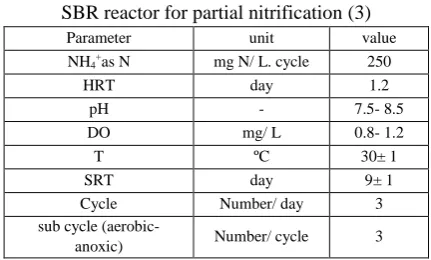
After about one month of acclimation with no sludge withdrawal, the biomass was mixed with the secondary sludge from the WWTP for simultaneous denitrification. Then, final sludge inserted into SBR as a side stream process to treat synthetic wastewater in 8 hours cycle's under optimum conditions for partial nitrification based on Table 2. The lab- scale SBR and other automatic equipment for regulation of temperature and DO, filling and decanting, external carbon source injection are shown in Fig. 1- a.
Table 2- Optimum conditions used in side stream SBR reactor for partial nitrification (3)
Parameter unit value NH4+as N mg N/ L. cycle 250
HRT day 1.2
pH - 7.5- 8.5
DO mg/ L 0.8- 1.2
T ºC 30± 1
SRT day 9± 1
Cycle Number/ day 3 sub cycle (aerobic-
anoxic) Number/ cycle 3
Using Excess Biomass Sludge Acclimated in Side Stream Partial Nitrification to Evaluation Partial Nitrification … 57
Fig. 1- a) Lab- scale side stream SBR reactor, b) Lab- scale main stream batch reactor
Table 3- Factors & its levels in partial nitrification batch tests
Levels Factor
1 2 3 4
Factor A:Temperature (ºC) 30± 1 25± 1 20± 1 15± 1 Factor B:Initial ammonia (mg NH4+- NL−1) 50± 5 75± 5 100± 5 150± 5
Factor C:MLVSS (mg VSSL−1) 1250± 10 1000± 10 750± 10 500± 10
Factor C:Time (minute) 60 120 180 270
Design of experiments and data analysis:
In order to reduce batch tests, experimental design by Taguchi method was used. Based on this method, the factors and their levels, an L- 16 array were designed and selected.
Based on experimental design and L- 16 array, S/ N (signal/ noise) analysis and ANOVA by Qualitek4 (QT4) software were done and contribution of any factors
on results was calculated. Finally
eliminated experiments were estimated (24)
Analytical methods: NH4+- N was
measured by Nesler and spectro-
photometric method in 410 nm. (DR 4000, Hach Co., USA) (27). Nitrite and nitrate were measured by spectro- photometric method (DR 4000, Hach Co., USA) (28). MLVSS were measured according to the Standard Methods (27). DO concentration and pH were measured by DO meter (Oxi 340i- WTW) and pH meter (pHs- 25cw;
microprocessor pH/ mv meter, LIDA, China), respectively. sAOR and NO2/ NOx
ratio were calculated based on Equations 2 and 3.
Results
Partial nitrification & AOB cultivation in
side stream SBR: Partial nitrification was
done under steady state conditions based on
optimum environment which was
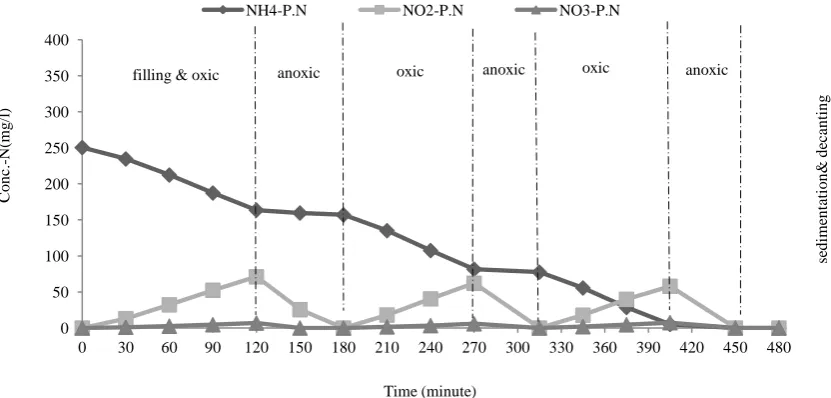
summarized in Table 1. Based on this strategy, the results of ammonia and nitrite oxidation and nitrate formation in the 8 hours cycle and under steady state conditions are shown in Fig. 2.
58 Iranian Journal of Environmental Technology, 1st Year,Vol. 1, No. 2, Autumn & Winter 2015
ratio were calculated and analysis by S/ N and ANOVA as follows:
sAOR analysis results: Table 4 shows
results of sAOR analysis in main stream reactor. Also Fig. 3 shows sAOR after cold shock with and without removing the effects of other factors except temperature (indirect and direct compassion). Moreover, this figure illustrate reduction on sAOR by =1.072 as an accepted temperature dependency coefficient. Based on sAOR
reduction, exponential trend line was used
to calculate temperature dependency
coefficient (Fig. 4).
NO2/ NOx ratio analysis results: Results
of NO2/ NOx ratio analysis as an important
index for demonstrating nitrite
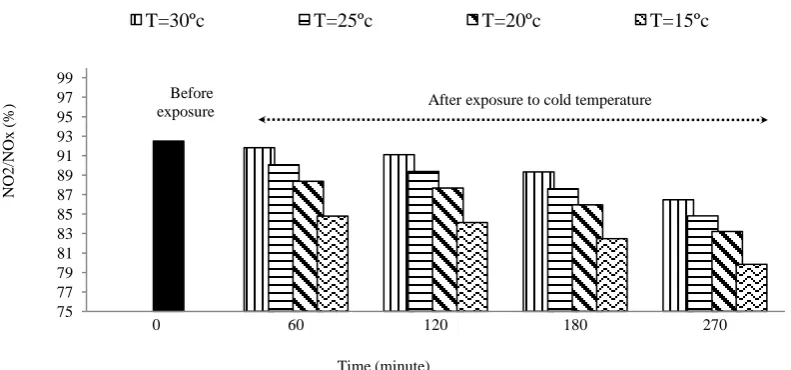
accumulation ratio and partial nitrification after ANOVA are shown in Table 4. Also Fig. 5 displays the effect of time and temperature on NO2/ NOx ratio after adding
excess sludge to main stream reactor.
Fig. 2- Side stream partial nitrification results after steady state conditions
Table 4- ANOVA & S/ N Analysis results of main stream reactor after excess sludge adding
indexes
Factors
sAOR NO2/ NOx
DOF
(
f)
v
ar
ia
n
ce
F
-
R
at
io
(
F
)
P
er
ce
n
t
in
fl
u
en
ce
O
p
ti
mu
m
le
v
el
s
DOF
(
f)
v
ar
ia
n
ce
F
-
R
at
io
(
F
)
P
er
ce
n
t
in
fl
u
en
ce
O
p
ti
mu
m
le
v
el
s
Temperature 3 133.2 16964.6 98.5 1 3 0.35 187.8 49.7 1 Initial ammonia 3 0.13 16.3 0.09 4 3 0.1 56.05 14.6 4
MLVSS 3 0.09 11.1 0.06 4 3 0.03 14.8 3.7 4
Time 3 1.8 229.6 1.3 4 3 .22 116.4 30.7 1 Other/ error 3 0.007 - 0.03 - 3 0.001 - 1.3 -
0 50 100 150 200 250 300 350 400
0 30 60 90 120 150 180 210 240 270 300 330 360 390 420 450 480
C
o
n
c.
-N
(mg
/l
)
Time (minute)
NH4-P.N NO2-P.N NO3-P.N
anoxic
filling & oxic oxic anoxic oxic anoxic
se
d
ime
n
ta
ti
o
n
&
d
ec
an
ti
n
Using Excess Biomass Sludge Acclimated in Side Stream Partial Nitrification to Evaluation Partial Nitrification … 59
Fig. 3- sAOR reduction after cold shock in direct and indirect comparison
Fig. 4- Exponential trend line for temperature dependency factor calculating (a- indirect and b- direct)
Fig. 5- Effect of temperature & time on NO2/ NOx ratio after biomass adding to new environment
30 25 20 15
0 20 40 60 80 100
Temperature (ºC)
sA
O
R
T
/sA
O
R
30
Indirect comparison Direct comparison =1.072
B
ef
o
r
ex
p
o
su
re
y = 100e-0.101x R² = 0.979
0 10 20 30 40 50 60 70 80 90 100
0 5 10 15 20
sA
O
R
30
-T
/sA
O
R
30
30-T(º C)
b
y = 100e-0.092x R² = 0.955
0 5 10 15 20
0 20 40 60 80 100
30-T(ºC)
sA
O
R
30
-T
/sA
O
R
30
a
0 60 120 180 270
75 77 79 81 83 85 87 89 91 93 95 97 99
Time (minute)
NO
2
/N
O
x
(
%)
T=30ºc T=25ºc T=20ºc T=15ºc
After exposure to cold temperature Before
60 Iranian Journal of Environmental Technology, 1st Year,Vol. 1, No. 2, Autumn & Winter 2015
Discussion and Conclusion
Side stream results: The average of
sAOR and NO2/ NOx ratio in any cycle of
side stream reactor after steady state conditions were calculated to be 14.83± 1.92 mg N- NH4+ (gr VSS.hr) −1 and 91.2±
1.3%, respectively. These results showed
that this approach caused partial
nitrification and nitrate production inhibition which is in agreement with other studies (3). Dosta et al. have reached sAOR about 19 mg N- NH4+ (gr VSS.hr) −1 and
NO2/ NOx ratio up to 95% for T=30ºC and
250- 300 mg N- NH4+/ L (3). Results
suggested the superiority of AOB on NOB based on high NO2/ NOx ratio. Therefore,
excess sludge from this reactor had more AOB than NOB and thus was suitable for partial nitrification in another reactor under different condition and for temperature dependency coefficient calculation in partial nitrification instead of nitrification.
sAOR: Analysis of sAOR in main
stream reactor demonstrated that
temperature, initial ammonia, MLVSS and time affected this index by 98.5, 0.09, 0.05 and 1.3%, respectively (Table 4). These results showed that temperature had serious effects on sAOR and by reduction of temperature; excessive reduction in sAOR was acquired. The average reduction in nitrification rate (sAOR) with the sudden decrease in temperature after cold shock from 30 to 25, 20 and 15ºC were about 25, 55 and 78%, respectively (Fig. 3). For more investigation, the Arrhenius equation (Equation 1) was used by considering 1.072
values as the accepted temperature
correction coefficient for gradual
temperature change. The sAOR would possibly be decreased after cold shock by 29, 50 and 65% at 25, 20 and 15ºC,
respectively (Fig. 4). Comparison of these results shows that in sudden temperature decreases, further reductions will occure in a process rate. Hwang and Oleszkiewicz revealed that by adding nitrifying biomass from 20 to 10ºC, a deeper decrease in nitrification rate as predicted by 1.072 value (about 20%) (21) would be induced. They also demonstrated that adding nitrify biomass from 30 to 10ºC, caused 82% reduction in nitrification rate which is close to 84% decrease estimated in the present study for temperature reduction from 30 to 10ºC. Guo et al. (29) observed that sAOR
decreased by 1.5 times when the
temperature is decreasing from 25 to 15ºC. This is in agreement with 55% reduction from 30 to 20ºC in the present study.
By using Equation 1, sAOR30 and
sAORT as rT0 and rT, respectively, and by
using indirect comparison, the temperature dependency factor is calculated about 1.0965 which is closed to Biowin Default (Table 1). Because the effect of temperature on sAOR was bigger than the other factors, direct comparison can also be used. By
direct comparison the temperature
dependency factor is about 1.106 which has slight differences with the previous value and closed to Hwang and Oleszkiewicz (21). They used direct comparison to calculate this coefficient. This means that direct comparison may produce different results based on the effect of other factors except temperature.
NO2/ NOx: Analysis of NO2/ NOx ratio
showed that temperature, initial ammonia, MLVSS and time affected NO2/ NOx ratio
Using Excess Biomass Sludge Acclimated in Side Stream Partial Nitrification to Evaluation Partial Nitrification … 61
caused NO2/ NOx ratio reduction. This
reduction indicated that NOB activity had recovered based on low free ammonia and temperature reduction. These results appeared that maximum NO2/ NOx ratio
has been happened at 30ºC by initial ammonia about 150 mg N- NH4+/ L and
time less than 60 minutes by about 94.9%. This is in good agreement with side stream partial nitrification results in the present study and with those reported in other studies (3 & 14). Guo et al. (29) observed that nitrite accumulation ratio was always above 90% which is in agreement with present results.
The results showed that time increasing to 120 minutes didn’t have important effects on NO2/ NOx ratio. Bigger time up
to 270 minutes had serious effects on NO2/
NOx ratio and was reduced to 89.4% which
showed that NOB has recovered its activity by time (Fig. 5). Therefore, using excess
sludge that acclimated in partial
nitrification process is a good idea to partial nitrification in main stream, especially in short times.
In this study a side stream SBR was used for partial nitrification and biomass acclimation. The SBR was perfumed with three cycles per day, temperature about 30ºC, SRT 9± 1 days and HRT 1.2 days. Under steady state conditions, sAOR and NO2/ NOx were about 14.83± 1.92 mg N–
NH4+/ grVSS. hr and 91.2± 1.3%,
respectively. These results indicated that partial nitrification and AOB acclimation were happened.
Moreover, after biomass acclimation in side stream SBR, excess sludge from this reactor has been added to another batch reactor (main stream) which was used in
different conditions based on L- 16 array. Factors which were evaluated in this research were temperature, initial ammonia, MLVSS and time. The results of main stream experiments showed that by abrupt temperature decreases, sAOR and NO2/
NOx ratio were decreased but effects of
temperature in any index were different.
Outcomes displayed that temperature
affected these indexes by 98.5and 49.7, respectively.
Furthermore, initial ammonia has
influenced only NO2/ NOx ratio by 14.6%,
so that initial ammonia increasing caused NO2/ NOx increases. Time also seriously
affected only NO2/ NOx by 30.7%. Time
elapsing caused NO2/ NOx ratio decreasing.
This study showed that use of excess acclimated biomass (bio- augmentation) in partial nitrification process for SRT regulation (predominance AOB against insufficient NOB) could be an effective way to partial nitrification in different conditions for short times usually less than 120 minutes. Also, it founded that temperature was an important factor that affected sAOR and NO2/ NOx ratio after
clod shock. By using Equation 1 and indirect comparison (ignore effect of other
factors except temperature), the
temperature dependency factor is calculated about 1.0965 for estimating cold shock
effect. By direct comparison, the
temperature dependency factor is about 1.106.
Acknowledgement
The authors are grateful for the grants
received from Isfahan Water and
62 Iranian Journal of Environmental Technology, 1st Year,Vol. 1, No. 2, Autumn & Winter 2015
References
(1)Guo X., Kim J., Behera S., Park H. Influence of dissolved oxygen concentration and aeration time on nitrite accumulation in partial nitrification process. International Journal of Environmental Science & Technology 2008, 5 (4), pp 527- 534.
(2)Pambrun V., Paul E., Sp´erandio M. Control and modeling of partial nitrification of effluents withhigh ammonia concentrations in sequencing batch reactor. Chemical Engineering and Processing 2008, 47, pp 323- 329.
(3)Dosta J., Galí A., El- Hadj T.B., Macé S., Mata- Álvarez J. Operation and model description of a sequencing batch reactor treating reject water for biological nitrogen removal via nitrite. Bioresource Technology 2007, 98 (11), pp 2065- 2075.
(4)Gao D., Peng Y., Wu W.- M. Kinetic model for biological nitrogen removal using shortcut nitrification- denitrification process in sequencing batch reactor. Environmental science & Technology 2010, 44 (13), pp 5015- 5021.
(5)Chai L.- Y., Ali M., Min X.- B., Song Y.- X., Tang C.- J., Wang H.- Y., et al. Partial nitrification in an air- lift reactor with long- term feeding of increasing ammonium concentrations. Bioresource Technology 2015, 185, pp 134- 142.
(6)Ge S., Wang S., Yang X., Qiu S.,Li B., Peng Y. Detection of nitrifiers and evaluation of partial nitrification for wastewater treatment: A review. Chemosphere 2015, pp 85- 98.
(7)Paredes D., Kuschk P., Mbwette T.S.A., Stange F., Müller R.A., Köser H. New aspects of microbial nitrogen transformations in the context of wastewater treatment- A Review. Engineering in Life Sciences 2007, 7 (1), pp 13- 25.
(8)Wett B., Rauch W. The role of inorganic carbon limitation in biological nitrogen removal of extremely ammonia concentrated wastewater. Water Research 2003, 37, pp 1100- 1110.
(9)Peng Y., Zhu G. Biological nitrogen removal with nitrification and denitrification via nitrite
pathway. Applied Microbiology and
Biotechnology 2006, 73 (1), pp15- 26.
(10) Chandran K., Yu R., Ahn J.H. Inventors systems and methods for achieving partial nitrification in a biological nitrogen removal Reactor. US Patent 2014.
(11) Yongzhen P., Shouyou G., Shuying W., Lu B. Partial nitrification from domestic wastewater by aeration control at ambient temperature. Chinese Journal of Chemical Engineering 2007, 15 (1), pp 115- 121.
(12) Pambrun V., Paul E., Spérandio M. Control and modelling of partial nitrification of effluents with high ammonia concentrations in sequencing batch reactor. Chemical Engineering and Processing: Process Intensification 2008, 47 (3), pp 323- 329.
(13) George T., Franklin L., Stensel H.D. Wastewater engineering: Treatment and reuse. Metcalf & Eddy, Inc.:New York, 2003.
(14) Gali A., Dosta J., Mata- Alvarez J. Optimisation of nitrification- denitrification process in a SBR for the treatment of reject water via nitrite. Environmental Technology 2007, 28 (5), pp 565 - 571.
(15) Hulle S.V. simulation and optimization of autotrophic nitrogen removal processes. PhD. Thesis, GENT University, Belgium, 2005.
(16) Sinha B., Annachhatre A.P. Partial
nitrification- operational parameters and
microorganisms involved. Reviews in
Environmental Science and Bio/ Technology 2007, 6 (4), pp 285- 313.
(17) Zhang L., Zhang S., Gan Y., Peng Y. Bio- augmentation to rapid realize partial nitrification of real sewage. Chemosphere 2012, 88 (9), pp 1097- 1102.
(18) Bartrolí A., Carrera J., Pérez J.
Bioaugmentation as a tool for improving the start- up and stability of a pilot- scale partial nitrification biofilm airlift reactor. Bioresource Technology 2011, 102 (6), pp 4370- 4375.
(19) Head M., Oleszkiewicz J. Bioaugmentation for nitrification at cold temperatures. Water Research 2004, 38 (3), pp 523- 530.
(20) Van Hulle S.W., Volcke E.I., Teruel J.L., Donckels B., Van Loosdrecht M., Vanrolleghem P.A. Influence of temperature and pH on the kinetics of the Sharon nitritation process. Journal of Chemical Technology and Biotechnology 2007, 82 (5), pp 471- 480.
Using Excess Biomass Sludge Acclimated in Side Stream Partial Nitrification to Evaluation Partial Nitrification … 63
(22) Ozyonar F. Optimization of operational parameters of electrocoagulation process for real textile wastewater treatment using Taguchi experimental design method. Desalination and Water Treatment 2016, 57 (6), pp 2389- 2399.
(23) Silva M.B., Carneiro L.M., Silva J.P.A., dos Santos Oliveira I., Izário Filho H.J., de Oliveira Almeida, C.R. An application of the Taguchi method (robust design) to environmental engineering: Evaluating advanced oxidative processes in polyester- resin wastewater treatment. American Journal of Analytical Chemistry 2014, 5, pp 828- 837.
(24) Roy R.K. Design of experiments using the Taguchi approach: 16 steps to product and process improvement. John Wiley & Sons: USA, 2001.
(25) Mauret M., Paul E., Puech- Costes E., Maurette M.T., Baptiste P. Application of experimental research methodology to the study of nitrification in mixed culture. Water Science and Technology 1996, 34 (1- 2), pp 245- 252.
(26) Weon S.Y., Lee S.I., Koopman B. Effect of temperature and dissolved oxygen on biological nitrification at high ammonia concentrations. Environmental Technology 2004, 25 (11), pp 1211- 1219.
(27) APHA. Standard methods for the
examination of water and wastewater. American Public Health Association (APHA), Water Environmental Federation: Washington DC, USA, 2005.
(28) HACH. Water analysis handbook. HACH company: Loveland, Colorado, USA, 2008.
7 ناریا یطیحم تسیز یروانف