Removal of Hg (II) and Cd (II) Ions from Aqueous Solution Using Chitosan: Kinetics and Equilibrium Studies
*Soheil Sobhanardakani1 Raziyeh Zandipak2 Arash Javanshir-Khoei3 Seyed Mehdi Hosseini4 Mehran Moslemi5 Parisa Delfieh6
1- Department of the Environment, School of Basic Sciences, Islamic Azad University, Hamedan Branch, Hamedan, Iran 2- Young Researchers and Elite Club, Islamic Azad University, Hamedan Branch, Hamedan, Iran
3- Department of Fisheries, School of Agriculture and Natural Resources, University of Tehran, Karaj, Iran
4- Department of the Environment, School of Natural Resources and Marine Sciences, Tarbiat Modares University, Noor, Iran 5- Department of Fisheries, Jouybar Branch, Islamic Azad University, Jouybar, Iran
6- Department of Fisheries, School of Marine Natural Resources, Khoramshar University of Marine Science and Technology, Khoramshar, Iran
( Received: 7 Jun 2014; Revised: 14 Nov 2014; Accepted: 19 May 2015)
Abstract
Background and purpose: The discharge of toxic heavy metal ions into the environment is a
serious pollution problem. Heavy metal ions pose adverse toxic risks to human health at very low concentrations. The aim of this paper is the adsorption potential of chitosan (CS) in the removal of Hg(II) and Cd(II) ions from aqueous solution.
Materials and Methods: This study was conducted in laboratory scale. In this research, CS was
used as an adsorbent for the removal of Hg(II) and Cd(II) from aqueous solutions. In batch tests, the effects of various parameters such as metals concentration (40-350 mg/L), pH solution (2-8), contact time (5-120 min), and adsorbent dose (0.25-2 g) were investigated.
Results: The results showed that adsorption of Hg(II) and Cd(II) ions on CS strongly depends on
pH. The experimental data were analyzed using the Langmuir and Freundlich isotherm models. Equilibrium data fitted well with the Langmuir model and the maximum adsorption capacity of the CS for Hg(II) and Cd(II) were 52.63 and 58.8 mg/g, respectively. Kinetic analysis showed that adsorption was most accurately represented by a pseudo-second-order model.
Conclusion: The obtained results showed that CS is a readily, available, economic adsorbent and was found suitable for removing Hg(II) and Cd(II) ions from aqueous solution.
[*Sobhanardakani S, Zandipak R, Javanshir-Khoei A, Hosseini SM, Moslemi M, Delfieh P. Removal of Hg (II) and Cd (II) Ions from Aqueous Solution Using Chitosan: Kinetics and Equilibrium Studies. IJHS
2015; 3(2): 21-30] http://jhs.mazums.ac.ir
Key words: Adsorption, Chitosan, Mercury, Cadmium, Removal Efficiency
Original Article
Original Article
Original Article
Original Article
1. Introduction
Environmental contamination by heavy metals is of growing concern because of health risks on humans and animals (1). Heavy metals including mercury and cadmium are toxic for human health and other organisms. Metals are non-degradable and accumulation throughout the food chain and hence in the human body (2). Heavy metals are discharged into the aqueous environment through various sources including metal smelters, effluents from plastics, paper industries, microelectronics, mining operations, using of fertilizers and pesticides (3). The World Health Organization (WHO) has set a maximum guideline concentration of 0.003 mg/L for Cd in drinking water (4). Mercury has been reported to cause various diseases, for example, Amyotrophic lateral sclerosis, Alzheimer’s diseases and Parkinson’s disease (5). Also, cadmium can cause nausea, salivation, muscular cramps, anemia and cancer (6). So, the removal of metals in water samples is important. Many treatment processes, such as oxidation, reduction, precipitation, membrane filtration, ion exchange, and adsorption have been used to remove metal ions from aqueous solutions (7). Among the above methods, the adsorption is simple and cost-effective, thus has been widely used (8). One of the low-cost adsorbents is chitosan (CS). It is a type of
natural polyaminosaccharide, synthesized
from the deacetylation of chitin (9). CS
(poly-β (1,4)-2-amino-2-deoxy-D-glucose) is known
as an ideal natural support for enzyme
immobilization because of its special
characteristics such as hydrophilicity,
biocompatibility, biodegradability,
non-toxicity, adsorption properties, etc. CS can be used as an adsorbent to remove heavy metals and dyes due to the presence of amino and hydroxyl groups, which can serve as the active sites (10). From the literature it is clear that CS can be used to remove numerous trace metals (Cu(II), Pb(II), U(VI), Cr(III), Cr(VI), Ni(II), Cd(II), Zn(II), Co(II), Fe(II), Mn(II),
Pt(IV), Ir(III), Pd(II), V(V) and V(IV)) from wastewater. In these studies CS has been used in a variety of forms, which include CS beads, flakes, and membranes (11-15).
In this study, CS was used for removal of Hg(II) and Cd(II) from aqueous solutions. The effect of pH, initial concentration, contact time and CS dose were investigated. Isotherm and kinetics of adsorption were evaluated.
2. Materials and Methods
CS (ash: 0.55%, moisture: 5.4%,
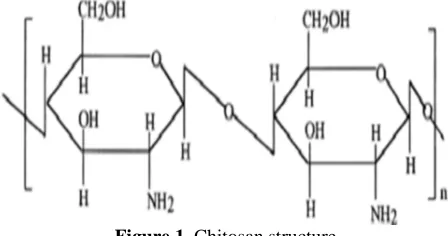
deacetylation: 88%) was purchased from Sigma-Aldrich (South, Africa). Figure 1 show
the structure of CS. Hg(NO3)2·6H2O,
Cd(NO3)2·6H2O, hydrochloric acid (HCl) and sodium hydroxide (NaOH) with the highest purity available were purchased from Merck (Darmstadt, Germany). Double-distilled water was used in all experiments. Stock solution of Hg(II) and Cd(II) were prepared by dissolving
Hg(NO3)2·6H2O and Cd(NO3)2·6H2O in
double-distilled water. The solutions of different initial concentrations were prepared by diluting the stock solution in appropriate proportions.
Figure 1. Chitosan structure
Cd(II) concentration was measured using an inductively coupled plasma spectrometry (Verian 710-Es Australia). All the operating parameters were those recommended by the
manufacturer. The optimum operating
conditions and measurement parameters for intracranial pressure are including RF power: 1.5 kW, carrier gas flow rate: 0.9 L/min,
makeup gas flow rate: 0.15 L/min, integration time: 0.1 s.
Hg(II) concentration was measured using cold vapor atomic absorption using direct
mercury analyzer (DMA-80). All pH
measurements were made with a 780
pH-meter (Metrohm Switzerland) with a
combined glace-calomel electrode.
1 g of CS added to 40 ml of Hg(II) and Cd(II) solutions (40-350 mg/L), and the pH of the solution was adjusted at 6.0 with 0.1 mol/L HCl or/and 0.1 mol/L NaOH solutions and then the mixture was agitated using a magnetic stirrer with a the stirring speed 160
r.min−1 for 60 min. Subsequently, the CS with
adsorbed Hg(II) and Cd(II) were separated from the mixture using Whatman filter paper with a diameter of 42 µm. The concentration of the Hg(II) and Cd(II) ions that remained in the solution were determined by cold vapor atomic absorption using DMA-80 and inductively coupled plasma spectrometry
(Verian710-Es Australia), respectively.
Finally, the concentration of the Hg(II) and Cd(II) ions remained in the adsorbent phase (qe, mg/g) were calculated using the Eq. (1):
(
0 e)
e
C C V
q
W
− =
(1)
Where, C0 and Ce are the initial and equilibrium Hg(II) and Cd(II) concentrations in solution, respectively (mg/L), V (L) is the volume of solution and W (g) is the weight of adsorbent.
For studying the effect of solution pH on
Hg(II) and Cd(II) ions adsorption,
experiments in different pH (varying from 2.0 to 8.0) were conducted. To observe the effect of adsorbent dose on Hg(II) and Cd(II) ions adsorption, different amounts of adsorbent (varying from 0.25 to 2 g) were used. In order to investigate the effect of contact time on adsorption Hg(II) and Cd(II) by CS used from contact times 5, 15, 30, 45, 60, 75, 90, 105 and 120 min.
Finally, the Hg(II) and Cd(II) removal percent (R%) was calculated by the Eq. (2):
0 e
0
C C
R(%) 100
C
−
= ×
(2)
Where: C0 and Ce (mg/L) were the initial and final Hg(II) and Cd(II) concentrations (16).
3. Results
Effect of solution pH
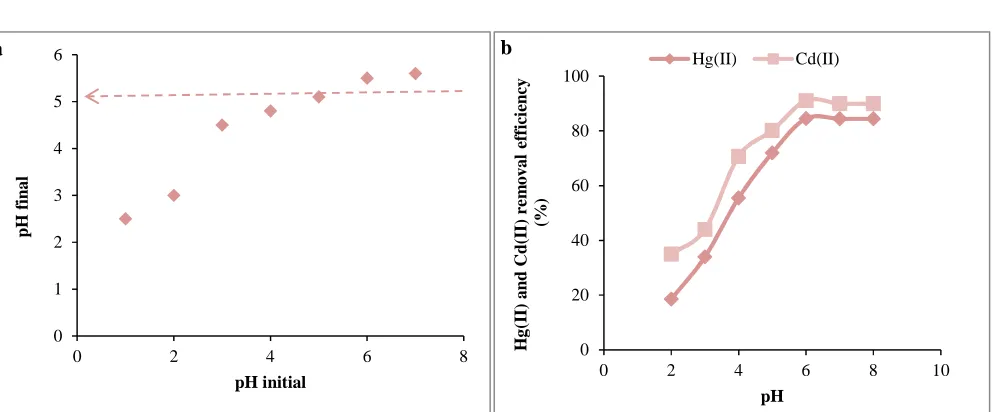
The primary study shows that the adsorption efficiency depends strongly on the solution pH, initial metal concentrations, CS dose and contact time. The influence of initial pH on adsorption amount was studied in the range of 2.0-8.0 for initial metals ion concentration of 40 mg.L. Also, the zero point charge (pHZPC) for the CS was determined around pH = 5.1 (Figure 2a). It was observed from figure 2b that the removal efficiency of Hg(II) and Cd(II) increased significantly with increasing pH from 1.0 to 6.0 and then remained nearly constant at higher pHs.
Effect of initial metal concentration
The effect of initial metals concentration on adsorption of Hg(II) and Cd(II) onto CS were investigated in the concentration range 40-350 mg/L at pH 6.0 and temperatures 25 ± 1°C. The results are showed that the adsorption capacity decreases with the increase of initial Hg(II) and Cd(II) concentrations (Figure 3).
Effect of adsorbent dose
The dependence of the adsorption of Hg(II) and Cd(II) to the amount of CS were studied at temperature 25 ± 1°C and at pH 6.0 by varying the adsorbent amount from 0.25 to 2.0 g in contact with 40 mg/L of Hg(II) and Cd(II). The effect of adsorbent dose on Hg(II) and Cd(II) removal percentage is shown in figure 4.
Figure 2. (a) The determination of the point of zero charge of the chitosan (CS), (b) effect of solution pH on the
adsorption of Hg(II) and Cd(II) onto CS (initial concentration 40 mg/L, contact time 45 and 30 min for Hg(II) and Cd(II) respectively, adsorbent dose 1.0 g, temperature 25 ± 1°C)
Figure 3. Effect of initial concentration on adsorption
of Hg(II) and Cd(II) onto chitosan (pH = 6.0, contact time 45 and 30 min for Hg(II) and Cd(II) respectively,
adsorbent dose 1.0 g, temperature 25±1°C)
Effect of contact time
The effect of contact time on the adsorption of Hg(II) and Cd(II) were studied to determine the time taken by CS to remove 40 mg/L Hg(II) and Cd(II) solutions at temperatures 25 ± 1°C. Figure 5, shows the removal percentage of Hg(II) and Cd(II) ions at various time intervals onto CS from aqueous solution. The uptake-percent of metals by CS increased with increasing contact time and then became constant.
Figure 4. Effect of adsorbent dose on the adsorption
of Hg(II) and Cd(II) onto CS (pH = 6.0, Initial concentration 40 mg/L, contact time 45 and 30 min for
Hg(II) and Cd(II) respectively, temperature 25 ± 1°C)
Adsorption isotherm
Two different isotherms such as Langmuir and Freundlich models are applied in this study for analyzing experimental adsorption equilibrium parameters to obtain some
important information on the surface
properties of the adsorbent and its affinity to the metals molecules. Figure 6 and table 1 show the results of linear fitting in Langmuir and Freundlich isotherm for CS.
0 1 2 3 4 5 6
0 2 4 6 8
p H f in a l pH initial a 0 20 40 60 80 100
0 2 4 6 8 10
H g (I I) a n d C d (I I) r e m o v a l ef fi ci en cy (% ) pH b Hg(II) Cd(II) 0 20 40 60 80 100
0 100 200 300 400
H g (I I) a n d C d (I I) r em o v a l ef fi ci en cy (% )
Initial metal concentration (mg l-1)
Hg(II) Cd(II) 0 20 40 60 80 100
0 0.5 1 1.5 2 2.5
H g (I I) a n d C d (I I) r em o v a l ef fi ci en cy (% )
Dose of adsorbent (g)
Hg(II) Cd(II)
Figure 5. Effect of contact time on adsorption of
Hg(II) and Cd(II) onto CS (pH = 6.0, initial concentration 40 mg/L, adsorbent dose 1 g,
temperature 25 ± 1°C)
Adsorption kinetics
In order to analyze the adsorption kinetics of Hg(II) and Cd(II) by adsorbent the pseudo-first-order and pseudo-second-order models,
were tested. The result of fitting are listed in figure 7 and table 2.
Effect of initial metal concentration
The effect of initial metals concentration on adsorption of Hg(II) and Cd(II) onto CS were investigated in the concentration range 40-350 mg/L at pH 6.0 and temperatures 25 ± 1°C. The results are showed that the adsorption capacity decreases with the increase of initial Hg(II) and Cd(II) concentrations (Figure 3).
Effect of adsorbent dose
The dependence of the adsorption of Hg(II) and Cd(II) to the amount of CS were studied at temperature 25 ± 1°C and at pH 6.0 by varying the adsorbent amount from 0.25 to 2.0 g in contact with 40 mg/L of Hg(II) and Cd(II). The effect of adsorbent dose on Hg(II) and Cd(II) removal percentage is shown in figure 4.
a
Ce (mg/L)
0 20 40 60 80 100 120
Ce /qe
(
g/
L
)
0.0 0.5 1.0 1.5 2.0 2.5
Hg Cd
b
lnCe
-2 -1 0 1 2 3 4 5
ln
qe
1.5 2.0 2.5 3.0 3.5 4.0 4.5
Hg Cd
Figure 6. (a) Langmuir and (b) Freundlich isotherms for Hg(II) and Cd(II) adsorption onto Chitosan at 25 ± 1°C
Table 1. Isotherm parameters of adsorption of Hg(II) and Cd(II) onto CS
Parameters Langmuir Freundlich
b (L/mg) qm (mg/g) R2 Kf (mg1−(1/n) L1/n g−1) n R2
Hg(II) 0.111 52.63 0.989 164.05 2.638 0.976
Cd(II) 0.197 5558.80 0.992 325.08 2.630 0.981
CS: Chitosan 0 20 40 60 80 100
0 20 40 60 80
H
g
(I
I)
a
n
d
C
d
(I
I)
r
em
o
v
a
l
ef
fi
ci
e
n
cy
(%
)
Contact time (min)
Hg(II) Cd(II)
Effect of contact time
The effect of contact time on the adsorption of Hg(II) and Cd(II) were studied to determine the time taken by CS to remove 40 mg/L Hg(II) and Cd(II) solutions at temperatures 25 ± 1°C. Figure 5, shows the removal percentage of Hg(II) and Cd(II) ions at various time intervals onto CS from aqueous solution. The uptake-percent of metals by CS increased with increasing contact time and then became constant.
Adsorption isotherm
Two different isotherms such as Langmuir and Freundlich models are applied in this study for analyzing experimental adsorption equilibrium parameters to obtain some
important information on the surface
properties of the adsorbent and its affinity to the metals molecules. Figure 6 and table 1 show the results of linear fitting in Langmuir and Freundlich isotherm for CS.
Figure 7. Pseudo-second-order kinetic plot for the
adsorption of Hg(II) and Cd(II) onto chitosan at 25 ± 1°C
Adsorption kinetics
In order to analyze the adsorption kinetics of Hg(II) and Cd(II) by adsorbent the pseudo-first-order and pseudo-second-order models, were tested. The result of fitting are listed in figure 7 and table 2.
4. Discussion
The aqueous solution pH is an important controlling parameter in the heavy metals adsorption processes. The increase in the adsorption of Hg(II) and Cd(II) on CS with increase in the solution pH can be explained based on the surface charge of CS and the metal molecule (Figure 2b). At lower pH (˂pHzpc), the CS surface will be positively
charged, creating electrostatic repulsion
between the positively charged surface of the CS and the Hg(II), and Cd(II) ions. At higher pH (>pHzpc), the number of positively charged sites is reduced and raised the number of negatively charged sites, which increases the electrostatic attractions between metals ions and CS surface. The increase in the adsorption of Hg(II) and Cd(II) on CS with increase in the solution pH is also explicable on the basis of increased dissociation of surface hydroxyl groups from the surface of CS and the subsequent formation of metal ions species
such as HgOH+, Hg(OH)2, CdOH
+ and Cd(OH)2 of low solubility may contribute in part to maximum percentage removal of metal ions. At a lower pH, the oxide surface will have a positive character and there exists a competition between H+ ions and M(II) ions for the active surface sites and hence, lesser adsorption was observed.
Table 2. Pseudo-first order and pseudo-second order kinetic model parameters for the adsorption of Hg(II) and Cd(II)
onto CS
Parameters C0 (mg/L)
Pseudo-first-order kinetic model Pseudo-second-order kinetic model
qe exp(mg/g) qe1(mg/g) k1 (min−1) R2 qe2 (mg/g) k2 (g/mg/min) R2
Hg(II) 40 7.52 1.010 0.170 0.842 8.62 0.011 0.999
Cd(II) 40 7.86 0.828 0.138 0.855 8.69 0.019 0.995
CS: Chitosan 0 2 4 6 8 10 12
0 20 40 60 80
t/
q
t
(m
in
g
/m
g
)
t(min)
Hg(II) Cd(II)
At higher pHs, metals were precipitated in the form of hydroxides. Therefore, the effects of pHs higher than 8.0 were not investigated. A similar phenomenon has also been shown in the adsorption of Ni(II) ion from water with oxidized multi-walled carbon nanotubes (17).
The adsorption capacity is dependent on the initial metal ion concentration. As in figure 3 was seen, by increasing the initial metals concentration from 40 to 350 mg/L, the removal efficiency (%) decreased from 97% to 70% for Hg(II) and from 98 to 76% for Cd(II). At a constant CS dose, the decrease in the adsorption efficiency is probably due to the saturation of the active binding sites on the CS surface at higher Hg(II) and Cd(II) concentrations. On the other hand, by increasing the initial Hg(II) and Cd(II) concentrations the actual amount of metals adsorbed per unit mass of the CS increased.
The higher initial Hg(II) and Cd(II)
concentrations provides an important driving force to overcome the mass transfer resistance for Hg(II) and Cd(II) transfer between the solution and the surface of the CS. Similar results were observed by Ruis (2005) who investigated the effect of initial concentration of metal ions on removal of mercury (II) from
aqueous solution by clay mineral
montmorillonite and indicated that adsorption decreases with increasing initial concentration of metals (18).
One of the parameters that strongly affect the adsorption capacity is the adsorbent dose. As it is clear from figure 4, the removal efficiency increased with the increase in dose of the CS and the maximum adsorption was observed at 1.0 g for Hg(II) and Cd(II). This phenomenon was also observed by Madrakian et al. who studied the adsorption efficiency of U(VI) on modified maghemite nanoparticles and indicated that adsorption percentage increases with increasing adsorbent dose (19).
The contact time between the adsorbate and the adsorbent is important in the metals removal from the solution by the adsorption
process. As was seen in the figure 5, the removal efficiency of Hg(II) and Cd(II) by CS increased with increasing contact time and then became constant. An equilibrium adsorption is observed within 45 and 30 min for Hg(II) and Cd(II), respectively, that due to the availability of large number of vacant sites. Subsequently, the less availability of the remained active sites and the decrease in the driving force lead to the slow adsorption process. Similar results have been found by Sobhanardakani et al. (20).
The analysis of isotherm data is important for predicting the adsorption capacity of the adsorbent, which is one of the main parameters required for the design of an adsorption system. In this study, the Langmuir (Eq. 3) and Freundlich (Eq. 4) isotherms are using to describe the adsorption behaviors of Hg(II) and Cd(II) onto CS. The linear equations are as follows (21,22):
e e
e m m 1
C C 1
q =q +q b (3)
e e f
1
ln q ln C ln k n
= +
(4)
Where, Ce (mg/L) is the equilibrium
concentration of Hg(II) and Cd(II) ions in
solution, qe (mg/g) is the equilibrium
adsorption capacity of CS, qm (mg/g) is the maximum adsorption capacity of CS for monolayer coverage, b (L/mg) is a constant related to the adsorption free energy, Kf (mg1−(1/n) L1/n g−1) is a constant related to adsorption capacity, and n is an empirical parameter related to adsorption. Figure 6a and b shows the equilibrium isotherms for the adsorption of Hg(II) and Cd(II) onto CS, and the parameters of adsorption isotherms are summarized in table 1. The results indicate that Langmuir isotherm fit better with experimental data than Freundlich isotherm. This also suggests that Hg(II) and Cd(II) adsorption on CS maybe monolayer coverage.
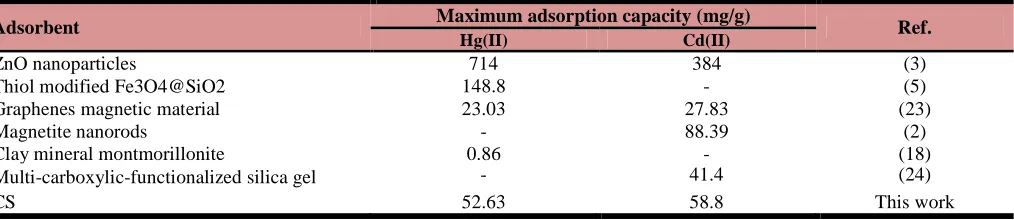
Table 3. Comparison of maximum adsorption capacity (qm) of different adsorbents for Hg(II) and Cd(II)
Adsorbent Maximum adsorption capacity (mg/g) Ref.
Hg(II) Cd(II)
ZnO nanoparticles 714 384 (3)
Thiol modified Fe3O4@SiO2 148.8 - (5)
Graphenes magnetic material 23.03 27.83 (23)
Magnetite nanorods - 88.39 (2)
Clay mineral montmorillonite 0.86 - (18)
Multi-carboxylic-functionalized silica gel - 41.4 (24)
CS 52.63 58.8 This work
CS: Chitosan
The maximum adsorption capacity of CS for Hg(II) and Cd(II) were 52.63 and 58.8 mg/g. In table 3, we compared the ability of the proposed adsorbent in the removal of Hg(II) and Cd(II) ions from water with some other works.
In order to explain the adsorption mechanism particularly the potential rate-controlling step, two adsorption kinetics models, first-order model and pseudo-second-order model were used to analyze the adsorption kinetic data. The linear forms of pseudo-first-order and pseudo-second-order models are expressed as follows (25,26):
1
e t e
k t ln(q q ) ln(q )
2.303
− = −
(5)
2 2
t e e
t 1 t
q =k q +q (6)
Where qe and qt are the amount of Hg(II) and Cd(II) ions adsorbed (mg/g) at equilibrium and time t (min); k1 is the rate constant of pseudo-first-order (min−1); k2 is the rate constant of pseudo-second-order (g/mg/min) for adsorption. As shown in table 2, higher values of R2 were obtained for second-order than for pseudo-first-order adsorption rate models, indicating that the adsorption rates of Hg(II) and Cd(II) onto the CS can be more appropriately described using the pseudo-second-order rate rather than pseudo-first-order rate (Figure 7).
This study shows that the CS is an effective adsorbent for removal of Hg(II) and Cd(II) ions from aqueous solution. Results of
adsorption experiments revealed that the removal efficiency of the CS is strongly affected by the initial solution pH. The optimum pH for the maximum adsorption by CS were found at pH 6.0 for Hg(II) and Cd(II). The adsorption efficiency of Hg(II) and Cd(II) on CS decreased with the increase initial Hg(II) and Cd(II) concentrations from 40 to 350 mg/L. Adsorption equilibrium were attained after 45 and 30 min for Hg(II) and Cd(II) respectively. Moreover, the adsorption efficiency of Hg(II) and Cd(II) on CS increases with increasing adsorbent dose. Isotherm modeling revealed that the Langmuir equation could better describe the adsorption of Hg(II) and Cd(II) onto the CS as compared to Freundlich model. The kinetic study of Hg(II) and Cd(II) on CS were performed based on first-order and pseudo-second-order. The data indicate that the adsorption kinetics follows the pseudo-second-order rate.
Acknowledgement
The authors are grateful to the University of Tehran for providing facilities to conduct and complete this study.
References
1. Chen C, Hu J, Shao D, Li J, Wang X. Adsorption behavior of multiwall carbon nanotube/iron oxide magnetic composites for Ni(II) and Sr(II). J Hazard Mater 2009; 164(2-3): 923-8.
2. Karami H. Heavy metal removal from water by magnetite nanorods. Chemical Engineering Journal 2013; 219(0): 209-16.
3. Sheela T, Nayaka YA, Viswanatha R, Basavanna S, Venkatesha TG. Kinetics and thermodynamics studies on the adsorption of Zn(II), Cd(II) and Hg(II) from aqueous solution using zinc oxide nanoparticles. Powder Technology 2012; 217(0): 163-70. 4. Boparai HK, Joseph M, O'Carroll DM.
Kinetics and thermodynamics of cadmium ion removal by adsorption onto nano zerovalent iron particles. J Hazard Mater 2011; 186(1): 458-65.
5. Zhang S, Zhang Y, Liu J, Xu Q, Xiao H, Wang X, et al. Thiol modified Fe3O4@SiO2 as a robust, high effective, and recycling magnetic sorbent for mercury removal. Chemical Engineering Journal 2013; 226: 30-8.
6. Ruparelia JP, Duttagupta SP, Chatterjee AK, Mukherji S. Potential of carbon nanomaterials for removal of heavy metals from water. Desalination 2008; 232(1-3): 145-56.
7. Kaprara E, Seridou P, Tsiamili V, Mitrakas M, Vourlias G, Tsiaoussis I, et al. Cu-Zn powders as potential Cr(VI) adsorbents for drinking water. J Hazard Mater 2013; 262: 606-13. 8. Xu YY, Zhou M, Geng HJ, Hao JJ, Ou QQ,
Qi SD, et al. A simplified method for synthesis of Fe3O4@PAA nanoparticles and its application for the removal of basic dyes. Applied Surface Science 2012; 258(8): 3897-902.
9. Celis R, Adelino MA, Hermosin MC, Cornejo J. Montmorillonite-chitosan bionanocomposites as adsorbents of the herbicide clopyralid in aqueous solution and soil/water suspensions. J Hazard Mater 2012; 209-210: 67-76.
10.Wan Ngah WS, Teong LC, Hanafiah MAKM. Adsorption of dyes and heavy metal ions by chitosan composites: A review. Carbohydrate Polymers 2011; 83(4): 1446-56.
11.Kolodynska D. Chitosan as an effective low-cost sorbent of heavy metal complexes with the polyaspartic acid. Chemical Engineering Journal 2011; 173(2): 520-9.
12.Zhao F, Yu B, Yue Z, Wang T, Wen X, Liu Z, et al. Preparation of porous chitosan gel beads for copper(II) ion adsorption. J Hazard Mater 2007; 147(1-2): 67-73.
13.Deans JR, Dixon BG. Uptake of Pb2+ and Cu2+ by novel biopolymers. Water Res 1992; 26(4): 469-72.
14.Popuri SR, Vijaya Y, Boddu VM, Abburi K. Adsorptive removal of copper and nickel ions from water using chitosan coated PVC beads. Bioresource Technology 2009; 100(1): 194-9. 15.Kaminski W, Modrzejewska Z. Application of
Chitosan Membranes in Separation of Heavy Metal Ions. Separation Science and Technology 1997; 32(16): 2659-68.
16.Deng C, Liu J, Zhou W, Zhang YK, Du KF, Zhao ZM. Fabrication of spherical cellulose/carbon tubes hybrid adsorbent anchored with welan gum polysaccharide and its potential in adsorbing methylene blue. Chemical Engineering Journal 2012; 200-202: 452-8.
17.Yang S, Li J, Shao D, Hu J, Wang X. Adsorption of Ni(II) on oxidized multi-walled carbon nanotubes: effect of contact time, pH, foreign ions and PAA. J Hazard Mater 2009; 166(1): 109-16.
18.Green-Ruiz C. Adsorption of mercury(II) from aqueous solutions by the clay mineral montmorillonite. Bull Environ Contam Toxicol 2005; 75(6): 1137-42.
19.Madrakian T, Afkhami A, Rahimi M. Removal, preconcentration and spectrophotometric determination of U(VI) from water samples using modified maghemite nanoparticles. J Radioanal Nucl Chem 2012; 292(2): 597-602.
20.Sobhanardakani S, Parvizimosaed H, Olyaie E. Heavy metals removal from wastewaters using organic solid waste-rice husk. Environ Sci Pollut Res Int 2013; 20(8): 5265-71. 21.Dotto GL, Lima EC, Pinto LA. Biosorption of
food dyes onto Spirulina platensis nanoparticles: equilibrium isotherm and thermodynamic analysis. Bioresour Technol 2012; 103(1): 123-30.
22.Konicki W, Pe_éech I, Mijowska E, Jasiska I. Adsorption of anionic dye Direct Red 23 onto magnetic multi-walled carbon nanotubes-Fe3C nanocomposite: Kinetics, equilibrium and thermodynamics. Chemical Engineering Journal 2012; 210(0): 87-95.
23.Guo X, Du B, Wei Q, Yang J, Hu L, Yan L, et al. Synthesis of amino functionalized
magnetic graphenes composite material and its application to remove Cr(VI), Pb(II), Hg(II), Cd(II) and Ni(II) from contaminated water. J Hazard Mater 2014; 278: 211-20.
24.Li M, Li My, Feng Cg, Zeng Qx. Preparation and characterization of multi-carboxyl-functionalized silica gel for removal of Cu (II), Cd (II), Ni (II) and Zn (II) from aqueous solution. Applied Surface Science 2014; 314(0): 1063-9.
25.Azizian S. Kinetic models of sorption: a theoretical analysis. J Colloid Interface Sci 2004; 276(1): 47-52.
26.Venkatesha TG, Viswanatha R, Arthoba Nayaka Y, Chethana BK. Kinetics and thermodynamics of reactive and vat dyes adsorption on MgO nanoparticles. Chemical Engineering Journal 2012; 198-199: 1-10.